I first heard about James Castle at the Outsider Art Fair on Houston Street almost twenty years ago.
A gallerist told me a story that lodged in my brain, one of those stories that I may have misheard and embellished but still seems so touching and relatable that most of it had to be true.
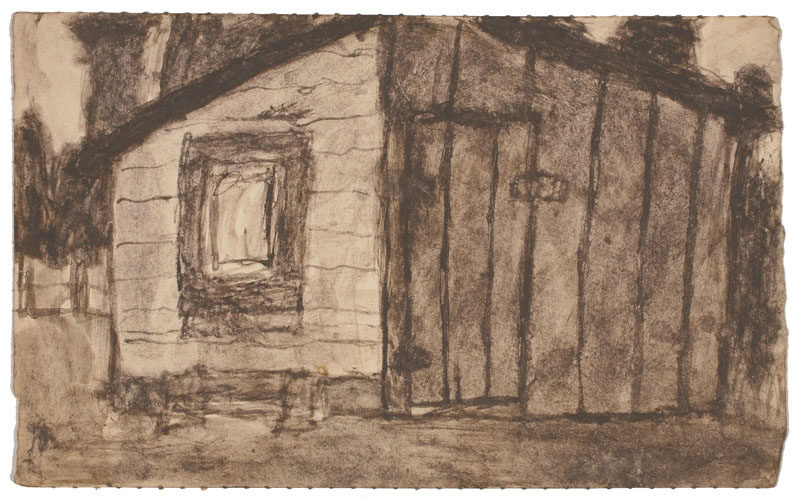
The story was that James was a deaf mute who one day started to make art. He lived on a tiny farm in a remote part of Idaho and knew nothing of the Art world beyond. He taught himself to make art, using home made art supplies. He would draw on any piece of cardboard that came to hand — many of my favorite pieces were on the backs of unfolded ice cream cartons. He made his own ink, mixing soot from the wood stove with his own spittle. He soaked the pigment out of crepe paper to add color to his paintings. He drew with sharpened sticks.
What I remember most vividly about James’s story was his subject matter. Profoundly deaf and unable to use sign language, James lived his whole life with his family, subsistence farmers who barely got by. And so James compulsively drew houses, dream houses, big and small, making hundreds of paintings and drawings of the houses he saw and the ones he imagined.
One day, James’ nephew came to visit. Bob worked at an art school in Oregon and recognized the genius of James’ house drawings. Soon the Castles were overwhelmed by offers to stage exhibits and to buy the art. The family finally had enough money to build James his own little house on the property.
As soon as the house was completed and James moved in, he never made paintings of houses again. His work was done.
Art has that power for me too — not to create real estate perhaps, but to focus me on what’s really important. To communicate with those parts deep inside me that don’t have a voice. To take that yearning and draw it out.
In my case, it’s not as simple as just wish fulfillment. It’s a barometer on how I feel, my degree of confidence or of focus. It shows me the value of what I have, the wonders of my city, the treasures in my home, the beauty of the people who fill my life. It puts a beautiful gilt frame around the things I have been too distracted to see.
Drawing alone can clear a path through the fog and chaos and help me see what I truly want out of life.
But unlike James, my work will never be done. At least I hope not.
I want to share a few experiences I’ve had recently which you might enjoy too.
An Excuse to Draw: I mentioned Tommy Kane’s book a while ago, but it’s a pleasure I’ve re-experienced over and again since then and it has filled me with so many emotions.
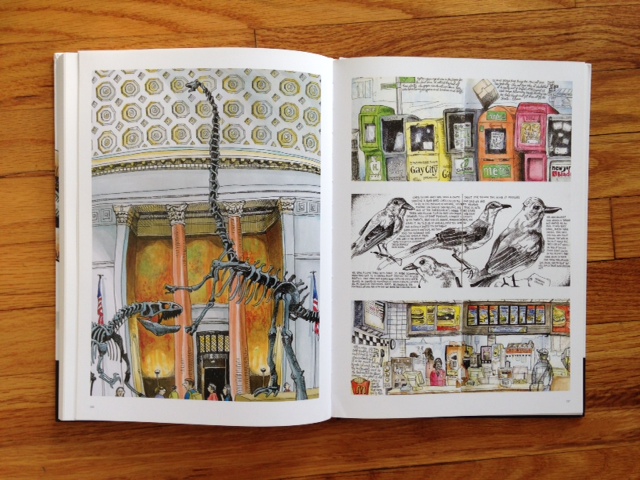
One is enormous pride in my friend who is such an extraordinary and hard-working artist. I have always loved the things that Tom makes but seeing them all in one place, takes my breath away. The enormous variations of things he draws, the intense detail and perfection of each image, the wit, the beauty — they ricochet me about. And seeing them all hardbound and being shared with the world, well, that’s the fate he always deserved and I’m immensely glad he is finally getting his due.
Another is admiration at his tenacity. Tommy is such a perfectionist, to the point of obsessiveness, filling each page edge to edge, never forsaking a drawing if it starts to go awry, always riding it out to the end, which is never bitter. Each page is a grand battle, Tom vs. Tommy, slugging it out until Nirvana is reached. The sheer volume of time, sweat and ink that went into tis book would loop around the world many times I admire his balls and wish I had that perseverance.
Third, is the pleasure in seeing the drawings I’ve watched him make and all the ones that he made on the other side of the world — all together. This book is as big and complex as the planet, so many details one every page, so many pages, so many pages within pages, all laced with jokes, and stories, and observations. Poring over it reminds me of how I used to read books when I was a kid, studying every picture, looking for faces in the windows, scrutinizing each detail and fantasizing about going to every place. It’s an adventure.
If you haven’t ordered a copy of Tommy’s book yet, start saving up. It will educate you, entertain you, and blow you away.
Oh, and if you want to see how he does it all first-hand, I hope you enrolled in “Beginnings” at Sketchbook Skool. His klass is the final one in the kourse.
Urban Watercolor Sketching by Felix Scheinberger
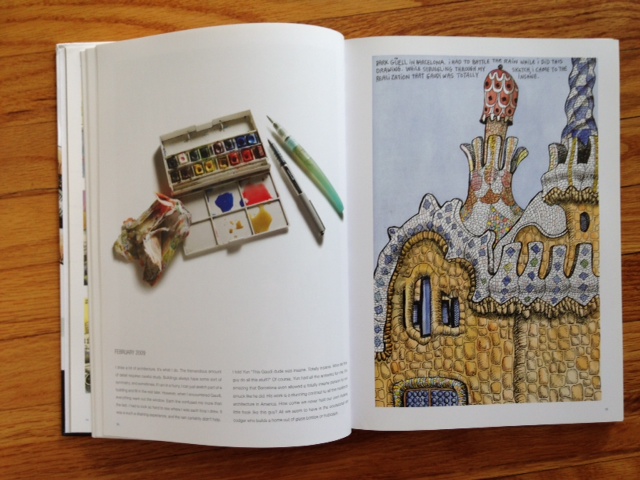
Urban Watercolor Sketching: Another friend and collaborator on An Illustrated Journey has a new book out too. It’s actually not brand-new except in its English translation. Felix Scheinberger is a great illustrator, teacher and author.
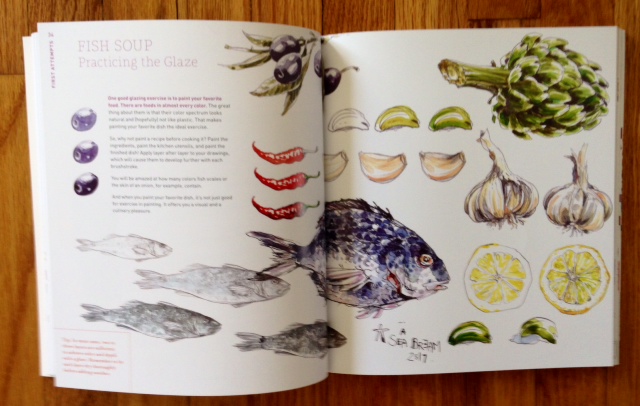
This book (which I think is kinda misnamed as it doesn’t actually just focus on Urban Sketching but is about all things watercolor) is a treasure trove because it has so many witty, loose, energetic, gorgeous watercolors by Felix that are inspiring me over and again but also contains so much deep technical information, all presented in such a useful and accessible manner. Reading Felix’s book has re-whetted my appetite and rewetted my palette too. I am chomping at the bit to get out there and paint. I think it may have a similar effect on you too. Now if I can only convince him to teach a klass for us!
Pocket Palette:
Pans labyrinth.
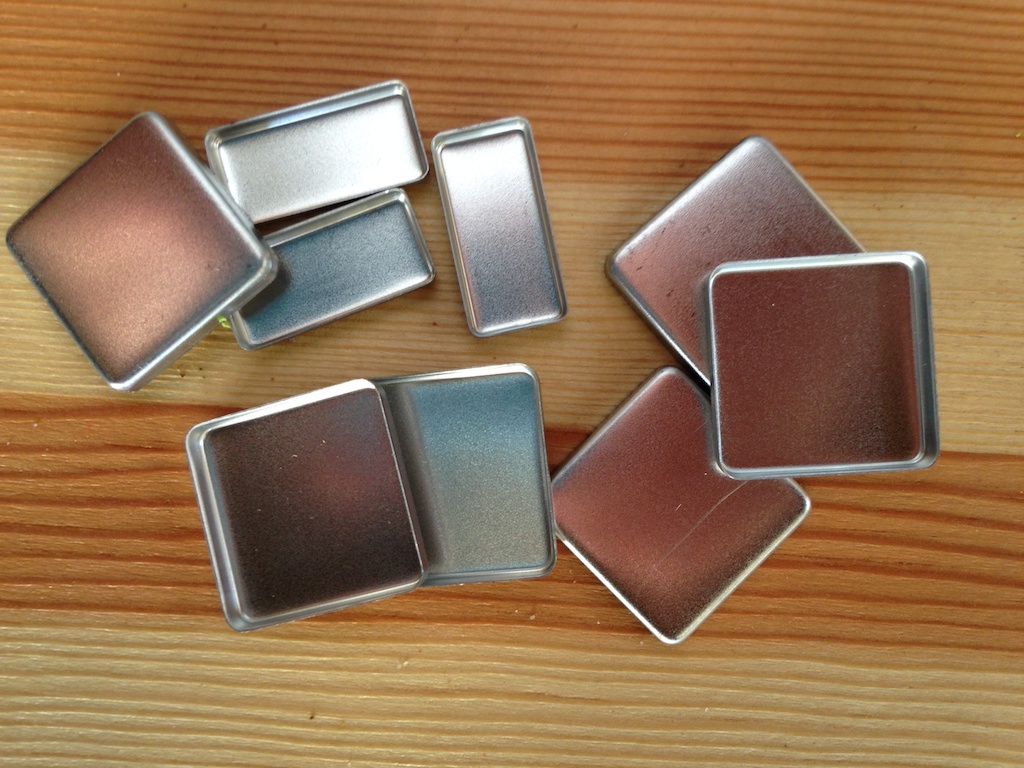
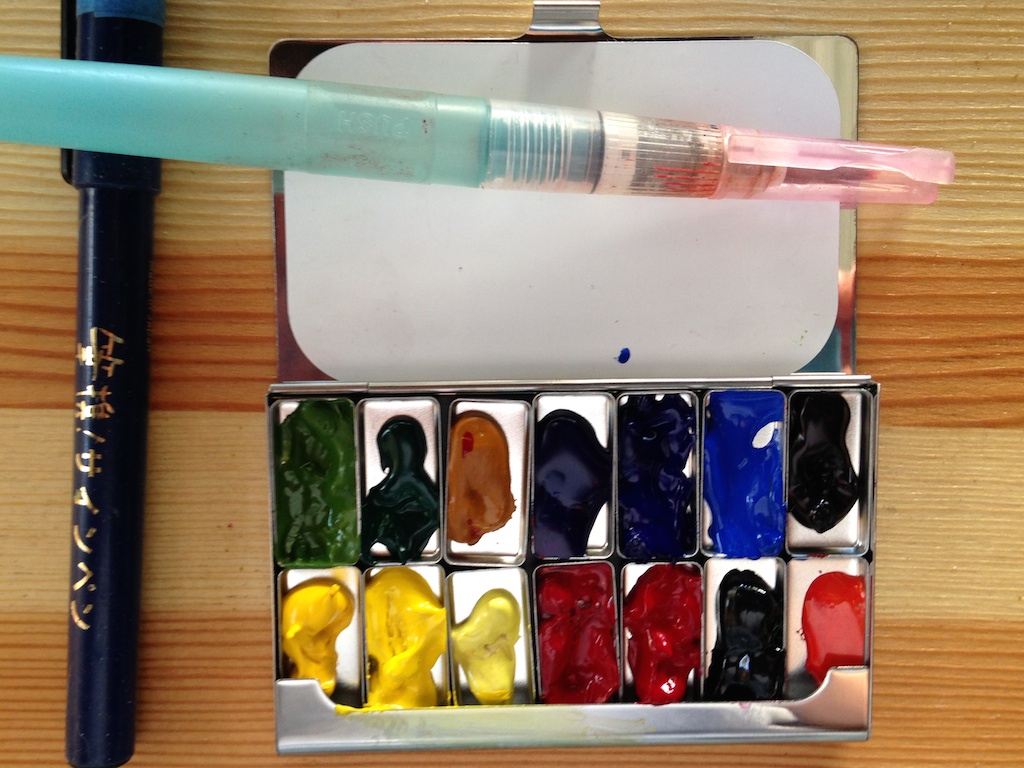
And speaking of my palette, Maria Coryell-Martin just sent me a credit card-sized metal palette with a magnetic base into which you can swap pans of watercolor. There are two sizes of pans and they all snap into place in this sleek little package. I just filled it up with my favorite tube paints and am ready to try it out. I am curious about how the mixing surface will work. Maria is an expeditionary artist who has painted in some amazing places and this invention seems quite genius. If you’d like one of your own, visit her shop.
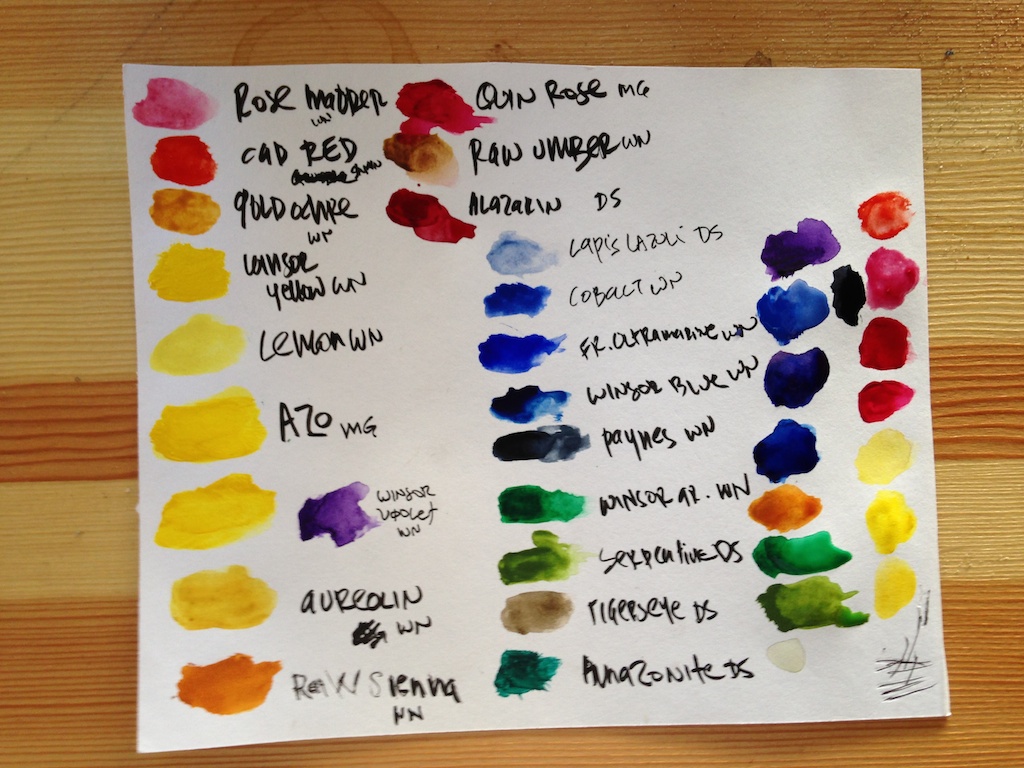
My current favorite colors
Until now, my palette situation has become less than optimal. I have my Winsor-Newton portable set which I just replenished, two teeny palettes which Roz sent me, and a big metal palette with too many paints in it.
Teeny weeny kiddy paintbox
They are all a little dirty and muddy so sitting down and laying out my palette from scratch was a great feeling. Now to pack up my gear and head out.
I just need to locate my favorite brush which seems to have strayed. Heeeere, brusy-brushy!
My pal, Tommy Kane and his wife Yun just spent a few days with us in California. It was so good to have them with us and we spent a lot of time eating in good restaurants, wandering through Venice and, of course, drawing.
I have known Tom for thirty years and we have drawn together for the last ten. Despite how close we are, when it comes to drawing we are quite different. Tommy is an illustrator, an artist who works toward beautiful finished pages, every one suitable for framing. His journals are immaculate, and each page is perfect from corner to corner. He just put out a lovely book of his work and it is a treat to have all that perfection in one place. The experience of looking at his journals is like looking at a final, published book—so immaculate, so rich.
My style of drawing is far more hasty, slapdash and impatient. And that can be a problem when we draw together. Tom expects to spend hours and hours doing a single drawing. He has a very specific way of doing a page, starting with his uniball pen, putting in loads of careful hatching, then adding watercolors and finally a layer of bright pencil marks. He’d prefer to do the entire thing on location, perched on his little stool. He has a patient wife/traveling companion and has drawn this way all over the world.
When we sit down together, as we did on the Venice Boardwalk and on Lincoln Boulevard, I find myself adjusting to his pace and do horrible overdrawn pages that don’t look like my normal work. I find it impossible with the way I draw to spend hours on a single page, Tom also compromises when we’re together and usually only manages to finish his line drawing before I start squirming and pacing and has to color his picture later on, from a photo.
I don’t begrudge Tom his slow and careful pace. He manages to capture so much detail and observation and yet keep his work fresh and bright. I draw, like almost everything else, at a neurotic pace, and the luxury of time just stirs up the mud.
Everyone has their own speed. Our friend Butch draws at a glacial pace, thinking nothing of spending ten or twenty hours on a page, D.Price, on the other hand, can knock out a drawing in three minutes. We have all drawn together and it’s like a tap dancer, a heavy metal guitarist, a tuba player and a sitarist trying to jam.
Whenever I go on a sketchcrawl, I have to adjust to the group, moving toward the mean of all the people drawing together. And it’s good to challenge that someotimes, to go faster or slower to add variation and stretch. In the long run, though, the work I do with others is never my favorite. It’s more of a fun, communal, social experience than a satisfying artistic one.
I’m not antisocial and I love to hang out with my friends.
But I’d rather pee, nap and draw alone
PS if you’d like to draw with Tommy Kane, join his klass at sketchbook skool.
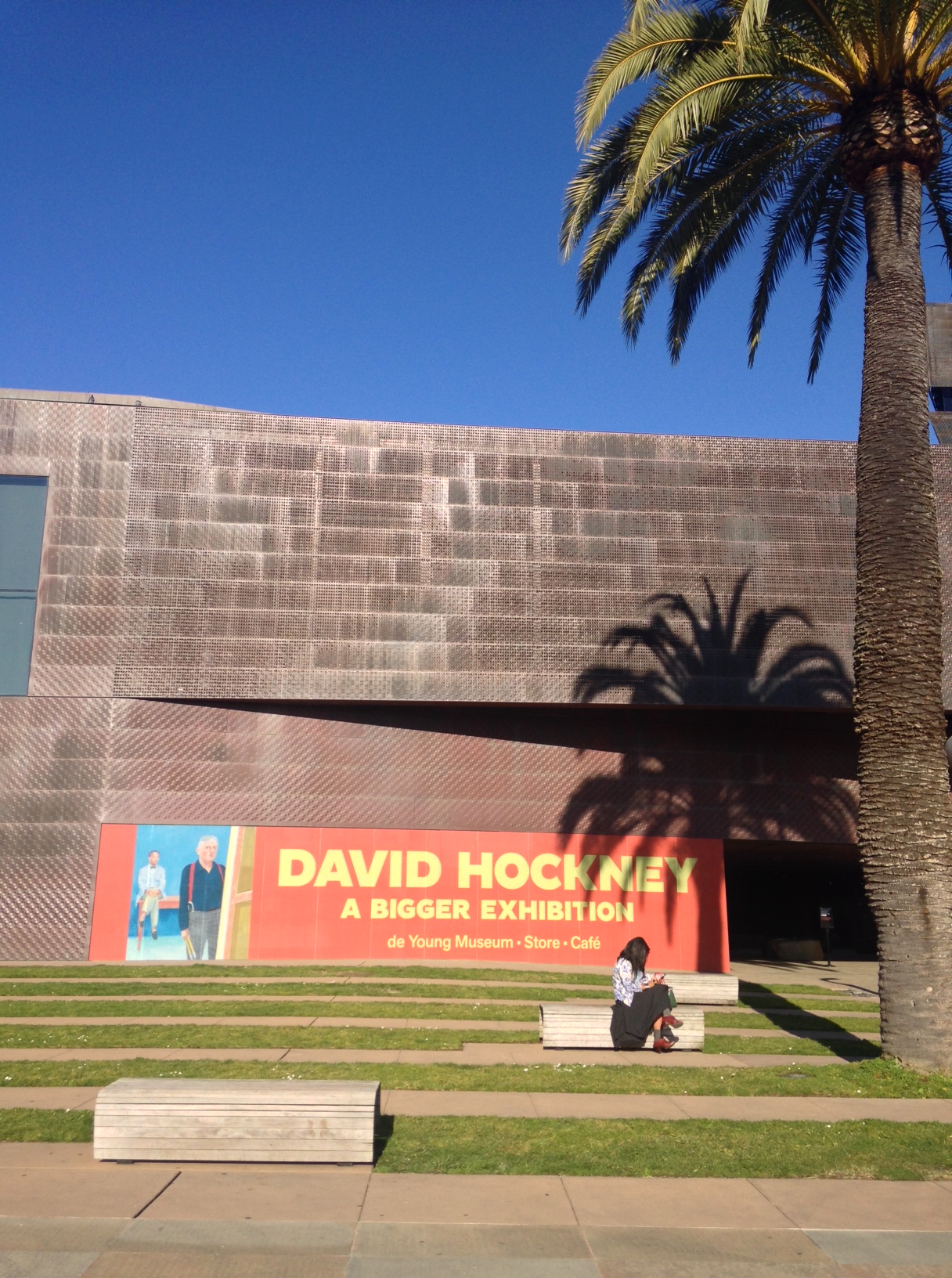
A couple of mornings ago I got up a bit early and took a plane, train and a bus to the de Young Museum in San Francisco. I had an early lunch in the cafe with my old pal Andrea Scher and then we began to tour A Bigger Exhibition, David Hockney’s retrospective of the past decade or so.
Color, color, color, color.
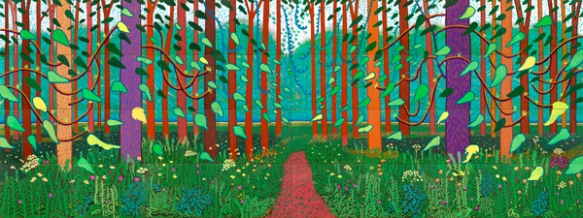
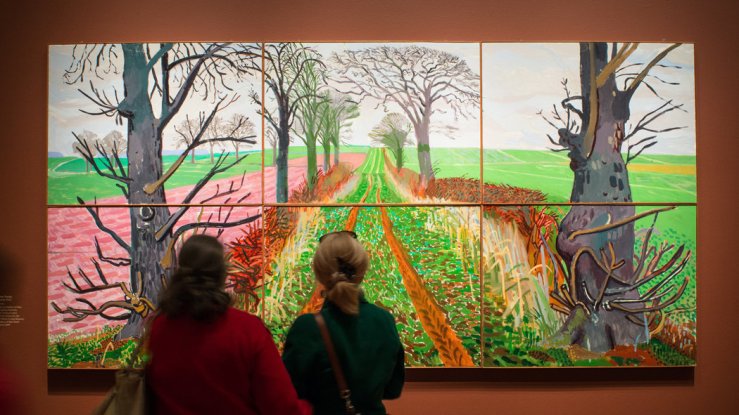
The work is traditional in a sense — all landscapes and portraits. But that’s where the familiar ends. Room after room is deluged in color, the colors that are Hockneys signature, salmon, teal, violet, burnt orange, sky blue, fuschia, and every imagine able shade of green. There are rooms full of Watercolors, watercolor that does things mine never do, bright, clean colors that vibrate off the paper, Watercolors that look like acrylics, acrylics that look like television screen, oils that fill the walls as he stacks two, then four, then twelve, then thirty (!) individual canvases to make landscapes that are as big as the landscapes themselves.
Nine canvases. He painted this scene in every season.Iphone painting blown up 15 feet tall.
There were several rooms of paintings he made on his iPhone and iPad then blew up into prints that are ten or more feet tall, prints that look like oils from across the room and look like electric squiggles close up.* There’s a room filled with screens and on each one new iphone images appear. You can watch them unfolding as he layers lines and pure colors. And there are hundreds and hundreds of them, landscapes, portraits, still lifes, … blah!In other rooms, long processions of watercolor and oil portraits, people sitting in the same chair in the same room, all different, all alive.
Thirty cavases, sandwiched together.
I kept getting waves of inspiration throughout the show, a fizzy feeling in my belly that I had to run away immediately and start to paint, draw, anything. I love Hockney so much and I learn from everything he does. He’s always the smartest kid in the class, the one genius among we sheep. His work is not heady and intellectual, it’s right there, familiar and yet, he makes it looks so easy. Watch him paint and you think, okay, okay, that’s doable. But he manages to knock out fields of spring flowers while I wade through the mud. He’s a seventy-five year old geezer but he’s working in ten media at once, filling a whole room of sketchbooks, and paintings and making these insane Cubist Videos by strapping twenty high-def cameras to his car and driving through the forest, season after season.
Drawn on a freakin’ iPad!
The man jumps onto every new thing as soon as it half emerges. He made fax drawings in the ’70s and Polaroid collages. He drew on the computer before any one. I hope he keeps living and showing me what it can all be.
By Andrea Scher
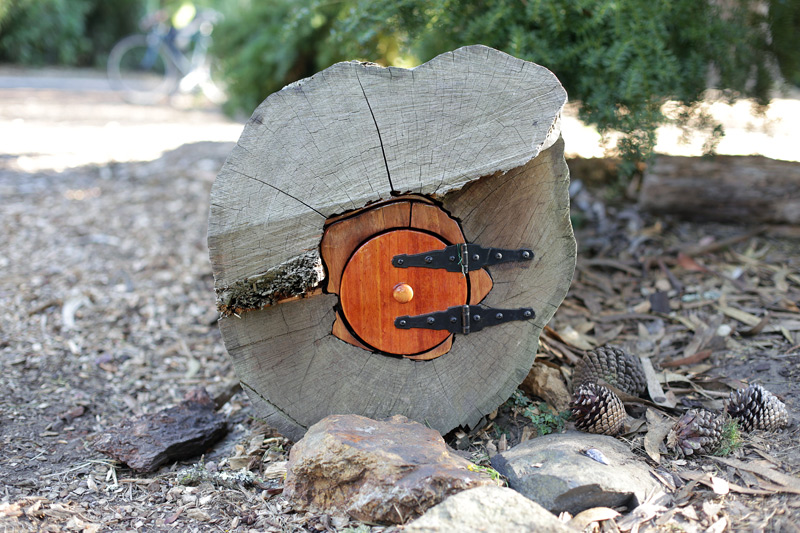
Then, on the way out, Andrea and I found a fairy door in a log in Golden Gate Park.
The perfect end to a magical day.
______
* I looked at my own iPhone in disgust and showed it these works of genius. “All you seem to do is send texts and visit Facebook all day,” I sneered, “Why don’t you make some art?” Siri just said, “Okay” and showed me a website about making Valentine’s Day hearts. Why can’t you be more like Scarlett Johansson?
———
P.S. I would urge you to go but the show closes this weekend. 😦
Vincent van Gogh was not the only Dutch artist I met in Amsterdam. I also had a lovely time with Koosje Koene, a wonderfully talented illustrator who has been my online pal. Koosje draws amazingly well — I am especially amazed by her work with color pencil — but also has a lovely sense of wit and wisdom. She creates cartoon characters, illustrates food, tell visual stories, and has become the mentor for lots of people in the EDM community.
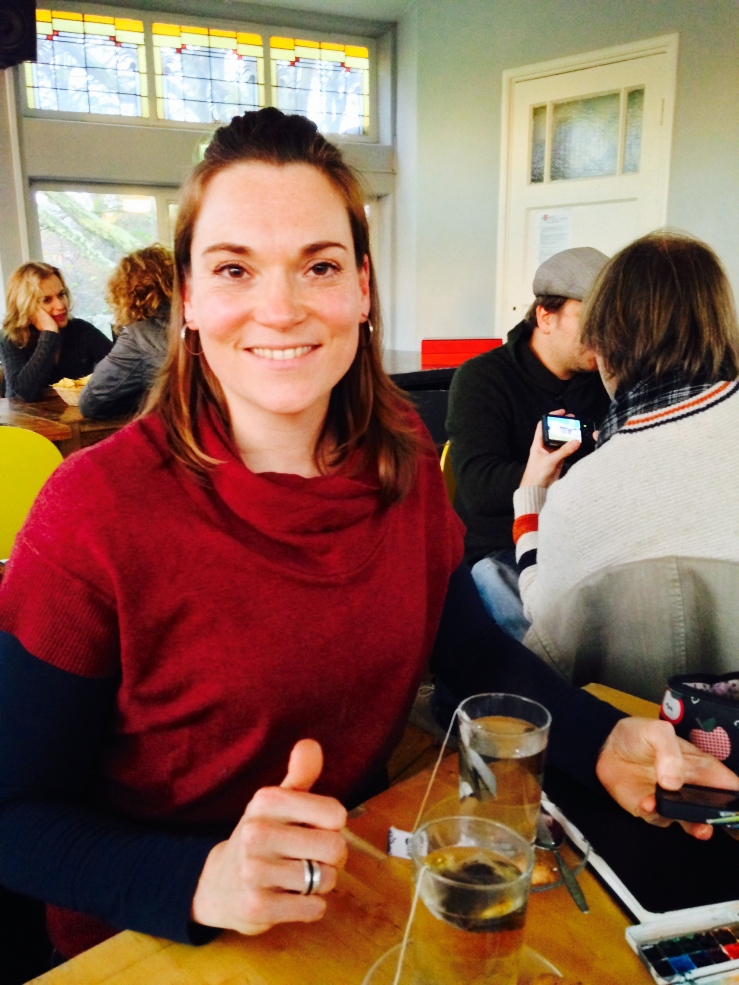
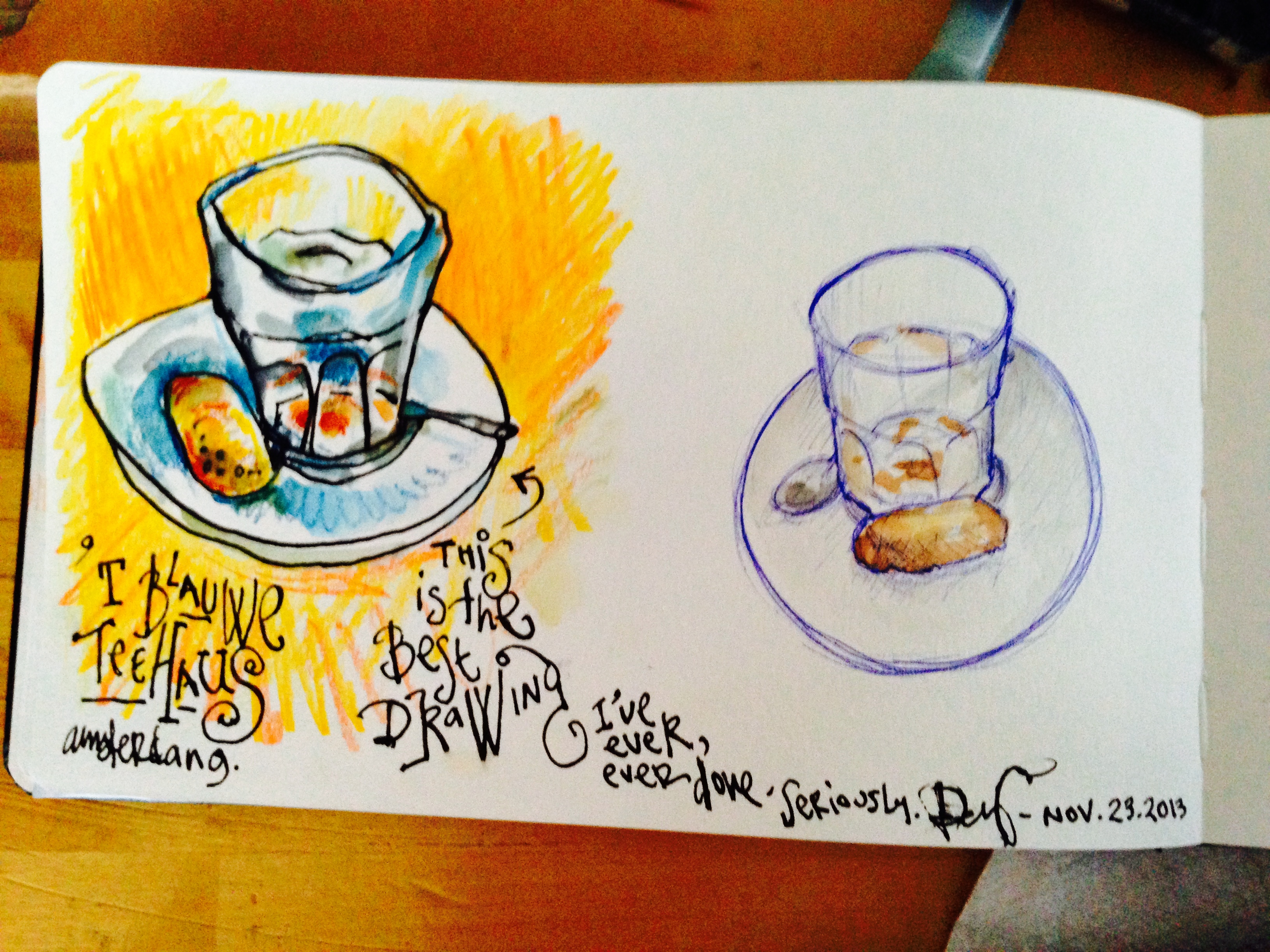
We met at a teahouse in the Vondelpark, shared stories, tea, and a stack of journals, then drew together. Our styles are different but complementary, doncha think? Then we met up with Pascal, Koosje’s musician husband, and had a sumptuous Indonesian feast.Koosje is also one of the first people to offer really great online classes in drawing and she has been really helpful with advice on my budding efforts. I urge you to check out her work, watch her free weekly drawing tip videos, and sign up for her next class. She’s awesome!
A mural in my ‘hood foreshadows my trip to Amsterdam.
The conference and Amsterdam’s cold, damp (I miss LA!) didn’t leave me a lot of opportunity to roam around the city but I did get to the Rijksmuseum and the Van Gogh Museum.
Vincent van Gogh has alway been a huge inspiration to me. I love his colors, his ferocity, but most of all, the whole journey of discovery he took trying to beat and bend himself into being an artist. In just ten years, he went from painting awful brown crap into changing art for all time. I’ve always even a kindred spirit because of the way he went about teaching himself, how he absorbed so many influences, how he went down one path after another to get clearer and more direct in his work. He spent a few months in art school, studied under a couple of professionals, read loads of instructional books, but most of all he just painted and painted, often filling a canvas a day, day after day.
As you can imagine, I was really excited by the enormous show called “Van Gogh at Work”. It focusses entirely on this process, showing how Vincent learned and evolved through more than 200 drawings, paintings, and sketchbooks. There are exhibits of his easels, his paints, palettes, preparatory drawings, and loads of completed masterpieces, in a sweeping chronological exhibit covering four entire floors.
I learned a huge amount in the hours I spent there.
First, there was the shock of seeing all these amazing paintings as working examples, rather than “Priceless Masterpieces,” giving them an immediacy that made me understand how Van Gogh himself must have seen them.
Have you ever had the experience of seeing an artist with his own work, how he might rub the paint with his thumb, or want to repaint a corner, or throws them onto a stack in the corner? Artists have such a different relationship with their pieces than curators or gallerists who tiptoe around with white gloves and X-ray machines, because artists value the process of their art as much, if not more, than the actual products of that process. Van Gogh would paint on the back of old paintings, or just scrape them down so he could make something new. He would knock out stacks of paintings of the exact same subject, trying new and different things. When you see, for example, both paintings of his room at Arles, two version of an iconic image hanging next to each other, similar but different in a hundred ways, you feel the living artist behind them, how he thought and developed, what he was considering, where he saw mistakes that became lessons. How often he would make copies of his paintings so he could give them to other people or just to brighten up his room. All those priceless sunflowers — he made them just so Gauguin would be happy in a cheerfully decorated room when he came to Arles.
And he was such a thirsty sponge. He was always studying others, absorbing, mimicking, incorporating, and then surpassing a long list of painters who seem at first to be him betters but ultimately look regressive, formulaic, and only of their moment, now past.
You get the sense that people are always telling him, “No, this is how you must make Art,” from the one professional teacher in his hometown who briefly mentored him, to the teachers at the Académie who gave him the worst marks, to the Impressionists who opened his eyes in Paris to Gauguin and on and on. Everyone knows better and he seems to listen, guilelessly. But, unlike them, he is never satisfied, never thinks he has the final answer, and keep pushing on.
You could sense how hard he was working and how he kept pushing himself onward. Even if he liked a painting he’d done, he would try something new. A new approach, a new subject, new materials, different canvas sizes… new, new, new. He never felt like the journey was over, that he had arrived; there was so much more to discover. I love that hunger and enthusiasm.
And, as the chronology of the show takes him (and you) from milestone to milestone, you can see his work progress and yet retain certain things that make them all Van Gogh. He copies and copies and copies — Impressionists, Dutch masters, Japanese Woodcuts, all of his friends from Lautrec to Seurat, absorbing each influence, going down by ways and dead ends, accumulating new ideas and ways of seeing, and yet each brush stroke can’t help but look like his. He couldn’t help being Van Gogh.
If you hear a voice within you say ‘you cannot paint,’ then by all means paint, and that voice will be silenced. — Vinny vG.
His passion and his passion never abate and the miracle of what he is making himself into through sheer force of will is exciting and inspiring. No matter how familiar the images look, seeing them in the flesh makes them new and exciting.
Oh, and he is always drawing.
There are lines over and under the paint, that give everything definition and clarity. That’s been my desire with my paintings too but it didn’t seem “painterly” and he shows how it can be. His influences in this are those Japanese woodcuts, Lautrec, and Gauguin — lines that are sometimes black or in contrasting colors or just darker shades or hues of the blocked-in shapes. Or lines that graduate in color and tone along their length. Sometimes the lines are picture elements: a branch, a window frame, a doorway, the edge of a petal, but often they are just there to separate planes and outline color fields.
Also: I was surprised to learn that he used store-bought, pre-stretched canvases. And that for a long period, he relied on a wire perspective frame to help him draw more accurately. And that he would used lengths of colored wool to plan out the color compositions of his paintings. They displayed the actual box full of balls of yarn that corresponded to many of his most famous works.
And finally, I saw that his work is a record of his life. He painted the people he knew: lovers, friends, neighbors, postmen, landlords. The places he lived. The cafés he ate in. The landscape all around him. His subjects had meaning to him and it shows in his best work.
When he does academic work, painting from professional models or plaster casts, it feels dull and lifeless. But when he paints sunflowers he picked, irises he wants to decorate a room he will live in, the difference is palpable. I have always loved his painting of almond blossoms against a teal background, a background that he painted last, carefully outlining every branch. Now I know that he painted it so carefully for his newly born nephew, blossoms for a fresh life, and there is love and care in every stroke.
Great art isn’t scary and imposing and “Important”. It’s personal and full of feeling. At some point, van Gogh gave up making paintings to be sold — that seemed like it would never happen. Instead he made so many paintings because he had to, he wanted to, he had problems to unravel and the world around him was beautiful and cried out to him to be embraced.
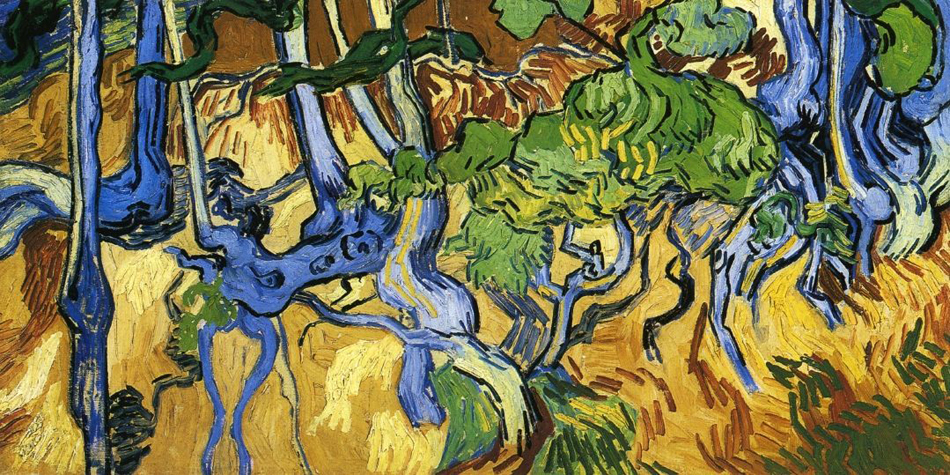
The last two paintings in the show left me with a lump in my throat, like the ending of a great 1940s movie. The wheat field aswirl with crows, big wet-on-wet strokes that he slapped down in the baking sun, is well-known as a symbol of his tortured state. But the very last painting was one I had never seen before. It’s of the roots of trees, tangled like snakes, and it’s unfinished. It was his last lesson and he never completed it.
What must that last day have been like, him stopping in the middle of a painting and deciding that he’d had enough, that it was hopeless, and putting a revolver to his chest? One can never know. But as I walked down from the fourth floor of the museum, after seeing all of his hard work over the years, all of his experiments and discoveries, his catching up to and then surpassing so many other great artists, it was so sad to think that, in the end, van Gogh felt he had failed.
The monkey got him.
Skateboards and mousepads in the gift shop.
Imagine if Vincent had known how loved he would soon be. How we would all learn from his lessons and discoveries. How his works would become icons and decorate tea towels and boxershorts. And that the voice in his head was utterly wrong, despite how it seemed that one lousy day.
The monkey is almost always wrong. And the only answer is to keep trying and pushing and learning and discovering. The road has no end, just lots of twists and turns, and it keeps moving upwards even if we can’t feel it all the time.
Once a week, usually on Friday, I check out one of LA’s museums.
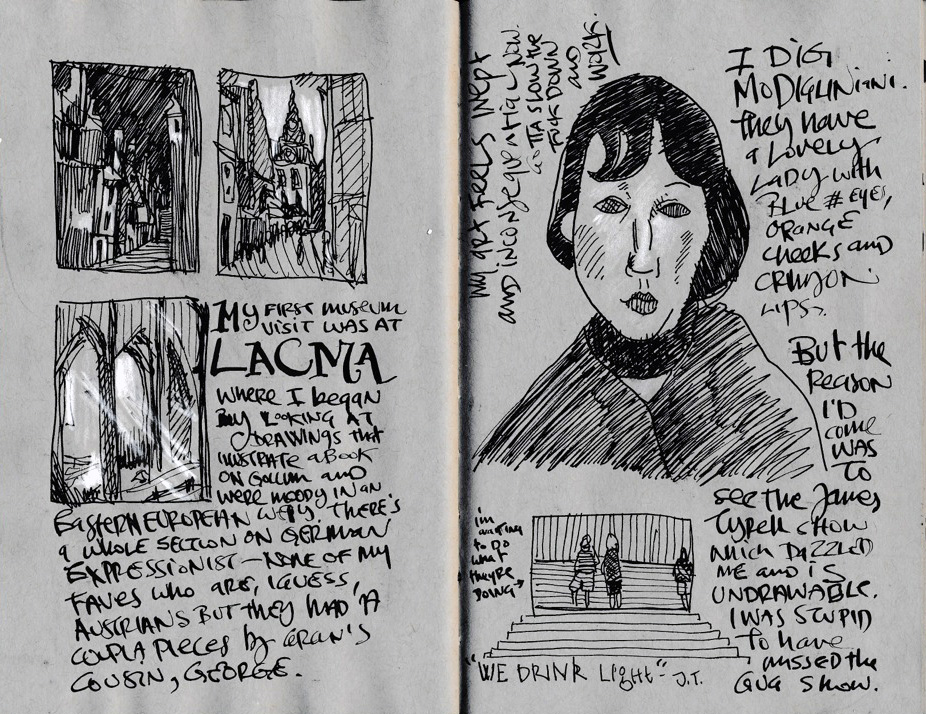
Two weeks ago, I went to the James Turrell at the LACMA which really dazzled me. I’ve seen his piece in Phoenix but missed the show at the Guggenheim. The Skyspace at ASU’s Tempe Campus is a rectangular room with an open donut ceiling. You sit on a bench against a wall and if you are patient, the relationship of that hole in the ceiling to the room you’re in changes. It soon starts to seem continuous with the walls and you begin to notice the shifting colors of the light. Soon the walls and the sky are on the same plane and it is startling and hallucinogenic when a cloud drifts by or a planes slices the sky.
As Hector, one of the museum guards said to me in LA, “His work rewards your patience.”.
Several of the piece in LA were really mind-altering, making me feel like Wile E. Coyote with spinning kaleidoscopes for eyeballs. You stand in a room like something out of Kubrick’s 2001 and gaze into pure color which slowly shifts; when you look away everything is now bathed in the complimentary color as your rods and cones go nuts.
If you have never heard of Turrell or seen his work, I urge you to soon. There have never been as many opportunities to experience his work as there are this year.
Richard Sheppard is a longtime illustrator but only started drawing on location about three years ago. I love his work and his interesting color palette.
Richard shares a lot more in my book. Here’s an excerpt:
“But upon arriving in Ireland, I found that sketching from photographs didn’t prepare me for anything other than sketching from photographs. I was too self-conscious to draw in public and ended up taking photographs the entire time. I kept telling myself that I could paint from the photographs when I returned home. It never happened. There is no substitute for learning to draw from life, out-of-doors. You can’t fake it.…” (continued)
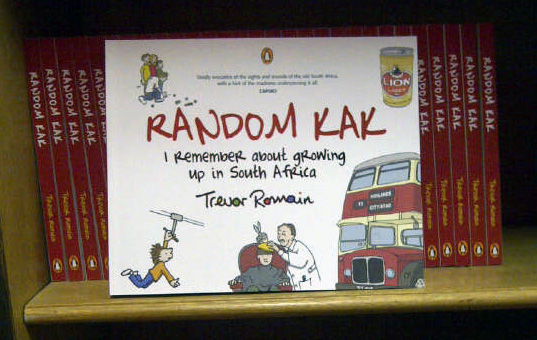
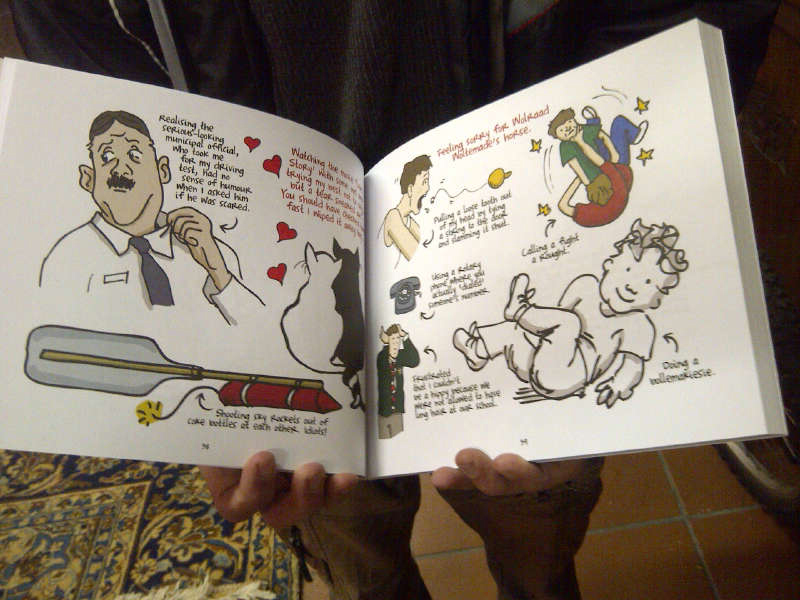
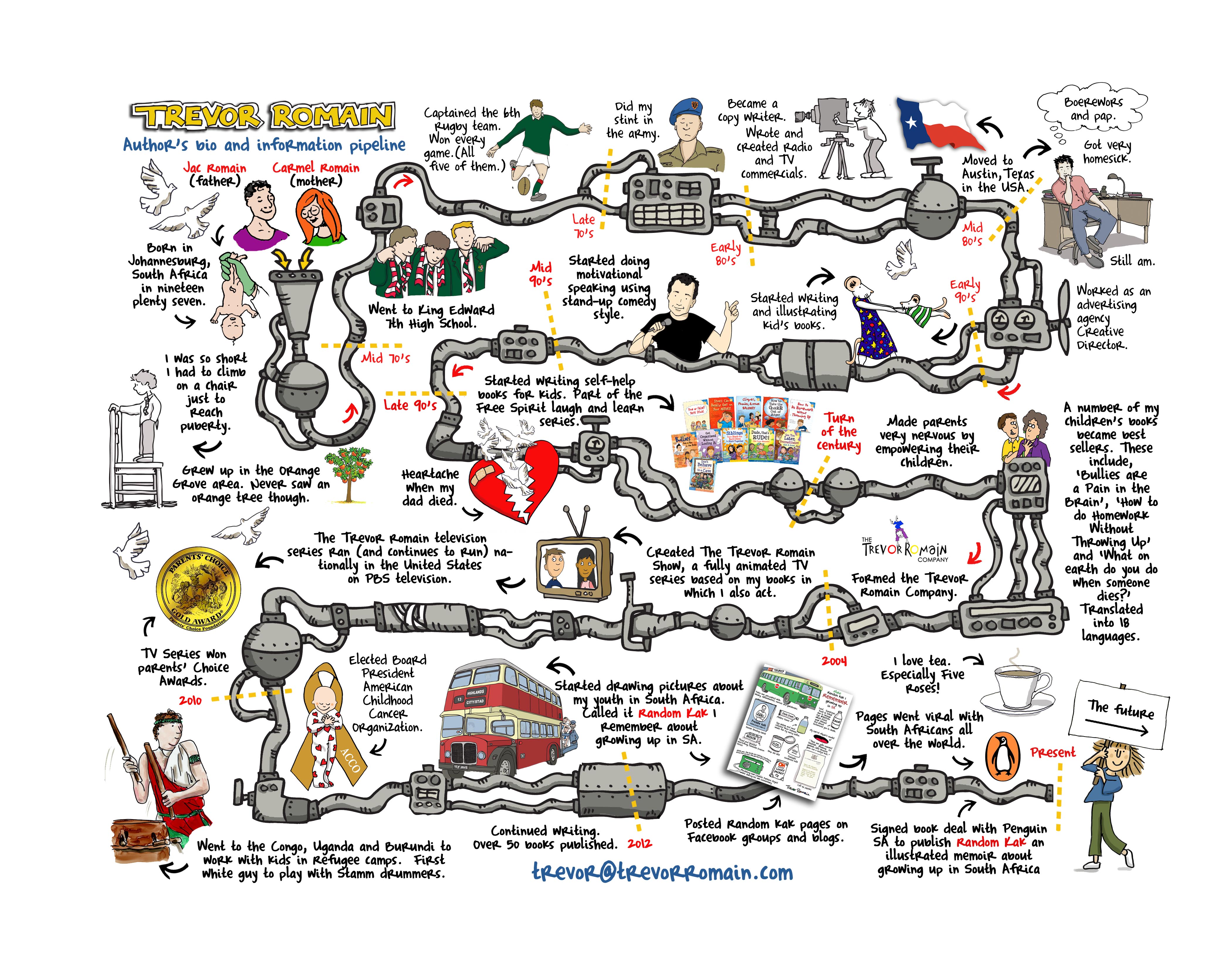
My pal Trevor Romain (you may remember him from An Illustrated Life) is a huge-hearted and talented artist in Austin, Texas and I was so excited to get the following email from him:
Hi brother Danny –
I hope this e-mail finds you well and happy. My new book, ‘Random Kak‘, was just released in South Africa. I wanted to share this exciting news with you as one night in your flat in New York (many years ago), while pouring over your journals (and pouring vanilla vodka) you urged me to document growing up in South Africa as an illustrated memoir in my journal. Patti nagged me about it every time I spoke to her. Some time later, I finally posted some of my journal entries on various Facebook and blog pages and it went viral. Then I was approached by Penguin Books in South Africa to do a three-book series based on my little drawings and notes.
Your last blog post with Cynthia Morris was a wonderful validation and reminded me once more of how much you have inspired and supported me over the years. I am now using this illustrated memoir technique to help children in refugee camps in Africa and children who are terminally ill, share and express their feelings, and their story, even if it’s just in stick figure style. When I met Nelson Mandela a number of years ago he said, “When a person dies, their library of stories dies with them. So they must share their story so that it is not forgotten. Even the most simple story can teach and inspire other people.“
I can honestly say if it weren’t for you this book would still be an idea waiting to happen. Thank you again for unlocking the door and inspiring me to walk into my past where I gathered arm-fulls of great memories and turned them into my newest book.
Because he made making art a pleasure to watch, because he inspired zillions of people to just start making stuff, and most of all because he was infectious with his belief that making art was something anyone could do and that it would transform the way you see the world around you, let’s remember Bob Ross today.
“I got a letter from somebody here a while back, and they said, ‘Bob, everything in your world seems to be happy.’ That’s for sure. That’s why I paint. It’s because I can create the kind of world that I want, and I can make this world as happy as I want it. Shoot, if you want bad stuff, watch the news.”
Please watch and share the following loving tribute. And from all of us here, I’d like to wish you happy painting, and God bless, my friend.









 Watch him paint and you think, okay, okay, that’s doable. But he manages to knock out fields of spring flowers while I wade through the mud. He’s a seventy-five year old geezer but he’s working in ten media at once, filling a whole room of sketchbooks, and paintings and making these insane Cubist Videos by strapping twenty high-def cameras to his car and driving through the forest, season after season.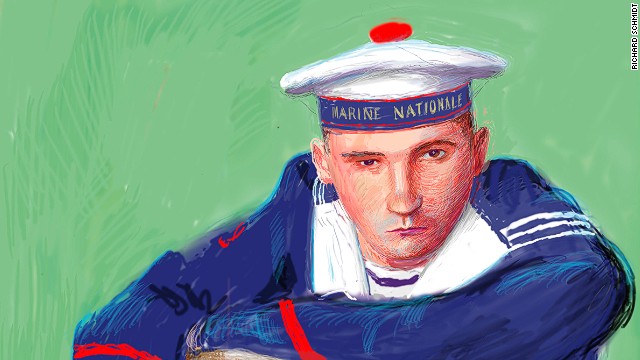










 Danny Gregory