My way or the highway

readingWhen I was nine in Pakistan, my grandfather’s chauffeur drove me to school every day. After a year, my grandfather told me that today he wanted me to tell the driver how to get to school.  He instructed the driver to follow my directions to the letter and we would see where we ended up. Ninety minutes later, we ran into the Indian/Pakistan border. I had guided us out of the country. I shrugged and the driver turned around and took me to school.

Living in Los Angeles means spending a lot of time almost lost. I am forever heading toward destinations unknown, with no landmarks to aim at, no Empire State to reckon by, no buildings more than a story or two tall, the horizon shrouded in smog or the marine layer. And Los Angeles, even more than New York, has no time for the timid, does not allow you to hesitate and peer around in confusion or slow down to read road signs or fumble for the map. It’s a brutal town that way.

Thank God for Roger L. Easton, the inventor of GPS. For nearly six months, I have relied on that computer lady to tell me exactly where to go anyhow to get there. Actually I have three computer ladies, one of whom is an Australian man. They dispense wisdom from our two phones and our car’s built-in sat nav system. When I am feeling especially disoriented and insecure, I sometimes have them all on at the same time,  barking out conflicting commands in various accents or recalculating in disgust at my inability to follow the most basic orders.

All these decades later, I am just as lost behind the wheel of my truck as I was in the backseat of Gran’s Mercedes.  All this step-by-step guidance is now as useless as last summer’s directions for assembling my Ikea bookshelves, in one ear and out the window.  I barely know my way around town, have only the vaguest sense of where Hollywood is relative to Downtown and that there are lots of town and cities and neighborhoods in between with names that are familiar from the movies but which I couldn’t begin to drive toward if my cel service went out.

Which brings me, inevitably of course, to drawing.

For the last few months, I have gotten more and more deeply into teaching people how to make art. I’m doing workshops, I’m writing a new book, and I’m pretending to be the co-headmaster of Sketchbook Skool. So I have to figure out how to tell other people, sometimes in just a couple of hours, how to do what I have taken a decade and a half to do.
blind-handI never learned much of anything from those step-by-step diagrams in art instruction books or in “watch me paint” demos on YouTube. Following someone’s suggestion to first draw a circle and then draw two more circles and then add a triangle and then erase this bit and that till it looks like an old sea captain just has nothing to do with why I draw. I love Bob Ross’ voice and his Afro but I never learned anything about picture making from watching him paint the reflections of pine trees in a tranquil lake. 

I think the way you have to teach people is by releasing a catch hidden deep inside of them. That catch that’s locking them down with the fear of making a mistake. They are so concerned that their drawings won’t look exactly like what they are trying to draw that they can’t get off their duffs and start making some marks on paper. They so badly want to be able to pick up a pencil and draw like da Vinci that anything less unrealistic seems pointless and defeating. Instead, they waste a bunch of time saying they have no talent, can’t draw a straight line, are so stupid, and so on.

But if you can just reach that catch and unlatch it, the world of possibilities swings open. Suddenly you see that drawing isn’t a way of making wall decorations or proving you have some innate gift, it’s how you see the world.  And the funny thing is, there are as many ways of seeing the world as there are see-ers of the world.  All cameras make the same sorts of images but all artists make things differently.  As Oscar Wilde put it, ”Be yourself. Every one else is taken.”

One man wrote to us at Sketchbook Skool and said, “Before I sign up, can you guarantee that you’ll teach me to draw?” I told him, um, absolutely not. Only he can guarantee to teach himself to draw. One less customer, I guess.

So how do you teach people to make art? Well, you start by turning off the GPS lady. You can’t draw if I’m holding your hand. Instead of turn-by-turns, you start by inspiring them with some postcards of wonderful places other people have sent back from their travels and then you let them start off in a random direction.

In the driveway, you might teach them a couple of simple principles like negative space and how to take measurements but you explain that these aren’t really rules, they’re just helpful suggestions to grasp at when you worry you’re going off the rails. You hang on in the back seat and encourage them to keep going, and make a few gentle suggestions, to maybe slow down on the curves a bit, and to stop pumping the gas and the brakes together. You tell them to loosen up and not clutch the pen so tight. You point out where they made an interesting turn and you console them when they think they are hopelessly off the road. You show them that if they just keep going, they will always end up somewhere new and interesting and probably not where they thought they were headed. And the driving metaphor finally runs out when you tell them that they can and should take risks and be brave, that no one ever died making a drawing, no matter how ‘bad’ it was.

The key is to build their confidence. To let them know that they can do it. If you have confidence, then you can start to let your self come out, the self that has been watching the world through your eyeholes all these years, that has noticed odd little things. that feels deeply about certain matters, that doesn’t necessarily speak in words, and that wants really badly to share its POV with the world, if only you will let it.  You can’t force that voice and vision or even describe shortcuts to it. You just have to let it feel safe and have ample opportunity to stick is head out from that deep hole in your soul.

It’s up to you. Your mom taught you to walk. But you taught you to run. Your dad taught you to drive in a parking lot. But you taught you to drive down the 405 while checking your email, singing along with Pharrell, applying lip gloss, arguing with your husband, and remembering to buy milk.

There are no shortcuts or instruction books to being a human being or to being an artist. Every single day is a lesson and the skool year never ends.

Command Z

Day before yesterday, I was working on a painting. A proper easel painting of a still life, as if I was Paul Cezanne or Wayne Thiebaud or someone. It was quite idyllic, a mild breeze coming in the studio door, hounds slumbering on the rug, Badly Drawn Boy playing on Spotify.

I had sort of blundered into the painting as if it was just another page in my sketchbook. I had a bunch of dirty breakfast dishes piled on the table and I plunked a sheet of cardboard on my easel and started making marks. The fact that I had just plowed into it kept haunting me, a little monkey voice in my head reminding me that I’m not Jan Davidszoon de Heem and I wasn’t even painting on a canvas, for crissakes. Before I had even put the second snausage of paint on the palette, a large percentage of me was convinced it was futile.

Nonetheless, soon the whole picture was covered with a first layer of paint. It all felt a little top heavy, the things in the foreground seemed distorted for no good reason, and my palette just seemed to contain shades of brown. I was tempted to stop thinking of it as a painting and get out a big Sharpie and start drawing on top of the paint with black lines that might somehow fix it.

But a little donkey in my head kept on painting. It refused to listen and just kept traveling back and forth to the dishes, then back at the palette, then up to the painting and back to the dishes, ‘round and ‘round.

Every so often I stepped back and walked out into the garden, listened to the doves that loiter on our neighbors’ phone lines, ate a tangerine off the tree, then came back and was pleasantly surprised.  It was starting to look more like, well, a pile of dirty dishes. Fair enough.

Mid-afternoon, Jack texted me, attaching the half-dozen brilliant paintings he’d just done. I fired back a snapshot of my easel and grumbled, ”I am wrestling with a shitty painting at the moment.” He texted back encouragement and support — but what does he know about painting, he’s a kid.

At one point, I got a bit highlight mad and started putting little flecks of white on everything that could be even vaguely reflective. Maybe years of watercoloring have starved me for the luxury of using white paint, but soon my painting was a snow storm and I had to rework it all back down.

The most notable moment, and the reason I even thought to write about it today, was a moment when I was painting the corner of the teapot and the paint I had managed to get on the sleeve of my hoodie sudden slalomed across the painting and left an ugly magenta streak across what was supposed to be white china.  And at that moment (and it was a moment, so fast, so subconscious), I felt my thumb and index finger and some glinting little part of my brain simultaneously type and say, “Command Z”.

Command Z.  That’s the keyboard shortcut for ‘undo’.

What a scary moment, on several levels.  The most obvious being that, despite my new creative odyssey into my garage/studio, I still find myself tapping away at the keys of this infernal machine too many hours a day as I have done since 1983, and I have clearly been reprogrammed like some bloody pigeon in a box in a Psych 101 lab.

But on another level, despite all of the conflict between my mental monkey and my mental donkey, I don’t like to fail. I don’t want to make mistakes. I just want to create effortlessly, perfect paintings with very little work or thought.

The painting I ended up with, for better or worse, was not what I set out to do.  In fact, I’m not sure what it was I had in mind when I set up my easel but I hadn’t imagined this. And again, for better or worse, this painting, like most art worth spending most of the day doing, is a constant negotiation between mistakes and rethinking. You draw something too big or too blue, or your line’s too fat or too straight or too just wrong, and you’ve gotta just keep going, donkey head down, until it gets better. You come up with  a solution and the work gets a bit better and richer and more interesting. You don’t just drive from A to B. You zig and zag deep into adventure and discovery.

But Command Z robs you of that possibility.

Bottom line, despite my weaknesses. I don’t want to undo my mistakes, I want to triumph over them. Because the keyboard of my life doesn’t have an escape key or a delete key or control or command or return.

I blunder on and eventually get to places I’d never planned. And that’s no mistake.

after breakfast painting

The way to work

My last office was about two miles from my home.  I could walk three blocks west, hop on the subway, get off at 23rd Street, then walk the three streets and three avenues to get to my desk in about 30 minutes. I became so used to this commute, that I could read a book the whole way. Not just while sitting in the train but while walking the streets, even when crossing them, eyes down, turning the pages.

Then I began to experiment. Some times I’d take a cab. That would save me five minutes and cost me ten bucks.  When I walked, I’d add five minutes but the trip was an adventure. I would pick a slightly different path each day, because it was grassy and wanted wear, trying to never take the exact same route. I would never read a book when I walked, never wanted to. I might listen to a podcast or some music but most of the times I left my ears as open as my eyes and I just strolled. I walked year round, no matter the temperature, taking mass transportation only when it was pouring with rain.

treeMy commute went from being a drudgery to something I genuinely looked forward to. I saw so many strange and beautiful things as I walked, I connected with the seasons, with the changes in my neighborhood, with the world around me. I would get to my office refreshed and charged up.

As drawing becomes a habit, the way I draw can become habitual too. I go through periods of being in love with the same brand of pen, using the same colors in my watercolor box, reaching for the same shades of colored pencil. In some ways that’s a good thing. Working with the same approach and the same media over a long time give me more and more proficiency. I become more efficient, more adept, and able to get my tools to work just as I want them to.

But that rarely lasts. I shake things up every few weeks. In part, it’s because I get bored with the same playmates. When I grab some new media, my drawings astonish me again. They looked like someone else, someone new drew them.  I’ll study a new illustrator, a new artist, and find their influence popping up in my own work. The journey continues over new terrain.

The deep reason for my promiscuity is that I don’t want to walk through life with my nose in a book. I want adventure and I want clarity.  It’s too easy to slide into a rut and grind out more of the same. But with novelty comes a renewed awareness, another bucket of ice water over the head, the shock of the new.

Drawing is seeing is living. Keep it real. Keep it fresh.

Drawing away the veil.

like drawing because it helps me to see. It shows me what is actually in front of me. That is important to me because I’ve tended to live in my head a lot. 

I think that started when I was very small, when a lot of time the world around me wasn’t very nice and the hard walls of my skull offered me protection. I disappeared into books. I constructed theories about the world that would explain a lot of things that even to this day are inexplicable. The seismic changes in my life that were beyond my control, peoples’ disappearances, the random and selfish behavior of grownups. In my head, things could become rational, orderly and manageable.

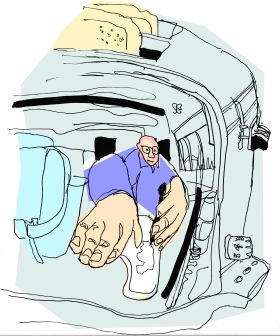
toaster reflection

But my constructions weren’t accurate. They couldn’t be. They were purposeful distortions that worked to protect me, at least for a while.  I didn’t really want to live in the real world, to face reality, because it wasn’t a good place for me. Reality didn’t use to be a friend of mine.

As an adult, when the world did mean things to me, it was very tempting to move deeper into my intellectualized view of the world.  By creating my own logic to explain the world, I could save myself from random acts.  But one pays a heavy price for disconnecting. It’s impossible to understand other people, to get a real bearing on one’s life, and ultimately to be happy. Because when you live in unreality, you can never trust your feelings.

And that’s where drawing has come in. When I hold a pen and look hard at something, I am piercing the veil and stepping out of the Matrix. It may not last for long, like diving deep to see a coral reef. But the bursting of the bubble, again and again, means breaking the temptation to disassociate from reality and run away. Instead of making habit out of fantasy, I force myself to see.

I’ve learned that being here now is not as scary as it might seem. I find now that it is easier to face even awful things things than to dwell in a fog of denial and fantasy. Some things in the world are harmful, most aren’t. Clarity makes it easier to distinguish them rather than establishing a blanket policy that keeps everyone and everything at arms’ length.  Anxiety comes from repeating old patterns when they are no longer appropriate. Treating every noise as the approach of a saber tooth tiger may have protected our ancestors but it can leave us as quivering messes. Better to face your fears, one a time, and vanquish them.

Drawing has made me look the world in the eye. That’s the only way to do it. That’s why I rarely draw from my head any more, rarely draw the cartoony faces and silly monsters that filled the margins of my high school notebooks. Now I look at a half-eaten piece of toast, a pile of bills, a broken tree branch and I boldly examine its every inch. And I do it with a pen, like an upright sword, compelling me to advance out of the shadows, to see and be seen, to take my punishment if I must, but to never again run away in fear.

Working it.

IMG_1113Sorry if I seem to have vanished.  I am hard at work on my next book, art Before Breakfast, which I have to turn in to my publisher all too soon.

I love working on this book and it has taken a back seat for far too long. It’s funny how one can love doing something and somehow forget how much, especially when it’s your own project and nobody else is prodding you back to work.

In the old days, when my creative work was being done for large corporations, there were always herds of people in suits thundering in and out of my office, making sure I was being productive.

But now, as I sit in my studio with my hounds and pre-war Swedish jazz on the radio, I’m the only one to remind myself of why I’m here. The most insistent voices are the dinging of incoming emails, the buzzing of text messages, and the growling of my stomach. Like some great Pavlovian dog, my instinct is to respond to them first, dutifully answering emails, updating my calendar, and debating whether I have to go to the gym before or after lunch.

Being an artist or an author or a blogger or an Olympic biathlete requires tenacity and discipline. Creative habits are all too easy to break, especially if there are louder voices in the room to lead you astray. That goes for me in the studio all day but probably for you too, struggling to fit in the time to draw in your journal between chores and obligations and paid work.

What I discovered years ago —but all too often forgot under the pressures of life — is that making art is not a guilty pleasure. It’s as essential to living properly as flossing and getting aerobic. Without it, life is shorter and duller, and the world lacks meaning and beauty. Not to mention it’s fun.

However, no one will tell you to make time for art. No one will find the time on your calendar to draw your lunch. No one will make watercoloring your bagel a priority for you. You must do it — and do it you must.

Speaking of which, I have to get back to work. Scratch that, I want to get back to making stuff. I hope you’ll find the opportunity to do the same.

The fears of a clown.

I am afraid. I am afraid of lots of things and always have been.
When I was little, I was afraid of getting lost, of monsters, of the dark.

Later I became afraid of girls.
Of exams.
Of plane crashes.
Of my stepfather.
Of fire engines pulling up outside my house.
For a while, I was afraid of going to the ATM, afraid I had no money
I have long been afraid of my body, of the hidden diseases and disasters it is concealing.
I have been afraid of strangers who write me mean emails telling me why they no longer like me or my blog.
I have been afraid of speaking to crowded rooms.
I have been afraid of death, especially the deaths of people I love.
I have been afraid to draw, afraid I can’t do it.

If we are willing to open ourselves up and be laid bare, to respond to the moment and without hesitation, to connect deeply with our audience’s eyeballs and the minds behind, we will be freed of the bullshit that holds us back.

I have come to believe that my life’s purpose, the key to my happiness, is to pare away the things I fear.

Some I have outgrown — I can now sleep with the door closed and the lights off.

Some I have had shaken out of me — I don’t fear death much anymore. Bring it on, bitch.

Some I have just faced — I have had a physical, so I know I am healthy, regardless of what the monkey voice tries to make of that twinge in my gut, the ache in my knee. I speak to groups of all sizes, no butterflies. I drive the freeways, radio blasting. I fly hundreds of thousands of miles, cool as a clam. I quit my fucking job. I fell in love again. I moved across the country. I roar, goddamn it, and I rock.

A few months ago, I overheard somebody at the gym talking about something called “Clown School”. I googled it. I found there’s one here in town. I signed up for the next intensive session. Why? Because I have no idea what it is but it sounds scary and important and utterly alien. Then I committed to not to think about it again until the day arrived. Why? So I wouldn’t chicken out.

I am now in my final day of Clown School. It was very scary — as clowns can be. Not because we wore makeup and big shoes, which we haven’t, but because we confronted many of the things that scare me the most. I stood in front of a room of strangers staring each one in the eye and telling embarrassing shameful things. I collaborated with strangers on humiliating choreography. I shrieked with fear, wailed with grief, howled with anger until I literally lost my voice. I sung a spontaneous song about what I loathe most. I danced across the stage, by myself, to demonstrate my self-confidence, and then had to do it again and again and again, until I was utterly without guile or reserve.

I have never before seen the people who saw me do this, and I sincerely hope that, though I loved them all, I never see them again. I couldn’t have done it otherwise.

Mostly, I revisited the most powerful emotions there are, familiar and often hateful emotions that I have worked so hard for so long to deny and avoid. And now, for day after day, I have sought them out and felt them surge through my body, grip my throat, shudder through my veins, cramp my stomach, churn my bowels. Terror. Loss. Humiliation. Sorrow. And joy, lots of joys — the longest lasting physical toll was the aches in my cheeks and neck and stomach: aches from too much laughter.

I am not a physical person, I spend all too much time living exclusively between my ears. But a few days of Clown School have helped me loosen my hips, have reminded me of what it is to really move with feeling, to express myself spontaneously from my gut, from my spine, from my balls, to be gripped by rhythm and to respond on a subconscious visceral level to another’s movement, to an impulse, to an emotion deep within.

Our teacher, a wise and hilarious clown, told us that clowning is about the importance of being ridiculous, because to be ridiculous is to fail, and failure is what we all have in common, the most basic and honest human experience, the one that helps us grow and change and improve and survive. If we are willing to open ourselves up and be laid bare, to respond to the moment and without hesitation, to connect deeply with our audience’s eyeballs and the minds behind, we will be freed of the bullshit that holds us back. We will tap into the deep wellsprings of creativity that lie beneath our artifice and style and self-conscious crap and hesitation and self-deception and excuses and fears. We will make art of truth.

Time and again, as I addressed old emotions in a new way, I thought about drawing.

About how the most important part of drawing is not what pen you use or the weight of your paper. At their core, drawing, painting, clowning, all art, are about letting go, of responding from your gut, of trusting, of working hard. Can you let go of all your preconceptions and finally, truly, truthfully see? Can you embrace and trust your audience rather than trying desperately to impress or con them? Can you put in the hours, the sweat, the pain of failure, so you can get deeper and deeper, looser and looser, sharper and sharper, digging down to essential truths?

Art is not entertainment. It is the way to what matters in our lives. To conquer our fears, we must face them, turn their ugly lies to beautiful truth, and share what we have made of them on the page or the stage.

I may just be a clown and a not very good one at that, but I ask you this: If you aren’t making art, what are you afraid of?

On making shit.

turd
A recent turdlette.

It’s so easy to despair. You sit down, uncap your pen, start drawing and then realize you have drawn a large, stinking turd. It’s inescapable and it’s bad. So bad that the stench drives you from your sketchbook for days.

Congratulations, you are on your way. The fact is, crap is the inevitable byproduct of the creative process. It’s supposed to be. And it happens to us all.

(And now you know why the background of my blog is brown).

Let’s get some perspective. I recently took a huge book out of the library that contained all 2,137 known works by Vincent van Gogh. It almost broke the rear axle of my truck. Now, bear in mind that those are the 2,137 pieces that have actually survived for 125 years. You just know that there were several times as many that Vinnie or his brother or some skeptical landlord trashed, burnt or flushed long ago. So, maybe van Gogh made five or ten thousand drawings and paintings over his ten years of art making. Three a day. Sounds reasonable considering the tear he was on.

How many are great? Ten? Twenty? Let’s go crazy and say, a hundred — that still means his hit rate was, generously, 1%.

I love the movie Amadeus. But let’s face it, it’s fiction. The idea that Mozart just sharpened a fresh quill and wrote down the Requiem or the Jupiter or Don Giovanni or any of his other 623 works of varying quality as fast as he could take dictation from God is just nonsense. He  squeezed out turds every day, just like the rest of us.

Picasso left behind 50,000 works. On some days, he made five paintings. The Cahiers d’Art, the complete catalog of his works, takes up 33 volumes and costs $20,000! Did Pablo think all 50,00 were genius? Did his gallery owner? I doubt it. So, these are some of the greatest geniuses of all time and even they didn’t hit home runs every time at bat. That’s why they worked on paper — because it can be crumpled up and hurled against the wall in frustration.

We have good reason to be afraid of failure.  Even if we actually are great.

In our commercially rapacious world, we don’t allow for crap (although there’s certainly plenty of it). The minute we set someone up on a pedestal, we start working to pull them down. If you write a great book, have a great show, make a great record, expectations will be immediately ratcheted up. But your initial success will probably be followed by something that isn’t quite as good. Overnight, you’re the Knack or the Stone Roses or Terence Trent D’arby. Or Skeet Ulrich. Or Lindsay Lohan. And once you stumble, you’re dead Meatloaf. There is little tolerance for failure.

Better to just be Harper Lee and quit while you’re ahead.

You are different. Because you are learning (hopefully for the rest of your life).To succeed in the creative process, you need a long-term view. Thick hide. And you need to keep working. You can’t get hung up with self-doubt and give up at the gate. You can’t mistake a failed drawing for a failed you. You aren’t your turds. You just aren’t.

And stop insisting on perfection as the price of moving on. Even Tiger Woods isn’t Tiger Woods. You have to swing at lots of balls, before you slowly inch your way from van Gogh’s brown potato paintings to Sunflowers and Irises. It’s a battle of inches. Slowly but surely, your turds will smell sweeter.

Learn from your mistakes. Otherwise all the pain you endured from making that bad art was just a pricey ticket you never got punched.

Bottom line: If you’re going through a period of making bad art, you must go on. You can take a break, but eventually, soon, you must go on. Because otherwise what you’re running away from isn’t the way you put pen on paper. It’s fear of who you are. And you’ll never escape who you are. Instead learn to accept and to love it. Flaws and all. And then to go on. Trust me, you are more together and less smelly than Vincent van Gogh.

Don’t be tripped up by a few bad drawings.  Keep them and learn from them and let them improve your future art and your future self.

People who never produce turds die of constipation.

Vinnie’s balls.

IMG_0718
A mural in my ‘hood foreshadows my trip to Amsterdam.

The conference and Amsterdam’s cold, damp (I miss LA!) didn’t leave me a lot of opportunity to roam around the city but I did get to the Rijksmuseum and the Van Gogh Museum.

Vincent van Gogh has alway been a huge inspiration to me. I love his colors, his ferocity, but most of all, the whole journey of discovery he took trying to beat and bend himself into being an artist. In just ten years, he went from painting awful brown crap into changing art for all time. I’ve always even a kindred spirit because of the way he went about teaching himself, how he absorbed so many influences, how he went down one path after another to get clearer and more direct in his work.  He spent a few months in art school, studied under a couple of professionals, read loads of instructional books, but most of all he just painted and painted, often filling a canvas a day, day after day.

As you can imagine, I was really excited by the enormous show called “Van Gogh at Work”. It focusses entirely on this process, showing how Vincent learned and evolved through more than 200 drawings, paintings, and sketchbooks. There are exhibits of his easels, his paints, palettes, preparatory drawings, and loads of completed masterpieces, in a sweeping chronological exhibit covering four entire floors.

I learned a huge amount in the hours I spent there.

First, there was the shock of seeing all these amazing paintings as working examples, rather than “Priceless Masterpieces,” giving them an immediacy that made me understand how Van Gogh himself must have seen them.

Have you ever had the experience of seeing an artist with his own work, how he might rub the paint with his thumb, or want to repaint a corner, or throws them onto a stack in the corner?  Artists  have such a different relationship with their pieces than curators or gallerists who tiptoe around with white gloves and X-ray machines, because artists value the process of their art as much, if not more, than the actual products of that process. Van Gogh would paint on the back of old paintings, or just scrape them down so he could make something new. He would knock out stacks of paintings of the exact same subject, trying new and different things. When you see, for example, both paintings of his room at Arles, two version of an iconic image hanging next to each other, similar but different in a hundred ways, you feel the living artist behind them, how he thought and developed, what he was considering, where he saw mistakes that became lessons. How often he would make copies of his paintings so he could give them to other people or just to brighten up his room. All those priceless sunflowers — he made them just so Gauguin would be happy in a cheerfully decorated room when he came to Arles.

And he was such a thirsty sponge. He was always studying others, absorbing, mimicking, incorporating, and then surpassing a long list of painters who seem at first to be him betters but ultimately look regressive, formulaic, and only of their moment, now past.

You get the sense that people are always telling him, “No, this is how you must make Art,” from the one professional teacher in his hometown who briefly mentored him, to the teachers at the Académie who gave him the worst marks, to the Impressionists who opened his eyes in Paris to Gauguin and on and on. Everyone knows better and he seems to listen, guilelessly. But, unlike them, he is never satisfied, never thinks he has the final answer, and keep pushing on.

vvg quote

You could sense how hard he was working and how he kept pushing himself onward. Even if he liked a painting he’d done, he would try something new. A new approach, a new subject, new materials, different canvas sizes… new, new, new. He never felt like the journey was over, that he had arrived; there was so much more to discover. I love that hunger and enthusiasm.

And, as the chronology of the show takes him (and you) from milestone to milestone, you can see his work progress and yet retain certain things that make them all Van Gogh. He copies and copies and copies — Impressionists, Dutch masters, Japanese Woodcuts, all of his friends from Lautrec to Seurat, absorbing each influence, going down by ways and dead ends, accumulating new ideas and ways of seeing, and yet each brush stroke can’t help but look like his. He couldn’t help being Van Gogh.

If you hear a voice within you say ‘you cannot paint,’ then by all means paint, and that voice will be silenced. — Vinny vG.

His passion and his passion never abate and the miracle of what he is making himself into through sheer force of will is exciting and inspiring. No matter how familiar the images look, seeing them in the flesh makes them new and exciting.

IMG_0786

Oh, and he is always drawing. 

There are lines over and under the paint, that give everything definition and clarity.  That’s been my desire with my paintings too but it didn’t seem “painterly” and he shows how it can be.  His influences in this are those Japanese woodcuts, Lautrec, and Gauguin — lines that are sometimes black or in contrasting colors or just darker shades or hues of the blocked-in shapes. Or lines that graduate in color and tone along their length. Sometimes the lines are picture elements: a branch, a window frame, a doorway, the edge of a petal, but often they are just there to separate planes and outline color fields.

Also: I was surprised to learn that he used store-bought, pre-stretched canvases. And that for a long period, he relied on a wire perspective frame to help him draw more accurately. And that he would used lengths of colored wool to plan out the color compositions of his paintings. They displayed the actual box full of balls of yarn that corresponded to many of his most famous works.

Vinnie's balls

And finally, I saw that his work is a record of his life. He painted the people he knew: lovers, friends, neighbors, postmen, landlords. The places he lived. The cafés he ate in. The landscape all around him.  His subjects had meaning to him and it shows in his best work.

When he does academic work, painting from professional models or plaster casts, it feels dull and lifeless. But when he paints sunflowers he picked, irises he wants to decorate a room he will live in, the difference is palpable. I have always loved his painting of almond blossoms against a teal background, a background that he painted last, carefully outlining every branch. Now I know that he painted it so carefully for his newly born nephew, blossoms for a fresh life, and there is love and care in every stroke.

Great art isn’t scary and imposing and “Important”. It’s personal and full of feeling. At some point, van Gogh gave up making paintings to be sold — that seemed like it would never happen. Instead he made so many paintings because he had to, he wanted to, he had problems to unravel and the world around him was beautiful and cried out to him to be embraced.

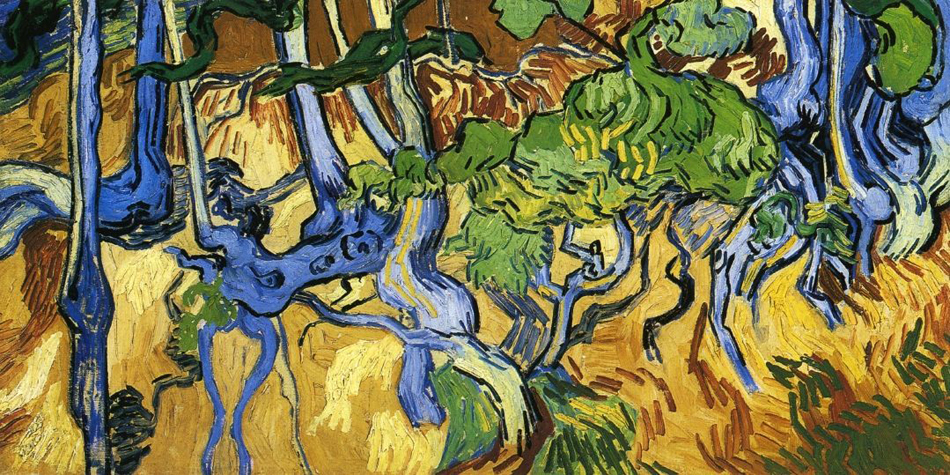
The last two paintings in the show left me with a lump in my throat, like the ending of a great 1940s movie. The wheat field aswirl with crows, big wet-on-wet strokes that he slapped down in the baking sun, is well-known as a symbol of his tortured state. But the very last painting was one I had never seen before.  It’s of the roots of trees, tangled like snakes, and it’s unfinished. It was his last lesson and he never completed it.

roots

What must that last day have been like, him stopping in the middle of a painting and deciding that he’d had enough, that it was hopeless, and putting a revolver to his chest? One can never know. But as I walked down from the fourth floor of the museum, after seeing all of his hard work over the years, all of his experiments and discoveries, his catching up to and then surpassing so many other great artists, it was so sad to think that, in the end, van Gogh felt he had failed.

The monkey got him.

Skateboards and mousepads in the gift shop.

Imagine if Vincent had known how loved he would soon be. How we would all learn from his lessons and discoveries. How his works would become icons and decorate tea towels and boxershorts. And that the voice in his head was utterly wrong, despite how it seemed that one lousy day.

The monkey is almost always wrong. And the only answer is to keep trying and pushing and learning and discovering. The road has no end, just lots of twists and turns, and it keeps moving upwards even if we can’t feel it all the time.

Thinking about my super hard-working boy.

IMG_0616 - Version 2

Artists are dismissed as dreamers. But being an artist takes focus and perseverance. It is a tough job, grounded firmly in the real.

Dreamers are roadkill. Artists work. That’s why they call it “The Work”. Not “the ideas,” “the notions”, “the dreams”, “the visions”.  The Work.

Being an artist means seeing the world as it is and having something to say about it. Most people don’t. Most people are content with hackneyed second-hand points of view. Tree hugger or tea partier, paper or plastic. But being an artist means diving into what is really out there, building your own filter from scratch, a filter that adjusts the contrast, brings out the details, heightens the textures and looks deep into the shadows. If you have nothing to say, your hands will tremble, your lines will be weak, your compositions will be flat and your audience will be yawning. You need to reach down and take a stand. On something, anything.

Being an artist means working to see yourself as well. To figure out what colors you see in. What shapes you like. What appeals to you. And trying in some way to understand why. Not why as in words but why as in feelings, nuances, shades. What do I like, me? I like bent things, dead things, wounded things. I like things that are beaten by the sun and wrinkled by the years. I like to see their history in their surfaces, to feel what has happened to them, to trace the map of their journey carved into their flesh, to empathize. Why do I like these things? Is it because I know I am not perfect, I have been ravaged, I persevere and I honor those who do too? Or is it because I cannot actually make beauty? I need to ask myself these questions, even though I don’t aim to ever articulate the answers. I need to see in to that ugliness and share why it is so beautiful to me. So you can see it too, so you can see the love inside your own pain.

Being an artist takes courage. It takes balls and sweat to see the world through fresh eyes and to develop the skills to express that vision and then go out on a limb and share it. Because it’s a long row to hoe, a thankless journey most of the way, a trip no one ever asked you to take and no one feels obliged to cheer you along on. If there are any spectators along the road, they are probably skeptical, probably see you as a self-indulgent weirdo too lazy to get a proper job. But don’t look to me for sympathy. Or applause. Because being an artist is a cause you choose for yourself, the rewards are in the journey, and there is no Promised Land. You have to want to proclaim your vision, to broadcast your voice, to change the world. The finish line doesn’t lie at the doors of the Whitney Biennial, it lies at the grave. Every day is a lesson and a revelation and they follow one after the other to the horizon, providing their own reward. Artists accumulate wisdom and depth and no gallery owner can take a cut of that and no auctioneer can ring a gavel down upon the lessons learned. 

The only thing to goad you on is your fire and your nerve. Because after all, who asked you? Who asked you how you see the world, what’s good or bad, what needs changing, what could be. No one. You decided you had something to say and now you want to say it. No one is obligated to listen but you will make them sit up and take heed.

Being an artist means being an entrepreneur who imposes his vision, who asserts the value of what he is doing and insists people look at it and take him seriously. No one else will do it for you. No one else will come up with your business plan or a strategy or a new idea. You don’t answer to a committee or a board or market research. You make your product, you sell your product, you create your market, you get your ass out of bed each day and punch the clock you built.

Being an artist means being a craftsman, a self-promoter, and productive without a boss, a company, a client. You are making a product no one asked to buy, sourcing your own materials, developing your strategy, and above all, shipping what you make. It can’t just sit in your brainpan or your sketchbook, it needs to be stretched, framed, and hung up for the world to see and buy and resell and love and learn from.

If that scares you, cool. Museums show about 2% of the work they own. There’s already plenty of genius in storage.

But if that excites you and inspires you, awesome. Do the work and bring it on.

“Don’t ask yourself what the world needs. Ask yourself what makes you come alive and then go do that. Because what the world needs is people who have come alive.” 

—Howard Thurman

The art of living.


Life is not an oil painting, sealed behind varnish and clamped in a golden frame, hanging in a white walled gallery in Chelsea, waiting to be bought by a hedge fund manager’s third wife.
Life is not an edition of etchings, a long series of identical impressions.
Life is not a mural, intended as a public display or the backdrop to an expensively furnished room. Life is not wallpaper.
Life is not a bronze sculpture, cold, monumental, an abstracted, idealized image of a hero long forgotten.

Life is a shelf.
A long shelf partly filled with journals. Some of the journals are hand-made, some store-bought, some in ornate covers, some stained and dog-eared.
Some of the journals are completely filled, others are abandoned half-way, maybe to be taken up at a later date. Some of the books are filled with paper that felt just right under your pen, smooth and creamy, bold and bright. Others were experiments that failed or overreaches, made of materials you weren’t ready to master quite yet.
Sections of the shelf may be filled with identical volumes, a type of book that you found comfortable at the time and stuck with it, disinterested in experimentation and change so you kept filling one after another. On the shelf, they may look the same, identical spines all in a row like a suburban cul-de-sac. But inside, each page is different, drawn by the same hand and pen, yet recording unique observations, days that fill up identically-sized boxes on the calendar but were all filled with different challenges, discoveries, lessons and dreams.
Each page of each journal is always different. Some are perfectly drawn and brilliantly written, insightful and illuminating. Others are a failure, with poor perspective and distracted lines. Some of the pages are dappled with raindrops or a splash of champagne, others are drawn in haste, still others crosshatched with great intensity and care. Some contain shopping lists, phone numbers of new friends, boarding passes to far-away places. Some are bright and colorful, witty and bold. Others are intimate and personal, never to be shared. Some pages describe loss and death, others a drawing of a gift you took to a baby shower.
None of these pages is an end in itself. No matter how good it seems at the time, eventually, you turn each one over. Even the ones at the end of a volume are merely leading to the first fresh page of the next. You fill the page, maybe you like what you drew or maybe it was a disappointment, but there’s always another to follow and another beyond that.
You try your best with each blank page, try to make something fresh and beautiful. Some of the time you feel excited and proud of what you’ve made, at other times you are disappointed and desperate. Often, a page you thought was just a turd looks a whole lot better when you come back to it years later. The drawing you thought was clumsy and flawed reveals some new insight and truth about who you were at the moment, fresh energy, naiveté, hope, darkness before the dawn. Each drawing, whether you know it at the time or not, contains truth. You just have to trust it and keep on drawing and writing and living your life.
Life is a process, and every one has the same end result: that last volume, partly-filled, cut off when we thought there was still art left to make. No need to rush to get there. Make the most of the page that lies open before you today.