Process.


limoDo you want to write? Or do you wanna publish?

Do you want to draw? Or do you wanna shop for art supplies?

Do you want to paint? Or do you wanna gallery?

Do you want to direct? Or do you wannan Oscar?

Do you want to be in a play? Or do you wanna be in a magazine?

Do you want to do? Or do you wanna dream?

QWERTY and all that.

Hankz

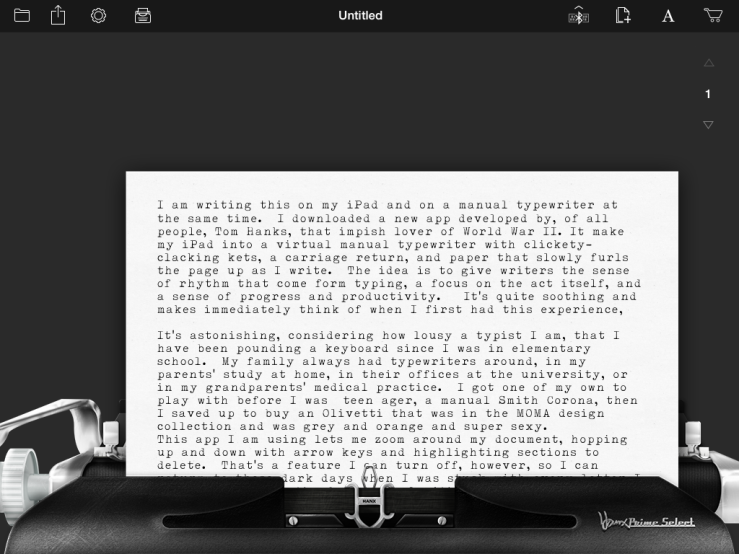
I am writing this on my iPad and on a manual typewriter — at the same time.  I downloaded a new app developed by, of all people, Tom Hanks, that impish lover of World War II. It make my iPad into a virtual manual typewriter with clickety-clacking keys, a carriage return, and paper that slowly furls the page up as I write.  The idea is to give writers the sense of rhythm that come form typing, a focus on the act itself, and  a sense of progress and productivity.   It’s quite soothing and makes immediately think of when I first had this experience,

It’s astonishing, considering how lousy a typist I am, that I have been pounding a keyboard since I was in elementary school.  My family always had typewriters around, in my parents’ study at home, in their offices at the university, or in my grandparents’ medical practice.  I got one of my own to play with before I was  teen ager, a manual Smith Corona, then  I saved up to buy an Olivetti Lexikon 83DL that was in the MOMA design collection and was grey and orange and super sexy.

This app I am using lets me zoom around my document, hopping up and down with arrow keys and highlighting sections to delete.  That’s a feature I can turn off, however, so I can return to those dark days when I was stuck with every letter I mistyped. Back in the day, to deal with my inevitable plague of typos, I used a typewriter eraser, a round thing with a plastic brush for wiping away the crumbs.  And Liquid Paper which I consumed by the gallon. It also came with little plastic brush to apply the opaque paint in little dabs.

This app lacks a few other features I remember. Like the way the keys would tangle together if I hit several at the same time in my zeal to get the words down. I used carbon paper if I thought there was any reason to have more than one copy of what I wrote.  When I worked for my local paper I would write on rough yellow paper and type —30— at the end of each article.

But I always hankered for an IBM Selectric, which had the backspacing correction function and used a little golf ball with different exchangeable typefaces, like “Orator”.

Then, when I got my first job as a writer, there was an actual  Selectric at my desk.  I felt I had arrived. But within a year or two, I had my first word processor, a TRS-80, and I could save my articles onto cassette tapes, reformat them, backspace away typos virtually, and write wand write without ever having to roll in  another sheet of onionskin paper.

I have written on so many things in my life — notebooks, legal pads, index cards, pages torn from the ends of paperbacks and the corners of newspapers, on laptops, desktops, phones, tablets…  Each new tool arrives with a fanfare, but they were all peripheral to the real tool, the one resting between my ears that has not yet been replaced.  I work everyday to upgrade it — with reading, living, thinking, and pounding on whatever keys are at hand.

Why it doesn’t look just like the picture.

fax-faceIn the 1980s when photocopying technology became increasingly available, David Hockney made a series of prints using a Xerox machine.  I was looking at some of these prints recently and trying to overcome my initial dismissive reaction: these aren’t ‘prints’. But of course, they are. They were state-of-the art prints in their day.

Printing is and has always been a mechanical method of making multiple reproductions of an image. In the past artists used woodblocks, etchings, engravings, then lithography, screen printing and so on. Today, many artists sell giclée prints of their work, prints that are digital scans of their drawings which are then processed and printed on inkjet printers. And what if we skip the paper part of it all together and use an iPhone and a distant computer server. Isn’t that basically the same idea?

Our instincts say no. It’s somehow not hard or special enough. Where’s the craft? But of course a good digital scan take experience and tools and work. So that’s not it. Or maybe it’s posterity, the sense that an old Xerox or a computer print out surely won’t survive for hundred of years like a Dürer woodcut. But with archival papers and inks and proper handling, that’s probably not the case either.

No, I think the real issue is scarcity. If you can just push a button and bang out an infinite number of reproductions, it is no longer precious, a limited edition, valuable. If someone can make an infinite number of copies, then there’s no value to any particular one. A Work of Art is reduced to the same status as a call report or a lost pet flyer. So the Art Market has trained us to dismiss this way of looking at it. If it can’t be bought or sold for increasing amounts, don’t bother making it.

Now, if inventive, creative, curious people like Dürer or Rembrandt had been able to make thousands and thousands of copies of their images with just the push of a button, believe me, they would not have been sweating over blocks of wood. They weren’t burdened with the same market concerns that weigh down our view of art. They made limited editions mainly because it took a helluva lot of work to get even a dozen proper prints from a copper plate.

But that’s not what I want to talk about.

Thinking about Hockney’s Xeroxes made me think about how technology is constantly improving the ways it solves basic human problems. Not just labor saving devices, but things that make our lives better and richer. Examples abound.

But what about image making? There was a point when people drew on cave walls with blood and mud, to make some point lost to the sands of time but they were using the best image-making technology they had. Eventually we figured out how to carve stone statues, to make fresco, to stretch canvas, and so on.

This image-making and image-sharing had a purpose. Usually it was to tell a story or pass on some vital information: this is what the Gods did, this is how we won this war, This is how handsome and powerful the King is, this is how Jesus came back, and so on. Nowadays, if Jesus came back again, we would probably use Vine or a Facebook post to share the news, not a fresco or calligraphy on a goatskin.

So if, in one split second and with no real experience or skill, you can use the phone in your pocket to make an image that is technically superior and precise to anything you can make with pencil, why make art at all anymore?

That’s a question people have been asking themselves for almost two centuries. And the answer that Manet and Monet and Seurat and Cezanne and Van Gogh and the rest of the gang came up with over a hundred years ago is that the purpose of art is no longer to reproduce physical reality, it’s to convey how we feel about it. To capture the human condition, the way we see the world through the veils of subjectivity, experience, emotion, history and all the rest of the stuff that make us who we are.

This is something we have to think about when we draw.  Stop assessing your work based on how close it is to “reality”. Don’t bother posting a snapshot of your dog next to the drawing you did of it. Who cares if you are almost as good as that camera in your pocket. ‘Cause in fact, you’re not even close. That photo is a far better way to make that image. More efficient, more accurate.

But that image isn’t really what you want, is it? What you want is to capture your soul, your inner state, the love you feel for that dog. You want to make a picture of the inside of your mind.

Don’t worry about Xerox®ing reality with your sketchbook. Focus on capturing You instead.

So far nobody, in Silicon Valley or elsewhere, has come up with an app for that.

Why do I like?

ghost-bikeTo me, the most interesting art isn’t necessarily well-rendered, accurate, realistic. Often, quite the contrary.

So, what does make it interesting? What are the qualities that make me like a work, my own or someone else’s?

This seems important, so let me think on it a bit.

First of all, specificity. A drawing that is of a very particular thing. Not just a car, but a specific car with all its dings and reflections.  A car that looks like it was really studied by the artist. It’s true in all art forms, in a documentary, a novel, a record. The little details that make me know more about the subject.

And it’s not just that the artist noticed and captured the specifics of the subject, it’s also the specifics of how he or she did it, the feel of the hand behind the pen, the little eccentricities that make it original, the catch of the pen on the paper, the oneness of the particular piece, the particularity of the personality and the vision behind the line.

That’s why I like a recording where you can hear Segovia’s fingers squeak over the metal strings of his guitar. Or the recognizable grit  of a specific New York street corner in 1970 in Panic in Needle Park when Al Pacino crosses Amsterdam and 86th early in the morning and you can just smell it, taste it. A Ronald Searle drawing that has splashes and blotches of ink and redrawn lines. Karl Ove Knausgard’s amazing novel, My Struggle, bringing to life the tiniest, most specific details of everyday memories to give the mundane deep meaning.

Art that is too perfect, Photoshopped, processed, loses this specificity. In fact, any reproduction lacks these little specifics. That’s why seeing an original is always a completely different experience, even if the image seems familiar.  When I looked at a pyramid of Cézanne’s oranges in a Google image search, I get the gist. But when I see them hanging on the wall of the Met, I get a feeling, a series of revelations as I see more and more through the varnish. I have the opportunity to explore deeper and deeper with my eyes, to see layers and brushstrokes that the “image” alone doesn’t convey, the way the paint that Cézanne chose and placed does when it’s sitting right in front of me. The specifics.

When I draw from a photograph, it’s often impossible to get that deep sense of seeing, to see the particulars on a deeper and deeper scale. All too soon, I hit grain, pixels.

For me, drawing is an opportunity  to avoid the clichés and the symbols and to focus on what is really there, warts and all.

Story is another aspect of specificity.

Not an illustration per se but a drawing that captures my imagination and starts a movie in my head. A captured moment that evokes a bigger context, like any painting by Hopper. Or shows the marks on a object that tells you where it’s been or what’s done. The lines and wrinkles on a face that are a roadmap, a drawing that become a biography.

Scale is another way to add interest.

To zoom in tight on something and see it afresh.  The details of a butterfly’s wings, a bagel’s crumbs, a bicycle’s greasy chain. Or to stand way back and see it in a different context. To look at the Empire State Building poking out on the horizon from behind a row of four-story brownstones. Giant blades of grass on a lawn and a tiny plane in the sky way above. A page crammed full of tiny drawings of giant trucks.

Interesting art also contains a surprise.

It could be in the lines themselves, lines with an unusual but true thickness or movement. A variety of sweeping brush strokes and then details in fine pen lines. Inconsistencies that draw my eye and, with a moment’s reflection, become a revelation.

In color: Complimentary colors, A wash of liquidy teal watercolor and a tiny, sharp spot of orange gouache.  Unexpected shades. Purple cheeks, orange eyes, a green sky.

A wall of perfectly drawn bricks and then a hastily drawn broken window. A third ear that lets me in on the artist’s process, a reconsideration, a redrawing.

Elements that make me pause, break my assumptions, jar me into reconsideration. The art in startle.

None of the above are rules, just springboards that can turn ho-bummery into something fresh and exciting. Or can help guide me in understanding why I like or don’t like the art in front of me.

Are there more? You tell me.

Addicted.

Scan 10

When I’m anxious, I do something, I make something.

It feels like making something changes something and therefore I will be okay.

Or is making something, “look, I’m a good boy” credit that acts as a bulwark against whatever the monkey is needling me about?

Or is it just a distraction?

Is that how real artists feel? Soothed by their creativity?

I guess I have always been anxious a fair amount and that’s why I have always been pretty productive.

I don’t think much about the quality of what I’m making, it’s just the process, the act that acts as protectant. And if anyone comments on how much I get done, I feel more embarrassed than proud, as if I was getting credit for nail biting or nose picking.

I’m being particularly self flagellating right now, and maybe writing this down will just reshuffle the deck and I can get on with things again.

Could be worse, I guess — I could be a drinker or pick fights with strangers.

Instead, I’m writing this to you.

Don’t roll your eyes at me.

Scan 17

Imagine if your head was in a metal box and your neck didn’t move. In fact your entire body was rigid, like a quadriplegic locked into a wheelchair. You can only look straight ahead and, at any given time, your eyes are locked on a certain point. Some things are in focus, others are blurry and indistinct.

Fortunately that’s not how you see. But it is how a camera sees. A camera sees only from a one-point, locked perspective that creates a single image of a specific vantage point with certain focal characteristics.

When we look at something, our eyes constantly move about. Even if we are sitting down in a chair, our eyes dart around, passing back-and-forth over different details, noticing one aspect and sliding quickly to some other point, perhaps paying less attention to certain information between. Our impression of what we’re looking at is actually lots of different perspectives all blending into one undulating picture. And because our eyes focus on points that are different distances from us, flexing and bending our lenses, absorbing different amounts of light and therefore changing the quality of information that we absorb, all these different images that we are recording are in fact quite different from each other. One might have a wide-angle perspective, then one might feel like our aperture is more open, while another is focusing more on black-and-white information about edges or shadows, another is saturated by color.

Amazingly our brains take all this information and instantaneously create a sense of what we ‘see’. It’s not a single picture but lots of different impressions that are all blended together. (That’s what the Cubists were getting at, trying to record all those different angles and perspectives into a single painting to simulate the way that we see. They were trying to show the distinction between how humans see and what the camera was introducing. People think of Cubism as abstract art but it actually was an attempt to be even more accurate about literally how we see the world.)

This process of observing is what goes on when we draw too. If we are drawing a landscape, an urban street scene for example, we look at the corner of the building on the left in lots of technical ways quite different from the way we are observing the street sign right in front of us or the blades of grass below or the mass of leaves on a tree above. We look at one section of the view and record it in a certain way and then we change our tools, bend lines, shift focus, let in more light from the shadows, record details all in different ways. An interesting drawing is a record of all those different forms of observation on one place.

Do you see how fundamentally different that is from taking a photograph? The camera is observing everything in the same way at the same instant, with no consideration of what it is. But we observe in a cumulative fashion, first taking the scene quickly and then scrutinizing and observing a myriad of details.  When we draw from a photograph you don’t have the benefit of all those different forms of observation. We are locked into that single view the camera gives. It takes time and lots of  observations to record the rich scene before us. The image unfolds and gets more detailed from the more perspectives you acccumulate as you spend more time drawing. That’s what gives the drawing life, that someone was living when they made, living over a period of time. Photographs don’t have that advantage, that mystery, that richness.

Photos also don’t include all of the information that go into the experience of the moment. The photographer can’t record the smells, the sounds, the movements, the moments, the moods, that he is feeling and experiencing. His camera is just recording the light waves. But when you make a drawing you have the opportunity to convey all of those diverse experiences and impressions as well. The drawing done by somebody standing in an uncomfortable and cramped position is very different from the drawing done by somebody sitting in a plush armchair. The scene they are looking at is the same but the way in which they are seeing it is influenced by their physical comfort. So the person who is rushed, or in love, or worried about paying the rent, will make a different sort of drawing.

If you focus entirely on creating what you think is an accurate representation, it would seem that using a photograph as the basis of your drawing gives you an advantage. But the fact is the camera see the world differently than human beings do.  And that’s why drawings done by people are very different from the mechanical event that is a photograph, or even the mechanical process that is a drawing done from a photograph.

Life is so complex, so rich, so ever-shifting, and the wonderful power of art (that has never been eclipsed by the invention of the camera) is to capture that experience and share it with others who are also alive. See?

The Museum of You

Scan

For most of the history of mankind, mankind had little time for Art. People spent all their days just trying to survive, tilling the soil, tending to their herds, struggling to turn raw nature into subsistence.

Then we invented machines that could do a lot of that work and time opened up a bit. A hundred years ago, ordinary working people were finally able to afford musical instruments in their home, then they could buy radios, cameras, televisions. For the first time they actually had time to entertain themselves and to look for the beauty around them. Not just the beauty that they saw when wiping their brows and peering over the handle of the plow at the setting sun, but time to go to museums, to watch films, to listen deeply to music just for its own sake.

Of course, people have been making art for hundreds of years before this. But they’d been making art for the select few, those very wealthy people who had the time to enjoy it and pay for it. Royalty, then the rich burghers, and of course the church, art to tell stories to those people who had the time to come into the Cathedral on Sunday, and to be appropriately wowed and cowed by the display of gold, marble, and fresco that showed the true history of God’s works here on earth.

Artists used to be hired to perform, hired like gardeners, footmen, and stableboys. But since industrialization, being an artist who created works for his own satisfaction became possible. Artists could paint what was in their minds, could paint the things that they chose, humble subjects, everyday things, accessible beauty, and then those works could become commodities and be sold to those people of means who could afford them.

And the number of people who could actually be artists was limited. Being an artist has always been a struggle, a self-selecting profession, and very few people manage to survive. Rembrandt, Vermeer, Mozart, van Gogh, all died penniless. Ironic because the economics of the art world means that there are always limits to the amount of product available, limits that drive up prices, and generate profit for someone. And as today there are more wealthy people than ever, the limited supply of art becomes more expensive. That’s why these days we see record prices for art, for art that was created centuries ago but also art that was created last year. And we see certain people creating tighter and tighter markets for certain artists’ work, therefore those prices escalate, artificially. We are reminded time and again that art is to be made by Artists, by trained professionals, but certified by the establishment. The rest of us don’t have talent worth cultivating, can’t make anything of value.

But what about the rest of the emerging middle classes? What about all the other people who have moved up Maslow’s hierarchy of needs and for the first time are able to afford art and entertainment in their lives? They bought movie tickets, import recorded music, and the technology with which to enjoy it. And they bought museum tickets, tickets that now cost $25 or more. Access to museums full of art that was originally created for people far wealthier than them, people who did not share great art with the great unwashed but kept it behind their high gates and guarded walls.

What do you do if for the first time you have the leisure and the disposable income that will allow Art to fill a part of your life, a part that wasn’t available to your parents or your grandparents and ancestors before them? Well, it’s unlikely that you’ll be able to afford any of the art made by professional artists these days. Long gone are the days when one could travel to Paris and buy the work of the young Picasso for a few pennies on the dollar. Even today’s Picassos are already out of reach. Today there is simply not enough art being made by the system of Galleries and professional Artists to satisfy the needs of the more and more people who want and can afford art in their lives. That’s by design of course, making sure that demand will rise by artificially suppressing supply.

But there’s good news, for all of us who now have the time to make art a part of our lives. Because we don’t need to invest in the works of art that has been credentialed by the art establishment, we don’t need to look for art that is been marked up by Galleries, or bona fide by museums. We don’t have to believe the limitations of the established wisdom that identifies art made outside of the system as outsider, naïve, amateur, hobbyist, inferior. We may have just a little bit of spare change or spare time, but we don’t need to invest tens of millions of dollars in order to have beauty in our lives.

Instead we can start to value the art that appears in formerly blank sketchbooks, on empty canvases bought at the local art supply store. We can find inspiration by doing a Google image search. We can find instruction by looking at YouTube or enrolling in an online course.
The wonderful thing about the world we live in is that we all now have the time to appreciate art and we all can be free to make it for ourselves. You don’t need to buy into the same conceits that ruled the art world for all of those years, namely that artists were journeymen to be hired by the rich, the value of their work artificially inflated by critics, gallerists and curators. Know that we are free to take our leisure time and do what our ancestors did — till the soil, sow the seeds, and reap the rewards of homegrown art. Art that we can give as gifts, swap with our neighbors, share in our communities and enrich our lives. If we make it, it is good. It is a reflection of who we truly are —not passive shoppers or customers — but an inherently creative, expressive and productive species.

We are now entering the time of art with a small a, not Art that goes under the gavel and hangs in the hallway of billionaires, but art that is of us and is therefore infinitely more valuable to you and me.

We’ve moved from a time of no Art to a time of consuming Art and now to the time of creating art.

Have you gotten with the times yet?

Toast master.

toast closeup
I can smell the toast so deeply I can taste it. Not like “I want that so badly, I can taste it” but literally, like the atoms of carbonated bread have drifted through the air, into my nostrils, and pachinkoed down to the floor of my tongue where my taste buds are “Holy cow”ing about the yeasty taste of freshly toasted Italian bread. I have not been eating bread for a while, because I am middle aged and paunchy and this seems likes a smallish sacrifice to make in order to hold on to my boyish charm. I’m not completely convinced this is working, and perhaps I need a chemical peel, some Spanx and a toupee to really push back the years where they belong. Perhaps, but for now, I am just skipping toast.

I didn’t make this toast to eat, but to draw. It’s cooling and hardening and I can quite effectively tell myself that it will taste like cardboard and I should put the smell out of my mind.

I uncap my rollerball, bend back the covers of my sketchbook, look at the toast hard for a minute and then pick a spot to start. It’s in the upper left, my usual point of embarkation. I pick a corresponding point on the page and make my first mark. I move slowly and confidently at first, my eyes mainly snapped to edge of the toast, like a zipper. I slide along, heading right, enjoying a ziggedy path full of toasty landmarks. This is the easy bit; there’re lots of anchor points to reassure me that my line is correct. Then I hit a smooth part, an unbroken stretch, and my confidence wavers. I can deal with this  — I pause to measure the length of this flat bit, then backtrack, calibrating the distance traveled, and finding where that distance led me on the path so far. I locate a landmark on the edge of the toast, find its mirror on the drawing, then measure the corresponding distance. Now the flat path isn’t a mystery any more. I can say with certainty how long it is. I fire up my pen again and head down the road. Eventually I have circumnavigated the whole slice and am back in the upper left. On my page is a lopsided rectangle that seems to perfectly map the outer edge of the toast, all its harbors and lengths of coast navigated and known.

Now to bivouac then head inland. I look at the tiny holes that nestle against the crust. A freckle mass of pinholes where hot air escaped from the dough and pushed its way to the surface. I count six in a lopsided star configuration and copy them onto my page. Then I slide a wee bit to the left till I get to the next topographic event, a twig-shaped indentation, that goes down a fraction of the inch. I imagine myself roped up like a miniature spelunker and lowering down that crevasse. I note the footholes on the way down and copy them down in ink. I walk along the bottom of the cave, then spring back to the surface. I move on down to the next gathering of crumbs.
I continue across the toast like this for awhile, recording every indentation and protrusion, my drawing filling up with speckle and dashes.

Then I pause to survey the whole, rising up into the clouds above the island to see what I have wrought. I look around, take my bearings and suddenly feel queasy. The edge that I have been charting does not correspond with what’s on my page. I have been moving too quickly perhaps. Or maybe too slowly. I immediately feel regret, another drawing poorly observed, despite my pledge to be consistent and slow, to check every inch. The little horn that protrudes above the crescent cleft in my drawing is actually a half inch further along on the actual edge of the toast. I have jammed too much information and now my drawing is inaccurate. One mistake and everything that follows it dominoes further off the cliff. One slip-up and everything connected to it is off by more and more. Disgusted with myself, I hop across the toast and resolve to come at it from the opposite direction, hoping to deliberately distort the journey back in such a way that I will meet up in the right places, two wrongs making a right.

I head south and realize that the toast is far narrower than my drawing. My disgust deepens. Perhaps this is a lost cause. Perhaps it will work as an incomplete drawing and I should just quit now. Perhaps I should just eat the toast.

But then, the clouds break. I realize that I have forgotten how much room the thickness of the bread takes up. What I thought was the inner edge of the top was actually included the crust as well. I thought I was in South Texas but I am barely in Oklahoma. I am okay. I carry on.

I come across a large hole, the biggest one, a veritable dry lake that almost goes clear through to the other side. How do I deal with its shadows? I don’t want to cross hatch or simulate the lighting in any way. If I do, I will no longer be mapping and the tiny details will get lost in a wilderness of lines, lines that don’t describe actual observations but instead pretend to be light and dark. I only want to mark lines where there are lines. It’s a rule I set for myself early on in the trip.

So just look for more and more detail in the shadows. I indicate darkness not with the artificiality of hatching but by drawing more complex details in some areas and less where the light is stronger. Details create a sense of volume without pretending to be darkness.

I pull back up to a 50,000 foot view again. I see an area that looks more sparsely populated and head back down to see what I have missed. Another area also lie bald and patchy but i decide to leave it incomplete for the sake of contrast. If you add every detail, you end up with an undifferentiated mass. Pauses here and there to add the contrast that makes for drama and interest. The viewer’s brain fills in the missing details, staying engaged. Less work for me.

I darkening the lowest edge. It’s a conceit and rules violation because I vowed not to indicate shadows, but the drawing needs it, simulating a third dimension and lifting the toast off the page. Rules are meant to be broken, just so long as you acknowledge you know they are there.

The toast is utterly cold and dead now, the smell long dissipated. And so is my need to draw. I recap my pen, flip the book closed and wander back to the kitchen to see if there’s any celery in the fridge.

You talkin’ to me?


IMG_1831

I’ve always talked to myself. When I was little, I would narrate my doings, describing the astonishing thing I was building with Lego, the culmination of a stellar building career, summarized in grandiose terms by a plummy narrator, like a BBC biographical documentary.

As big, batty person, I talk to myself in the shower a lot, singing, using accents, getting louder and louder, repeating phrases I like just to feel them roll off my tongue and into the tub. Usually someone else in the house knocks on the door and asks if I’m okay.

I talk to myself when I make dinner, pretending I am hosting a cooking show, explaining how to properly julienne.

I talk to myself, less loudly, when I walk, immediately clamming up if someone passes by. Or sometimes I’l wear headphones just so it seems I’m just on the phone.

I dunno, I like to hear my voice in my head, and I like the idea of saying silly nothings that could amuse only me. Those I live with sometimes get irritated by my chipperness. They aren’t morning people. Or morning dogs. No problem, I’ll talk to the sparrrows.

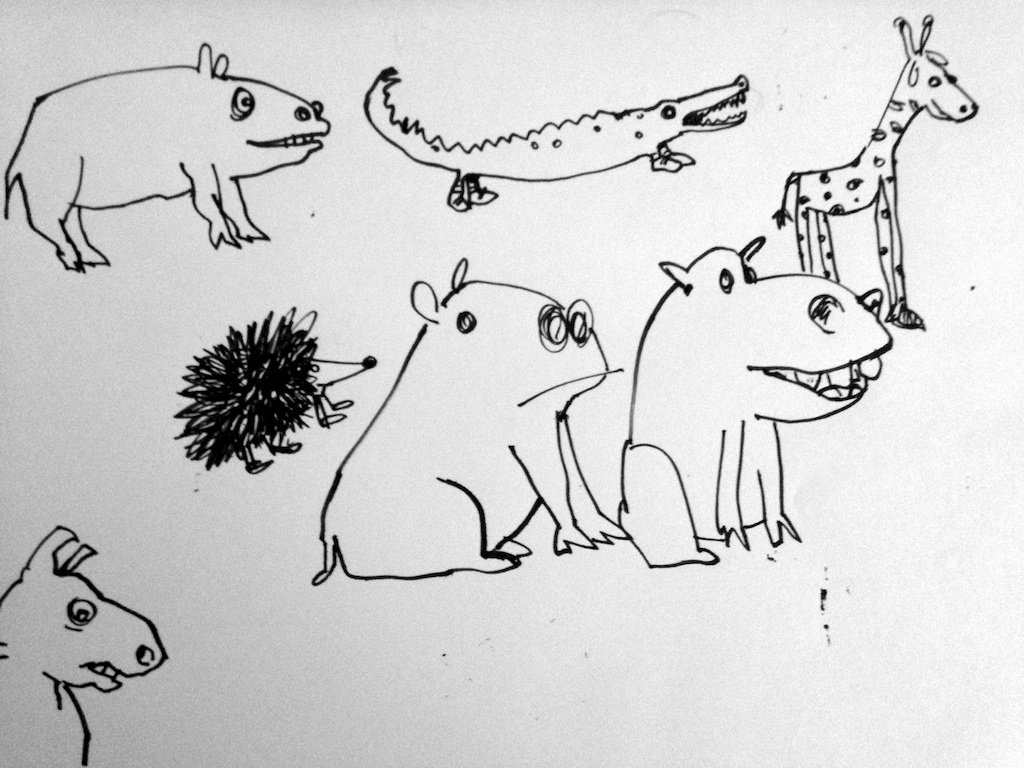
Sometimes drawing is like talking to myself, especially when I am drawing from my imagination. A couple of days ago, I listened to the radio and filled a page of typing paper with hippos, some buck toothed, some with trotters, a giraffe or two, a crocodile in ballet shoes. They spoke to me.

I like it, it passes the time, it is not for anyone but me. But I like to listen to whatever it is in me that wants to say hi.

Kiss all frogs.

Scan 18

When I was running a creative department a few years ago, I decided to make a film about creativity at the agency. Not about my department, but about people in accounting, account services, production, catering, media, and human resources. When I first put out the request for people to tell me about their creativity, the silence was deafening. Wasn’t that the job of my people?  But I insisted, and soon uncovered lots of examples of hidden creativity.  People who never saw fit to mention it in the office, went home and cooked incredible pastries, played the banjo, wrote sci-fi stories, won prizes for their roses, build radio-controlled helicopters, were in the Guinness Book of World Records.

The film was a smash and it opened all of our eyes. By removing labels, we discovered the hidden assets in our company. And we started using those assets in new ways, inviting new people to brainstorming sessions, giving them problem-solving assignments, asking them to help us crack the tougher nuts. Soon the whole agency was a creative resource. Instead of a few dozen people in my department, I could call on the whole staff.

We just don’t know where answers will come from. And when we insist on judging situations prematurely, we limit ourselves and our potential. Instead, we need to open up and stow the labels.

Invention doesn’t land neatly. We have ideas and don’t know where they go or what their purpose is yet. We need to honor those ideas — especially if they seem like mistakes.

For example, misconceptions are a sort of mistake that can lead to innovation. You mishear the assignment, you misread the brief, you misunderstand the problem, and 1+1 don’t make anything coherent.  Because the puzzle won’t snap neatly together, you really scrutinize the pieces. You come up with all sorts of explanations for this perplexing situation. You dream up new theories, new explanations for how things work.  Maybe you get a new tool and you toss away the instructions unread. You find a box of paints you’d forgotten about in the back of the cupboard and discover they don’t mix like they should. You visit a new country and can’t understand how they can eat what they do.

Most of these musings lead nowhere — after all, they’re built on a foundation of error.  But some of them, maybe just one, pivot your thinking, open your eyes to a whole new perspective. Your imagination struggles, flails and then comes up with a link no one has ever seen before. If the pieces fit too neatly, you’d be stuck doing the same old same old.

Sometimes knowing too much means not having room for the answer. Out of the mouths of babes (of all ages and all departments) come surprising insights, based not on experience, but on a fresh point of view.

Don’t be afraid to fail. Don’t shun your mistakes. Don’t burn bridges.

Our wastepaper baskets contain the seeds of revelations and brighter tomorrows.

P.S. Happy 616, PL.