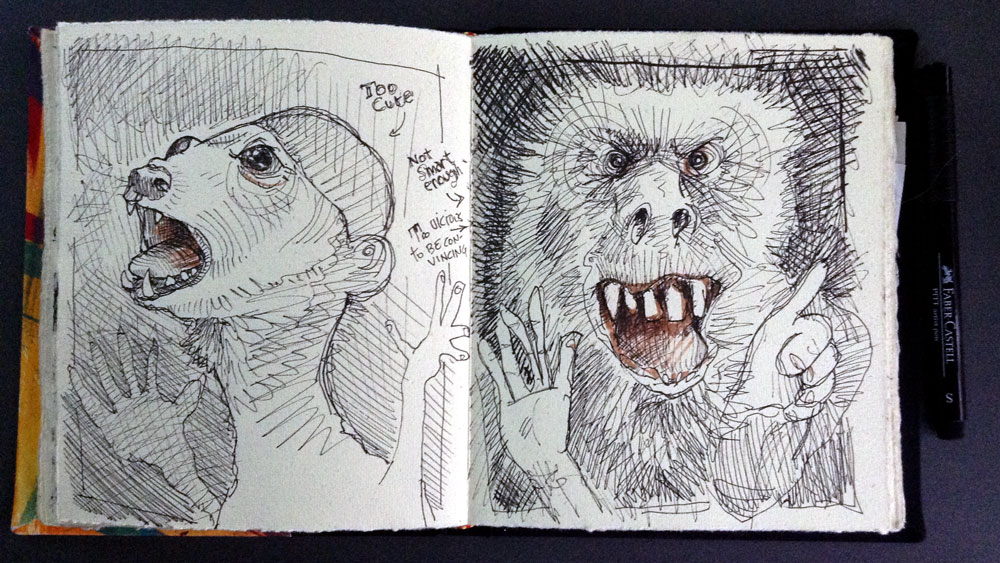
Thinking about my super hard-working boy.

IMG_0616 - Version 2

Artists are dismissed as dreamers. But being an artist takes focus and perseverance. It is a tough job, grounded firmly in the real.

Dreamers are roadkill. Artists work. That’s why they call it “The Work”. Not “the ideas,” “the notions”, “the dreams”, “the visions”.  The Work.

Being an artist means seeing the world as it is and having something to say about it. Most people don’t. Most people are content with hackneyed second-hand points of view. Tree hugger or tea partier, paper or plastic. But being an artist means diving into what is really out there, building your own filter from scratch, a filter that adjusts the contrast, brings out the details, heightens the textures and looks deep into the shadows. If you have nothing to say, your hands will tremble, your lines will be weak, your compositions will be flat and your audience will be yawning. You need to reach down and take a stand. On something, anything.

Being an artist means working to see yourself as well. To figure out what colors you see in. What shapes you like. What appeals to you. And trying in some way to understand why. Not why as in words but why as in feelings, nuances, shades. What do I like, me? I like bent things, dead things, wounded things. I like things that are beaten by the sun and wrinkled by the years. I like to see their history in their surfaces, to feel what has happened to them, to trace the map of their journey carved into their flesh, to empathize. Why do I like these things? Is it because I know I am not perfect, I have been ravaged, I persevere and I honor those who do too? Or is it because I cannot actually make beauty? I need to ask myself these questions, even though I don’t aim to ever articulate the answers. I need to see in to that ugliness and share why it is so beautiful to me. So you can see it too, so you can see the love inside your own pain.

Being an artist takes courage. It takes balls and sweat to see the world through fresh eyes and to develop the skills to express that vision and then go out on a limb and share it. Because it’s a long row to hoe, a thankless journey most of the way, a trip no one ever asked you to take and no one feels obliged to cheer you along on. If there are any spectators along the road, they are probably skeptical, probably see you as a self-indulgent weirdo too lazy to get a proper job. But don’t look to me for sympathy. Or applause. Because being an artist is a cause you choose for yourself, the rewards are in the journey, and there is no Promised Land. You have to want to proclaim your vision, to broadcast your voice, to change the world. The finish line doesn’t lie at the doors of the Whitney Biennial, it lies at the grave. Every day is a lesson and a revelation and they follow one after the other to the horizon, providing their own reward. Artists accumulate wisdom and depth and no gallery owner can take a cut of that and no auctioneer can ring a gavel down upon the lessons learned. 

The only thing to goad you on is your fire and your nerve. Because after all, who asked you? Who asked you how you see the world, what’s good or bad, what needs changing, what could be. No one. You decided you had something to say and now you want to say it. No one is obligated to listen but you will make them sit up and take heed.

Being an artist means being an entrepreneur who imposes his vision, who asserts the value of what he is doing and insists people look at it and take him seriously. No one else will do it for you. No one else will come up with your business plan or a strategy or a new idea. You don’t answer to a committee or a board or market research. You make your product, you sell your product, you create your market, you get your ass out of bed each day and punch the clock you built.

Being an artist means being a craftsman, a self-promoter, and productive without a boss, a company, a client. You are making a product no one asked to buy, sourcing your own materials, developing your strategy, and above all, shipping what you make. It can’t just sit in your brainpan or your sketchbook, it needs to be stretched, framed, and hung up for the world to see and buy and resell and love and learn from.

If that scares you, cool. Museums show about 2% of the work they own. There’s already plenty of genius in storage.

But if that excites you and inspires you, awesome. Do the work and bring it on.

“Don’t ask yourself what the world needs. Ask yourself what makes you come alive and then go do that. Because what the world needs is people who have come alive.” 

—Howard Thurman

The art of living.


Life is not an oil painting, sealed behind varnish and clamped in a golden frame, hanging in a white walled gallery in Chelsea, waiting to be bought by a hedge fund manager’s third wife.
Life is not an edition of etchings, a long series of identical impressions.
Life is not a mural, intended as a public display or the backdrop to an expensively furnished room. Life is not wallpaper.
Life is not a bronze sculpture, cold, monumental, an abstracted, idealized image of a hero long forgotten.

Life is a shelf.
A long shelf partly filled with journals. Some of the journals are hand-made, some store-bought, some in ornate covers, some stained and dog-eared.
Some of the journals are completely filled, others are abandoned half-way, maybe to be taken up at a later date. Some of the books are filled with paper that felt just right under your pen, smooth and creamy, bold and bright. Others were experiments that failed or overreaches, made of materials you weren’t ready to master quite yet.
Sections of the shelf may be filled with identical volumes, a type of book that you found comfortable at the time and stuck with it, disinterested in experimentation and change so you kept filling one after another. On the shelf, they may look the same, identical spines all in a row like a suburban cul-de-sac. But inside, each page is different, drawn by the same hand and pen, yet recording unique observations, days that fill up identically-sized boxes on the calendar but were all filled with different challenges, discoveries, lessons and dreams.
Each page of each journal is always different. Some are perfectly drawn and brilliantly written, insightful and illuminating. Others are a failure, with poor perspective and distracted lines. Some of the pages are dappled with raindrops or a splash of champagne, others are drawn in haste, still others crosshatched with great intensity and care. Some contain shopping lists, phone numbers of new friends, boarding passes to far-away places. Some are bright and colorful, witty and bold. Others are intimate and personal, never to be shared. Some pages describe loss and death, others a drawing of a gift you took to a baby shower.
None of these pages is an end in itself. No matter how good it seems at the time, eventually, you turn each one over. Even the ones at the end of a volume are merely leading to the first fresh page of the next. You fill the page, maybe you like what you drew or maybe it was a disappointment, but there’s always another to follow and another beyond that.
You try your best with each blank page, try to make something fresh and beautiful. Some of the time you feel excited and proud of what you’ve made, at other times you are disappointed and desperate. Often, a page you thought was just a turd looks a whole lot better when you come back to it years later. The drawing you thought was clumsy and flawed reveals some new insight and truth about who you were at the moment, fresh energy, naiveté, hope, darkness before the dawn. Each drawing, whether you know it at the time or not, contains truth. You just have to trust it and keep on drawing and writing and living your life.
Life is a process, and every one has the same end result: that last volume, partly-filled, cut off when we thought there was still art left to make. No need to rush to get there. Make the most of the page that lies open before you today.

Yarddogs.

IMG_0163

Since they were wee pups, my dogs Tim and Joe have spent their days on our apartment on the 8th floor of a Greenwich Village building. They had free rein — running around the living room, rassling on the cowhide rug, napping on the couch, yapping at the elevator — and if they want fresh air, they could go out on one of our balconies and look down on the street to monitor for cats and large black dogs.

Three times a day, they would don their collars and leashes for a walk up to the Park and down Thompson Street. Tim would pee on the corner of West 3rd Street, Joe would poo outside the Catholic Center, then they would come back through the double doors of our lobby and hop in the elevator. They were so comfortable with this routine that if I had a chore to run, I could let them ride up on the elevator on their own, confident that they would get out on 8 and wait for me in the apartment.

Their lives were pretty typical of New York dogs, many of whose lives are quite unusual. I have a friend who cooks her dog breakfast every morning and then pays a person to sit in her apartment all day with her dog so she never has to be alone. Maybe that’s typical too. When she complains about how badly the dog behaves, I would tell her (jokingly),”You need to just chain that dawg up in the yard and leave her to guard your property.”

When we arrived in L.A., Tim and Joe were a little bewildered. No elevators to ride, no fire engines to bark at, no half-eaten chicken bones to snatch off the sidewalk.

At first, we left them briefly alone in the house and they had a field day, knocking things over, peeing, howling at the neighbors.  Then we bought a gate so they could be sequestered in the kitchen — more peeing, more whining. I was getting worried — while I do spend a lot of time working in the house, I need to be able to go to Costco without hiring a dog sitter every time.

Each morning, I open the kitchen door and they trip down the steps into the backyard.  Within seconds of waking up, they can be peeing — dog heaven. But for Tim this luxury was utterly confusing. He looked up at me as if to say,”If you don’t want to pee in the house, but only outside on a leash when we go for a walk, what am I supposed to do here in the yard ?” Meanwhile, his brother was under a lemon tree, extruding a foot-long turd.

As I walked them, around the block several times a day, I noticed all the dogs barking at us from behind our neighbors’ fences. A lightbulb went on in my head. Aha! People leave their dogs in the backyard all day while they are at work. Yarddogs!

And so began Tim and Joe’s, transitions to yarddogginess. After several days in the back, they are content to spend the day lolling in the grass, sniffing through the geraniums, or relaxing in the shade of the orange trees. When I come home, they amble up to me casually, not clambering up my shins or clawing madly at the screen door. They meet me like a fellow animal. Being yard dogs, spending the day watching the hummingbirds at the feeder or rolling on the lawn, has made them more dog-like. The cold, hard streets of New York seem far away.

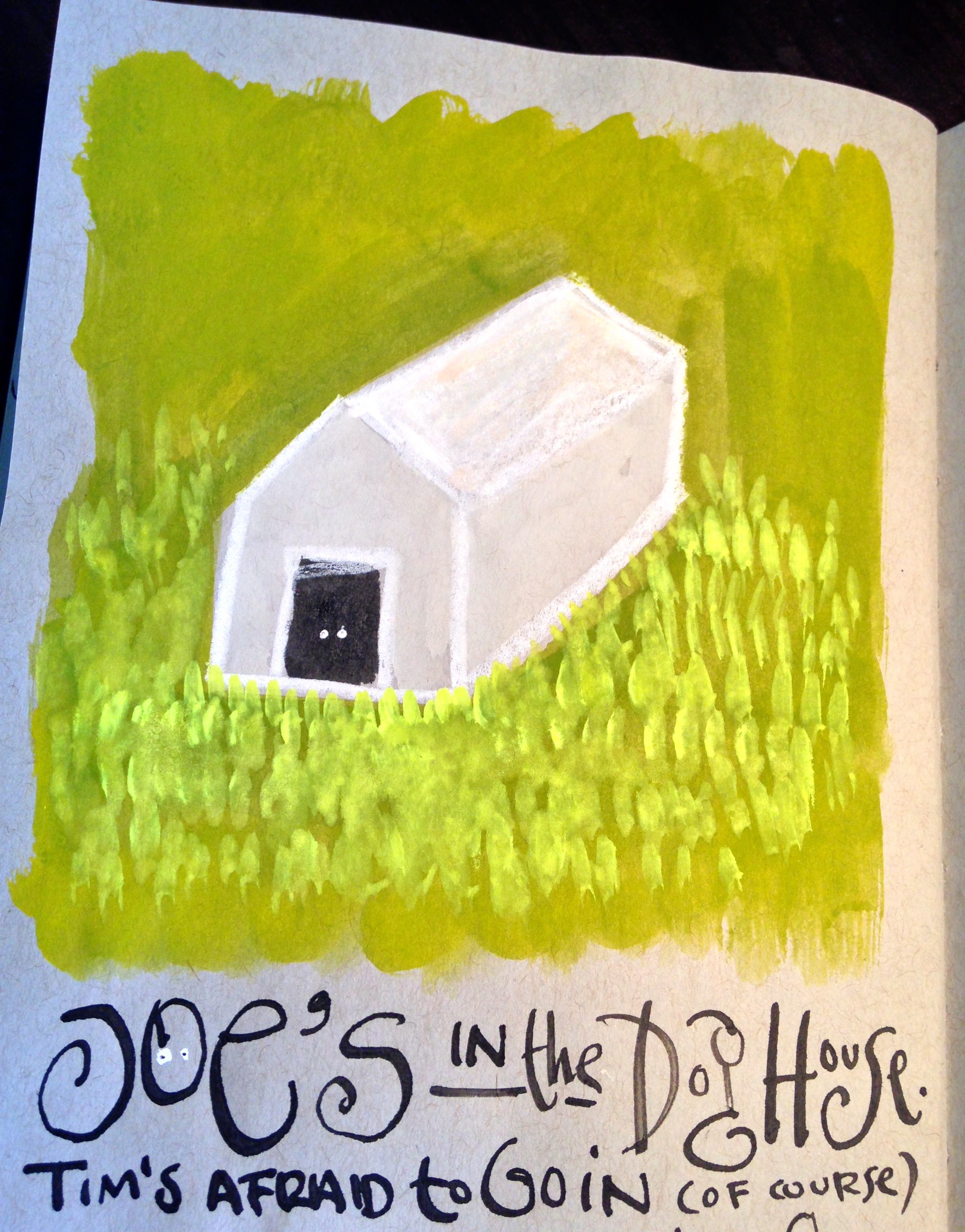
We built  a fomecore dog house. Joe likes it. Tim's not so sure.
We built a fomecore dog house. Joe likes it. Tim’s not so sure.

Slowly, I am undergoing my own yarddog transformation. I spent my first two weeks here in a frenzy of activity, building furnitures, stocking the pantry, reading guidebooks, writing and painting to fill the walls. I felt like I was still doing a job, in this new jury-rigged office I’d built in the back yard. I was still putting on my collar and leash and mimicking my old life in New York. But no one was holding the other end, no one was there to guide me and tell me what do.  I’d started to work for myself, but I had an absentee boss. I lost my sense of what the day’s work amounted to, because I was doing a lot of busy work to fill the day and it wasn’t moving me forward. And, for the first time in my adult life, I was alone all day. Instead of being surrounded by colleagues, meetings and deadlines, I was an old weirdo sitting alone in the garage drawing pictures for the hell of it. It should have felt liberating but I was still far from liberation.

So I made a couple of changes.

I started to structure my day and to set up some goals. I put landmarks on my calendar: going to the gym, drawing, working on my book, preparing my presentations, going to museums, and so on.  I would work on one project for a couple of hours, take a break and switch to some thing else.  It was still orderly, and somewhat corporate in its structure, but it provided me with a lot of relief, just like walking Tim around the bock before setting him free in the yard.  Eventually, I’m sure my regimen will loosen up as I discover new rhythms and a sense of accomplishment, but for now, I am getting lot more done and I feel more relaxed in this new life.

Another realization I had was that though I am not physically surrounded by co-workers, I do know a lot of people who are doing similar things. They are the ones who inspired me and showed me what a different sort of work life could be like. Illustrators, designers, drawing teachers, entrepreneurs, who work on their own and have designed successful creative careers and who I can reach with a an email or by opening Skype. They are my new colleagues. So many of my friends have generously offered me their time, chatting with me and giving me perspective. Sharing their wisdom has shown me how to do this. I am still weird, still in the garage, but I am not alone.

Changing one’s life is exciting and fresh but it is also scary and a lot of work.  I am learning so much every day.

The art of time management

calendar

When you punch a clock, even a gold-plated, corinthian-leather-encased execuclock, your time does not belong to you. You have sold it and the highest bidder can do what he wants with it. He can use it to make wonderful things that will improve the world or to get him coffee and scrub his bowl. You can gripe, you can whimper, but you have punched that clock and now it is going to punch you back, suckah.

These days, my time belongs to me, the new boss, same as the old boss. And I insist that this time I have bought back gets used properly, to the last tock of the ticker. There will be no lolling on the midday couch, no leisurely lunches or bowel evacuations, no navel gazing or whittling of any kind. Every day must and will be filled with productivity.

Now, because I am currently an “artist “(it says so on my LinkedIn page, so it must be true), I am allowed some wool gathering and beard stroking, so long as it is clearly being used to hunt down that pesky muse, drag her to the altar, and squeeze every last drop of creative inspiration out of her. That requires scrupulous documentation.

In the image above, you can see a page from my weekly calendar. I find it essential to structure my day so the hours don’t slip through my fingers and dribble out the door. I insist on logging what I do all day, as if I was still filling out timesheets. One simply must have a clear record, nicht? Otherwise, I might end up cracking open my first six-pack right after breakfast and playing the bongos all day in Washington Square.

So I log my hours and I color-code ’em too. Pink is personal time, hanging with friends, reading on books, kissing my girl, walking my hounds, discipling my boy.Yellow is what I now call ‘work’: drawing, painting, writing, making videos, stuff I used to call ‘fun’. And blue is old school, freelance writing and consulting projects for clients I am still connected to after all those decades in the salt mines. Those blue hours are the lucrative ones, folding-money-wise, but they also cost me the most. My heart is no longer in them though the monkey keeps picking up the phone and signing new contracts. But in my pink hours, I spend time scheming on how to get the blue hours down to a precious few. And I think I’m winning. Slowly but surely my calendar is shifting hue and by the time I’m in LA, I’ll be out of the blues for good and all.

I have had a lot of fun with the yellow hours this week. I have made a half dozen videos for my upcoming class and I am really hitting my stride. I am happy with how they are turning out and I hope you will be too. Another big addition to the yellow column is a new book — my lovely editrix, Bridget, just told me that the acquisitions group at Chronicle is really excited about my proposal and we should have the details of the contract hammered out any day. Then I have to get serious and write and draw it. I think my deadline is sometime in the spring. It’s going to be a humdinger.

20130829-231238.jpg
Pink is getting busy too, Jack and I spend two half days painting his room. You can imagine what a room that a boy has lived in for almost every one of his 19 years can be like. Instead of painting, I thought of calling in one of those companies that clean up crime scenes. I haven’t painted a room since I was in my twenties but it’s not a skill you forget and we had a great time working together, listening to music, cracking jokes and getting paint in our hair. Being Gregorys we managed to get splatters of white paint on the blue wall and blue paint on the ceiling but when we were done and exhausted to the bone, we agreed it looked amazing, like a real grownup room again.
Soon we will both leave our apartment for a good long while, meeting up again here at Thanksgiving and in the meantime we’ll have memories of a great summer, and of lots of time well spent

Big data

20130824-180221.jpgInformation. The world is just jammed with it. I’m not talking about Facebook posts and texts from your besties; I mean the sort of analog information that is constantly flowing into the holes in our head and all over our skin.

But how much exactly? What would be the equivalent in terms I am familiar with — dpi, mexagpixels, gigs, etc.?

Well, the Internet has loads of answers but none are really definitive. The best I can make out is that if our eyes were digital cameras, they would each have the equivalent of around 600 megapixels and the resolution of the images we receive is about 530 pixels per inch (as a reference, the resolution of images we get on the internet is 72 dpi). Our ears are also constantly receiving sound data, and we can distinguish differences in the ~160kbps range.  Our skin can feel vibration, touch, pressure, temperature and of course, pain. We have 20 square feet of skin, all studded with zillions of receptors — Our fingertips alone have 2,500 receptors per cm2.

In short, our bodies are getting a huge amount of data every second. A commonly quoted estimate says that our brains receive 400 billion bits of information each second. That’s 400 gigs, enough to fill my laptop’s hard drive, every second.

But…we have this enormous data stream coming in, and what are we doing with it? According to a recent study in the MIT Technology Review, our brains can only process 60 bits of information a second. And we are only conscious of about 2,000 bits per second. That means that .000000000015% of what comes in actually gets responded to.

Wow.

Obviously, the vast majority of the time, we are screening out almost all of what is around us. How is that even possible? Well, we are living in the preconceived patterns we built for ourselves long ago, the patterns that put most things into categories that require very little data. We simply don’t need to see every pixel of every face we encounter because we know immediately, “that’s Mary”.  We may not notice that Mary is wearing a knee-length, ocean blue floral print dress with six pearl buttons, etc. because that data has no immediate value. It wouldn’t help us to survive in the wild.  Those of our ancestors who couldn’t quickly form observations into categories would have been overwhelmed by data and couldn’t have responded quickly enough if Mary turned out to be a pouncing saber-toothed tiger.

Relying on these quick sorting algorithms has been a useful way to survive, what with terabytes of incoming data and the fairly slow processors in these 3-pound, neck-top computers we were all issued.

But … over time, the price we pay for this has grown higher. As the data becomes more intense (iPhones, laptops, 2000 channels, etc), we have retreated more and more into categories and preconceptions and further and further from all the stuff that’s going on around us in what we oldsters quaintly call “the Real World”. The problem is what happens when you decide that your Facebook stream is so much more manageable than the 400 gigs of real data. You will be utterly oblivious as you cross the street, lost in your smartphone, and a saber tooth tiger pounces or an SUV squashes you flat. End of your gene line.

Which brings me to drawing.

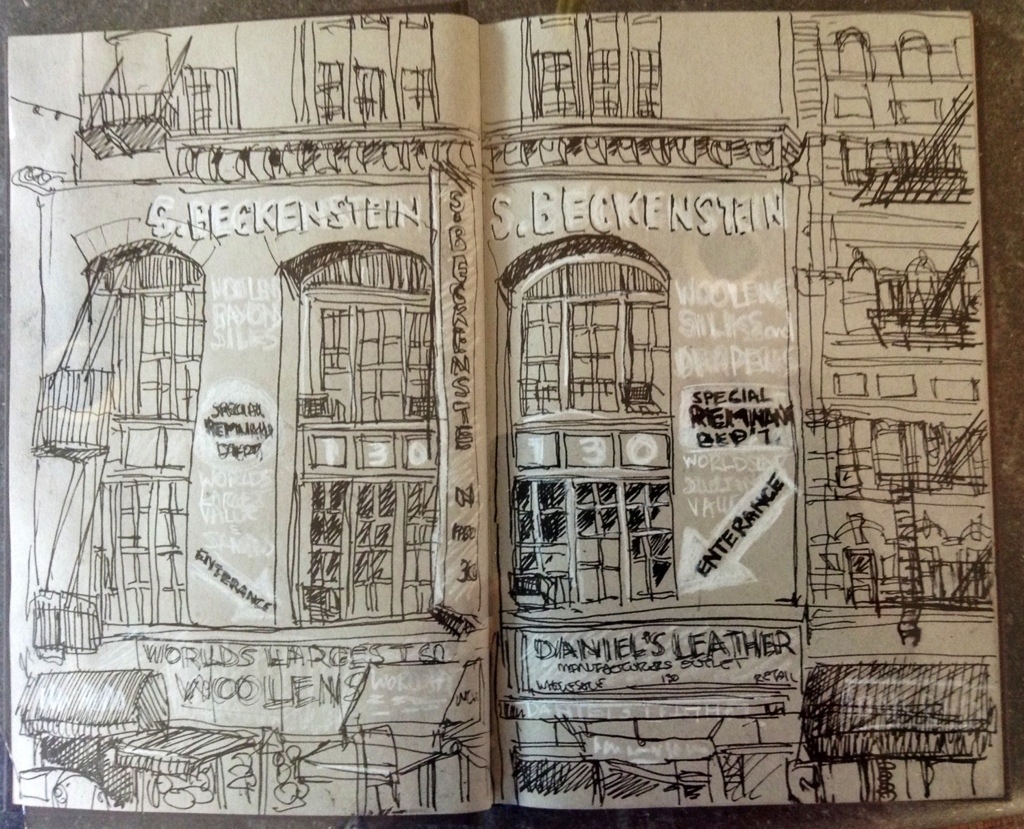
A few days ago, I was walking on the Lower East Side and I saw this building festooned with painted signs. I sat down on the pavement, leaned against a wall, and pulled out my Lamy Safari. I spent the first hour or so just drawing the building underneath the signs.  I started to see that the building itself was quite interesting, that it had curved windows and lots of interesting brickwork. I discovered how the building was constructed, how the windows lineup, where the structural underpinnings were arranged. I noticed all the stores on the ground floor, their merchandise and the ways that their awnings were hung. It seemed I was tapped into the full data stream (though oblivious to my dehydration, cramped buttock, and sleeping right leg).

Finally, I pulled out  a white pencil and start to letter the signs.

Here’s the thing. I had spend a couple of hours starting at this building but now I realize how much I still wasn’t seeing. Yes, I had studied its structure but I had skipped over a lot of the details, I had missed air conditioners, reflections, broken bricks and more. I had approximated so many things based on the patterns I could divine. And I had not observed the perspective or the lighting at all.

But what really blows me away was this weird mistake I made. I misspelled “Entrance”. It’s certainly a word I know how to spell. And I was looking right at the letters on the wall, paying careful attention to the letterforms, to the kerning, the condensed type, the wear of the paint, and then I misspelled “Entrance”. I can’t explain it (Oh, and to cover my goof, I purposefully misspelled it again on the left).

My brain, despite all the time and care I was taking, still had to jump to conclusions. And to a conclusion that I knew was wrong. I somehow drifted away and came back to see my hand adding that ‘E.’ Some other thing was inhabiting my skull, hands on the controls, driving along, a barely-literate lizard brain that just took over while my conscious floated away and debated what I should have for dinner. It’s literally, mind-boggling. Maybe it was a full blown right-brain thing, drawing what was in front of me and disengaged from the rational world of letters and numbers. But then why the mistake? Was I just overwhelmed by the raw data flow?

All this information. And all this human frailty. What we really need is a little wisdom.

On drinking the water.

20130811-164947.jpg
As our plane swooped down over Mexico, endless green filled the windows. My first instinct was to wonder what sort of farming this could be, dense, unbroken and stretching to the horizon in every direction. As the wheels touched down, I saw it was jungle, an impenetrable mass of unruly, complex life. The runways had been cut out of the wilderness but no attempt had been made to cultivate the creepers and trees. Nature was too vast, man too small.
Mexico is a mostly modern country with drive-through Starbucks and TGIFridays. But many Mexicans accept the unrelenting power of nature, impossible to dominate completely when the air is humid and the sun shines brightly all the live long year. Grasshoppers the size of iPhones, careen through the sky with chartreuse scales and hot-pink wings. Raccoons wander into four-star restaurants and take corn chips off the bar. Cars are sun-faded, concrete is cracked, donkeys walk slowly. It’s not a rich country, but that’s not the reason things seem shop-worn and resigned. It’s because Mexicans accept the inevitable encroachment of Nature, that it’s pointless to be fastidious when geckos will wander onto your kitchen counters and carpets of kelp will wash onto your freshly grouted patio.
I like it.
In New York, we have been beating Nature back for 500 years and we think we’ve won. So we can’t help but freak out when mice nibble on the organic granola box, when mosquitos find their way under our 600 thread count sheets, when Hurricane Sandy knocks out our wifi for a week. If Nature gains the slightest foothold, we take it as a sign that our entire civilization is crumbling.
I like that in general Mexicans are so much less uptight about perfection. They are cool if you do things that are a little risky — but hardly dangerous. Things that would have flocks of lawyers descending anywhere in the States. Unsecured seatbelts don’t have those annoying warning alarms. There are packs of cigarettes in the minibar. People build restaurants out of driftwood and light them with masses of candles. Some cars are missing fenders or bumpers and are painted patchily by hand. Most streets have no sidewalks or street lights so walking at night under starry skies can be an adventure.
We sat in a beachside restaurant that served food that would have been the envy of any entry in the NYC Zagat. But before our appetizer arrived, the waiters patrolled through with smoking pails, emitting clouds of burning citronella so chokingly dense we could barely see our $12 artisanal margaritas. The mosquitos and gnats were barely dissuaded but no one bothered to complain to the Health Department, pausing only to reach under our designer linens to scratch the welts.
Mexicans don’t value their lives less than their Northern neighbors. They just accept that we can’t control everything all the time. And that this acceptance makes life easier and preserves resources for more important things. Insisting on perfection makes thing a lot less interesting and spicy. It’s also a losing battle.
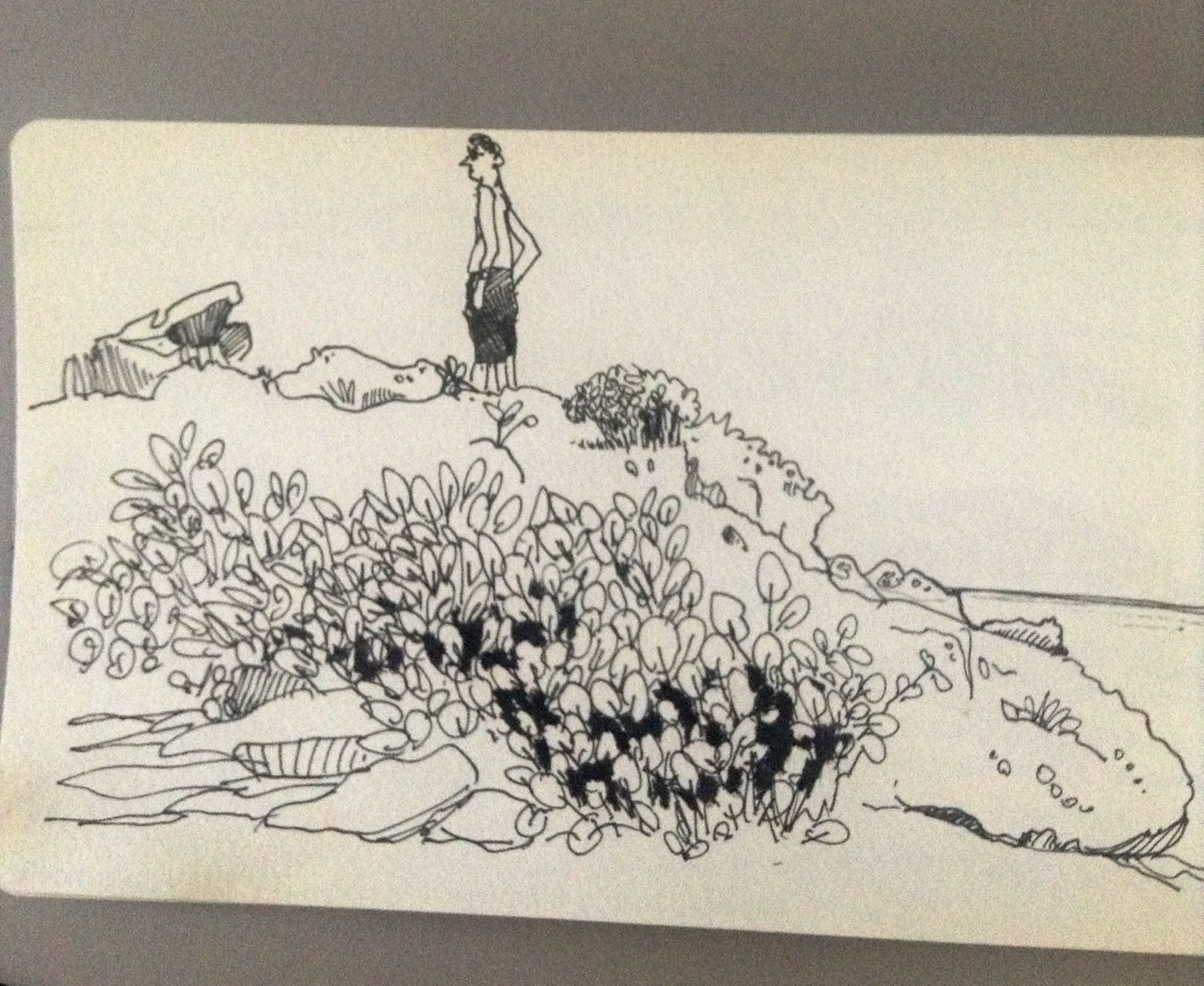
Maybe it was the heat or the Negro Modelo but my pen line was a little looser in Mexico. I did a number of scrawled pages in my journal, drawn half lying down, book propped against my spreading gut, mango juice on my unshaven chin. Maybe this was how Gauguin felt.
I am sloppy as a rule, but I’m not always loose. I value looseness because it feels more organic and expressive, more human, more natural, more the way life is. Less uptight, less gringo. Jack tells me his drawing teacher insists they draw standing up, with their pads on an easel, and that they draw from the shoulder, not from the wrist, to make bold and sweeping lines with their whole bodies. Flat on my back on my chaise, I am far from that, but I feel integrated, natural, in tune with my surroundings. My body, immersed in sweat and heat and verdant richness, feels sensual and at ease. My inner critic, the monkey is dulled too. He is chewing lazily on a mango in the shade, indifferent to my drawing. He can’t be bothered to nag me when we have the jungle at our doorstep. In Mexico, monkeys sit on your roof, squat on your car, hoot from the trees above your hotel window. But it seems they stay out of your head.
Over this past week in Mexico, I haven’t been as insanely productive as I might have been. But I have been more in tune with my nature. I’ve dismantled waves, I’ve counted grains of sand, I’ve listened to grackles eat French Fries, and I’ve felt the walls of perfection erode. Rules, goals and expectations, it turns out, may not help me make as much stuff as simply sitting in the sun and letting the world grow on around me.

FOM (Friends of the Monkey)

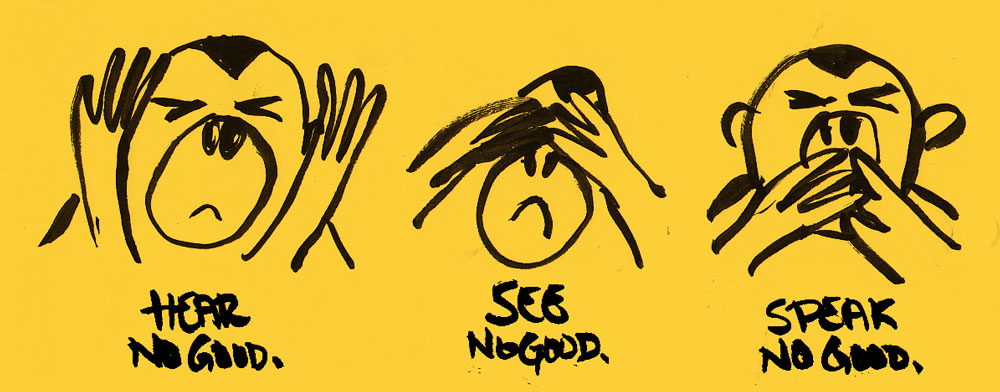
3-monkeys

While your inner critic, that churlish monkey, sits glowering in your head, he has allies all around. They are camped on the hill and are riding in from all points of the compass, waiting for their colleague on the inside to lower the gates and let them flood in and maraud.  Most of these confederates are unwitting. They don’t know they are part of the army that can bring you down. But the monkey knows.

Some of them are driven by monkeys of their own. When you share your creative plans, your intention to start making art or to invest in yourself, they will start chattering from the trees, gibbering in fear. Fear for themselves. When you announce your brave decision to reverse the course of your life, to begin to make things again as you haven’t since third grade, you will set a shining example that will reflect back their own failures to live up to their dreams.

This isn’t universal of course. Many will applaud you and offer you encouragement. But skulking in the crowd will be those who are resentful and bitter and frustrated. And they will begin to lob suggestions, improvements, cautions, and advocacy for the Devil, designed to make you balk and backtrack.

Creativity is a particular magnet for this sort of monkey convocation. In my decades as a creative professional, I have encountered this spirit time and again. When I am awash with excitement at a new project or the possibilities of an assignment, these monkeys slink into my office, slump on to my couch and start to tell me the latest gossip, the latest management bungle, the latest reason to lose faith. They will complain about the assignment, the industry, the market. They will try to drag me into long sessions of venom and bile. They will splash me but I work to remain unblemished. Better to get up and leave that be infected with their toxicity. They are creative at coming up with reasons to stall and malinger, such is their monkeys’ gift of gab, and my own internal monkey howls with glee and joins the chorus.  These voices get me nowhere and need not to be heeded. Cut the chat short and get back to work.

And, while I am busy pointing fingers, let me point them at the mirror too. For in my own moments of weakness and doubt, I have been equally capable of joining or even initiating these grumblefests, feeling insecure in myself, acquiescing to the primate within and dragging in to a colleague’s office, leaning on my hairy knuckles. It’s a toxic affair that makes everyone feel, not purged, but depleted and sick.

Another band of accomplices are the media. The monkey loves the mindless vegetation of watching TV, numbing you with celebrities and gossip. Not the stories of artists and creative inspiration but the mindless doings of fabricated and often malignant chitchat. Besides being a time waster and anesthetic, the media can also skew your perception of art, artists and the true nature of success.

The banker is another friend of the monkey, cajoling you to focus on the bottom line. So is the electric company and the credit card company. They can make you do the monkey’s bidding, downscaling your ambitions because you feel trapped. They don’t deal in might-bes, they want theirs and now. They warn you not to take risks, to keep your day job, to be sensible. Of course, they have the right to get paid. But not to decide your future.

If you are a creative professional, you had to overcome the monkey just to get your career started. The monkey probably warned you and your parents: Don’t be a designer, an art director, an illustrator, an architect, a programmer, a musician, etc. It’s too risky, too competitive, etc. but you did nonetheless. But maybe now you see that the monkey finally let you follow this professional path but now won’t let you pursue your true passion — making art, speaking in your own voice, being your own client. The monkey giveth and he taketh away.

If you are wrestling with this issue, stop thinking. The monkey wants to engage you, wants you to obsess about his heckling and turn your creative energy into a response ego him. Don’t. Focus instead on what you want to do. Draw something. Write something. Then don’t look at it. Don’t judge it. Don’t show it to anyone else. Turn the page and write some more, do another drawing, dream another dream. When the books is done, fill another. Just keep going. Don’t ask for feedback from anyone who might derail you. Better to work alone in a cave than throw your work to the monkeys. Distance and perseverance are the best antidotes to this scourge. Build up your ramparts and lock the beast in your darkest, deepest dungeon.

Then get back to work.

Do you find your monkey has allies? What do they say? How do you deal with them? I’d love to know.

Tragedy in the Art world.

burnt-picasso

I just finished reading a horrible story in the paper. Apparently a Romanian woman’s son stole a number of works of art from a museum in Rotterdam, paintings and drawings by Matisse, Monet, Gauguin, Picasso, Lucian Freud and more. Convinced that if the paintings no longer existed, her son could not be prosecuted, the woman burned them all in the stove. Experts analyzed the ashes and concluded that her grim tale is almost certainly true. These masterpieces are lost to the world forever.

As I sat in the kitchen reading this sad story, my mind wandered off on a tangent. How many works of art have I destroyed? Not literally in my kitchen stove, but in the furnace of my mind. How many paintings have I not done? How many drawings have I aborted? How many pots have I not thrown? How many films have I not made? I thought of all the times I thought I should do some drawing and instead watched “Real Housewives”. I thought about that etching class I was thinking of taking last year and didn’t. Poof, all those would-be etchings went up in smoke. Or that three-week trip I took to Japan when I didn’t do a single sketch in my book. Or that Sketchbook Film we planned to do about a fashion illustrator but never got around to.

This isn’t the monkey talking, brutalizing me for my indolence. It’s just a fact. Every time I find a reason not to create, the art I might have made doesn’t exist. It may not have all been great art, worthy of Rotterdam, but it would have been another step on the path to better art, more fluid, more expressive, more fun.

What have you not made? And how can we fight the fire?

Fresh wisdom to trump the monkey.

3-monkeys

I was served two giant helpings of insight this morning, both in my email inbox.

First, this note from Evelyn:

Hi Danny,

I recently ran a drawing class for adults – a sort of introduction to urban sketching, really. On the first day I shared the story of my own rediscovery of drawing, a rediscovery largely fueled by Everyday Matters. I talked about letting go of attachment to the outcome, focusing on seeing and the connection that is made with the world around us as we draw. I said don’t wait for it to be perfect before you share what you draw.

One of the participants then told me, ” I don’t have much confidence and I have no experience. The reason I signed up for this class was because the drawing on the flyer was not that good.”

It was a drawing I’d done with a bamboo pen and ink I didn’t know was water soluble, so the watercolour kind of ran into the ink and there are some pretty messy bits.

This woman’s words made a big impression on me. There is so much value in modelling joyful imperfection!!

When I teach in high schools, I don’t teach art, but the same principle holds. We need to help people to be able to love themselves unconditionally. To be self critical without anxiety and to create fearlessly.

With gratitude for all you have given, and my best wishes, Evelyn

And then, on a different but somehow related note, this blogpost from Jennifer: Live up to your full potential. It’s a lovely perspective on how to judge whether you are making the most of your gifts.

What if we redefined what this whole potential thing really meant? What if, instead of having to prove our creative selves in a particular area of art, we could reach our potential by simply living artfully? What if, instead of striving to make lots of money with our art, or show just how technically perfect we could draw… what if we engaged in our everyday lives with an artful eye, probing the moments for beauty? What if, we reached our potential by daily living the life WE HAVE, the good and the bad, the mundane and the magical, with open arms and full hearts, celebrating and capturing some of it in an artful manner along the way? What if living up to our potential as artists had MORE to do with seeing the beauty in all of life and sharing it with one or more persons, than with being able to say we have devoted our whole lives to making a career of x or y or z.

To me, these are both conversations about the monkey, about how we can cope with the incessant jabber of our self-doubt and -criticism that wastes so much energy and time. As Evelyn points out, our ‘failures’ are in fact our richest lessons. The most important things is just to start, to make, to move forward, and to shun the wimper within that woud keep us forever in the starting blocks. That voice isn’t just an impediment, it’s a cancer that chews on us, winnowing us down to smaller and smaller versions of ourselves, as we brutalize ourselves with doubt and recrimination. Be kind to yourself, and be creative.

Jennifer’s lessons comes from outside, from the larger world that uses the dollars as the only true yardstick, from the golden monkey now internalized. This monkey voice is just one of the sheepdogs of economics and really has nothing to do with us.  It barks the simple cry of the market. For art to be valued financially, it must be a limited commodity. If everybody made art, it would be so common it would have no financial value. So our society is geared towards making art an exceptional behavior created by the few, a meager supply managed by the system of galleries and museums that turn human creativity into a market.

So it’s not surprising that when you graduate from crayons and want to continue creating art as part of your everyday life, you are discouraged from making at every turn. The only way that art can be sanctioned is if you pass through the system of art schools, galleries and critics that will cull the herd and protect the market.

Fortunately, the Internet has made it possible to share your creativity with other people and to get positive feedback and constructive criticism without financial transactions. The Internet has liberated us from the marketplace of art. It has restored the impulse for creative expression that has existed in our species since we painted bison on the  walls of caves.

This isn’t anti-capitalist. It is pro-self-expression. And it is optimistic. Because no matter whether it is stifled by the government, by religion, by the marketplace or by snobs and bores, ultimately that impulse will return and prevail. Now more than ever.

One of the wonderful things about the Internet is that value and scarcity are no longer inextricably linked. Now good ideas are what are valuable and good ideas can be copied over and over and shared with billions and still retain their value. We live in the golden age of creativity, a new renaissance. Now making art will no longer be discouraged. it will be essential.

art with a small a is not a product. It’s a point of view.  It’s a way of life.

art isn’t for museums. art is for everyday.

The Art world is about money. art is about passion, love, life, humanity — everything that is truly valuable.

The Voice.

monkeyWhy are you here? Here, on my blog, why are you here?

Are you here for the reason that I’m here? Which is, I think, because I have a vague itching inside that says ‘make something.’ But the thing I feel I ought to be doing when that impulse arises, namely drawing something, is somehow not appealing right now.  Maybe that’s because it’s after midnight, I’m sitting in the darkened cabin of an airplane flying to Tokyo, and the only thing I could draw at this moment is the dimly lit, freckled, meaty arm of the guy sleeping in the next seat. So I’m doing something else instead. Writing this.

But maybe a more honest reason why I’m typing instead of drawing is that I am afraid. I’m often a wee bit afraid when I start to make a drawing — yes, even now after zillions of drawings over a decade and a half. I’m afraid of the Voice. Not the TV show (though that can be scary too) but that teeny, nagging voice saying that the drawing will possibly (or probably) suck. The Voice isn’t always there when I uncap my pen, but it often pipes up once the first line starts to go down. “Oh, well, you blew that one. It’s all gonna be repair-work from here on.” Or “Better start cross hatching now, it looks flat and weak.” Or “Come on, let’s finish this one up and watch TV.” Or just “Puhleez … you cannot draw for beans, you worthless, posturing fraud.”

Whose voice is that?

I used to suppose it was my art/shop teacher from 6th grade. Or maybe it was my second stepfather. Or my father. Or my mother. Or a kid I knew in high school who was way cooler than almost all of us. Or a guy who thumbed through one of my books in a Barnes & Noble in Dayton and shrugged it back not the shelf. Or maybe it was your voice — maybe that was the real reason you came here today, to tell me how much this drawing will suck.

But I know now it’s not any of those voices. It’s one I know much better. It’s the voice that’s editing this blogpost as I write it. It’s critiquing my typing skills. It’s correcting my posture. It’s the voice of fear.

The voice that says,”Why bother? Why take a risk? Why put yourself out there? You suck, it will suck, and nothing good will come of it.”

It’s not Linda Blair’s possessed voice in the Exorcist. It’s not the sneering, sing-song voice of the bully that cracked open my head with a rock when I was eleven. It’s a voice that sounds just exactly like mine, though it whispers, hisses even, back there in my skillet darkness of my skull.

That voice doesn’t just concern itself with drawing. No, it has opinions about most things. Whether I should wear this shirt, whether I floss enough, whether I should have desert, what my client meant by that remark, whether I should write another book, teach another class, look for a new place to live, have another cookie. It’s a busy little voice and it can think of a good reason to be afraid of most decisions, of any impending event, big or small. It can give me umpteen reasons to do something tomorrow instead of now, to ask more and more people’s opinions before I make a move, can tell me what that stranger at the cocktail party will reply if I say hi. Despite its apparent rock-solid convictions about things, the voice is always willing to switch sides with alacrity if it will serve to unsettle me. It can say I’m not good enough — or too good. It can say I should settle for the easy way out — or tell me I always refuse to go the extra mile.

I imagine that voice coming from a smallish, hunched-over ape with bright eyes and twitching fingers crouching right behind the backside of my eyeballs. Sort of like Gollum, but meatier, furred. It’s the voice that tells me the water is too cold and too deep, the girl’s too pretty, the assignment’s too hard, the competition’s too stiff, the road’s too long.

This voice has the keys to the file room and knows the combination of the vault. It can use everything I know against me, push very button, pull every lever, and it is unrelenting. It is smarter than me and it has plenty of time on its hand.

Think about this — would the voice put so much effort into fighting me if it didn’t matter?  Do dragons guard empty caves? Maybe it’s so hard to do this because it matters so much?

But don’t worry about that now. It’s time to silence the voice.

Because it can be hushed. It can be beaten.

The secret is so easy, so simple, it took me ages to figure it out. I tried fighting back, debating, fresh approaches, corroborating opinions. But the answer, plain is simple, is to out-dumb it. To not look but just leap. To make not a plan but a move. To get the lead, or the ink, out. Now.

I pick up a pen and mindlessly start to draw. I don’t try to figure out what I’m drawing. I don’t consider the anatomy of the eyeball or the laws of light reflection or where the vanishing point should be. I don’t think about whether my proportions are off, or whether the subject is interesting, or whether my butt is falling asleep, or if the ink is soaking through the paper.

I am the whistling mule, head down, shoulder to the plow, just here to draw, ma’am, pushing the pen on and on. If the voice clambers out of its grotto and starts to harangue me, I switch to humming and I keep pushing that pen. And when the drawing is done, I don’t stop to look at it, I don’t evaluate it or make a few changes. I turn the page and I start the next one. I am not here to have drawn, I am here to be drawing.

And after a couple of pages, the voice has fallen silent. Given up because it is a bully and it can’t face defeat.  Poor little ape. See you tomorrow.

This blogpost is a demonstration of this secret weapon. I started writing with no real idea of what I wanted to say exactly but just an urge to say something.  And somehow I managed to get all these words typed and, when I get around to rereading them, I think they’ll stand up (I was about to start making some self-deprecating, parenthetic aside apologizing for how second-rate what I ended up doing is in fact, but screw it, I stand by these words and that monkey better get back in its box).

So, if you’re here because you’re killing time, time to get back to work. And if you’re looking for inspiration, you got it. Now, put on your expensive, high-performance drawing shoes and just do it.

It may well suck, but so what? A bad drawing beats no drawing every time. And good drawings are just bad drawings’ grandchildren.

What do you think? Do you ever hear the Voice? What do you say to it? Share with us.