My Name is Mud

3-thingsAlfred Hitchcock meticulously planned out every shot in his films long before he set foot on the set. Then he waddled on with precise storyboards, his angles, lenses, lighting directions all completely worked out.
Most artists aren’t so controlled. Many of us sit down to a blank page with only an inkling of what we will do with it. Then we lay down the first lines, the first words, the first notes and begin to play around. While some novelists plot out their stories on index cards and detailed notes, others enjoy discovering where the plot will twist as much as their readers.
There is a danger inherent in either approach.
For the Planner, there is the danger of staleness, of uninspired, mechanical execution. Hitch found shooting a film to be quite a bore— he was simply executing the comprehensive instructions he had already laid out for himself and his crew. His films, while beautiful and gripping always have a certain cool, artificial quality because of his iron grip, and he rarely got the best performances from his actors.
But for the Free Spirit, there is quite another danger: the descent into mud. You look out the window to see the sun shining and the road beckoning and stride out, a sandwich in your pocket and a breeze in your hair, off to look for adventure. But, at some point in the journey, a storm may brew. The sky darkens, the horizon disappears behind clouds, the road fills with potholes and puddles and you, still driven and unwitting, plod on. Eventually you collapse — dirty, wet, miserable and lost.

rooftopsWhen all of the colors of the spectrum merge, they form clear, pure white light. But when you combine all the colors in your paint box, you always get that same khaki brown.
Sometimes, particularly when I am painting, I will get a picture to a certain point and then, unhappy with the way it looks, I’ll go too far. I’ll deepen the shadows, I’ll strengthen the outlines, and then when I’m very desperate, I’ll introduce some garishly bright color to distract the eye, vermillion skies, chartreuse skin. It never works.
Painfully, it’s when I am doing a commission or making a present for someone that I am most likely to encounter this problem. Some part of my brain will not let go and sits in the background, whining and harping and firing suggestions. Instead of letting the piece takes its natural course, I try to twist it in a direction it doesn’t want to go and the results is mud.
I’ve seen this phenomenon in my career in advertising so many times. Because the process requires the approval and opinions of many people and compromise is often the watchword of the day, we slop a lot of mud. How often I’ve been working with a composer on the score of a TV spot only to have a client wade in with ‘issues’ and suggestions. Soon new layers of drums and strings and effects are thrown over the music until it is muffled under a blanket. The same happens with writing, as adjectives and claims get inserted at the last minute like tumors metastasizing on paragraphs that had been edited and polished until they were organic and easy on the ear. So often the reason is stated: ”Sure,you understand it the way you’ve written it, we understand it, but will the consumer understand it? Let’s emphasize the main points more strongly. “And so additional legs and wings and humps are sewn on to the monster, not because anyone’s gut instinct requires them but because of second guessing and lack of vision.
When Jack was in preschool, there was one teacher whose class always did the most amazing paintings. Each one was clear and sharp and intelligent, Picassos in a sea of muddy fingerpaints. I asked her what she taught her kids, what she said to keep their visions so pure. She replied, “I don’t tell them anything, really. I just know when to take their paper away.”

What does not kill me makes me stronger

Two years ago, the manuscript of what was to be “Everyday Matters” was lying in a drawer. At the time, it was pretty much like the book that’s in stores today but it was called simply “A New York Diary”.
In late January, 2002, I had lunch with a friend who had just published a monograph of his work. He encouraged me to pick a list of publishers who had made books I liked and just send out my manuscript. “Invest a hundred bucks in copies and stamps and see if anything happens,” he urged.
So I made a list of thirty publishers and over the next few weeks, filled the mail with manilla envelopes. It took a year for twenty six of them to get around to sending me rejection letters (I’m still waiting on the last four).
This morning, inspires by my 24 hours of nausea, this morning I took out the file of letters and present some edited selections from the nicer ones:

rejectionsputnamAlthough, my efforts may seem futile they weren’t. I believe by making the effort, I set wheels in motion that through twists and turns caused my life to change, books to come out, this dialogue with you to happen.
Destiny is hard to seize. It’s impossible to control every step you will take. But by doing, by making, by generating energy, you cause things to happen.
These letters hurt me when they arrived. But they didn’t stop me. Though I felt like I was facing an endless monolithic wall, I finally found a toe hold and climbed into the Promised Land (a scary place where feelings of rejection continue to abound. More on that some other time). It’s not just because I am brilliant and devilishly handsome. I think it’s primarily because I kept beavering on.
Now… what do you have in a drawer?

If you’re so great, why aren’t you rich?

TV1

(Drawings done while watching a little over an hour of network TV)
These are dark times for the nexus of art and commerce. Every industry that tries to make a buck from others’ creativity is moribund or in flames.
The music business is more intent on suing children for downloading MP3s than trying to incorporate innovations in technology. The publishing business focuses a disproportionate amount of energy on the works of two dozen best selling and second rate authors. The movie business barely scraped a top ten list together last year. Network television bemoans the final act of geriatric shows like Friends and 60 Minutes, unable to generate anything new that mass audiences will flock to. Instead of intelligent, adult programming, they program sleaze. Fashion’s top designers have become factories or left the business. Advertising is unable to come up with any strategy to combat Tivos.

Over the past decade, conglomerates have engulfed each of these industries. Huge businesses demand regular, increasing profits to feed Wall Street and are loath to bet on anything but a sure fire hit with mass appeal. They slather on bureaucracy and centralize decisions to minimize risk and surprise. But risk and surprise are the food and drink of creativity.

And yet, despite this Armageddon, we are in the middle of an enormous renaissance of creativity. Look around you. People are taking digital pictures. They’re recording their own songs. They’re shooting, editing, scoring movies. They’re scanning artwork. They’re writing essays. They’re sharing stories, and recipes and patterns and ideas. They’re supporting each other, inspiring each other, feeding and cheering and promoting each other.

The only ‘problem’? Oh my god, no one’s making money off all these blogs and personal websites and zines and chats. So they can’t be real. They can’t count.
If they were any good, they’d turn a profit, right?

Just like cave painters had three picture deals. Just like Shakespeare had licensing partners. Just like Mozart was a millionaire, Van Gogh was pursued by paparazzi, Nijinsky had his own MTV pilot… For most of human history, creative people made creative things because they had to. Now, perhaps, we’re getting back to an understanding of how essential and human that is.

By the way, if anyone knows a major corporation that would like to sponsor this blog, please put them in touch with my corporate parent. Just kidding.

Marching to the beat of your own drummer

jacks-drum-lessonJack’s been fairly adamant about it since last summer. He wants to learn the drums. I suggested the harmonica, the ukulele, the Jew’s harp, but he won’t yield. I point out that we have an apartment and neighbors, that drummers are the least cool guys in the band, that you have to wear a sweat band… he won’t be budged.
So this afternoon I sat in with him as Frank taught him to read music and to whack away at the cymbal and the snare while hoofing at the bass drum.
I drew as they drummed, listening as Frank explained music notation, the part of music lessons that I could never grasp, incomprehensible gibberish that led me to give up the keyboard, the guitar and to keep my harmonica in the shower where I can wail away without an audience or any sheet music.
Amazingly, Jack seemed to grasp this foreign language and was hammering out a coherent tattoo by class’s end.
Two things: 1) there’s no feeling as amazing as when your kid does something you can’t.
and 2) Music is built into us, just as drawing is. It’s hardwired into our motherboards. But musical theory, notation, and just talking about music in the abstract is a very different matter. It uses other parts of the brain that make me feel like rubbing my tummy and tapping my head.
I don’t know how you could learn it efficiently without discussing these concepts but I have never been able to get over that hump. And I do love music so.
So many books on drawing begin by explaining all the different sorts of pencils you could use, all the different kinds of paper there are, the laws of perspective, anatomy, composition, etc., all studded with works from the great masters, insisting you use every part of your brain except the part that sees and draws. I think the basics should start with the basics. Having fun, letting it out, getting some visceral, sensual reward immediately. As soon as Jack got his very own pair of sticks, his teacher let him wale away randomly at all the drums, smashing the cymbals with all his might, not music anyone would recognize but food for his soul, pure joy. Hooking him.
Think about that exuberance next time you worry someone will see your awful, cramped drawing. You’ve got to wale and flail and fail, before you headline at the Garden. And I know Jack isn’t thinking about that.
He just wants to play … music.

A martini memory

pierre-hotel

This is a photocopy of a watercolor I just made for our friend, Cynthia. It commemorates the night I introduced her to Patti, four years ago. We went to the Pierre, had too many martinis and, upon leaving, Patti shot out of the bar and spilled (out of her chair) and onto Fifth Avenue! Cynthia was so cool about this debacle that we knew she would be our friend.
I am fairly happy with the uptown, 1950s feeling of the drawing and I hope it’ll look good in her pad.

Ideas and the end of the world

dinosaur

In nature, we organisms have a tendency to seek balance. We want to adapt to our environment and develop the most efficient life style based on the resources around us. You and your descendants will change in order to find your niche. If there is an abundance of a certain hard nut, those with a large, hard nut cracking beak will survive. If the leaves are most plentiful at the top of the trees, those with longer necks will flourish. Once you reach this equilibrium, you won’t have much incentive to continue changing. In fact, change could imperil your success as a species.
As a result, evolution goes in spurts of change with long periods of stasis in between.
Our lives work the same way: most of us tend to seek a stable job, a stable community, a regular diet, or form of exercise. We find a place we like to vacation and we go there every year and lie in the sun reading our favorite authors. We go to the same church, vote the same party line. We make friends with people who share our interests and we settle into regular social schedules with them.
We avoid disruption. We shun risk.
Deep in our reptile brains, we know that this is the key to survival. Herds only change grazing lands when the drought comes.
There are two results of this type of habitual existence: The first is that we are afraid of trying something new for fear that it won’t bring us the same level of reliable reassurance as the things we have always been doing. We don’t want to endure the discomfort of failure or even of the unknown. We prefer to limit suspense to Friday night at the movies. Better not to do at all than to do badly. We wouldn’t want to stick out and possibly send ripples through the quiet watering hole. I’m not saying any of this derisively; it’s a perfectly logical perspective, a perspective the vast majority of people in our society share. Far better the devil you know.
The second result is that we are completely unhinged when change does occur. And there is no question that it will occur, as sure as summer follows spring, as death follows the cradle, as the #9 train rolls into Christopher Street station.
America had no real idea how to respond, for example, to September 11. When I was eleven and living in Israel, terrorist bombings were regular events. When my bus stop was blown up fifteen minutes before school let out, they didn’t even bother reporting it in the local paper. But in America we had a real sense of apocalyptic doom after the World Trade Center attacks. It seemed like everything was going to unravel and our entire way of life was done. We were like hens in a coop, completely unable to interpret any howl in the night. Perhaps that’s why we have so many pundits, so many people who reassure us by telling us what is to come. The fact that their collective opinions cover every possible outcomes doesn’t shake our confidence.
My point is not political. Because what I am really discussing here is creativity. We must understand that creativity is both essential to survival and anathema. That’s why it can be so hard to overcome the resistance we have to our own creativity. Why it causes us such a deep sense of fear and dread. And it is why artists are so reviled in our fat, contented world. Look at the government sponsored art of the WPA. Look at the creativity that springs up during revolutions. Think of the wild architecture that was proposed to rebuild downtown New York in the immediate wake of the attacks. As the dust still lingered we welcomed a vision of a new world, collective recognition that our times and our landscapes were different. But all too quickly, we became more conservative, more calcified and the designs morphed back into the predictable, corporatist visions that suited a calming with the public mood.
To be creative, you must be brave and allow your self to take risks. You also must be a little crazy to take these risks.
But have an appropriate degree of perspective. You must reassure yourself that by doing a watercolor or throwing a pot you won’t set off some chain reactions that destroys your entire universe. The whole reason that you are feeling any sort of need to be creative is because you, as an organism, feel some need to adapt to changes in your environment. Your job may be too restrictive. Your relationship may be showing you new possibilities. Your daily paper may be reshuffling your deck. Your body may be changing. Or you may just be more sensitive than those around you, a canary on the coal mine, a bell weather to changes that others don’t yet sense.
Under all those conditions, creative change is no longer a risk, It’s an imperative. Give yourself the chance to experiment and reconfigure your life. Start today. Before the volcano erupts or the meteor hits the earth, before you get run over by a bus, or your candidate loses, or your bosses makes a cut back, before the changes erupt, and it’s all too late. And even then, it won’t be.
It’ll just be time to stop being a dinosaur and start figuring out how to become a bird.

Dear Danny:

I’ve been lucky enough to get lots of email from visitors to this journal. These are some of the interesting questions I received over the past month:

When did you start to draw? I mean, did you ever draw when you were younger? Or try to draw? — Katharine

This is a tricky question. If I show you an example of how I use to draw before I let myself have permission to make drawing a habit, and you say, "well, that’s pretty good. I could never do that." then it’ll be raw meat for all those innner critics out there, just chomping to trash your drawings. Or you might just say, "Hold on, this guy sucks! What the hell am I listening to him for?" (Right answer, by the way).
So let me put it this way:
I’ve always doodled in symbols: cartoon heads, cubes, grids, etc. and over the years I’ve done a half dozen lame acrylic paintings. But everything changed when I developed the habit of truely seeing and of recording, deliberately and carefully and without preconception, what I saw on paper. As I have mentioned here and in my book, that is a very different thing from doodling. But if you’d still like to see some typical doodles and promise not to get thrown by it either way, go for it.

O no… you can’t take away "25 books"! — Katrine

Noooo… we NEED the 25 books! — Serena

Oh, okay. here it is: the return of 25 Books.

untitled-18a

I would like to start drawing/sketching/doodling. Do you have recommendations for paper/pencils etc for a beginner — Alan

My tools change all the time. I love to experiment and playing with materials is part of the fun for me. Generally, the only pencils I use are colored ones and I never erase my lines no matter how ‘wrong’ they may seem at the time. I urge you do to do the same. Try out different pens till you get something you like. It should flow smoothly and feel good in your grip. I like Sakura’s pigma micron pens, also Faber Castell’s PITT artist pens, and my new beloved Staedler pigment liners, but there are many other good choices. As for paper, I like to buy heavy bond paper, in sketch pad form. It’ll hold up to all sorts of abuse, ink, paint, markers, without bleeding and it feels solid and good. It also makes each page feel important, somehow.
Frankly, though, you could use a ball-point pen and a sheet of copier paper. The main thing is to begin, have fun, get hooked and then branch out. Don’t worry about posterity, readers, mistakes, etc.

My husband could not locate your book in B&N in Manhattan on Monday. THEY said they had quite a few copies and then three people could not find a single one. We ordered it from Amazon instead. — Melly

Bastards. It’s a part of the massive conspiracy to keep journal-making an obscure hobby instead of an awesome power that will take over and transform the world. Barnes & Noble loves to shelve my book in the New York section. Look for it there or take some form of political action.

I don’t know who you are! Stop emailling me! Take me off your fucking list! — Ganesh

I’m not sure who Ganiesh is either. He won’t be joining us in future discussions.

Was wondering, do you ever sign your books and sell them yourself or should I just follow the link from your site and buy the book on Amazon? — Myra

The most efficient way for you to get a copy of Everyday Matters is via Amazon or by badgering your local bookshop. If your really want, though, I’ll gladly sign it for you. And please let me know what you think of the book when you get it.

Did you hand-write the text in Everyday Matters or use a font?  I’m curious because your handwriting is fascinating to look at.  If you’ve managed to make your own font, I’d be interested in downloading or purchasing it… or just admire it from afar.  I really like your handwriting. — Wileen

While I hand wrote large parts of my book, the opening pages were primarily set in a font based on my own handwriting. It helped to distinguish these big blocks of text form the rest of the higgledy-piggledy stuff and stopped my publisher from asking if we couldn’t just set the whole thing in type. I find it ironic that an English teacher would admire my handwriting — when I was in high school, I was always getting in trouble for illegibility!

What do you use to color in your drawings?  I have been wanting to color in some of mine in my moleskines but I don’t want to mess them up. —Joe

Although I am not a moleskine user any more, I used Tombow brush markers, colored pencils and occasional patches of ink. The pages are water resistant so they’re not friendly with many paints. But don’t be afraid to experiment; it’s part of journaling. Even if you screw up a page you can always write about the experience!

Did you do a little Photoshopping on the color lay-in (of your Martha Stewart Piece), maybe? If so, how’d you like the experience? – Karen

I hated it.
I rarely work this way and regret it when I do. I did random sketches on location and made notes. Then I came home and scanned the pages and built my layouts in Photoshop, then printed them out, wrote in the captions, rescanned the calligraphy and laid it back in. Then, I colored the whole thing on screen because I was rushed. The colors are insipid and vague and didn’t come from observation. The computer makes me fussy and wooden. I also hate having the ability to undo things and to mechanically work with transparent layers and I hate using a Wacom tablet instead of a pen and I hate working vertically instead of flat on my lap. And I also hate the fact that it exists only in 72 dpi form on line. I hated it. Hate.

I was just curious as to how you get such great resolution on your drawings whenever they are posted to the web. — Jon

I scan my book at 75 dpi. Then, in Photoshop, I adjust the curves so the whites are white, the blacks are black, and the colors look right. Then I use the ‘Save for Web’ function, and boil it all down to a medium quality, JPEG 650 dpi wide. Then I mutter a brief prayer to St. Twain, the patron saint of scanning.

I’d stopped drawing and printmaking when I started a new career, but have since rediscovered journalling through your book and website…I discovered, yesterday, that I had inadvertently left my journal on the subway. What did you do when you left your journal on the plane? — Michelle

Maybe the pain of losing your journal was meant to remind you of all the days you lost when you weren’t making things. Don’t lose any more! As for some practical advice: put your name and number in future ones!

Patti's problem

pens

Patti and I were discussing her journals and scrapbooks a few days ago and, for once, I was able to give her some useful advice. Her dilemma: she collects all sorts of clippings and pictures and cards and souvenirs and stuffs them between the pages of her book or into an envelope, waiting for the rainy day that she’ll stick them all in and make something beautiful. But it rarely arrives, so the piles of ephemera grow bigger and more daunting, like a corner of the Collier Brothers’ apartment, until the whole thought of tackling the project is more than she wants to deal with. Why is it so hard to move from the collecting phase to the making phase, she asked me.

I think it comes down to a matter of purpose. Why do you want to assemble this stuff? What are you going to say with it? Is it just there because you collected it, because it seemed interesting or pretty at the time, but has long since lost its significance? Souvenirs shouldn’t get amnesia. It’s more important to have a point, a vision, a story to tell than it is to use all the materials you have. But most important of all is to just get started and make something.

I have lots of different kinds of art supplies, but I never sit down and say, well, I’d better make sure I use everything that’s in the box. I also usually don’t sit down, thinking, I haven’t use my burnt umber Caran d’Ache pencil in a while I really ought to. No, I just have a glimmer of an idea, look at my materials, and gravitate towards one pen or another.

A variation on Patti’s problem I encounter in others: “I haven’t written in my journal for so long, I have months of catching up to do, It’s too overwhelming, I’ll wait till another day.” It’s the same impulse that’ll make you put off going back to the gym or breaking up with your lousy boyfriend.
The only solution is to express something, anything. Turn over a fresh page and just do something about procrastination or dread or laziness or … You don’t need to record every single moment of your life. Just record one, in a careful and heartfelt way and the rest, all interlocking, will string along with it.

These are your enemies: procrastination, self doubt, obligation, perfectionism, judgmentalism. Now, depict them in your journal and you’ll already have them licked.

It's not easy being chartreuse

colorpants

I start most days by choosing a palette. It’s often a fairly subconscious process as I flip through my pants, shirts, sweaters, etc in the semi-darkness of my closet. I have a lot of drab, typically male colors: khaki, olive, grey, brown, black. But I also have some ludicrous shades to pick from because I like to buy light color trousers and dye them in my washing machine. I have bright orange cords, raspberry and Pepto-Bismol jeans, lime green, lemon yellow and purple paisley chinos.
So what determines why I’ll end up wearing a sap green cashmere sweater and burnt umber jeans one day and a black turtleneck and black jeans another? It ‘s nothing to do with my mood really.
I can be bad tempered and dress like a clown or feel chipper and gear up like a mime. And when I choose Jack’s clothes, I invariably dress him in a similar style and spectrum to whatever I picked for myself.
Of course, a major factor is whom I’m dressing for: although when I go to ad agencies a wild wardrobe can work for or against me. The biggest subconscious factor is probably the view out the window. If skies are sunny and blue, I put on the peacock. If the day lacks color, so will I.
Then Patti will come in and say: "You’re not wearing that are you?" and I’ll say, "Of course not" and head back to my closet. Color me yellow.

Ars longa, vita brevis

football

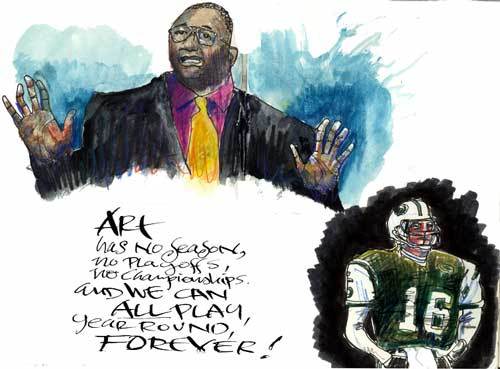
Every biographical movie about an artist depicts its subject as some sort of dysfunctional weirdo. Picasso – a woman hater. Van Gogh – a psychotic suicidal. Basquiat – a drug addicted suicide. Pollock – a drunken suicidal. Warhol – a weirdo and con man in a wig. Michelangelo – a disagreeable obsessive. Kahlo – a victim of love and disability. Toulouse-Lautrec – a horny dwarf, Mozart – a child. Beethoven – a deaf crank. Their genius is a curse, fed only by their tortured souls.
In America, we love athletes. We love pop stars. But we love to hate artists.
When we are about ten we are taught that being an artist is impractical, childish, and self indulgent, that ‘talent’ is a god-given gift you either have or you shouldn’t bother. Artists are arrogant, disconnected, elitist, millionaires or paupers. This myth is why parents accept all the cuts in art and music education yet will do anything to promote athletics in school. No one would want their kid to want to grow up to be an artist.
It wasn’t always this way. Doing watercolors used to be a standard part of a decent education, So did reading and writing poetry. Mozart, Beethoven, Bach, they were all government employees.
But in 21st century America, that critic in your head has the support and encouragement of the whole gang; your parents, your teachers, your neighbors, bosses, and role models (even so –called creative people in the media promote the illusion that it’s either a fool’s game or the lottery).
Small wonder it’s so hard to drown out. It says, “Don’t sing unless you’re going to become a pop star. Don’t paint unless you know you’ll be a genius who is recognized in your own lifetime. And if you have to practice at something, work on your pitch, your swing, your kick, skills that’ll pave the way for your future.”
You are fighting enough obstacles as it is. Don’t let your own brain join the conspiracy. Tell it to shut the hell up and let you get back to work.
Because all those voices, so right about how to build profit, are flat wrong about how to build a decent life. Without art, your soul suffers; you lack a chance to express who you are, to hone your own point of view, to make your life your own. You are less than human, no matter how many Super Bowl rings you’re wearing.
When you do make something and share it with the world, your voice will be proven wrong again. People won’t say, “Well, that drawing is pathetic. That poem is lame. That note was slightly flat. That diary reveals what a moron the writer was.” If they stop to judge it all, they’ll almost certainly say, “I wish I did that.” Which will give you the chance to say “Well, why don’t you?”