Bulletproof

I saw some cops having lunch at the diner the other day. There were three of them, big guys crammed into a booth, working through sandwiches and fries.  They each wore a heavy leather utility belt with a flashlight, handcuffs, mace, a Taser, a notebook, a radio, a nightstick, a big handgun and God knows what else.  These cops sat very erect — under their uniforms, their torsos were girded in a thick bulletproof vest.

When their meal was done, one officer reached for the bill — but it slipped out of his grip and fluttered to the floor. He leaned over, grunting, to pick it up. Straining and cursing, he couldn’t bend in the middle to reach it. The gun, the vest, all the clobber had him strapped down and inflexible. Eventually, the waitress saw his predicament and darted down to lightly pick up the bill and replace it in front of him.

Life can force us to armor up. As we endure traumas, abuse, poor judgment, we layer on defenses to protect us from what has happened. As they say in the Pentagon, we are always preparing to fight the last war. But many of our shields are redundant, obsolete, and confining. As we bolster ourselves against more and more possible eventualities, we become like medieval knights struggling to get back on the horse under a load of steel plate.

Do you need it all? Look at your ramparts. Monitor your reactions. Check your gear and see if, maybe, you can lighten your load.

Spine-tingling

My uncle Michael published half a dozen books. Everyone in our family prominently displayed their set. A foot-long row of familiar spines standing proudly together — his books, his name repeated across them. I envied the pleasure I imagined that gave him, that cube of honored real estate.

I made my first book when I was six. A stack of deliciously thick paper. The smell of library paste, a smell I can taste (probably because I did). A clear plastic sleeve filled with a rainbow of markers. Brass paper fasteners.

I treasured the pleasures of bookmaking. Carefully lettering my name on the title page. Alternating pages of drawings with pages filled with large, neatly penciled letters. Numbering all the pages. Making up the front matter: the publisher, the copyright, the dedication. Conjuring up blurbs from my favorite authors to put on the back.

My biggest regret: my books never had a proper spine. I couldn’t run my name and title and the Dewy Decimal number down the edge. It didn’t look right on the shelf.
But that was a minor blunt to my pleasure. I was still “an author”.

A half century later, whenever I visit a book store or a library, I always, eventually, wind up looking for my books on the shelf. I can spot them from across the room, familiar faces in a sea of stripes, like spotting my son on a crowded playground.

No matter how many books I publish or sketchbooks I fill, that boyhood thrill is still there. I love the shelves of books I’ve made, all together, spines aligned like little soldiers.

Oh, BTW, I am soon gonna add a new spine to my collection. Shut Your Monkey: How  to control your inner critic and get more done is in the design/illustration phase and will soon head to the printer.  It’ll be on the shelves of your local bookstore this fall.

Spare the rod.

My second stepfather was quick with his fists. He would escalate disagreements with waiters into brawls in parking lots.  He threw chairs in parent-teacher conferences. He wouldn’t hesitate to pull the car over and reach into the back seat to swing at me and my little sister. He was six feet tall with meaty forearms covered with red hairs. When I was ten years old, his right hand left an imprint on my left cheek which I wore to school for a week.

We moved a lot when I was little and, as the new kid, I was an easy target for bullies. I was tripped, teased, and occasionally had to get stitches. I was told to just walk away or to stand up for myself or to name names, but nothing made much difference. I was a wimp and a weed.

I’m no longer the new kid. And my second stepfather has been dead of pancreatic cancer for over a decade. These days, the only likely sources of physical violence I encounter are drunks and madmen. I live in Greenwich Village so there are a fair number of each around but I haven’t been struck since a large, intoxicated man appeared out of nowhere and knocked me to the ground in Washington DC. That was during the first Clinton Administration. Except for 9/11, the Bush and Obama years have been without incident.

It’s pretty unusual to see an adult strike a child in public these days. When it happens, it seems so barbaric, like witnessing a street fight. No doubt family services will soon be called, courts, foster care, but when I was a kid, it was an everyday thing, never discussed with outsiders, a family affair. I can’t imagine striking Jack. He’s taller than me these days and goes to the gym all the time, but even when he was knee-high, I would never have turned my frustration into any sort of physical response. It just wasn’t in me.

But what is in me is the battle against the impending threat. While I haven’t been physically assaulted in this millennium, a part of me is ever vigilant, waiting for an attack. It’s the part of me that bruises too easily. My ego. The slings and arrows of garden-variety disagreements and critiques can still sting disproportionately. A blog comment, a client request, a passing suggestion from my girlfriend, all can raise the specter of my second stepfather, his shadow on my doorstep.  My only weapons are flimsy and malfunctioning: defensiveness, sarcasm, withdrawal — the sorts of things that do me more harm than good.

I have long been working on toughening up. I’ve had to. I spent decades in the trenches of advertising where curt dismissal was part of the job, where hard-earned ideas would ride out of conference rooms on their shields, where creative competitions are called “gang bangs.” I have spent decades on the Internet too, where anonymous trolls are free to lumber in, 24/7, and empty their bowels on my creations with the click of  a mouse.

Here’s what I tell myself, not always successfully:

A) Everyone has the right to an opinion.

B) Each critique is an opportunity to better my work.

C) My second stepfather is dead. Even if he does live on in my head.

I force myself to first take a deep breath and try to clear the fog of emotion. This is now. It is not the past. (I know, I know. Easier said than done).

Then I consider the content of the input. (God, even the way I wrote that last sentence shows how tightly I clutch the reins). I look at my idea as objectively as I can, as if it was not mine, unvested — and then I apply the critique. Is it helpful? Can I use it? If so, all good. Thanks very much for saving me from myself. Now I can do better.

But if I am unsure of the critique, if it seems not to fit at all with the way I see the situation, then it’s time to consider the intention behind it. Is the critic there to help? Or to throw a fist? Do they want me and my idea to succeed? Or will they profit in some way from my failure? Will it make them bigger? Will it prop up their vanity and insecurity?  Because if their motives are suspect, maybe their criticism is too.

This is easier said than done, but I think it’s right.

Whatever sort of childhood you’ve had, being creative thins your skin. You take your work so personally. You have to, that why you care enough to make it good.  Not because of the money or the acclaim but because it’s a part of you that you are putting out there.

But remember that the world is essentially kind and welcoming. The people who matter want you to succeed. They will collaborate with you to help you make your work as good as it can be, because good work makes the world a better place for all of us.  And the assholes? They see your success as further proof of their own failures. That’s not your concern.

Unfortunately, I have long given my second stepfather a sort of immortality by letting him enter my dreams. But I won’t let him crush them too.

No returns, no regrets

Getting what you want out of any creative form takes work. You have to make a lot of crap to get to the good stuff. You invest time. You tussle with the monkey. You doubt yourself.

Why bother?

It’s easy to avoid being great. In fact, the world seems to want you to avoid it. It bombards you with temptations and distractions. It seems not to understand why you are wasting your time. It fills your browser with zillions of example of people who are doing what you should be doing, only better and seemingly without effort.

But being great at what you’re good at has lots of benefits. And they’re not the benefits you imagine. The goal is not numbers: not more $ in the bank, more Twitter followers, more awards on your mantle.

The goal is to be who you are meant to be: a person who is living a life of fulfillment, who is working for something bigger than themselves, who is helping, who matters.

You have gifts to give to the world. But it may just take some sweat to unwrap them.

Freaky Friday

A few days ago, I woke up in a parallel universe. It took a while to realize that I was in a new dimension because my bedroom, my bathroom, my dachshunds, all looked pretty much the same. But the back page of my neighbor’s New York Post, lying face down on the elevator floor, clued me in.

The headline screamed, “Yee Dominates Open” over a picture of some ceramic sculptures. The caption went on to explain that artist Lulu Yee’s work was all the rage at the Bushwick Open Studios.

I nudged through the rest of the paper with my toe. Where I expected to see hockey scores and an update on the Yankee’s quest for a shortstop, I found reviews of two shows at the new Whitney, a long essay on Robert Motherwell’s legacy, and a table charting the top twenty seniors at RISD and their expected prospects at Art Basel in Miami.

I walked back into my apartment and hit the remote. A flashy logo for ESPN (the Exhibition, Sculpture & Painting Network), swept across the screen. Two talking heads were discussing Gerhard Richter’s decision to switch to a new brand of paint thinner, then rumors about Damien Hirst’s wrist injury, the economics of a trade of three Rachel Whiteread sculptures between the Guggenheim and a huge new museum in Dallas, and Matthew Barney’s newly trimmed beard.

In this alternate world, art schools recruited talented third graders, galleries poached art school freshmen, and major corporations viciously competed to sponsor retrospectives at the Guggenheim. There were hundreds of extraordinary new artists I had never heard of before: they now had the chance to show their work, were supported and encouraged to push boundaries and create new dimensions in art.  School art programs were lavishly supported and even the most provincial colleges had big, sun-swept studios, subsidized art supply stores and  deep pockets. Most athletic programs, alas, had meager support and sparse attendance.

Every city built stadiums to present Pussy Riot performance pieces and screen Tom McCarthy videos. Teenaged girls mooned over half-naked pinups of Richard Prince. Marina Abramovic had her own cable network. Every street tough wore Basquiat dreadlocks and paint spattered shoes. Kids coveted jackets festooned with Liquitex and Grumbacher logos. Parents named their babies “Winsor” and “Newton”. Art students lived in mini-mansions and drove Escalades to Starbucks where star quarterbacks made them pumpkin lattes.

Exhilarated and exhausted by my first day in this wonderland, I drank too much absinthe and passed out. When I woke up the next morning, it was to the sound of reality, two cab drivers across the street arguing over how the Yankee’s star pitcher’s strained forearm would effect their season. Art funding was still in crisis, parents still worry about their creative kids’ prospects, museums catered to the lowest common denominator, and our education system and our culture were still ruled by sports and money.

Oh, well.

If I figure out how to get back to the other side,would you want to come with me?

Child’s Play

Sometimes I want a spoonful or two of sugar in my tea. I want to reread The Wind in the Willows. I want to watch Tom & Jerry. I want to eat Lucky Charms, or a meat pie with ketchup, peanut butter and jelly on white bread. I want to listen to Danny Kaye singing Hans Christian Andersen.

I want to spoil the kid in me.

My childhood was far from idyllic but things from my childhood can make me feel comfortable and free. And that freedom makes me feel creative in a visceral, fundamental way. The smell of paste, the feeling of scribbling with crayons, splattering poster paint with a big mushy brush, they loosen something in my head, the something that binds me to judgment and fear. School art supplies release me from rules and expectations and let me free to play.

I’ve been using materials like these more and more, since I started to explore in my California garage and then spent time with schoolkids in Beijing. I bought tempera and huge rolls of brown paper and Play-Do and sheets of cardboard and started to let loose.

It took work to let go, to undo the handcuffs and shake off the rust, but poster paints and fat cheap brushes helped a lot. There was nothing at stake. I could chuck paint around then toss the results in the trash. I didn’t care. And the kids in China didn’t either. We were just playing.

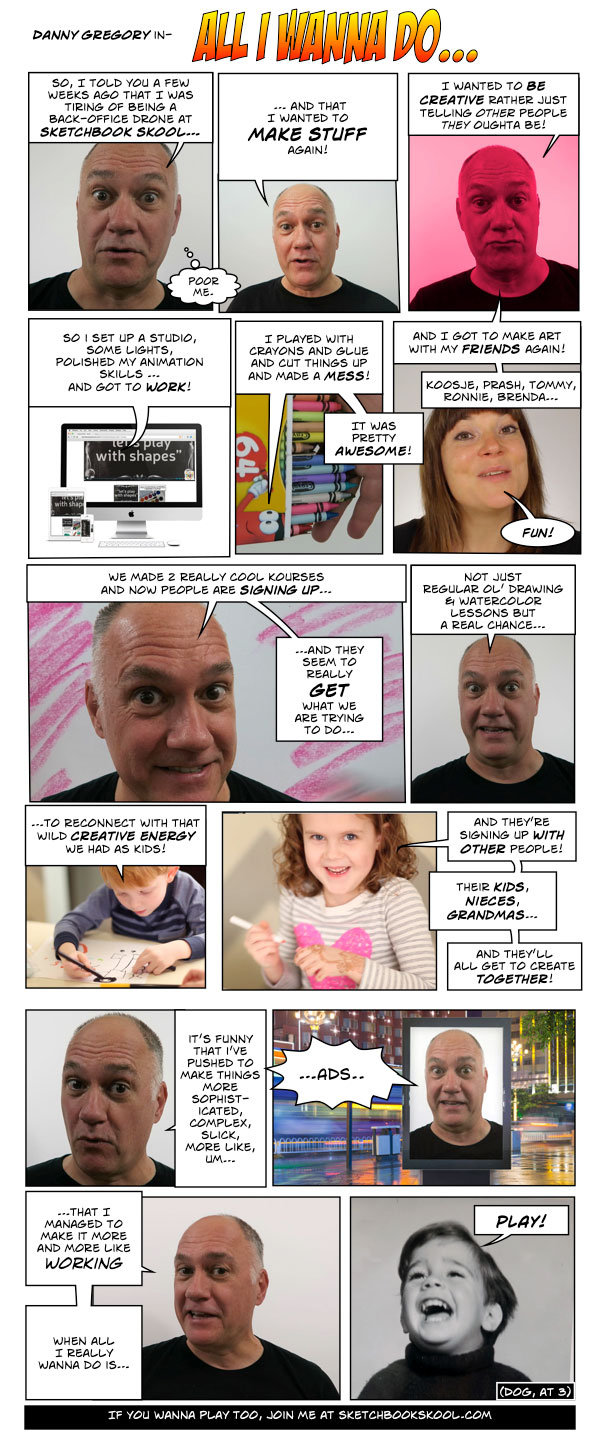
A couple of months ago, I started working on some projects using these childhood materials I’d rediscovered. I made some videos for an imaginary kid, someone six or eight or ten, to show him or her some cool things we could make together. I turned my thumbs into rubber-stamps, I melted crayons, I made masks out of grocery bags, I made stop-motion animations — and I had a lot of fun.

These videos were the foundation of a new set of lessons that I plan to take with me to Switzerland and Dubai these fall, to work with kids and show them some new ways to play. But they are also a new kourse we created for Sketchbook Skool because playing is something that’s not just for kids, it’s for the kids in all of us. I’ve seen time and again that when grow-ups are given permission to mess around with cheap art supplies, they reconnect with their original creative impulse, that impulse that fuels even the most sophisticated art and professional creative projects. Without that wild child, art becomes business, stiff and academic and overthought, and driven by fear and judgment. But unleashed it can produce anything.

I also liked the idea of creative projects that kids and grownups could take together and inspire each other. And that kids, out of school for the summer, could do on their own to keep their creative flames a flickering.

The monkey fought me a lot as I put these lessons together. What if adults resented being treated like children, felt patronized? What if I looked foolish? Unprofessional? Lost my ‘authority’?

Aw, screw it. I had fun and I think anyone watching the lessons will find some fun in them too — or might want to ask themselves why not. They gave me the same sort of comfort I find in childish things and my drawings and writing have been a lot looser since I started, more open to experimentation, less filled with consequence. I can’t wait to work with schoolkids again this fall. And to see what you make of our new kourses, Playing and More Playing at Sketchbook Skool. Here’s a little preview of the kourse if you’re interested:

Me, Myself and ________.

The forms of art I work at are solitary. Writing, drawing — I start with blankness and have to look inside myself to fill it up.

So many other artists have collaborators.  Choreographers who work with dancers. Pianists who work with Mozart. Directors who work with screenwriters and cinematographers and editors. They have sand in their oysters, something to push off. I start only with me.

But I wouldn’t trade with them. I never have to compromise, dilute, or share. My hands stay on the reins and I pick the path, lonely and rocky though it may be. I own the blame and the glory.

What I make is mine. And that’s fine.

Write on.

The old cliché of the teenager spending hours talking on the phone has been replaced with a new cliché: The teenager spending hours talking with her thumbs.

The positive aspect of this development: we all write a lot more than we used to, typing endless texts and emails to communicate on virtually every subject. We write a lot but not necessarily well. We have to rely on ALL CAPS and exclamation marks and acronyms (LOL! OMG!) and emoticons 🙂 to overcome the deficiencies in our vocabularies.

All this writing is really typing. The keyboard has replaced the pen and apparently for good. Virtually every one of the United States has recently changed the core curriculum for their schools eliminating a cursive learning requirement. They’ve replaced it with a mandate for keyboard proficiency.

Now, malcontents have been bemoaning the decline of handwriting since the invention of the typewriter 150 years ago. Most offer iffy arguments — Doctors with bad handwriting kill patients with illegible prescriptions. F’real? Others say we are losing the ability to read crucial old documents, that kids who can’t write cursive can’t decipher it either and they’ll never be able to read the Bill of Rights, Democracy will wither, and we’ll all go to heck in an illegible handbasket. Whatevs.

I have always had messy writing and I’m also a fairly poor typist, so I can go either way on this (nonexistent) debate. But I have thought of a more compelling reason for the young ‘uns to brush up on their penmanship.

Zombies.

Most of the entertainment loved by tweens and teens these days is dystopian. The Hunger Games, Divergent, The Maze Runner, and endless variations on how tsunamis, asteroids, aliens, bird flu, Benedict Cumberbatch and/or werewolves will soon take over the world. When this happens (and it could be any day now), down goes the electrical grid and the Internet — and with them the power of the keyboard.

A whole generation of people who don’t know how to use ham radios or morse code will also not be able to legibly write signs warning that there are seriously zillions of zombies coming down this road or not to drink the brown water or kiss a chicken or leave home without a hatchet. People will stand around trying to work out what the signs mean and meanwhile, vampires will emerge for the caves or zombies will come out of the trailer park … and the writing will be on the wall.

It’s high time The Calligraphers Lobby® and The Penmens’ Guild™ started infiltrating Hollywood and embedding scenes in movies in which brave young men and women write gorgeous Palmer Method graffiti that save their pals from the monster invasion. Neatly lettered, perfectly grammatical signs could well be the salvation of humankind.

Think about it. Maybe write your Representative a letter.

(I had some other important ideas on this subject but unfortunately I wrote them down on an envelope and now can’t read a word of it. 😦 )

P.S. PL: Happy 616!!

The Stare Master.

What were the very first things you ever learned? Unless you are Mozart, they were probably things like walking, talking, using a spoon and a sippy cup. You learned these skills from someone who knew how to do them well, like your mum or your older brother. And you learned them by watching, watching intently. Check out how a baby or a toddler watches — it’s like a lion on the veld or my dachshunds as we unpack groceries. Unblinking, rigid with attention.

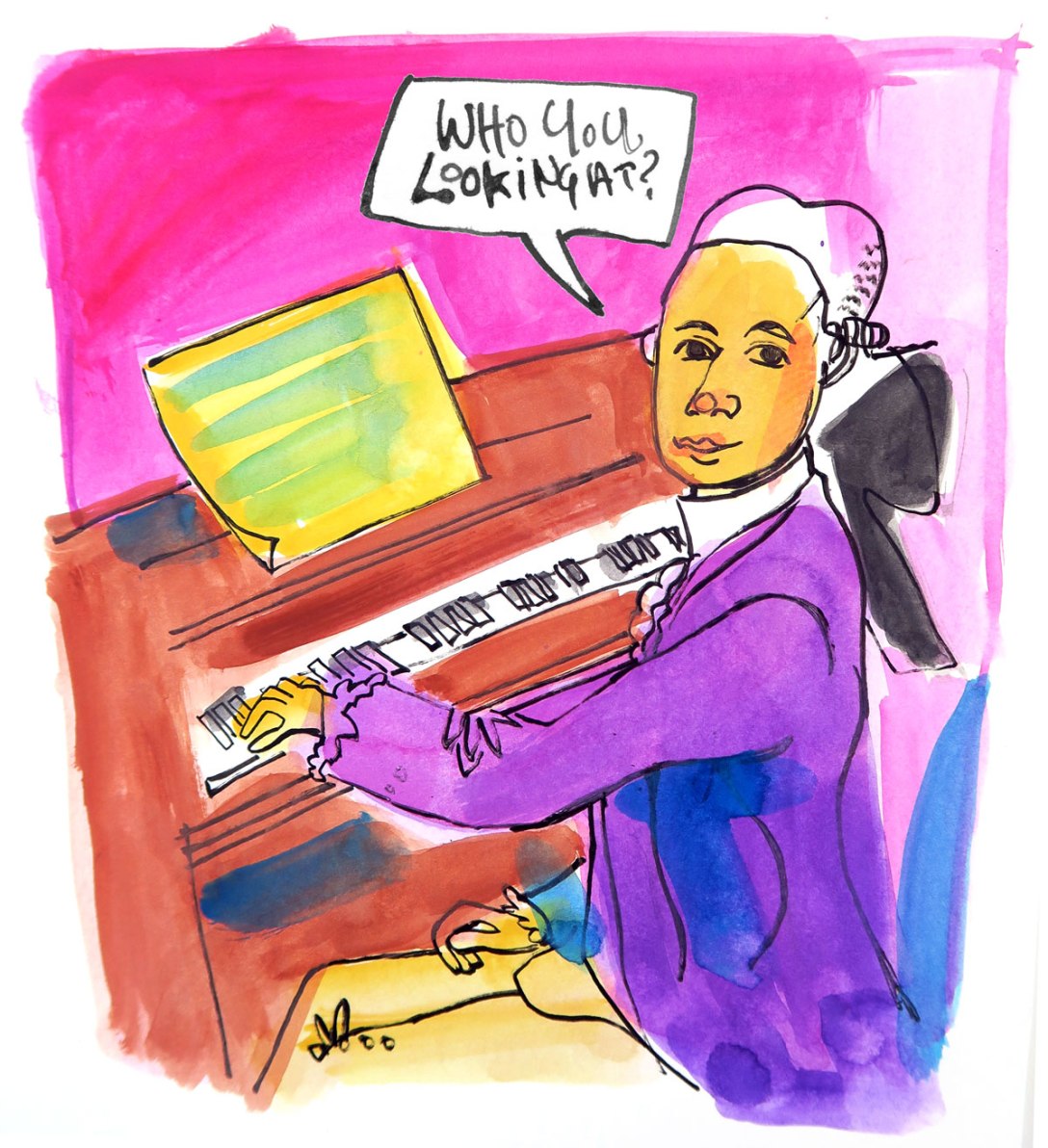
Oh, and speaking of Mozart, how do you think he became a prodigy at three? He watched his older sister take harpsichord lessons and he watched his father play the violin. It’s no coincidence that so many prodigies, from Michael Jackson to Wayne Gretzky, were the youngest kids in large families. Lots of people to stare at and learn from.

When you learn this way, you create a vision of yourself performing the skill, a mental video you play over and over. As the scene loops, it is burned into your brain, creating new neural pathways and locking in the nuances of the skill. You notice not only the steps the experts take but the intensity and rhythms with which they perform the action, the way that all the component parts of actions come together into one cohesive and coordinated whole. In time, these observations lead to fluid and confident motions.

Learning a physical skill is a very complex process, most of it nonverbal. You are programming your head and body to dance together in a thousand little ways. You must keep refining those dance steps, polishing them until there are no hitches or hesitations, until they run like greased, teflon-dipped clockwork. That’s how you learn to walk, to dribble a soccer ball, to drive a car, to play the guitar, and to draw. You program neurons.

If you want to improve your golf swing, watch Ben Hogan on YouTube. If you want to improve your jump shot, watch LeBron during this week’s NBA finals. If you want to improve your drawing, watch any of my Sketchbook Films or the demo videos on Sketchbook Skool. Watch them again and again. And don’t watch passively, like you were dozing off in front of a Seinfeld rerun. Sit forward, engage, focus, mimic, stare. Let your body respond as you watch. Feel your muscles tense, your fingers twitch. Throw yourself into it and absorb the rhythms, the linkages, the unspoken logic behind the scenes.

Your meat computer takes longer to train than silicon chips, but it lasts longer too. Once you have forged these connections, they will last a lifetime. Neglected, they may get rusty and overgrown, but, with a little practice, you can prune them and get them up and running again, like a long forgotten stretch of railroad track. You never fully forget how to ride a bike. And the same holds true for the network you’ve built between your brain, eyes, and hands so your pen will make lovely marks in your sketchbook.

Stare, engage, mimic. And repeat.