Here are some pages from the tiny journal I kept recently in Amsterdam. (Click on any thumbnail to open the gallery)


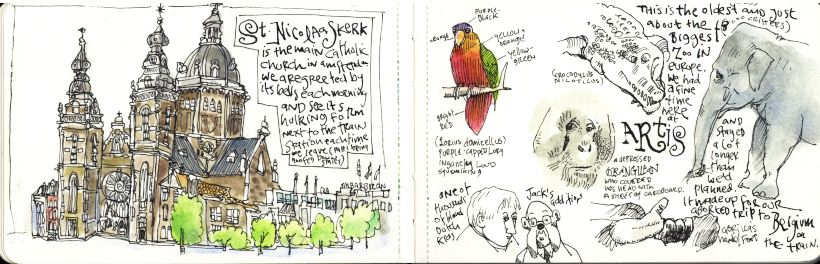

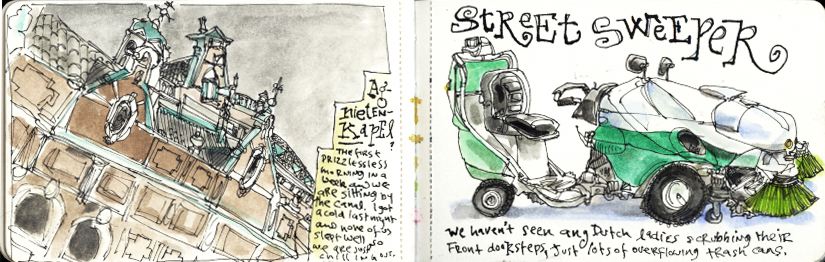

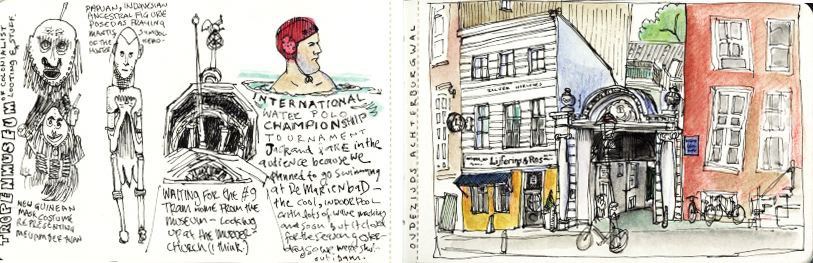
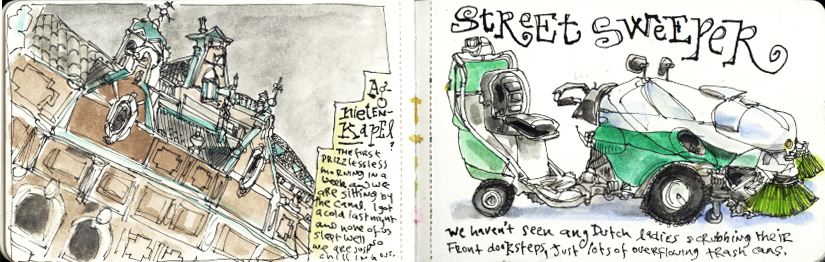


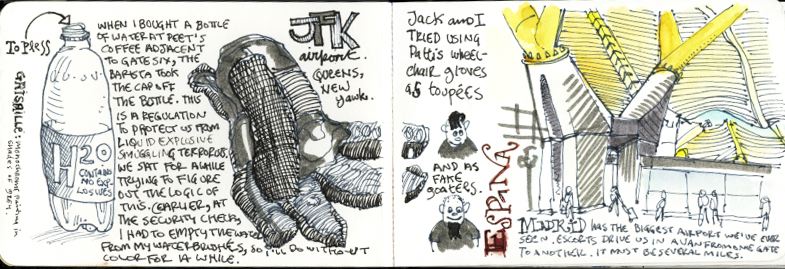

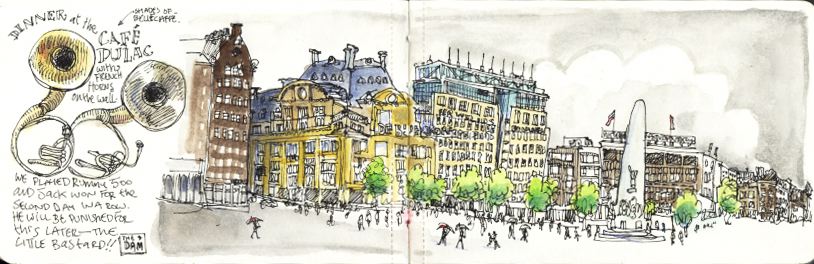


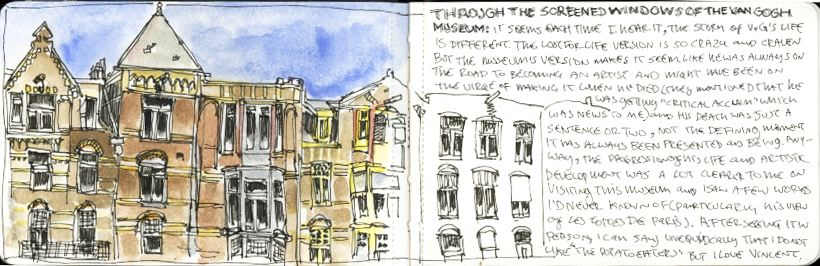








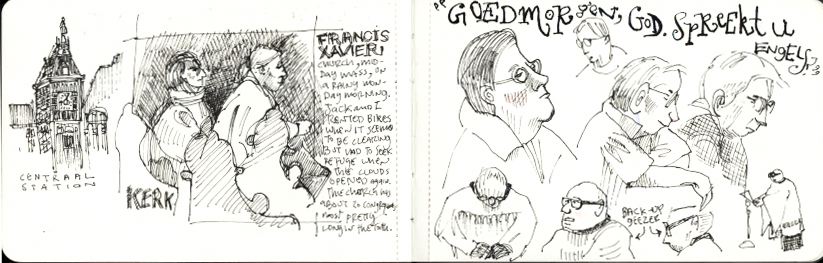
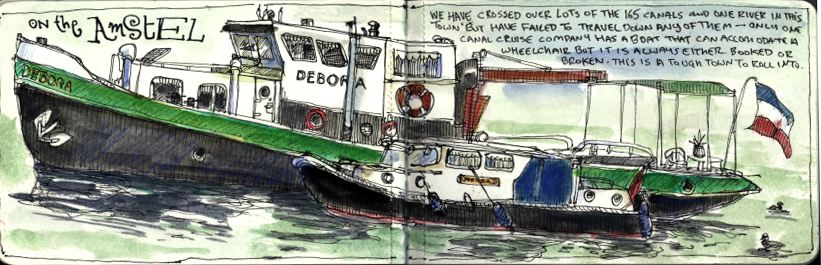


Here are some pages from the tiny journal I kept recently in Amsterdam. (Click on any thumbnail to open the gallery)

Yesterday, Jack and I overcame our usual aversion to art classes and joined Patti on 6th Street and Avenue B at a comic drawing class. The teachers were graduates of a comic drawing college in NJ, though one of them has left the biz and become an illustrator. They handed out a thick package of material Xeroxed from some great anatomy and comic drawing books, then gave us a few assignments, one to make up a character and draw a spec sheet of the character from all angles and write a description, of the character and his powers. This seemed dull to me so I decided to tackle a comic right off.

I haven’t really tried to draw a full up comic since I was a kid, and since I generally don’t draw from my imagination, it was a bit of a struggle, I just started drawing panels describing what was going on in the class, and, because I couldn’t be bothered to write real dialogue, I just filled bubbles with chicken scratching.

Patti, who’d initiated the thing, ended up having to leave early so Jack and I drew on.

He invented a bunch of weirdo characters, including a hilarious slug-like bunny.

Then we were asked to draw a 2 page comic about two characters finding a box.

Jack was cursing and crumpling up paper, damning his own drawing abilities, which was pretty unlike him.

I got very into the minutiae of the character’s morning ablutions and only got around to the box in the last few panels. There were several layout and composition problems I couldn’t crack. Fortunately, Jack is a genius and helped me out.

I quite like drawing the comic though it was far from my normal drawing experience, I like pushing myself to draw from my head and should probably do a lot more of it.
My father has been drawing self portraits every day for ages. He just sent me a day’s output, drawn looking down into a mirror lying flat on the table.

In the accompanying note, he says:
“Doing things in pen is very nerve wracking as if you get one line wrong the whole thing is ruined. This makes you concentrate so you tend to get a picture that is more accurate than otherwise. I n each case I started with the left eye which is the only one I can see out of (the other has been blind all my life), I did the last two in the afternoon, I had to wear my glasses (as you can see in the pics) because after lunch I am unable to see without them, (except all blurry).”

It is sad that I didn’t know about my father’s blindness until this letter. He sends these sorts of little packages to me every year or so. They are more or less the only contact I have with him any more. My parents were divorced when I was about three so I don’t know a lot about him.

His drawings are so similar. He has really developed his ability to draw himself down to an almost mechanical science.

He is pretty unflinching in his scrutiny too.

I decided to try my hand at the same experiment. It is a very unflattering, through-the-nose-hairs sort of perspective on oneself. The last time I saw my father, about three years ago for a couple of hours in London, we were walking down the street and he said to me, “Is that your stomach?” As a result, I made my head very thin in this first drawing.

More accurate, less paranoid view of self.

Third go: scary, pig-snoutish.

I tried a version with my glasses and could barely see my reflection through them. The resulting drawing looks a lot like Ozzie Osbourne’s loutish son, Jack.
 My second book, a memoir about my wife’s accident and how I learned to draw. Now available in paperback from Hyperion. Learn more about this book
When I was a teenager, I decided that I would look more mature and intelligent if I had glasses. So I told my mother that I was having headaches and wanted to get my vision checked. When the optician had me in his infernal machine and began twiddling knobs and swapping lenses, I slightly blurred and crossed my eyes. When his tests were completed, he told me that I had a slight astigmatism and should be fitted with reading glasses. I cheered quietly to myself and picked out a pair of tortoiseshell frames.
I could see fine through the new glasses but, after a while, ironically, they started to give me a headache. My mother began to badger me to wear them and so, eventually, I trod on them, they shattered, and they were never replaced.
I have always had very good eyesight. I can read a street sign from a block and a half away, that sort of thing. Most of the things that are important to me are experienced through my eyeballs: reading, drawing, watching movies, making commercials, etc.
My drawing pal, Tom Kane, is a couple of years older than me but when we go to out to dinner, he squints hard at the menu. Occasionally he remembers to bring his reading glasses along and stops just ordering the daily special. He says that his new far-sightedness doesn’t impact his drawing at all.
Patti wears glasses to watch movies or TV and is very shortsighted. So is virtually everyone in her family. My mother wears glasses, always has. She’s far sighted. I was surprised that last time I saw my father, he pulled out some reading glasses too. I had always counted on his genes.
I love to read just before bed; it help transition me to sleep. Over the last couple of months though, I’ve had to strain a little harder than normal to read. The letters are a little soft and, if I’ve had a really long day, I have to blink and rub my eyes to get decent focus. Most days, I spend a lot of hours in front of the computer screen in my office and recently have started to feel myself getting a little headache-y by mid afternoon.
Last week, I tried a colleague’s drugstore reading glasses and, pow!, everything was big and clear and bright and lovely. Damn, I guess I need reading glasses — for real this time. (Of course, my hypochondria lead me to assume that I was actually on a rapid descent into blindness and that my livelihood, hobbies, and chief pleasures would all soon be taken from me.)
I did some google research and discovered that it’s basically inevitable that, after forty, one’s lenses will start to harden and some sort of correction is inevitable. It’s called presbyopia.
Patti tells me I look sexy in glasses but I hate the idea. To go with my spreading middle and vanishing hair, I now have another pair of horn rims. I am not one of those people who obsesses about getting old, but, if I last as long as my grandfather (95 and counting), I assume I will have to come to better grip with my apparent mortality.
Of course, the day after I got the glasses, my vision improved and I stopped using them. But when the day’s been long and I’m tired, they help me more than I am happy to admit.

 To learn just about any task, we start by breaking it into its smallest component parts. That’s how a computer works, breaking every operation into millions of unambiguous instructions which are then executed sequentially at the speed of light. Cooking a complex French dish becomes possible, even easy, if you have a clear recipe which breaks the preparation down into a long series of clear parts. Even playing a Beethoven symphony is technically a matter of reading the notes from overture to finale.
Drawing works the same way.
Most anything you’d want to draw is made up of straight lines and curves. You can almost certainly draw a short, reasonably straight line. And with a little care you can probably draw an arc or a fairly round circle. Improving your ability to do either of these things is primarily a function of how slowly you you do them. And practice will make you better.
But you’re probably no more interested in drawing lines and arcs than you are in learning to boil water or to play a single note on the piano. It’s assembling the individual components that makes the idea of drawing satisfying and challenging. But that’s all it is, a challenge, not an impossibility, no matter who you are.
Drawing is about observation, about dismantling whatever you are looking at into the lines and curves that make it up. So let’s start with somethings simple, say a pencil or a coffee mug. Examine it for a minute or two. Let your eye follow the outer edges of the object and really think about what you are seeing. Ask yourself questions. How long is a particular stretch of edge? What happens when it encounters another edge? What sort of angle do lines make when they meet? Are the lines on one side parallel to those on the other? Keep scrutinizing and studying, like a detective grilling the subject so you can get at the truth. The truth is right in front of you and yet it is elusive. Why? You are not used to seeing clearly because you are bogged down with preconceptions. You want to overcome those preconceptions about what a pencil looks like by forgetting that it is a pencil. Instead you want to see it just as as line and curves and angles.
If you are having trouble, stop looking at the object from two perspectives at once, with your right eye and your left. Close one eye and now you will be committed to a single perspective. Just as your pen does on paper, you will now be dealing only with a 2-D world. Drawing that pencil is just a matter or recording your observations on paper, copying the length of one line, then adding on the curve, noting down an angle. Try it. Run your eye down the edge, then run your pen down the paper. Slowly, slowly. Then connect the next edge, checking your angle. The slower you go, the more you’ll know. Work your way around the whole object, checking parallel lines, seeing where things meet up. It’s just like measuring a window for drapes or flour for cookies. Slowly, slowly. Measure twice, cut once, as the carpenters say.
If you screwed up somewhere, just correct yourself. Don’t erase or freak out, just redraw the lines, training your brain, your eye, your hand.
Take a break, pat yourself on the back.
Soon, do it again. And again. Then when you’re ready, add another object and draw them together, thinking about the relationship between the two. Lay your pencil near your mug. Look at the shapes that are defined by their edges. Think about the negative space they form (that’s the chunk of table that lies between them). Get into the habit of looking for negative space. Look at a tree’s branches. The sky you see between the branches is negative space. So is the carpet or wall you see between chair legs. Observe it. Draw it.
Devote half an hour a day to this sort of observation and recording and, within a week, you will begin to amaze yourself.
The next step is just to add more complexity. Find more complicated objects or scenes to draw. Set up a still life of common objects. get intricate. Draw the seeds on top of a bagel or the hairs on your dog’s face. Sure there are a lot of them but tackle them one by one. Draw a detail then move over to the next one and record it. Keep going and then step back and see the forest after drawing the trees (A word of caution: challenge yourself but don’t raise the bar so high that you start to feel like a failure).
Once you are rolling, make drawing an everyday thing. Record the world around you. Draw your breakfast, your cat, your spouse’s shoes, your child’s toys. Join our Yahoo! group and try out some of Karen Winter’s challenges.
Your inner critic may well balk at all this. First off, how could it be that easy? Well, it is. Now that you know the elements (careful observation, recording lines, angles and curves) and are willing to practice them for a little while, you will soon be able to draw anything on earth. Sure, it will take more time to make and record accurate observations quickly but it’s not beyond reach. I’m not a bird describing to you how to fly; you have all the necessary equipment and abilities already. You simply need to focus, slow down, and persevere. The biggest step is shedding the preconception that you can’t do it.
Second objection: is it art? I have no idea. At first, it will be hard to put a lot of style or expression in your drawing but, trust me, every line you draw, right from the get go, is pureyou. Soon you will have enough control to lead your work in any direction you choose. Think of this as a golf lesson. I am teaching you to hit the ball. It’s up to you to keep working and lower your score. You probably won’t wind up being Tiger Woods … but so what? You’ll still have loads of fun.
Want to know more? Read a good book.
 I think, therefore I am. And yet to truly be, I have to control, even stifle that part of me that thinks and thinks and thinks. It’s important, particularly when life gets overwhelming, to take time to just be in the moment.
I’ve never been able to shut down through a program of meditation; the voices of boredom soon intrude on my tranquility. But when I’m drawing, that yammering voice of worry and criticism starts to disengage from my mind and then float away. Time slows, then stops. After twenty minutes or so, I come back to reality — refreshed, clear, my buttocks still asleep.
But I’ve found other ways to slow down.
 I walk to work most days, covering the two and a half miles in thirty five minutes. I generally wind through Greenwich Village, then up through the meat packing district and along the river. I don’t encounter much traffic and the landscape is varied and interesting: 19th century brownstones and warehouses, taxi garages, car washes, art galleries, empty lots, some gentrified conversions. For a year or so, I wore my headphones en route and listened to music, books on tape or NPR podcasts. But recently I began leaving my iPod at home and slowed my pace down a bit. Now I spend my traveling time just listening to the morning. I find the time to think through ideas, to make connections, to be.
 When I’m overly busy, my perspective gets so distorted. My loved ones become distractions. My pleasures become chores. I just want to get through things so I can work my way down the list.
 Our turtle Mo-hammed is a low-maintenance creature. We feed him in the morning and clean out his tank once a week. Under the wrong circumstances, I ask myself (or worse, Patti and Jack) why do we have this creature in our kitchen in his heavy fetid tank of water, making more work for poor, burdened me. But when I come to my senses*, I take pleasure in feeding him dozens of little tablets of food one at a time or watching him walk around the kitchen counter, exploring. His striped skin is so beautiful. His shell like a horn of thumbprints, symmetrical and yet funky and organic. Pick him up when he wants to keep going on and he’ll emit a little hiss, like a cat or a radiator.
 Walking with Joe through the park can be a perspective shift — if I let it. What’s it like to see the world from 12 inches, to note every previous dog’s markings, to yearn for every discarded chicken bone and bagel stub? I observe the politics of the dog run. A new dog enters and the pack’s pecking order needs to be re-calibrated. Every butt must be re-sniffed. Each dog must decide if he’ll submit or try to dominate the rest. The power struggles tend to be bloodless and quick. Dogs thrust their chests out or expose their genitals. Many encounter include a period of assessment, a brief standoff, during which each party stares and vibrates and finally chooses his place. Or, has it chosen for him. Studying and flowing with these basic interactions makes me feel at peace and in harmony. If only office politics were so clear and simple.
 Drawing with my boy, cuddling with my wife, weeding my garden, folding laundry, staring out the window, sunbathing with my hound, flossing, drinking tea… the day is full of opportunities to stop and be. I never regret the time spent being thoughtless. I need to think of more ways to do it.
____
*“Come to my senses.” I just instinctively typed in that phrase and yet it seems so exactly right. I spend a lot of time away from my senses, in a revery or an imagined depiction of the what the world is really like. Being in the here and now means brushing away the fabricated veil, dealing only with what actually is (or at least what my senses really seem to be experiencing, Neo).
 Like every twenty-first century critter, I am surrounded by exciting possibilities that latch onto the throat of my life and suck out my plasma. Every second is so jam-crammed with diversions: 500 channels, ten billion websites, a zillion blogs and podcasts and videocasts and magazines and art supply stores and people to chat with and email with and lunch with and … gak!
Life is American Idolized as our culture dangles the carrot of success and adoration at every street corner and browser window. Everyone is getting their 15 megabytes of fame. We keep inventing more and more entertainment and interactivity and yet my watch still only manages to tick off 24 hours each day and my calendar only offers seven days each week.
I am a child who’s lost in the candy-store so long he is exhausted from hyperglycemic sugar fits. My cheeks are stained by tears and smeared with corn syrup. My tongue aches, my taste buds refuse to respond. I am slumped in the corner after a glut of trying to podcast and videopod and become a ‘serious artist’ and promote my books and answer every piece of friendly email and delete all the spam and plan my next blog entry and I am lonely from breaking appointments with friends because I am dull and spent and just want to put my feet up and watchHouse.
But most of all, I am sick of what has happened to my drawing.
Between advertising and books and illustrations and design projects and blogging, I forgot what the hell I am doing.
I have lost touch with the most important thing to me, my life as I live it. Not my life as it is ornamented and sugar crusted but the plain old eat-some-cereal, smell-the-tuberose, watch-the-dog-sunbathe life that I actually lead. The life that isn’t destined for some other purpose or audience or analysis but just is. The authentic life that starts each day with an emptying bladder and wraps it up with a stretch of floss.
It’s not just me. It’s easy for anyone to get caught up with the enthusiasm for this drawing stuff to get overly involved in drawing prompts, in posting to a blog, to shopping for art supplies, taking classes, and planning sketchcrawls, and to forget the most important thing, the true purpose of it all. To draw what you live so you will live it more deeply.
I am going to go out and have that tattooed on me somewhere prominent. But first, let me do some research into tattooing, pick a type face, plan out a color palette, comparison-shop pain killers…


 Danny Gregory