TCL: Supplementary Material, III: Richard

As readers of this site probably know by now, Richard Bell is an extraordinary nature illustrator who, despite the many miles and water between us, is one of my very best pals and a major influence and teacher.
When I spent several days with Richard and Barbara in their Yorkshire cottage, I go them to haul out all of his sketchbooks and made a pile that was taller than Richard at six foot something (there’s a picture of the stack in The Creative License). He has books that go back to when he was a boy; one done when he was less than ten, had an epic book plotted out that seemed to encompass the history of the entire universe. We poured over books he kept in university when he was in a department of one, the only person studying both nature and drawing. A compulsive sketcher, he has his whole life documented; we even found drawings he did at a party decades ago and we recognized that one of the guests was Barbara, a drawing done before they’d ever even spoken.
We talked about how he has made a living all these years. Barbara is a librarian and Richard has brought in his fair share entirely through drawing. His first books were published by others and he did illustrations for other writers, but ultimately he decided to take matters into his own hands and be his own press and now he has brought out many different kinds of books: a long line of field guides, tours of various parts of Yorkshire, and a lovely series of spontaneous little 32-page sketchbooks called the ‘sushi series’ for the freshness of the product. Most recently he created the enchanting Rough Patch. His work has changed in the past year or two, becoming more personal, less didactic, charting the course of his days and subjective impressions about life and nature and feeling less obliged to be all scientifically accurate. He has always seen his work, including his online journal, not as an exhibition of his art but as a way to share his scientific observations about the nature of his environment. It’s a personal diary but he still sees it as data.
Richard’s self-sufficiency is very inspiring to me; I can’t imagine any thing more perfect than wandering around observing, drawing, a painting and then printing your work and offering it to a growing public. Being so entrepreneurial is a constant evolution for Richard and he is always thinking of new and different ways to produce and market his work.
We talked about all this and more while I let the tape recorder run.
Image

RICHARD: “I’m probably one of these Victorian naturalists that kept visual diaries. I always say I’m not an artist. I’m a nature illustrator. A friend of mine always said that we illustrators are failed writers, not fine artists. Even after I went to art college, I thought I should get a degree in zoology or ecology to improve my illustrations. I got an A on my Geology A level and then I taught it for a while. It goes back to my interest in dinosaurs, a study of time; it runs through my work back to when I was seven.
It was part of my upbringing that you didn’t just do things because you wanted to, it had to have some aspect of improving one, some utility. My mum was a school teacher and she always had us doing interesting crafts and thing and she encouraged that, but my dad said you should study English and mathematics and then when you get to college you can do you art. There was never any sense of ‘go and have fun, enjoy it’. I can’t really do the whole idea of art as improvisation, free. It always ends up trying to demonstrate, explain, teach something.
There’s a tension in me between what I should drawn and what I want to draw.
I can’t walk into a landscape without thinking of it through time. I can’t just be a camera, I bring along my knowledge of the history, the formation of the land. I like faces that have responded naturally to what’s happened to them. It’s hard to draw good-looking children. You can look at a face and see the history of its people, of the effect of the landscape, of the impact of time.
I see a 200 million year old magnesium limestone from an extinct sea that once stretched from here to Poland and is now fashioned into this column on this cathedral and I think about who carved it and how he was a local craftsman who could just walk down the road and see it and then what’s happening to it because of the environment’s eroding effects and the symbolism of vines and serpents and how medieval vineyards probably grew right outside the cathedral, it’s all in there in the back of my mind, layer upon layer. But it seems too self conscious and new-age-y to write all that down so I just hope that it all gets into the drawings and then I just give it a simple caption, like: “Column, 13 century”.
Image

I’ve always thought that if one wanted to, it wouldn’t be a clever trick to go out and make a lot of money. So the question is, if I’ve been so hard up, why didn’t I take off a few months, go out and do that? Work at any old job, not art related, and just bring home the money? The closest I could do was to paint some plates.
Souvenir China plates can pay you 500 pounds. And really people are after cute dogs, so I went out to and painted some beagle in among some potted plants, one knocks them over, naughty puppies. But then I realize I can’t do cute, it’s just not in me.
I’ve never thought of getting a job outside of art, the closest I did was giving lectures at schools and talk about art, and about writing books. It was very encouraging for kids and it brought in more than a day illustrating. And yet I would go in to school to talk about being an illustrator and yet I wasn’t doing it because I was giving this same talk over and again to schools. If I’d put in the time in I talked about writing children’s books, I could have written a book. I’ve set up at street fairs and drawn portraits for money. I got quite good at catching the likenesses.
As for getting a job in a shop or an office, I’ve never really considered it. I couldn’t do waitressing, I can never remember what drinks people have ordered.
To me drawing is like sitting in comfy chair, relaxed yet supported, secure. You’re alert and yet reassured, you know what you’re doing. It is so natural, like eating or breathing, something I’ve always done. It’s hard for me to understand people who are so resistant. It’s hard for me to teach anybody who doesn’t already have that spark.
Image
When I was about 7, maybe 9, I wrote instructions on how to keep a nature diary. It was a real alternative to schoolwork, which was so rigid in those days. It was more visually exciting, more like comic strips than compositions. It wasn’t fantasy. Even when I wrote fiction, it was just storyboarding films I’d seen. I saw movies like ‘The Long Ships’ about the Vikings and then I came home and drew storyboards of the film. I kept the framing from the film and just remade it. I can’t really remember ever concocting stories, perhaps that’s a blind spot in what I do.
When I look at my early sketchbooks, it’s as if I was waiting for the Internet. Instead of them sitting in a box in the attic, that information, my observations could be useful to people. There’s such a multiplicity of ways that journals can be done and the Internet had also shown me all these different ways of doing it.
I think doing paintings and drawings to be framed is the kiss of death; too self-conscious, too cute. I’ve come to realize that life is a series of little incidents and my diary was missing the observer, so I started to add a record of my own life. I’m getting more at expressing a mood and experience these days, less about just recording the appearance of a church or a street scene.
I’m also beginning to question my obligation to be a teacher. I don’t want to step out of who I am but I am aware of the path I’m treading.”

RATART


This post was inspired by Brenda.
Jack has been working on drawing rats for the last few days (he is studying the Bubonic plague in school) and we have been thinking a lot about them. He doesn’t want them to be cute so we have been thinking about what makes things cute. He doesn’t want them to be mistaken for mice so we have been thinking about the differences between mice and rats.
Here’s some new stuff we’ve learned:

Rats have longish, lozenge shaped heads. Their ears are small, like little cupped leaves, and are set back on their skulls. Their eyes should be drawn smallish and are best when smoldering with coal-like intensity as if lit by some inner demonic desire to spread the plague. They are sort of hunch-backed with wringing little claw-hands and long naked tails.
There are so many issues with rats and we have worked through many of them in the past few days.
My friend Dan used to always say that his son Shane was his favorite artist and he would send me drawings Shane had made of spaceships and laser guns and weird robots locked in conflict. For a while, I didn’t get it. My own kid was still a baby and I didn’t understand the power of watching a child make anything but filled diapers at the time. Then, when my own little artist-in-residence was able to use crayons, I started to experience that magic of this little person who you thought you made suddenly being able to make and see things that were so amazing. Perhaps the element of love makes Jack’s art all the more incredible to me but I think anyone would see that they are cool.
Watching him bent over his drawing book has often prompted me to draw as well, to loosen up my stroke, to experiment, to be as cavalier with my finished works as he is. Nonetheless, we have gathered every drawing and doodle he has done in to a bookshelf of binders, each labeled “The Art of Jack Tea Gregory“. We have filled many big fat volumes and he has filled another few dozen sketchbooks.

My Conversion

pl
Dear W_____:

First of all, thanks for your note and, secondly sorry, for the delay in my response. Your words were quite important and I wanted to give them some time to think of proper response.

I have looked for God for many years. When I was small, I had only the foggiest sense of what God was.

He seemed like a sort of arbitrary and indifferent creature who let lots of bad things happen to people who spent a lot of time worrying about how to please him. My father is of agnostic/Protestant stock while my mother and my two stepfathers were casual Jews who were vaguely interested in the historical aspects of tradition but were at heart unblievers too, to the extent that they thought about it. My grandparents were hounded and threatened by people in Germany, Poland, Italy, India, and Pakistan, all in the name of various beliefs.

At about your age, as part of my endless quest for identity, I read a lot of Karl Marx, most of the Bible, bits of Sartre, and then eventually gave up and drank more, smoked more, met more women, and went into advertising.

When my wife was run over by a subway train, I had a renewed need for meaning. While she rehabilitated and learned to live in a wheelchair, I met with the minister at the nearby Baptist Church. I went to the local synagogue. I sat in the back of the nearest Catholic church. I went down to the Buddhist temple in Chinatown. I conferred with Hare Krishnas in the East Village. I read books and books. At the core of it all, I was looking for faith, for some confirmation of God’s presence. I didn’t want an explanation for what had happened to Patti, I just wanted to feel connected.

I found nothing that I could call my own. Nothing that was real. I tried to convince myself but I couldn’t. I don’t dispute the beliefs of those who have them but I was unable to experience what so many seem to take for granted.

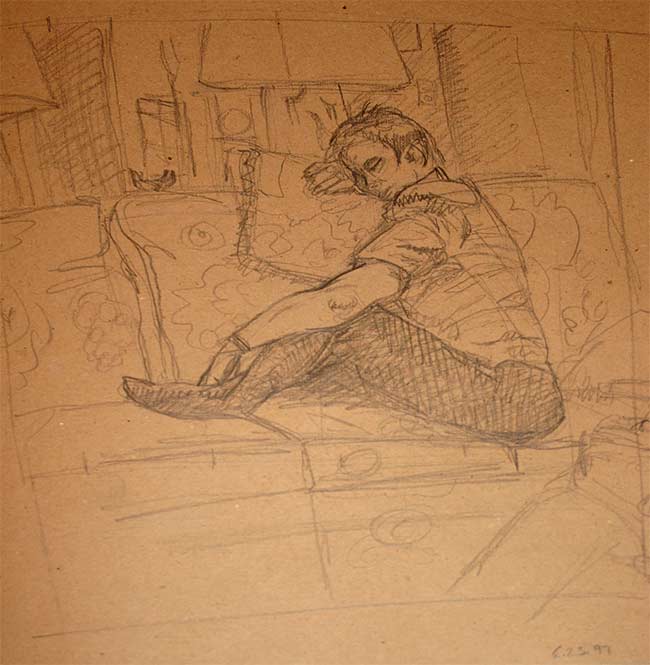
One day, I was moved to draw. I don’t know why, it just sort of happened. I drew some pictures from a magazine. I drew a vase of flowers. Then, very slowly, I drew Patti, resting on the couch. Something about that drawing was deeply moving to me. It wasn’t a ‘great’ drawing but it was mine.

I discovered that, as I drew, I felt peace. I felt connected to the things around me. I saw them deeply and somehow we became one. Was that what the Buddhists meant? Was that what Christ offered? I don’t know. I never found meaning in a church or temple. I found it in my living room.

Now I find that I want to draw. I can’t do it every day but I am drawn (as it were) to draw again and again. It doesn’t matter what I draw. It doesn’t matter whether the drawing is accurate or worth keeping and sharing. It’s nice when the drawing is ‘good’ but that’s not the point.

There were times I lapsed. Once, when my job was particularly ensnarling, I didn’t draw for three years. It wasn’t a great time and when I stopped working that way and started drawing again, I felt better.

Some of my religious friends will probably tell me that I am practicing drawing as a religion. That my drawing is a communion with God, a form of prayer. I don’t know or care. If God is that tricky and elusive, I can’t be bothered to call him by name. And I sure am not asking him for help or answers. I make my own drawings, just me and my pen.

What with my website and my books, I have found myself in this weird position of being an evangelizer for drawing. I’m not sure how it happened and I sometimes wonder if I am spending more time on the prosthelytizing than on the drawing and whether that’s a particularly good thing.

I like having people to draw with and I like sharing the things I notice about drawing when I am doing it. Drawing doesn’t harm anyone. It doesn’t pass a collection plate or condemn gay people or inspire people to blow up skyscrapers in my backyard or care one way or the other about abortion or try to effect my vote or meddle in school curricula or cast stones. But it does help me to see the beauty in people and things, to cherish what I have, to reach out to others, to favor creation over destruction, to find peace and feel more alive.

May it do the same for you.
Amen.
Your pal,
Danny

TCL: Supplementary Material, II: Walton

Walton Ford and I met when we were both sixteen and at the Rhode Island School of Design summer program. He was one of those rare creatures who was born with phenomenal talent. The drawings he did at four and five would put most adult artists to shame. We eventually lost touch and only crossed each others’ paths decades later by which time he had emerged as one of the top painters in the NY fine art scene. He makes enormous (sometime twenty feet long) watercolors of animals. Each is life sized and breathtakingly accurate. They are clearly influenced by early naturalist/illustrators like John James Audubon and Carl Bagner and yet he has added political allegories to his work that make them very contemporary.
Of all of the people I know, Walton is the most “successful” as an artist. He is represented by one of Chelsea’s finest galleries, does a couple of shows a year, and will probably be able to spend the rest of his life living comfortably from his art. Though they have six-figure prices, his paintings are enormously marketable and every show is sold out before the opening. Despite all this success and talent, Walton still struggles with the politics of the art world and is fiercely competitive with those contemporary artists who are just ever so slightly better know than he is. He also resents the fact that his craftsmanship was slighted and ignored in the days when figurative painting was not what the market sought. As I talked to him I realized that the art world is basically just another industry, a bunch of stores selling stuff; dealers create and maintain the market and the artists themselves, regardless of their ability and vision, primarily luck into popularity.
I hung out with Walton at his upstate New York studio and we ran a tape recorder while he prepared a huge sheet of watercolor paper for an upcoming painting, turning the pristine paper into a mottled, browning relic that looked like it had fallen out of an 18th century folio of engravings.

Image

Danny: So what role does journaling play in your work? I know you were very influenced by Audubon and by his work in the field. How does that sense of process and discovery go into your paintings?

Walton: I like to see Art as a tool. Audubon cut things out, pasting things together, scribbled notes to printer on it… The process of making was part of the work. The drawings weren’t the end result, the work was the final engravings so he allowed himself the freedom to be so cavalier with his work, not precious. I make my paintings look like they have that attitude, that feeling of unfinished ness, like it was done in the field. The writing focuses it, explains it.
I make 10-foot watercolors of tigers in which the stripes tell allegorical stories about Vietnam. Paintings so large they are experiential, like a diorama, filling your peripheral vision. I make them life size because, well, when you see a beaver, you think of it like the size of a woodchuck with a weird tail, then you see what it’s really like, it’s awesome, it’s totally startling, the size of a 50 gallon drum, it’s freaky and I like to that in my work, the fun of finding an animal that large and more grotesque than in your mind’s eye. When its life sized, when it’s extinct, it’s shocking. Flocks of millions of passenger pigeons that have never been painted before. It’s like a time machine too. To see things for real that can’t be seen anymore.

Danny: So what’s your attitude towards the fine art world? You have always made figurative paintings even when they were hardly in vogue. Isn’t it a little surprising that despite the accessibility of your work you have had such success?

Walton: I got a lot of very positive feedback on how I could draw and how I could see when I was young. I was a very precocious talent. My daughter, who’s a talented violinist won’t practice on that frantic, 18 hour a day level. It’s different in art than in music or sport. Art is a lot more forgiving you can be really good without working quite as hard. And there’s not that competitive thing battling for a small number of slots. But the drop out rate, the number of people who can’t handle, can’t go to the studio every day, is enormous. I was incredibly persistent and didn’t take no, I wasn’t terribly interested in being trendy. For many years it was not cool to do what I was doing. I had to not be discouraged by the fact that I was doing something that at the moment might not be hip. Now there’s a trend toward representational art, but so much of it strikes me as incredibly lazy and lacking in thought or depth. It’s just about irony and it’s hard to compare with the great portrait painters of the past, to Sergeant, for example. I feel like I don’t want to waste your time if you’re going to bother paying attention to what I’ve done, I want to at least have put in as much thought in doing it as the person looking at it. I didn’t want to stop even if others who I didn’t think were as capable were getting more success. And still something encouraging happened very year making it worth while if I looked as a long term thing.

I still have this feeling that I don’t quite belong. Those who get success much younger have a sense of entitlement I haven’t got. I have to try to develop that attitude and stop cringing, “Thank you for the attention.” My work is so accessible that for ages people made me think was stupid. I think it’s more important to make something that’s great art and is also popular, not just for other art professionals. It’s just a feeling that driven into you as soon as you come to New York, that being a populist isn’t interesting, creating narrative is stupid. Look at Goya, Daumier, Doré,etc.

People are very suspicious of craftsmanship. But Mathew Barney and John Curren are craftsman that are considered successful, intelligent artists so it’s good for me, that benefits all artists who care about carefully making beautiful pictures. There’s no meaningful distinction between art and craft. Once you’ve sussed out what the idea for a picture will be, it’s all craft, it’s all about making your picture. You need technique.

Danny: Is it terribly hard to be a fine artist? To make it in that world?

Walton: The hardest part of being an artist is not getting noticed. I worked very, very hard on a show about ten years ago and I thought it was a very good show. It went up came down and no one wrote about it, no one bought anything, and I felt like I had done all this work for no reason. Being able to get over that was very hard but kept me around for when people started to admire my work. You want people to admire what you do. I don’t care if it’s vanity or greed or what the motivation was when I looked at a work of art. The work redeems it.

Danny: Yeah, but practically…how did you survive until you made it?

Walton: I was able to survive for years as an artist, living on grants and selling a few paintings and then my big show was a flop and I had to go to work for the first time for years, doing restoration carpentry, wood refinishing, and some illustrations work, book covers and things. Making museum exhibits, building scale models of ships. It wasn’t what I wanted to be doing but it made ends meet.
I resigned myself to the idea that it wasn’t going to go as well as it ended up going. I always had some people who liked my work but it’s delusions of grandeur for an artist like me to think that there were people who didn’t like my work. It was more that nobody knew it, like a restaurant with no customers. Perfectly nice pizza pie but no one comes in. That humility helped me get by.

Danny: Is it important to be an artist?

Walton: At the end of the day, the only thing that human beings have to feel proud about is what sort of art did that culture leave behind, what sort of music, food, creativity, writing, the objects they made. That’s the value and legacy that will endure.

In traditional societies, the making of things was tied to the survival of the group. They didn’t worry about justifying their motivations. They all knew they were doing it for the interest of the group. The rugs on the floor, the paintings on the wall.

Danny: So what’s changed? It sure doesn’t feel that way today.

Walton: People nowadays are made to feel self conscious about drawings, about singing, about being different. And professionals are to blame for mystifying the role of the artist to the point that people feel stupid if they don’t understand things. And there is no attempt to educate people as to why the things that they may not understand right away are worth understanding. And then there’s this tortured pathetic version of an artist. Ed Harris showing Jackson Pollock as an inarticulate bastard, Kurt Cobain blows his brains out.
All this stuff adds up and people don’t want to be involved in this kind of thinking or being or making stuff. They’re interested instead in Hollywood people who aren’t that interesting but who corporations make money out of.

Danny:So is it worth it? Would your recommend that people try to make a living as an artist?

Walton:The advantage I have over people who don’t do this for a living is that I get to do it to think about it all day, every day. I get to wake up each day and just think about making some thing cool.

Danny: That does sound cool.

Image

You can see some example of Walton’s paintings and video clips of an interview from PBS here.

My recent post to the EDM group

Art making is not a competitive sport. Being intimidated by what others do, by the clarity of their vision, the steadiness of their line, means thwarting the very thing that will get you to where you want to be. If you don’t draw because others, who have done it longer and more often, do it ‘better’ you are robbing yourself.

Give yourself analogies. Should you stop jogging because some people finish marathons in a a couple of hours? Should you stop cooking your family dinner because you love the food great chefs prepare in four star restaurants? Should you stop writing emails because of Shakespeare’s poetry? Should you stop contributing to your favorite charity because of Mother Teresa’s example?
There are always going to be people who are doing work you admire. Celebrate them. Buy reproductions of their work (or better yet, originals) . Study what they do, how they learned. Study their teachers and heroes to to learn where they came from. Absorb as much as you can. Then lay your influences aside, take a deep breath and plunge in. Get in touch with yourself, the unique you, the only one of your kind. Express that uniqueness. Do it again and again, getting ever closer to the truth.
If you must be self-critical, make it constructive and specific. How can you accomplish what you want? Are you clear on what that is? And bear in mind that by committing to your art, you are becoming a hero to some other novice. As you look at those ahead of you, be aware of those who are following your example.
And, most importantly, as you proceed down the path to your goals, enjoy the view. Never lose your sense of pleasure in each drawing you make, even if it’s not ‘good enough’. The pleasure is in the making.

Your pal,
Danny

TCL: Supplementary Material, I: Roz

Despite the hundreds of drawings and essays and exercises and blood and sweat and tears, many readers have said that they wish they could get more of The Creative License.

We’re not ready for a box set or a deluxe edition (The Da Vinci Code), it ain’t), but I am going to release some supplemental stuff that didn’t make it into the book.
When I started out, I planned to have a significant section that would include in-depth profiles of various people who were living various types of creative lives. I thought I’d explore various issues with them such as: what is it like to be a successful fine artist, or conversely what is it like to be fully committed to making art regardless of the financial impositions it takes, what is it like to become an an artist after living a different sort of life, and so on.
I traveled half way round the worldvisiting and interviewing people for this part of the book but in the end felt like this material was dragging the book in a different direction than I wanted to go. Instead of it being an intimate dialogue between me and you the reader, it became more of a spectator event.
Nonetheless, I learned a lot from my artists friends, and much of this accumulated wisdom found its way into the book in other forms.
Recently, I was rereading a lot of the interviews and photos I took on the trip and decided that they would probably be worth sharing. Over the next week or two, I’ll be presenting a series on our chats here on dannygregory.com. Stay tuned.

Image

Roz Stendahl is a designer and teacher and bookbinder and dog trainer in Minneapolis, Minnesota who has been a great inspiration to me and to many people on the EDM group. There are several of her journal pages in the book and they are beautiful and detailed. We talked about many things during my visit and I left with a bunch of tips and expanding ideas. Here’s some of what she said about drawing in public during the several days I was lucky to spend at her house.

Image

ROZ: I’m pretty used to writing and drawing in public and do it all the time. In fact some would say it is the only way I function. OK, let’s just say, I can’t help myself. My journal is pretty much attached permanently to my arm, until of course I need to start a new journal.

You get used to drawing in public and the advice I would give is borrowed from Nike, “Just Do It.” Over time you’ll be glad you did even if a particular session doesn’t go well. My philosophy is that if every fifth page of my visual journal isn’t a complete mess than I am not trying and the whole point of my journal for me is to capture my life, the way my brain functions, the things that I observe, the projects I want to do, the painting ideas, story ideas, whatever, that occur to me, and whatever happens to be right in front of me, and to practice, practice, practice.

It’s all practice. I can always use more practice. (I’ll be practicing until I die.) Those really bad drawings and messed up pages, I learn the most from them.

If you aren’t used to drawing in public you might want to hang out with people who are used to it. Being in a group sort of dilutes any curious attention paid individually to you. (People focus instead on the paranoid aspects of, “gee, they are all drawing, maybe I should be drawing,” and leave to get a sketchbook, or just leave.)

There is also the very funny thing that happens when you’re out with a group of friends sketching and someone comes up and asks what you’re doing and you all say something bland like, “just drawing.” The person asking questions is just convinced that there must be something you are all noticing that he needs to notice. He’ll repeat the question. It’s pretty funny.

We just don’t look in our culture (U.S.). I was at the San Diego Zoo a couple years ago and a woman, man, and two kids in tow came whipping by me at the bat display. I was standing there sketching and they pushed right in front of me, which is no big deal for me because, hey, I know I’ll be there long after they are gone.

Click, click, click, went the man with the camera, “Got them, let’s go,” he said. The kids hadn’t even up to the enclosure. I don’t think they ever did see the bats. I have a feeling the photos didn’t turn out.

I digress. Seriously, going out with a veteran public journaler (is that a word?) is great for another reason. I tend to be anti social and going out with those more gracious than I am has allowed me to painlessly learn ways to deflect the curious without generating any bad karma. I find that if you look intently at your drawing and drawing subject someone might come over and say something, but if you give monosyllabic responses in a polite tone and keep focusing on your drawing people leave you along. And it’s very easy, if you’re in the middle of THE DRAWING OF YOUR LIFE, to simply say, “thanks” to any compliment the observer might give, while you keep drawing.

Alternately you can begin to write down everything the interloper says. They tend to read over your shoulder and see that you are writing about them and bug out pretty quickly. I call that “found dialog,” some people (back me up here Bonnie from Minnesota) call this part of “Minnesota Nice,” and clinically I think it’s called “passive aggressive.” Whatever you want to call it, it’s effective. (I don’t think the karmic cost is high, but I’m not an expert on karma.)

My best journaling in public story: I had a class of nature journaling students (adults) at the Minnesota Zoo. They all spread out to work. I was standing alone drawing a small miniature deer from Southeast Asia, being available if any student had a question or problem (or started having a panic attack from trying to draw in public). A small child, a boy, about 7 or 8, squeezed in front of me, walking along the fence line. I kept drawing. He squeezed in again in the opposite direction.
I was holding my watercolor set and painting so I pretty much had my hands full, but the third time he went by he stopped right in front of me and paused and I thought, maybe I should step away, nah, too much stuff to move (my coat was at my feet with my back pack). So I kept drawing. His mom called him from stage right, and back he went again, past me. I caught him looking at me smiling, when our faces were even, because his passing coincided with my looking up at the subject. He had a wonderful smile.

I finished my drawing and bent down to pack up my painting kit. There was a small pile of M&Ms (plain not peanut, thank you very much!) on my back pack which he had placed there on his third fly-by as a gift to me.

New Year's Resolution


“You must be the change you wish to see in the world”.- Gandhi
New Year’s Day. It’s a good time for stock-taking, for self-appraisal. With each change one makes in oneself, one see more changes yet to be made. of PITT artists’ pens.
I am still trying to figure out how exactly this will work but I was thinking how cool it would be

Not to self-flagellate but in the spirit of creative expansion. To be alive is to grow and adapt and to spend one’s days awake and aware.
In 2005, I took on several new creative challenges.
We completed The Creative License, my largest design, illustration and writing project. We launched the new advertising campaign for Chase: a dozen or more commercials and a hundred or so ads. This website was relaunched, thanks to my friends Tricia and Jacob. I made a lot of new friends and connections through the Everyday Matters group and developed the social aspects of my art making. And I discovered Rome, deeply immersing myself in a city and its art I’d never known well before.
At home, Patti and I got to spend more and better time together, deepening our love as it enters its twentieth year. My relationship with Jack changed a lot this year too and I am prouder than ever of him as he took on the challenges of entering a new school and a new community.

I’m pretty happy with much of what happened this year. But I have a new and different plan for 2006.

While it has been really rewarding letting drawing and journaling transform my life, I feel a deeper and stronger need to do more. I don’t just want to sell books and checking accounts. I want to promote awareness. In the coming year, I want to see how to use art to make a difference for others. Not just to unleash their own creativity but to create a new awareness of the world and to forge a community that can make it a better place. I want to try to help people rediscover their love of drawing and then bring them together to help others. To raise awareness, to raise funds, to help make the world a more beautiful place. I began drawing because of a trauma. When Patti had her accident, drawing helped me to gain a fresh perspective, the strength and vision to persevere and also to improve. I have not done enough to spread that power to others. I think that drawing and journaling could help people with spinal cord injuries and other disabilities, with life threatening illnesses, with addiction and depression. I would like to talk to health care professionals to see how I can share what I have experienced. I know that a lot of people in the Everyday Matters community have used their art to cope with physical limitations, with mental and spiritual challenges, and I would like to find a way to share those experiences and use them to help mobilize something. I would also like to reach out to people who help others to learn — librarians and teachers — and see how we can encourage creativity, drawing and journaling among their students too, to help develop what could be a life long creative habit. I would also like to use communal drawing experiences like Sketchcrawls in a new way. As we raise awareness by drawing together, I would like to focus the community to help others. I think that group drawing can be a valuable fund raising tool to help people in need. Just as walkathons and marathons raise money through individual pledges, I think we can use drawing as a way to motivate people to give. For now, Patti and I have been calling it “Drawn Together” (though I think there’s a cartoon show by that name).

Here’s one thing we could all do together:

We are going to put together a drawing outing at the Rubin Museum of Art, the only museum devoted to Himalayan Art. On Friday evening, February 3rd, any one who wants to can join us and draw some of the amazing treasures there. We’ll get to socialize, share our journals and our love of drawing. But this time we will have a cause too.
As I’m sure you know, the people of Northern Pakistan and Kashmir, people of the Himalayan region, have been devastated by the recent earthquake and now with the onset of winter are in terrible peril. We can make a difference by raising money to buy them blankets. A dollar will buy a blanket that could provide much-needed comfort and protection. Five dollars will provide all a family needs to weather the bitter winter. Five bucks. The price of a couple if people could arrange sponsors who would pledge to give say, a dollar for each drawing their sponsored draw-er did on the sketchcrawl. Do ten drawings and ten people get blankets. I think I may also be able to get the museum to pledge our admission prices to the fund too.
At the end of the day, we will have a wonderful experience: we’ll see great art, we’ll make our own art, we’ll hang out with other like-minded people, and we’ll help folks in real need. Maybe it would be possible to set up a parallel effort in other cities. The LA County Museum of Art has a South Asian art collection. So does the Art Institute of Chicago. Or maybe people could just gather at an Indian restaurant and share lunch and draw. Or order in some curry and sit at home and draw from photos from a digital collection like this one.
I am not by nature a particularly generous or philanthropic person. I am just a New York ad guy, let’s face it. But somehow, after Katrina and Iraq and Pakistan and Karl Rove and all that has happened this past year, I am feeling this need to do something bigger than my little selfish life well up inside me. I expect that I won’t be particularly good at it at first and that my ego and my usual tendencies will muddy the waters, but it feels like a resolution I can stick with longer than a low carb diet or a gym regime or a pledge to stop biting my nails. We’ll see.
Stay tuned.

From my Father

keir1.jpg
My stepmother just sent me recent work from my dad in Leicestershire. It seems he has moved beyond self-portraits.

keir2.jpg
keir3.jpg

Dibujo en Mexico*

We are back after an all too brief trip to Mexico. It’s a country that I have always liked so much but never spent time in before. I would love to do a long cross country sketchcrawl sometime.

We stayed in Puerto Vallarta which is a touristy place with a huge Walmart and we spent a fair amount of our vacation sunbathing and reading trashy novels and eating from buffets and avoiding the horrors of New York in December and the transit strike.

I spent a grim evening at the bullfights watching four innocent creatures being tortured to death in front of several hundred tourists fresh off the big cruise ships., I went in the spirit of seeking out new adventures when possible but left feeling nauseated and vegetarian.

From a drawing perspective, this trip certainly didn’t have the immersive qualities of trips I’ve taken to Rome or Jerusalem or Paris. However I think that even a daytrip to Dayton is made richer by drawing and writing about one’s travels and so I thought I’d set down some things I’ve discovered about travel journaling:

I like to travel fairly light. I carry a smallish shoulder bag with my journal, pens, watercolors. I like NiJi waterbrushes because you can load them with water in the morning and they will carry you through the whole day without needing to carry water jars that could spill. I recommend some sort of folding stool. You can buy them light and inexpensively at camping stores and they let you set up where you want to without having to worry about being in the way or finding an empty bench.

Be prepared but not overly so. Make sure you have enough of your favorite pens but if you pass a local art supply store, always check it out. You may make some wonderful new discoveries. Don’t shlep more than would be comfortable. Improvise. I sometimes rub local soil and leaves onto my drawings for color. I’ve used pasta sauce as paint in Tuscany.

Don’t just draw postcards. It’s fine to sketch monuments and tourist spots but also try to capture local color and everyday life. Draw your meals, travel on public transportation, use art to immerse yourself in a different way of life.

Be bold. I’ve great characters in Roman catacombs, Death Valley bordellos, San Franciscan homeless shelters, and Yorkshire flea markets, all through drawing. Talk to people and don;t be embarrassed to show your work. Most people are impressed that you are even doing it and won’t judge your art as harshly as you do.

Let your art be your tour guide. Every minute you’re lying in your hotel bed could be spent drawing. The more pages you fill, the richer your memories will be. I still remember the sights and sounds of street corners from years ago just because I spent twenty minutes drawing somewhere. The memories are so much more intense than if I’d just been seeing the sights through a tour bus window.

Jot down notes as you draw, not just recording the where and when but conversations you overhear, thoughts and associations you make, smells and sounds specific to the place. Show how travel broadens your mind.
—–
*Translated by Google. Apologies if it’s garbled.

Danny's Not Got a Brand New Bag

bag.jpg
Thursday, 8:10 a.m. Getting ready to leave the house and start the frigid, two-and-a-half-mile walk to my office, I suddenly realize I don’t have the bag I use to tote my pens, paints, and my journal. I feel my heart actually move in my chest and my eyes tear up.

A shot of adrenaline sizzles up my neck. It’s not by my desk or next to the couch or hanging on the coat rack. I don’t even look ’cause I know where it is.

Flashback

Wednesday 7:30 p.m. The annual MorningNews.Org holiday party is being held at Thady Con’s Bar in Midtown. I strip off my coat, throw it on a pile on a bar stool and accept my first Dewars’ and water. I sling my bag on to the floor, next to the bar rail, and then retrieve it to pull out gifts: copies of my new book, The Creative License, for my editors, Rosecrans and Andrew. As the crowd converges around the pristine copies of my book and the Highland’s finest blended scotch courses down my gullet, my bag sinks back down into the dark on the floor.

Wednesday 9:30p.m. I yank my coat off the pile, wish everyone a good year, and, warmed by the conviviality of my colleagues and a reasonable amount of good cheer, sail out into the night and plunk myself in a cab. Obliviously bagless.

Flash forward

Thursday 9:30 a.m. A call to Rosecrans confirms my fears. The rest of the gang also left the bar last night without my bag.

9:32 a.m. I call Thady Con’s. The bar opens at 11 but a man with a thick accent picks up the phone. Unfortunately, he doesn’t seem to understand my question and asks me to call back at 10.

9:34 a.m I reminisce to myself about my bag and its contents. It’s made of olive canvas, with many pockets and a shoulder strap. Inside, there are about a dozen pens. Most of them are brown Faber-Castells, some Fs, some Ms, some Ss. There’s even a B. A few, though I’m not sure which, I bought last summer at a pen store near Mussolini’s former headquarters in Rome. There’s a small bottle of brown ink with a wax stopper that my pal, Kane, brought me from Venice. It’s in a snack sized Ziploc bag along with a pen holder and my favorite nib and a waterbrush filled with sepia Dr.Martin’s transparent watercolor.
In the inner pocket, there’s a mitten I found on the street a few weeks ago. It has a special flap that folds back to expose my fingers and then Velcros back into position, ideal for drawing outside in cold weather. The mitten was dirty and lying on the sidewalk but after a good wash it proved to be white and very comfy. There’s also a copy of the 51st issue of Dan Price’s Moonlight Chronicles, dog-eared from its third consecutive reading.
The most valuable object in the bag, at least to me, is my journal, Volume 46. I lost one earlier volume, I think it was #7, when it slid between the cushion and the arm rest of a window seat of an United flight to Chicago and for some reason didn’t deplane with me. I’d neglected to write my name and number in it and we never saw each other again.
Volume 46 has been a good friend to me. I decided to do the whole thing only in shades of brown and black. It begins with a record of Chelsea art shows I’ve enjoyed, followed by several pages of drawings of dogs and tools. Then I began preparing pages before I drew on them, soaking and spattering them in Dr.Martin’s colors, generally yellows, oranges and browns. There are drawings of my office, of a trip to a radio performance of King Kong, of a breakfast with my friend Steve, an egg sandwich, last weekend’s Sketchcrawl, my visit to the Beerhorsts’, some flowers I got from Julie and Bill, and various other things. I had not scanned any of the pages except for the few I posted here last week.

I have thought, and said, and written that what matters is not the product of art, but the process of making it. I’ve said that one might as well toss away every drawing you make, wipe your arse with it, give it to a stranger, as hang on to it like some sort of cherished totem. That what matters is the slow careful study of reality, the meditative calm that comes with drawing, the counting of one’s blessings as one learns to appreciate the world around. And yet, here I am with thundering heart and sour stomach worrying about a little Canson watercolor book as if it were my second (or 46th) born. I love my journals, the rows of them on their shelves, flipping back through past ones, soothing their pages, brushing their hair.
What hypocrisy! Oh, shut up, I’m grieving.

10:01 am. I call the bar again and speak to Graham, He puts me on hold, roots around a bit, finally returning to tell me, in a lilting brogue, that he indeed has my bag. I tell him I’ll drop by at lunch time to get it.

10:02 a.m. I ask myself,” Should I bother to post this? Or should I get back to work?”

Addendum: Exciting conclusion

11:30 a.m. I duck out of the office and take the E train to Lexington Avenue. I walk down the street with my iPod blasting and up to the door of the bar. Suddenly, over the screech of MC5 I hear people yelling at me, “Don’t go in!”. I look around and saw that there were firemen and fire engines swarming up and down the block. One was stretching out a yellow line of tape. Someone else yells “The building could fall down at any minute.!” I back up and huddle with the Irish barmen and waitstaff, explaining that my bag is inside. They tell me that they were getting ready to open when someone noticed a huge crack running across the kitchen floor. Some construction workers around the corner, excavating a hole for a new building, had accidentally damaged the foundations of the old bar. Firemen run around turning off the gas and electricity, worried that the building could blow up.
Then a fireman comes out of the bar carrying two axes and my drawing bag and hands it to me.
I’m not sure if the bar will survive. But at least Volume 46 is safe