Pre-crastination

I’m sitting on a deadline.

Well, not on it ; it’s still a few months away. I don’t know when it is exactly, maybe late January or mid- February. I could look it up — but I’ll forget it right away. It’s a line and it’s dead and it sucks in everything around it like a big black hole.

Will I die if I cross it without my manuscript neatly tucked under my arm? Of course not, but the monkey tells me I might.

Could I extend it with a phone call? Probably. My publisher seems to like me and will certainly understand. But the monkey won’t let me try.

Am I scared of it? Not exactly. I feel it out there, inching toward me like Sauron’s armies, scorching everything in its path, but I know I need it.

I need it like I need Death itself, forcing me out of bed each morning, saying, ‘make the donuts, write the blog, tick things off your endless to-do list. Time is running out and there’s buckets left to do‘.

When I was twenty-one, I faced the biggest deadline I’d seen so far. My senior thesis was due sometime in April or May. I could see that date, a smoking rut, glowing on the horizon all the way from the middle of my junior year. So I started writing before the summer began, then through the fall, and finally deposited 400 pages on my advisor’s desk in early January. He glowered at me. “Couldn’t you submit this in the spring, like a normal person? I don’t want it hanging around here till then.” I left him with my tome, the responsibility passed.

Deadlines drive me. They drive me crazy. Drive me forward. Drive me to do more and better. So, this coming deadline, I’m pretty sure I’ll come under it and over-deliver. But for now, I’ll just have to feel it tighten around my windpipe every day. Besides, I’ve told myself all along that writing a book about the monkey was just asking for trouble, like writing with a loaded gun by my laptop, that I’d have to wrestle it away from my temple every day.

I’ve gotten loads written. At least I’m pretty sure I have. I type then toss each page over my shoulder into a growing pile. One day soon, I will push them all together, and start organizing a coherent whole. Each day, the monkey tells me that I actually have nothing, that it’s all chaos and crap, and I’m dying to look back and see if he’s right. But some force keeps shoving my head down and my fingers back on the keys.

The monkey says, ‘take a break and write a blog post about deadlines’  and I listen. But now I’m gonna stop and head back to the grindstone.

That deadline’s getting closer and I am surfing its undertow.

The limit’s the sky.

It’s tempting to blame limitations for limiting us.
To wish we had more resources, more time, more help, more talent.
But there’s never enough — and you don’t need it.

Limitations free your efforts and creativity, help you avoid being overwhelmed by infinite possibilities.
If you have no rules, you have no game.
If you have no gravity, no seasons, no wind and rain, you cannot grow.
All creativity work with limits.
Pushing against them moves us to new places.
Limits build up pressure that pops us into new dimensions

Hemingway used just 26 letters.
Miles had but three valves on his horn.
Painters limit themselves with canvas size, with the colors on their palettes, with the history of the artists that precede them.
Binary code limits engineers to just 111s and 000s. That limitation produced the computer you’re reading this on.
Shakespeare didn’t use iambic pentameter just to produce plays with iambic pentameter.
He used it to force himself to use new words which expressed new ideas.

How can you limit yourself?

Vinny and the monkey

If you hear a voice within you say ‘you cannot paint,’ then by all means paint, and that voice will be silenced.
Vincent Van Gogh

Pulling my head out of my head.

brown paper packages

Miles Davis’ quartet is working How Deep is the Ocean a few feet away. I have an almost drained but still frosty glass of pilsner next to me on the window sill. There’s a slight breeze coming through the open window, 76 degrees, just a hint of humidity. My neighbor is roasting a chicken, smells like some tasty ‘taters and broccoli too.A cab pulls up to the stoplight downstairs, and I can year the Yankee game on his radio, there’s a pitch, a swing, and then the light changes and the game pulls away.  I am just a teeny bit light-headed from the cold beer, the first I’ve had in days.

This is the sort of moment I dreamt of in January, or in a too-long meeting, or in a middle seat to Godknowswheristan, this exact sort of moment — living is easy, all’s right with the world, summertime, deep sigh.

But this moment is only here because I suddenly let it be, put down my book, closed my eyes, felt the breeze, smelled the chicken, heard the ball game. I hadn’t noticed ten breezes, ten chickens, ten cabs before this one, hadn’t heard Miles’ last ten tunes, hadn’t tasted the last ten sips of beer.

And that’s the danger of living in my head, of not being here and now, of wishing for summer when summer is here, of missing her when she is in my arms — the voracious tyranny of imagination and distraction, of the mental life, of modern life, of mature life, of the whole parade passing by as I am busy making plans.

Time to wake up and smell the chicken.

How to fight a critic.

critic

It’s tempting to fight back against criticism. But where does it get you?

Take Manet, the father of Impressionism. Outraged by a critic’s attack, he challenged him to a duel. They met in a forest, hacked ineffectually at each other with swords until they bent them, shook hands, and limped away. Neither man was badly injured and they both went back to work.

Take Whistler, a bad-tempered and thin-skinned genius whose memoir is called “The Gentle Art of Making Enemies.” When John Ruskin wrote an especially vicious review of one of his paintings, Whistler took him to court, strenuously defended his modernist aesthetic — and was awarded a farthing for his troubles.

In the long run, both men beat the critics with a different weapon — the brush.

Manet is known for launching impressionism, for making it acceptable to paint everyday life, for Olympia, Le Dejeuner, and the critic, well, his name was Edmond Duranty—ever heard of him? Whistler’s legacy is bit more ironic, due not to his critics but to fans of his most famous work, “Arrangement in Grey and Black No.1.”  After spending his life fighting against art based on moral lessons and maudlin emotion, he is known for a painting of his mommy. But it is a great painting and, even after the trial, he continued making many more.

Critics, internal and external, can raise any artist’s hackles. They can provoke you into violent defense of your work, into self-doubt, even into halting your creativity all together. One man’s opinion, published in a newspaper, or muttered in a gallery, or imagined in a moment of weakness, can suck up your energy and threaten your creative life.  Few critic’s opinions endure and that’s something to remind yourself of. Because opinions are products of the moment, influenced by current trends, by ignorance, by poor digestion. They are not eternal, objective, blanket truth.

Any condemnation of a work of art, whether it comes from a professional, from a neighbor, from a monkey’s voice in your head, should only be responded to with more work. Prove them wrong — if you have to acknowledge them at all — but never let them get you down.

Forget lawyers and swords. Make your case with a brush, a pen, a blog post.

The fears of a clown.

I am afraid. I am afraid of lots of things and always have been.
When I was little, I was afraid of getting lost, of monsters, of the dark.

Later I became afraid of girls.
Of exams.
Of plane crashes.
Of my stepfather.
Of fire engines pulling up outside my house.
For a while, I was afraid of going to the ATM, afraid I had no money
I have long been afraid of my body, of the hidden diseases and disasters it is concealing.
I have been afraid of strangers who write me mean emails telling me why they no longer like me or my blog.
I have been afraid of speaking to crowded rooms.
I have been afraid of death, especially the deaths of people I love.
I have been afraid to draw, afraid I can’t do it.

If we are willing to open ourselves up and be laid bare, to respond to the moment and without hesitation, to connect deeply with our audience’s eyeballs and the minds behind, we will be freed of the bullshit that holds us back.

I have come to believe that my life’s purpose, the key to my happiness, is to pare away the things I fear.

Some I have outgrown — I can now sleep with the door closed and the lights off.

Some I have had shaken out of me — I don’t fear death much anymore. Bring it on, bitch.

Some I have just faced — I have had a physical, so I know I am healthy, regardless of what the monkey voice tries to make of that twinge in my gut, the ache in my knee. I speak to groups of all sizes, no butterflies. I drive the freeways, radio blasting. I fly hundreds of thousands of miles, cool as a clam. I quit my fucking job. I fell in love again. I moved across the country. I roar, goddamn it, and I rock.

A few months ago, I overheard somebody at the gym talking about something called “Clown School”. I googled it. I found there’s one here in town. I signed up for the next intensive session. Why? Because I have no idea what it is but it sounds scary and important and utterly alien. Then I committed to not to think about it again until the day arrived. Why? So I wouldn’t chicken out.

I am now in my final day of Clown School. It was very scary — as clowns can be. Not because we wore makeup and big shoes, which we haven’t, but because we confronted many of the things that scare me the most. I stood in front of a room of strangers staring each one in the eye and telling embarrassing shameful things. I collaborated with strangers on humiliating choreography. I shrieked with fear, wailed with grief, howled with anger until I literally lost my voice. I sung a spontaneous song about what I loathe most. I danced across the stage, by myself, to demonstrate my self-confidence, and then had to do it again and again and again, until I was utterly without guile or reserve.

I have never before seen the people who saw me do this, and I sincerely hope that, though I loved them all, I never see them again. I couldn’t have done it otherwise.

Mostly, I revisited the most powerful emotions there are, familiar and often hateful emotions that I have worked so hard for so long to deny and avoid. And now, for day after day, I have sought them out and felt them surge through my body, grip my throat, shudder through my veins, cramp my stomach, churn my bowels. Terror. Loss. Humiliation. Sorrow. And joy, lots of joys — the longest lasting physical toll was the aches in my cheeks and neck and stomach: aches from too much laughter.

I am not a physical person, I spend all too much time living exclusively between my ears. But a few days of Clown School have helped me loosen my hips, have reminded me of what it is to really move with feeling, to express myself spontaneously from my gut, from my spine, from my balls, to be gripped by rhythm and to respond on a subconscious visceral level to another’s movement, to an impulse, to an emotion deep within.

Our teacher, a wise and hilarious clown, told us that clowning is about the importance of being ridiculous, because to be ridiculous is to fail, and failure is what we all have in common, the most basic and honest human experience, the one that helps us grow and change and improve and survive. If we are willing to open ourselves up and be laid bare, to respond to the moment and without hesitation, to connect deeply with our audience’s eyeballs and the minds behind, we will be freed of the bullshit that holds us back. We will tap into the deep wellsprings of creativity that lie beneath our artifice and style and self-conscious crap and hesitation and self-deception and excuses and fears. We will make art of truth.

Time and again, as I addressed old emotions in a new way, I thought about drawing.

About how the most important part of drawing is not what pen you use or the weight of your paper. At their core, drawing, painting, clowning, all art, are about letting go, of responding from your gut, of trusting, of working hard. Can you let go of all your preconceptions and finally, truly, truthfully see? Can you embrace and trust your audience rather than trying desperately to impress or con them? Can you put in the hours, the sweat, the pain of failure, so you can get deeper and deeper, looser and looser, sharper and sharper, digging down to essential truths?

Art is not entertainment. It is the way to what matters in our lives. To conquer our fears, we must face them, turn their ugly lies to beautiful truth, and share what we have made of them on the page or the stage.

I may just be a clown and a not very good one at that, but I ask you this: If you aren’t making art, what are you afraid of?

FOM (Friends of the Monkey)

3-monkeys

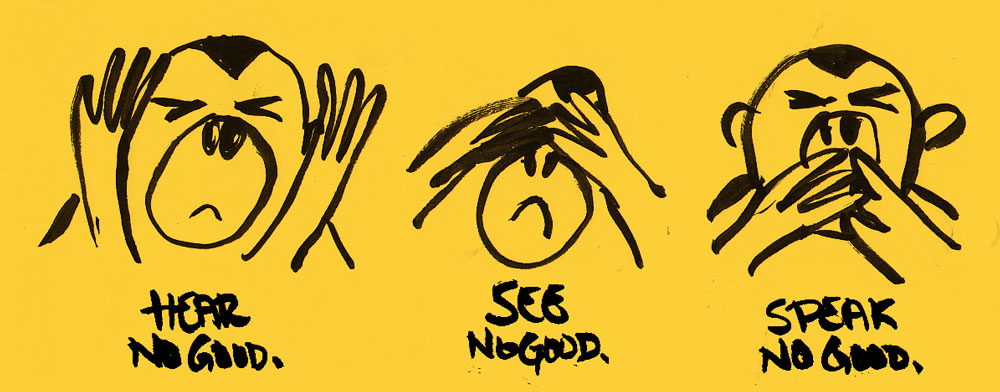
While your inner critic, that churlish monkey, sits glowering in your head, he has allies all around. They are camped on the hill and are riding in from all points of the compass, waiting for their colleague on the inside to lower the gates and let them flood in and maraud.  Most of these confederates are unwitting. They don’t know they are part of the army that can bring you down. But the monkey knows.

Some of them are driven by monkeys of their own. When you share your creative plans, your intention to start making art or to invest in yourself, they will start chattering from the trees, gibbering in fear. Fear for themselves. When you announce your brave decision to reverse the course of your life, to begin to make things again as you haven’t since third grade, you will set a shining example that will reflect back their own failures to live up to their dreams.

This isn’t universal of course. Many will applaud you and offer you encouragement. But skulking in the crowd will be those who are resentful and bitter and frustrated. And they will begin to lob suggestions, improvements, cautions, and advocacy for the Devil, designed to make you balk and backtrack.

Creativity is a particular magnet for this sort of monkey convocation. In my decades as a creative professional, I have encountered this spirit time and again. When I am awash with excitement at a new project or the possibilities of an assignment, these monkeys slink into my office, slump on to my couch and start to tell me the latest gossip, the latest management bungle, the latest reason to lose faith. They will complain about the assignment, the industry, the market. They will try to drag me into long sessions of venom and bile. They will splash me but I work to remain unblemished. Better to get up and leave that be infected with their toxicity. They are creative at coming up with reasons to stall and malinger, such is their monkeys’ gift of gab, and my own internal monkey howls with glee and joins the chorus.  These voices get me nowhere and need not to be heeded. Cut the chat short and get back to work.

And, while I am busy pointing fingers, let me point them at the mirror too. For in my own moments of weakness and doubt, I have been equally capable of joining or even initiating these grumblefests, feeling insecure in myself, acquiescing to the primate within and dragging in to a colleague’s office, leaning on my hairy knuckles. It’s a toxic affair that makes everyone feel, not purged, but depleted and sick.

Another band of accomplices are the media. The monkey loves the mindless vegetation of watching TV, numbing you with celebrities and gossip. Not the stories of artists and creative inspiration but the mindless doings of fabricated and often malignant chitchat. Besides being a time waster and anesthetic, the media can also skew your perception of art, artists and the true nature of success.

The banker is another friend of the monkey, cajoling you to focus on the bottom line. So is the electric company and the credit card company. They can make you do the monkey’s bidding, downscaling your ambitions because you feel trapped. They don’t deal in might-bes, they want theirs and now. They warn you not to take risks, to keep your day job, to be sensible. Of course, they have the right to get paid. But not to decide your future.

If you are a creative professional, you had to overcome the monkey just to get your career started. The monkey probably warned you and your parents: Don’t be a designer, an art director, an illustrator, an architect, a programmer, a musician, etc. It’s too risky, too competitive, etc. but you did nonetheless. But maybe now you see that the monkey finally let you follow this professional path but now won’t let you pursue your true passion — making art, speaking in your own voice, being your own client. The monkey giveth and he taketh away.

If you are wrestling with this issue, stop thinking. The monkey wants to engage you, wants you to obsess about his heckling and turn your creative energy into a response ego him. Don’t. Focus instead on what you want to do. Draw something. Write something. Then don’t look at it. Don’t judge it. Don’t show it to anyone else. Turn the page and write some more, do another drawing, dream another dream. When the books is done, fill another. Just keep going. Don’t ask for feedback from anyone who might derail you. Better to work alone in a cave than throw your work to the monkeys. Distance and perseverance are the best antidotes to this scourge. Build up your ramparts and lock the beast in your darkest, deepest dungeon.

Then get back to work.

Do you find your monkey has allies? What do they say? How do you deal with them? I’d love to know.

Fresh wisdom to trump the monkey.

3-monkeys

I was served two giant helpings of insight this morning, both in my email inbox.

First, this note from Evelyn:

Hi Danny,

I recently ran a drawing class for adults – a sort of introduction to urban sketching, really. On the first day I shared the story of my own rediscovery of drawing, a rediscovery largely fueled by Everyday Matters. I talked about letting go of attachment to the outcome, focusing on seeing and the connection that is made with the world around us as we draw. I said don’t wait for it to be perfect before you share what you draw.

One of the participants then told me, ” I don’t have much confidence and I have no experience. The reason I signed up for this class was because the drawing on the flyer was not that good.”

It was a drawing I’d done with a bamboo pen and ink I didn’t know was water soluble, so the watercolour kind of ran into the ink and there are some pretty messy bits.

This woman’s words made a big impression on me. There is so much value in modelling joyful imperfection!!

When I teach in high schools, I don’t teach art, but the same principle holds. We need to help people to be able to love themselves unconditionally. To be self critical without anxiety and to create fearlessly.

With gratitude for all you have given, and my best wishes, Evelyn

And then, on a different but somehow related note, this blogpost from Jennifer: Live up to your full potential. It’s a lovely perspective on how to judge whether you are making the most of your gifts.

What if we redefined what this whole potential thing really meant? What if, instead of having to prove our creative selves in a particular area of art, we could reach our potential by simply living artfully? What if, instead of striving to make lots of money with our art, or show just how technically perfect we could draw… what if we engaged in our everyday lives with an artful eye, probing the moments for beauty? What if, we reached our potential by daily living the life WE HAVE, the good and the bad, the mundane and the magical, with open arms and full hearts, celebrating and capturing some of it in an artful manner along the way? What if living up to our potential as artists had MORE to do with seeing the beauty in all of life and sharing it with one or more persons, than with being able to say we have devoted our whole lives to making a career of x or y or z.

To me, these are both conversations about the monkey, about how we can cope with the incessant jabber of our self-doubt and -criticism that wastes so much energy and time. As Evelyn points out, our ‘failures’ are in fact our richest lessons. The most important things is just to start, to make, to move forward, and to shun the wimper within that woud keep us forever in the starting blocks. That voice isn’t just an impediment, it’s a cancer that chews on us, winnowing us down to smaller and smaller versions of ourselves, as we brutalize ourselves with doubt and recrimination. Be kind to yourself, and be creative.

Jennifer’s lessons comes from outside, from the larger world that uses the dollars as the only true yardstick, from the golden monkey now internalized. This monkey voice is just one of the sheepdogs of economics and really has nothing to do with us.  It barks the simple cry of the market. For art to be valued financially, it must be a limited commodity. If everybody made art, it would be so common it would have no financial value. So our society is geared towards making art an exceptional behavior created by the few, a meager supply managed by the system of galleries and museums that turn human creativity into a market.

So it’s not surprising that when you graduate from crayons and want to continue creating art as part of your everyday life, you are discouraged from making at every turn. The only way that art can be sanctioned is if you pass through the system of art schools, galleries and critics that will cull the herd and protect the market.

Fortunately, the Internet has made it possible to share your creativity with other people and to get positive feedback and constructive criticism without financial transactions. The Internet has liberated us from the marketplace of art. It has restored the impulse for creative expression that has existed in our species since we painted bison on the  walls of caves.

This isn’t anti-capitalist. It is pro-self-expression. And it is optimistic. Because no matter whether it is stifled by the government, by religion, by the marketplace or by snobs and bores, ultimately that impulse will return and prevail. Now more than ever.

One of the wonderful things about the Internet is that value and scarcity are no longer inextricably linked. Now good ideas are what are valuable and good ideas can be copied over and over and shared with billions and still retain their value. We live in the golden age of creativity, a new renaissance. Now making art will no longer be discouraged. it will be essential.

art with a small a is not a product. It’s a point of view.  It’s a way of life.

art isn’t for museums. art is for everyday.

The Art world is about money. art is about passion, love, life, humanity — everything that is truly valuable.

How to kick monkey butt.

I’ve written a lot about the nature of the inner critic that confounds our creativity. And so far, I’ve urged you to fight it by just getting to work. That may not be as easy as all that, so let me be more specific with some ways you can push past that hectoring little voice in your head.

Just start. Do one small drawing on one small piece of paper. A Post-It. Or draw a loose grid on your sketchbook page and fill in one single square with a line drawing of your foot. Whistle while you do it. If the monkey starts to grumble, hum louder. Push off that inner criticism for 120 seconds until you can get something down on the page.

Creating something, anything, can break the logjam. And it can give you something to look back at hours later, to get excited about. Initially, the monkey may sneer about your tiny attempt but go back at it and look at it again. Find something to love in it. It’s in there.

Don’t talk about it. If you are having block, don’t endlessly discuss it and seek solace from others. The more you do, naming it and broadcasting it, The more you solidify the block, the more of  a living entity it becomes. Give it a name and you give it power. Stress over it and you become twisted and jailed.

My words here are a double-edged sword. I want you to be able to see that your problem is a common one, that you don’t suck any more than the rest of us. But the more we dwell on this discussion, the more attention the monkey gets, and the less time we are spending making something.

Give him a banana.  Try holding out some sort of reward to yourself. A bribe to get it done. Say, “if I do three drawings today, I can buy a new fountain pen. ” “Or I can watch TV for an hour if I draw during three of the commercial breaks”. Or “I can eat that donut, if I draw it first .”

Use this tool judiciously. You don’t want to end up obese, broke, or in jail.

donut

Get your lazy ass up. If the monkey tells you are a hopeless slug, agree with him. Tell him you want to improve and so you are going to set the alarm a little earlier and start the day right. Sit down and draw before your first cup of coffee. Fifteen minutes of drawing the reflections in the toaster as the coffee perks. Monkeys are lazy bastards too and they can’t get it together so early. I find I do my best work before I start reading email and talking to people and dealing with the day. Then for the rest of the day, I glow with that knowledge that I have already made art today and the rest is gravy. By knocking out a few drawings with the dawn, you will lubricate the wheels of habit while the monkey turns over and keep on snoring.

Do something you definitely suck at. Buy a medium that’s absolutely new to you. Draw on your iPad for the first time. Paint with ketchup on the kitchen counter. Play the digeridoo. By doing something you have never done before, you have the perfect excuse for sucking. If the monkey pops up, you can say, yes, yes, I know but this is my first time. Have fun. You’re making something. Sure, it’s no good. But keep going. Keep making. Keep exploring.

The great ape debates. If you can’t screen out your monkey, tune him in. Really put his critiques to the test. Ask the monkey to take the stand. Grill him.  But this time bring your inner lawyer to dissect his arguments.

Give the primate the benefit of the doubt. Take his arguments at face value and see if they hold any water. Maybe you do have room for improvement — none of us is perfect. You can learn and grow from self-examination. The thing we must avoid is self-destruction and abuse.

So, write down his complaints about you and come up with strong rational responses.  Write these down too. Next time the monkey levels these same criticisms at you, just tell him, “I’ve heard you and responded to the charges. What else you got?”

Stock your own arsenal. Sit down, like I’m doing, and come up with a bunch of ideas to trick yourself into sitting down and coming up with a bunch of ideas. If you want, start by critiquing my suggestions and then making up better ones that will work for you. Hate the idea of getting up at dawn? Fine, then draw at lunch, draw in the train, draw on the toilet. Come on, plus my ideas. What works for you?

The monkeys of yesteryear

old-monkey

Whose voice does your monkey channel?

Remember Linda Blair in The Exorcist?  The devil in her spoke to the priest in his mother’s voice, freaking him the hell out. Who is your demon quoting? Maybe it was the first art teacher who said something casual and cruel: “Remember, most people don’t have talent. I’m sure you’re good at something.” Was it your mother who you overheard telling your dad, “He wants me to pay for that painting class. I gotta break it to him, it’s an utter waste of money.” Was it the dean of the art school who rejected your application? The boss who killed all of your favorite ideas? An article about the percentage of art school grads who now work at Starbucks?

For all too many of us, the monkeys of the past are victimizing us, holding us back. Your shrink will tell you that we just have to realize that those monkey ghosts are only alive become we resuscitate them. You can defeat the specters by making stuff, by asserting your talent, by ignoring the grey-bearded monkey ghosts rehashing childhood bullshit. Want to relive an ancient drama? Read Hamlet.

Tell yourself this and believe it: whatever voice you’re hearing, it’s just a spectre. Whatever sword carved the scars into your psyche, you have the power to move past it. As grownups, we have the ability to see that the affronts and critiques of the past are just puffs of air that have long since dissipated. Only we carry them forward, re-recording them in the deepest wrinkles of the brain, keeping them alive year after year. 78 to 45 to cassette to CD to MP3. Same old song.

Every cell in your body is replaced every seven years.  You are a completely new being from cerebellum to big toe nails. You have the power to override the rewrite, to define these ancient wounds as irrelevancies that do not bear on the wonderful creature you are today, an emerging artist with great strength and potential.

You can prove your legacy wrong. Oh, your father wanted to go to art school but wasn’t supported by your grandfather and had to become an accountant so he spent your childhood channeling his pain into squashing you? To hell with that. Whatever happened before Watergate has a statute of limitations and should not crush the dreams you had last night. (That’s a little-known federal law).

Time for a fresh start that’s bright and creative.

What disappointments and harsh words are you reliving whenever you think of making art? How can we help you get past them?