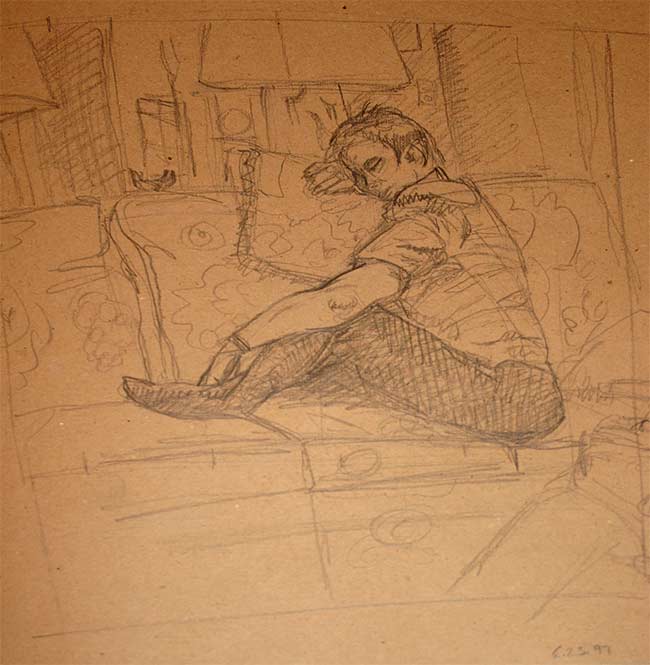
My Conversion

pl
Dear W_____:

First of all, thanks for your note and, secondly sorry, for the delay in my response. Your words were quite important and I wanted to give them some time to think of proper response.

I have looked for God for many years. When I was small, I had only the foggiest sense of what God was.

He seemed like a sort of arbitrary and indifferent creature who let lots of bad things happen to people who spent a lot of time worrying about how to please him. My father is of agnostic/Protestant stock while my mother and my two stepfathers were casual Jews who were vaguely interested in the historical aspects of tradition but were at heart unblievers too, to the extent that they thought about it. My grandparents were hounded and threatened by people in Germany, Poland, Italy, India, and Pakistan, all in the name of various beliefs.

At about your age, as part of my endless quest for identity, I read a lot of Karl Marx, most of the Bible, bits of Sartre, and then eventually gave up and drank more, smoked more, met more women, and went into advertising.

When my wife was run over by a subway train, I had a renewed need for meaning. While she rehabilitated and learned to live in a wheelchair, I met with the minister at the nearby Baptist Church. I went to the local synagogue. I sat in the back of the nearest Catholic church. I went down to the Buddhist temple in Chinatown. I conferred with Hare Krishnas in the East Village. I read books and books. At the core of it all, I was looking for faith, for some confirmation of God’s presence. I didn’t want an explanation for what had happened to Patti, I just wanted to feel connected.

I found nothing that I could call my own. Nothing that was real. I tried to convince myself but I couldn’t. I don’t dispute the beliefs of those who have them but I was unable to experience what so many seem to take for granted.

One day, I was moved to draw. I don’t know why, it just sort of happened. I drew some pictures from a magazine. I drew a vase of flowers. Then, very slowly, I drew Patti, resting on the couch. Something about that drawing was deeply moving to me. It wasn’t a ‘great’ drawing but it was mine.

I discovered that, as I drew, I felt peace. I felt connected to the things around me. I saw them deeply and somehow we became one. Was that what the Buddhists meant? Was that what Christ offered? I don’t know. I never found meaning in a church or temple. I found it in my living room.

Now I find that I want to draw. I can’t do it every day but I am drawn (as it were) to draw again and again. It doesn’t matter what I draw. It doesn’t matter whether the drawing is accurate or worth keeping and sharing. It’s nice when the drawing is ‘good’ but that’s not the point.

There were times I lapsed. Once, when my job was particularly ensnarling, I didn’t draw for three years. It wasn’t a great time and when I stopped working that way and started drawing again, I felt better.

Some of my religious friends will probably tell me that I am practicing drawing as a religion. That my drawing is a communion with God, a form of prayer. I don’t know or care. If God is that tricky and elusive, I can’t be bothered to call him by name. And I sure am not asking him for help or answers. I make my own drawings, just me and my pen.

What with my website and my books, I have found myself in this weird position of being an evangelizer for drawing. I’m not sure how it happened and I sometimes wonder if I am spending more time on the prosthelytizing than on the drawing and whether that’s a particularly good thing.

I like having people to draw with and I like sharing the things I notice about drawing when I am doing it. Drawing doesn’t harm anyone. It doesn’t pass a collection plate or condemn gay people or inspire people to blow up skyscrapers in my backyard or care one way or the other about abortion or try to effect my vote or meddle in school curricula or cast stones. But it does help me to see the beauty in people and things, to cherish what I have, to reach out to others, to favor creation over destruction, to find peace and feel more alive.

May it do the same for you.
Amen.
Your pal,
Danny

Notes from a chat with Julie Dermansky

julie-journal-1

Julie Dermansky: Journal page – European monumental architecture

Julie is one of my favorite artists and she has always been a huge source of inspiration and encouragement to me. She is so committed to making art and has a lot of experience in how one survives financially and psychically as a creative person.

JULIE: Inspiration is overrated. It’s all about discipline. There are glimmers of inspiration, when you lose touch with time and place but you can’t wait around for that. When I start working on something where I am so excited it’s like some sort of drug, I’m just alive. But the only way to get there is through discipline.
It doesn’t matter why you make art, you’ve just got to make stuff and eventually you’ll understand. I won this grant that allowed me to travel for a year. I just had to write four letters back to the foundation over that year. That was it. I was 20 and I could do whatever I wanted. So I just made drawings in my journal, drawing monumental architecture all over Europe. That was my only discipline, my commitment to do at least one drawing every single day. And because the fancy journal books were too expensive, I made my own, ripping up water color paper and tying it together. It evolved as I went. And when a book was filled, I would send it home and I had no idea what the value of what I was doing could be until I came home and saw all those journals. It came out of me with no forethought and I’d never done it that way before. It just came out that way. I didn’t worry what people would think, I just tried to be honest. And I didn’t worry about the quality of the drawing, I just went with it. I hated having a page I didn’t like so I kept working it until I liked it. Those pages are so vibrant and visceral, so raw. I don’t know if I can get back to that looseness, pure hand /eye. The more time I had the more I let go, the looser, the better it all got. That art was my reason for getting up each day. For me, travel is a lot of work. Nothing planned, figuring everything out on the fly, real work.

julie-2Julie Dermansky: Steel Gate at her studio in Deposit, New York

JULIE: I was at the art students league taking drawing and this teacher came behind me and I was making a mess like I do and he said “Ah, a lefty. But its nothing like Rembrandt,” and I was, like, “Rembrandt? Fuck you! Why would I draw like him? He was great but he already drew like that. I’m not here to do that.”
If I can recognize something you did without being told you did it, you have done something magic, you have created a visual vocabulary. Good, bad, doesn’t matter you’ve created something brand new. Everything’s been tried but no one can draw like you, unique, special. It’s not the materials, it’s you.
Everyone can multiply. You struggle at algebra but you can learn it. Everyone can draw. Everyone can do their times table. It’s just a matter of developing the skill. Drawing is a skill and a science, like learning perspective.
I love Tennessee Williams – At the beginning of Cat on a Hot Tin Roof., he says something like “Every human being is in their own jail call and all we can do to communicate is to take the thing you know the best and put it out there. The strongest part of you that everyone can interpret in their own language.” He took his internal dramas and made works of art that are in the mainstream yet retain that rawness. You don’t need to know all about his internal extremeness to enjoy his work.
I don’t know why I make the things that I do and I don’t overanalyze it. I never took formal art education classes, I learned it from art historians, composition, color theory, I learned it right from the work, not from academics.
There’s work I’ve done that was completely derivative and I wouldn’t show it. It’s not part of my vocabulary. It’s my homage to the artists I love.
If you go to a museum or a gallery and you have to read the thing on the wall to understand the art, the work is bullshit. However if you go that museum and have some sort of response to the work you can’t understand, and then you read the wall, and reading the explanation helps you develop another layer of appreciation and understanding, that makes the work more rewarding, it will be a beautiful thing.
I went to see the Calder retrospective at the Whitney when I was in second grade. And I appreciated that he is a great artist but I just didn’t like it and it bugged me and I said to myself, I can make better things than that and I knew that I would. I was that confident as a child. Then looking at Picasso, I thought how did he make so many pictures and then when I really started rolling with my own stuff, I said, Oh, if you make work everyday it’s not that hard to make that much stuff. I just compared myself to the pros and never found that conceited. In Europe, it’s very conceited to say ‘I’m an artist’ but it’s fine to say ‘I’m a painter’ or ‘I’m a sculptor’.
For me the definition of an artist is someone who has created a visual vocabulary. I may not like it. But when you look at a retrospective of an artist’s work, you can check it and look for the vision, the palette, even if you don’t respond to it. It’s not about liking but seeing quality, consistency.

julie-bird

Julie Dermansky: from the Lumis Collection in the basement of the Robinson science center, Binghamton, NY

JULIE: My work isn’t really done until it’s out in the world.
My uncle is an artist and told me, never sell anything for less than say $100, or make up your own number. If it’s less than that number, then just give it away. But don’t sell it. I like that rule. Keep the value for yourself. Joseph Cornell hated to sell his stuff. Leo Castelli could never get it away from him.
Andy Warhol said make pictures you’d sell for $100 and others you’d sell for $10,000. That way you just get your work out there by having something for every budget.
Some people feel the universe should take care of you, and others get out there and hustle.
There’s always a way to make money, one way or another. I grew up around the drive to make it for its own sake but for me it was a way to be an artist. Being an artist costs money and I needed money in my pocket. I started making and selling jewelry when I was 14. In college, I would go to the dorms, not be shy, just say, “would you like to see some jewelry” and spill it on the bed. I’d make $400 or $500 which made it pretty impossible to go do some job for $6 an hour. It didn’t make any sense. My art objects always sold.
I’m not qualified to do anything so it’s lucky people have always bought my stuff.
People romanticize self-employment but it’s a heavy burden because you can’t count on regular money coming in. I’ve envy people with steady jobs on one level. I have no safety net but then again no one is 100% safe and the rug can be pulled out from under anyone.
A lot artists don’t do their homework. You have to hustle, have to keep going, Have to have faith in your work. You have to be willing to go below your level sometimes without bumming out. If you insist on selling everything for thousands and never do, you’ll end up with no money and no collectors. If you need the money, don’t feel bad, get your work out there. That’s what makes your work into a commodity, because it’s visible. I don’t know who created the rules about artistic integrity, that money is evil, that you shouldn’t make work in order to sell it, that it shouldn’t have a decorative element. And no art schools have classes about marketing. It’s frowned upon.
It’s so easy to give up, to forget to market, to forget to find a market place, to not do your homework. You’ve got to feel confident about your work, that’s a key to salesmanship. You’ve got to learn about grants and sources of funding. Artists have a knack for being self effacing and for being overly self critical instead of learning skills and promoting themselves.
The art world is very seductive and full of hangers-onners. there’s so much energy and people want to latch on to it. When I’ve had relationships that have reached the point where men say you’ve got to decided between me and the work, it’s too much and there just wasn’t a choice for me, of course, it was the work.
I can’t be something else, even if I wanted to.

To see more of Julie’s work, please visit her website.

Living well through bad drawings

gravestone

When some people see an illustrated journal, they say, “Wow, that’s great. I could never do that.” With some coaxing, they may be persuaded nonetheless to give it a try. Others say, “Wow, I’m going to do that.” And they start too. And quite a few say, “Huh, where do you find the time?” then use your journal as a coaster.
It’s comparatively easy to start. To bring yourself to draw your breakfast once or your coffee cup once and to keep it up for a couple of days. Ideally those first few days infect you with the fever and you’re compelled to carry a long series of journal books around with you for the rest of your days.
But more likely, your initial enthusiasm will wane. You’ll forget to do it one day, give in to resistance the next, then feel like you’ve broken the chain, the narrative is lost, a month’s gone by, and you drop it altogether. Why? Often it’s because you are disappointed with your drawings. You may say you don’t have the time, forgot your book, grew bored but it’s really because you aren’t that impressed with your drawing skill. You haven’t made something that looks like Art.
I don’t think that illustrated journaling is really about doing great drawings. You’re not out to make something that you could frame or give as an Xmas present. I’m not really into doing the sort of exercises on perspective and tone that you see in most drawing books, exercises that will move your skills to another level artistically. Not that you shouldn’t do them if they are fun or if you have some other goal in mind but I don’t think they are essential for the true purpose of illustrated journaling.
That purpose? To celebrate your life. No matter how small or mundane or redundant, each drawing and little essay you write to commemorate an event or an object or a place makes it all the more special. Celebrate your hairbrush and it will make you appreciate the intricacy of the bristles, the miracle of your lost hair, the beauty of you. Sounds sappy but it’s in there. Draw your lunch and it will be a very different experience from bolting down another tuna on rye. If you take your time (and we’re just talking maybe 10-20 minutes here, folks) and really study that sandwich, the nooks and valleys, the crinoline of the lettuce, the textures of the tuna, you will do a drawing that recognized the particularity of that sandwich,. That’s the point: to record this particular moment, this sandwich, not something generic. If you approach it with that attitude, you will create something as unique. reaching that place is just a matter of concentration and attention. A brief meditation and you will have a souvenir to jog your memory back to that a moment forever more. Imagine if you can keep doing that, keep dropping these little gems in your day, recognizing the incredible gift you are given each morning upon awakening. You will be a millionaire.
There’s a demon in your mind that will fight this, that will tell you your life is unworthy of acknowledgment, that today sucks through and through. It will tell you you have no time for this, that you are too harried, too stressed. Which brings me to Marybethd who wrote to me from Nebraska where she just had emergency eye surgery. For two weeks, she could only see the floor. She wasn’t sidelined though— she drew all of her visitor’s feet. She pulled art out of that tragedy, celebrated her visitors, created a positive memory that she will have to cherish long after her vision is back to normal. He nightmare became a lesson.
I have gone through my fair share of shit. My regret is that I didn’t celebrate all of it. I can’t say it often enough: life is short, art is long. Get the habit.

Art Supply Porn

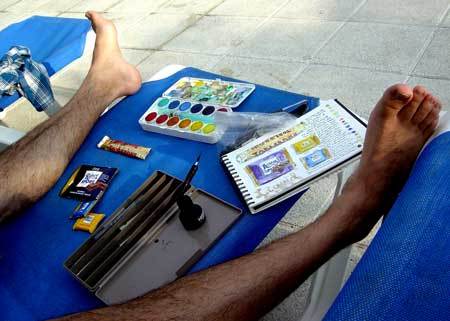
vacation-art-legs

I didn’t even know I had a great aunt Greta (twice removed). But I was happy to take the call from her lawyer, the executor of her estate. Now I am the lucky owner of a 5,000 square foot studio loft not far from our home.
It is a quiet space but when I open the floor to ceiling French doors, the birds’ twittering can be heard from Central Park below. The ceilings are high, about 18 feet and, but for a few graceful, sculpted columns, the space is open and expansive with freshly painted white walls and well varnished, wide plank floors. The most notable feature is the enormous skylight overhead that floods the room with sunshine on even the gloomiest days.
Greta, who apparently enjoyed my drawings when I was six, also left me an open ended, unrestricted trust fund for art supplies and furniture, so I have been busily organizing and shopping for the past few days.
First, I had my friend Dean help me plan out the space. We covered the eastern wall with cork for pinning up drawings and things torn out of books and magazines. Next to it, we erected twelve foot high bookshelves with one of those sliding ladders. In the corner by the door, I have a seating area with a Mies leather couch (for afternoon naps) and three Eames chairs and walnut stools. There’s a large kitchen and we just had to have some of the counters redone (I love to draw at the kitchen table) and a new fridge with an ice maker installed.
There’s another wall for storage with oak flat files and cabinets for storing supplies. I have two different drawing tables, one of which is a BF23 from Italy and can be angled, and raised with a foot pedal. I have a wooden print rack and several taborets that roll around on the floor and hold pens and stuff. They’re delivering the G5 Mac tomorrow afternoon and the server, which will hold my MP3 collection. Then the guys from Harvey Electronics just need to hook the system up to the Niles Audio AT8700 speakers they installed in all the walls and we’ll have Miles playing in ever corner.

So, off to the store.
Let’s start with watercolors. I want all the colors that Daniel Smith makes, every series, big fat 15 ml. tubes. Then I’m also going to try out a few other brands, so I’ll get all three of the Maimeri sets that Catherine Anderson advertises. I’ve had fun with the Dr Ph Martin’s transparent liquid watercolors I own but I want to move up a notch to their Hydrus colors so I’ll pick up all24 colors they make. I see Schmicke makes powdered metallic watercolors – they could be fun to use in my journal so I’ll take those: rich gold, pale gold, copper, silver and aluminum. Here’s something called Ox gall Liquid; no idea what its for but I like the sound of it. In the basket.
Next, I want the best brushes money can buy. Really great watercolor brushes always spring back to a natural, razor sharp point and I think male Kolinsky red sable is considered the best (they’re made from the tips of animal tails which is mildly disturbing but maybe they just trim off the tip and it grows back like a lizard’s. In any case, I’ll ask the lawyer if the trust fund can make a contribution to PETA or something). Here’s a #14 brush for $311.95. I’ll take three. It’s by Isabey and they’re nickel plated. But the #14 is pretty chunky; for safety’s sake, I should get the whole line, 00 though 12. And, for fooling around with, maybe those Squirrel quills. And a 2″ squirrel wash or two. Oh and some fun brushes: a few of those filberts and fans, a set of lettering brushes and those weird angled tear drop brushes.
I’ll need some good new palettes, the big English glazed porcelain ones. Grab half a dozen. That watercolor bucket looks interesting – it has water basins and palettes inside it and there are holes in the hadles to keep brushes upright. Oh, and this Rinse-Well thing is cool. You fill the big bottle with water, it fills a basin with clean water and when it’s dirty, you press a button and it flushes it into a hidden reservoir. Cute and just $30. I need three. Might as well get this Sta-Wet palette with the lid that seals the paint like Tupperware. It seems a bit fiddly and I can always just get fresh paint but, oh, what the hell… in the basket.
Watercolor canvas? Apparently it has a special coating that takes the watercolor, you can lift off mistakes or even wash the whole image off the surface and start again. It doesn’t rip or shred and comes in huge rolls so you could do paintings that are 4 and half feet by 18 feet! Wow.
I also need loads of Fabriano Artistico watercolor paper. I want to try the hot press too and both 140 and 300 lbs. I love the Canon Montval Field books for journaling but also want to try out these Michael Rogers books with 140 lb. cold press acid free paper. Take a half dozen of each. This Nujabi journal looks good too: 25 130 lb. deckled pages in a Royal blue cover. In the basket. Lots of empty pans and half pans and an enameled steel box to hold them. Some nickeled brass palette cups. Check. One of these steel tube wringers that squeeze out paint. Check. A few dozen empty jars and squeeze bottles. Check.
I’ve never used a Mahl stick to rest my hand on while painting. It’s very Rembrandt looking. In the basket. And a thing called an Artist Leaning bridge, a transparent shelf that sits right on top of your page so your grubby paws don’t get on the work.
Here’s a very cute and must have item, the art traveler, a combination back pack and stool, with aluminum legs and lots of pockets and padded straps.
I like these huge art bins with the casters on them, full of individual boxes that neatly stack. Even a pocket for my wireless phone. Do they have to be such an ugly shade of purple?
I’m getting a huge paper cutter for bookbinding. I am used to the arm cutters (which could live up to their name an sever a limb) but am intrigued by the Rotatrim that rolls the blade along a bar. They have a massive 54″ one here that’s a bargain at just a little over a grand.
I need pencils: These Faber-Castell Polychromos come in a box of 120 colors and , for some reason, a CD-ROM. I like the idea of pencils so sophisticated you need to use a computer to work them. I’ll take the matching Albrecht Durer Watercolor Pencils too. In a wooden box, just $300 a piece. I’ll also need an electric eraser, just in case I ever make a mistake. These triangular TrioColor pencils looks interesting. Oooh, and these color pencil easels that organize everything in rows behind elastic straps and Velcro closures. Very nice.
I want to try some new media too: Encaustic crayons that you apply with a special electric iron. British scraper board for beautiful cross hatched drawings tat look like engravings. I’ll take some in black and some in white. And foil too. Oh and a set of cutters and scrapers you need to work on them.
No pastels. I never like drawing with them and I never like the look of pastel drawings. Except for Degas. And Lautrec.
Some gold leafing. I’ve used cheap stuff and it’s very dramatic but I’m going for the real stuff this time, 22k Double Gold and Pure Palladium too. The perfect way to class up a humble line drawing.
I’m going to have to order some clay for sculpting but I might as well pick up the armature set, the metal mesh and the riffler tools for shaping. This rotating sculpture stand is cool. It goes up and down and has a little adjustable shelf for tools. And this clay gun extrudes different shapes of clay, like a grown up play do maker, only in steel. Ultimately I want to get a welding setup and a kiln but this’ll do for now.
I love pure pigments, no idea what to do with them, but I want a few jars of them sitting around: Sennelier sells a nice starter set for just $1250 in a handsome wooden box.
I want some gouache to try out for the first time. This Lukas brand looks sort of interesting but I think Roz urged me to get Schminke. Better ingredients, less chalky and dull.
Now that I have all this space, I’m going to do some oil painting. I have painted on canvas before but always hastily, using a dining room chair as an easel and acrylics because they dry fast. I’m intrigued by Williamsburg paints. They’re made here in New York by an artist who based his recipes on research into the paint houses that supplied Monet and Cezanne. I’ll need 150 ml. tubes and the colors go from $25-145 so I should probably get the whole range, looks like about 150 colors. I can’t stand the smell of turpentine and how it gets into everything so I better get some Turpenoid and a citrus based thinner.
Brushes: If in doubt, buy the most expensive. In this case, more Kolinsky Sable. I’m getting a set of flats, of rounds, of filberts and of liners: grand total, a mere $1802.15. Hang on, these color shapers look like fun. They’re silicone brushes which I can use for applying and scraping paint, sort of like more elegant paint knives. But I should get paint knives too. Here’s a set of 60 different ones for $450. Done. Oh and a smock. Here’s a nice black one, cotton, lots of pockets. And though I won’t be getting a beret to go with it, I like this life sized human skeleton made of wood. Beautiful, and look, life sized posable manikins. They have men, women, boys and girls. A lovely family for just about two grand. And a posable giraffe too. Other miscellanea: a reducing glass les for looking at my canvas without having to step back and … duh, an easel, I’ll get two: one for plein air, a french easel that folds up into a little box to strap on my back like Van Gogh did. And then a big one made of oiled oak wood with cranks and shelves and casters. Here’s a nice one, called appropriately, the Manhatttan and it’s just $1707. Greta would approve.
Finally, canvas, double primed cotton duck to start with, and then a roll or two of Belgian linen and loads of stretcher strips and canvas pliers and a really good staple gun. And a few maple panels for painting on too, the really thin kind, satin smooth. Oh, and a Bob Ross video, maybe “More Joy of Painting”.

(This grotesque fantasy of excess was inspired by the arrival of Jerry’s Artarama catalog in our mailbox. In the real world, I ended up buying a bamboo sketch pen, for $1.79).

Why do I do it?

adrian2

At six, it was universal. We all drew, and painted, sang and sculpted. We were all architects and actors, potters and dancers. It was innate and natural.
I lived around the world as a child, in Lahore and London, in Pittsburgh and Canberra, studied at St. John’s and on a kibbutz. I could quickly fall in with any other kid and we’d pretend to be mountain climbers or scientists, we could build forts out of sofa cushions or turn a refrigerator box into a theater. I wrote and illustrated books. In a school play, I played a dog that saved a family from their burning house. I had an alter ego, Roger Watford, an English lord who smoked a pipe and carried a sword. I made pirate maps, soaked them in tea for verisimilitude. I wore my Halloween costume year round.
Twenty years later, I wore ties. I drew only when doodling on the phone. I never went to galleries or museums or playgrounds. I watched golf on TV.
I was not an artist any more.
When I was a eighteen, I wrote a college application essay on why I felt that writing rather than drawing was the more appropriate and useful medium of expression for me. It came down to a simple equation. Artists starved. Writing was useful in all aspects of business.
Princeton had a painting department. I assumed that its members were lazy, unwilling to take on a proper major or to attend a real art school. Architect students worked notoriously long hours. Fools, again. At best, I’d heard, they’d make $30 grand a year.
By twenty one, I’d become cynical, rigid and unimaginative. I was ready to get to work.
I had talked myself out of going to art school because I believed that the only way to make a living would be to be a ‘commercial’ artist which seemed horribly compromised. My experience working for a local paper had led me to believe that journalists were mere observers rather than participants. My friends who went into investment banking were total sellouts. Three months after graduation, I fell into advertising. It was a job, and got me out of my parents house.
For the next twenty years, it was what I did. I was “creative”. Noun, rather than adjective. In Harper’s, I read an essay that concluded ‘Creative people in advertising are artists “with nothing to say.” It seemed apt.
The advertising profession is divided into creatives and account people. Creatives are divided into art directors and copywriters. I was the latter and yet I drew more and better than the art directors I worked with. I had endless opinions about the visual side of the business but I was adamant that I was a copywriter. I would not be judged as a visual person. I was not an artist.
Despite all the meetings I sat through, all the product I moved, all the concessions and compromises I made, the urge to make things could not be completely quashed. First of all, I made ads. I worked with photographers and directors and editors and composers to make polished little 30 second turds. We all threw ourselves most fervently into these productions, being adamant about the tiniest things, the shade of blue of a models blouse, the placement of a comma. We would fall on our swords all the time, so intent were we to assert our creative will.
This inner artist plagued me like homosexuality must plague those still in the closet, I would jam it down, insisting it was impractical, that I was not good enough, that it was a huge waste of time and then that creative urge would pop its head out somewhere else
I was not a painter (though I did paint at home, balancing huge canvases on my dining room chairs because I would not commit to having an easel).
But I was not really a Writer either and stopped writing the fiction I had pumped out in school.
When I was twenty three, I wrote a play and some producers started to raise money to put it on. We did a reading and Kevin Bacon played the lead. I did nothing to help. The production grew until the plans were to try to open it Off-Broadway at the Henry Miller theater, then on Broadway itself. I stood by. Eventually the plans grew so big, they collapsed. I did nothing to revive the play. I’m not sure if I still even have a copy.
Three different times, I bought myself a keyboard and set up music lessons. Each time, I sabotaged myself after a week, missing practice and lessons because I was so busy at work.
I designed and built the furniture for our apartment out of birds’ eye maple. But then told myself we could afford to replace it at Ikea.
I got a book contract to write a book of highly subjective funny essays about New York bars. I wrote 250 pages but then my editor left the house. My new editor wanted to make changes. I refused. The book faded away but I held on to the advance.
I would come home and cook, hand grinding spices, rolling out raviolis, shopping for months for the perfect knife, making elaborate dishes that I would eat by myself, standing over the sink. I worked hard on what I wore, scouring vintage stores for hand made suits, collecting hundreds of ties, dressing and redressing myself to get the look just so.
Someone gave me a harmonica and I kept it in the shower where I would play it till the pipes ran cold. Whenever someone in our family had a birthday, I would develop elaborate themes to my presents and print my own wrapping paper.
I saw every movie that came out, hundreds a year, telling myself it was part of my job and tax deductible to boot, I watched them intently, memorizing camera placements, noting editing techniques, the names of key grips.
I made my girlfriend elaborate hand made gifts. I wrote and illustrated books for her, even epic poems. I convinced my boss to let me have a laser printer in my office, and then worked behind closed doors to print my books on special papers, to make slip cases and design my own type. I would finesse each piece over and over, readjusting the kerning, the leading, till it was perfect. I worked for months on each item, a single edition of one book. I was doing it for my love. But I didn’t deal with the fact that I was doing it because I had to.
Long before we became parents, I made intense home movies, costuming Patti and driving her to interesting locations. I drove her in a car I had bought simply because it was beautiful, a 1962 Mercury Monterey that was 18 feet long and two tone, cornflower blue and white. It was completely impractical, far too big for Manhattan and I rarely drove it but I polished it and reupholstered it, a gleaming feast for the eye.
Fade out.
Another decade passes. I am married. I have gained a son and thirty pounds.
My career has continued to climb. I am at the top of my field, running the creative department of an agency.
But I am suffocating.
I am under enormous pressure to make other people produce creative ideas. Money is inextricably wound up in everything. All our efforts are judged and harshly.
I slowly came to realize I have been leading a false life for so long, that I am not who I am pretending to be. I have been using my ability to make things purely in terms of how it will provide money to my family, There is no joy in the process. The things I make are completely at the behest of others, I am making advertising campaigns for investment banks, for people who sell weapons systems, for chemical producers and management consultants. I am making more money than ever have and yet I fell completely bankrupt. Nothing I do is for me. I am bitter and insomniac.
A few years before, I had found one outlet that meant a lot to me. I had begun an illustrated journal and had become quite good at drawing the little things I encountered every day. I took a class in bookbinding and learned to make my own journals. For a while, it was a great escape. But then I’d stopped that too. My position as creative director meant there was no time for such things, for the folderol of making things that did not contribute to the agency’s bottom line. I locked my journals away and for five years I focused exclusively on my job, twelve hours a day. My wife grew distant but I didn’t notice. I had no friends outside of work but no time for them in any case. Whatever little burblings of creativity used to have, that I channeled into cooking and fashion and gifts was 100% channeled into servicing clients.
The camel’s back finally broke.
Through my job I started to meet some of the top graphic designers, people like Stefan Sagmeister, Woody Pirtle, Paul Sahre, and as I talked to them, I found myself admitting how much I hated what I did, how lost I felt. I was supposed to be their client but I treated them like mentors. I so envied their lives, making all sorts of things for people, working on their own projects, committing themselves to social change, turning down work if they felt it was wrong, living on a fifth of what I was making and seeming well rounded and complete. Finally one of them suggested I get back to my journaling. Hesitantly, I did.
I let art back in the door and suddenly the walls started to crack. Within a month, I had a book contract. A few months later, I had a second, this one to publish my illustrated journals. Before long, I had an agent and was no longer a creative director.
Instead, I was me.

Notes on notes

notesonnotes

Doing my homework for color theory class this week, I discovered I had made the sort of thing I had always admired. It’s a great feeling , to look at your own work, and say, “Hey, that’s how you do that!” and see that you just did. The thing I made was not just a watercolor of an orange – but a page with little swatches of color and handwritten notations that, as a composition, captured the process I went through in making the picture.

There’s a fair amount of carelessness in the whole thing which evokes the way I was working but there’s also a progression that shows how I was learning and experimenting.

This is the tip of the iceberg of what I am realizing is my aesthetic.

I have always been very drawn to notebooks and diaries and I see now that this is primarily because of the way they look. When I was a kid, I was a big fan of Gerald Durrell and wanted to be a naturalist or a vet. I also loved drawing maps and making books. Perhaps that’s where this taste for logs and sketches and Latin names first began.

I remember going to an exhibition of diaries at the Morgan Library a few years ago and there was a huge book that contained a captain’s log, kept in the 18th century. The book was open to a spread that contained a painted map surrounded by spidery calligraphy. I could feel the voyage in those two pages, the creaking of the ship at night as the captain filled in his log and drew the map.

Field manuals kept by botanists and naturalists also have this palimpsest aesthetic; that’s part of why I love the work of Richard Bell, Roz Stendahl and Hannah Hinchman. Not just a report on nature but nature itself invading the report, smudges and fingerprints, taped-down specimens, random thoughts inspired by the moment, teeny gestural sketches surrounding a carefully rendered drawing. My old pal, Walton Ford, does this to a T, making enormous, spectacular watercolors that evoke 19th century explorers and are meticulously rendered. His work has put me to shame since we met at sixteen.

I am in full sympathy with Bill Gates for paying as much as he did for Leonardo’s Codex, not just because it contains the discoveries of one of the greatest minds to ever ride around on human shoulders but because of how beautiful it as, the sepia drawings, the mirror handwriting, the thick parchment pages.

When I was in college, I knew a rather crafty fellow named Brody Neuenschwander who was pursuing a course of independent study, hand grinding his on pigments and illuminating manuscripts. I’m not sure where such a major ultimately lead him, though he did do the calligraphy in a few Peter Greenaway movies, but what a wonderful way to spend your time.

I have always liked Peter Beard’s diaries; for a couple of years he had his work on display in SoHo and we went many times to look through his huge diaries, filled with photocollages and the phone numbers of his famous friends. I also love architects’ plans, those perfect sketches, wonderfully strange lettering, elevations and notes and marginalia. You can feel the ideas unfolding. And skritchy scratchy dip pens like the ones Ralph Steadman uses, spraying inkblots all over the words.

(I’ve never been that much of a fan of Nick Bancock’s work. I find his stories muddled but worse of all, it’s all artificial and seems like much of it was computer generated to simulate real letters and postmarks and the like).

I have a big collection of old diaries, ought at flea markets and on eBay and best of them, particularly the travelogues, have this layered, lived-in feelings that is wonderful. The same goes for collections of old letters, stacked and tied with faded ribbon.

Of course, computers threaten this aesthetic. Biologists and naturalists, explorers and cartographers use laptops now and everything is rendered on the web. Fat chance that there will be musty piles of old servers found behind cobwebs or that this blog will be enshrined in a dusty vitrine some day.

If you’re so great, why aren’t you rich?

TV1

(Drawings done while watching a little over an hour of network TV)
These are dark times for the nexus of art and commerce. Every industry that tries to make a buck from others’ creativity is moribund or in flames.
The music business is more intent on suing children for downloading MP3s than trying to incorporate innovations in technology. The publishing business focuses a disproportionate amount of energy on the works of two dozen best selling and second rate authors. The movie business barely scraped a top ten list together last year. Network television bemoans the final act of geriatric shows like Friends and 60 Minutes, unable to generate anything new that mass audiences will flock to. Instead of intelligent, adult programming, they program sleaze. Fashion’s top designers have become factories or left the business. Advertising is unable to come up with any strategy to combat Tivos.

Over the past decade, conglomerates have engulfed each of these industries. Huge businesses demand regular, increasing profits to feed Wall Street and are loath to bet on anything but a sure fire hit with mass appeal. They slather on bureaucracy and centralize decisions to minimize risk and surprise. But risk and surprise are the food and drink of creativity.

And yet, despite this Armageddon, we are in the middle of an enormous renaissance of creativity. Look around you. People are taking digital pictures. They’re recording their own songs. They’re shooting, editing, scoring movies. They’re scanning artwork. They’re writing essays. They’re sharing stories, and recipes and patterns and ideas. They’re supporting each other, inspiring each other, feeding and cheering and promoting each other.

The only ‘problem’? Oh my god, no one’s making money off all these blogs and personal websites and zines and chats. So they can’t be real. They can’t count.
If they were any good, they’d turn a profit, right?

Just like cave painters had three picture deals. Just like Shakespeare had licensing partners. Just like Mozart was a millionaire, Van Gogh was pursued by paparazzi, Nijinsky had his own MTV pilot… For most of human history, creative people made creative things because they had to. Now, perhaps, we’re getting back to an understanding of how essential and human that is.

By the way, if anyone knows a major corporation that would like to sponsor this blog, please put them in touch with my corporate parent. Just kidding.

Ars longa, vita brevis

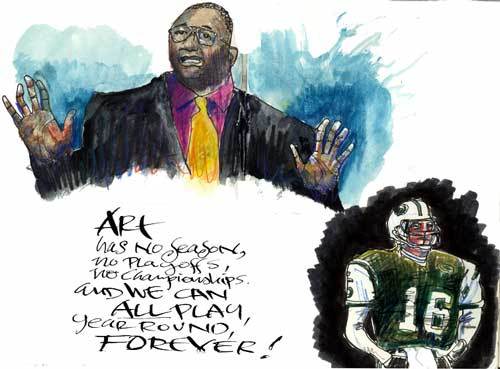
football

Every biographical movie about an artist depicts its subject as some sort of dysfunctional weirdo. Picasso – a woman hater. Van Gogh – a psychotic suicidal. Basquiat – a drug addicted suicide. Pollock – a drunken suicidal. Warhol – a weirdo and con man in a wig. Michelangelo – a disagreeable obsessive. Kahlo – a victim of love and disability. Toulouse-Lautrec – a horny dwarf, Mozart – a child. Beethoven – a deaf crank. Their genius is a curse, fed only by their tortured souls.
In America, we love athletes. We love pop stars. But we love to hate artists.
When we are about ten we are taught that being an artist is impractical, childish, and self indulgent, that ‘talent’ is a god-given gift you either have or you shouldn’t bother. Artists are arrogant, disconnected, elitist, millionaires or paupers. This myth is why parents accept all the cuts in art and music education yet will do anything to promote athletics in school. No one would want their kid to want to grow up to be an artist.
It wasn’t always this way. Doing watercolors used to be a standard part of a decent education, So did reading and writing poetry. Mozart, Beethoven, Bach, they were all government employees.
But in 21st century America, that critic in your head has the support and encouragement of the whole gang; your parents, your teachers, your neighbors, bosses, and role models (even so –called creative people in the media promote the illusion that it’s either a fool’s game or the lottery).
Small wonder it’s so hard to drown out. It says, “Don’t sing unless you’re going to become a pop star. Don’t paint unless you know you’ll be a genius who is recognized in your own lifetime. And if you have to practice at something, work on your pitch, your swing, your kick, skills that’ll pave the way for your future.”
You are fighting enough obstacles as it is. Don’t let your own brain join the conspiracy. Tell it to shut the hell up and let you get back to work.
Because all those voices, so right about how to build profit, are flat wrong about how to build a decent life. Without art, your soul suffers; you lack a chance to express who you are, to hone your own point of view, to make your life your own. You are less than human, no matter how many Super Bowl rings you’re wearing.
When you do make something and share it with the world, your voice will be proven wrong again. People won’t say, “Well, that drawing is pathetic. That poem is lame. That note was slightly flat. That diary reveals what a moron the writer was.” If they stop to judge it all, they’ll almost certainly say, “I wish I did that.” Which will give you the chance to say “Well, why don’t you?”

Trust or Bust

jarrett

In 1975, Keith Jarrett recorded the best selling solo piano album ever, The Koln Concerts. What’s even more extraordinary is that the music is purely improvised. Jarrett had spent the day feeling jet lagged and under the weather, he had to sit down and start performing almost immediately after arriving at the concert hall with little chance to prepare himself, and the piano he was provided with slowly went out of tune.

Jarrett credits the quality of his performance to all these distractions. Before every performance, he tries to make himself blank. He doesn’t practice for a month beforehand. He doesn’t plan, he doesn’t have tricks to get over the hump; he just empties his mind, feels the silence completely, then wanders out on stage and sits down before the 88 keys. What balls.

“It’s far more interesting for me that for the audience even,” he said in a recent interview on WNYC. “If you don’t have total freedom, you will not make mistakes. With total freedom, you’ll make mistakes you would never have dreamed of and may end up hating yourself more than ever. I aim to be completely devoid of ideas. But I’m not going to tell the music what I should be doing.”

He is just a vehicle, an audience member, and his art has a life of its own.
Now, how do you get to that place? If I sat down in front of a concert hall full of Germans, we’d all thrill to 15 seconds of chopsticks and that would be that. But Jarrett has laid down a lot of foundation. He had years of lessons, then played in cocktail lounges and Pocono resorts for years and committed all the jazz standards to mind. He played with Miles Davis and others, learning, absorbing, filling himself up. But so far that’s ‘just’ technical preparation. Many other people have that.

But when Jarrett improvises he allows the performance to be a distillation of who he is and what he knows. He says you have to assume that what you are doing is meaningless, be willing to toss it away. You can’t think that what you are making will be recorded, sold, reviewed, even listened to. Just do it and see what happens.

The best moments, he says, “are when I am playing only in the present and not heading anywhere. I aspire to not know what I am doing.” This is mindfulness, living in the present.

In this week’s New Yorker, in a review of Savion Glover’s new show at the Joyce, there’s the following quote: “I try to keep my chops up,” Glover told Jane Goldberg, for Dance Magazine, “so I can just be.” Glover is the greatest tap dancer who ever lived, a breathtaking artist and his goal: to just be.

Don’t dismiss all this because these are incredibly accomplished craftspeople. Sure, you need enormous amounts of technical expertise to be the best in the world. But to accomplish mindfulness, you just need something you already have: the willingness to quiet down, clear the crap and trust yourself.


  • This piece was inspired by re-reading Keri Smith**’s new essay, Ode to Ross Mendes but I have tried to avoid reiterating what she has already written so eloquently. Nonetheless, I have come to a similar conclusion via a different path: “The answer is me.”

** Keri is a wonderful illustrator and writer and a very good soul —if you’ve not done so already, please examine her inspiring new book Living Out Loud

Drawing bread

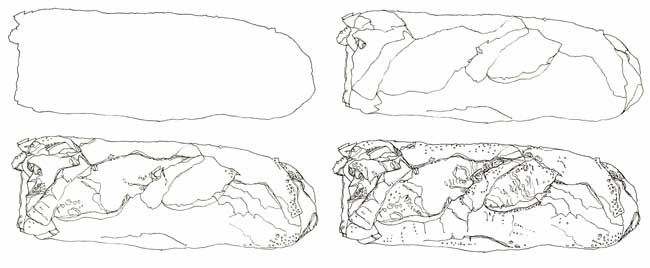
breadDrawing is seeing. If you can see, you can draw. But can you see?

Let’s see.

Looking is a language. Look: a dog, a tree, a car, a man. We apply labels — to things in order to understand and process them. In Genesis, God has Adam name the animals. Labels makes abstract thinking possible. But because we over do it, looking replaces seeing and we soon stop seeing things for what they truly are. We say ‘tree’ and stop saying ‘elm’, stop saying ‘thirty year old elm, with silvery bark missing in fist sized circles on the eastern half of its trunk, 37 foot 8 inch elm with 37,437 leaves, some mustard colored, others sap green”, and we completely miss going to the next level where language fails us all together, where things are so specific they can have no name, where they are absolutely real.

This is where drawing comes from. When you can look at something slowly and carefully and refuse to see it for anything but what it is – at this very moment – in this light – from this angle. And as you begin to see, you cease to be the many things that limit you. You drop judgments, cultural biases, history, and baggage. Time slows, and then disappears. All you feel is the pen on the paper, the slow cutting drag of the nib against the grain till even that sensation fades away too. You don’t think about art or what people will say or whether you are inept or ugly or stupid or self indulgent. You stop thinking about bills and aches and grievances and chores. You, your pen, your paper, your subject, you just are.

You sink deeper and deeper as you see more and more. You draw the edges and then the textures, the shadows, the textures and shadows within textures and shadows. The orange, the tree, the body you are drawing is just a landscape your eyes traverse. Your line takes you through adventures and surprises, over hill and down valley, into light and through shade. And eventually your journey brings you home again and you feel your pen thud back against the dock, the door step, and the world slowly cranks back up again like the merry-go-round it is and you come back to all your senses, sharpened, refreshed, renewed.

On your paper, there’s a map of your trip, a souvenir, only as accurate as the clarity of your vision. Keep it if you want, frame it, sell it, but it won’t matter – every twist and turn of the trip itself will be seared into your mind.

Are you ready to give it a try?