Don’t roll your eyes at me.

Scan 17

Imagine if your head was in a metal box and your neck didn’t move. In fact your entire body was rigid, like a quadriplegic locked into a wheelchair. You can only look straight ahead and, at any given time, your eyes are locked on a certain point. Some things are in focus, others are blurry and indistinct.

Fortunately that’s not how you see. But it is how a camera sees. A camera sees only from a one-point, locked perspective that creates a single image of a specific vantage point with certain focal characteristics.

When we look at something, our eyes constantly move about. Even if we are sitting down in a chair, our eyes dart around, passing back-and-forth over different details, noticing one aspect and sliding quickly to some other point, perhaps paying less attention to certain information between. Our impression of what we’re looking at is actually lots of different perspectives all blending into one undulating picture. And because our eyes focus on points that are different distances from us, flexing and bending our lenses, absorbing different amounts of light and therefore changing the quality of information that we absorb, all these different images that we are recording are in fact quite different from each other. One might have a wide-angle perspective, then one might feel like our aperture is more open, while another is focusing more on black-and-white information about edges or shadows, another is saturated by color.

Amazingly our brains take all this information and instantaneously create a sense of what we ‘see’. It’s not a single picture but lots of different impressions that are all blended together. (That’s what the Cubists were getting at, trying to record all those different angles and perspectives into a single painting to simulate the way that we see. They were trying to show the distinction between how humans see and what the camera was introducing. People think of Cubism as abstract art but it actually was an attempt to be even more accurate about literally how we see the world.)

This process of observing is what goes on when we draw too. If we are drawing a landscape, an urban street scene for example, we look at the corner of the building on the left in lots of technical ways quite different from the way we are observing the street sign right in front of us or the blades of grass below or the mass of leaves on a tree above. We look at one section of the view and record it in a certain way and then we change our tools, bend lines, shift focus, let in more light from the shadows, record details all in different ways. An interesting drawing is a record of all those different forms of observation on one place.

Do you see how fundamentally different that is from taking a photograph? The camera is observing everything in the same way at the same instant, with no consideration of what it is. But we observe in a cumulative fashion, first taking the scene quickly and then scrutinizing and observing a myriad of details.  When we draw from a photograph you don’t have the benefit of all those different forms of observation. We are locked into that single view the camera gives. It takes time and lots of  observations to record the rich scene before us. The image unfolds and gets more detailed from the more perspectives you acccumulate as you spend more time drawing. That’s what gives the drawing life, that someone was living when they made, living over a period of time. Photographs don’t have that advantage, that mystery, that richness.

Photos also don’t include all of the information that go into the experience of the moment. The photographer can’t record the smells, the sounds, the movements, the moments, the moods, that he is feeling and experiencing. His camera is just recording the light waves. But when you make a drawing you have the opportunity to convey all of those diverse experiences and impressions as well. The drawing done by somebody standing in an uncomfortable and cramped position is very different from the drawing done by somebody sitting in a plush armchair. The scene they are looking at is the same but the way in which they are seeing it is influenced by their physical comfort. So the person who is rushed, or in love, or worried about paying the rent, will make a different sort of drawing.

If you focus entirely on creating what you think is an accurate representation, it would seem that using a photograph as the basis of your drawing gives you an advantage. But the fact is the camera see the world differently than human beings do.  And that’s why drawings done by people are very different from the mechanical event that is a photograph, or even the mechanical process that is a drawing done from a photograph.

Life is so complex, so rich, so ever-shifting, and the wonderful power of art (that has never been eclipsed by the invention of the camera) is to capture that experience and share it with others who are also alive. See?

The Museum of You

Scan

For most of the history of mankind, mankind had little time for Art. People spent all their days just trying to survive, tilling the soil, tending to their herds, struggling to turn raw nature into subsistence.

Then we invented machines that could do a lot of that work and time opened up a bit. A hundred years ago, ordinary working people were finally able to afford musical instruments in their home, then they could buy radios, cameras, televisions. For the first time they actually had time to entertain themselves and to look for the beauty around them. Not just the beauty that they saw when wiping their brows and peering over the handle of the plow at the setting sun, but time to go to museums, to watch films, to listen deeply to music just for its own sake.

Of course, people have been making art for hundreds of years before this. But they’d been making art for the select few, those very wealthy people who had the time to enjoy it and pay for it. Royalty, then the rich burghers, and of course the church, art to tell stories to those people who had the time to come into the Cathedral on Sunday, and to be appropriately wowed and cowed by the display of gold, marble, and fresco that showed the true history of God’s works here on earth.

Artists used to be hired to perform, hired like gardeners, footmen, and stableboys. But since industrialization, being an artist who created works for his own satisfaction became possible. Artists could paint what was in their minds, could paint the things that they chose, humble subjects, everyday things, accessible beauty, and then those works could become commodities and be sold to those people of means who could afford them.

And the number of people who could actually be artists was limited. Being an artist has always been a struggle, a self-selecting profession, and very few people manage to survive. Rembrandt, Vermeer, Mozart, van Gogh, all died penniless. Ironic because the economics of the art world means that there are always limits to the amount of product available, limits that drive up prices, and generate profit for someone. And as today there are more wealthy people than ever, the limited supply of art becomes more expensive. That’s why these days we see record prices for art, for art that was created centuries ago but also art that was created last year. And we see certain people creating tighter and tighter markets for certain artists’ work, therefore those prices escalate, artificially. We are reminded time and again that art is to be made by Artists, by trained professionals, but certified by the establishment. The rest of us don’t have talent worth cultivating, can’t make anything of value.

But what about the rest of the emerging middle classes? What about all the other people who have moved up Maslow’s hierarchy of needs and for the first time are able to afford art and entertainment in their lives? They bought movie tickets, import recorded music, and the technology with which to enjoy it. And they bought museum tickets, tickets that now cost $25 or more. Access to museums full of art that was originally created for people far wealthier than them, people who did not share great art with the great unwashed but kept it behind their high gates and guarded walls.

What do you do if for the first time you have the leisure and the disposable income that will allow Art to fill a part of your life, a part that wasn’t available to your parents or your grandparents and ancestors before them? Well, it’s unlikely that you’ll be able to afford any of the art made by professional artists these days. Long gone are the days when one could travel to Paris and buy the work of the young Picasso for a few pennies on the dollar. Even today’s Picassos are already out of reach. Today there is simply not enough art being made by the system of Galleries and professional Artists to satisfy the needs of the more and more people who want and can afford art in their lives. That’s by design of course, making sure that demand will rise by artificially suppressing supply.

But there’s good news, for all of us who now have the time to make art a part of our lives. Because we don’t need to invest in the works of art that has been credentialed by the art establishment, we don’t need to look for art that is been marked up by Galleries, or bona fide by museums. We don’t have to believe the limitations of the established wisdom that identifies art made outside of the system as outsider, naïve, amateur, hobbyist, inferior. We may have just a little bit of spare change or spare time, but we don’t need to invest tens of millions of dollars in order to have beauty in our lives.

Instead we can start to value the art that appears in formerly blank sketchbooks, on empty canvases bought at the local art supply store. We can find inspiration by doing a Google image search. We can find instruction by looking at YouTube or enrolling in an online course.
The wonderful thing about the world we live in is that we all now have the time to appreciate art and we all can be free to make it for ourselves. You don’t need to buy into the same conceits that ruled the art world for all of those years, namely that artists were journeymen to be hired by the rich, the value of their work artificially inflated by critics, gallerists and curators. Know that we are free to take our leisure time and do what our ancestors did — till the soil, sow the seeds, and reap the rewards of homegrown art. Art that we can give as gifts, swap with our neighbors, share in our communities and enrich our lives. If we make it, it is good. It is a reflection of who we truly are —not passive shoppers or customers — but an inherently creative, expressive and productive species.

We are now entering the time of art with a small a, not Art that goes under the gavel and hangs in the hallway of billionaires, but art that is of us and is therefore infinitely more valuable to you and me.

We’ve moved from a time of no Art to a time of consuming Art and now to the time of creating art.

Have you gotten with the times yet?

Toast master.

toast closeup
I can smell the toast so deeply I can taste it. Not like “I want that so badly, I can taste it” but literally, like the atoms of carbonated bread have drifted through the air, into my nostrils, and pachinkoed down to the floor of my tongue where my taste buds are “Holy cow”ing about the yeasty taste of freshly toasted Italian bread. I have not been eating bread for a while, because I am middle aged and paunchy and this seems likes a smallish sacrifice to make in order to hold on to my boyish charm. I’m not completely convinced this is working, and perhaps I need a chemical peel, some Spanx and a toupee to really push back the years where they belong. Perhaps, but for now, I am just skipping toast.

I didn’t make this toast to eat, but to draw. It’s cooling and hardening and I can quite effectively tell myself that it will taste like cardboard and I should put the smell out of my mind.

I uncap my rollerball, bend back the covers of my sketchbook, look at the toast hard for a minute and then pick a spot to start. It’s in the upper left, my usual point of embarkation. I pick a corresponding point on the page and make my first mark. I move slowly and confidently at first, my eyes mainly snapped to edge of the toast, like a zipper. I slide along, heading right, enjoying a ziggedy path full of toasty landmarks. This is the easy bit; there’re lots of anchor points to reassure me that my line is correct. Then I hit a smooth part, an unbroken stretch, and my confidence wavers. I can deal with this  — I pause to measure the length of this flat bit, then backtrack, calibrating the distance traveled, and finding where that distance led me on the path so far. I locate a landmark on the edge of the toast, find its mirror on the drawing, then measure the corresponding distance. Now the flat path isn’t a mystery any more. I can say with certainty how long it is. I fire up my pen again and head down the road. Eventually I have circumnavigated the whole slice and am back in the upper left. On my page is a lopsided rectangle that seems to perfectly map the outer edge of the toast, all its harbors and lengths of coast navigated and known.

Now to bivouac then head inland. I look at the tiny holes that nestle against the crust. A freckle mass of pinholes where hot air escaped from the dough and pushed its way to the surface. I count six in a lopsided star configuration and copy them onto my page. Then I slide a wee bit to the left till I get to the next topographic event, a twig-shaped indentation, that goes down a fraction of the inch. I imagine myself roped up like a miniature spelunker and lowering down that crevasse. I note the footholes on the way down and copy them down in ink. I walk along the bottom of the cave, then spring back to the surface. I move on down to the next gathering of crumbs.
I continue across the toast like this for awhile, recording every indentation and protrusion, my drawing filling up with speckle and dashes.

Then I pause to survey the whole, rising up into the clouds above the island to see what I have wrought. I look around, take my bearings and suddenly feel queasy. The edge that I have been charting does not correspond with what’s on my page. I have been moving too quickly perhaps. Or maybe too slowly. I immediately feel regret, another drawing poorly observed, despite my pledge to be consistent and slow, to check every inch. The little horn that protrudes above the crescent cleft in my drawing is actually a half inch further along on the actual edge of the toast. I have jammed too much information and now my drawing is inaccurate. One mistake and everything that follows it dominoes further off the cliff. One slip-up and everything connected to it is off by more and more. Disgusted with myself, I hop across the toast and resolve to come at it from the opposite direction, hoping to deliberately distort the journey back in such a way that I will meet up in the right places, two wrongs making a right.

I head south and realize that the toast is far narrower than my drawing. My disgust deepens. Perhaps this is a lost cause. Perhaps it will work as an incomplete drawing and I should just quit now. Perhaps I should just eat the toast.

But then, the clouds break. I realize that I have forgotten how much room the thickness of the bread takes up. What I thought was the inner edge of the top was actually included the crust as well. I thought I was in South Texas but I am barely in Oklahoma. I am okay. I carry on.

I come across a large hole, the biggest one, a veritable dry lake that almost goes clear through to the other side. How do I deal with its shadows? I don’t want to cross hatch or simulate the lighting in any way. If I do, I will no longer be mapping and the tiny details will get lost in a wilderness of lines, lines that don’t describe actual observations but instead pretend to be light and dark. I only want to mark lines where there are lines. It’s a rule I set for myself early on in the trip.

So just look for more and more detail in the shadows. I indicate darkness not with the artificiality of hatching but by drawing more complex details in some areas and less where the light is stronger. Details create a sense of volume without pretending to be darkness.

I pull back up to a 50,000 foot view again. I see an area that looks more sparsely populated and head back down to see what I have missed. Another area also lie bald and patchy but i decide to leave it incomplete for the sake of contrast. If you add every detail, you end up with an undifferentiated mass. Pauses here and there to add the contrast that makes for drama and interest. The viewer’s brain fills in the missing details, staying engaged. Less work for me.

I darkening the lowest edge. It’s a conceit and rules violation because I vowed not to indicate shadows, but the drawing needs it, simulating a third dimension and lifting the toast off the page. Rules are meant to be broken, just so long as you acknowledge you know they are there.

The toast is utterly cold and dead now, the smell long dissipated. And so is my need to draw. I recap my pen, flip the book closed and wander back to the kitchen to see if there’s any celery in the fridge.

You talkin’ to me?


IMG_1831

I’ve always talked to myself. When I was little, I would narrate my doings, describing the astonishing thing I was building with Lego, the culmination of a stellar building career, summarized in grandiose terms by a plummy narrator, like a BBC biographical documentary.

As big, batty person, I talk to myself in the shower a lot, singing, using accents, getting louder and louder, repeating phrases I like just to feel them roll off my tongue and into the tub. Usually someone else in the house knocks on the door and asks if I’m okay.

I talk to myself when I make dinner, pretending I am hosting a cooking show, explaining how to properly julienne.

I talk to myself, less loudly, when I walk, immediately clamming up if someone passes by. Or sometimes I’l wear headphones just so it seems I’m just on the phone.

I dunno, I like to hear my voice in my head, and I like the idea of saying silly nothings that could amuse only me. Those I live with sometimes get irritated by my chipperness. They aren’t morning people. Or morning dogs. No problem, I’ll talk to the sparrrows.

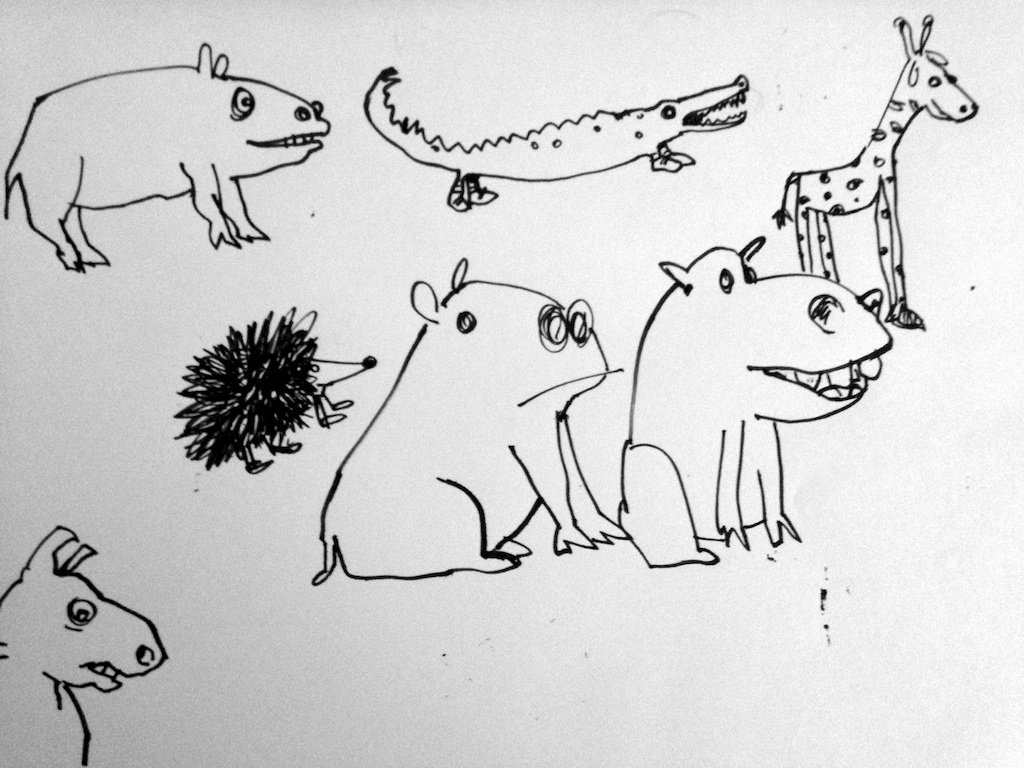
Sometimes drawing is like talking to myself, especially when I am drawing from my imagination. A couple of days ago, I listened to the radio and filled a page of typing paper with hippos, some buck toothed, some with trotters, a giraffe or two, a crocodile in ballet shoes. They spoke to me.

I like it, it passes the time, it is not for anyone but me. But I like to listen to whatever it is in me that wants to say hi.

Kiss all frogs.

Scan 18

When I was running a creative department a few years ago, I decided to make a film about creativity at the agency. Not about my department, but about people in accounting, account services, production, catering, media, and human resources. When I first put out the request for people to tell me about their creativity, the silence was deafening. Wasn’t that the job of my people?  But I insisted, and soon uncovered lots of examples of hidden creativity.  People who never saw fit to mention it in the office, went home and cooked incredible pastries, played the banjo, wrote sci-fi stories, won prizes for their roses, build radio-controlled helicopters, were in the Guinness Book of World Records.

The film was a smash and it opened all of our eyes. By removing labels, we discovered the hidden assets in our company. And we started using those assets in new ways, inviting new people to brainstorming sessions, giving them problem-solving assignments, asking them to help us crack the tougher nuts. Soon the whole agency was a creative resource. Instead of a few dozen people in my department, I could call on the whole staff.

We just don’t know where answers will come from. And when we insist on judging situations prematurely, we limit ourselves and our potential. Instead, we need to open up and stow the labels.

Invention doesn’t land neatly. We have ideas and don’t know where they go or what their purpose is yet. We need to honor those ideas — especially if they seem like mistakes.

For example, misconceptions are a sort of mistake that can lead to innovation. You mishear the assignment, you misread the brief, you misunderstand the problem, and 1+1 don’t make anything coherent.  Because the puzzle won’t snap neatly together, you really scrutinize the pieces. You come up with all sorts of explanations for this perplexing situation. You dream up new theories, new explanations for how things work.  Maybe you get a new tool and you toss away the instructions unread. You find a box of paints you’d forgotten about in the back of the cupboard and discover they don’t mix like they should. You visit a new country and can’t understand how they can eat what they do.

Most of these musings lead nowhere — after all, they’re built on a foundation of error.  But some of them, maybe just one, pivot your thinking, open your eyes to a whole new perspective. Your imagination struggles, flails and then comes up with a link no one has ever seen before. If the pieces fit too neatly, you’d be stuck doing the same old same old.

Sometimes knowing too much means not having room for the answer. Out of the mouths of babes (of all ages and all departments) come surprising insights, based not on experience, but on a fresh point of view.

Don’t be afraid to fail. Don’t shun your mistakes. Don’t burn bridges.

Our wastepaper baskets contain the seeds of revelations and brighter tomorrows.

P.S. Happy 616, PL.

Father’s Day

boothHow do you convey what it is to feel pride in your child? It makes one’s own accomplishments pale. Because it is your doing — and so much more.
It is the sum of the love and work you put in over the years, the lost sleep, the dilemmas, the improvisation, the fear that your own failings would leave scars. And it is a second chance at your own life, a do-over that lets you rewrite the decisions you came to regret. It is the high road.
But of course it’s not so simple. A child is not a puppet to toe a well-laid plan. Every child has her own intentions, his own hopes and flaws. And yet when things turn out well, when they amaze, there is no height more exhilarating.
I grew up without a dad and had to write my own handbook. And becoming a father was a scary business at the start. Every setback seemed so high stakes, so unutterably bleak. But I was fortunate to have a boy who rarely disappointed or scared us. Quite the contrary. And now I feel him pass me on the track, surging ahead to make his own brighter mark. For what more could I hope?
Being a father is a dance — step forward, step back; lead, follow; hold, then let go. You are investing your all in a person who is destined to fly away and then (you pray) to return.
And the stakes of that dance are so high. Of all the jobs you can fail at, none is more significant than being a parent. And we all fail. How we dance back from that brink is a test of our mettle and our ultimate effect on the world to come.
When your child is suffering or lost, there is no deeper fear or sharper pain. ‘Take me instead,’ you inevitably say. Because only parenthood reveals the awesome power of unconditional love, of how much even your feeble heart is capable of.

Another human that makes us more so.

Master of None.

Scan 7

I have always been a dabbler. I have tried so many things, thrilled at the initial excitement of learning a new skill.
Here’s a partial list.
In high school, I learned the basics of how to write computer programs in BASIC. I sort of learned to solder electrical circuits, to make picture frames, to throw pots, to weave, to make silver jewelry and cloisonné.  I formed a Marx and Engels study circle after school. I learned the rudiments of playing the banjo, the piano, the saxophone, the harmonica, the electric guitar and the vibes. I acted in plays and directed them too.
In my twenties, I learned about cooking, photography, carpentry, and construction.
In my thirties, I learned to bind books, to screen print, to ballroom dance, to lift weights, to edit film, to design books, to get around a golf course, and to change diapers.
In my forties, I learned to watercolor, to use a dip pen, to podcast, to properly pack a suitcase, to write in HTML, to use a DSLR, and to make ice cream.
So far in my fifties, I have dabbled in barbecuing, painting in acrylics, gardening, entrepreneurialism, and driving properly.

Despite all this dabbling, I am not especially good at any of these things. I am not an expert, not even particularly skilled. (I can sound like I am which can be useful to dinner parties, allowing me to find common interest with almost anyone, except rabid hockey fans.) And yet there is still an enormous attraction to me in learning something new, in going to YouTube to research instructional videos, in buying specialized equipment, in delighting at those first glimmers of ability.
Some of the skills I have tried to pick up seem like they could transform my life. Many just seem interesting. And many turn out to be a lot harder than I thought, frustrating me until I throw down my banjo in disgust, and wander away, beating myself up at another failure.
But I don’t regret being a dilettante. I think far-ranging curiosity is key to a creative mind. Though recently, I’ve wondered if I need to cool it and stay on track. Time seems to be finite and it’s better to refine what I know.
But then again, I’ve always wanted to try my hand at lithography. And boxing. And After Effects, Oh, and the ukelele. Yeah, the ukelele.

The Club

Scan 20

Over decaf, a friend told me of the time her teacher inherited a country club . Acre upon acre of sprawling grounds, putting greens, tennis courts, bungalows, a pool. Each August, he closed the club for a month, hung a chain across the drive, and filled it with artists, his students. He flew in models from New York and all day long they drew. At night they spread their work across the ballroom and he picked through the field of paper, a cassowary in a stained polo shirt, diving into the pile to pluck out a sheet of newsprint here, a watercolor there. As they sat cross-legged, smoking and paring the paint from their cuticles, he would weave a long twisting narrative that connected the works, a story of art and struggle and life.
This magical month of sunshine and charcoal and stories fueled the students through the year of ordinary living, until they could return the next summer to sip bottled beer on the club porch and pass around their sketchbooks once more.
I felt my cheeks grow hollow as I listened to this story from another era, a time of commitment and freedom I will never know. To live art so utterly, to learn without end, to share, to be young, to be led, to experience the drawing life as a mighty oak to add ring after ring to, never completed, always stretching and growing and failing and learning. Not a hobby or a vocation but a 24-hour life without end.
The story made me feel old and spent, standing on an empty train platform in the rain. Yearning for youth and ink and sunshine and possibility. Till deep in my head, a voice, a boy’s voice, said the sun was still shining and the day was still long.

Walk on the Wild Side

IMG_1614I have never been a great devotee of exercise. Maybe it was because I was always picked last for playground teams. Though I have gone through occasional paroxysms of gym-going and developed surprising muscles here and there, I would rather read a book.

My grandfather claimed to have been quite athletic as a young man and, to demonstrate his prowess, at sixty years old, kicked my soccer ball over the house and into the neighbouring bullock paddock, never to be seen again. Though he never went to the gym after graduating from the gymnasium (as secondary school is called in Germany), he was a doctor and, except for the smoking pipes, cigars and cigarettes, had a healthy and balanced diet throughout his life, (lots of veg, not much meat, etc).His one exercise regimen I remember is that he walked for half an hour every day and always took a post-lunch nap. It seemed to have worked — he lived to be 98.

The one form of exercise I actually like is walking. In New York, I used to work to my office and back each day, rain or shine, forty minutes or so each way. I don’t know how much it qualified as exercise —despite all those feeble studies that say mowing a lawn or brushing a dachshund or lifting an especially thick paperback is all the exercise the normal adult needs.

I walked as much as I did for other reasons. Taxis make me car sick and cost too much. Buses are painfully slow. I don’t own and wouldn’t drive a car in the City. The subway will do when it rains but there still a lot of walking needed to and from stations, so why not walk the whole way and save $2.50?  Bicycles get stolen and can get you killed. And it’s really hard to find  a decent rickshaw any more these days.

But the biggest reason: walking gives me ideas.

I have written huge chunks of all my books while walking the street of New York. I have written commercials, had life-changing ideas, worked out seemingly insoluble problems, and all while strolling through my favorite city in the world (sorry, LA!).

I’m not alone apparently. Researchers at Stanford University put people on treadmills and found that they were far more creative when they were walking. And even after taking a walk, they came up with a lot more ideas than before, up to sixty percent more! The researchers can only surmise why this is — perhaps it’s because when we walk, we feel good, and when we are optimistic, ideas flow. It could be because when you are diverting energy to walking, it’s not as available to the monkey, and right-brainish restrictions are relaxed. Your mind is simply freer, swinging its arms and whistling a happy tune.

Since coming to LA, I’m tempted to drive everywhere. But I walk my dogs for half an hour each afternoon and I try to walk to the grocery store a few blocks away rather than take the truck.  And even walking on a treadmill at the gym works and almost as well as strolling through a sylvan park.

How do I write while I walk? Well, I used to pull the journal out of my pocket and scrawl down thoughts in pen. But now, I use my phone. I am addicted to Evernote — I just launch the app, and the amazingly accurate speech recognition software turns my murmured thoughts into text which I can then refine when I get to where I’m going. If speech reco isn’t working well for some reason, I just make a little recording on my phone and listen to it later.

Amazingly, most of these ideas float up out of nowhere and, later on when I look at them, they seem magical. I don’t even remember having most of them. Getting those ideas down right away is key. If I clutch them in my mind, trying not to forget, my creativity freezes. The idea needs to be jotted down, stored and moved off stage for new ideas to show up.

Okay, see you later. I’m off to take a walk.

On beginning

Intersection_dog

Beginning starts with a dream.

A dream to draw.

A dream to create.

A dream to play the ukelele. Speak Portuguese. Ride a bike. Lose five dress sizes.

A dream to be what you always wanted to be.

A dream to finally face that part of your life that you’ve avoided so long because it shames you or makes you feel weak.

You hold that dream in your mind, you caress it at night, you turn it over and over and wish it would come true. That you could do this thing you dreamed of, effortlessly, fluidly, joyously.

And with that dream of doing this one thing come dreams of doing other things, of being other things, of feeling strong, and competent, on top of your game, happy. Complete.

Achieving this one dream feels like it could mean achieving all those others as well.

This dream means so much to you that you hold it delicately, like an egg that could shatter and dash all your expectations of yourself. To pursue this dream could mean to fail and so you take a long time before you muster the courage to take the first step towards reaching it.

So, beginning, starts with a lot—too much—at stake.

And beginning starts in a realm you can only imagine, because you haven’t ever been there. You’ve seen other people achieve that dream. You’ve seen the drawings they’ve made, heard theme singing that aria, tasted the soufflé they whipped up so easily. And you think you know what that must be like. You think you know what the journey there must entail. If only you had the courage to actually begin.

But so far, all you really have is that dream, turning slowly in your mind, lit by thousand candles.

And then a day breaks, more sunny than the rest, a day that fills you with a new type of hope, and so you decide to begin. You breathe deep and pick up that pen. You sit down at that piano. You dive into the deep end of that pool.

You are filled with exhilaration and hope. Your dream glimmers on the horizon

And then as soon as you leap, you flounder and flinch. You gasp. You sink beneath the waves.

The water is colder, deeper, and darker than you’d ever imagined.

That first line that you have imagined in your head is finally on paper. That first chord thunders across the strings…

And it is flat and leaden and ugly, the work of a fool. Nothing like what you had seen in your dream. You flail and struggle on, despair sinking like clouds over the moon, plunging you into darkness.

And then, through the shadows, you hear the first righteous wails of the monkey. Wails? Or hoots and cackles? That voice in your head that delights in holding you back has finally fought its way through the lavender  bushes and daisy fields that surround your dream, bringing with it an icy dose of ‘reality’. It delights at your failure, your hubris at thinking you—ugly you, stupid you, hopeless you—could do this thing.

It wraps a protective arm around your shoulder and starts to lead you back to safety.

“You don’t have to keep doing this,” it tells you. “It’s too hard. Your talents too meager. The teacher’s too  incompetent. This isn’t really your fault. Just don’t try it again.”

That monkey is in your head to keep from risk, from new experiences, from growing. That monkey voice was implanted in you when you really needed it, when you had to have a warning voice to say, “you’ll put your eye out with that, you’ll break your neck, you’ll catch your death of the cold.”

New things still make that monkey scamper out of the darkness with alarm. The unknown, the challenging, the scary, the hard. Things that could make you cry.

And it has a hundred tools up its hairy sleeves to keep you in check and on the reservation.  It can make you panic. It can make you beat yourself up.  It can make you lash out at those around you. It can make you freeze and suck your thumb.

  It can make you panic. It can make you beat yourself up.  It can make you lash out at those around you. It can make you freeze and suck your thumb.

This what happens when your dream first meets reality. A rude awakening.

You feel shocked. You feel hopeless. You feel humiliated. You feel blind to the path ahead.

The monkey says, “See, this is why you haven’t done this before.  Because. You. Can’t. Do. It.”

The monkey says, “Stop now, stop the pain, crawl back on shore. Go back to where you were.”

The sense of failure spreads beyond the task at the hand, this particular challenge.

The monkey uses this opportunity to tell you what a failure you have always been, at so many things throughout your life, at every new effort you ever undertake.

The monkey, of course, glides over all of the things you have accomplished, all the battles you’ve won since you took your very first step at 11 months. The monkey edits your life down to show you that you have done nothing but shit since birth.

You cry yourself to sleep.

You wake up, the sun shining. You are still you. But now you have learned one lesson.

That lesson might be if you try and fail, it hurts.

That lesson might be if you try and fail, it hurts and you should neverever try again.

That lesson might be that the pain is temporary. That you can weather it. That you are now a day older, a day wiser and that challenge is still there to be conquered.

You regroup. You uncap your pen. You charge once more.

And this time (or the next time or the tenth time after that), you suddenly feel a shift. You look down at your sweaty paper and one part of one corner of one wretched drawing gleams with hope.

It’s good, that bit there.

Through all the mangled notes, one cord rings true. Amidst all the collapsed and burned cakes and pies, one crumb of one cookie tastes sweet.

You can do it.

You have seen the first shred of evidence that you don’t utterly suck to the core of your marrow.

Now, that glimmer of proof may actually have been there in your first or second drawing or concerto or cookie. But you missed it. That first shock the monkey dealt you, that first brutal wakeup call, made you temporarily blind and deaf. When you first stumble and crash to the ground, your head is ringing, your nose is bloodied, and you can’t see straight. You can’t assess your work, you can only cringe and cover your head.

But when the day comes that your vision clears, your objectivity returns, you will discover the value in what you have made, the beauty, the reward.

And now you can clutch on to that one sign of hope.  You can continue even as you blunder through more mistakes, more beautiful, educational mistakes that teach you lessons galore with every ham-fisted stroke.

And that dream that started you off? It wasn’t wrong to have. Even though getting to that castle on the hill is harder going that you’d dreamt, you can look over your shoulder and see that you are getting higher and soon you are walking through clouds. That dream remains essential because it is the thing that keeps you going, especially when the going gets tough.

The monkey is still hanging on for dear life.  He still claws at your shoulders and ears as you struggle forward. But his grip is weakening. His voice is dimming. He is wrong. You can do it if you will do it.

You just need to begin and keep on beginning and discover that it’s the journey that is the reward. The dream is just to keep you moving forward, a mirage, fantasy. It’s the journey makes you smarter and stronger and better and happier.

Now, what would you like to begin?