Why me?


20130821-091348.jpgI try to be good.

I take a multivitamin each morning. I floss each night. I give to my local public radio station. I rarely beat or kick my child. Then this….

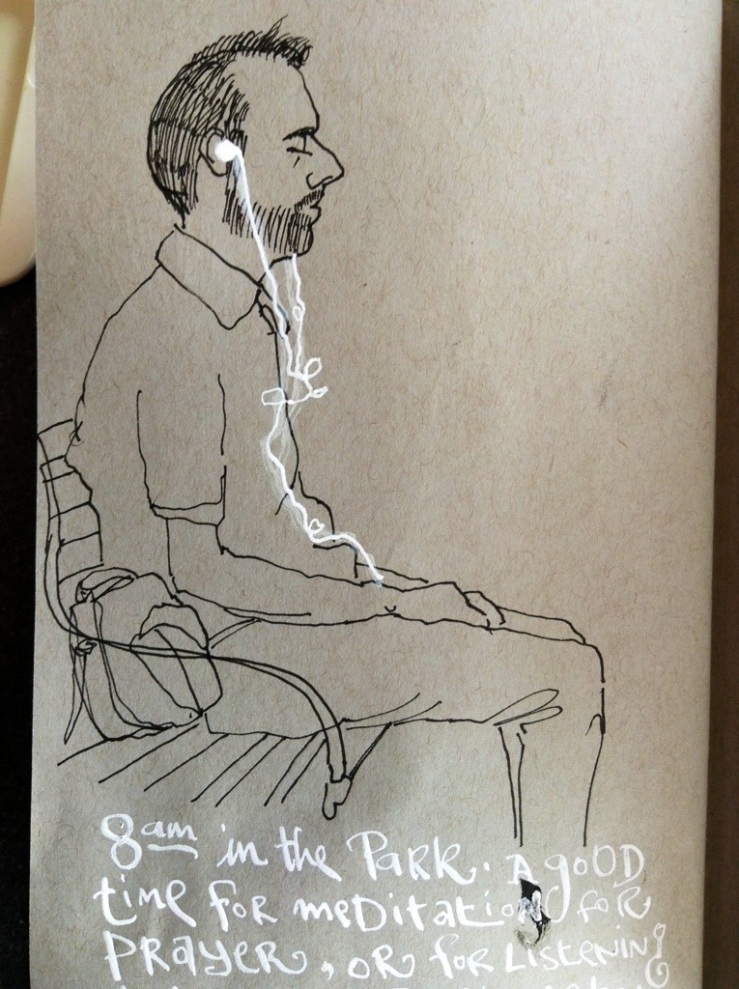
So this morning, I take my dogs to the park and plan to begin the day with a small drawing, nothing too challenging, a little amuse bouche. I see this guy on the bench nearby and it seems he is planning to sit immobile for a couple of minutes so I dash off the drawing above. At home I write a little caption with a dip pen and white ink and I am happier with a journal page than I have been in weeks.

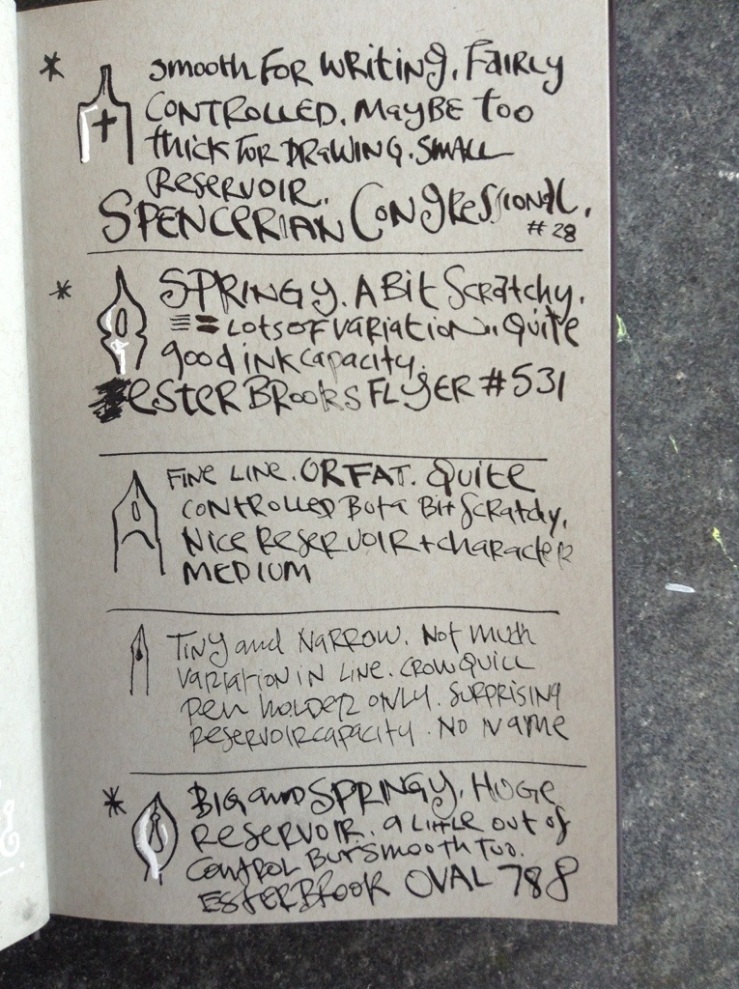
After breakfast, I decide to inventory my pens. I am going through a period of transition, easing away from markery sorts of pens like the PITTs and tending more to my dip pens. But I have a big messy box of steel nibs and I decide it’s high time to clean and inventory them. So I make a little page in my journal and chart my favorites.

20130821-091158.jpg


It’s a messy business, prying nibs off the holder, rummaging around in the vat of pen cleaner, ink and paper towels all over the place. I am trying to be fastidious but it really goes against my nature. An astrologer once did my star chart and told me I am something called “a triple Virgo” which mean I should be incredibly anal and neat and able to change a pen nib without courting disaster.

Hah ha. Not so fast.

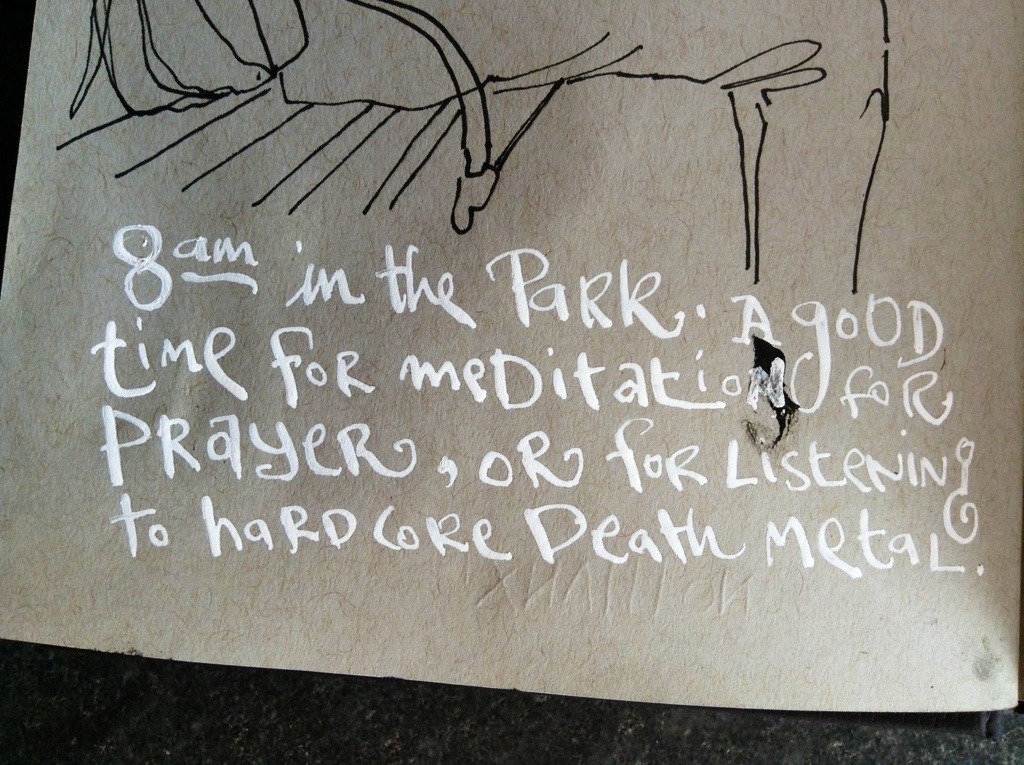
I look back at the left hand side of my spread, and somehow, mysteriously, damnably, I have managed to smear black ink across my writing. What the hell? You can see below, I try to fix it up with another layer of white ink but it probably looks even worse.

God. Damn. It.

20130821-091357.jpg

I tell you this sad story for a number of reasons. First because I am still in the grip of the anguish it caused. Secondly, I guess I can try to extract some sort of life lesson from it to share with you so at least we can profit from this disaster. What would that  be?

Do not fear mistakes. There are none.” WTF? That’s clearly not the case. That smear is a big, annoying mistake. It may not look it to you but to me, it’s a huge festering boil in the middle of Kate Moss’s forehead.

It’s the journey not the destination.” Again, I guess so, but the ink blot was part of the journey, the Montezuma’s revenge, the Metro pickpocket, the cancelled hotel reservation of the journey. Thanks for not much.

Slow down, butthead.” I guess. But I was trying to be slow and deliberate. Granted my whole dining table was covered with bottles and boxes and crumpled paper towels and my hands were black up to the wristwatch. I am a klutz and a slob so I should try to operate at 1/2 speed.

Maybe I should stick to crayons. And wear rubber gloves.

Epic.

snail2

My mother just sent me a link to a site documenting a journalist’s trek on foot from southern Africa to South America (I’ll give you the link in a minute). This isn’t just another endurance stunt —Paul Salopek is a Pulitzer Prize winning writer for National Geographic so his trip is all about science and journalism. He started earlier this year and will take seven years to complete the odyssey.

I have always been fiercely attracted to this sort of epic journey.

A few years ago, I was in thrall as my pal, d.price, rode his recumbent bike some 5,000 miles from Eastern Oregon to Key West. I loved Travels with Charley and On the Road.  Kon-Tiki by Thor Heyerdahl (finally a movie!), Bill Bryson’s Appalachian trail book, A Walk in the Woods, Cheryl Strayed’s Wild. The Happiest Man in the World by Alec Wilkinson describes Poppa Neutrino’s quest to build a boat out of garbage and sail it across the Atlantic. Mike McIntyre walked across the country with no money and relied entirely on The Kindness of Strangers (which is the name of his amazing book about the trip). The list goes on.

Ten years ago, I wrote a proposal for a book in which I’d follow the original epic travel journalists, Lewis and Clark, from St. Louis to the Pacific. I was going to adhere to their path and record the differences the couple of centuries had wrought. My editor said, “Make the trip, write the book, and then we’ll see.”  I didn’t. Life got in the way. Good thing Jefferson wasn’t counting on me.

Recently, Jenny has been urging me to drive across country with our dogs. I am sort of intrigued by the idea. Pros: 1. It seems romantic and epic and larger than life. 2. This is the perfect time of year for it. 3. It would be a great symbolic start to my life on the West Coast.  Cons: A) I don’t have a car. B) I think taking the dogs would make this a really bad idea. C) This is really her fantasy and she’ll already be across the country in her office in LA while I check into a long string of Motel 6s. For now, the cons have probably won but I still like the idea a lot, particularly if I could get a travel companion who I could stand to sit next to for a couple of weeks and who would be willing to stop and draw along the way.

Maybe next spring.

What intrigues me a lot about Paul Salopek’s journey is its emphasis on slow. He is taking seven years (!) to do this because he really wants to absorb the world as he goes. And he is looking for people along the way who are also seeking slowness in this madcap, speed obsessed world.

I think that’s the right thing to look for. Boy, it’s hard to slow down. I sat in the park this morning with my dogs and did a drawing. It was a small drawing, just filling a little box on the page, but I had to catch myself mid-way because I was tearing through it, barely looking at the arch I was drawing, just scratching out hasty, inaccurate and ugly lines. What the hell was my rush? It’s Sunday morning, I have nowhere to be till brunch, everyone else is sleeping, and yet I am belting through this drawing as if I was in an Olympic event. If I was Paul Salopek, I’d probably be half way to Rio by now.

Even though it’s been several weeks since I left the rat race, I still have my rat cleats on. I can feel it in the need I still have to accomplish things, to generate product, to log hours on my calendar. I so very much want to focus on the journey, the process, not the finish line but all these decades in the business world, in New York, still have me panting and pushing. I remind myself: I am on an epic adventure that will probably take another few decades to finish (in fact, I would like to push off the ending as far as possible) and what matters is the daily walk through life — the things I see, the people I meet, the lessons I learn.

If I’m really honest with myself, the reason I am not driving across country with my dogs is that the monkey is telling me I need to get to LA and start getting on with it. There’s no time for meandering and roses sniffing. I need to set up shop and start making something of myself. The monkey is wrong, again, of course. I make something of myself every day. It may not be something that can be direct-deposited, it’s true, but it’s also something that can’t be accelerated. Step by step, day by day, eyes open, head up.

—-

Here’s the link to Paul Salopek’s journey.  (I have put off giving it to you till the end of this blogpost for fear that you would rush off to read it and never come back to finish my blather. Clearly, I am better at slowing you down than I am at putting my own brakes on.)

My Summer Romance

In the interest of trying something new, I’ve recently taken to spending my mornings in a basement with a naked person and a pencil. The oddest part (if you’ll forgive an old copywriter the observation) is not the graphic nudity but the graphite.

As you may know, I have been a loyal pen man ever since I took up drawing last century. When I draw with a pen, I have always said, I am committed to my mark and so I draw more slowly and am fairly sure of my stroke. My line is decisive and, if it’s wrong, I must live with it and work my way out of the problem I have created.

But now, I have this pencil. Actually it’s usually a stick of graphite in a wooden handle with a little set of gripper teeth to hold it in place. And I must say, it feels sort of right for now. First off, I like the feeling of it in my hand, the chunkiness of it. And I like the organic variations, the way the mark gets soft and grey or bold and dark and everything in between. I like the range of hardnesses, the Hs and Bs with all their numbers and degrees of yield. I am least fond of the ends of the spectrum, the super hard H pencils that rip into the paper like cat’s claws or the utter spinelessness of the super soft high number Bs, malleable as turds in my paw. But in between there are a nice number of notes to play, combinations, of soft and smooth, hard and precise.

A long pose is a process and it starts by ogling. I stare at the model and paint him or her with my eyeballs. Then I take a few measurements, the overall height, midpoints, widths as a function of head heights, that sort of thing. Then I do a blind contour, my eyes slowly coursing over the edges of the body while my hand, unattended, records the line. I may look down at the page once or twice or not at all. Surprisingly, this first automatic line is usually pretty damned accurate, capturing the mood and balance of the pose, and it remains the basis for the several hours of drawing to follow. Maybe the knowledge that this is just a pencil line lets me feel comfortable and willing to take this blind risk. In any case, I can also go back in and correct here and there. I like being able to erase. It’s a relief after all those ink spattered years, like letting out my gut after I pass my reflection in a shop window.

Then I start remeasuring and seeing if my proportions will hold. I may have to erase an entire shin or redo the foreshortening on an arm — the first hour is all about tweaking and nudging until I can drop down on any point on the body and see that the angles and relationships are right.

The next hour or so is all about light and volume, trying to get a sense of the dimensions and weight of the body. I go back and forth, using the pencil sometimes as a tool that can blur and blend, and then one that makes hatches and crosshatches, creating tone out of marks. I still have one foot in the world of pen and ink, working in line as much as tone.

Finally, I’ll bring out my bag of colored pencils. I quite like all the colors and the fact that every color has so many permutations and degrees of intensity. though they don’t have the agility or smoothness of my sable brush and watercolors.

If you have had any sort of art training, you might be appalled by my technique but it works for me, these stages and homemade techniques, and I am reasonably happy with the process and my progress.

So I quite like the pencil, but it’s a summer romance, not marriage material.

The fact is, pencils make me feel like a wimp.

Maybe that goes with how i’m feeling these days, a little wimpy, a little less confident about my view of the world because I am evolving and changing. So maybe I want to record my life in pencil right now, and not to commit for the rest of time. I will not be getting a tattoo this month either.

Ink is forever. Pencil lines are more like thoughts, fleeting, evanescent, unreal. Any pencil drawing I do in my sketchbook is bound to blur and fade with time. Generally, I want to be confident and see and record the world as it truly is, but in times like these, when my life is turning a corner, and the view out of the window seems to blur, then maybe it’s more appropriate to render them in this fragile and temporary way.

This period of being soft and fragile and hopefully isn’t a permanent one. I’m in transit shuttling between one life, one coast, and another. Transit is a time of indefiniteness when you aren’t sure which suitcase you put your sandals in and if you left your toothbrush behind. But that’s okay, because when you get to your destination you can put everything in its right drawers and hang the pictures and reshelve the books. In the meantime, it’s okay to live with a little blur, to have erasers standing by just in case. Mistakes made in pencil are still lessons, but gentler, less consequential ones. Nonetheless each one helps me improve, perfect my line, tighten my observation, be in the moment, which is what this whole thing is about, this thing called drawing, and this thing called life.

On drinking the water.

20130811-164947.jpg
As our plane swooped down over Mexico, endless green filled the windows. My first instinct was to wonder what sort of farming this could be, dense, unbroken and stretching to the horizon in every direction. As the wheels touched down, I saw it was jungle, an impenetrable mass of unruly, complex life. The runways had been cut out of the wilderness but no attempt had been made to cultivate the creepers and trees. Nature was too vast, man too small.
Mexico is a mostly modern country with drive-through Starbucks and TGIFridays. But many Mexicans accept the unrelenting power of nature, impossible to dominate completely when the air is humid and the sun shines brightly all the live long year. Grasshoppers the size of iPhones, careen through the sky with chartreuse scales and hot-pink wings. Raccoons wander into four-star restaurants and take corn chips off the bar. Cars are sun-faded, concrete is cracked, donkeys walk slowly. It’s not a rich country, but that’s not the reason things seem shop-worn and resigned. It’s because Mexicans accept the inevitable encroachment of Nature, that it’s pointless to be fastidious when geckos will wander onto your kitchen counters and carpets of kelp will wash onto your freshly grouted patio.
I like it.
In New York, we have been beating Nature back for 500 years and we think we’ve won. So we can’t help but freak out when mice nibble on the organic granola box, when mosquitos find their way under our 600 thread count sheets, when Hurricane Sandy knocks out our wifi for a week. If Nature gains the slightest foothold, we take it as a sign that our entire civilization is crumbling.
I like that in general Mexicans are so much less uptight about perfection. They are cool if you do things that are a little risky — but hardly dangerous. Things that would have flocks of lawyers descending anywhere in the States. Unsecured seatbelts don’t have those annoying warning alarms. There are packs of cigarettes in the minibar. People build restaurants out of driftwood and light them with masses of candles. Some cars are missing fenders or bumpers and are painted patchily by hand. Most streets have no sidewalks or street lights so walking at night under starry skies can be an adventure.
We sat in a beachside restaurant that served food that would have been the envy of any entry in the NYC Zagat. But before our appetizer arrived, the waiters patrolled through with smoking pails, emitting clouds of burning citronella so chokingly dense we could barely see our $12 artisanal margaritas. The mosquitos and gnats were barely dissuaded but no one bothered to complain to the Health Department, pausing only to reach under our designer linens to scratch the welts.
Mexicans don’t value their lives less than their Northern neighbors. They just accept that we can’t control everything all the time. And that this acceptance makes life easier and preserves resources for more important things. Insisting on perfection makes thing a lot less interesting and spicy. It’s also a losing battle.
Maybe it was the heat or the Negro Modelo but my pen line was a little looser in Mexico. I did a number of scrawled pages in my journal, drawn half lying down, book propped against my spreading gut, mango juice on my unshaven chin. Maybe this was how Gauguin felt.
I am sloppy as a rule, but I’m not always loose. I value looseness because it feels more organic and expressive, more human, more natural, more the way life is. Less uptight, less gringo. Jack tells me his drawing teacher insists they draw standing up, with their pads on an easel, and that they draw from the shoulder, not from the wrist, to make bold and sweeping lines with their whole bodies. Flat on my back on my chaise, I am far from that, but I feel integrated, natural, in tune with my surroundings. My body, immersed in sweat and heat and verdant richness, feels sensual and at ease. My inner critic, the monkey is dulled too. He is chewing lazily on a mango in the shade, indifferent to my drawing. He can’t be bothered to nag me when we have the jungle at our doorstep. In Mexico, monkeys sit on your roof, squat on your car, hoot from the trees above your hotel window. But it seems they stay out of your head.
Over this past week in Mexico, I haven’t been as insanely productive as I might have been. But I have been more in tune with my nature. I’ve dismantled waves, I’ve counted grains of sand, I’ve listened to grackles eat French Fries, and I’ve felt the walls of perfection erode. Rules, goals and expectations, it turns out, may not help me make as much stuff as simply sitting in the sun and letting the world grow on around me.

Doing the wave.

20130806-200906.jpg
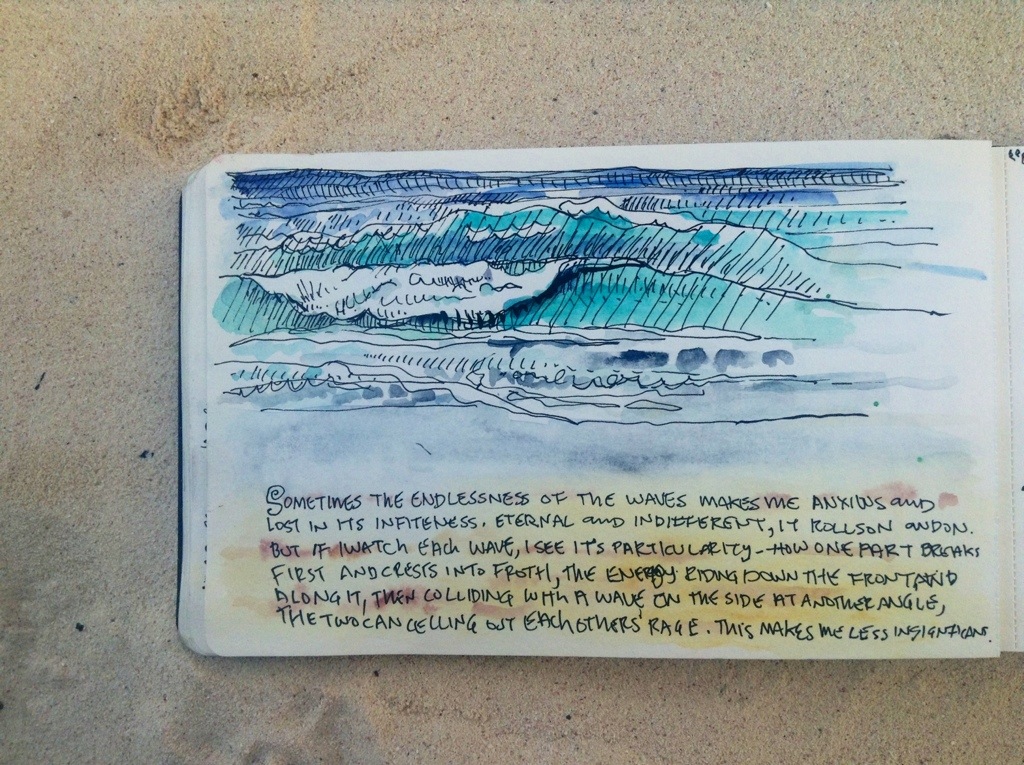
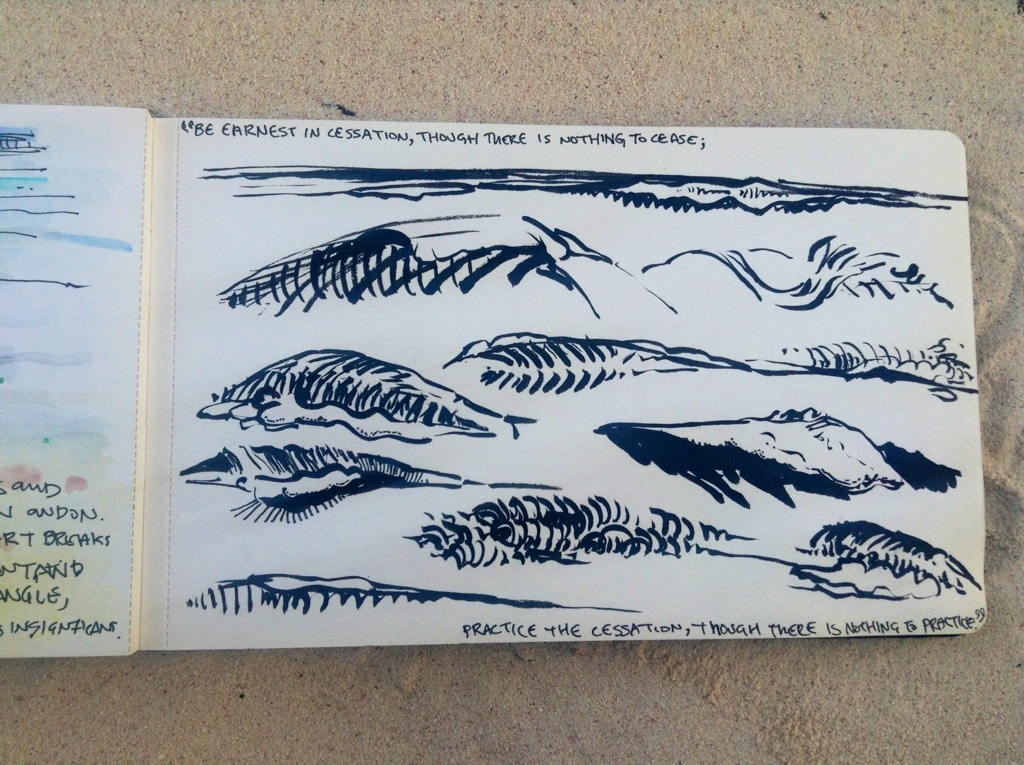
I spent last week in a basement in SoHo, looking at great length at naked people. I’ve spend the past two days looking as intently at the sea. I watch the waves and try to understand how to draw them, to turn their ceaseless roiling into lines on my page.
This close to shore, a wave’s life seems to last for five seconds, rarely more than ten. It emerges from the surface as a slowing building wall, some twenty yards wide. The pressure builds from both ends towards the middle and it becomes narrower and sharper at the peak. When I pull myself off my chaise and galumph into the sea to stand waist deep and cool off, from the side it is a narrowing triangle that reflects the sun as its angle grows more extreme. Its leading edges are dappled with bumps and ridges of energy that shimmer like the frosted glass on a public bathroom door, shadowy figures moving behind it, flashes of light bouncing of its front. The sun shines through its knife edge as it rolls forward, gleaming. Webs of foam are swept back from the ruins of previous waves and rise up to adorn its front wall, a white trellis quickly shredded in the wave’s rapacious path.

When the wall has grown as tall and thin as it can, it begins to collapse. A crest of foam appears along its battlements. The energy that was coordinated in the wave’s big charge now grows chaotic and splinters into fingers of white. The tongue of foam laps down the front of the wave and plunges into the surf, wrenching down its keystone and dragging it all down behind. Some of the froth ping-pongs on the surface, leaping to and fro, and then dives deep into the sand. The grandeur of the surge turns into a mad dash towards the shore, each water particle for himself

How the hell do I draw that?Leonardo tried. So did Hokusai.

So I watch a hundred waves wash in. Some are green, some blue, some auburn with kelp. My mind’s eye looks for a freeze frame, the single moment that explains the wave but is also of the wave. But though the waves arrives in a somewhat even rhythm, they are not purely cyclical. They follow similar patterns but each has a variation. Overeager waves shoulder past each other, jostling and disrupting the regular flow of energy, crashing the transition from hill to wall to blade to foam to shore.

So each drawing becomes an abstraction of waves in general. It’s impossible to track a single one perfectly. My pen’s not that fast. Nor’s my brain. I can record only the averages of my observations.
20130806-201209.jpg
Everything changes.

The best life-models aren’t the best looking or those with the best bodies. They’re the ones who can hold perfectly, unnaturally still and come back from their rest breaks and hit the exact same marks. They can look the same for three hours straight while I try to bolt down my powers of observation to notice the exact angles of their limbs, the creases in their hide.

Cezanne rarely painted cut flowers in a vase. He preferred pears and oranges that could sit in a still life for weeks without changing shape. His favorite subject was a mountain.

I am impatient, but training myself to be less so. To slow down and study, to be here and see what really is. Man, that’s hard. Especially when your subject jumps and changes its nature every millisecond. But the truth is, it’s not the sea I have to contend with. I am changing constantly. My eyes flit, my lungs expand, my heart pulses. I am all aquiver too, pulsing with nature’s rhythm.

Even if I drew Cezanne’s Mt. Ste. Victoire, or one of my beloved pieces of taxidermy, or a frozen photo of a great tsunami, I would be changing and moving. I change with every heartbeat. And even if I could control my breath and slow my eyes, the world would keep turning, the stars would keep dying, the universe would keep expanding, and life would move on. I learn with each line I make. I am different than when I began observing. The wave moves me too.

The Buddha told us long ago: Change is inevitable, suffering is optional. Roll with the flow.

FOM (Friends of the Monkey)

3-monkeys

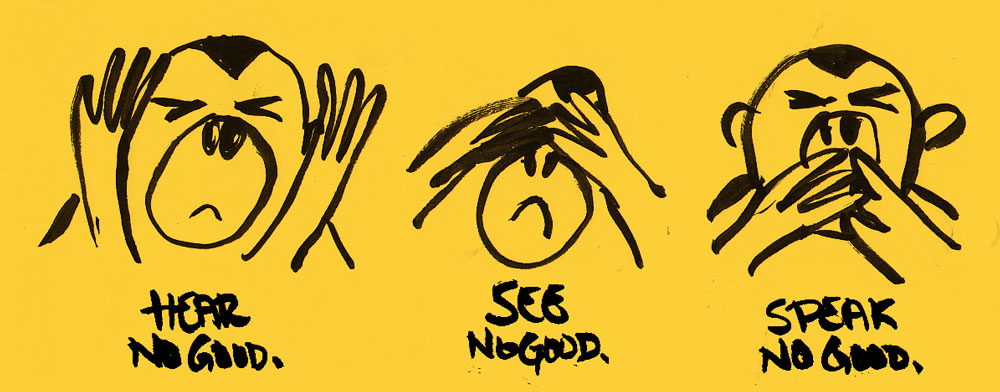
While your inner critic, that churlish monkey, sits glowering in your head, he has allies all around. They are camped on the hill and are riding in from all points of the compass, waiting for their colleague on the inside to lower the gates and let them flood in and maraud.  Most of these confederates are unwitting. They don’t know they are part of the army that can bring you down. But the monkey knows.

Some of them are driven by monkeys of their own. When you share your creative plans, your intention to start making art or to invest in yourself, they will start chattering from the trees, gibbering in fear. Fear for themselves. When you announce your brave decision to reverse the course of your life, to begin to make things again as you haven’t since third grade, you will set a shining example that will reflect back their own failures to live up to their dreams.

This isn’t universal of course. Many will applaud you and offer you encouragement. But skulking in the crowd will be those who are resentful and bitter and frustrated. And they will begin to lob suggestions, improvements, cautions, and advocacy for the Devil, designed to make you balk and backtrack.

Creativity is a particular magnet for this sort of monkey convocation. In my decades as a creative professional, I have encountered this spirit time and again. When I am awash with excitement at a new project or the possibilities of an assignment, these monkeys slink into my office, slump on to my couch and start to tell me the latest gossip, the latest management bungle, the latest reason to lose faith. They will complain about the assignment, the industry, the market. They will try to drag me into long sessions of venom and bile. They will splash me but I work to remain unblemished. Better to get up and leave that be infected with their toxicity. They are creative at coming up with reasons to stall and malinger, such is their monkeys’ gift of gab, and my own internal monkey howls with glee and joins the chorus.  These voices get me nowhere and need not to be heeded. Cut the chat short and get back to work.

And, while I am busy pointing fingers, let me point them at the mirror too. For in my own moments of weakness and doubt, I have been equally capable of joining or even initiating these grumblefests, feeling insecure in myself, acquiescing to the primate within and dragging in to a colleague’s office, leaning on my hairy knuckles. It’s a toxic affair that makes everyone feel, not purged, but depleted and sick.

Another band of accomplices are the media. The monkey loves the mindless vegetation of watching TV, numbing you with celebrities and gossip. Not the stories of artists and creative inspiration but the mindless doings of fabricated and often malignant chitchat. Besides being a time waster and anesthetic, the media can also skew your perception of art, artists and the true nature of success.

The banker is another friend of the monkey, cajoling you to focus on the bottom line. So is the electric company and the credit card company. They can make you do the monkey’s bidding, downscaling your ambitions because you feel trapped. They don’t deal in might-bes, they want theirs and now. They warn you not to take risks, to keep your day job, to be sensible. Of course, they have the right to get paid. But not to decide your future.

If you are a creative professional, you had to overcome the monkey just to get your career started. The monkey probably warned you and your parents: Don’t be a designer, an art director, an illustrator, an architect, a programmer, a musician, etc. It’s too risky, too competitive, etc. but you did nonetheless. But maybe now you see that the monkey finally let you follow this professional path but now won’t let you pursue your true passion — making art, speaking in your own voice, being your own client. The monkey giveth and he taketh away.

If you are wrestling with this issue, stop thinking. The monkey wants to engage you, wants you to obsess about his heckling and turn your creative energy into a response ego him. Don’t. Focus instead on what you want to do. Draw something. Write something. Then don’t look at it. Don’t judge it. Don’t show it to anyone else. Turn the page and write some more, do another drawing, dream another dream. When the books is done, fill another. Just keep going. Don’t ask for feedback from anyone who might derail you. Better to work alone in a cave than throw your work to the monkeys. Distance and perseverance are the best antidotes to this scourge. Build up your ramparts and lock the beast in your darkest, deepest dungeon.

Then get back to work.

Do you find your monkey has allies? What do they say? How do you deal with them? I’d love to know.

Tragedy in the Art world.

burnt-picasso

I just finished reading a horrible story in the paper. Apparently a Romanian woman’s son stole a number of works of art from a museum in Rotterdam, paintings and drawings by Matisse, Monet, Gauguin, Picasso, Lucian Freud and more. Convinced that if the paintings no longer existed, her son could not be prosecuted, the woman burned them all in the stove. Experts analyzed the ashes and concluded that her grim tale is almost certainly true. These masterpieces are lost to the world forever.

As I sat in the kitchen reading this sad story, my mind wandered off on a tangent. How many works of art have I destroyed? Not literally in my kitchen stove, but in the furnace of my mind. How many paintings have I not done? How many drawings have I aborted? How many pots have I not thrown? How many films have I not made? I thought of all the times I thought I should do some drawing and instead watched “Real Housewives”. I thought about that etching class I was thinking of taking last year and didn’t. Poof, all those would-be etchings went up in smoke. Or that three-week trip I took to Japan when I didn’t do a single sketch in my book. Or that Sketchbook Film we planned to do about a fashion illustrator but never got around to.

This isn’t the monkey talking, brutalizing me for my indolence. It’s just a fact. Every time I find a reason not to create, the art I might have made doesn’t exist. It may not have all been great art, worthy of Rotterdam, but it would have been another step on the path to better art, more fluid, more expressive, more fun.

What have you not made? And how can we fight the fire?

Fresh wisdom to trump the monkey.

3-monkeys

I was served two giant helpings of insight this morning, both in my email inbox.

First, this note from Evelyn:

Hi Danny,

I recently ran a drawing class for adults – a sort of introduction to urban sketching, really. On the first day I shared the story of my own rediscovery of drawing, a rediscovery largely fueled by Everyday Matters. I talked about letting go of attachment to the outcome, focusing on seeing and the connection that is made with the world around us as we draw. I said don’t wait for it to be perfect before you share what you draw.

One of the participants then told me, ” I don’t have much confidence and I have no experience. The reason I signed up for this class was because the drawing on the flyer was not that good.”

It was a drawing I’d done with a bamboo pen and ink I didn’t know was water soluble, so the watercolour kind of ran into the ink and there are some pretty messy bits.

This woman’s words made a big impression on me. There is so much value in modelling joyful imperfection!!

When I teach in high schools, I don’t teach art, but the same principle holds. We need to help people to be able to love themselves unconditionally. To be self critical without anxiety and to create fearlessly.

With gratitude for all you have given, and my best wishes, Evelyn

And then, on a different but somehow related note, this blogpost from Jennifer: Live up to your full potential. It’s a lovely perspective on how to judge whether you are making the most of your gifts.

What if we redefined what this whole potential thing really meant? What if, instead of having to prove our creative selves in a particular area of art, we could reach our potential by simply living artfully? What if, instead of striving to make lots of money with our art, or show just how technically perfect we could draw… what if we engaged in our everyday lives with an artful eye, probing the moments for beauty? What if, we reached our potential by daily living the life WE HAVE, the good and the bad, the mundane and the magical, with open arms and full hearts, celebrating and capturing some of it in an artful manner along the way? What if living up to our potential as artists had MORE to do with seeing the beauty in all of life and sharing it with one or more persons, than with being able to say we have devoted our whole lives to making a career of x or y or z.

To me, these are both conversations about the monkey, about how we can cope with the incessant jabber of our self-doubt and -criticism that wastes so much energy and time. As Evelyn points out, our ‘failures’ are in fact our richest lessons. The most important things is just to start, to make, to move forward, and to shun the wimper within that woud keep us forever in the starting blocks. That voice isn’t just an impediment, it’s a cancer that chews on us, winnowing us down to smaller and smaller versions of ourselves, as we brutalize ourselves with doubt and recrimination. Be kind to yourself, and be creative.

Jennifer’s lessons comes from outside, from the larger world that uses the dollars as the only true yardstick, from the golden monkey now internalized. This monkey voice is just one of the sheepdogs of economics and really has nothing to do with us.  It barks the simple cry of the market. For art to be valued financially, it must be a limited commodity. If everybody made art, it would be so common it would have no financial value. So our society is geared towards making art an exceptional behavior created by the few, a meager supply managed by the system of galleries and museums that turn human creativity into a market.

So it’s not surprising that when you graduate from crayons and want to continue creating art as part of your everyday life, you are discouraged from making at every turn. The only way that art can be sanctioned is if you pass through the system of art schools, galleries and critics that will cull the herd and protect the market.

Fortunately, the Internet has made it possible to share your creativity with other people and to get positive feedback and constructive criticism without financial transactions. The Internet has liberated us from the marketplace of art. It has restored the impulse for creative expression that has existed in our species since we painted bison on the  walls of caves.

This isn’t anti-capitalist. It is pro-self-expression. And it is optimistic. Because no matter whether it is stifled by the government, by religion, by the marketplace or by snobs and bores, ultimately that impulse will return and prevail. Now more than ever.

One of the wonderful things about the Internet is that value and scarcity are no longer inextricably linked. Now good ideas are what are valuable and good ideas can be copied over and over and shared with billions and still retain their value. We live in the golden age of creativity, a new renaissance. Now making art will no longer be discouraged. it will be essential.

art with a small a is not a product. It’s a point of view.  It’s a way of life.

art isn’t for museums. art is for everyday.

The Art world is about money. art is about passion, love, life, humanity — everything that is truly valuable.

How to kick monkey butt.

I’ve written a lot about the nature of the inner critic that confounds our creativity. And so far, I’ve urged you to fight it by just getting to work. That may not be as easy as all that, so let me be more specific with some ways you can push past that hectoring little voice in your head.

Just start. Do one small drawing on one small piece of paper. A Post-It. Or draw a loose grid on your sketchbook page and fill in one single square with a line drawing of your foot. Whistle while you do it. If the monkey starts to grumble, hum louder. Push off that inner criticism for 120 seconds until you can get something down on the page.

Creating something, anything, can break the logjam. And it can give you something to look back at hours later, to get excited about. Initially, the monkey may sneer about your tiny attempt but go back at it and look at it again. Find something to love in it. It’s in there.

Don’t talk about it. If you are having block, don’t endlessly discuss it and seek solace from others. The more you do, naming it and broadcasting it, The more you solidify the block, the more of  a living entity it becomes. Give it a name and you give it power. Stress over it and you become twisted and jailed.

My words here are a double-edged sword. I want you to be able to see that your problem is a common one, that you don’t suck any more than the rest of us. But the more we dwell on this discussion, the more attention the monkey gets, and the less time we are spending making something.

Give him a banana.  Try holding out some sort of reward to yourself. A bribe to get it done. Say, “if I do three drawings today, I can buy a new fountain pen. ” “Or I can watch TV for an hour if I draw during three of the commercial breaks”. Or “I can eat that donut, if I draw it first .”

Use this tool judiciously. You don’t want to end up obese, broke, or in jail.

donut

Get your lazy ass up. If the monkey tells you are a hopeless slug, agree with him. Tell him you want to improve and so you are going to set the alarm a little earlier and start the day right. Sit down and draw before your first cup of coffee. Fifteen minutes of drawing the reflections in the toaster as the coffee perks. Monkeys are lazy bastards too and they can’t get it together so early. I find I do my best work before I start reading email and talking to people and dealing with the day. Then for the rest of the day, I glow with that knowledge that I have already made art today and the rest is gravy. By knocking out a few drawings with the dawn, you will lubricate the wheels of habit while the monkey turns over and keep on snoring.

Do something you definitely suck at. Buy a medium that’s absolutely new to you. Draw on your iPad for the first time. Paint with ketchup on the kitchen counter. Play the digeridoo. By doing something you have never done before, you have the perfect excuse for sucking. If the monkey pops up, you can say, yes, yes, I know but this is my first time. Have fun. You’re making something. Sure, it’s no good. But keep going. Keep making. Keep exploring.

The great ape debates. If you can’t screen out your monkey, tune him in. Really put his critiques to the test. Ask the monkey to take the stand. Grill him.  But this time bring your inner lawyer to dissect his arguments.

Give the primate the benefit of the doubt. Take his arguments at face value and see if they hold any water. Maybe you do have room for improvement — none of us is perfect. You can learn and grow from self-examination. The thing we must avoid is self-destruction and abuse.

So, write down his complaints about you and come up with strong rational responses.  Write these down too. Next time the monkey levels these same criticisms at you, just tell him, “I’ve heard you and responded to the charges. What else you got?”

Stock your own arsenal. Sit down, like I’m doing, and come up with a bunch of ideas to trick yourself into sitting down and coming up with a bunch of ideas. If you want, start by critiquing my suggestions and then making up better ones that will work for you. Hate the idea of getting up at dawn? Fine, then draw at lunch, draw in the train, draw on the toilet. Come on, plus my ideas. What works for you?

The monkeys of yesteryear

old-monkey

Whose voice does your monkey channel?

Remember Linda Blair in The Exorcist?  The devil in her spoke to the priest in his mother’s voice, freaking him the hell out. Who is your demon quoting? Maybe it was the first art teacher who said something casual and cruel: “Remember, most people don’t have talent. I’m sure you’re good at something.” Was it your mother who you overheard telling your dad, “He wants me to pay for that painting class. I gotta break it to him, it’s an utter waste of money.” Was it the dean of the art school who rejected your application? The boss who killed all of your favorite ideas? An article about the percentage of art school grads who now work at Starbucks?

For all too many of us, the monkeys of the past are victimizing us, holding us back. Your shrink will tell you that we just have to realize that those monkey ghosts are only alive become we resuscitate them. You can defeat the specters by making stuff, by asserting your talent, by ignoring the grey-bearded monkey ghosts rehashing childhood bullshit. Want to relive an ancient drama? Read Hamlet.

Tell yourself this and believe it: whatever voice you’re hearing, it’s just a spectre. Whatever sword carved the scars into your psyche, you have the power to move past it. As grownups, we have the ability to see that the affronts and critiques of the past are just puffs of air that have long since dissipated. Only we carry them forward, re-recording them in the deepest wrinkles of the brain, keeping them alive year after year. 78 to 45 to cassette to CD to MP3. Same old song.

Every cell in your body is replaced every seven years.  You are a completely new being from cerebellum to big toe nails. You have the power to override the rewrite, to define these ancient wounds as irrelevancies that do not bear on the wonderful creature you are today, an emerging artist with great strength and potential.

You can prove your legacy wrong. Oh, your father wanted to go to art school but wasn’t supported by your grandfather and had to become an accountant so he spent your childhood channeling his pain into squashing you? To hell with that. Whatever happened before Watergate has a statute of limitations and should not crush the dreams you had last night. (That’s a little-known federal law).

Time for a fresh start that’s bright and creative.

What disappointments and harsh words are you reliving whenever you think of making art? How can we help you get past them?