
 Jack takes a lunch box to school but when he goes to summer day camp, his carrot sticks, cookie and sandwiches (unvaryingly: one salami, one PB&J), travel along in a brown paper bag. At one point, maybe it was last summer or the summer before, Patti asked me to write his name on the bag. Soon this became a ritual and each morning after breakfast I would do more and more elaborate calligraphy to identify his bag.
Then I started making up panels from super hero comics and printing them on the bag with my ink jet. This year I alternate between dip pen hieroglyphics and watercolors and gouache (which look great on the biscuit brown paper).
When I first came to America at thirteen, I got my first lunch box. I think I picked it out myself, a Scooby Doo model. It wasn’t long before my classmates started to snicker and then openly deride me for my cluelessness.
Before long, I’d gotten the message and began to brown bag it. No name or watercolors.
Summer Time Blues
I have been working fairly hard since coming back from vacation and, between that and trying to wedge in some drawing (and absolutely hating my ultra-expensive-from-the-tube watercolors as opposed to my tried-and-true Grumbacher set) and not doing enough guitar practice or going to the gym or telling my wife that I love her (in fact, she left yesterday morning to fly to Los Angeles for the Poseidon Adventure convention ( don’t ask) and various new book matters including signing my new contract and gearing up the Change Your Underwear publicity tour (apparently, I’ll be on CNN morning news, Good Morning America, Today Show , etc. after Labor Day), this blog has moved to the back of the pack. So, sorry about that.
A propos of nothing much but the fact that it’s summer and I’m working, I’ve been thinking about summer jobs I had as a kid.
 My first summer job was when I was eleven, and wanted desperately to be a veterinarian. I got a job working for the town vet (this was in a small Israeli town called Kfar Saba) who worked in the pound and the adjoining slaughterhouse. My job was basically to clean out cages and feed the dogs and cats but I also helped out where needed. I remember the sickly sweet smell of the gassing room and the stiff dog limbs sticking out of garbage cans in the back.
Someone once brought in a skinny dog that was entirely covered with shiny green ticks. He looked like a bunch of grapes and we had to shampoo him and pour kerosene on him then shampoo him again; slowly the ticks dropped off, squirting his blood onto the cement floor. A week later, the dog joined the others in the garbage cans in the back.
I was as ghoulish as any prepubescent boy and loved to hang around the slaughterhouse. The cows would be herded up a ramp and would meekly follow the cow ahead until they got close enough to smell the blood of the abattoir. Then they would raise their heads and roll their eyes and try to back down the ramp or climb over the rusting railing. One could have painted a line on the floor to mark the point at which they all realized their fate.
Once inside, men converged up on each cow and shackled their hooves. Motors mounted to the ceiling raised the shackles on chains and the cows would soon be dangling upside down and then lowered into a long metal tub. A board was put under the cow’s head and a rabbi stepped forward to slit her throat. To be properly kosher, the knife had to be so sharp that a piece of paper dropped onto the blade would be cleaved in two.
Next, the shackles were removed from the dying cow’s front hooves and the motor would hoist her up to be dressed by the butchers. A minute or two after crossing the imaginary line, the cow would be unrecognizable, a side of beef.
Occasionally I would help out in a two-story shed behind the slaughterhouse. Cow intestines were brought in by the barrelful and we would slide them through v-shaped boards that would squeeze out the contents into gigantic metal sinks, leaving us with empty sausage casing. The cow shit would run down to the first floor and into a cart tethered to a balding donkey. Without looking over his shoulder, the donkey knew when the cart was filled and would then trudge out of the shed and across the courtyard to a deep pit. He would back the cart against a pole upending the contents into the stinking pit. Then the donkey would trudge back to its post in the shed.
One afternoon, the rabbis discovered they had unwittingly processed a pregnant cow. I was called in to haul the purple fetus away and carve it up. The dogs ate it with relish, untroubled that the meat wasn’t kosher.
The vet’s thirteen-year-old son would occasionally hang around the office, snacking and picking his cavernous nostrils. One day, he announced that his father didn’t like me ‘ as a person. I was so upset by this first ever job review that I never returned to work. The vet called my parents, who were a little horrified by my daily descriptions of my job, and they decided for me that it was for the best that I spend the rest of the summer playing marbles and swimming.
At sixteen, I went to work at the McDonalds that had just opened on Court Street, rotating through all of the jobs in the restaurant. I worked the grill making Big Macs and burgers, twelve at a time during the lunch rush, toasting and dressing buns, searing frozen patties and stiffing them all into Styrofoam clamshells. Every few hours, I would scrape down the grill and then slide out the steel grease traps and carry them through the back door and into an alley. I would pry open one of the three steel oil drums that stood in a cloud of flies and dump in the grease and chunks of burnt meat. A seething bed of cream-colored maggots floated on the entire surface of the liquid within and would converge quickly on my offering. The smell was thick and alive and I would frantically slam down the lid.
I worked the register too, filling bags for sullen customers and praying that my register drawer would balance at the end of the shift. I made French fries, my arms slowly roasting under the heat lamps, my grill-burns stinging under showers of salt. Every week, an 18-wheeler would pull up to the curb outside and I would have to empty it contents into the freezers in the basement. I would pull a case of frozen burgers out of the refrigerated truck, carry it across the scalding July sidewalk, then down the stairs and into the store’s freezer, then up the steps, back out into the heat, into the frozen truck, back and forth, forty times. It was like training for a Rocky movie or the Iron Man triathlon.
The job I dreaded the most was working the lobby. The first part wasn’t too bad ‘ I pushed a little broom around and emptied the trashcans every ten minutes or so. I would drop the full bags through a steel door marked ‘rubbish’ and into a chute that dropped through to the basement. But twice a day or more, I would have to go downstairs and gather up everything that had come down the chute. This included all the bags I had dropped but also all the detritus that customers, confused by the sign on the chute door, had tossed down. Half eaten burgers, cups of ketchup, sodden French fries, dirty napkins, and diapers floated in ankle deep greasy water. All of this mess went into the trash compactor in the corner. Sometimes, I was so overcome by the smell and the vileness that I would rush over and throw up into the compactor, push the button to compact it and continue working. When I was done I would have to wrap wire around the bale and muscle it out of the compactor.
One day the owner took me a side and told me that since I was the only white employee, he had decided to send me to McDonald’s University to train to become a manager. I explained that I still had another year of high school to go and he told me I could get a GED later. I told him I was flattered but my parents had their hearts set on my going to an ivy league college. He looked at me like I had crawled out of one of the oil drums in the alley and told me to go down and compact the trash.
The next summer, after senior year, I worked in a record store. It was the summer of ‘78 and hald the albums we sold were the soundtrack to Saturday Night Fever. More modest hits that summer: George Benson’s Breezin’, Steely Dan’s Aja, and Fleetwood Mac’s Rumors.
I spent a lot of time studying the bins of records and soon knew the inventory cold. I developed a roster of regular clients who would come in on Fridays after work and they would usually walk out with a half records I’d recommended.
There were two phones next to the cash register and Peter, the owner was adamant that I not answer the white one. Occasionally, by accident, I would. The callers would invariably say they would like to ‘order a limo’. Whenever I passed such a message onto Peter, he would be irritated with me and tell me not to answer the white phone again. Other wise, our relationship was decent and he would give me occasional spot bonuses when I he saw me moving a lot of merchandise to my regulars.
Towards the end of the summer, Peer took me aside and asked me about my plans. I told him I was going to college. ‘Forget that, man,’ he said and told me that he would make me an assistant manager if I stayed. Besides the various girls who worked the register, I was the only employee so the promotion didn’t seem reason enough to cancel my plans to go to Princeton. ‘Come on, man,’ he hissed, ‘ I didn’t go to college and look at me now.’ I thanked him for the tutelage and again blamed it all on my parents. They had their hearts set on me going to an ivy league school. Peter glared at me and told me to get back out front.
The next morning he gave me an assignment. He had a wall covered with steel milk crates packed with records and he wanted me to move to his apartment, I spend the better part of the afternoon lugging them across the street and up to his fourth floor walkup. Halfway through, I realized that I would probably only be working for him for an other day or two and that if I quit now I could stop this back-breaking work.
Peter was in his bedroom with the door closed. I knocked and he said, ‘Don’t come in,’ so I went back to moving crates. After three more trips, I knocked again. ‘I need to talk to you,’ I said through the door.’ ‘Don’t come in!’ Three more crates. ‘Listen, Peter, I have to tell you something important.’ I said and turned the doorknob. Peter was sitting on his bed, which was completely covered by hundred of joints. He had a machine on his lap and was in the middle of rolling another one. Apparently this was the true nature of Peter’s ‘limo’ business.
‘Why’d you come in?! You’re fired,’ he roared. ‘I came in to quit,’ I said. ‘Well, you can’t because you’re fired! Just finish moving those crates.”
I went back to the store, selected copies of all my favorite albums and left the crates where they were.
 After my freshman year, I got a job working for my congressman, the Hon. Fred Richmond. Fred had been arrested a couple of years before for soliciting a young boy but, in a style that would seem very out of place today, admitted his guilt, did his time, apologized to his constituents if he’d embarrassed them and the following year was reelected with a huge majority. I was his assistant press secretary, writing press release on how appropriations were being spend in the district and inserting various ridiculous things in the Congressional Record: “Mr. Chairman, the 14th district of the great stat of New York would like to acknowledge 23 years of productivity from the Waldman Tool and Die plant on Nostrand Avenue….”
The next summer I became an intern in the White House. My joke about the experience is that Jimmy Carter lusted after me, but only in his heart. I worked for National Security Advisor Zbigniew Brezinski and occasionally helped out in Vice President Mondale’s office. The coolest thing about the job came each morning as I pushed past the tourists, waved my pass and strutted through the huge iron gates.
Despite the glamour, it was a shitty time. Each night I would take the bus way up north to Chevy Chase and sit in my rented room listening to my landlord scream at and then mercilessly beat his children. I was restricted form the main part of the house beyond my room and so I cooked on a small electric plate and washed my dishes in the bathroom. It was the summer of ‘80n and Carter was getting whooped in the polls. All of the political appointees were busy updating résumés and so I had only career bureaucrats to learn from. I spend most of my time in the White House library writing a paper on the War Powers Act that described how the president could commit troops to battle without congressional permission. This was during the Iranian hostage crisis and when the helicopters that Carter had secretly sent over the border crashed into the Iranian desert, my project tanked.
I decided to leave my internship but my mother and second step father were adamant: I was not allowed to come back to New York unless I had a paying job lined up in advance (I didn’t know it at the time but they were in the last months of their marriage). I was furious and decided to stay in DC and get a job.
I went to Georgetown and walked into the first French restaurant I saw. I was interviewed by the owner: “Have you any experience?” (I lied). “Do you speak French? “(Mais, oui) have you a tuxedo (I’d brought mine to DC in anticipation of the State diners I’d be attending). I started the next day, poured an entire dish of Boeuf Bourguignon on a patron’s Chanel suit and was immediately dismissed.
The next day, I went to a French restaurant on the other side of Georgetown. Same questions. with one addition: Where have you worked? I mentioned the place I’d worked the night before but not the terms of my departure. “Tres bien!” said the owner. ”That’s my cousin!” As he dialed the other restaurant, I slunk out the door. The following day, I was hired as a busboy at a Spanish restaurant. After lunch, the all Chinese kitchen staff asked me what I planned to do until the dinner shift. “Come with us!” the dishwasher said magnanimously. He had just bought a Camaro from the other busboy who had acquired a new Corvette from the waiter. I discovered their secret at the racetrack where they turned my $12 in lunch tips into $200. Clearly, I was onto a good thing.
Back at the restaurant, I discovered some sticky politics. The Maitre d’ who’d hired me was th partner of the chef who had been absent during the lunch shift. It turned out they absolutely loathed each other. When the chef discovered I’d been hired by the maitre d’, he fired me on the spot.
My next job was at a sandwich and ice cream store. I worked my ass off and ate all my meals for free at the restaurant. I didn’t speak to my mother for the rest of the summer and ignored her letters. By Labor Day, I had put aside $600, all in one dollar bills which I packed in to a suitcase and took back to New York. When I arrived home, my mother and stepfather asked me where I had been. With a dramatic flourish, I unlocked the valise and flung the contents into the air. “I’ve been making money like you told me to!” I cried, gesturing to the shower of green. They weren’t terribly impressed by my gesture.
The next summer I had one more restaurant job, this time at the chic River Café at the the foot of the Brooklyn Bridge. It was celebrity hangout of sorts: I peed in the urinal next to John Belushi and watched a waiter perform the Heimlich maneuver on Elizabeth Taylor’s escort.
Once a month or so, this mobbed-up guy would come in with a thick wad of bills and announce to the maitre d’, “I’ve got sixteen large on me. Help me spend it.” He sat with the stack at his wrist, tipping every member of the staff that came by. Each time he flicked his cigarette, a busboy would present him with a fresh ashtray and he would reciprocate with a fifty dollar bill. He even went into the kitchen and tipped the dishwashers and the sous chefs. By the time the night was through, his stack was gone. He thought he was big man. We thought he was a dick.
Our shifts would sometimes stretch from lunch till 4 am and the restaurant soon became my whole world. I was buddies with the Chinese busboys who would sleep on metal shelves in the pantry, nesting on the fresh linen. They lived together, squirreled away by the dozen into tiny walk-ups in Queens, and saved every penny they earned. After a couple of years, they planned to return to the Mainland to open restaurants of their own. My pal Phillipe was the valet and I would nip out when I could and we pile into a Rolls or a Bentley and cruise the BQE.
Tokoyama-san was the sushi chef and he would make me secret spicy tuna. One hot afternoon, as I worked on the outside cocktail deck, he made me a bowl of sashimi which I stashed under the bar. I would return to pick at the snack, not noticing that the raw meat had spoiled in the August heat. Soon I had a near hallucinogenic case of food poisoning and didn’t eat Japanese food again for a decade.
Inklinations
 The only downside to my vacation (and this will give you an indication of what a hopeless nerd I am) were a few pen problems. First of all, though we packed virtually everything in the house into our car for the trip, I left my trusty Rotring Rapidoliner in my bedside table drawer. The only reason for such an oversight is that I had just begin to use a device called the Rotring Art Pen — a sort of fountain pen that Richard Bell uses all the time and seems to swear by. I have been interested in drawing with a fountain pen of late because I like the more variable line it gives (I love my Rapidoliner because it flows so smoothly but the line can seem a little mechanical and rigid at time) and so I have been two-timing the Rapidoliner with this long, black stranger.
The Art Pen has one obvious design flaw, the back end tapers to a near point which mean that when you take off the cap, you can’t snap it onto the back and have to lay it down somewhere and then be mildly distracted about whether or not you’ve left it behind which may effect your drawing in a sort of stone-in-your-shoe sort of way.
Then, poolside, I discovered a more significant problem.
 The Art Pen comes with a half dozen little prefilled plastic ink cartridges. The ink, I discovered after laboriously drawing this geezery couple and then beginning to slather on the old water color, is not waterproof. The ink began to branch out into spidery tendrils and my lines became fuzzy.
Fortunately I had bought a special bladder, the “Piston Fill Ink Converter”, that allows me to fill the pen manually and later I tossed out the feeble cartridge and pumped in some India Ink.
 Another minor problem arose which is that the bladder, which is a sort of syringe that you advance and withdraw by rotating a little stick at the end, doesn’t seem to draw entirely of its own accord and one must ocasionally recrank it up and refill the nib. If you don’t do this very carefully, big drops of ink fall onto your drawing.
All that having been said, I continue to use the Art Pen but plan to send Richard a nasty note.
I’ll admit, I am a fickle pen owner. I search for years, find perfection, but my eyes keep roaming. Another pen I keep on the side is called the Grumbacher Artist Pen (there’s not alot of creativity in the pen naming community, it would seem) which has the teeniest needle point and the same pointed-end, cap-losing design as the Art Pen.
It is not refillable but the line is so fine it seems to last forever anyway. I did a drawing or two with it on my trip and still quite like it but for optimal performance, use very smooth paper.
Finally, the Art-Pal Creative pen — a very groovy-looking, gold pen with a brush nib that you fill with the ink of your choice. Looks, however, are horribly deceiving. It is a piece of junk. I filled it, used it briefly twice, and the nib sort of crumbled and the tip broke off. It might be possible to replace the nib but the pen came from Jerrys Artarama with no instructions and no way to buy new nibs. I’ve written to them for explanation but so far they have been mute.

 And finally, I am determined to pick up some gouache today. I tried working with watercolor and no line drawing but the results felt wishy-washy. I need to be able to add a layer that is more defined and sharp and bright on top of watercolor and I have resorted to white ink put on with a dip pen and then tinted the ink with watercolor which works okay but is fiddly and hard to control.
I’m sure if I paid better attention to my lessons from Roz I wouldn’t have this dilemma but it seems easier to just buy more art supplies.
Bunnies or Jesus

You are not here merely to make a living. You are here in order to enable the world to live more amply, with greater vision, with a finer spirit of hope and achievement.
– Woodrow Wilson
One of the things I love about my friend Julie is her relentless energy. She is a sculptor, a painter, a photographer, and a hardworking entrepreneur who doesn’t hesitate to apply her enormous creativity to ways of funding her art.
In the last few years, she’s put her welding torch to work making furniture and fixtures for corporations that bought her art supplies and paid the mortgage on her farm. When she was in art school and realized that she could get a lot more than the minimum wage cafetraeria workers by making jewelery and selling it dorm to dorm. But back when we first met her, before Jack was even born, she lived in a crowded storefront on Elizabeth Street. She made money painting murals for fishmongers, and built elaborate iron fences entwined with grinning animals for the local school.
Every so often we would get a postcard from Julie: “I need a new refrigerator and will be having a drawing marathon on August 18th” or “I need health insurance and will be doing a drawing marathon for 24 straight hours.” For $25, she woul;d send you one of the drawings or paintings she made and you could pick from one of the themes listed on the card: President Kennedy or dogs; war or fishes. One of the best was on Easter: pick either a bunny or a Jesus. The bunnies were horrifying plaster casts with taxidermy eyes; every Jesus drooled blood with insane googly stares.
We would often drop by her studio during the marathons; there would always be a few other people around, drinking jug wine and talking to each other whole Julie spattered ink and paint, taking a break now and then to chat. It was fun fore every one and paid Julie’s dentist, Con Ed, and MasterCard.
Art ain’t about galleries and museums and the like; it’s about love and sweat and bits of yourself. Don’t be stingy. Don’t be afraid.
——–
P.S. I never mentioned here before what happened just a few days after I went up to visit Julie and her farm last month.A freak tornado came through and lifted her lovely pre-civil war farmhouse three inches up in the air and dropped it, twisting the walls. It dinged the front of her painting studio. But her welding studio took the full brunt and went from this to this. Julie’s fine and so was her poodle Tess. But then, too soon after, Tess a teenager, passed away from old age. It’s been a tough time for Julie but she’s pulling through with a lot of courage and help from friends, family and insurance companies. Her spirit won’t be phased.
See more of her great work on her website.
Desk Job
 It’s taken me months to get around to cleaning my desk. I’ve just chucked things into the back of it, and they’ve accumulated in tectonic layers. I have a general sense where important things are and can root around in the heap and eventually find them. There’s a letter rack back there on the left and my drawing book, watercolors and favorite pens tend to be stacked somewhere on the front left. My color theory homework tends to be somewhere in the back right, there are second-string pens unsorted in cups and jars somewhere in the back and my Wacom tablet’s there too, I think. My passport is in one of the top drawers and the charger for my camera is probably in the second drawer from the top, underneath. The other 90% of the stuff is just an undistinguished mass. Loads of things have just disappeared into the swamp unlabeled, un-databased, unremembered, and I forget they ever existed.
I’ll take some or even most of the blame. Other factors: Patti’s desk tends to accumulate junk at a far faster rate and regularly disappears under the enormous pile like the Collier Brother’s dining table. The other factor is that my cool teak 1950’s Swedish desk is just to damned small. It’s just 40″ across . Once my laptop is opened and room cleared for the mouse, I have barely enough room to plant my elbows on either side. It’s basically impossible to draw at, so I use my lap and balance my paints on the corner.
Before Jack was born, we went shopping for a house in the country, an idle sort of thing, with no real conviction behind it. The place I remember best was an early 19th century place that belonged to an 80-year old widow, somewhere near Connecticut. Her husband had been an illustrator and we were shown into his spectacular studio with loads of room for drawing tables and easels and leather chairs and various tables still set with his cans of brushes and pens. It had an enormous floor-to-ceiling window, a good twenty feet high, looking out into the garden and the forest beyond which flood the studio with light.
I mentioned that memory to Patti a few months ago (it had prompted me to write an essay called “Art Supply porn” ) and she though that maybe we could do something to give our own apartment more of that feeling. After all, we rarely have people over to sit in all of our arm chairs and eat at our dining table maybe once a month. Most of the time the place is piled high with half-finished projects and games and musical instruments and stuffed dead animals. The decor is still pretending we have some sort of normal life we never actually had. So one of these days we will move out credenzas and knicknacks and move in drawings tables and flat files and the like.
In the meantime, I have to deal with this reality. So I set to straightening my desk on Sunday morning. I sorted drawings projects into individual manilla envelopes, labeled some boxes and files and sorted through the papers I didn’t toss, and uncovered a handful things I would have bet money that I’d never owned or even seen before:
– A Superman-in-chains rubber stamp
– An unopened 2 oz. bottle of black sumi ink
– A badge from the Webelos with three woven ribbons studded with 12 pins depicting a car, a ghost, gears, the constitution,a palette, a swimmer, a mountain and various other doodads
– My grandmother’s hammer/tool kit
– A pin from a Peruvian restaurant called Bajo el Puente
– One left brown glass eye in a case
– A box of linoleum carving tools
– The Speedy Stitcher® sewing awl
– An unused box of 24 Conté crayons
I used the last item to draw an ‘After’ picture. I don’t think I’ve used them before. A little smudgy but they have a distinctive chalky feeling I quite like. I sprayed the whole deal with stinky fixative afterwards, hoping that would keep it from mucking up my journal and my nice clean desk.
By George
 While I was drawing this, after dropping Jack off at school and sitting under the Washington Arch with its two newly restored statues of the general/president/slave owner/lumberjack, I heard something soft land on the ground ahead. Then, through the proscenium of the Arch, a man strode onto the stage – a 30ish black man in a tuxedo, sans the jacket, which he’d just thrown at the arch. He yelled at the top of his lungs: “Fuck you, George Washington!” Fuck you!” Then he picked up his jacket and strode offstage.
Another morning in New York City.
I drew the lines with my Rapidoliner and inked in the trees with Dr. Martin’s.
I contain multitudes
I am a wiry cowboy or maybe an ex-con, sideburned, sunburned, sheathed in jailhouse tats, wearing Dickies, Vitalis and Old Spice, a hand-roll dangling below my Fu-Manchu, stonily silent, a solid peckerwood who’s 1000-yard-staring through glacial blue eyes.
I am Robert DeNiro as Vito Corleone in Godfather II. Poised, determined, resourceful, lethal.
I am Aimee Mann: thin, blonde, beautiful; cynical, hilarious,profane; part angel, part construction worker.
I am Eminem.
I am Miles.
I am Tyson.
I am the Dalai Lama.
I am Jimi Hendrix: my fingers scrabbling and singing across the strings, my cheeks sucked in, my eyes closed, my shirt a riot of psychedelic paisley.
I am Steve McQueen, leaping the barbed wire fence into Switzerland on the back of a stolen German motorbike.
I am Francis Bacon.
I am Warren Buffett.
I am Jesus Christ.
I am Keith Richards: kohl eyes, turtle skin, brown bony arms gripping my axe.
I am Curtis, holding a piece of cardboard and a cup on Sixth Avenue.
I am Vincent in the wheat field.
I am Arnold, winning Mr. Olympia yet again.
I am Henry Miller, fingering in Clichy, scribbling in Brooklyn.
I am Dy Thomas, blowing a fag end into a BBC mike.
I am a spotty fourteen-year-old with a meager moustache.
I am a bloated middle-aged bald man.
I am a corpse.
I am Chas Eames.
I am Dick Feynman.
I am Wally Whitman.
—
Last night I was thinking about how hard it is to stay in my own skin. Maybe that’s the way art is supposed to make you feel, to catapult you into another aspect of yourself and let you dwell there a while. Or maybe that’s just what it is to be human and to try to live an examined life.
I’m reacting intensely to all of the things I am going through right now, all of the different audiences I seem to be strutting past. I want to’ be me’, to express that me-ness, and yet it is so varied, so contradictory. There’s me as husband, father, son, and brother. Illustrator, author, blogger, copywriter, professional, and novice. Teacher, student, know-it-all, and idiot. Ad guy, art-guy, ugly American guy, and Registered Alien. Jew, Christian, Buddhist, and atheist. Hermit, tireless self-promoter, success, and failure.
It’s not really that I’m seeking the answer any more. My adolescence is so far behind me, and I have worn out my allotment of mid-life crises. It’s more that I’m perpetually restless, only temporarily satisfied with every conclusion.
Perhaps this is the biological imperative that moves successful organisms towards adaptation and evolution. Those who are content to keep chowing down on a certain kind of leaf or to hang out by a certain waterhole are secure … until the shit comes down. Then it’s only those shifty, scuttling rodents in the undergrowth that make it to the next level. We are the descendants of every successful shape shifter there’s been till now, the freakiest of all mutated freaks, and these days, as the shit comes down more heavily than ever, only the unsatisfiable will survive. So perhaps I’m working my way up to missing linkhood.
Or maybe I’ll just be the first lemming off the cliff.
Or worse yet, somewhere lost in the middle of the herd.
Homeless Journal
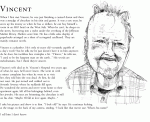

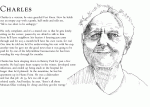
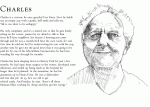
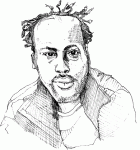
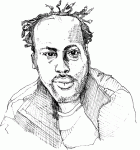
Recently, I found myself angsting about money. I decided that I should go out and talk to people who had none. I approached homeless people in my neighborhood and asked them to share their stories with me. At first it was terrifying, breaking the barrier. But I soon found that if you don’t want anything from people but their story and perspective, they are enormously forthcoming and trusting. They’ll soon forget to wonder why you’re asking.
These images and stories were published in the Morning News where my journal entires were transcribed into text.
All Quiet on the Artistic Front

Where’s Johnny Got his Gun? Where’s All Quiet on the Western Front? Where’s Catch 22? A Farewell to Arms and For whom the Bell Tolls? From Here to Eternity? The Naked and the Dead?
Where’s Guernica?
Where’s Alice’s Restaurant? Where’s All Along The Watchtower? Where’s Give Peace a Chance? Boogie Woogie Bugle Boy? We Gotta Get Out of This Place? Born in the USA? Rocking the Casbah?
Where’s The Star Spangled Banner?
It’s been three years since 9/11 and yet, (except for a couple of forgettable efforts from Springsteen and Bowie, a few made-for-TV movies, and Michael Moore’s upcoming Fahrenheit 911) artists don’t seem to have responded in a significant way that has caught on with the public. Where’s the first great anti-war hip hop song? The Whitney Biennial was great but if any of it referenced 9/11 and the Afghanistan and Iraq wars, I missed it.
Granted, it may have taken a few years for great art to emerge from other wars, and so far no one’s been drafted for this one, but we live in accelerated times and all feel threatened and yet there doesn’t seem to even be a movement afoot. These events are changing our lives and our world, and people all over the planet seem to have strong feelings about it and yet, the music, film, fiction and art world seem way, way too peaceful.
A new old friend

Sunday afternoon, I was walking through Astor Place when I saw a man in a familiar position, hunched over a big old moleskine, a pen twitching between his fingers. I knew, from across the road, that he was drawing in a journal.
As I approached, I suddenly realized it was my old partner, Tom Kane. We’d worked together in the mid-80s, dreaming up advertising campaigns for Life magazine, for cigarettes, for Barnes & Noble— we even did a very early rap song about IBM (“We were the mothers who invented high tech, now everybody wants to play Star Trek, but there just ain”t room for all that crew, all the wildest ideas come out of Big Blue, etc…).
Although I never saw him actually draw, I had seen a few pieces in his apartment, near-photorealistic paintings of pop icons, horses, and women. He obviously had a lot of talent but he expressed it on the sly. We’d lost touch over the next decade, but hooked up for a long, candid noodle lunch three years ago. Then I, in my executive haze, lost touch with him again. And now here was Tom drawing in a moleskine. What a weird coincidence.
Tom looked up from his page and, seemingly unsurprised to see me, immediately told me that he had been bought multiple copies of my last book and been lurking around this blog for a while, my book, all of which had inspired him to start keeping his first ever journal. I was floored. It was so strange to find someone who I knew and admired as a very creative and talented person hooking up with the Everyday Matters crew.
Well, as you can see from the drawing Tom was doing at the time, he sees very well. Look at how specific each window is, not just a row of squares but the very particular windows, one by one. His crosshatching is rhythmic without being monotonous, reminding of my all time favorite, r.crumb. I also love the way he fills the page, how he uses the negative space of the sky and integrates his text right into the scene. It’s a great drawing and a beautiful exercise in mediation.
Tom is a very imaginative art director. If you’ve ever seen those wild, bubble headed girls in the ads for Steve Madden shoes, you’ve seen what Tom does in his day job. We dropped over at his place and he showed me dozens of fantastic paintings, photo collages, drawings and rows of tomato cans. I could sense that he is being called more and more to devote his energy to making things that express his passions rather than peddling ladies’ shoes. I hope he follows that call.
In the meantime, I have a new journaling buddy to roam the streets with. What a happy accident it was, running into him.
 Danny Gregory
