$urviving

One of the chief obstacles many creative people face is how to cope with the intersection between our creative and our professional lives. Is drawing, painting, photography, music, whittling, just a hobby? Or are we serious about it and wiling to throw ourselves over the cliff’s edge and base our livelihood up on it? Anxiety over this issue is what derails a lot of us when we are young. Do we go to art school or a “real” college? Do we spend the rest of our lives in a split-level ranch or a garret? Do we break our parents’ hearts or become accountants?
Like most things in life, it’s not that black and white. People who make money doing creative things usually reap a varied harvest. It’s never 9 to 5 and the paychecks are rarely steady but there are more and more ways to sell your creative products. It’s not about getting your slides accepted at a New York gallery. And your patrons may be people just like you, not just investment bankers looking for investable art. For example, the internet means you can show and sell posters of your work and never leave the farm. You can sell drawings and jewelry and t-shirts and greeting cards and zillions of things.
And most importantly, you can call yourself an artist, regardless of how much money you make or how many pieces you sell.
I make a smallish percentage of my living from my personal work. I write books, I write articles, I do illustrations, but the lions’ share of my income is from my job in a company, working for the Man. I am pretty comfortable with this arrangement. It means I don’t feel desperate, I do the projects I want to do, and the extra money keeps me in 24 karat fountain pens and hand-bound unborn-calf-velllum sketchbooks.
Recently, I asked two successful illustrator to share some of the details of their lives, particularly to explain this issue of commitment and financial survival. First, Penelope Dullaghan, whom you may know as the originator of Illustration Friday. She took the leap from advertising into full-time illustration a couple of years ago and I remember how suspenseful but ultimately very satisfying the whole process was for her.
Second is Torontian Alana Machnicki. I like her drawings a lot and am inspired by the broad range of ways she applies them. I have learned a lot from both their stories. I hope you find them useful too.

Penelope Dullaghan

I think that leading a creative life is both rewarding and really really hard. It’s not just creative painting and being messy all the time. It is a real business, like any other. (Well, maybe not like any other. I think this is way more fun.)

To manage a creative life, I think first and foremost you need to be a good planner. You are not guaranteed a paycheck or steady income, so sometimes it gets really thin and you have to adjust accordingly. If you have a bad month, you better have some money left over from a good month to float through it. The people who work at the phone company and the power company have steady jobs and will not understand if you tell them you’ve had a bad month. 🙂 So you need to budget!

But planning goes beyond financial. Time is also yours to plan. A good balance of work and gathering inspiration and personal time is important (I struggle with this a lot). Being an entrepreneur is hard. No one makes the rules for you and no one is there to tell you to work (or to stop working). If you decide to take time off and accidentally miss a deadline, you’re in trouble. At the same time, if you work around the clock and burn out, that’s no good either. Balance is in planning.

Secondly, I think it takes faith. Faith that the next job will eventually come, even if it sometimes feels like no one will ever call again. If no client has called with a new job or assignment, it can be really scary. Self doubt creeps in and you start to wonder if you’re really cut out for this. Working at the mall starts looking really appealing. But this is something to be waited out…and not sitting down. If you are bored, you’re doing it wrong. If no paid work is coming in, do something for your business. Start working on a new image for self-promotion. Update your website. Write some thoughts down about avenues to get your name out there. Work on personal work for yourself, while at the same time, bettering your skills. Give yourself an assignment…challenge yourself to think conceptually. Read a business book to hone that side of things. There’s always something you can work on. Always room for improvement.

Or, if you are a workaholic like me, try to relax and take some downtime. Go to a movie (a matinee to save money) or go for a walk in the park. Fill your well. By the time a client calls again (and they will!), you’ll be ready and inspired to do the project at hand.

And thirdly, it takes a lot of plain, hard work. I have a lot of things going on all the time (maybe too much) to help me pay my bills as well as keep the creative fire burning (for both me and others). But it’s work I enjoy doing. I get a lot out of having fun little contests (just finished up a “Draw a Witch” contest for Halloween) and doing free things like Paper Doll Mix n Match to help promote my new tshirts. I have an online store to sell prints and stuff to help financially and just for fun (I like thinking up new tees and postcards to print).

I also started Illustration Friday as a way to challenge myself…to grow my portfolio and force myself to think conceptually. Then I opened it up to others because I figured they would like the challenge too. And now it’s a huge, fun thing that many people participate in each week. I love seeing all the new names pop up in the column and checking their illustrations to see how their minds work. It’s also become a great form of self-promotion… even though that’s not why I created it (I think of it as a perk for running it!). The site was recently named a HOW Top Ten Website, which I thought was cool not only because it’s good promotion for the site, but because it kind of speaks to the creative community at large… maybe we’re not all isolated artists, but we seek to be a part of something bigger by supporting each other and talking to each other. Illustration Friday helps with that.

I’m also a part of a local illustrators group. I look forward to getting together with them once a month to chat about the industry, ask questions, give answers and just be with like-minded people. Part of a community, again…

I’m going to be honest and say that it is sometimes really hard to have so much going on. I get stressed out and unbalanced. Keeping up with my normal workload, Illustration Friday, doing self-promo, creative-community things, running an online store, gallery shows and trying to maintain a personal life… can be a bit much. I sometimes miss having a regular job with regular hours and regular paychecks. But I really can’t imagine giving it up. I feel like it’s kind of built itself…each thing I do is a part of me. It’s good for my creative spirit and hopefully feeds my business, too.

More on Penelope here, here and here.

Alana Machnicki

As a creative I’ve always found it important not to put all my eggs in one basket, so to speak. I like to have a little going on in different aspects. I have a tendency to get bored really easily and having a cornucopia of outlets to choose from keeps me happy.
I also find it much easier to live as a creative when I’m not under financial pressure. Because of this I’ve come to accept that having a part time job in the background is essential for me. Also, having the foresight to keep the job, even when I’m having a particularly profitable month, is even more important. I never know when a dry spell is going to come along and leave me scrambling to pay the bills.
I try to promote myself as best as I can. I hand out business cards at every opportunity, even if it is to someone who will never need my services. There’s always that chance they’ll pass the card or my website on to someone who does. I also travel to Comic Conventions with my fiancé where I sell prints of my work. This has lead to jobs, commissions and sometimes the print sales add up to more than what I would have made selling the original. It’s also a great way to expose my work to the masses and hand out more business cards.
I also sell my prints online, but I’ve found people are quite wary of the whole system. The orders I have processed have been through email and the “I’ll mail you a cheque” method, rather than Paypal. I guess people prefer to deal with a real person.
I rarely turn down any job that comes my way, unless I’m totally swamped. Even those with a lower budget could be seen by another art director who wants to offer me my dream job. I’ve also done a couple “sample” jobs where I’ll work on a piece just to show them what I can do for them. Sometimes I get the job (this is how I got my Absolut Vodka ad) other times I’m left with another piece in my files. A few of these filed samples have lead into other jobs.
I do a little graphic design here and there. I design websites occasionally. I used to even have a part time job where I altered travel photos to make grey skies blue and erase trash from the street. I think it’s just a matter of being open minded and knowing what you’re capable of. I’m also a very quick learner, so I usually know if people just give me a chance I’ll pick up on the skills needed.
A lot of artists have issues with being labeled a “sellout,” especially when working commercially. Personally, I think I’m very lucky to be able to do what I love and get paid for it.
Currently I’m trying my hand a sculpting my wedding cake topper (maybe this could parlay into some kind of wedding topper business), and have plans for a line of t-shirts. I’ve also been thinking of different things to sell at the comic conventions, such as smaller pre-framed prints. I’m also working on a children’s book for Scholastic that features intricate paintings of carousel horses, as well as 400 spot illustrations for a Kitchen Dictionary.

Nancy with the pencil

Nancy wrote to me:

Hello Gregory,
I have one question so far while reading your book – I wanted to know why you require us to draw with a pen and not a pencil. I’m on page 60, and maybe I haven’t gotten there yet, but I am curious to know why pen and not pencil?
Cheers,
Nancy

I responded, somewhat acerbically:

Hi, Nancy:
Drawing with a pen forces you to commit. You avoid being sketchy ( p.90) and hone your vision. Drawing helps to clarify what you see, to concentrate and to be specific. Ink helps seal that commitment.
Pencils are great to draw with but, particularly as you learn to draw and learn to expand your creativity, try to strengthen your resolve whenever you can. Shut that internal critic up. If that little nagging judgmental voice in your head takes over you will want to erase to correct to second guess. Don’t.
When you feel in control of this medium, by all means, branch out. I spent two years just drawing with a pen, then I started adding color. I still almost never work in pencil. And I don’t own an eraser.
“Do not fear mistakes. There are none”. Miles Davis said that.
Recently on the Everyday Matters Yahoo group we had a long talk about this., People who were convinced and switched to drawing in pen reported miraculous changes overnight. Don’t believe me? Join the group and you’ll see.

Your pal,
Danny

PS My name is Danny.
Gregory is my last name.
Too bad we can’t write email in pencil.

Everyday Matters – now in Korean!


This afternoon, Patti called me at work to tell me, “It’s here!”. And when I got home, there, sure enough, it was. We immediately started drawing parallels. Jack reminded me that Homer Simpson had found a box of Japanese soap in the dump with a strange Japanese version of himself on the label that he discovered was a major animated character. We talked about Bizarro Superman and, even more bizarre and àpropos, Bizarro Seinfeld.
But nothing was as odd as seeing my book Everyday Matters translated into Korean. Not just translated but painstakingly reproduced in Korean. The calligraphy, the rubber stamps, everything was done absolutely perfectly. It is such an unusual feeling to stand in my living room, loking over the journal pages I made right here, and to now see them in this other skin, one made on the other side of the planet and yet so in tune. I don’t know if I can fully explain the oddness of it all.

The wonderful translator, Suh Dongsoo, wrote to me several weeks ago:

I haven’t met you, but I feel like I am familiar with you.
Maybe that’s because I spent several months reading your book, and trying to feel like you, writing your sentences in Korean.

I really enjoyed translating your book. I was deeply moved by your book.
Right before I started translating your book, I had a very unhappy experience myself.
Maybe it wasn’t such a big disaster for other people, but I was very shocked by that experience, and was living with an empty heart, thinking how should I live from now on, everyday, every minute.
And then I met your book, and I felt so attached to the book.
I believe translating the book was something very important in my life.
I can’t forget one afternoon when I had to cry leaning over my computer translating a sentence.
I want to thank you for giving me the chance to translate this book.
Thank you very much.

How wonderful, and how lucky I am.

The book is apparently doing very well and is about to go into its second printing. And for those of you waiting for the 2nd printing of the book in English, I understand it will be ready in a just a few weeks.

Odder still, as readers of this blog may appreciate, was my discovery of this site, whose contents I don’t understand at all, apparently about my book.
I used Google to tranlate part of it and came up with the following:

Love hero unit of be picture lost chance ni that ley ring (Danny Gregory) It was born from Great Britain and when to 12 flesh moving in New York the State of Israel back and and until, the blood chu bug, Canberra, Commonwealth of Australia and Republic of Pakistan, it came and went enough. phu lin su then It studies a political science from the college, nothing after the that el the printed style of writing it eats and and it does not live to be in agony, about 20 it worked from year between advertisement industry. 1995 year wife phay the mote in subway accident the lower half of body after becomes disabled, it draws the picture, it started.

What a weird trip we’re on.


Change of scene

When I was drawing with my pal Roz Stendahl, I was amazed to see that certain pages of her journals were randomly pretreated before she turned to them. She might have a fat, wet brush stroke across a spread or have some lovely textured paper glued onto a page. When she turned to that page, she just worked on it like any other blank sheet.
I found this very disconcerting at first. “What if the colors you’ve slopped onto the page don’t fit in with what you’re drawing,” I asked. She explained that this what made it fun. Each new spread became a double challenge: to capture the drawing and also resolve it with the obstacle she had set up for herself (Roz has just set up a gallery of some of these pages pre- and post-drawing here).
I spent a year with this in the back of my head and then, last month, I decided to try it. As readers of this site will have noticed, most of the drawings I did in December were on orangish blotchy backgrounds. This happened to have worked really well when I was in Mexico, an orangish blotchy sort of place, but that was just serendipitous.

I chose this palette at the beginning of my journal #43 because I had been looking at a lot of 18th and 19th century drawings in sepia ink (best of all the wonderful Van Gogh exhibit at the Met) and wanted to focus on warm colors rather than the black ink and bright watercolors I have been using for the past year. I unspiraled my book and took a handful of pages into the kitchen and one by one doused them in water. Then I took various bottles of orange and brown and yellow Dr. Martin’s and dripped and sloshed them around . Then I popped the pages into the toaster oven and, when they had dried, added some more layers. Patti described the results as ‘very Cheetos’. She also pointed out the drips of Doc Martin’s on the counter that only came out with bleach and elbow grease.
I drew most of the time with Faber-Castell PITT brown S nib pens and did my writing with a dip pen for maximal splashiness. But one of my favorite things about this technique has been the opportunity to use white pencils to bring out highlights. I just love the look of this.

Last weekend, I inaugurated Vol. 44, which has heavy Kraft paper and so I have stopped the Doc Martin’s pre-treatment. I am still using the same media to draw with but am doing a more traditional illustrated diary sort of thing with each right hand page being a drawing and each left hand page a straightforward record of my day. It’s another way of getting a drawing and some writing into each day and also having a sort of ancient looking document to work in. I have fantasies about burning certain pages and sloshing wine around.
Drawing on colored backgrounds is giving me a chance to think more clearly in terms of values. Because I have at least three tones in my palette right off (brown lines, tan paper, white pencil) and then the infinite variations in between (varying degrees of solid ink and cross hatching, different line weights, different degrees of pressure on the pencil from light dusting to solid opaque), I really pay attention to what is the darkest and brightest points in my subject and then try to capture the correct variations in between.

On drawing from photos

Drawn from life.
Drawn from a photo.
Can you see the difference in detail, in energy, in understanding of the scene?

Occasionally I make drawings from photographs. If I have an illustration assignment to draw something that I can’t get my hands on or a location that is remote or a human in a particular position or a drawing that needs specific detail, I will resort to photographic reference. If I am cooped up in the house during a cold spell and bored with drawing my environment, I may pull down one of the old yearbooks I collect and draw ancient faces. If I am stuck on the runway with nothing to draw but seat backs, I may flip through the in-flight magazine and be inspired by the pretty pictures. But, always, drawing from photos is a hollow experience. Photos are useful reference for illustration but as a basis for real art and for the sort of meditative drawing that expands my consciousness and creativity, I find it a lot less helpful. Far better, I’d say, to draw a cluttered corner of my desk from a half dozen angles than waste time drawing from photos of celebrities or far-off places or someone else’s kitten or the like. I’d rather draw what I see in front of me.
Image
So what is it about photography that makes for a peculiar kind of drawing experience? I’m going to jot down some thoughts, in some case taking extreme anti-photography positions in order to get a better grip on this phenomenon.
Image
Is photography more accurate or more authentic than a drawing? Does the average snapshot actually capture what the picture taker originally noticed in the scene? Does the camera see as the eye does? Does the viewer look at a photo and see it as one does reality or as one sees a drawing’s depiction of reality? How long can you look at a photo and remain connected? Compare that with the experience of looking at a drawing or painting, particularly one you made.
Image
A photo captures a scene without emphasis or subjectivity — it is a mechanical rendering with no human element in the process. It also captures just a fraction of a second of time. Even if the subject doesn’t move, it lacks the fourth dimension, the influence of time on the scene that comes with looking at reality or art – it is frozen and there fore unreal in a fundamental way. Time does not stop. It is difficult to remain connected as you spend more time looking at the photo than the time represented in the photo; the more disproportionate, the more difficult to remain engaged.
Image
Drawing from photos is really bridging media. Can you imagine drawing from a piece of music or dancing to a painting? I propose that if you did you would not be copying what you see but instead give yourself a lot of latitude in reinterpreting. But when you draw from a photo, do you give yourself that sort of creative license? Great photographers have made many great photographs that are powerful art. I have yet to see a drawing from one that would be considered equally great. Imagine a Diane Arbus or a Steichen or Mappelthorpe rendered in graphite or ink. Ugh.
Image
A camera sees all in one fell swoop – the focus is deep, the whole scene, from 90Ë™ corner to corner is captured with same emphasis. That is not how the human eye, and more importantly, the human brain see. We scan back and forth at a varying rate, observing more or less, capturing more or less detail, depending on our degree of interest in the subject. Even if we observe a photo in this manner we are not having a true viewing experience. That is why drawings done from photos seem to me to have an inherent flatness (which is further exaggerated by the optics of the camera lens) or an unlikely amount of detail in elements that are not inherently interesting. Photorealistic paintings and drawings are immediately recognizable as having been done from projected, traced photos because of a certain eeriness, the quality of their reflective surfaces, the deadness of the scene.
Image
Some people are also concerned about the legal issues in drawing from someone else’s photo. Technically, if the picture has been copyrighted and you draw it, you are making an illegal copy. Obviously most photographers won’t bother to hire lawyers and impound your sketchbooks but it is a consideration. More dangerous to your experience as an artist is the practice of drawing something you have actually never seen. Sealing someone else’s vision may not land you in court but it will arrest your development. Stick to your own experience of the world. If you insist on drawing from photos, take them too. It’s so easy to shoot a digital picture and then pump out a print to draw from that there’s no reason to violate others’ copyrights if you can help it.
Image
Drawing from photos is also easy and faster because the camera has already done the conversion from three to two dimensions. When we draw, we are always selecting between the data provided by one eye or the other, shifting back and forth, picking and choosing. But the camera has just one eye and so it flattens the perspective, seeing just from a single POV. It doesn’t have to choose where one plane intersects another or if a shadow contains variations in light or where one plane sits behind another. All the calculations are worked out for you and you just transfer them form one page to another. Again my brain and my creative-decision-making apparatus are robbed of the pleasure millions of little decisions, the decisions that are mine, decisions that make it art.
Image
Another consideration is that the composition of the picture is dictated by the original photo and photographer, All too often something will look better when the POV is shifted or the picture elements are rearranged. If I don’t really know what my subject looks like, can’t see in to the shadows, don’t understand the surface and the lighting, this is very hard to do effectively. And again someone else’s photo or my own hasty snapshot will not come close to the careful consideration and particular priorities I bring to the subject when I make a drawing. I also think that a drawing is influenced by what’s beyond the frame – the artist’s experience of the scene and the moment, the sounds, the temperature, the smells, the parts not seen within the boundaries of the frame and again, the time that passes in contemplation of the scene, the moving light, the changing world, the way I, my mind, my body are becoming different as I draw and I capture the hundreds of glances that go into careful observation, glances from slightly different vantages as my head shifts, my lungs expand, my heart beats, all these changes add life to my creation. Drawing is life and life is time.
Image
If you are overly committed to drawing from photos, think again, long and hard, about why you are drawing. Is it to impress with the ‘accuracy’ and photographic ‘realness’ of your final image or it to have the drawing experience, the life affirming contemplation that comes from slow and intense observation of some object or creature in your environment. Do you get it from drawing from a photo? Maybe you do. I find it hard. Every time I draw from a photo, I feel like a bit of a cheat. When I’m done, covering the content of the photo, transferring it to the page, and I look back to find more, there is none. It’s done, emptied of content, wrung out. It’s like a tracing. But when I draw from life, I can keep going deeper and deeper puling more and more stuff out, as if I am diving between the molecules, heading to the subatomic realm that unites all things. P.S. For further digestion of what I have written here, check out Jay Savage’s thoughtful analysis on the Digital Photography Weblog. P.P.S. For an amazing photo experience. spend some time here.

TCL: Supplementary Material, III: Richard

As readers of this site probably know by now, Richard Bell is an extraordinary nature illustrator who, despite the many miles and water between us, is one of my very best pals and a major influence and teacher.
When I spent several days with Richard and Barbara in their Yorkshire cottage, I go them to haul out all of his sketchbooks and made a pile that was taller than Richard at six foot something (there’s a picture of the stack in The Creative License). He has books that go back to when he was a boy; one done when he was less than ten, had an epic book plotted out that seemed to encompass the history of the entire universe. We poured over books he kept in university when he was in a department of one, the only person studying both nature and drawing. A compulsive sketcher, he has his whole life documented; we even found drawings he did at a party decades ago and we recognized that one of the guests was Barbara, a drawing done before they’d ever even spoken.
We talked about how he has made a living all these years. Barbara is a librarian and Richard has brought in his fair share entirely through drawing. His first books were published by others and he did illustrations for other writers, but ultimately he decided to take matters into his own hands and be his own press and now he has brought out many different kinds of books: a long line of field guides, tours of various parts of Yorkshire, and a lovely series of spontaneous little 32-page sketchbooks called the ‘sushi series’ for the freshness of the product. Most recently he created the enchanting Rough Patch. His work has changed in the past year or two, becoming more personal, less didactic, charting the course of his days and subjective impressions about life and nature and feeling less obliged to be all scientifically accurate. He has always seen his work, including his online journal, not as an exhibition of his art but as a way to share his scientific observations about the nature of his environment. It’s a personal diary but he still sees it as data.
Richard’s self-sufficiency is very inspiring to me; I can’t imagine any thing more perfect than wandering around observing, drawing, a painting and then printing your work and offering it to a growing public. Being so entrepreneurial is a constant evolution for Richard and he is always thinking of new and different ways to produce and market his work.
We talked about all this and more while I let the tape recorder run.
Image

RICHARD: “I’m probably one of these Victorian naturalists that kept visual diaries. I always say I’m not an artist. I’m a nature illustrator. A friend of mine always said that we illustrators are failed writers, not fine artists. Even after I went to art college, I thought I should get a degree in zoology or ecology to improve my illustrations. I got an A on my Geology A level and then I taught it for a while. It goes back to my interest in dinosaurs, a study of time; it runs through my work back to when I was seven.
It was part of my upbringing that you didn’t just do things because you wanted to, it had to have some aspect of improving one, some utility. My mum was a school teacher and she always had us doing interesting crafts and thing and she encouraged that, but my dad said you should study English and mathematics and then when you get to college you can do you art. There was never any sense of ‘go and have fun, enjoy it’. I can’t really do the whole idea of art as improvisation, free. It always ends up trying to demonstrate, explain, teach something.
There’s a tension in me between what I should drawn and what I want to draw.
I can’t walk into a landscape without thinking of it through time. I can’t just be a camera, I bring along my knowledge of the history, the formation of the land. I like faces that have responded naturally to what’s happened to them. It’s hard to draw good-looking children. You can look at a face and see the history of its people, of the effect of the landscape, of the impact of time.
I see a 200 million year old magnesium limestone from an extinct sea that once stretched from here to Poland and is now fashioned into this column on this cathedral and I think about who carved it and how he was a local craftsman who could just walk down the road and see it and then what’s happening to it because of the environment’s eroding effects and the symbolism of vines and serpents and how medieval vineyards probably grew right outside the cathedral, it’s all in there in the back of my mind, layer upon layer. But it seems too self conscious and new-age-y to write all that down so I just hope that it all gets into the drawings and then I just give it a simple caption, like: “Column, 13 century”.
Image

I’ve always thought that if one wanted to, it wouldn’t be a clever trick to go out and make a lot of money. So the question is, if I’ve been so hard up, why didn’t I take off a few months, go out and do that? Work at any old job, not art related, and just bring home the money? The closest I could do was to paint some plates.
Souvenir China plates can pay you 500 pounds. And really people are after cute dogs, so I went out to and painted some beagle in among some potted plants, one knocks them over, naughty puppies. But then I realize I can’t do cute, it’s just not in me.
I’ve never thought of getting a job outside of art, the closest I did was giving lectures at schools and talk about art, and about writing books. It was very encouraging for kids and it brought in more than a day illustrating. And yet I would go in to school to talk about being an illustrator and yet I wasn’t doing it because I was giving this same talk over and again to schools. If I’d put in the time in I talked about writing children’s books, I could have written a book. I’ve set up at street fairs and drawn portraits for money. I got quite good at catching the likenesses.
As for getting a job in a shop or an office, I’ve never really considered it. I couldn’t do waitressing, I can never remember what drinks people have ordered.
To me drawing is like sitting in comfy chair, relaxed yet supported, secure. You’re alert and yet reassured, you know what you’re doing. It is so natural, like eating or breathing, something I’ve always done. It’s hard for me to understand people who are so resistant. It’s hard for me to teach anybody who doesn’t already have that spark.
Image
When I was about 7, maybe 9, I wrote instructions on how to keep a nature diary. It was a real alternative to schoolwork, which was so rigid in those days. It was more visually exciting, more like comic strips than compositions. It wasn’t fantasy. Even when I wrote fiction, it was just storyboarding films I’d seen. I saw movies like ‘The Long Ships’ about the Vikings and then I came home and drew storyboards of the film. I kept the framing from the film and just remade it. I can’t really remember ever concocting stories, perhaps that’s a blind spot in what I do.
When I look at my early sketchbooks, it’s as if I was waiting for the Internet. Instead of them sitting in a box in the attic, that information, my observations could be useful to people. There’s such a multiplicity of ways that journals can be done and the Internet had also shown me all these different ways of doing it.
I think doing paintings and drawings to be framed is the kiss of death; too self-conscious, too cute. I’ve come to realize that life is a series of little incidents and my diary was missing the observer, so I started to add a record of my own life. I’m getting more at expressing a mood and experience these days, less about just recording the appearance of a church or a street scene.
I’m also beginning to question my obligation to be a teacher. I don’t want to step out of who I am but I am aware of the path I’m treading.”

RATART


This post was inspired by Brenda.
Jack has been working on drawing rats for the last few days (he is studying the Bubonic plague in school) and we have been thinking a lot about them. He doesn’t want them to be cute so we have been thinking about what makes things cute. He doesn’t want them to be mistaken for mice so we have been thinking about the differences between mice and rats.
Here’s some new stuff we’ve learned:

Rats have longish, lozenge shaped heads. Their ears are small, like little cupped leaves, and are set back on their skulls. Their eyes should be drawn smallish and are best when smoldering with coal-like intensity as if lit by some inner demonic desire to spread the plague. They are sort of hunch-backed with wringing little claw-hands and long naked tails.
There are so many issues with rats and we have worked through many of them in the past few days.
My friend Dan used to always say that his son Shane was his favorite artist and he would send me drawings Shane had made of spaceships and laser guns and weird robots locked in conflict. For a while, I didn’t get it. My own kid was still a baby and I didn’t understand the power of watching a child make anything but filled diapers at the time. Then, when my own little artist-in-residence was able to use crayons, I started to experience that magic of this little person who you thought you made suddenly being able to make and see things that were so amazing. Perhaps the element of love makes Jack’s art all the more incredible to me but I think anyone would see that they are cool.
Watching him bent over his drawing book has often prompted me to draw as well, to loosen up my stroke, to experiment, to be as cavalier with my finished works as he is. Nonetheless, we have gathered every drawing and doodle he has done in to a bookshelf of binders, each labeled “The Art of Jack Tea Gregory“. We have filled many big fat volumes and he has filled another few dozen sketchbooks.

My Conversion

pl
Dear W_____:

First of all, thanks for your note and, secondly sorry, for the delay in my response. Your words were quite important and I wanted to give them some time to think of proper response.

I have looked for God for many years. When I was small, I had only the foggiest sense of what God was.

He seemed like a sort of arbitrary and indifferent creature who let lots of bad things happen to people who spent a lot of time worrying about how to please him. My father is of agnostic/Protestant stock while my mother and my two stepfathers were casual Jews who were vaguely interested in the historical aspects of tradition but were at heart unblievers too, to the extent that they thought about it. My grandparents were hounded and threatened by people in Germany, Poland, Italy, India, and Pakistan, all in the name of various beliefs.

At about your age, as part of my endless quest for identity, I read a lot of Karl Marx, most of the Bible, bits of Sartre, and then eventually gave up and drank more, smoked more, met more women, and went into advertising.

When my wife was run over by a subway train, I had a renewed need for meaning. While she rehabilitated and learned to live in a wheelchair, I met with the minister at the nearby Baptist Church. I went to the local synagogue. I sat in the back of the nearest Catholic church. I went down to the Buddhist temple in Chinatown. I conferred with Hare Krishnas in the East Village. I read books and books. At the core of it all, I was looking for faith, for some confirmation of God’s presence. I didn’t want an explanation for what had happened to Patti, I just wanted to feel connected.

I found nothing that I could call my own. Nothing that was real. I tried to convince myself but I couldn’t. I don’t dispute the beliefs of those who have them but I was unable to experience what so many seem to take for granted.

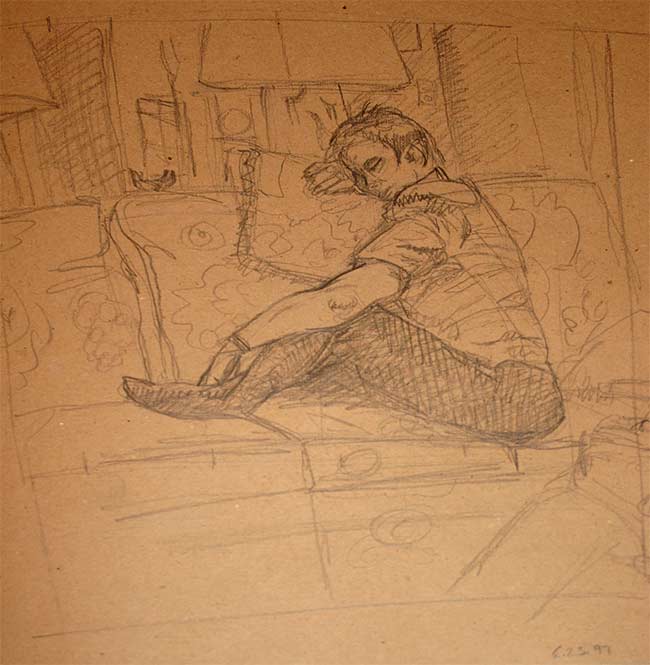
One day, I was moved to draw. I don’t know why, it just sort of happened. I drew some pictures from a magazine. I drew a vase of flowers. Then, very slowly, I drew Patti, resting on the couch. Something about that drawing was deeply moving to me. It wasn’t a ‘great’ drawing but it was mine.

I discovered that, as I drew, I felt peace. I felt connected to the things around me. I saw them deeply and somehow we became one. Was that what the Buddhists meant? Was that what Christ offered? I don’t know. I never found meaning in a church or temple. I found it in my living room.

Now I find that I want to draw. I can’t do it every day but I am drawn (as it were) to draw again and again. It doesn’t matter what I draw. It doesn’t matter whether the drawing is accurate or worth keeping and sharing. It’s nice when the drawing is ‘good’ but that’s not the point.

There were times I lapsed. Once, when my job was particularly ensnarling, I didn’t draw for three years. It wasn’t a great time and when I stopped working that way and started drawing again, I felt better.

Some of my religious friends will probably tell me that I am practicing drawing as a religion. That my drawing is a communion with God, a form of prayer. I don’t know or care. If God is that tricky and elusive, I can’t be bothered to call him by name. And I sure am not asking him for help or answers. I make my own drawings, just me and my pen.

What with my website and my books, I have found myself in this weird position of being an evangelizer for drawing. I’m not sure how it happened and I sometimes wonder if I am spending more time on the prosthelytizing than on the drawing and whether that’s a particularly good thing.

I like having people to draw with and I like sharing the things I notice about drawing when I am doing it. Drawing doesn’t harm anyone. It doesn’t pass a collection plate or condemn gay people or inspire people to blow up skyscrapers in my backyard or care one way or the other about abortion or try to effect my vote or meddle in school curricula or cast stones. But it does help me to see the beauty in people and things, to cherish what I have, to reach out to others, to favor creation over destruction, to find peace and feel more alive.

May it do the same for you.
Amen.
Your pal,
Danny

TCL: Supplementary Material, II: Walton

Walton Ford and I met when we were both sixteen and at the Rhode Island School of Design summer program. He was one of those rare creatures who was born with phenomenal talent. The drawings he did at four and five would put most adult artists to shame. We eventually lost touch and only crossed each others’ paths decades later by which time he had emerged as one of the top painters in the NY fine art scene. He makes enormous (sometime twenty feet long) watercolors of animals. Each is life sized and breathtakingly accurate. They are clearly influenced by early naturalist/illustrators like John James Audubon and Carl Bagner and yet he has added political allegories to his work that make them very contemporary.
Of all of the people I know, Walton is the most “successful” as an artist. He is represented by one of Chelsea’s finest galleries, does a couple of shows a year, and will probably be able to spend the rest of his life living comfortably from his art. Though they have six-figure prices, his paintings are enormously marketable and every show is sold out before the opening. Despite all this success and talent, Walton still struggles with the politics of the art world and is fiercely competitive with those contemporary artists who are just ever so slightly better know than he is. He also resents the fact that his craftsmanship was slighted and ignored in the days when figurative painting was not what the market sought. As I talked to him I realized that the art world is basically just another industry, a bunch of stores selling stuff; dealers create and maintain the market and the artists themselves, regardless of their ability and vision, primarily luck into popularity.
I hung out with Walton at his upstate New York studio and we ran a tape recorder while he prepared a huge sheet of watercolor paper for an upcoming painting, turning the pristine paper into a mottled, browning relic that looked like it had fallen out of an 18th century folio of engravings.

Image

Danny: So what role does journaling play in your work? I know you were very influenced by Audubon and by his work in the field. How does that sense of process and discovery go into your paintings?

Walton: I like to see Art as a tool. Audubon cut things out, pasting things together, scribbled notes to printer on it… The process of making was part of the work. The drawings weren’t the end result, the work was the final engravings so he allowed himself the freedom to be so cavalier with his work, not precious. I make my paintings look like they have that attitude, that feeling of unfinished ness, like it was done in the field. The writing focuses it, explains it.
I make 10-foot watercolors of tigers in which the stripes tell allegorical stories about Vietnam. Paintings so large they are experiential, like a diorama, filling your peripheral vision. I make them life size because, well, when you see a beaver, you think of it like the size of a woodchuck with a weird tail, then you see what it’s really like, it’s awesome, it’s totally startling, the size of a 50 gallon drum, it’s freaky and I like to that in my work, the fun of finding an animal that large and more grotesque than in your mind’s eye. When its life sized, when it’s extinct, it’s shocking. Flocks of millions of passenger pigeons that have never been painted before. It’s like a time machine too. To see things for real that can’t be seen anymore.

Danny: So what’s your attitude towards the fine art world? You have always made figurative paintings even when they were hardly in vogue. Isn’t it a little surprising that despite the accessibility of your work you have had such success?

Walton: I got a lot of very positive feedback on how I could draw and how I could see when I was young. I was a very precocious talent. My daughter, who’s a talented violinist won’t practice on that frantic, 18 hour a day level. It’s different in art than in music or sport. Art is a lot more forgiving you can be really good without working quite as hard. And there’s not that competitive thing battling for a small number of slots. But the drop out rate, the number of people who can’t handle, can’t go to the studio every day, is enormous. I was incredibly persistent and didn’t take no, I wasn’t terribly interested in being trendy. For many years it was not cool to do what I was doing. I had to not be discouraged by the fact that I was doing something that at the moment might not be hip. Now there’s a trend toward representational art, but so much of it strikes me as incredibly lazy and lacking in thought or depth. It’s just about irony and it’s hard to compare with the great portrait painters of the past, to Sergeant, for example. I feel like I don’t want to waste your time if you’re going to bother paying attention to what I’ve done, I want to at least have put in as much thought in doing it as the person looking at it. I didn’t want to stop even if others who I didn’t think were as capable were getting more success. And still something encouraging happened very year making it worth while if I looked as a long term thing.

I still have this feeling that I don’t quite belong. Those who get success much younger have a sense of entitlement I haven’t got. I have to try to develop that attitude and stop cringing, “Thank you for the attention.” My work is so accessible that for ages people made me think was stupid. I think it’s more important to make something that’s great art and is also popular, not just for other art professionals. It’s just a feeling that driven into you as soon as you come to New York, that being a populist isn’t interesting, creating narrative is stupid. Look at Goya, Daumier, Doré,etc.

People are very suspicious of craftsmanship. But Mathew Barney and John Curren are craftsman that are considered successful, intelligent artists so it’s good for me, that benefits all artists who care about carefully making beautiful pictures. There’s no meaningful distinction between art and craft. Once you’ve sussed out what the idea for a picture will be, it’s all craft, it’s all about making your picture. You need technique.

Danny: Is it terribly hard to be a fine artist? To make it in that world?

Walton: The hardest part of being an artist is not getting noticed. I worked very, very hard on a show about ten years ago and I thought it was a very good show. It went up came down and no one wrote about it, no one bought anything, and I felt like I had done all this work for no reason. Being able to get over that was very hard but kept me around for when people started to admire my work. You want people to admire what you do. I don’t care if it’s vanity or greed or what the motivation was when I looked at a work of art. The work redeems it.

Danny: Yeah, but practically…how did you survive until you made it?

Walton: I was able to survive for years as an artist, living on grants and selling a few paintings and then my big show was a flop and I had to go to work for the first time for years, doing restoration carpentry, wood refinishing, and some illustrations work, book covers and things. Making museum exhibits, building scale models of ships. It wasn’t what I wanted to be doing but it made ends meet.
I resigned myself to the idea that it wasn’t going to go as well as it ended up going. I always had some people who liked my work but it’s delusions of grandeur for an artist like me to think that there were people who didn’t like my work. It was more that nobody knew it, like a restaurant with no customers. Perfectly nice pizza pie but no one comes in. That humility helped me get by.

Danny: Is it important to be an artist?

Walton: At the end of the day, the only thing that human beings have to feel proud about is what sort of art did that culture leave behind, what sort of music, food, creativity, writing, the objects they made. That’s the value and legacy that will endure.

In traditional societies, the making of things was tied to the survival of the group. They didn’t worry about justifying their motivations. They all knew they were doing it for the interest of the group. The rugs on the floor, the paintings on the wall.

Danny: So what’s changed? It sure doesn’t feel that way today.

Walton: People nowadays are made to feel self conscious about drawings, about singing, about being different. And professionals are to blame for mystifying the role of the artist to the point that people feel stupid if they don’t understand things. And there is no attempt to educate people as to why the things that they may not understand right away are worth understanding. And then there’s this tortured pathetic version of an artist. Ed Harris showing Jackson Pollock as an inarticulate bastard, Kurt Cobain blows his brains out.
All this stuff adds up and people don’t want to be involved in this kind of thinking or being or making stuff. They’re interested instead in Hollywood people who aren’t that interesting but who corporations make money out of.

Danny:So is it worth it? Would your recommend that people try to make a living as an artist?

Walton:The advantage I have over people who don’t do this for a living is that I get to do it to think about it all day, every day. I get to wake up each day and just think about making some thing cool.

Danny: That does sound cool.

Image

You can see some example of Walton’s paintings and video clips of an interview from PBS here.