All the t-squares in China

stuck-in-traffic

Some clichés are based in truth.  The one I encounter a lot in China is the Asian student who drives her/himself super hard and who is forced by expectant parents to be overachieving and highly pragmatic.

These kids have been coming to me, one by one, to ask for my advice on their future plans. A classic was the senior who said she was picking colleges to study art based on whether they also had a  great physics programs — in case she had to switch directions.

I understand their anxiety.  They live in a country that is going through a massive transformation and there’s a lot resting on the new generation.  They want to be as prepared as possible, to dot every ‘i’, take every course, ace every test…

Here’s my message to them and it might be useful to you too.

It’s good to be prepared, but what are you preparing for? I think the only thing you can intelligently anticipate is change. And no number of degrees or job offers at investment banks will prepare you for the unknowable. That takes creativity. An ability to adapt. A willingness to live with ambiguity. Resourcefulness. A knack for collaboration.

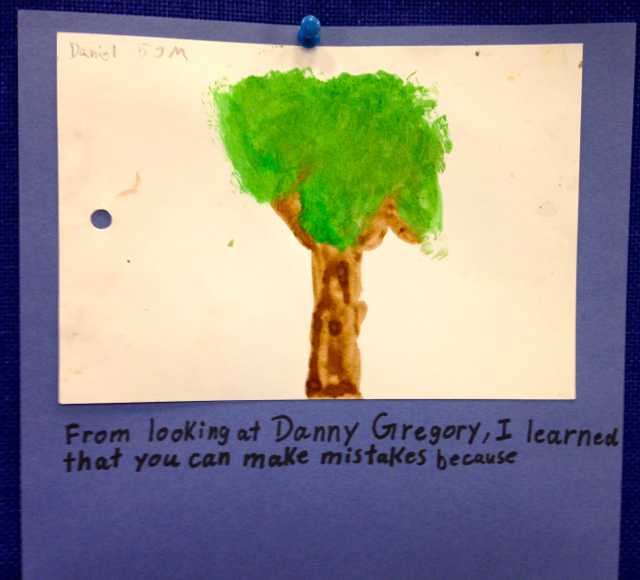
I encountered their core problem when they made art. They were so afraid of mistakes.  Kids would go to rip up their work if they encountered any sort of screwup, a bent line, wonkiness. And I would say to them, “Hold on! Try to turn that into something. Work with it. Solve the problem. It’s okay.”

mistake
I love this. It says it all.

When the teachers asked their students what they got out of my stay at their school, they say things like:” Danny taught me to make masterpieces our of mistakes” and “I tried making drawings unique instead of exact.”

Learning to live with (and embrace) our essential fallibility. It’s what I learned at Clown School earlier this year.  And I hope I managed to pass it on to all those kids who will be contributing to our imperfect future.

Speaking of mistakes, if you miss the greatest semester yet of Sketchbook Skool… well, we wouldn’t want that would we.  Enroll today!

I’m on my way to speak in San Francisco

20130622-221855.jpg
Ill be at the HOW Design Conference, hosted by one of my awesome publishers. I spoke at the conference before, when An Illustrated Life first came out, and it was a wonderful experience.
I will be talking to hundreds of graphic designers about How your sketchbook can open your mind, boost your creativity, and rock your world. I am always amazed at how many creative professionals have forgotten how to draw. I hope to turn them on again.
If you are at the conference, please come up and say hi.

The Voice continues

monkey-2
I am traveling again, this time on the 6 a.m. train to Washington DC. And again, I am thinking about the Voice in my head (I first wrote about it a couple of days ago) and the other ways in which it can monkey with my creative plans.
This jabbering voice doesn’t resort only to vicious critiques to stymy my creativity. It likes to concoct diversions to distract me too:
Like, why make a drawings with the pen that’s in my pocket when I could plan a trip to the art supply store, and burn up money and energy instead? That’ll make sure I end up on the couch, dozing, my new art supplies still in the bag by the door.
Or, maybe I should just check out some of my pals’ blogs, see what they’re up to. Man, they are so creative and productive. I really do suck by comparison.
Or how about a snack? Maybe we should go out for a donut?
Okay, back to work. Wait, I should get some inspiration, do some research. Let me try to find that David Hockney book I have on the shelf somewhere. Ah, here it is. Hmm, so Hockney mentions a Franz Hals painting here, what did that look like exactly? Let me just pop open Google Images and see… Oh, look, that cat is cute…
All this activity makes it seem like I am doing something, but I’m not really. I’m just pissing away time and defeating my creative impulse with thoughts of fine art, chocolate, naps, sex… The illusion of productivity is the bone the monkey throws me. We’ll start tomorrow, I swear .
Negotiation is the monkey’s ploy. If it isn’t condemning or seducing, it’s bargaining.
But remember, the monkey doesn’t want what’s good for me. He is selfish and vindictive. He wants me slow and weak and distracted so he can have his way — uncreative, status quo,
Here’s another ploy: “There’s no point in starting until you have your act together so let’s get the ducks in a row”. A good stalling tactic but I wont fall for it. Back off, chimp. There are way too many ducks and rows are for accountants. Organization is irrelevant to making stuff. Art needs to be messy. A neat stall is the sign of a dead horse. Sure, it’s a good idea to know where you keep your pencils but being anal doesn’t help you create shit (as it were). The random juxtaposition of stuff and chaos is the seeds of art. If oysters were prissy about keeping out all the sand, we wouldn’t have pearls.
The fact is order, security, and perfection are all illusions. Life can never be perfect and again I am just wasting time.

no-pearl
(For some reason, I am reminded of those boat owners who sit in the marina drinking beer on board and never raise their anchors and head out to sea. Rather than adventures, they have the most expensive bar stools in town.)
The ape loves a good fight too. If I find I am quarreling with others and venting emotion inappropriately, chances are that I am not drawing, not writing, not thinking. Or alternatively, I may find myself overworking, nights and weekends (on projects fueled by drudgery and obligation not passion) living out of balance, out of harmony, out of fast food containers, far from my true self. The monkey loves french fries and insomnia.
In my job, I often encounter people who are driven to melodramatics by their inner monkey puppeteers. They act out, drawing attention to themselves, making excuses, having fits, being prima donnas, making demands, when they could just put their heads down and make more stuff. Client questions your decision? Throw a fit. Need to cover up a blunder? The best defense is a good offensive speech of self-righteous indignation. Not.
Making more stuff is the best revenge. Put your creative energies to work coming up with more ideas, not with histrionics. Get back to work.
Another monkey game is monkeying with my health, mental and physical. Am I not productive because I am depressed? Or is the other way round? Is this cancer or hypochondria? Start doing and see what happens to your mood. If something indeterminate ails me, I hang it up for long enough to write or draw a page or two of my dream. See if I feel better, less blue, more energized. My back won’t hurt, my allergies will recede. When I wake up at 3 a.m. with the ape chattering in my ear, I can only take so much lying there in the darkness. So I crawl out of bed, go to my desk and draw or write something, anything, Then my mind is eased, the chimp goes back to sleep and so do I.

How does the Voice monkey with you? I’d love to know…

Senioritis

A tentative first step back into my illustrated journal. Drawn while sitting, overtired, in bed.

Jack was eager to settle his college plans early and so was I. His acceptance to RISD was a huge relief for both of us. The stress and uncertainty of the college process was over and now we can both relax until September.
But doing next to nothing turns out to be a lot less fun than he thought it would be. Fall is a long way away and Jack still has to get up at 7:00 each morning and sit in classes all day, listening to droning teachers, half-heartedly writing homework assignments in the period before they’re due, doing the bare minimum to keep his grades above water so his acceptance isn’t rescinded.
I say to him, well, you’re still being taught useful and interesting things, even if your grades really don’t mean as much. Can’t you just learn … for the fun of it? What’s the point, he groans. Who cares? I’ll study when I get to college… Etc.
Senioritis isn’t confined to teenagers. At every point in life, it’s easy to be so focused on goals that one can’t see the value in anything that doesn’t pertain directly to them. All around are books and classes and conversations and experiences that would enrich us greatly but it’s easier to just do the same-old and not expend the effort for something that doesn’t same to have a direct benefit or relevance to one’s occupation or obligations. What’s the point in learning to draw or reading about ancient history or trying sushi or visiting China? We think we know it better, so despite the richness of the world around you, if your mindset is wrong you won’t absorb or even register it. You screen it out.
When we’re toddlers, we are constantly exploring and asking questions about everything we encounter. That impulse diminishes when we get older because our pre-frontal cortex develops and filters out the firehouse of information that is constantly streaming in. Most of the time, we certainly need that filter so we can be focused and goal oriented — it would be impossible to get anything done if we were always walking around in slack-jawed amazement. So we increasingly notice only those things that we have decided are related to our preconceived goals and orientations.
That means it takes an extreme form of novelty or trauma to snap us out of this narrow tunnel we have burrowed into. Something like 9/11, a death, an accident, can force us into a reassessment and new orientation. Our eyes are opened, we say, and suddenly we see things we’d never seen before.
We use this metaphoric language to describe this epiphany but what if we take this notion literally and force ourselves to actually see things anew. We can reorient our perception and put on a wider lens. Of course, we don’t want to eliminate this screening function altogether or else we might wander off the road and spend all day picking wild flowers, but we can pick moments to relax our pre-frontal cortex, return to a more childlike state, rebuild our muscles of perception, and restock our cache of creative stimulation.
When you draw something you see it in a new way. A good drawing is a fresh perspective on an object you may have seen a thousand times before: a building, a body, a bowl of fruit, your breakfast dishes. But by paying deliberate and careful attention to every nook and cranny, you flood your mind and your page with new information about what you are seeing — the texture of a banana skin, the way light hits a brick, how the knee connects to the shin bone, the exact curve of a cup handle. You are suspending the critical function of your pre-frontal cortex, refusing to decide whether there’s importance to each individual line and aspect; you just record them all. This information isn’t actually that important to you beyond the act of drawing, you don’t need to retain the visual data about that banana skin, it may have no further utility to you. But it is expanding your awareness of the world around you, strengthening for observation muscles — it has as much purpose as lifting the same weight over and over at the gym.
When your mind’s eye is open and your screens and filters are down, you get more and more useful information, and that information and experience are the raw fodder for creativity. Forming associations between apparently disparate things to create a new idea is what creativity is all about. And the more open your mind is, the more you are open to experiencing things are interesting but may not have immediate and obvious relevance to your current endeavors. By exposing yourself to art, to novelty, to new ideas, facts and experiments, you stretch your mind so that it is pliable and elastic, so that it doesn’t seize up when you have to move in a new direction. Your reservoirs of references are loaded and you have oodles of bits and bobs to build new ideas with.
Senioritis hits senior citizens too. It’s easy, as you become middle aged and older, to think you know it all, that you have discovered what matters, that you know what you like to eat and like to vote for and where you like to visit and what you like to read and that experimentation and exploration are things of the past. But if you can loosen up your built-in filters, if you can slow down and draw every petal of a flower or the hairs on a dog’s muzzle, you’ll soon see that you don’t know everything, far from it, and in fact you never will. And that realization, that the more we know the less we know, will set you free to devote the rest of your days to exploring the depth of your ignorance, to gathering sticks and shells and tastes and smells, and weaving them together in to combinations you and no one else have ever seen before.
Jack can afford to suspend learning until September. But I can’t.

Now, watch this:

Paint it blue

A recent email:
Hi Danny,
Do you think being creative and artistic makes a person more depressed or prone to depression? I read a book about this a long time ago. They actually used Jonathan Winters as an example of the creative mind and artist and his bipolar disorder. Something about how being creative taps into the same part of the brain as the emotional area.

I think that being creative makes one more sensitive which could enhance one’s tendency for depression but that could also translate into increased optimism. I’ve found that focusing on art has shown me the beauty of the world in the face of calamity. I guess everyone’s chemistry is different.
Next question: Do you believe that sketching everyday makes you more conscious and in the moment? (I'm talking more like what the Buddha states about it.) I do seem to remember Dan Price talking about this also.
As I’ve written in my last two books, I know that drawing is a powerful form of meditation and very definitely enhances one’s awareness of the Now.
I guess I'm just curious if doing art everyday creates a more conscious, but also a more likely to be depressed person?

I understand the theorem you are testing here: a) Drawing makes you more sensitive so therefore b) more sensitivity leads to more depression. I know the first part is true, but is the second? And the sort of sensibility one develops through drawing is as much about knowing the outside world as it is one’s inner state, in fact more so. I find that when I draw my brain sort of goes on hold, that the things agitating me recede as I dwell in the moment.
I believe that making art and, importantly, sharing art with other people, enhances my view of the everyday and my positive outlook. I know that I can feel down some days and not even want to draw but that if I kick my butt into doing it it usually makes me feel better. Do I think that making art can drive one deeper into depression? From my limited experience, no. There are certainly many depressed, even deeply depressed people in the history of art but I don’t know that they constitute a disproportionate part of the overall community of art-makers vs. the general community.

Being neither a psychologist nor a depressive, I invite ask any readers with a POV to comment on this topic.

Advertising and Its Discontents – Part II: Charity

unravel.jpg

I like nice. I like sweet. But even more I like raw. I like real. And Ilove Charity Larrison. She and I have been corresponding for a couple of years ago and she always cracks me up and take my breath away with her honesty. Charity’s story is pretty different from Trevor’s and it is far from resolved. I won’t say much more in the way of introduction but to say, Charity is the real thing. We can all learn a lot from her bravery, creativity and independence.

The Fundamental Distraction by Charity Larrison


At 18, the idea of going to art school, being a real artist, whatever, you know – seemed basically useless. My family was poor – college was not even an option really. And college for something as abstract as “being an artist” – ha ha. I might as well not even think about it.
I remember spending my whole senior year of high school in a corner of the art room working on paintings - buying extra time here and there doing the whole fluttery-eyelashes thing, “Oh come on, *please* Mister Whatever Stupid Teacher - I finished the assignment in five minutes! Can't I *please* go down to Miss McKannicks' for the rest of the period?? - i'm working on A GREAT PAINTING!”
So like any good comic book loving skateboard punk rocker with no way out of small town America hell – I joined the army.

I remember when I was in basic training my drill sergeant secretly pulling me over to the side and saying: “ONUSKA, take these markers and these flags up to the latrine and draw E-328 Predator faces on them so I can give them as prizes at the end to the other drill's. If you get caught you're in trouble, so don't get caught!”
And then there was the Sunday afternoon when I was in advanced training, learning my 68G10 - Aircraft Structure Repair crap; I was walking through the platoon area on my way to the smoking table when I was accosted by my Drill Sergeant to report for detail to the enlisted club, where I ended up spending the rest of the summer assisting his wife painting a mural of a bunch of Blackhawk helicopters landing on the wall in front of the dance floor.
She yelled at me one day: “YOU DON’T BELONG HERE!” Then it was a few really a lot louder sentences in Korean that I am still glad that I couldn't understand & I remember shrugging my shoulders at her and saying: Don't worry, Sun, I have it all worked out.

I got married. We had fun for a while. I got pregnant. He got kicked out of the service. I decided to opt out and follow him home. Our marriage didn’t survive the strain. I packed my baby and what belongings I could fit into his gold Fiero (dear god) and never looked back. I was twenty. Worked and worked and worked. Lots of crap jobs. Night shifts at the convenience store. Short order cook. Bank teller.
I remember it is two am and I am standing under fluorescent lights in an all night convenience store slicing endless little piles of lunch meat, passing the time wondering who it was that got to have the job where you made all the dumb signs. I would be good at that job.
I remember hanging out at my teller station when I worked at the bank, copying pictures out of comic books every moment of time where there were not incredibly crabby people in front of my face blaming me for all their money problems.
I remember lucking into a seasonal civil service gig with Pennsylvania state parks. Where I got to take care of the computers. Burning another boring afternoon clerking it in the office, doodling on post-its when Kevin, the Assistant Boss Park Ranger dropped a stack of instructions in front of me and said: “Larrison: if you can figure out how to network all our computers and make it work, you can have the internet. (THE INTERNET!!!! FINALLY!!!)

I decided I needed to cave in and try to go to college. To get out and get something better. Thinking to maybe get some kind of IT certificate, as I was so swell at computers and all. Looked it up on the Internet. Looked halfheartedly at stuff, then saw it. The graphic design program. You know: the “oh, that’s what i’m supposed to be doing” moment. (omg – like art school! But like – you could actually GET A JOB) (try not to cry laughing at me :D) anyway – once i saw it, it was too late. I had to do it. So i did. It was insanity. I worked five million jobs and went to school and somehow held everything together with just, pure will. (because seriously, this was the stupidest gamble of all time WHAT ARE YOU THINKING etc.)
See – I loved graphic design. I loved it more than anything in the whole universe. There was nothing like it to me. I knew how to make the pages talk. Then i learned how to make the pages sing. I made pretend magazines and taught myself how to make web pages, and I demanded that i get a REAL internship at a REAL place. Because even though i was just some jackass with an Associates’ degree from a tech school – that didn’t make me not THE BEST. (quit laughing :D)

Anyway, i got my internship. They hired me right out of school. Their art director moved to Atlanta, and I got his job. I was never, ever, ever, so miserable in my entire life than how miserable i was for those six months. I remember my favorite part of the day was whenever I could go down and sit in the restroom just so that I could spend five or ten minutes not having to be in the same room with those people. I mean, holy shit – these guys were some serious assholes. I was so depressed. I mean this? This is what graphic design is for? Lying? And lying and lying forever? GAH. And I’d spent so much of myself learning and it felt like, all for nothing.
I lasted about six months till they fired my ass. I remember dancing up the street Fred Astaire style the afternoon they fired me. Sure it sucked and I was doomed, but lunchmeat at two am was better than that crap.
Not to be thwarted, once i finished celebrating being fired from the ninth circle of hell, I threw my resume up on monster.com and got a call. Some company needed someone who could use Photoshop. Okay. I can do that. Went. Interviewed. They ended up hiring me on the spot. Was a small engineering company. Tired of getting raked over the coals from the ad agency that was doing all their stuff previously, they wanted just someone who could use Photoshop to fix some images for them.
I was all like, well, you know, i can do everything those bastards were doing for you, except better, and cheaper. So they hired me and gave me a million raises and built me a giant office and bought me every toy I asked for. It was fantastic for about a year. I made everything for them from out of nothing. I was like a great hero, rescuing my company from the tyranny of the great evil of advertising agencies.
I suppose you see what’s coming by now. I mean, there’s only so much you can do. After a while my job started to consist of just updating and tweaking and pressing buttons. I joke that it is my George Jetson job. I just rush in push a button then put my feet up on the desk. Which everyone says is so great. Which I suppose it is, but what happens if you are crazy and actually LIKE to work, but have no work to do? It sucks. But you can’t leave your great job when you are the sole support of your tiny family. You gotta just suck it up and go to work.
So, I sit in my giant office in the middle of nowhere America and spend my days floating around the great now of the Internet. I don’t know that I had a plan really when I started out. I mean, I just did the things I already liked to do. I followed comics websites and comics artists and followed their advice about how to learn how to draw, and i just kept trying to learn how to draw. Because that’s what I wanted more than anything. To learn how to draw for real. So i could draw comic books. For real. So i just kept drawing. I made myself websites to put my drawings on, cause that kind of made it feel like an activity. I made horrible comic books. I made friends and enemies.
I have some friends who are writers, they asked me to draw their stories, so I did. Because I love them, and I love that they write stories, and I love making words into pictures, and the challenge of making the pages read and flow. Figuring out just the right thing to draw to make the story move the best way. It’s the funnest game ever. It makes me work hard. I could do it till the end of the universe.
And slowly I started to learn how to learn.
It’s funny about learning. It’s never what you expect. I am starting for the first time ever, to actually get the hang of it, and make some things that are kind of cool and that i really love. I am starting to learn how to see the world, and my heart is constantly in like this odd vice of joy. I want to draw everything all of the time. But time is precious – which things to spend the time on? I want to draw that tree – but really shouldn’t I be working on something serious? I mean, that is the kind of thing I have been thinking to myself lately.
See – honestly, I hate my job. It’s awful. I am all by myself all the time. There is no one to talk to ever, except the dumb internet, and I want out. Having basically one client only for the past four years, my portfolio is utter crap. And, Jesus, I don’t want to be a graphic designer anymore anyway. I want to draw. But how do you make a living from drawing? How do you make a living from drawing without starting to hate drawing, is the main thing i think. I have been trying to figure it out. Trying to figure out what way to push so that I can still love it, and still get out of here.
So I have been trying to remember why I started this. Why I am here. What did I want when I began? To maybe find some kind of clue that will help me figure out what to do. What is important? Why do i do all these things that I don’t actually care about anymore when I would really rather be out drawing trees?

These days I just wake up every day and do what I have to do to buy the extra time down miss mckannicks' to work on the paintings. And think it is pretty awesome that I get to stay here this time and don't have to go to the Army again, because that sucked.

Advertising and Its Discontents – Part I

adnotes.gif Above: Notes taken during a really important meeting I no longer remember.


One of the chief obstacles many creative people face is how to cope with the intersection between our creative and our professional lives. Is drawing, painting, photography, music, whittling, just a hobby? Or are we serious about it and wiling to throw ourselves over the cliff’s edge and base our livelihood up on it? Anxiety over this issue is what derails a lot of us when we are young. Do we go to art school or a “real” college? Do we spend the rest of our lives in a split-level ranch or a garret? Do we break our parents’ hearts or become accountants?
Like most things in life, it’s not that black and white. People who make money doing creative things usually reap a varied harvest. It’s never 9 to 5 and the paychecks are rarely steady but there are more and more ways to sell your creative products. It’s not about getting your slides accepted at a New York gallery. And your patrons may be people just like you, not just investment bankers looking for investable art. For example, the internet means you can show and sell posters of your work and never leave the farm. You can sell drawings and jewelry and t-shirts and greeting cards and zillions of things.
And most importantly, you can call yourself an artist, regardless of how much money you make or how many pieces you sell.
I make a smallish percentage of my living from my personal work. I write books, I write articles, I do illustrations, but the lions’ share of my income is from my job in a company, working for the Man. I am pretty comfortable with this arrangement. It means I don’t feel desperate, I do the projects I want to do, and the extra money keeps me in 24 karat fountain pens and hand-bound unborn-calf-velllum sketchbooks.
Recently, I asked two successful illustrator to share some of the details of their lives, particularly to explain this issue of commitment and financial survival. First, Penelope Dullaghan, whom you may know as the originator of Illustration Friday. She took the leap from advertising into full-time illustration a Notes from a really important meeting I no longer remember.
A few years ago, I temporarily detached from the ad teat. It had been a good run. Ad agencies had provided a good steady income, kept my family health-insured, taken me on some all expense-paid junkets to interesting places. But the experience has often been depleting, humiliating, demoralizing, and I had to see what it was like it cut loose. Eventually I got sucked back in but I still question the wisdom of succumbing.

I’m not alone in wondering. Most advertising creatives would like to break free. A few brave ones do. A couple of weeks ago, I asked some pals who had jumped ship to tell me what drove them to do it, how they did it, and how they feel in retrospect. I was going to gang them together in a single post but when the first one arrived, from Trevor Romain, it was so good, I had to get it to you right away.

Have you had a similar or completely different experience? Please let me know, either by posting a comment below or by writing me a longer description. And stay tuned for more in this series.

The Very Moment by Trevor Romain

I’ll never forget that day.

It was the morning after I had pulled an all-nighter creating an advertising campaign for a client. The campaign was a good one. I felt great about it. With a number of Clio awards and dozens of Addy and One Show awards under my belt I felt confident that the client would love the ideas we were presenting.

The cigar-chomping, excessively-sweating client – who I created the campaign for – was reviewing the work. He was looking over the ad campaign with disdain.

He said. “This is bad. I hate it. Why don’t you just take the logo and fill the page with the entire thing? Now that would be branding.”

My heart sank. Then I felt anger. Extreme anger. Not at the client, but at myself. I remembered a promise I had made to myself twenty years before. A promise I had not kept.

It happened when I was in the army in South Africa. I was walking through a field hospital filled with kids from small rural villages who had been brought to a clinic for treatment from the army medical corps. The conditions were abysmal. There were almost six kids per bed, it was nauseatingly hot and there were flies everywhere, especially around the corners of the children’s eyes and mouths.

As I was walked down the center aisle I caught sight of a little boy who was about five years old sitting on the edge of one of the hospital beds. I looked into his huge brown eyes as I walked by and then noticed with shock that he had no legs. Instead I saw dirty bandages wrapped around two stumps. The boy had lost his legs in a landmine accident on the Angolan border.

As I walked by, the little boy put up his hands and said “Sir, can you please hold me.”

I will never forget the haunting look of sadness in his eyes. Huge tears rolled slowly down his cheeks and dropped to the floor, their significance lost in the dust and grime of war.

The Sergeant Major, who was walking alongside me, grabbed my arm and pulled me away from the child.

“Romain,” he grunted. “Leave him alone. Don’t get emotionally involved. We’re here for security, not child-care.”

As the Sergeant Major pulled me away the little boy, in a broken chocked-up whisper, spoke again. His voice tugged at me from behind.

“Sir, please, please can you just hold me?”

Something happened to me that moment that I will never forget. My life changed instantly. It felt like a hand came out of the sky, reached inside me, and flipped a switch that turned on my soul.

I pushed the Sergeant Major’s hand away, turned, walked back and picked up the little boy. I have never been held so tightly in my life. His trembling little body clung to me for all it was worth.

He put his head against my chest and he began to cry. His tears ran down my neck and inside my shirt. I held that little boy with my arms, my heart and my soul and every ounce of compassion in my being. I never wanted to let him go, ever.

At that second I promised myself that I would never waste a second of my valuable life. That I would use my creative talents to change the world for children.

But I didn’t.

I went into advertising because it was safe and the money was good and everyone told me that it was almost impossible to make a living writing and illustrating children’s books.

I believed them.

I got sucked into the advertising vortex. I allowed client after client put my work down, destroy my exciting ideas and turn me into a cynic, who spent every day, using my talents to convince consumers to buy things they didn’t need.

The inner explosion had been building for months. The cigar-chomping client wasn’t the reason I quit that day. He just lit the fuse.

My wife and I discussed the situation and both decided that I HAD to follow my dream.

I woke up the next day, sat in front of my yellow pad and started my new job as an un-published children’s author and illustrator.

Although getting started was difficult and sometimes frustrating, the sheer passion and joy of doing what I love was there. And it still is. I have been hungry, rejected, under-appreciated and often ignored but I LOVE what I do. I have been writing full time for ten years now and I am one of the happiest people I have ever met.

During my journey, after every book rejection I received, I heard the little boys voice in my head saying, “Sir, please can you just hold me.

And in my heart and soul I did.

And I still do.

I now have 30 books in print with over one million copies in circulation in twelve different languages.

And I’m not done yet. I still hear the little boy’s voice.couple of years ago and I remember how suspenseful but ultimately very satisfying the whole process was for her.
Second is Torontian Alana Machnicki. I like her drawings a lot and am inspired by the broad range of ways she applies them. I have learned a lot from both their stories. I hope you find them useful too.

Penelope Dullaghan

I think that leading a creative life is both rewarding and really really hard. It’s not just creative painting and being messy all the time. It is a real business, like any other. (Well, maybe not like any other. I think this is way more fun.)

To manage a creative life, I think first and foremost you need to be a good planner. You are not guaranteed a paycheck or steady income, so sometimes it gets really thin and you have to adjust accordingly. If you have a bad month, you better have some money left over from a good month to float through it. The people who work at the phone company and the power company have steady jobs and will not understand if you tell them you’ve had a bad month. 🙂 So you need to budget!

But planning goes beyond financial. Time is also yours to plan. A good balance of work and gathering inspiration and personal time is important (I struggle with this a lot). Being an entrepreneur is hard. No one makes the rules for you and no one is there to tell you to work (or to stop working). If you decide to take time off and accidentally miss a deadline, you’re in trouble. At the same time, if you work around the clock and burn out, that’s no good either. Balance is in planning.

Secondly, I think it takes faith. Faith that the next job will eventually come, even if it sometimes feels like no one will ever call again. If no client has called with a new job or assignment, it can be really scary. Self doubt creeps in and you start to wonder if you’re really cut out for this. Working at the mall starts looking really appealing. But this is something to be waited out…and not sitting down. If you are bored, you’re doing it wrong. If no paid work is coming in, do something for your business. Start working on a new image for self-promotion. Update your website. Write some thoughts down about avenues to get your name out there. Work on personal work for yourself, while at the same time, bettering your skills. Give yourself an assignment…challenge yourself to think conceptually. Read a business book to hone that side of things. There’s always something you can work on. Always room for improvement.

Or, if you are a workaholic like me, try to relax and take some downtime. Go to a movie (a matinee to save money) or go for a walk in the park. Fill your well. By the time a client calls again (and they will!), you’ll be ready and inspired to do the project at hand.

And thirdly, it takes a lot of plain, hard work. I have a lot of things going on all the time (maybe too much) to help me pay my bills as well as keep the creative fire burning (for both me and others). But it’s work I enjoy doing. I get a lot out of having fun little contests (just finished up a “Draw a Witch” contest for Halloween) and doing free things like Paper Doll Mix n Match to help promote my new tshirts. I have an online store to sell prints and stuff to help financially and just for fun (I like thinking up new tees and postcards to print).

I also started Illustration Friday as a way to challenge myself…to grow my portfolio and force myself to think conceptually. Then I opened it up to others because I figured they would like the challenge too. And now it’s a huge, fun thing that many people participate in each week. I love seeing all the new names pop up in the column and checking their illustrations to see how their minds work. It’s also become a great form of self-promotion… even though that’s not why I created it (I think of it as a perk for running it!). The site was recently named a HOW Top Ten Website, which I thought was cool not only because it’s good promotion for the site, but because it kind of speaks to the creative community at large… maybe we’re not all isolated artists, but we seek to be a part of something bigger by supporting each other and talking to each other. Illustration Friday helps with that.

I’m also a part of a local illustrators group. I look forward to getting together with them once a month to chat about the industry, ask questions, give answers and just be with like-minded people. Part of a community, again…

I’m going to be honest and say that it is sometimes really hard to have so much going on. I get stressed out and unbalanced. Keeping up with my normal workload, Illustration Friday, doing self-promo, creative-community things, running an online store, gallery shows and trying to maintain a personal life… can be a bit much. I sometimes miss having a regular job with regular hours and regular paychecks. But I really can’t imagine giving it up. I feel like it’s kind of built itself…each thing I do is a part of me. It’s good for my creative spirit and hopefully feeds my business, too.

More on Penelope here, here and here.

Alana Machnicki

As a creative I’ve always found it important not to put all my eggs in one basket, so to speak. I like to have a little going on in different aspects. I have a tendency to get bored really easily and having a cornucopia of outlets to choose from keeps me happy.
I also find it much easier to live as a creative when I’m not under financial pressure. Because of this I’ve come to accept that having a part time job in the background is essential for me. Also, having the foresight to keep the job, even when I’m having a particularly profitable month, is even more important. I never know when a dry spell is going to come along and leave me scrambling to pay the bills.
I try to promote myself as best as I can. I hand out business cards at every opportunity, even if it is to someone who will never need my services. There’s always that chance they’ll pass the card or my website on to someone who does. I also travel to Comic Conventions with my fiancé where I sell prints of my work. This has lead to jobs, commissions and sometimes the print sales add up to more than what I would have made selling the original. It’s also a great way to expose my work to the masses and hand out more business cards.
I also sell my prints online, but I’ve found people are quite wary of the whole system. The orders I have processed have been through email and the “I’ll mail you a cheque” method, rather than Paypal. I guess people prefer to deal with a real person.
I rarely turn down any job that comes my way, unless I’m totally swamped. Even those with a lower budget could be seen by another art director who wants to offer me my dream job. I’ve also done a couple “sample” jobs where I’ll work on a piece just to show them what I can do for them. Sometimes I get the job (this is how I got my Absolut Vodka ad) other times I’m left with another piece in my files. A few of these filed samples have lead into other jobs.
I do a little graphic design here and there. I design websites occasionally. I used to even have a part time job where I altered travel photos to make grey skies blue and erase trash from the street. I think it’s just a matter of being open minded and knowing what you’re capable of. I’m also a very quick learner, so I usually know if people just give me a chance I’ll pick up on the skills needed.
A lot of artists have issues with being labeled a “sellout,” especially when working commercially. Personally, I think I’m very lucky to be able to do what I love and get paid for it.
Currently I’m trying my hand a sculpting my wedding cake topper (maybe this could parlay into some kind of wedding topper business), and have plans for a line of t-shirts. I’ve also been thinking of different things to sell at the comic conventions, such as smaller pre-framed prints. I’m also working on a children’s book for Scholastic that features intricate paintings of carousel horses, as well as 400 spot illustrations for a Kitchen Dictionary.

The Creative License: Giving Yourself Permission to Be the Artist You Truly Are

creative-license

My guide to discovering and increasing your creativity. It’s over two hundred pages of essays, ideas, and watercolors. Here’s a peek inside.

Buy Now From Amazon

I got the first note from someone who has bought my new book at Barnes and Noble today and I realized it is high time I shared some more details about the book with everyone. First of all, I have put together a crude little gallery with a few representative spreads from the book, generally one from each chapter.


Next I’d like to share some opinions from people who’ve gotten their hands on it. I hope to do this less in the spirit of self-congratulation (though I am quite proud of this book) and more to just let people know what the whole things is about and hope fully to inspire some readership.

Let me also say something quite important up front. I have written this book and kept this website going for years now for a simple reason. Re-awakening my creativity and sense of myself as an artist changed my life and helped me to deal with the most horrible thing that has ever happened to me: the day Patti was run over by a subway train and her resultant paraplegia. I am not exaggerating when I say that Art became much of the reason for me to carry on with my life.

I believe that we are all born creative and that, at some point in most people’s childhoods, they lose the urge, but not the ability, to make art. This is a tragic loss. Through the history of our species, ordinary people have always made paintings, sung songs, decorated their homes, expressed themselves in a hundred ways. Today, however, we are increasingly creatures who expect others to provide us with entertainment and culture. We take for granted that creativity is the domain of professionals. We are convinced that if we cannot be perfect, we should not try.

What a loss. I believe fervently in the spirit of amateurism. I know in my heart that it is far better to do an inaccurate, clumsy drawing than not do one at all. It is better to sing off-key than be mute. A scorched home cooked meal is far more nourishing for the soul than a frozen dinner. And I want to rekindle that spirit in whomever I can.

I make a decent living at my job. So I don’t do drawings and watercolors and write essays about creativity or even publish books in order to make money. I do it because I feel that it is important to encourage others (and simultaneously myself) to give oneself permission to be the artists that we all truly are.

My book is called The Creative License but of course, I can’t issue such a license. I can’t give anyone permission to be themselves. All I can do is provide examples, suggestions, encouragement and hope that magic happens.

One of my first readers seems to be getting this. Tonight, after reading just a chapter she writes:

After only the first 11 pages, I feel like you are a voyeur in my life. You said it very well when you talked about people who just have to create. (When I see something beautiful, ugly, interesting–whatever, I don’t just want to look it–I want to get it down on paper and recreate it). But you really struck a nerve talking about those of us who put that creativity into a box and try to keep it there for whatever reason (Will my kids really want those journals that I fill when I’m gone?–yeah, they probably will.) “So with the very first chapter you have looked deep into the heart of people who know they are creative, but stifle it, and the people who are afraid to find out that they are creative. And that encompasses pretty much everyone! I realize that the title of the book is “…giving yourself permission…” but the “familiar” tone that you use to expose those thoughts about creativity almost make it feel like it’s OK for the permission to come from an outside source–the author–someone who has a grip on the understanding of the creative process. “

I hope her enthusiasm doesn’t wane and that the ensuing chapters continue to fuel her creativity and lead her to new places.

Finally, here is a very generous review from one of my favorite artists, my watercolor teacher and mentor, Roz Stendahl, one she recently posted to the Everyday Matters group:

“I was fortunate to be able to read the proofs of Danny’s new book, “Creative License: Giving Yourself Permission to Be the Artist You Truly Are.” First a disclaimer for those of you on the list who don’t remember my name from my infrequent posts. Danny is a pal. We’ve corresponded, chatted on the phone, he’s visited, we have drawn together. You could stop reading this email right now because of that, expecting a bias.

But I also am a life long journaler and I teach visual journaling at the Minnesota Center for Book Arts so I read almost all the books that come out in this field. I want to provide up to date recommendations for my students.

I think these things put me in an interesting position to tell you something: reading this book is just like spending time with Danny. His sense of humor comes through. He is silly and playful, wry and sarcastic by turns, but always engaging. Something is always popping out of his brain. He’s gathered all this up and put it in a book. And he wants to encourage you to draw and tap into your creativity.

There are a lot of books on creativity on the market. Some of them try cheerleading and cajoling, some encourage you through psychology, and others practically shame you into picking up your art materials. Danny’s approach is different. Like the great pitch man he is, he creates an analogy (creative license is like a driving license) and then joyfully explains and expands until you want in. The nice thing about this approach is that you don’t end up with two dozen vegematics in your attic like Opus. You’ll end up with a visual journal that records what’s important to you and you’ll be more connected to your life.

Danny’s book is organized in such a manner that it can be read straight through or dipped into. There’s an introduction which establishes the groundwork for you to view yourself as a creative being. The driving license analogy is introduced here.

This is followed by nine chapters which deal with everything from how to draw (giving you instructions for exercises to get you up and running today) to shock (getting out of a rut), resistance (going on), and identity (self acceptance as an artist). (And lots more.)

Each chapter is further divided into smaller sections, often only a page spread or two, dealing with some aspect of the chapter topic. These sub sections read like brief meditations, parables, or pep talks.

I feel this type of organization is one of the best aspects of the book. It allows the reader to come back to the book for small tune ups so he can get back on the road (keeping with the driving metaphor).

Throughout the book Danny provides his readers with suggestion upon suggestion of things they might want to draw, examine, think about, or respond to. If you are new to drawing, visual journaling, or doing creative activities in your life, this book will help you realize how you’ve been a creative being all along. Now’s the time to reengage your life, dreams, and creative self. Danny’s book will give you enough gas to get you a fair ways down the road and the insight to be able to spot refilling stations.

If you already have a creative license and use it daily in your life, the book will still encourage you. Chances are your take on visual journals and creativity is skewed differently because you already understand your process. But a fresh view, another angle, can help you appreciate what you have and enable you to flex your creative muscles even more.

After reading the book I felt that the experience was like being swept up into a brainstorming meeting where there was a lot of laughter and enthusiasm but also serious, earnest work. I believe you’ll enjoy this book.
I’ve only seen a black and white proof, but I’ve seen many of these journal sketches in person. The book is going to be a colorful and visually entertaining book.
Danny can sell an idea and he does it clearly and with humor. I’ll be taking this book along to my journaling classes so that my students can benefit from the perspective Danny brings to the topic.
Danny didn’t ask me to write a review, but I felt compelled to because there are a lot of “creativity” books on the market and we talk about books on this list. Why buy this one? If you’ve enjoyed and found Danny’s insights on his blog helpful, if you like the supportive aspects of exchange that happen on this list, then you’ll enjoy this book which grows out of this seed. The book will speak to you in accessible ways that other creativity books might not.”

If you gotten this far, I hope you’ll check out the book. And if you do buy a copy and read it, I hope it’ll motivate you to expand your creativity. And finally, I hope you will evangelize, gently helping others to see their own creativity, helping make the world more present, more forgiving and more beautiful.Peace out. Commercial over.

Collaboration isn't just for the French

air

I am writing this on a flight to Los Angeles where we are going to shoot the first five commercials for the campaign I began last summer. It was July 27th when I stood at a urinal on 22nd street and was suddenly struck with the idea which, through various barrel jumps, backflips and slaloms, has brought me to this seat on American Airlines.
Of course, it’s absurd that it should have taken 200 days for three or four minutes of advertising to go from my urinal to your television. Well, actually the commercials haven’t even been filmed yet. It’ll be closer to 300 days before they actually hit the airwaves. This is certainly a long time for even advertising to be birthed, but not unheard of.
When you sell your creative work, the results are invariably a collaboration between your imagination and the processes of the person or corporation who is funding them. In the case of a new brand advertising campaign, your collaborators include various levels of decision makers in your agency, some ‘creative’, some administrative and some strategic, all of who provide input based on their own experience, ego, time and attention span.
Next, the work runs through the filter of the client company’s marketing executives. Some have long and illustrious careers producing great advertising and can often make your ideas better and sharper. Others have ended up in marketing by virtue of their success or failure in another part of the company. I have worked with clients who were former antifreeze salesman, flight attendants, bank tellers, and tax attorneys. When I created ads for the Postal Service, my client was a former mail carrier. However, their past is not necessarily an indication of their utility as creative collaborators.
As I have done a lot of corporate and brand advertising, I invariably end up presenting to CEOs and CFOs. Most of them have little interest in advertising and consider it a waste of time and money. They tend to be results oriented, I’m from Missouri, kind of left brainers, Some, by virtue of having a lot of money and a lot of power, have odd and interesting ideas about how advertising should work. They often cite their wives’ or children’s opinions. Because they are unused to talking about executional creative matters, their words are often ambiguous and hard to take at face value and much time is spent by others, parsing their phrases and trying to determine the hidden meaning behind all sorts of cabalistic executive signs. I have worked with agencies who note down the colors of executives’ ties and shirts in an effort to come up with logo and advertising palettes that will pass muster.
These creative approvals are funny things. They are so often subjective and frankly irrelevant to the effectiveness of advertising. The best clients are the ones who are extremely clear and smart about what they know best. They tell you what they want to accomplish with their businesses and how advertising can help. They couch their reactions to the work you bring them in terms of their original intent. Often they are surprisingly lucid and insightful, demonstrating in spades how they got to where they are. They respect the people they hire and assume that they will do their work well. They keep their egos in check and use their authority to clear impasses further down the food chain. They can break loggerheads with a phrase or two. As one CEO said to me recently, ‘People assume that because everyone has a voice that this is a democracy. It’s not. I want this done so let’s move on.” Someone who works for someone who works for someone who works for him and who had been our daily contact had said something equally memorable and candid in an earlier meeting:” My boss told me that my job is to tell you what you have done wrong. I can’t see anything wrong in what you’ve done but I still have to figure out how to do my job.”
There’s little question that, unfortunately, much of what we are paid for is to deal with the process. To be able to listen to someone’s incoherent rant and turn it into some thing actionable. To respond to the various thumbs stuck in the wet clay of one’s idea and yet emerge with something that isn’t embarrassing and wasteful.
There are different styles that creative people have to deal with this obstacle course. Some defend their work against every single remark and soon devolve into shrill defensiveness. Others sit quietly, waiting for the moment to insert a devastating retort. Some try to come up with constructive responses as the clients lays out his objections. Some give long rebuttals that communicate little but ego and leave the client wondering if they heard a word she said. Some sit gulping in anxiety, waiting for others to defend their efforts. Some smirk smugly, all but saying ‘ You are such an idiot”.
The most constructive approach is, first, just to listen. Particularly when there are lots of clients of various levels in a room, they tend to circle around each other, ideas canceling each other out, objections overruled, problems solving themselves. Then, if the audience has the patience, summarize what they have said and see if they agree with your summary. Then offer a solution or two for the present and withdraw and try to form a coherent plan of response. When you do respond, show them what they asked for, accompanied with a range of other solutions.
I think most clients like the creative process. They want to be wowed. When they come up with their own ideas and insist upon them, they also have a nagging feeling that they’re doing the wrong thing, buying a dog and barking themselves. In some ways, advertising seems easier than other creative forms. When I do illustration work, no one has ever redrawn my pictures like some clients feel they can rewrite my copy. When I work with composers, I have (almost) never seen a client tell them which specific notes to play. A bad and desperate client will push past agency and director and go up to an actor and tell him specifically how to say his lines but he’ll rarely get in front of the camera himself.
The key again is to listen and observe. That’s the way to get the clearest sense of what’s really going on. Then by re-presenting the client’s POV to him or her, you show that you get it, you want to help, you care. Don’t insist on logic — often the process spits up a lot of nonsensical mandates that come about through intricate games of Telephone that make no real sense. People, intimidated by their inarticulate bosses, can resort to just taking dictation and passing the buck on to you. But try to see through that and get to the truth underneath.
Then, try to take all of the comments as a new creative challenge. Be willing to sacrifice your children in order to end up with an even stronger result. I’ve often had good ideas become great ones as they were annealed on the forge of the approval process. Despairing of being able to fix your crippled creation, you toss it aside and fabricate a far more elegant solution.
Am I making it all sound horrible? Do I seem like an arrogant know-it-all who thinks all clients are boobs? Maybe so, but I don’t really feel that, not most of the time. It’s a thin line to tread between making something that fits the needs of the people who hired you to do it and something that you are proud of, that is fresh and exciting to you. I often write commercials based on events or perceptions that have occurred to me and it is heart breaking to see them mangled beyond recognition. It feels very personal. But in the end, it really isn’t. That’s what Art is for, to express the personal. The creative work we are paid to do, while growing from our integrity and values and personal aesthetic, is always a collaboration and must be respected as such. When created honestly and openly and generously, it is is the best sort of collaboration, Rogers and Hammerstein, Dolce & Gabbana. At other times it’s more Rogers & Frankenstein, Dolce & Gambino. So you pick your fights. You say to you yourself, if they want to drive this Lamborghini over the clff, it’s their dollar. I won’t allow myself to be twisted in the wreckage. Recognizing that jobs and millions of dollars are at stake, that these matters are impacting people’s better judgment, doesn’t make you a hack. Just a professional.
So the simple answer is: throw yourself 90% into what you do for money. Reserve that small part for self-protection. Be willing to stand back, to be objective and dispassionate. And channel the feelings you have, the reaction to disappointment and limitations, and put it into the work that really matters: your Art. Now be uncompromising. Insist on the highest quality from yourself. Be clear, be strong, be energetic and bold. Experiment, reach, push. Stay up later than you would on a client project. See yourself in this work, the real you. Keep working, keep fighting, be heedless of others. And keep telling yourself that you work to earn a living and that you must never forget to to do the living that you have earned.

A good thing (Nancy Howell's story)

jurors-composite

From my visit to Martha’s trial last year. The Morning News editors were advised by their lawyers not to run it in my story. I’m sort of glad as it’s a fairly shitty drawing done in the height of nervous anxiety at breaking New York law.

My office is in a large building on Manhattan’s West Side. Our neighbor, one floor down, is the headquarters of Martha Stewart Living OmniMedia, so we expect to see the old ex-con wandering our halls and lurking around the showers any day now. Her stock has been soaring since she went into the clink, so I imagine we’ll hear well mannered caws of redemption from the many willowy blondes we see in the elevator each morning.
I like Martha (though I wish she’d lighten her ass up a tad) but I’m not going to talk much more about her today.
Instead I want to tell you about Nancy.
nancyNancy grew up in the South West, I think it was Albuquerque. She was always a creative person and, over Dad’s objections, she majored in Art at U of NM because she loved to draw. This was in the 70s when, frankly, drawing was not the thing. Instead her instructors were pushing performance art, conceptual art, earth works, that sort of thing. Before the first semester was over, Nancy, beaten, changed her major. She decided to become a physical education instructor., She figured art and PE both had something to do with anatomy, so she’d still be in a related field. When she graduated, she got a job as a substitute gym teacher. She would lie in bed each morning with the pillow over her head, hoping not to hear the phone ring and call her in. She hated being a gym teacher.
Nancy loved playing music. She was in band after band, playing the clubs and bars around town, making a little cash here and there. Not enough cash, however, so she got a job in a bank. She was the teller in the drive-through, sending deposits back to the branch over a pneumatic tube. She hated this job too and sucked at it.
One day, Nancy was on her lunch break at the TGIFridays across the road. It was decorated in that nostalgic style that blossomed in the ’60’s, full of mustache cups and barber poles and merry-go-round horse amidst the spiderplants. Hanging over each table was an ersatz Tiffanty lamp. Nancy deiced there and then that what she wanted to do was to work professionally in stained-glass. She found out that one of the country’s largest commercial workshops for stained glass was right there in Albuquerque and she soon had a job there.
Nancy’s friends were envious. She’d quit her straight job and was making money entirely through creative endeavors — glass in the day, music at night.
Nonetheless, Nancy still wasn’t happy. She realized that despite her field, she wasn’t really an artist. The glasswork she did was not original; she was just working from pattern books, filling orders from templates. And her band, good as it was, was really just a cover band. If they ever played original compositions, the audiences squirmed and the bar owner would complain. Albuquerque ain’t no CBGB and there was little appetite for true originality
So Nancy shed her job, her hometown and her husband, and came to New York City. Soon she had a job with the premier stained glass workshop in the country. She worked on St. John the Divine, on corporate headquarters. She even redid the glass in the Statue of Liberty’s torch. For the next fifteen years or so, she was at the top of her game. She had a new band with her new husband and they played the cutting edge clubs of the City. She had two kids. She seemed fulfilled.
Then Nancy reached the next crisis. She was the #2 person in the #1 firm. If she became #1 she would sit in an office at a computer all day and cease plying her craft. She’d topped out. She also felt past the age when she really enjoyed carrying enormous panes of glass into the grimy tops of old buildings. The work was more physical than she wanted. Time for a new page.
The part of glasswork Nancy had always enjoyed the most restoring or creating the hand-lettered legends that adorn big windows, naming the saints, the dates, the greats of the Church or the Corporation. So she decided to try her hand at something brand new to her. During her last year as a stained glass artisan, she spent each night taking classes and practicing calligraphy. She went to workshops, she learned materials and she worked hard at her craft. When the year was up, she opened her first business. She sent out a small announcement to editors and art directors and she was off doing work for weddings, for publishers, for all sorts of exciting and glamorous clients.
Within three years, Nancy went from a novice to the main calligrapher for Martha Stewart. Whenever you see some ornate lovely penmanship in MS Living, chances are Nancy did it.
Is she fulfilled now? More so than ever. But she tells me she’d still like to push further, to create pieces that are she writes herself, works of pure art that are not commercial but express herself at the deepest. She’s working on that now. Nancy and Mark and her kids are about to move out of the City to concentrate completely on their art, to play more music and to breathe fresh country air.
Nancy is a constant reminder to me that you can get what you want, no matter how far fetched it might seem. First off, know what it is you actually want. Then be willing to work hard, to take risks and most importantly, to listen only to the little voice in your head that first spoke the dream.
I hope Martha got a chance to listen to her voice as she weeded the prison grounds. Sadly. I have less faith in her than I have in Nancy. Or in you.