Portraits

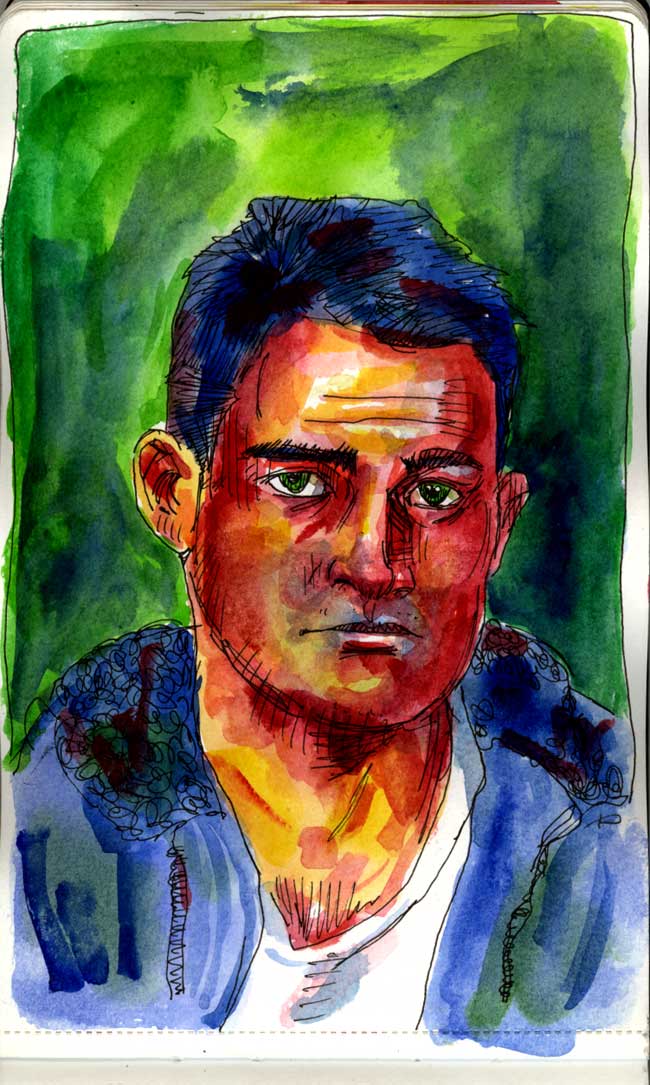
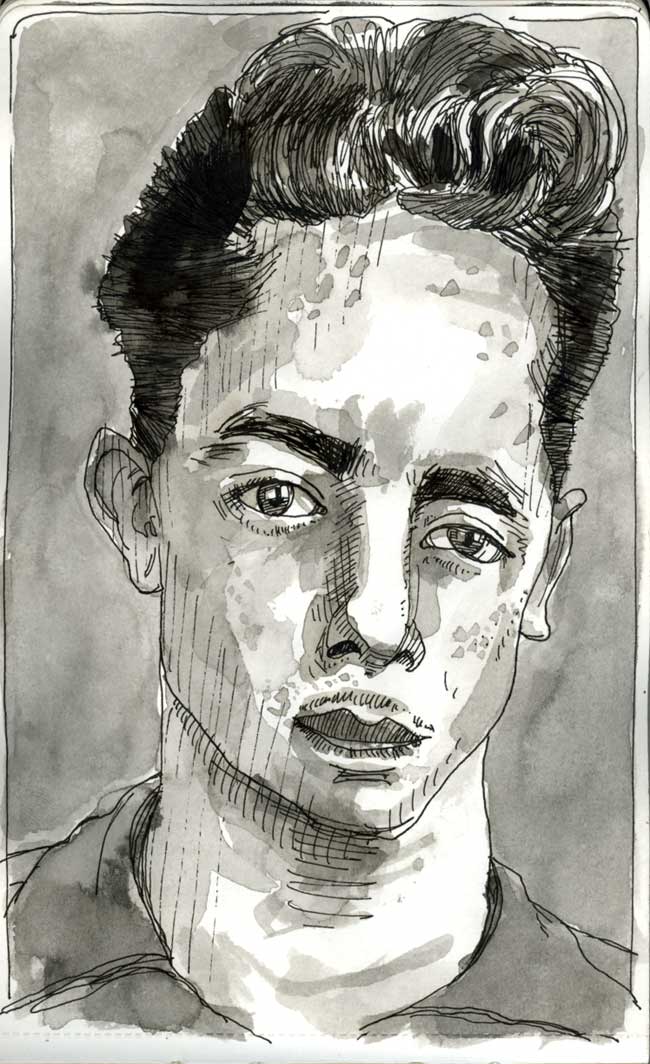
I’ve been working on this series for a while, all in one book. They are in watercolor, pen, brush and sumi-ink. They are all drawn upside down.

I made a couple of little time-lapse films of how I drew and painted some of these portraits.
Click To Play

Like father, like son.

My father has been drawing self portraits every day for ages. He just sent me a day’s output, drawn looking down into a mirror lying flat on the table.

In the accompanying note, he says:

“Doing things in pen is very nerve wracking as if you get one line wrong the whole thing is ruined. This makes you concentrate so you tend to get a picture that is more accurate than otherwise. I n each case I started with the left eye which is the only one I can see out of (the other has been blind all my life), I did the last two in the afternoon, I had to wear my glasses (as you can see in the pics) because after lunch I am unable to see without them, (except all blurry).”

It is sad that I didn’t know about my father’s blindness until this letter. He sends these sorts of little packages to me every year or so. They are more or less the only contact I have with him any more. My parents were divorced when I was about three so I don’t know a lot about him.

His drawings are so similar. He has really developed his ability to draw himself down to an almost mechanical science.

He is pretty unflinching in his scrutiny too.

I decided to try my hand at the same experiment. It is a very unflattering, through-the-nose-hairs sort of perspective on oneself. The last time I saw my father, about three years ago for a couple of hours in London, we were walking down the street and he said to me, “Is that your stomach?” As a result, I made my head very thin in this first drawing.

More accurate, less paranoid view of self.

Third go: scary, pig-snoutish.

I tried a version with my glasses and could barely see my reflection through them. The resulting drawing looks a lot like Ozzie Osbourne’s loutish son, Jack.

From my Father

keir1.jpg
My stepmother just sent me recent work from my dad in Leicestershire. It seems he has moved beyond self-portraits.

keir2.jpg
keir3.jpg

Dibujo en Mexico*

We are back after an all too brief trip to Mexico. It’s a country that I have always liked so much but never spent time in before. I would love to do a long cross country sketchcrawl sometime.

We stayed in Puerto Vallarta which is a touristy place with a huge Walmart and we spent a fair amount of our vacation sunbathing and reading trashy novels and eating from buffets and avoiding the horrors of New York in December and the transit strike.

I spent a grim evening at the bullfights watching four innocent creatures being tortured to death in front of several hundred tourists fresh off the big cruise ships., I went in the spirit of seeking out new adventures when possible but left feeling nauseated and vegetarian.

From a drawing perspective, this trip certainly didn’t have the immersive qualities of trips I’ve taken to Rome or Jerusalem or Paris. However I think that even a daytrip to Dayton is made richer by drawing and writing about one’s travels and so I thought I’d set down some things I’ve discovered about travel journaling:

I like to travel fairly light. I carry a smallish shoulder bag with my journal, pens, watercolors. I like NiJi waterbrushes because you can load them with water in the morning and they will carry you through the whole day without needing to carry water jars that could spill. I recommend some sort of folding stool. You can buy them light and inexpensively at camping stores and they let you set up where you want to without having to worry about being in the way or finding an empty bench.

Be prepared but not overly so. Make sure you have enough of your favorite pens but if you pass a local art supply store, always check it out. You may make some wonderful new discoveries. Don’t shlep more than would be comfortable. Improvise. I sometimes rub local soil and leaves onto my drawings for color. I’ve used pasta sauce as paint in Tuscany.

Don’t just draw postcards. It’s fine to sketch monuments and tourist spots but also try to capture local color and everyday life. Draw your meals, travel on public transportation, use art to immerse yourself in a different way of life.

Be bold. I’ve great characters in Roman catacombs, Death Valley bordellos, San Franciscan homeless shelters, and Yorkshire flea markets, all through drawing. Talk to people and don;t be embarrassed to show your work. Most people are impressed that you are even doing it and won’t judge your art as harshly as you do.

Let your art be your tour guide. Every minute you’re lying in your hotel bed could be spent drawing. The more pages you fill, the richer your memories will be. I still remember the sights and sounds of street corners from years ago just because I spent twenty minutes drawing somewhere. The memories are so much more intense than if I’d just been seeing the sights through a tour bus window.

Jot down notes as you draw, not just recording the where and when but conversations you overhear, thoughts and associations you make, smells and sounds specific to the place. Show how travel broadens your mind.
—–
*Translated by Google. Apologies if it’s garbled.

The Creative License: Giving Yourself Permission to Be the Artist You Truly Are

creative-license

My guide to discovering and increasing your creativity. It’s over two hundred pages of essays, ideas, and watercolors. Here’s a peek inside.

Buy Now From Amazon

I got the first note from someone who has bought my new book at Barnes and Noble today and I realized it is high time I shared some more details about the book with everyone. First of all, I have put together a crude little gallery with a few representative spreads from the book, generally one from each chapter.


Next I’d like to share some opinions from people who’ve gotten their hands on it. I hope to do this less in the spirit of self-congratulation (though I am quite proud of this book) and more to just let people know what the whole things is about and hope fully to inspire some readership.

Let me also say something quite important up front. I have written this book and kept this website going for years now for a simple reason. Re-awakening my creativity and sense of myself as an artist changed my life and helped me to deal with the most horrible thing that has ever happened to me: the day Patti was run over by a subway train and her resultant paraplegia. I am not exaggerating when I say that Art became much of the reason for me to carry on with my life.

I believe that we are all born creative and that, at some point in most people’s childhoods, they lose the urge, but not the ability, to make art. This is a tragic loss. Through the history of our species, ordinary people have always made paintings, sung songs, decorated their homes, expressed themselves in a hundred ways. Today, however, we are increasingly creatures who expect others to provide us with entertainment and culture. We take for granted that creativity is the domain of professionals. We are convinced that if we cannot be perfect, we should not try.

What a loss. I believe fervently in the spirit of amateurism. I know in my heart that it is far better to do an inaccurate, clumsy drawing than not do one at all. It is better to sing off-key than be mute. A scorched home cooked meal is far more nourishing for the soul than a frozen dinner. And I want to rekindle that spirit in whomever I can.

I make a decent living at my job. So I don’t do drawings and watercolors and write essays about creativity or even publish books in order to make money. I do it because I feel that it is important to encourage others (and simultaneously myself) to give oneself permission to be the artists that we all truly are.

My book is called The Creative License but of course, I can’t issue such a license. I can’t give anyone permission to be themselves. All I can do is provide examples, suggestions, encouragement and hope that magic happens.

One of my first readers seems to be getting this. Tonight, after reading just a chapter she writes:

After only the first 11 pages, I feel like you are a voyeur in my life. You said it very well when you talked about people who just have to create. (When I see something beautiful, ugly, interesting–whatever, I don’t just want to look it–I want to get it down on paper and recreate it). But you really struck a nerve talking about those of us who put that creativity into a box and try to keep it there for whatever reason (Will my kids really want those journals that I fill when I’m gone?–yeah, they probably will.) “So with the very first chapter you have looked deep into the heart of people who know they are creative, but stifle it, and the people who are afraid to find out that they are creative. And that encompasses pretty much everyone! I realize that the title of the book is “…giving yourself permission…” but the “familiar” tone that you use to expose those thoughts about creativity almost make it feel like it’s OK for the permission to come from an outside source–the author–someone who has a grip on the understanding of the creative process. “

I hope her enthusiasm doesn’t wane and that the ensuing chapters continue to fuel her creativity and lead her to new places.

Finally, here is a very generous review from one of my favorite artists, my watercolor teacher and mentor, Roz Stendahl, one she recently posted to the Everyday Matters group:

“I was fortunate to be able to read the proofs of Danny’s new book, “Creative License: Giving Yourself Permission to Be the Artist You Truly Are.” First a disclaimer for those of you on the list who don’t remember my name from my infrequent posts. Danny is a pal. We’ve corresponded, chatted on the phone, he’s visited, we have drawn together. You could stop reading this email right now because of that, expecting a bias.

But I also am a life long journaler and I teach visual journaling at the Minnesota Center for Book Arts so I read almost all the books that come out in this field. I want to provide up to date recommendations for my students.

I think these things put me in an interesting position to tell you something: reading this book is just like spending time with Danny. His sense of humor comes through. He is silly and playful, wry and sarcastic by turns, but always engaging. Something is always popping out of his brain. He’s gathered all this up and put it in a book. And he wants to encourage you to draw and tap into your creativity.

There are a lot of books on creativity on the market. Some of them try cheerleading and cajoling, some encourage you through psychology, and others practically shame you into picking up your art materials. Danny’s approach is different. Like the great pitch man he is, he creates an analogy (creative license is like a driving license) and then joyfully explains and expands until you want in. The nice thing about this approach is that you don’t end up with two dozen vegematics in your attic like Opus. You’ll end up with a visual journal that records what’s important to you and you’ll be more connected to your life.

Danny’s book is organized in such a manner that it can be read straight through or dipped into. There’s an introduction which establishes the groundwork for you to view yourself as a creative being. The driving license analogy is introduced here.

This is followed by nine chapters which deal with everything from how to draw (giving you instructions for exercises to get you up and running today) to shock (getting out of a rut), resistance (going on), and identity (self acceptance as an artist). (And lots more.)

Each chapter is further divided into smaller sections, often only a page spread or two, dealing with some aspect of the chapter topic. These sub sections read like brief meditations, parables, or pep talks.

I feel this type of organization is one of the best aspects of the book. It allows the reader to come back to the book for small tune ups so he can get back on the road (keeping with the driving metaphor).

Throughout the book Danny provides his readers with suggestion upon suggestion of things they might want to draw, examine, think about, or respond to. If you are new to drawing, visual journaling, or doing creative activities in your life, this book will help you realize how you’ve been a creative being all along. Now’s the time to reengage your life, dreams, and creative self. Danny’s book will give you enough gas to get you a fair ways down the road and the insight to be able to spot refilling stations.

If you already have a creative license and use it daily in your life, the book will still encourage you. Chances are your take on visual journals and creativity is skewed differently because you already understand your process. But a fresh view, another angle, can help you appreciate what you have and enable you to flex your creative muscles even more.

After reading the book I felt that the experience was like being swept up into a brainstorming meeting where there was a lot of laughter and enthusiasm but also serious, earnest work. I believe you’ll enjoy this book.
I’ve only seen a black and white proof, but I’ve seen many of these journal sketches in person. The book is going to be a colorful and visually entertaining book.
Danny can sell an idea and he does it clearly and with humor. I’ll be taking this book along to my journaling classes so that my students can benefit from the perspective Danny brings to the topic.
Danny didn’t ask me to write a review, but I felt compelled to because there are a lot of “creativity” books on the market and we talk about books on this list. Why buy this one? If you’ve enjoyed and found Danny’s insights on his blog helpful, if you like the supportive aspects of exchange that happen on this list, then you’ll enjoy this book which grows out of this seed. The book will speak to you in accessible ways that other creativity books might not.”

If you gotten this far, I hope you’ll check out the book. And if you do buy a copy and read it, I hope it’ll motivate you to expand your creativity. And finally, I hope you will evangelize, gently helping others to see their own creativity, helping make the world more present, more forgiving and more beautiful.Peace out. Commercial over.

My perspective on perspective

perspective-vanishingpt.gif
School’s back on and NYU students wander through my neighborhood, clutching new books and pencils. Quite often, I see some of them set up in the park, preparing to draw Washington Square arch. It’s a beautiful landmark, and I’ve often tackled it myself.
I like the ones who slop around with paint and charcoal but I can’t relate to those who show up with t-squares and turn out tight engineering schema, that look more like blueprints than any expression of soul. To me, drawing is about observation and sensuality more than perfection. That’s my esthetic.
I draw a lot of architecture because they define the landscape we New Yorkers live in. While I’m no Brunelleschi, I understand the principles of perspective. I know generally how to locate a vanishing point and that knowledge can be useful if I’m really stuck. But I think of it as more like understanding the principle of the internal combustion engine; I get it but it doesn’t enter my mind much when I’m driving down the road.
Here’s how I’d go about drawing* the view down my street. perspective-pen.gif
It’s a fairly complex scene so I lay down some little marks first. I find the midpoints of my page (in green) using my pen as a rough ruler. I take the same sorts of measurements of the thing I’m drawing. I also uses my thumbs as rough rulers� so and so many thumb widths to this point, so and so many pen cap lengths to this point � that sort of thing. If I didn’t measure things out like this, I’m sure I would have misjudged how wide the library’s facade was in the foreground. The actual part of the scene that is of interest only occupies about 1/8 of the whole space.
I usually start drawing in the upper left hand corner and work my way across. I’ll make little marks if need be to tell me where things intersect. When I just whip out a long diagonal line like the one in the upper left, it probably won’t hit the mark unless I set a target point.
I’ll also look for some sort of large and broken line somewhere to use as a reference point. In this case, the building on the right has a regular pattern of tiles down its length; I can use this like an in situ ruler to guide the other buildings’ proportions. I count down three tiles and say, ‘Okay, the roof of the ornate building in the center hits this height. Go down one more tile and that’s the point at which the angle of the receding part of the roof hits. Down two more and that ‘s the roof of the building behind it…’ and so on. If there’s no guide in the landscape (as there wasn’t horizontally here) I can also use my pen length to bifurcate the space and create a partial grid to set my reference points.
Remember to check your verticals. Unless you have birds’ or worms’ eyes, make sure your verticals are straight 90 degree angles to the ground. It’s so easy to start leaning them over and soon all of your lines will be out of whack.
I measure other sorts of angles by holding up my pen horizontally and then rotating it to meet the angle. That action temporarily imprints the deviation of the angle from the horizon into my brain. When I go down to the paper, I just repeat the rotation and I can usually get it pretty dead on.
I like to do all these little measurements rather than ruling down the artificial lines of perspective and then erasing them because I am trying to record my own observations in my drawings. I find that all these little measurements bring me closer and closer to my subject and that’s the goal of my work. I don’t care if it’s all accurate and perfect but that it reflects what and how I am seeing. The deeper I go the better. Somehow rulers and perspective lines make it all seem more mechanical and artificial and I just don’t like it.
In any case, the results seem okay to me. In fact, I will often be a lot wilder and just draw lines and angles on the fly. I don’t care that much of my buildings are misshapen and irregular, so long as they feel alive. Those T-square folks seem to make drawings that lie on the page like dead, academic fish.
Drawing buildings is just like drawing anything else. Be slow. Keep your eyes on the subject most of the time. Don’t freak out if you make a ‘mistake’. And do it as often as you can.
Drawing isn’t a science. Don’t reduce it to one.
—–
*Atypically, I drew this in Photshop on a tablet so I could use layers to demonstrate my methodology.

On crosshatching

Xhatch1.jpg
As you spend more and more time drawing, there usually comes a point when contour drawing isn’t enough. You can set down lines that perfectly describe the shapes in front of you but you become interested in giving your work dimension and exploring the effects of light and shade. Several people have reached that point recently and written asking me to talk discuss the whys and wherefores of cross hatching. let me try.
Cross hatching is quite miraculous. How is it that black ink lines on white paper have the ability to create an infinite number of shades of grey, to evoke all the colors of the rainbow and to suggest textures and materials and varied as silk and stone, glass and schnauzer hair?
xhatch11.jpg
The first thing to do is to get in the groove. Practice drawing lines until you can lay them down in fairly predictable parallel strokes. Do it in boring practice sessions or just start working them into your drawings. Try greying gradations, filling boxes from pure white to solid black — space the lines far apart in the first box, then halve the distance in the second box, then halve it again in the third and so on until your final block is completely black. Next, try crossing your vertical lines with horizontal ones, weaving darker and darker gradations. Then lay a diagonal set of lines over the grid, upper left to lower right, then cross back upper right to lower left. Try keeping them as regular and even as you can, so you can create various sorts of grey with various sorts of combinations of lines. Don’t make yourself nuts just experiment with lines at 45 and 90 degree angles.
The next things to consider: What do these shades of grey represent? The answer seems to fall into three main effects: Tone, color and texture. You can decide that darker greys mean things in shadow, or that different greys represent different surface colors, or that the lines represent different textures.
Xhatch6.jpg
These drawings (by Guptill — see below*) are basically about light and dark. The lines tell you the volume and direction of the light on the object and that’s about it.
Xhatch7.jpg
These lines tell you a lot more about the materials the objects are made from; straw, wood, wicker, etc. all accomplished with crosshatching various sorts of lines.
Xhatch8.jpg
In this drawings, my pal Tom Kane uses lines to suggest different colors in a girl’s kerchief.
Xhatch9.jpg
But here he uses the same sorts of lines to express the direction and shading of light on a girl’s hair.
As you can see, once you start introducing these tones, you have a lot more decisions to make. You aren’t just recoding shapes; you are expressing an opinion about what you found interesting in the scene.
Xhatch4.jpg
Consider the differences that values and tones make in these three interpretations of a scene:the various choices evoke different temperatures, distances, moods and degrees of importance.
Xhatch2.gif
It’s interesting to play around with line quality and stippling too: Consider the different feelings these drawings have because of the varying degree of regularity and the direction of the lines used in each identical composition.
My inclination is to avoid incredibly regular lines; they seem mechanical and inorganic to me. I lay down one value in the middle then go back and firth balancing areas with more or less crosshatching until I have described the effect I want. It’;s all a matter of balance and crosshatching is pretty forgiving, If things feel off, just go back and hit your darker areas with a new layer of lines to get the emphasis right.
Like so many things in drawing, there aren’t a lot of hard fast rules or rights and wrongs. Crosshatching is just another opportunity to record your observations, capture your feelings and have fun. And there’s something about that hypnotic regularity of drawing parallel lines that is very soothing.
Xhatch10.jpg
“Drawing is just an excuse to crosshatch”— R.Crumb
———–
* The greatest practitioners and teachers worked and published in the 19th century, when every day’s paper was full of endless engraved examples of cross hatching. I have learned a lot from the publications of Watson Guptill, beginning with seminal works by Arthur L. Guptill himself, like Rendering in Pen and Ink and moving on to the less encyclopedic but crystalline Henry C. Pitz’s Ink Drawing Techniques. I also love Paul Hogarth’s Creative Ink Drawing. Many of these are still in print or can be picked up cheaply second-hand.

Clarification

rome-25.jpg
I’ve been following a discussion on the Everyday Matters group and it has gotten my wheels turning. The talk has been about the utility of specific drawing assignments suggested by others, whether there’s really utility or purpose to everyone deciding to draw a piece of fruit one week, a pair of shoes the next, and then sharing their work and discussing it. While some people love it and have made it the main business of the group, others have complained that it has diverted the purpose of the group and distracted it from its original intention.
I’m not interested in taking sides because I think any sort of drawing is a good thing. However, I’d like to clarify what I’m up to with my drawing. While I have done some nice drawings here in Rome, I’m not interested in being a travel writer or an illustrator or a fine artist.
I want to live my life to its fullest and I find that drawing what I encounter deepens my appreciation. While I share my work with others, I make it for me. When I have unusual and interesting experiences like I’m having in Rome right now, my drawings seem to have a wider interest. But my core philosophy is that every day matters. Every single day. The day you meet the president. The day you have a baby. The day you find a special on sirloin at the supermarket. The day you get your shoes back from the cobbler. I find that drawing helps me to commemorate those events, large and small, dull and transformative. For me, that’s the point of art. To deepen my understanding of my life.
If someone else’s suggestion that I draw a particular thing opens my eye to fruit or glasses or the pattern of sunshine on my counterpane, then that’s great. But ultimately, we all live different lives and are handed assignments by each dawning day. Each day we’re handed a new set of challenges, new rivers to ford, new choices and wonders and pains and lessons. If we think the day is full and familiar, we need just dig deeper into it, look for fresh insight, peel back the layers of the onion. I find that drawing helps me do that.
Art lessons familiarize one with the tools but they are not a substitute for digging one’s own ditches, constructing one’s own nest. They are just abstractions and life is very concrete. I enjoy what I learn in life-drawing classes, but learn far more by drawing my wife’s sleeping body, my reflection in the bedroom mirror.
To draw, one must draw. Exercises and academic and books provide examples of what one might do, but experience is the real teacher. Take tomorrow as your assignment. Draw your breakfast, your bus stop, your bathroom wall while you’re shitting, your laundry as you fold it, your children as they watch TV, your pillow as you wait for lights out.
Be bold with your exploration. Capture what you do and have always done. Then push yourself to new experiences if only to draw them. Visit new neighborhoods and draw them. Meet new people and draw them. Try new foods, read new books, smell new flowers, do anything that will deepen your understanding and your appreciation of your world and your place in it.
I don’t care if you think your drawings suck, if you are ashamed to show them to anyone else. What matters is that you pause and contemplate. If your record of that contemplation is inaccurate, try again. Feel deeper. See deeper. Slow down. Relax. And tomorrow, do it again. You aren’t being graded or evaluated on your drawing. No more than you are being evaluated on your life itself. The only thing that matters is you. What you experience. How you experience it. How much you get out of this day and the next. This is your life. Dig into it. Embrace it. Notice its curves and angles. Explore its corners. Feels its edges and put them down on paper. The pen, the page, are just tools for you to take time and slow it down. I can’t make you do it my way, any more than I can force you to live your life my way. You decide, you forge your style, you pick the line that draws your life.
Take tomorrow and instead of hesitating and questioning and doubting and fretting, draw your breakfast, draw your day. Then try it again the day after. With each successive day, you’ll be clearer and deeper. If you miss a day, don’t freak out or beat yourself up. Just take on the day after that.
Share the results if you’d like. By sharing you will find commonality and support. But maybe you don’t need more than self sufficiency. In that case, keep your drawings for yourself. Or toss them out as you do them. The drawings don’t matter, the drawing does.

Technologica Artistica di Roma

Rome-20.jpg
So there have been various technical questions from readers who wonder what sort of mountain of gear I have brought with me here to the Holy City to get shit* onto paper and onto this site. It’s an important and pressing issue so I will explore it here in full.
Here’re the highlights: I carry an aluminum alloy Soltek Pro Easel in a calfskin and spandex torsal harness and a Herman Miller folding titanium stool with translucent Cygnus mesh; a 22×30″ Roma Luss Journal re-bound with 300 lb. Fabriano Artistico Cold Press; a full set of Series 44-14 Dan Smith Autograph Series Watercolor Round brushes in Russian winter male Kolinsky sable fur; my trusty 18 Kt rose gold finished Mother of Pearl 85th Anniversary Aurora fountain pen and three different sets of Daniel Smith watercolor pans, each customized for optimal performance under varying heat and humidity conditions.
Oh, and my personal assistant, Franellika, carries a 72″ linen parasol; two Art Bin Ultimate Solutions tote full of miscellaneous markers, pencils, paints, brushes, scalpels, quills, sandwiches, and iced martini fixins; a fully loaded iPod plus backup; a portable library of travel guides, art monographs and r.crumb sketchbooks; and a yellowing skull for contemplation
Back at the hotel, I have two Power Mac G5s (2.7GHz dual-processors) each rigged up to 30-inch Cinema HD Displays and 2-terrabyte external drives; I digitize my drawings with my Aztek Premier drum scanner and run off prints of each page on my HP Color LaserJet 3700dtn Printer. The gear takes up most of the extra hotel room I set up as EDM production HQ but it’s worth it to bring you my high quality art work in the sort of breath taking verisimilitude you have come to expect from this site.
Any further questions on techniques? Please post a comment and/or refer to this profile of my usual gear inventory and inventory of art supplies. Rome-21.jpg

—— *My language may be a little questionable today as I have discovered my new favorite filthy thing: The Dawn and Drew Show, the fucking funniest thing I have heard at least since coming to Italy if not before, and am listening to it on iTunes while I write this)