How to feel.

Patti at seven.

What follows is a long ago thought from my journal — I think I tapped it into my phone one day on the way to work —  that’s still 100% true. The guilt that can accompany acceptance of loss. Is it okay to be okay?

Usually I am fine.

It’s confusing because it can seem like I am calloused or past it or forgetting. How can such big feelings go away? How can such a big thing become smaller? This used to make me feel guilty. And I would hide it even from myself. Or I would force myself to feel bad.

But now I think I understand it better. It’s not that my feelings are gone. It’s that I know how to access them or put them away. They don’t overwhelm me anymore but I can summon them up when I want to, need to. The feeling is no longer an open wound. It’s a treasure, a precious charm on a chain around my neck that I can take out and kiss when I need to feel blessed.

A text from Miranda

Many of the observations and realizations that came to me during the period covered by A Kiss Before You Go didn’t appear while I was sitting with my sketchbook open on my lap.  I had thoughts in the middle of the night, while walking to my office, while brushing my teeth, and I would jot them down on scraps of paper or tap them into my phone.  Some of these thoughts were unique and didn’t recur, some were dreams, some were conversations. Many fell into particular categories and my subconscious would polish and deepen them over time. Occasionally, I would put a thought into my sketchbook and later have a better and truer version of that same idea. In the final, published book, I sometimes replaced the first mental sketch with this more developed thought. But at least 75% of the words in the book are the ones that came to me as they are in the page.

Here’s an example, a snippet of a text message from my sister that I saved and look back at when I need it.

“Remember — there were shitty times days and moods when Pat was alive. This is just what life is now and will change again. I promise you that.” — Miranda

She should know.  In addition to Patti’s accident and death, Miranda had to deal with the sudden death of her own husband. Less than a year after they were married, Brian died in his sleep, suddenly, unexpectedly. SInce that tragedy, she has remarried and has a daughter. My sister has had an unfair share of tough times but she has come through them with resilience and refused to let them toughen her soul. She remains empathetic, loving, loyal and smart.

My sister was also Patti’s best friend. She knew her so well and she was so right to say to me in so many words, “Don’t glamorize the past. Accept the present. Don’t despair of the future.” When someone dies, it’s tempting to put them on a pedestal and to think that happiness is vanishing down the sluice hole of the past. Guilt can be overwhelming. And sadness can seem like a never-dissipating fog.

When Patti died, Miranda was the first person by my side and she has guided me through the days since. She is a wise and beautiful person. I’m lucky to have her and to be able to learn from the vast experience of my kid sister.

It’s at the crossroads of life that you learn who is truly there for you.

More apron strings.

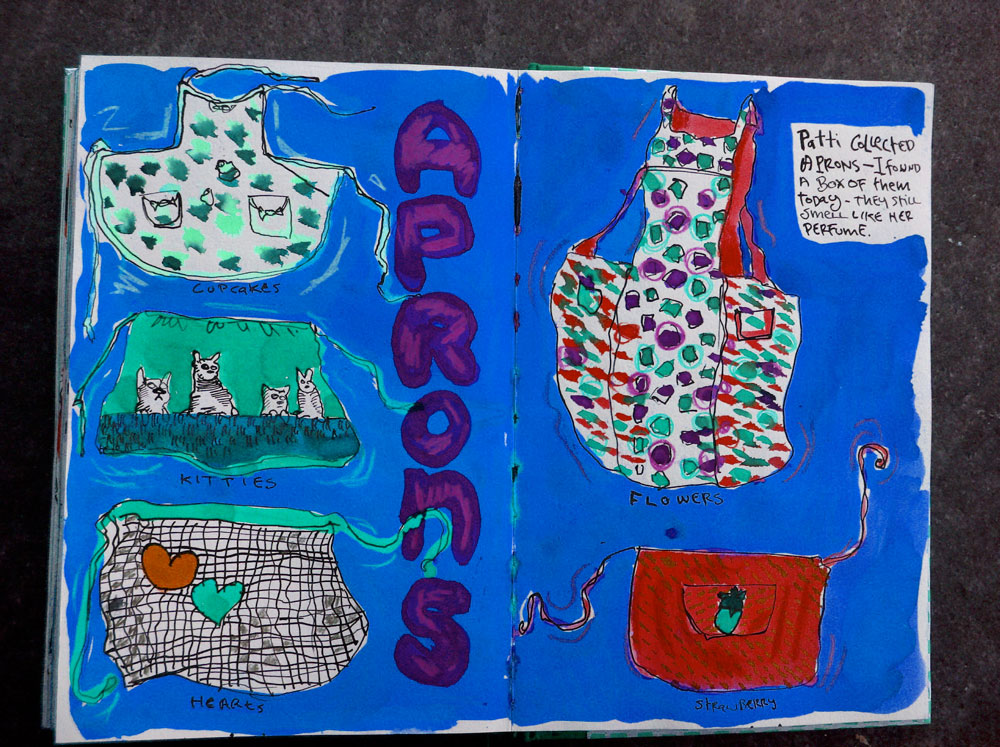
After sharing my apron drawing recently, I came upon the journal entry I wrote when I first encountered the aprons two years ago, a pain-filled essay that never made it into my book, A Kiss B4UGo.

” I was aiming to empty out a bunch of bags of stuff that have been sitting on our window seat ever since Patti and Donna filled them during their organizational sprees in early March. One of the bags was full of aprons, the bulk of Patti’s collection.

There is something very Patti about aprons. They are girly, though I occasionally had to wear one like some comic strip husband, some Dagwood. They were nostalgic objects, found in flea markets and thrift stores, but for her they were all functional and practical; because she had to cook (and do most everything) sitting down in her wheelchair, they protected her clothes from splashes of grease and spaghetti sauce. Most of them were handmade and whimsical, sewn with novelty prints of roosters or cows and embellished with frills and appliqués.

I went through the bags, finding one of her many purses filled with breath mints and tissues and little notebooks. There was a bag full of wool and half knitted things. There were lots of gift items, things she had gleaned at sales, full of potential and reminding her of someone. But they sat with the tags still on, and I had no idea who she planned to give them to.

I had intended to be so productive, finally tackling all of the piles of stuff I had been avoiding for the last five months, and suddenly, I was broken down and sobbing. My mind was empty of words but overwhelmed with feelings. Who would ever need all these aprons? Who would ever get these presents? How could I even throw away this box of breath mints?
I recategorized the things in the bags, then put most of them back. Then, suddenly furious, I ripped down the biggest box in the pantry, the one labeled ‘wheelchair parts’. All these broken brakes and axles and inflated cushions filed with punctures, the supplies I needed to constantly jury-rig repairs on her chairs, no longer necessary and taking up space. Cursing to myself, I emptied the box into a garbage bag, then stopped.
Do these things matter too? Will I one day be filled with regret that I threw them away? Should they all go back on the shelf? No, I resolved, I need to throw them away — but I’ll keep one brake mechanism as a reminder of the rest.
I had made no real progress against the thoughts that haunt me late at night, the seemingly overwhelming task of getting on with things by getting rid of things. Instead, Jack and I stripped the slipcovers off the couch and took them to the laundromat, then emptied the fridge and scrubbed its shelves. A minor step against the incursion of chaos, a battle won, the war still to be waged.”
—-
Update:  After reading various people’s comments on the above, I realize that I wasn’t clear enough about the origin of my words.  This is a quote from my journal of almost two years ago, when Patti’s loss was still very fresh, too fresh to be doing the sort of purging I was considering then.
But it gets easier. Now, almost three years after her death, Patti’s absence has sufficiently mellowed that I can look at her things and see them more objectively, still bathed in her light but less suffused with guilt and confusion. I still have so much of her in my home, but I am now in the process of being more selective about it all, of choosing the most precious objects and appreciating their power and beauty rather than being afraid of it. I am not the sort to repurpose her possessions into quilts and the like, but I l have discovered that having fewer mementos make each one more precious, more jewel-like.
And I still have, and probably always will, every one of Patti’s aprons.


Death doesn’t take a holiday

Another page that didn’t make it into my new book, AKissB4UGo.

I live down the street from a fire station — at any time of the day or night sirens ring out and jack up my blood pressure.  This used cause me great anxiety. I would wait to see if the fire engine or ambulance was going to pull up outside of my house. If I was coming home and the sirens were wailing, I would increase my pace down the street until I came to my corner, fully expecting to see my apartment ablaze, thronged with flashing lights and unfurling hoses.

My oldest neighbors were a couple in their late 80s. She was one of Patti’s favorites and was now had advanced Alzheimer’s. I came home to find her being taken away by this ambulance while her husband stood bewildered on the sidewalk. I felt that they were mirroring my own situation. Fortunately it was a minor incident and she came home in a few days. But then, a couple of weeks later, Arthur had a stroke and died on the living room floor. Two deaths in our building in as many months.

Fortunately, my siren anxiety has faded and gone. I no longer fear the worst, having been through it.

Whoomp, there it is!

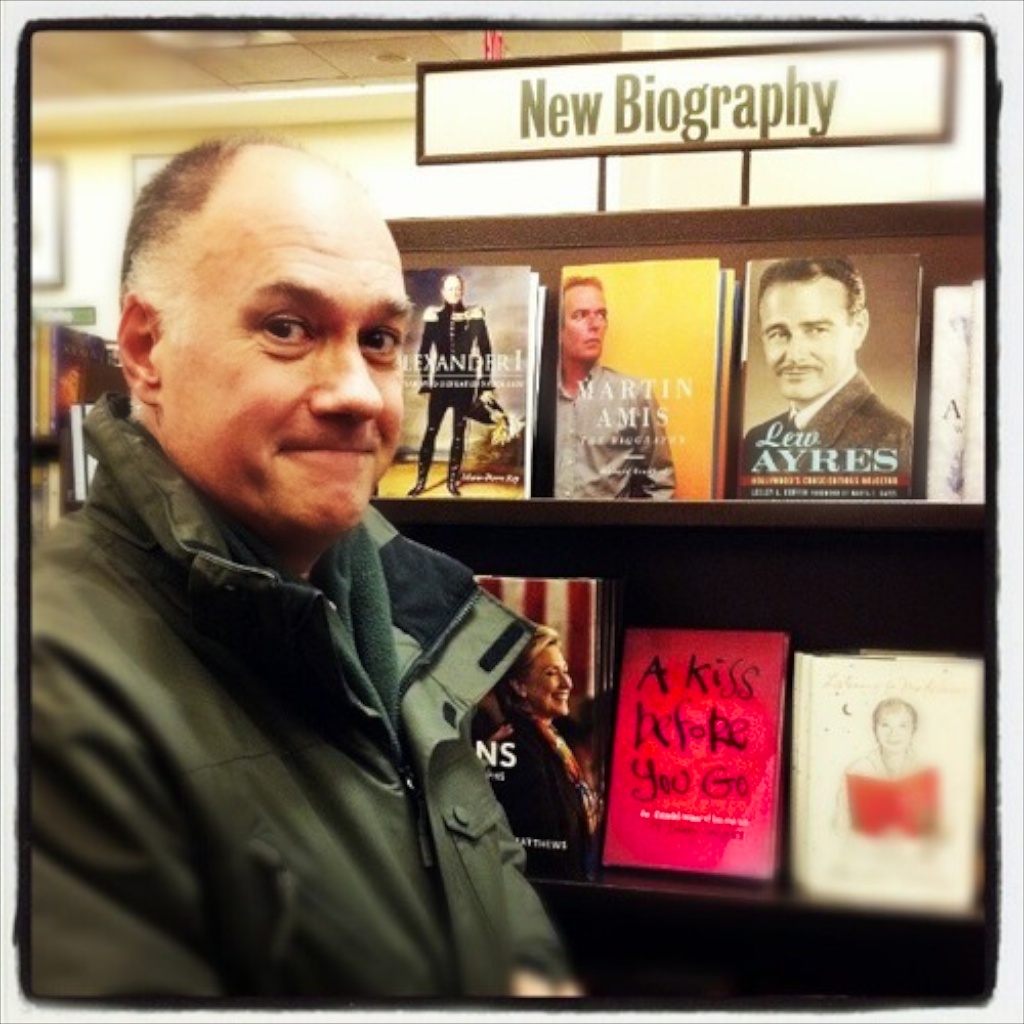
BandN
The first copies of my book encountered in a bookstore.
Barnes & Noble on 86th and Lexington in NYC.

Now that my book actually exists in the real world, can you help me to spread the word and help others find it? The simplest form of that is to share what you think of it on the Amazon page for A Kiss B4 U Go. Write a little or a lot  — but by sharing an opinion, you will help others know whether it’s worth reading or not.

It would also be fantastic if you would share it with people you know, friends and relatives, and the readers of your blog or Facebook page if you are so inclined. If you’d like to ask me questions and share my answers, I would be very happy to do that too.

Starting in January, we will be promoting the book in the press. Magazine, papers, blogs, radio, etc. But I always feel that word of mouth from people who know me and my work is the best and helps make the experience of writing a book complete.

If you have any other ideas on ways I can share the book with people who will enjoy it and get something from it, I am all ears.

Arrivederci

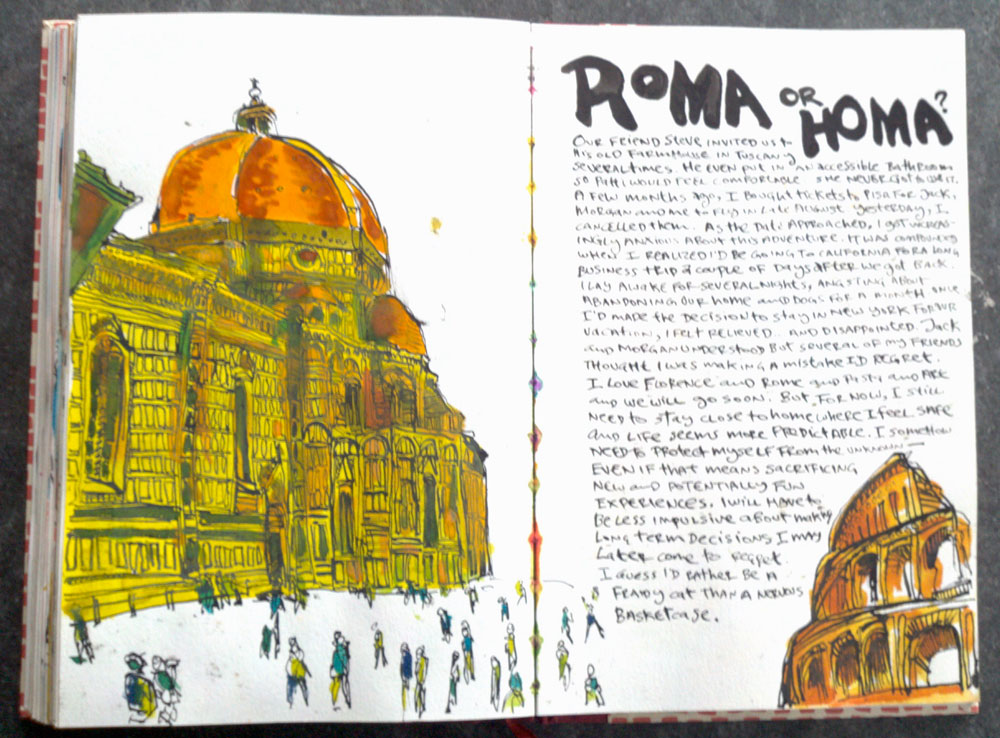
On not going to Rome. A journal page that didn’t make it onto my new book, AKissB4UGo.

I guess it’s appropriate that this spread never made it into the book because it’s about a painful decision I made to not do something.

My friend Steve had moved to Tuscany several years ago and renovated an old farmhouse. We’d been very excited for him and kept abreast of all the changes he was making in this life. He took great pains to make sure that his farmhouse was wheelchair accessible so that Patti could come and visit him.  He put in a special bathroom and was very excited about the day when we would arrive. That day never came.

At Patti’s memorial service, Steve encouraged Jack and me to come and visit him as soon as possible. And we planned the trip for three we should never have put off. My niece Morgan was to take Patti’s place and I bought tickets and served a rental car and we were all ready to go. But at the last minute, I just couldn’t do it.

I couldn’t bear the idea of leaving my home — it just seemed too scary and disruptive.  I was sure that Patti’s absence would hang so heavily over me if we made this long anticipated trip. I felt like I was stepping off a cliff;  it made me think of all the things that we could’ve and should’ve done together but now never would. I imagine waking up in a strange bed in a distant country in the middle of the night and feeling utterly and hopelessly alone. I just couldn’t stand it. Fortunately, Steve was understanding when I told him of our last minute change in plans.

This is still a painful and confusing memory.  I don’t know that I can fully explain it even now. Maybe that’s why it didn’t end up in the book.