From to-do to Done Deal.

I frequently risk being the prisoner of my ambition. I dream big and often, then wake up exhausted with a long to-do list and a sense of dread. How will I get it all done? How will I climb this mountain I have built?

I sit at its base, exhausted by the possibilities, wrapped in a sense of failure before I begin. That sense threatens to keep me from the first step. And the longer I wait to begin, the further away the summit will stretch.

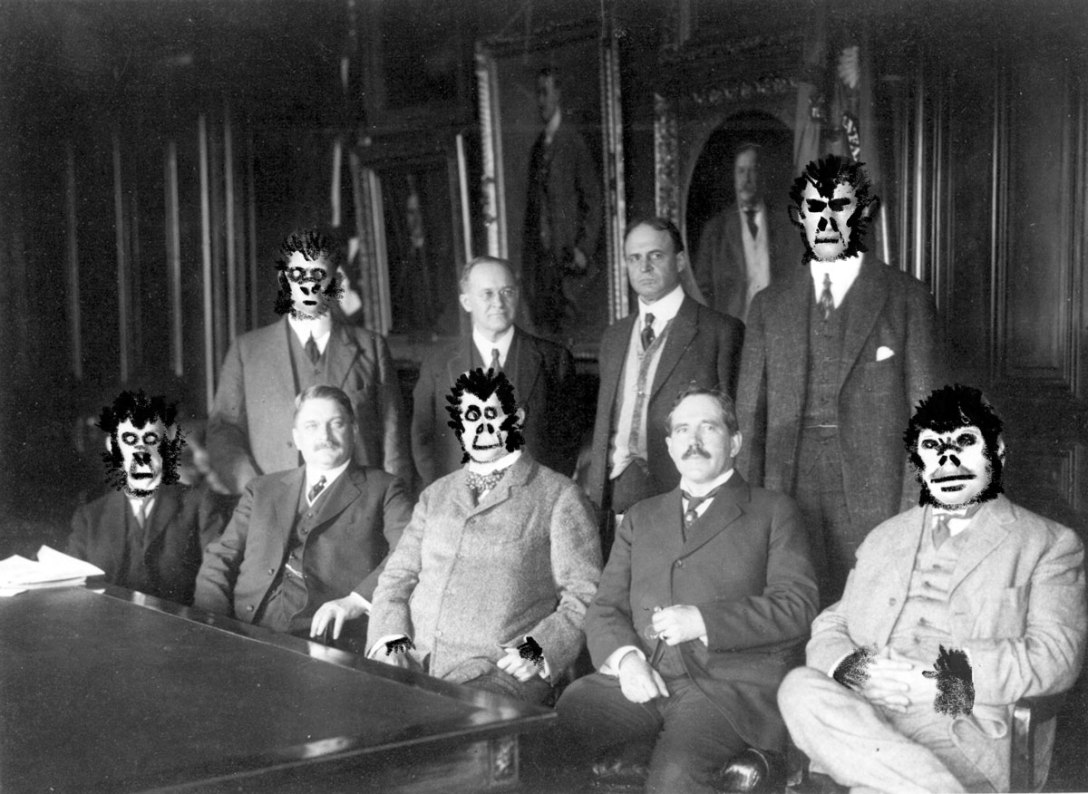
Not doing can easily become a reflex. Like a hoarder with newspapers to the rafters, like a 700 lb. man trapped in bed, like a refugee clutching a trash bag of possessions and a child’s hand, it can all seem too big to tackle. Submission to failure and the monkey can seem the only possible recourse.

But doing, like failure, can be incendiary. I start by taking on one challenge, maybe the easiest, teeniest one on the pile. When I have surmounted it, one checkmark on the epic list, I feel a flicker of hope. I pull the next task toward me and the flicker starts to smolder.

I make the bed, I got to the gym, I do a drawing, I write a blog post, I arrange a lunch meeting, I write a chapter, and soon the flames are roaring, wheels are turning, we are half-way up the peak.

Not doing can easily become a reflex.

Then, I sift through the list. I discard the pointless, the distracting, the indulgent. I break the most overwhelming obstacles into a small series of do-able tasks. I beaver on. Soon the list is a scaffolding, a set of pitons leading me hand-over-hand to the top.

Last night we watched The Martian. It’s a great move based on an even greater book. It deals with an impossible challenge: surviving on Mars, with rescue years away. The solution is increments — tackling one small problem, then the next, and so on. The more bite-sized the problems, the easier the whale is to digest.

Dream big. Start small.

La vita bohemien!

Ten years ago, I illustrated a book called A Writer’s Paris by Eric Maisel. It’s about why/how you could/should move to Paris, at least  temporarily, to fuel your artistic impulses. It worked on mine — Eric’s publisher paid for Patti and me to spend a long weekend wandering around Paris and making many of the drawings that would fill the book. What a time!

I’ll be honest, I don’t remember the book’s argument in detail. I was irritated that the publisher thought to combine my drawings with some collage artist’s work and so I couldn’t read the final version of the book with an open mind. That peevishness notwithstanding, the basic premise of Eric’s book came back to me as I sat here in the Piazza Benedetto Cairoli with my Macbook on my lap. I’ve been in Rome for less than forty eight hours, but the magic of a different continent, city, culture, place and pace is already working on me.

piazza-cenciAt Jack’s suggestion, I didn’t book a hotel room but found an AirBnB just a few meters from the door of his school. It’s a fourth floor walkup in a 15th century building with a giant front door key and iron shutters I swing open each morning to flood my room with sunshine. As I sit here in the Piazza across the road, I hear the tram rattle by, the chuckle of an accelerating Vespa, the doo-da, doo-da of the carabinieri, and snatches of Italian wafting over from the men on the next bench, smoking and joking. I’m not in Kansas anymore.

Being in a new place always open my eyes and ears. Everything is unfamiliar to some degree, a degree that inspires my record in ink to be deeper and fresher. My travel journals contain the richest pages on my shelves, the most experimental, the most free. Each day in a new city is both energizing and depleting. I strain every hole in my skull to suck in more and more information and end the day wrung out and deep in sleep.

jacks-alley
Hanging out with my boy in his new city
makes my imagination run wild. He lives and works in a gorgeous old building, a 15th century villa with frescos on the 16 foot ceilings and huge windows flung open upon mouldering terra cotta walls and stone alleyways strung with phone wires. His bed is narrow and hard but he has his own studio, bigger than our living room, with a checkerboard marble floor and walls filled with sketches and pages pulled from the old Italian magazines he buys at the flea market. A few blocks away is a park full of Roman ruins, fenced and gated to protect the hundreds of ferrel cats who’ve made it home. The Jewish Quarter is full of street markets selling big blocks of mozzarella and cadres of prosciuttos in chrome slings waiting to be shaven. Jack has learned to make pasta from scratch and to order a cornetto and a cappuccino with confidence.

He has less than a year till he graduates. But something in me tells him not to worry, to take it slow, to revel in this season in Italy, that it will be something he never forgets. Last week, he and his classmates traveled to Abruzzo and put on a performance in the earthquake ruins of a tiny village. Next week, he heads to Venice to sleep on a boat. I tell him that for the first year or two, he can keep his needs modest, can earn money here and there, can work on being a man of the world rather than a slave of the wage.

roman-viewI spent a year in a garage in LA. And then I came back to the Manhattan haunts I had commuted through for decades, a new perspective on the same streets. It would be nice to have a garret here in Rome. Or to couch surf across India like Prashant. Or to get a cabin in the woods or a minihouse I could pull behind my car. It’s hard to eat leftovers  with  the same relish, but certainly New York is the kind of place I can have creative reawakenings, just like Eric’s Paris or Jack’s Rome.

Going somewhere fresh and rich and living just for one’s art for a period, that’s something every creative person should try, methinks. Forget the pressures of income of language and culture and history, just for a month or two, long enough to rearrange the pieces and shake the monkey back into his hole.

I don’t know that I need an adventure so complete, to completely pull up roots and repot on foreign soil. More likely, the many trips I have planned over the next few months will suffice. Next weekend, I’ll be in Austin. Then to Prague, Doha, Reykjavik, maybe Hanoi too. Shifting perspectives, fresh pages in my travel journal, the search for adventure, new faces, new menus, new conversations, all adding up to a big thick deck to shuffle and deal myself out another winning hand.

Does the name Pavlov ring a bell?

This is annoying as hell. My dogs, Tim and Joe, are obsessed with the trash chute in our vestibule. Whenever I drop a bag of garbage down the chute, they go nuts, growling and barking and trying to leap up and into the chute in pursuit of the disappearing bag. This has been going on for years. In fact, it’s so obsessive that whenever we open the garbage can in the kitchen or even the dishwasher next to it, they go scrambling to the chute, waiting for something that’s just. Not. Going. To happen. It’s a habit, a pure, Pavlovian habit.

Habits can be a pain, like biting your cuticles or forgetting to floss, but they can also be a real boon to a creative person. They are a little subroutine we can plug into to our neck-top computers to make sure we draw or write or play the dulcimer on a regular basis, a basis that will make us more skilled, more expressive and happier with our work.

Habits have three basic parts. First, there’s what I call ‘the Spark’. That’s the event that triggers the habit. In my dogs’ case, it’s anything to do with throwing out garbage. Garbage in, the madness begins.

Next, there’s the habitual behavior. In this case, running like a lunatic across the apartment and gnashing your teeth at a small steel door in the wall.

Third, is the reward. Tim and Joe never actually get the reward which must be diving down the garbage’s burrow to throttle it deep in the ground (they are dachshunds after all, bred to kill badgers in their lairs). Or maybe it’s just the thrill of the chase.

In any case, think of those three steps in setting up whatever brain program you want to write. Let’s say you want to find time to draw on a regular basis but the monkey voice in your head tells you to watch TV instead. So let’s create a habit. 1. Put your sketchbook on the coffee table next to the remote. When a commercial comes, (spark), grab the remote, mute the TV, pick up your sketchbook and draw whatever’s in front of you (your feet, your coffee table, your slumbering Rottweiler, scenes from the commercial on the screen)  (habit) until you fill you up your sketchbook with awesome drawings (reward).

Think of other sparks you could link to habits. Every time you make a pot of coffee (spark), draw the view out the kitchen window (habit). Every time you sit on the toilet (spark), draw on a sheet of toilet paper (habit). Every time Donald Trump says “Mexican”(spark), draw your neighbor’s Chihuahua (habit).

Or, subscribe to my blog (sign up in the column on the right) and get an email three times a week when I post (spark), and do a drawing based on my featured image (habit). That will be rewarding for us both.

Greasing the daily grind.


I’ve always found it exciting and a bit chilling to read about the typical day on the life of an artist I admire. They invariably go something like this:

“I spring out of bed at 5 a.m., throw some Ethiopian into the french press, and swim in the Atlantic for 45 minutes with my Rhodesian Ridgeback, Horace. Then, still wet, I sit down at my 1928 Smith Corona and write for four hours or 4,000 words, whichever comes first. I pause to eat 200 ml. of fresh sheep yogurt, steel-cut oats and Lebanese dates. Then, 100 push ups.

“Next, I allocate 43 minutes to email  my editor, manager, publicist, agent, mistresses, and fans. When the tibetan sand clock that the Dalai Lama gave me gongs at noon, I walk down to an exclusive boîte on the main street of my quaint, artisanal town to eat lunch at my regular table with one or two of my equally famous artist friends.

Then I stroll home and have a two-hour nap, a massage, a high colonic, sex, two Bolivian chocolates, and return to my studio…

“Then I stroll home and have a two-hour nap, a massage, a high colonic, sex, two Bolivian chocolates, and return to my studio where I write until my housekeeper serves dinner which I eat with twenty of my closest friends and several cases of wine bottled by some aristocratic boyhood pal, then a few lashings of espresso and off to bed where I read some Keats, wash down a handful of Lunesta, adjust my satin eye shade, and dream about tomorrow’s work.”

Making art takes work. For some of us, it is our work. Work without a boss, or a quota, or a time clock. And that kind of job can be very hard to keep up. That’s why artists establish routines, to get them off their duffs and into the studio. We need to be motivated by something to put down the remote or the opium pipe and saddle up.

The only one who will make us do what we do — is us.  Sure, editors can give us deadlines in return for advances and gallerists can schedule gallery openings but we know deep down that we can always buy more time if we whine. No one can fire us.

For the last few months, I have pledged to myself that I would post something here three times every week, on Tuesday, Thursday and Saturday at 7 am. I have written several zillion posts here over the years but this is a bit more structured. I made this pledge because a deadline of some kind would keep me more productive than just waiting for inspiration, desire, and schedule to converge. I haven’t been utterly slavish about this pledge as you may have noticed but it has kept me reasonably committed.

The key has been to establish a proper routine about it, besides this slightly guilty feeling in the back of my head that I should sit down and write something. I like to do it early, before the press of the day has begun, when the streets are quiet, Jenny and the hounds are still in bed, and I have yet to read any emails or NY Times editorials  that could clutter or influence the flow. I awake with a vague notion, then make a few false starts, and soon the mechanism clicks in and the sentences spool out.

If you stay up until all hours kicking the gong and chasing chorus girls around Montparnasse, it’s a lot harder to rise with the dawn…

Starting one’s days productively takes structure. If you stay up until all hours kicking the gong and chasing chorus girls around Montparnasse, it’s a lot harder to rise with the dawn, so it’s helpful to be a little disciplined about what you do all day long, even when you aren’t creating. Eat protein, read actual books, don’t watch the Tonight Show. Repeat.

And just because my body is sleeping, my brain doesn’t get to punch out. If I mull for a minute or two about what I want to write in those minutes before sleep, it’s much more likely that I will wake up with the first sentence sticking out of my brain like the beginning of a roll of Scotch tape.

The art-making process can be mysterious but it can also be somewhat controlled. You can set a wakeup call for the muse if you give yourself a predictable program, an armature to build your work on.

I’ll write more about this next time. Which reminds me of another tip: never leave your work 100% completed at the end of the day. Park on the top of the hill, leaving half a sentence or a partially drawn face, so the You of Tomorrow can pick up the work in progress rather than wrestling with a cold start.

To wit: I will always remember what Andy Warhol said to me one evening in The Odeon, “Danny, old boy, never mix chickens, ball bearings, and…”


The right time to start.

I’ll start when the summer’s over.
I’ll start when the kids go back to school.
I’ll start when I have time to get to the art supply store.
I’ll start when everything calms down at work.
I’ll start when I retire.
I’ll start when I lose some weight.
I’ll start when I can find a class to take.
I’ll start when Danny’s new book comes out.
I’ll start when I feel better.
I’ll start when I have a week to myself.
I’ll start when someone makes me.
I’ll start when I finish this blog post.

The best drawing teacher.

A couple of days ago, I filled out the Sketchbook Skool survey we placed at the end of our most recent course, Playing. I shared it on Facebook but because FB is such a temporary place to store important thoughts, I am reproducing it here.


| Please fill your details below

What’s your name?
Danny Gregory

How did you find out about Sketchbook Skool?
My friend Koosje told me about it.

‘Playing’ | Your Experiences

Why did you sign up for this Kourse?
I have been worrying so much about perfection, about ‘getting better,’ about ‘making art’ that I was losing the pure joy of making. The idea of playing for a few weeks seemed like it would be fun. I didn’t want to just learn more new techniques, I wanted to reconnect with the spirit of creativity I had when I was six, a spirit that burned the hottest I’ve ever experienced and that made Picasso great.

Was the kourse what you expected?
Yes

What did you expect?
I expected some people to like it and some to be disappointed. I expected some people to let loose and dance the hootchy-kootchy and some to complain it was for kids and grumble that they had paid $69. I expected some people to grumble right off and then do one assignment that opened their eyes wide and they would go back and look back at the assignments they had just skimmed and suddenly find delight. I expected some adults to share their new found creative energy with kids, making sure that those kids never forgot how much fun art can be. I expected to be inspired by the enthusiasm and freshness I saw in the galleries.

Do you prefer the more shorter lessons, which is the style of Playing? Do you like more emphasis on projects than on lectures?
I thought the change was good. I’d heard a lot of people say they didn’t have time to do the more complex assignments they got in ‘Stretching’ and ‘Storytelling’ so I thought just screwing around with crayons would be a nice break.

If you’ve taken a Sketchbook Skool Kourse before, was ‘Playing’ a welcome change?
I loved learning from the great artists who teach at SBS. But the parts of the klasses that stretch me the most are the homework assignments. I learn a lot from doing them and from seeing what others do. I thought a kourse that was all about making stuff would be a cool change.

I have been drawing for twenty years and this is how I learned. I believe that it is the only way — to be inspired and to take my lit fuse and blast off in my own personal direction.

Sketchbook Skool | How do you feel about it?

At Sketchbook Skool we believe that the best way for you to learn is to be inspired, rather than giving you a lot of step-by-step instructions. How do you feel about that?
I have been drawing for twenty years and this is how I learned. I believe that it is the only way — to be inspired and to take my lit fuse and blast off in my own personal direction.

How do you experience Sketchbook Skool: Is it about exploring yourself or about community?
SBS inspires me to start and the community keeps me going.
The lessons make me challenge my assumptions, make me marvel at what is possible with just a pen and a book, and make me accept responsibility for my own creations and education — I am my own best teacher.
The community stretches me further, shows me more of what is possible, supports me when my monkey gets me down, pushes me to keep getting better and insists I stick to my creative habits.
I could draw alone. I could learn alone. I could evaluate my work alone.
But passion is so much better when it’s shared.


If you want to continue this face-to-face, come meet me in Phoenix.   I’m heading there now.

Off-Roading

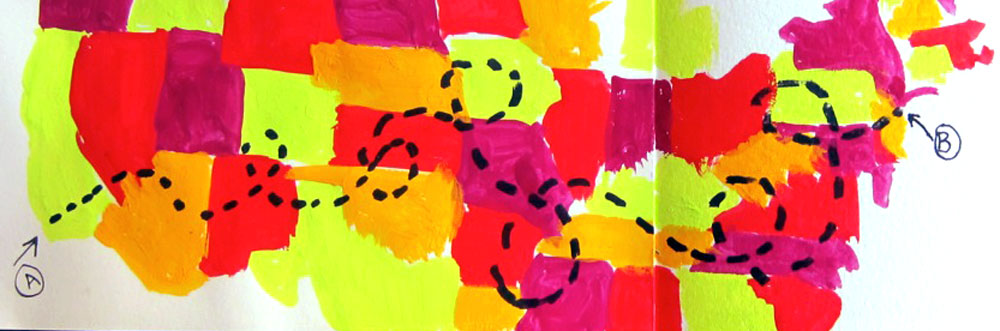
Almost exactly a year ago, Jenny and I drove from Los Angeles to New York City. In the months before, we talked a lot about where we might go and drew up lists of places to stop en route. We weighed the pros and cons of going north and driving the length of the Canadian border, of drawing a straight line from LA to NY and beelining across the Midwest, of meandering through the heat of Texas and the Deep South. I consulted web sites about cross-country drives, downloaded a half-dozen apps, and reread On the Road.

A couple of days before we left, we had a big yard sale and emptied the cottage we’d occupied for a year. Then we hit the road with 666 dollar bills in the glovebox.

Despite all our discussion and planning, we ultimately committed to just one decision: that each day we would  decide where to sleep that night and that decision could be postponed until the sun was setting. Sometimes we booked our hotel while sitting in its parking lot. This was pretty atypical behavior for Jenny and me — she’s a producer and I’m a Virgo, organized and methodical people who like a sense of control. But this trip was to be different. We intended to get New York in roughly two weeks — and that was all we knew for sure.

It was a risky and brilliant strategy. We meandered all over the map and saw things we had no idea even existed. We made monumental plans while driving, then scuttled them over dinner. We acted impulsively and took many roads less traveled. When we pulled onto our street in Greenwich Village, we knew we’d had an adventure that we would always remember. It was epic.

The core of my brain (and yours, hopefully) is the limbic system, the ancient part that sits under my cortex, deep in the most protected part of my skull. It manages my emotional reactions, its gnarled, primitive fingers fidgeting on the buttons that trigger my reactions and form my most salient memories. It is primitive and essential, making me happy, angry, hungry, horny or terrified. This part of my head is me at my most impulsive.

Sitting astride is my modern brain, the source of higher function, the part that cracks the bullwhip, straightens the cutlery, talks to my accountant, and imagines itself superior. I have relied too heavily on this ultra-rational part of my brain for most of my life. It has helped me think my way out of feeling too intensely, providing Mr. Spockian rationales for my baser yearnings, keeping me in check. It has helped me succeed — but I wonder how many roses it has kept me from smelling.

I have published a dozen or so books by now, and each one has started with a road map. Sometimes my editor has asked for it, an outline to include with the proposal she submits to her editorial board. But always my frontal lobes have insisted on it, wanting some clarity about the mission ahead. Believing that I can’t build a building without a scaffold or a monument without an armature, I have arranged bullet points and sub-points into neat staircases with sturdy handrails to lead me to the summit and safely back down again.

And then I have sat down at this machine and kicked the blueprints under my desk.

Outlines and bullet points are one thing but writing or painting something that lives and breathes are something quite other. No one wants to dance in the moonlight with a sturdy skeleton. Flesh and blood are lissome, moving under your finger tips, breathing and changing shape. And so it is with art. A sketch is meant to be done in pencil so it can be erased as better choices emerge.

All this preemptive planning just gives me the courage to turn the key in my driveway, the balls to say, let’s drive three thousand miles and trust that we’ll eventually get where we’re going. Even if I draw the route in the thickest Sharpie, I still plan to listen to my gut, to my amygdala, to the songbird at the crossroads who says, hey, let’s take a left here and see what lies around the bend.

We have GPS and we are safe to wander.

Friend of a friend

So, recently, a business associate told me I should further develop my network on LinkedIn. I know that’s sort of a horrible sentence but there you have it. I have business associates and they advise me to do things that probably have some purpose beyond my understanding. Generally I am okay with following their directives so long as they don’t involve public nudity or large amounts of money. They know more than me about some stuff.

The way LinkedIn works is by burrowing into your address book and your resume and your underwear drawer and pulling up long lists of names and smiling portraits and you are supposed to click on people who you know and want to link to. When you do, each person’s links are then joined to yours in an ever-expanding gyre of connections until every man, woman and Chihuahua on the planet is arrayed in concentric circles around you.

Let me now confess something else to you. Despite how garrulous I may appear within the confines of dannygregorysblog.com, I am not an especially outgoing person. For much of my career, I was the person standing in the dimly lit corner of the office party, gnawing carrot sticks and clutching a bottom-shelf gin and tonic. I was not glad-handing, back-slapping or table-hopping. Over time, as I grew older and slunk up the ladder, I knew more and more people who didn’t seem to despise me so I would allow myself to slink out of the safe zone and talk to people. But I was never and never will be a ‘networker.’ Fortunately for me, I have been in love with two women who were quite the opposite and dragged me into various social circles where I could mumble and make self-deprecating remarks to ever-increasing numbers of people.

When Linked In began to present me with long lists of smiling faces, I swallowed hard. Some faces looked familiar, some names looked familiar, and I began to click on the faces and request to be connected. Some people were easy, the ones who I knew well and who were outgoing. Some were harder, people I knew well but who I was embarrassed to be asking, who I assumed would scoff at such a fawning request, surprised that I was not, like them, too cool for school to network.

My associate prodded me to further expand my timid circle and so I delved deeper. I began to click on the faces of those I had not shot the breeze with in their cubicle and not invited to lunch, but had sat with in endless meetings, sometimes with dozens of others, people in other departments, of other ages and ranks, like soldiers in adjoining platoons, veterans of the same wars but not aways the same battles. People who I might nod to as we motored past each other in the hall, who I might have had that one long talk with as we waited for a flight to Columbus or Wichita for another regional committee meeting, people who I might have even had one drink too many within a Holiday Inn Express lobby on the eighth night of a shoot that seemed it would never end and shared opinions and revelations that I woke up the next day to regret.

And then there were those faces who I knew and who I knew knew me but who I thought hated me for one slight or another — a layout I hadn’t approved, a suggestion I had dismissed, an opinion I had contradicted. I winced reflexively thinking about what they might think years later when I appear on their virtual doorsteps, hat in hand. I assume these requests would be junked, that I would never hear from the person whose meeting I had twice arrived ten minutes late for, the person who scowled that one time when I interrupted in a briefing, the person whose coffee mug I had taken by accident.

But masochistically, I clicked their faces nonetheless.

In the next few hours, I received emails, confirming that even these outliers were willing to open their chains and link to mine. I reached out to a few with InMail™ messages, tail between my legs, wishing them well in their new endeavors. And they responded, tails aloft and wagging hard, sometimes with their paws stretched out, ready to play.

I’m perplexed and dismayed that someone who spends so much effort thinking about and writing about and drawing himself can be so self-unaware, that I often have no idea how I appear to others. I can think I have offended someone and they have no idea what I mean. I can think I have been a pal to someone and they will reveal a long-held grudge. I can pour over a blog post and get a stinging response from some reader, dash off another one unthinking and hear it has helped someone else a lot.

Despite my quest for seeing myself objectively, I have come to terms with the fact that it is pretty much impossible. In part, because no one else sees me objectively. In part because there may not be any absolute truth there. In part, because my monkey still lurks back in that dark hole. But most of all because I am a work in progress.

I try to do my best most of time, to avoid being a selfish dick, to contribute where I can and to take others’ feelings into consideration. But beyond that, I have to stick to my own knitting, to be true to what I know of myself, and to hope that those who are in my newly expanded network of links will see and value those things that I am.

It’s important to connect with others, to engage, to be of service, and not spend ones’s days crouched in a shadowy hermitage. But it’s just as important to link in with oneself.

Rusty beans and dusty gold.

One evening, you go to a friend’s house and she has rented a movie. She paid for it, but you get to watch it for free.

You notice a bestseller on the table and ask if you can borrow it. Your friend waves it away and tells you how disappointing it was. Instead, she urges another book on you that you never knew about. That book changes your life.

You have coffee with a friend who offers to introduce you to a colleague with professional experience that dovetails perfectly with yours.

You are on your phone, about to jaywalk. A bicyclist zooms past you and through a red light, almost getting clipped by a taxi. Your heart spasms with adrenaline as you step back on the curb and swallow hard.

You read a memoir of a man who went against the herd to start a business in an industry others had long since abandoned. He struggles, backslides, struggles some more, but by using certain surprising skills, he reverses the trend and creates a successful, beloved business. His book is full of specific descriptions that you can use to pursue your own dream.

You read a review on Amazon for a product you have been considering for a while. The review points out three unusual criteria you had never considered which make you act immediately.

Your mother-in-law smokes like a chimney. At sixty, she is dead of lung cancer. You used to have an occasional cigarette with your second martini. No longer.

You had a parent who withheld affection to the point of abuse.  When you have your own children, you use his behavior as a yardstick, a warning of things never to do.

Distracted, you say something unthinking to your spouse — who gasps aloud. You look up, suddenly aware of what you’ve said, and grow shocked at your own insensitivity.

Your grandfather survived the Great Depression. For the next sixty years, he counts every penny, then dies alone in a shabby house, its basement full of rusting canned goods and thirty pounds of gold bullion.

Every day life offers you a lesson you may or may not notice. What did you learn today? What did you teach someone else?

(Can’t think of anything? Well, that’s why there’s this.)

Keeping the fun in fundamentals.

Teaching yourself to make art is a lifelong endeavor. Books and courses will help but it’s up to you to keep the work interesting and relevant.

Look for creative ways to keep practicing the basics, like contour drawing, proportions, foreshortening, tone, shading, volume, etc.

Don’t make drills dull. Find ways to mix things up. Draw things that mean something to you.

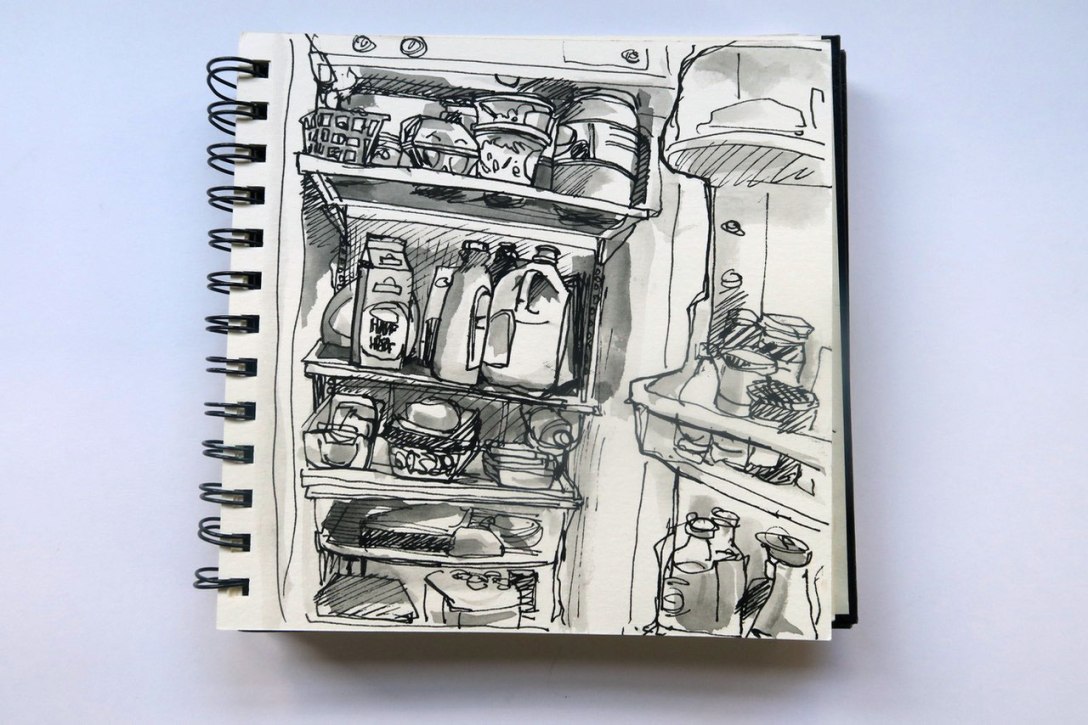
Instead of setting up artificial subjects like bowls of fruit or vases of flowers, draw the contents of your fridge. Draw the roses you got for your birthday and write about how you feel getting a year older. Instead of drawing naked strangers in a life drawing class, draw your naked spouse, your cat, your boss. Rather than doing “Drapery studies,” draw the shapes your feet make under the covers on a Sunday morning.

Be inventive. Be fresh. Be personal. It’s an adventure, not a chore.