

Recently, I was asked why I thought journaling, and Internet journaling in particular, has become such a phenomenon. I rattled off a bunch of bullet points but I’ve continued to think about my answer and thought I’d share my thoughts with you to see if you want to refute or amplify my hypotheses.
First, there’re the tools at hand. The Internet and blogging let us share our personal work with like-minded people more easily. In the past, one might keep a diary that some descendant could unearth in the attic after we’ve passed, but the practice was basically solipsistic. In the new millennium, while our stories and drawings may not find an audience in our homes or communities, the Web lets us find interested readers from Belgium to Brisbane. The fact that someone else is interested helps to keep us going.
But technology also helps to create the need. I think that all this technology and titanium has made handmade things much more appealing. Even if it ends up as a jpeg, putting ink, graphite, and good old watercolors down on paper is a warm and pleasant break from email and cel phoning.
The next factor is our zeitgeist. We live in the age of memoir and confession. Anything goes and everyone’s an audience. Reality TV, James Frey, Augusten Burroughs, Oprah, Bill Clinton, everyone is sharing their story whether anyone asked or not. You don’t need to be a celebrity or a world leader to be worth listening to any more; now, if you get a publishing contract your personal life is, well, an open book. It follows that we all have a heightened need for self-analysis and -exposure.
Our culture has also become increasingly about individual achievement: the star athlete, the maverick CEO, the non-aligned President, etc. Despite a brief window of collective focus after 9/11, ‘s not about community any more; instead ‘s about self-absorption.
Most if us have the leisure time for journaling. Oh sure there’re a zillion diversions and distractions but if we want to make the time, we can have it. Turn off the tube, the Crackberry, the RSS feed, and do a bit of self-analysis.
And more and more of us have that need because of a growing sense of our own mortality. Baby boomers are the largest group in the population and we are in mid-life. Beginning to sum up, to think about what we’ve learned from life, and interested in sharing what we find.
Another aspect of modern life is reflected in the last essay I wrote here, about the effects of globalization on our environment. The more homogeneity there is, the more we seek quirk and particularity in others and ourselves. If everyone’s wearing clothes from the same stores and eating food from the same restaurants, we have all the more need to make our own mark, to stand out from the crowd.
While the world imposes consistency on us through megabranding, it is also providing us with a lot of tumult and anxiety. We are looking for answers and perspective and sitting down with a blank piece of paper and a pen is a great way to start looking.
It also seems that organized religion hasn’t managed to give us a strong enough sense of meaning in the modern world. I don’t feel that the Pope or the mullahs or the Christian Right are providing any answers I can relate to; instead it seems ‘s up to me to get to the bottom of things and chart a path for passing through these troubled waters. Again, slowing down and meditating on the moment with a pen in my hand brings me peace and balance.
Why have you started journaling? And what role does drawing play in it?
Category: Advice & answers
Got a question, an issue, a dilemma, a gripe? Here’s my response.
Advertising and Its Discontents – Part II: Charity

I like nice. I like sweet. But even more I like raw. I like real. And Ilove Charity Larrison. She and I have been corresponding for a couple of years ago and she always cracks me up and take my breath away with her honesty. Charity’s story is pretty different from Trevor’s and it is far from resolved. I won’t say much more in the way of introduction but to say, Charity is the real thing. We can all learn a lot from her bravery, creativity and independence.
The Fundamental Distraction by Charity Larrison
At 18, the idea of going to art school, being a real artist, whatever, you know – seemed basically useless. My family was poor – college was not even an option really. And college for something as abstract as “being an artist” – ha ha. I might as well not even think about it.
I remember spending my whole senior year of high school in a corner of the art room working on paintings - buying extra time here and there doing the whole fluttery-eyelashes thing, “Oh come on, *please* Mister Whatever Stupid Teacher - I finished the assignment in five minutes! Can't I *please* go down to Miss McKannicks' for the rest of the period?? - i'm working on A GREAT PAINTING!”
So like any good comic book loving skateboard punk rocker with no way out of small town America hell – I joined the army.
I remember when I was in basic training my drill sergeant secretly pulling me over to the side and saying: “ONUSKA, take these markers and these flags up to the latrine and draw E-328 Predator faces on them so I can give them as prizes at the end to the other drill's. If you get caught you're in trouble, so don't get caught!”
And then there was the Sunday afternoon when I was in advanced training, learning my 68G10 - Aircraft Structure Repair crap; I was walking through the platoon area on my way to the smoking table when I was accosted by my Drill Sergeant to report for detail to the enlisted club, where I ended up spending the rest of the summer assisting his wife painting a mural of a bunch of Blackhawk helicopters landing on the wall in front of the dance floor.
She yelled at me one day: “YOU DON’T BELONG HERE!” Then it was a few really a lot louder sentences in Korean that I am still glad that I couldn't understand & I remember shrugging my shoulders at her and saying: Don't worry, Sun, I have it all worked out.
I got married. We had fun for a while. I got pregnant. He got kicked out of the service. I decided to opt out and follow him home. Our marriage didn’t survive the strain. I packed my baby and what belongings I could fit into his gold Fiero (dear god) and never looked back. I was twenty. Worked and worked and worked. Lots of crap jobs. Night shifts at the convenience store. Short order cook. Bank teller.
I remember it is two am and I am standing under fluorescent lights in an all night convenience store slicing endless little piles of lunch meat, passing the time wondering who it was that got to have the job where you made all the dumb signs. I would be good at that job.
I remember hanging out at my teller station when I worked at the bank, copying pictures out of comic books every moment of time where there were not incredibly crabby people in front of my face blaming me for all their money problems.
I remember lucking into a seasonal civil service gig with Pennsylvania state parks. Where I got to take care of the computers. Burning another boring afternoon clerking it in the office, doodling on post-its when Kevin, the Assistant Boss Park Ranger dropped a stack of instructions in front of me and said: “Larrison: if you can figure out how to network all our computers and make it work, you can have the internet. (THE INTERNET!!!! FINALLY!!!)
I decided I needed to cave in and try to go to college. To get out and get something better. Thinking to maybe get some kind of IT certificate, as I was so swell at computers and all. Looked it up on the Internet. Looked halfheartedly at stuff, then saw it. The graphic design program. You know: the “oh, that’s what i’m supposed to be doing” moment. (omg – like art school! But like – you could actually GET A JOB) (try not to cry laughing at me :D) anyway – once i saw it, it was too late. I had to do it. So i did. It was insanity. I worked five million jobs and went to school and somehow held everything together with just, pure will. (because seriously, this was the stupidest gamble of all time WHAT ARE YOU THINKING etc.)
See – I loved graphic design. I loved it more than anything in the whole universe. There was nothing like it to me. I knew how to make the pages talk. Then i learned how to make the pages sing. I made pretend magazines and taught myself how to make web pages, and I demanded that i get a REAL internship at a REAL place. Because even though i was just some jackass with an Associates’ degree from a tech school – that didn’t make me not THE BEST. (quit laughing :D)
Anyway, i got my internship. They hired me right out of school. Their art director moved to Atlanta, and I got his job. I was never, ever, ever, so miserable in my entire life than how miserable i was for those six months. I remember my favorite part of the day was whenever I could go down and sit in the restroom just so that I could spend five or ten minutes not having to be in the same room with those people. I mean, holy shit – these guys were some serious assholes. I was so depressed. I mean this? This is what graphic design is for? Lying? And lying and lying forever? GAH. And I’d spent so much of myself learning and it felt like, all for nothing.
I lasted about six months till they fired my ass. I remember dancing up the street Fred Astaire style the afternoon they fired me. Sure it sucked and I was doomed, but lunchmeat at two am was better than that crap.
Not to be thwarted, once i finished celebrating being fired from the ninth circle of hell, I threw my resume up on monster.com and got a call. Some company needed someone who could use Photoshop. Okay. I can do that. Went. Interviewed. They ended up hiring me on the spot. Was a small engineering company. Tired of getting raked over the coals from the ad agency that was doing all their stuff previously, they wanted just someone who could use Photoshop to fix some images for them.
I was all like, well, you know, i can do everything those bastards were doing for you, except better, and cheaper. So they hired me and gave me a million raises and built me a giant office and bought me every toy I asked for. It was fantastic for about a year. I made everything for them from out of nothing. I was like a great hero, rescuing my company from the tyranny of the great evil of advertising agencies.
I suppose you see what’s coming by now. I mean, there’s only so much you can do. After a while my job started to consist of just updating and tweaking and pressing buttons. I joke that it is my George Jetson job. I just rush in push a button then put my feet up on the desk. Which everyone says is so great. Which I suppose it is, but what happens if you are crazy and actually LIKE to work, but have no work to do? It sucks. But you can’t leave your great job when you are the sole support of your tiny family. You gotta just suck it up and go to work.
So, I sit in my giant office in the middle of nowhere America and spend my days floating around the great now of the Internet. I don’t know that I had a plan really when I started out. I mean, I just did the things I already liked to do. I followed comics websites and comics artists and followed their advice about how to learn how to draw, and i just kept trying to learn how to draw. Because that’s what I wanted more than anything. To learn how to draw for real. So i could draw comic books. For real. So i just kept drawing. I made myself websites to put my drawings on, cause that kind of made it feel like an activity. I made horrible comic books. I made friends and enemies.
I have some friends who are writers, they asked me to draw their stories, so I did. Because I love them, and I love that they write stories, and I love making words into pictures, and the challenge of making the pages read and flow. Figuring out just the right thing to draw to make the story move the best way. It’s the funnest game ever. It makes me work hard. I could do it till the end of the universe.
And slowly I started to learn how to learn.
It’s funny about learning. It’s never what you expect. I am starting for the first time ever, to actually get the hang of it, and make some things that are kind of cool and that i really love. I am starting to learn how to see the world, and my heart is constantly in like this odd vice of joy. I want to draw everything all of the time. But time is precious – which things to spend the time on? I want to draw that tree – but really shouldn’t I be working on something serious? I mean, that is the kind of thing I have been thinking to myself lately.
See – honestly, I hate my job. It’s awful. I am all by myself all the time. There is no one to talk to ever, except the dumb internet, and I want out. Having basically one client only for the past four years, my portfolio is utter crap. And, Jesus, I don’t want to be a graphic designer anymore anyway. I want to draw. But how do you make a living from drawing? How do you make a living from drawing without starting to hate drawing, is the main thing i think. I have been trying to figure it out. Trying to figure out what way to push so that I can still love it, and still get out of here.
So I have been trying to remember why I started this. Why I am here. What did I want when I began? To maybe find some kind of clue that will help me figure out what to do. What is important? Why do i do all these things that I don’t actually care about anymore when I would really rather be out drawing trees?
These days I just wake up every day and do what I have to do to buy the extra time down miss mckannicks' to work on the paintings. And think it is pretty awesome that I get to stay here this time and don't have to go to the Army again, because that sucked.
Advertising and Its Discontents – Part I
 Above: Notes taken during a really important meeting I no longer remember.
One of the chief obstacles many creative people face is how to cope with the intersection between our creative and our professional lives. Is drawing, painting, photography, music, whittling, just a hobby? Or are we serious about it and wiling to throw ourselves over the cliff’s edge and base our livelihood up on it? Anxiety over this issue is what derails a lot of us when we are young. Do we go to art school or a “real” college? Do we spend the rest of our lives in a split-level ranch or a garret? Do we break our parents’ hearts or become accountants?
Like most things in life, it’s not that black and white. People who make money doing creative things usually reap a varied harvest. It’s never 9 to 5 and the paychecks are rarely steady but there are more and more ways to sell your creative products. It’s not about getting your slides accepted at a New York gallery. And your patrons may be people just like you, not just investment bankers looking for investable art. For example, the internet means you can show and sell posters of your work and never leave the farm. You can sell drawings and jewelry and t-shirts and greeting cards and zillions of things.
And most importantly, you can call yourself an artist, regardless of how much money you make or how many pieces you sell.
I make a smallish percentage of my living from my personal work. I write books, I write articles, I do illustrations, but the lions’ share of my income is from my job in a company, working for the Man. I am pretty comfortable with this arrangement. It means I don’t feel desperate, I do the projects I want to do, and the extra money keeps me in 24 karat fountain pens and hand-bound unborn-calf-velllum sketchbooks.
Recently, I asked two successful illustrator to share some of the details of their lives, particularly to explain this issue of commitment and financial survival. First, Penelope Dullaghan, whom you may know as the originator of Illustration Friday. She took the leap from advertising into full-time illustration a Notes from a really important meeting I no longer remember.
A few years ago, I temporarily detached from the ad teat. It had been a good run. Ad agencies had provided a good steady income, kept my family health-insured, taken me on some all expense-paid junkets to interesting places. But the experience has often been depleting, humiliating, demoralizing, and I had to see what it was like it cut loose. Eventually I got sucked back in but I still question the wisdom of succumbing.
I’m not alone in wondering. Most advertising creatives would like to break free. A few brave ones do. A couple of weeks ago, I asked some pals who had jumped ship to tell me what drove them to do it, how they did it, and how they feel in retrospect. I was going to gang them together in a single post but when the first one arrived, from Trevor Romain, it was so good, I had to get it to you right away.
Have you had a similar or completely different experience? Please let me know, either by posting a comment below or by writing me a longer description. And stay tuned for more in this series.
The Very Moment by Trevor Romain
I’ll never forget that day.
It was the morning after I had pulled an all-nighter creating an advertising campaign for a client. The campaign was a good one. I felt great about it. With a number of Clio awards and dozens of Addy and One Show awards under my belt I felt confident that the client would love the ideas we were presenting.
The cigar-chomping, excessively-sweating client – who I created the campaign for – was reviewing the work. He was looking over the ad campaign with disdain.
He said. “This is bad. I hate it. Why don’t you just take the logo and fill the page with the entire thing? Now that would be branding.”
My heart sank. Then I felt anger. Extreme anger. Not at the client, but at myself. I remembered a promise I had made to myself twenty years before. A promise I had not kept.
It happened when I was in the army in South Africa. I was walking through a field hospital filled with kids from small rural villages who had been brought to a clinic for treatment from the army medical corps. The conditions were abysmal. There were almost six kids per bed, it was nauseatingly hot and there were flies everywhere, especially around the corners of the children’s eyes and mouths.
As I was walked down the center aisle I caught sight of a little boy who was about five years old sitting on the edge of one of the hospital beds. I looked into his huge brown eyes as I walked by and then noticed with shock that he had no legs. Instead I saw dirty bandages wrapped around two stumps. The boy had lost his legs in a landmine accident on the Angolan border.
As I walked by, the little boy put up his hands and said “Sir, can you please hold me.”
I will never forget the haunting look of sadness in his eyes. Huge tears rolled slowly down his cheeks and dropped to the floor, their significance lost in the dust and grime of war.
The Sergeant Major, who was walking alongside me, grabbed my arm and pulled me away from the child.
“Romain,” he grunted. “Leave him alone. Don’t get emotionally involved. We’re here for security, not child-care.”
As the Sergeant Major pulled me away the little boy, in a broken chocked-up whisper, spoke again. His voice tugged at me from behind.
“Sir, please, please can you just hold me?”
Something happened to me that moment that I will never forget. My life changed instantly. It felt like a hand came out of the sky, reached inside me, and flipped a switch that turned on my soul.
I pushed the Sergeant Major’s hand away, turned, walked back and picked up the little boy. I have never been held so tightly in my life. His trembling little body clung to me for all it was worth.
He put his head against my chest and he began to cry. His tears ran down my neck and inside my shirt. I held that little boy with my arms, my heart and my soul and every ounce of compassion in my being. I never wanted to let him go, ever.
At that second I promised myself that I would never waste a second of my valuable life. That I would use my creative talents to change the world for children.
But I didn’t.
I went into advertising because it was safe and the money was good and everyone told me that it was almost impossible to make a living writing and illustrating children’s books.
I believed them.
I got sucked into the advertising vortex. I allowed client after client put my work down, destroy my exciting ideas and turn me into a cynic, who spent every day, using my talents to convince consumers to buy things they didn’t need.
The inner explosion had been building for months. The cigar-chomping client wasn’t the reason I quit that day. He just lit the fuse.
My wife and I discussed the situation and both decided that I HAD to follow my dream.
I woke up the next day, sat in front of my yellow pad and started my new job as an un-published children’s author and illustrator.
Although getting started was difficult and sometimes frustrating, the sheer passion and joy of doing what I love was there. And it still is. I have been hungry, rejected, under-appreciated and often ignored but I LOVE what I do. I have been writing full time for ten years now and I am one of the happiest people I have ever met.
During my journey, after every book rejection I received, I heard the little boys voice in my head saying, “Sir, please can you just hold me.
And in my heart and soul I did.
And I still do.
I now have 30 books in print with over one million copies in circulation in twelve different languages.
And I’m not done yet. I still hear the little boy’s voice.couple of years ago and I remember how suspenseful but ultimately very satisfying the whole process was for her.
Second is Torontian Alana Machnicki. I like her drawings a lot and am inspired by the broad range of ways she applies them. I have learned a lot from both their stories. I hope you find them useful too.
Penelope Dullaghan
I think that leading a creative life is both rewarding and really really hard. It’s not just creative painting and being messy all the time. It is a real business, like any other. (Well, maybe not like any other. I think this is way more fun.)
To manage a creative life, I think first and foremost you need to be a good planner. You are not guaranteed a paycheck or steady income, so sometimes it gets really thin and you have to adjust accordingly. If you have a bad month, you better have some money left over from a good month to float through it. The people who work at the phone company and the power company have steady jobs and will not understand if you tell them you’ve had a bad month. 🙂 So you need to budget!
But planning goes beyond financial. Time is also yours to plan. A good balance of work and gathering inspiration and personal time is important (I struggle with this a lot). Being an entrepreneur is hard. No one makes the rules for you and no one is there to tell you to work (or to stop working). If you decide to take time off and accidentally miss a deadline, you’re in trouble. At the same time, if you work around the clock and burn out, that’s no good either. Balance is in planning.
Secondly, I think it takes faith. Faith that the next job will eventually come, even if it sometimes feels like no one will ever call again. If no client has called with a new job or assignment, it can be really scary. Self doubt creeps in and you start to wonder if you’re really cut out for this. Working at the mall starts looking really appealing. But this is something to be waited out…and not sitting down. If you are bored, you’re doing it wrong. If no paid work is coming in, do something for your business. Start working on a new image for self-promotion. Update your website. Write some thoughts down about avenues to get your name out there. Work on personal work for yourself, while at the same time, bettering your skills. Give yourself an assignment…challenge yourself to think conceptually. Read a business book to hone that side of things. There’s always something you can work on. Always room for improvement.
Or, if you are a workaholic like me, try to relax and take some downtime. Go to a movie (a matinee to save money) or go for a walk in the park. Fill your well. By the time a client calls again (and they will!), you’ll be ready and inspired to do the project at hand.
And thirdly, it takes a lot of plain, hard work. I have a lot of things going on all the time (maybe too much) to help me pay my bills as well as keep the creative fire burning (for both me and others). But it’s work I enjoy doing. I get a lot out of having fun little contests (just finished up a “Draw a Witch” contest for Halloween) and doing free things like Paper Doll Mix n Match to help promote my new tshirts. I have an online store to sell prints and stuff to help financially and just for fun (I like thinking up new tees and postcards to print).
I also started Illustration Friday as a way to challenge myself…to grow my portfolio and force myself to think conceptually. Then I opened it up to others because I figured they would like the challenge too. And now it’s a huge, fun thing that many people participate in each week. I love seeing all the new names pop up in the column and checking their illustrations to see how their minds work. It’s also become a great form of self-promotion… even though that’s not why I created it (I think of it as a perk for running it!). The site was recently named a HOW Top Ten Website, which I thought was cool not only because it’s good promotion for the site, but because it kind of speaks to the creative community at large… maybe we’re not all isolated artists, but we seek to be a part of something bigger by supporting each other and talking to each other. Illustration Friday helps with that.
I’m also a part of a local illustrators group. I look forward to getting together with them once a month to chat about the industry, ask questions, give answers and just be with like-minded people. Part of a community, again…
I’m going to be honest and say that it is sometimes really hard to have so much going on. I get stressed out and unbalanced. Keeping up with my normal workload, Illustration Friday, doing self-promo, creative-community things, running an online store, gallery shows and trying to maintain a personal life… can be a bit much. I sometimes miss having a regular job with regular hours and regular paychecks. But I really can’t imagine giving it up. I feel like it’s kind of built itself…each thing I do is a part of me. It’s good for my creative spirit and hopefully feeds my business, too.
More on Penelope here, here and here.
Alana Machnicki
As a creative I’ve always found it important not to put all my eggs in one basket, so to speak. I like to have a little going on in different aspects. I have a tendency to get bored really easily and having a cornucopia of outlets to choose from keeps me happy.
I also find it much easier to live as a creative when I’m not under financial pressure. Because of this I’ve come to accept that having a part time job in the background is essential for me. Also, having the foresight to keep the job, even when I’m having a particularly profitable month, is even more important. I never know when a dry spell is going to come along and leave me scrambling to pay the bills.
I try to promote myself as best as I can. I hand out business cards at every opportunity, even if it is to someone who will never need my services. There’s always that chance they’ll pass the card or my website on to someone who does. I also travel to Comic Conventions with my fiancé where I sell prints of my work. This has lead to jobs, commissions and sometimes the print sales add up to more than what I would have made selling the original. It’s also a great way to expose my work to the masses and hand out more business cards.
I also sell my prints online, but I’ve found people are quite wary of the whole system. The orders I have processed have been through email and the “I’ll mail you a cheque” method, rather than Paypal. I guess people prefer to deal with a real person.
I rarely turn down any job that comes my way, unless I’m totally swamped. Even those with a lower budget could be seen by another art director who wants to offer me my dream job. I’ve also done a couple “sample” jobs where I’ll work on a piece just to show them what I can do for them. Sometimes I get the job (this is how I got my Absolut Vodka ad) other times I’m left with another piece in my files. A few of these filed samples have lead into other jobs.
I do a little graphic design here and there. I design websites occasionally. I used to even have a part time job where I altered travel photos to make grey skies blue and erase trash from the street. I think it’s just a matter of being open minded and knowing what you’re capable of. I’m also a very quick learner, so I usually know if people just give me a chance I’ll pick up on the skills needed.
A lot of artists have issues with being labeled a “sellout,” especially when working commercially. Personally, I think I’m very lucky to be able to do what I love and get paid for it.
Currently I’m trying my hand a sculpting my wedding cake topper (maybe this could parlay into some kind of wedding topper business), and have plans for a line of t-shirts. I’ve also been thinking of different things to sell at the comic conventions, such as smaller pre-framed prints. I’m also working on a children’s book for Scholastic that features intricate paintings of carousel horses, as well as 400 spot illustrations for a Kitchen Dictionary.
$urviving

One of the chief obstacles many creative people face is how to cope with the intersection between our creative and our professional lives. Is drawing, painting, photography, music, whittling, just a hobby? Or are we serious about it and wiling to throw ourselves over the cliff’s edge and base our livelihood up on it? Anxiety over this issue is what derails a lot of us when we are young. Do we go to art school or a “real” college? Do we spend the rest of our lives in a split-level ranch or a garret? Do we break our parents’ hearts or become accountants?
Like most things in life, it’s not that black and white. People who make money doing creative things usually reap a varied harvest. It’s never 9 to 5 and the paychecks are rarely steady but there are more and more ways to sell your creative products. It’s not about getting your slides accepted at a New York gallery. And your patrons may be people just like you, not just investment bankers looking for investable art. For example, the internet means you can show and sell posters of your work and never leave the farm. You can sell drawings and jewelry and t-shirts and greeting cards and zillions of things.
And most importantly, you can call yourself an artist, regardless of how much money you make or how many pieces you sell.
I make a smallish percentage of my living from my personal work. I write books, I write articles, I do illustrations, but the lions’ share of my income is from my job in a company, working for the Man. I am pretty comfortable with this arrangement. It means I don’t feel desperate, I do the projects I want to do, and the extra money keeps me in 24 karat fountain pens and hand-bound unborn-calf-velllum sketchbooks.
Recently, I asked two successful illustrator to share some of the details of their lives, particularly to explain this issue of commitment and financial survival. First, Penelope Dullaghan, whom you may know as the originator of Illustration Friday. She took the leap from advertising into full-time illustration a couple of years ago and I remember how suspenseful but ultimately very satisfying the whole process was for her.
Second is Torontian Alana Machnicki. I like her drawings a lot and am inspired by the broad range of ways she applies them. I have learned a lot from both their stories. I hope you find them useful too.
Penelope Dullaghan
I think that leading a creative life is both rewarding and really really hard. It’s not just creative painting and being messy all the time. It is a real business, like any other. (Well, maybe not like any other. I think this is way more fun.)
To manage a creative life, I think first and foremost you need to be a good planner. You are not guaranteed a paycheck or steady income, so sometimes it gets really thin and you have to adjust accordingly. If you have a bad month, you better have some money left over from a good month to float through it. The people who work at the phone company and the power company have steady jobs and will not understand if you tell them you’ve had a bad month. 🙂 So you need to budget!
But planning goes beyond financial. Time is also yours to plan. A good balance of work and gathering inspiration and personal time is important (I struggle with this a lot). Being an entrepreneur is hard. No one makes the rules for you and no one is there to tell you to work (or to stop working). If you decide to take time off and accidentally miss a deadline, you’re in trouble. At the same time, if you work around the clock and burn out, that’s no good either. Balance is in planning.
Secondly, I think it takes faith. Faith that the next job will eventually come, even if it sometimes feels like no one will ever call again. If no client has called with a new job or assignment, it can be really scary. Self doubt creeps in and you start to wonder if you’re really cut out for this. Working at the mall starts looking really appealing. But this is something to be waited out…and not sitting down. If you are bored, you’re doing it wrong. If no paid work is coming in, do something for your business. Start working on a new image for self-promotion. Update your website. Write some thoughts down about avenues to get your name out there. Work on personal work for yourself, while at the same time, bettering your skills. Give yourself an assignment…challenge yourself to think conceptually. Read a business book to hone that side of things. There’s always something you can work on. Always room for improvement.
Or, if you are a workaholic like me, try to relax and take some downtime. Go to a movie (a matinee to save money) or go for a walk in the park. Fill your well. By the time a client calls again (and they will!), you’ll be ready and inspired to do the project at hand.
And thirdly, it takes a lot of plain, hard work. I have a lot of things going on all the time (maybe too much) to help me pay my bills as well as keep the creative fire burning (for both me and others). But it’s work I enjoy doing. I get a lot out of having fun little contests (just finished up a “Draw a Witch” contest for Halloween) and doing free things like Paper Doll Mix n Match to help promote my new tshirts. I have an online store to sell prints and stuff to help financially and just for fun (I like thinking up new tees and postcards to print).
I also started Illustration Friday as a way to challenge myself…to grow my portfolio and force myself to think conceptually. Then I opened it up to others because I figured they would like the challenge too. And now it’s a huge, fun thing that many people participate in each week. I love seeing all the new names pop up in the column and checking their illustrations to see how their minds work. It’s also become a great form of self-promotion… even though that’s not why I created it (I think of it as a perk for running it!). The site was recently named a HOW Top Ten Website, which I thought was cool not only because it’s good promotion for the site, but because it kind of speaks to the creative community at large… maybe we’re not all isolated artists, but we seek to be a part of something bigger by supporting each other and talking to each other. Illustration Friday helps with that.
I’m also a part of a local illustrators group. I look forward to getting together with them once a month to chat about the industry, ask questions, give answers and just be with like-minded people. Part of a community, again…
I’m going to be honest and say that it is sometimes really hard to have so much going on. I get stressed out and unbalanced. Keeping up with my normal workload, Illustration Friday, doing self-promo, creative-community things, running an online store, gallery shows and trying to maintain a personal life… can be a bit much. I sometimes miss having a regular job with regular hours and regular paychecks. But I really can’t imagine giving it up. I feel like it’s kind of built itself…each thing I do is a part of me. It’s good for my creative spirit and hopefully feeds my business, too.
More on Penelope here, here and here.
Alana Machnicki
As a creative I’ve always found it important not to put all my eggs in one basket, so to speak. I like to have a little going on in different aspects. I have a tendency to get bored really easily and having a cornucopia of outlets to choose from keeps me happy.
I also find it much easier to live as a creative when I’m not under financial pressure. Because of this I’ve come to accept that having a part time job in the background is essential for me. Also, having the foresight to keep the job, even when I’m having a particularly profitable month, is even more important. I never know when a dry spell is going to come along and leave me scrambling to pay the bills.
I try to promote myself as best as I can. I hand out business cards at every opportunity, even if it is to someone who will never need my services. There’s always that chance they’ll pass the card or my website on to someone who does. I also travel to Comic Conventions with my fiancé where I sell prints of my work. This has lead to jobs, commissions and sometimes the print sales add up to more than what I would have made selling the original. It’s also a great way to expose my work to the masses and hand out more business cards.
I also sell my prints online, but I’ve found people are quite wary of the whole system. The orders I have processed have been through email and the “I’ll mail you a cheque” method, rather than Paypal. I guess people prefer to deal with a real person.
I rarely turn down any job that comes my way, unless I’m totally swamped. Even those with a lower budget could be seen by another art director who wants to offer me my dream job. I’ve also done a couple “sample” jobs where I’ll work on a piece just to show them what I can do for them. Sometimes I get the job (this is how I got my Absolut Vodka ad) other times I’m left with another piece in my files. A few of these filed samples have lead into other jobs.
I do a little graphic design here and there. I design websites occasionally. I used to even have a part time job where I altered travel photos to make grey skies blue and erase trash from the street. I think it’s just a matter of being open minded and knowing what you’re capable of. I’m also a very quick learner, so I usually know if people just give me a chance I’ll pick up on the skills needed.
A lot of artists have issues with being labeled a “sellout,” especially when working commercially. Personally, I think I’m very lucky to be able to do what I love and get paid for it.
Currently I’m trying my hand a sculpting my wedding cake topper (maybe this could parlay into some kind of wedding topper business), and have plans for a line of t-shirts. I’ve also been thinking of different things to sell at the comic conventions, such as smaller pre-framed prints. I’m also working on a children’s book for Scholastic that features intricate paintings of carousel horses, as well as 400 spot illustrations for a Kitchen Dictionary.
Nancy with the pencil
Nancy wrote to me:
Hello Gregory,
I have one question so far while reading your book – I wanted to know why you require us to draw with a pen and not a pencil. I’m on page 60, and maybe I haven’t gotten there yet, but I am curious to know why pen and not pencil?
Cheers,
Nancy
I responded, somewhat acerbically:
Hi, Nancy:
Drawing with a pen forces you to commit. You avoid being sketchy ( p.90) and hone your vision. Drawing helps to clarify what you see, to concentrate and to be specific. Ink helps seal that commitment.
Pencils are great to draw with but, particularly as you learn to draw and learn to expand your creativity, try to strengthen your resolve whenever you can. Shut that internal critic up. If that little nagging judgmental voice in your head takes over you will want to erase to correct to second guess. Don’t.
When you feel in control of this medium, by all means, branch out. I spent two years just drawing with a pen, then I started adding color. I still almost never work in pencil. And I don’t own an eraser.
“Do not fear mistakes. There are none”. Miles Davis said that.
Recently on the Everyday Matters Yahoo group we had a long talk about this., People who were convinced and switched to drawing in pen reported miraculous changes overnight. Don’t believe me? Join the group and you’ll see.
Your pal,
Danny
PS My name is Danny.
Gregory is my last name.
Too bad we can’t write email in pencil.
On drawing from photos

Drawn from life.

Drawn from a photo.
Can you see the difference in detail, in energy, in understanding of the scene?
Occasionally I make drawings from photographs. If I have an illustration assignment to draw something that I can’t get my hands on or a location that is remote or a human in a particular position or a drawing that needs specific detail, I will resort to photographic reference. If I am cooped up in the house during a cold spell and bored with drawing my environment, I may pull down one of the old yearbooks I collect and draw ancient faces. If I am stuck on the runway with nothing to draw but seat backs, I may flip through the in-flight magazine and be inspired by the pretty pictures. But, always, drawing from photos is a hollow experience. Photos are useful reference for illustration but as a basis for real art and for the sort of meditative drawing that expands my consciousness and creativity, I find it a lot less helpful. Far better, I’d say, to draw a cluttered corner of my desk from a half dozen angles than waste time drawing from photos of celebrities or far-off places or someone else’s kitten or the like. I’d rather draw what I see in front of me.
Image
So what is it about photography that makes for a peculiar kind of drawing experience? I’m going to jot down some thoughts, in some case taking extreme anti-photography positions in order to get a better grip on this phenomenon.
Image
Is photography more accurate or more authentic than a drawing? Does the average snapshot actually capture what the picture taker originally noticed in the scene? Does the camera see as the eye does? Does the viewer look at a photo and see it as one does reality or as one sees a drawing’s depiction of reality? How long can you look at a photo and remain connected? Compare that with the experience of looking at a drawing or painting, particularly one you made.
Image
A photo captures a scene without emphasis or subjectivity — it is a mechanical rendering with no human element in the process. It also captures just a fraction of a second of time. Even if the subject doesn’t move, it lacks the fourth dimension, the influence of time on the scene that comes with looking at reality or art – it is frozen and there fore unreal in a fundamental way. Time does not stop. It is difficult to remain connected as you spend more time looking at the photo than the time represented in the photo; the more disproportionate, the more difficult to remain engaged.
Image
Drawing from photos is really bridging media. Can you imagine drawing from a piece of music or dancing to a painting? I propose that if you did you would not be copying what you see but instead give yourself a lot of latitude in reinterpreting. But when you draw from a photo, do you give yourself that sort of creative license? Great photographers have made many great photographs that are powerful art. I have yet to see a drawing from one that would be considered equally great. Imagine a Diane Arbus or a Steichen or Mappelthorpe rendered in graphite or ink. Ugh.
Image
A camera sees all in one fell swoop – the focus is deep, the whole scene, from 90Ë™ corner to corner is captured with same emphasis. That is not how the human eye, and more importantly, the human brain see. We scan back and forth at a varying rate, observing more or less, capturing more or less detail, depending on our degree of interest in the subject. Even if we observe a photo in this manner we are not having a true viewing experience. That is why drawings done from photos seem to me to have an inherent flatness (which is further exaggerated by the optics of the camera lens) or an unlikely amount of detail in elements that are not inherently interesting. Photorealistic paintings and drawings are immediately recognizable as having been done from projected, traced photos because of a certain eeriness, the quality of their reflective surfaces, the deadness of the scene.
Image
Some people are also concerned about the legal issues in drawing from someone else’s photo. Technically, if the picture has been copyrighted and you draw it, you are making an illegal copy. Obviously most photographers won’t bother to hire lawyers and impound your sketchbooks but it is a consideration. More dangerous to your experience as an artist is the practice of drawing something you have actually never seen. Sealing someone else’s vision may not land you in court but it will arrest your development. Stick to your own experience of the world. If you insist on drawing from photos, take them too. It’s so easy to shoot a digital picture and then pump out a print to draw from that there’s no reason to violate others’ copyrights if you can help it.
Image
Drawing from photos is also easy and faster because the camera has already done the conversion from three to two dimensions. When we draw, we are always selecting between the data provided by one eye or the other, shifting back and forth, picking and choosing. But the camera has just one eye and so it flattens the perspective, seeing just from a single POV. It doesn’t have to choose where one plane intersects another or if a shadow contains variations in light or where one plane sits behind another. All the calculations are worked out for you and you just transfer them form one page to another. Again my brain and my creative-decision-making apparatus are robbed of the pleasure millions of little decisions, the decisions that are mine, decisions that make it art.
Image
Another consideration is that the composition of the picture is dictated by the original photo and photographer, All too often something will look better when the POV is shifted or the picture elements are rearranged. If I don’t really know what my subject looks like, can’t see in to the shadows, don’t understand the surface and the lighting, this is very hard to do effectively. And again someone else’s photo or my own hasty snapshot will not come close to the careful consideration and particular priorities I bring to the subject when I make a drawing. I also think that a drawing is influenced by what’s beyond the frame – the artist’s experience of the scene and the moment, the sounds, the temperature, the smells, the parts not seen within the boundaries of the frame and again, the time that passes in contemplation of the scene, the moving light, the changing world, the way I, my mind, my body are becoming different as I draw and I capture the hundreds of glances that go into careful observation, glances from slightly different vantages as my head shifts, my lungs expand, my heart beats, all these changes add life to my creation. Drawing is life and life is time.
Image
If you are overly committed to drawing from photos, think again, long and hard, about why you are drawing. Is it to impress with the ‘accuracy’ and photographic ‘realness’ of your final image or it to have the drawing experience, the life affirming contemplation that comes from slow and intense observation of some object or creature in your environment. Do you get it from drawing from a photo? Maybe you do. I find it hard. Every time I draw from a photo, I feel like a bit of a cheat. When I’m done, covering the content of the photo, transferring it to the page, and I look back to find more, there is none. It’s done, emptied of content, wrung out. It’s like a tracing. But when I draw from life, I can keep going deeper and deeper puling more and more stuff out, as if I am diving between the molecules, heading to the subatomic realm that unites all things. P.S. For further digestion of what I have written here, check out Jay Savage’s thoughtful analysis on the Digital Photography Weblog. P.P.S. For an amazing photo experience. spend some time here.
My Conversion
Dear W_____:
First of all, thanks for your note and, secondly sorry, for the delay in my response. Your words were quite important and I wanted to give them some time to think of proper response.
I have looked for God for many years. When I was small, I had only the foggiest sense of what God was.
He seemed like a sort of arbitrary and indifferent creature who let lots of bad things happen to people who spent a lot of time worrying about how to please him. My father is of agnostic/Protestant stock while my mother and my two stepfathers were casual Jews who were vaguely interested in the historical aspects of tradition but were at heart unblievers too, to the extent that they thought about it. My grandparents were hounded and threatened by people in Germany, Poland, Italy, India, and Pakistan, all in the name of various beliefs.
At about your age, as part of my endless quest for identity, I read a lot of Karl Marx, most of the Bible, bits of Sartre, and then eventually gave up and drank more, smoked more, met more women, and went into advertising.
When my wife was run over by a subway train, I had a renewed need for meaning. While she rehabilitated and learned to live in a wheelchair, I met with the minister at the nearby Baptist Church. I went to the local synagogue. I sat in the back of the nearest Catholic church. I went down to the Buddhist temple in Chinatown. I conferred with Hare Krishnas in the East Village. I read books and books. At the core of it all, I was looking for faith, for some confirmation of God’s presence. I didn’t want an explanation for what had happened to Patti, I just wanted to feel connected.
I found nothing that I could call my own. Nothing that was real. I tried to convince myself but I couldn’t. I don’t dispute the beliefs of those who have them but I was unable to experience what so many seem to take for granted.
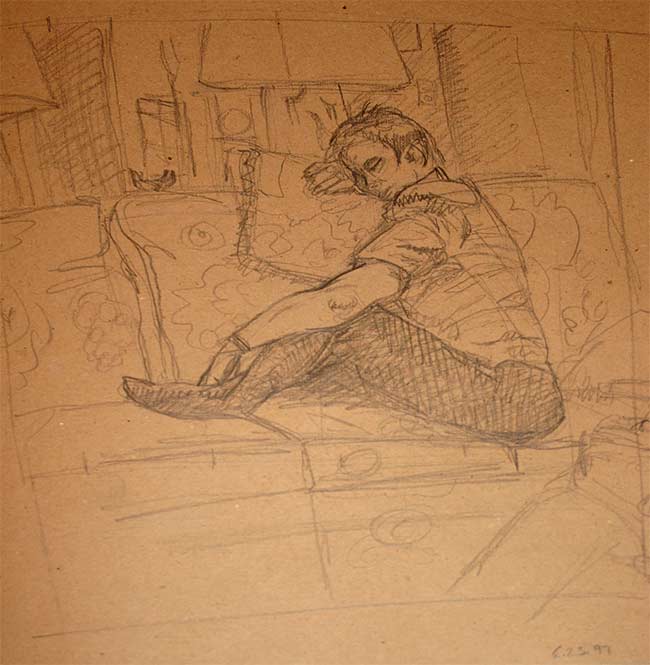
One day, I was moved to draw. I don’t know why, it just sort of happened. I drew some pictures from a magazine. I drew a vase of flowers. Then, very slowly, I drew Patti, resting on the couch. Something about that drawing was deeply moving to me. It wasn’t a ‘great’ drawing but it was mine.
I discovered that, as I drew, I felt peace. I felt connected to the things around me. I saw them deeply and somehow we became one. Was that what the Buddhists meant? Was that what Christ offered? I don’t know. I never found meaning in a church or temple. I found it in my living room.
Now I find that I want to draw. I can’t do it every day but I am drawn (as it were) to draw again and again. It doesn’t matter what I draw. It doesn’t matter whether the drawing is accurate or worth keeping and sharing. It’s nice when the drawing is ‘good’ but that’s not the point.
There were times I lapsed. Once, when my job was particularly ensnarling, I didn’t draw for three years. It wasn’t a great time and when I stopped working that way and started drawing again, I felt better.
Some of my religious friends will probably tell me that I am practicing drawing as a religion. That my drawing is a communion with God, a form of prayer. I don’t know or care. If God is that tricky and elusive, I can’t be bothered to call him by name. And I sure am not asking him for help or answers. I make my own drawings, just me and my pen.
What with my website and my books, I have found myself in this weird position of being an evangelizer for drawing. I’m not sure how it happened and I sometimes wonder if I am spending more time on the prosthelytizing than on the drawing and whether that’s a particularly good thing.
I like having people to draw with and I like sharing the things I notice about drawing when I am doing it. Drawing doesn’t harm anyone. It doesn’t pass a collection plate or condemn gay people or inspire people to blow up skyscrapers in my backyard or care one way or the other about abortion or try to effect my vote or meddle in school curricula or cast stones. But it does help me to see the beauty in people and things, to cherish what I have, to reach out to others, to favor creation over destruction, to find peace and feel more alive.
May it do the same for you.
Amen.
Your pal,
Danny
My recent post to the EDM group
Art making is not a competitive sport. Being intimidated by what others do, by the clarity of their vision, the steadiness of their line, means thwarting the very thing that will get you to where you want to be. If you don’t draw because others, who have done it longer and more often, do it ‘better’ you are robbing yourself.
Give yourself analogies. Should you stop jogging because some people finish marathons in a a couple of hours? Should you stop cooking your family dinner because you love the food great chefs prepare in four star restaurants? Should you stop writing emails because of Shakespeare’s poetry? Should you stop contributing to your favorite charity because of Mother Teresa’s example?
There are always going to be people who are doing work you admire. Celebrate them. Buy reproductions of their work (or better yet, originals) . Study what they do, how they learned. Study their teachers and heroes to to learn where they came from. Absorb as much as you can. Then lay your influences aside, take a deep breath and plunge in. Get in touch with yourself, the unique you, the only one of your kind. Express that uniqueness. Do it again and again, getting ever closer to the truth.
If you must be self-critical, make it constructive and specific. How can you accomplish what you want? Are you clear on what that is? And bear in mind that by committing to your art, you are becoming a hero to some other novice. As you look at those ahead of you, be aware of those who are following your example.
And, most importantly, as you proceed down the path to your goals, enjoy the view. Never lose your sense of pleasure in each drawing you make, even if it’s not ‘good enough’. The pleasure is in the making.
Your pal,
Danny
New Year's Resolution

“You must be the change you wish to see in the world”.- Gandhi
New Year’s Day. It’s a good time for stock-taking, for self-appraisal. With each change one makes in oneself, one see more changes yet to be made. of PITT artists’ pens.
I am still trying to figure out how exactly this will work but I was thinking how cool it would be
Not to self-flagellate but in the spirit of creative expansion. To be alive is to grow and adapt and to spend one’s days awake and aware.
In 2005, I took on several new creative challenges.
We completed The Creative License, my largest design, illustration and writing project. We launched the new advertising campaign for Chase: a dozen or more commercials and a hundred or so ads. This website was relaunched, thanks to my friends Tricia and Jacob. I made a lot of new friends and connections through the Everyday Matters group and developed the social aspects of my art making. And I discovered Rome, deeply immersing myself in a city and its art I’d never known well before.
At home, Patti and I got to spend more and better time together, deepening our love as it enters its twentieth year. My relationship with Jack changed a lot this year too and I am prouder than ever of him as he took on the challenges of entering a new school and a new community.
I’m pretty happy with much of what happened this year. But I have a new and different plan for 2006.
While it has been really rewarding letting drawing and journaling transform my life, I feel a deeper and stronger need to do more. I don’t just want to sell books and checking accounts. I want to promote awareness. In the coming year, I want to see how to use art to make a difference for others. Not just to unleash their own creativity but to create a new awareness of the world and to forge a community that can make it a better place. I want to try to help people rediscover their love of drawing and then bring them together to help others. To raise awareness, to raise funds, to help make the world a more beautiful place. I began drawing because of a trauma. When Patti had her accident, drawing helped me to gain a fresh perspective, the strength and vision to persevere and also to improve. I have not done enough to spread that power to others. I think that drawing and journaling could help people with spinal cord injuries and other disabilities, with life threatening illnesses, with addiction and depression. I would like to talk to health care professionals to see how I can share what I have experienced. I know that a lot of people in the Everyday Matters community have used their art to cope with physical limitations, with mental and spiritual challenges, and I would like to find a way to share those experiences and use them to help mobilize something. I would also like to reach out to people who help others to learn — librarians and teachers — and see how we can encourage creativity, drawing and journaling among their students too, to help develop what could be a life long creative habit. I would also like to use communal drawing experiences like Sketchcrawls in a new way. As we raise awareness by drawing together, I would like to focus the community to help others. I think that group drawing can be a valuable fund raising tool to help people in need. Just as walkathons and marathons raise money through individual pledges, I think we can use drawing as a way to motivate people to give. For now, Patti and I have been calling it “Drawn Together” (though I think there’s a cartoon show by that name).
Here’s one thing we could all do together:
We are going to put together a drawing outing at the Rubin Museum of Art, the only museum devoted to Himalayan Art. On Friday evening, February 3rd, any one who wants to can join us and draw some of the amazing treasures there. We’ll get to socialize, share our journals and our love of drawing. But this time we will have a cause too.
As I’m sure you know, the people of Northern Pakistan and Kashmir, people of the Himalayan region, have been devastated by the recent earthquake and now with the onset of winter are in terrible peril. We can make a difference by raising money to buy them blankets. A dollar will buy a blanket that could provide much-needed comfort and protection. Five dollars will provide all a family needs to weather the bitter winter. Five bucks. The price of a couple if people could arrange sponsors who would pledge to give say, a dollar for each drawing their sponsored draw-er did on the sketchcrawl. Do ten drawings and ten people get blankets. I think I may also be able to get the museum to pledge our admission prices to the fund too.
At the end of the day, we will have a wonderful experience: we’ll see great art, we’ll make our own art, we’ll hang out with other like-minded people, and we’ll help folks in real need. Maybe it would be possible to set up a parallel effort in other cities. The LA County Museum of Art has a South Asian art collection. So does the Art Institute of Chicago. Or maybe people could just gather at an Indian restaurant and share lunch and draw. Or order in some curry and sit at home and draw from photos from a digital collection like this one.
I am not by nature a particularly generous or philanthropic person. I am just a New York ad guy, let’s face it. But somehow, after Katrina and Iraq and Pakistan and Karl Rove and all that has happened this past year, I am feeling this need to do something bigger than my little selfish life well up inside me. I expect that I won’t be particularly good at it at first and that my ego and my usual tendencies will muddy the waters, but it feels like a resolution I can stick with longer than a low carb diet or a gym regime or a pledge to stop biting my nails. We’ll see.
Stay tuned.
Drawing Fire

I wrote about Steve Mumford last year when his work was only available on Artnet. Now he has published a sumptuous book collecting all of the watercolors and observations he made during his visits to war-torn Iraq.
He told me that he drew almost exclusively with a dip pen while there and that he carried his art supplies in the pockets of his flak jacket, ready to sweep everything together and haul ass if there was any sort of trouble. Some of his paintings are of bombs blowing up under humvees or soldiers returning sniper fire and those sorts of pictures he admitted he had done from photos he took on the scene and then painted back at his hotel or even in his studio safely in New York.
He said that drawing gave him a sort of access he could never have gotten as a journalist. Many photographers were embedded with troops but the Iraqis were often suspicious when they saw a camera. Women in particular did not like to have their pictures taken and retreated behind their veils.
But when Steve sat down to draw, he was trusted. People could see what he was doing, and knew how they were being depicted. And they had the universal interest most people have to watching a work of art come to life, seeing how the lines emerge and take shape. Iraqis have a rich artistic tradition and enormous respect for artists. Steve was able to sit in meetings between the soldiers and the Iraqis, to capture everyday life as it was led in the streets of Baghdad, because people welcomed him.
Steve says he is a shy person and yet he drew crowds whenever he set up his little folding stool and began to draw. Imagine what it’s like to sit on the sidewalk in a war-zone and sketch. Imagine being under the scrutiny of people who could be suicide bombers. Imagine being in tense situations like negotiations with local mullahs or driving down dusty roads in a US military convoy. I’m amazed he could relax enough to do such wonderful work.
Most people are enormously self-conscious the first time they draw in public. There is something very presumptuous in setting yourself up in public as ‘an artist’. You are sure people are watching your every move (which they may well be doing) and then dismissing your feeble efforts and snickering behind your back at your ineptitude. All of these paranoid thoughts swirl in your mind as you draw, little yammering voices nipping at your pen, distracting you, judging every stroke you make.
Of course, like so many excuses we give ourselves for not taking risks or trying new things, your fears are hogwash. The only reactions people have when they see an artist at work is fascination, respect, and envy. Most people will watch from a distance but some will stand right near you. When I draw in Chinatown, the locals come right up and virtually lean on me as I draw; often the same people will stay glued to my side for a half an hour as I work. Occasionally people will gently ask a question about what I’m drawing or why I’m drawing it. If I wear headphones, they probably won’t. I can stop and engage them and reap some quick admiration, or just carry on with my work. On extremely rare occasions, something a little more dramatic might happen. In Jerusalem, some boys try to rip my sketchbook out of my hands and run off with it. Every so often someone has realized I was drawing them and felt violated and insisted I stop (of course, I always do; I wouldn’t make a good drawarazzi).
I urge you to get out with your journal and capture life in the streets. If you are unbearably nervous, sit with your back against a wall or draw the view through a caf� window. I think it’s nice to share your work with the people you are drawing � though I don�t do it often enough. Last week, my pal Tom drew a fire station; the firemen saw him and loved the piece so much they gave him a t-shirt and asked to make a copy; they said they want to make it into a poster. I had a similar experience at a brothel in Nevada that Dan Price and I drew (long story, another time).
If you ever get horribly anxious as you ply your pen and pad out in public, think of Steve Mumford in his flak jacket surrounded by unfamiliar faces and the smell of smoke, and suck it up.
 Danny Gregory