Advertising and Its Discontents – Part I

adnotes.gif Above: Notes taken during a really important meeting I no longer remember.


One of the chief obstacles many creative people face is how to cope with the intersection between our creative and our professional lives. Is drawing, painting, photography, music, whittling, just a hobby? Or are we serious about it and wiling to throw ourselves over the cliff’s edge and base our livelihood up on it? Anxiety over this issue is what derails a lot of us when we are young. Do we go to art school or a “real” college? Do we spend the rest of our lives in a split-level ranch or a garret? Do we break our parents’ hearts or become accountants?
Like most things in life, it’s not that black and white. People who make money doing creative things usually reap a varied harvest. It’s never 9 to 5 and the paychecks are rarely steady but there are more and more ways to sell your creative products. It’s not about getting your slides accepted at a New York gallery. And your patrons may be people just like you, not just investment bankers looking for investable art. For example, the internet means you can show and sell posters of your work and never leave the farm. You can sell drawings and jewelry and t-shirts and greeting cards and zillions of things.
And most importantly, you can call yourself an artist, regardless of how much money you make or how many pieces you sell.
I make a smallish percentage of my living from my personal work. I write books, I write articles, I do illustrations, but the lions’ share of my income is from my job in a company, working for the Man. I am pretty comfortable with this arrangement. It means I don’t feel desperate, I do the projects I want to do, and the extra money keeps me in 24 karat fountain pens and hand-bound unborn-calf-velllum sketchbooks.
Recently, I asked two successful illustrator to share some of the details of their lives, particularly to explain this issue of commitment and financial survival. First, Penelope Dullaghan, whom you may know as the originator of Illustration Friday. She took the leap from advertising into full-time illustration a Notes from a really important meeting I no longer remember.
A few years ago, I temporarily detached from the ad teat. It had been a good run. Ad agencies had provided a good steady income, kept my family health-insured, taken me on some all expense-paid junkets to interesting places. But the experience has often been depleting, humiliating, demoralizing, and I had to see what it was like it cut loose. Eventually I got sucked back in but I still question the wisdom of succumbing.

I’m not alone in wondering. Most advertising creatives would like to break free. A few brave ones do. A couple of weeks ago, I asked some pals who had jumped ship to tell me what drove them to do it, how they did it, and how they feel in retrospect. I was going to gang them together in a single post but when the first one arrived, from Trevor Romain, it was so good, I had to get it to you right away.

Have you had a similar or completely different experience? Please let me know, either by posting a comment below or by writing me a longer description. And stay tuned for more in this series.

The Very Moment by Trevor Romain

I’ll never forget that day.

It was the morning after I had pulled an all-nighter creating an advertising campaign for a client. The campaign was a good one. I felt great about it. With a number of Clio awards and dozens of Addy and One Show awards under my belt I felt confident that the client would love the ideas we were presenting.

The cigar-chomping, excessively-sweating client – who I created the campaign for – was reviewing the work. He was looking over the ad campaign with disdain.

He said. “This is bad. I hate it. Why don’t you just take the logo and fill the page with the entire thing? Now that would be branding.”

My heart sank. Then I felt anger. Extreme anger. Not at the client, but at myself. I remembered a promise I had made to myself twenty years before. A promise I had not kept.

It happened when I was in the army in South Africa. I was walking through a field hospital filled with kids from small rural villages who had been brought to a clinic for treatment from the army medical corps. The conditions were abysmal. There were almost six kids per bed, it was nauseatingly hot and there were flies everywhere, especially around the corners of the children’s eyes and mouths.

As I was walked down the center aisle I caught sight of a little boy who was about five years old sitting on the edge of one of the hospital beds. I looked into his huge brown eyes as I walked by and then noticed with shock that he had no legs. Instead I saw dirty bandages wrapped around two stumps. The boy had lost his legs in a landmine accident on the Angolan border.

As I walked by, the little boy put up his hands and said “Sir, can you please hold me.”

I will never forget the haunting look of sadness in his eyes. Huge tears rolled slowly down his cheeks and dropped to the floor, their significance lost in the dust and grime of war.

The Sergeant Major, who was walking alongside me, grabbed my arm and pulled me away from the child.

“Romain,” he grunted. “Leave him alone. Don’t get emotionally involved. We’re here for security, not child-care.”

As the Sergeant Major pulled me away the little boy, in a broken chocked-up whisper, spoke again. His voice tugged at me from behind.

“Sir, please, please can you just hold me?”

Something happened to me that moment that I will never forget. My life changed instantly. It felt like a hand came out of the sky, reached inside me, and flipped a switch that turned on my soul.

I pushed the Sergeant Major’s hand away, turned, walked back and picked up the little boy. I have never been held so tightly in my life. His trembling little body clung to me for all it was worth.

He put his head against my chest and he began to cry. His tears ran down my neck and inside my shirt. I held that little boy with my arms, my heart and my soul and every ounce of compassion in my being. I never wanted to let him go, ever.

At that second I promised myself that I would never waste a second of my valuable life. That I would use my creative talents to change the world for children.

But I didn’t.

I went into advertising because it was safe and the money was good and everyone told me that it was almost impossible to make a living writing and illustrating children’s books.

I believed them.

I got sucked into the advertising vortex. I allowed client after client put my work down, destroy my exciting ideas and turn me into a cynic, who spent every day, using my talents to convince consumers to buy things they didn’t need.

The inner explosion had been building for months. The cigar-chomping client wasn’t the reason I quit that day. He just lit the fuse.

My wife and I discussed the situation and both decided that I HAD to follow my dream.

I woke up the next day, sat in front of my yellow pad and started my new job as an un-published children’s author and illustrator.

Although getting started was difficult and sometimes frustrating, the sheer passion and joy of doing what I love was there. And it still is. I have been hungry, rejected, under-appreciated and often ignored but I LOVE what I do. I have been writing full time for ten years now and I am one of the happiest people I have ever met.

During my journey, after every book rejection I received, I heard the little boys voice in my head saying, “Sir, please can you just hold me.

And in my heart and soul I did.

And I still do.

I now have 30 books in print with over one million copies in circulation in twelve different languages.

And I’m not done yet. I still hear the little boy’s voice.couple of years ago and I remember how suspenseful but ultimately very satisfying the whole process was for her.
Second is Torontian Alana Machnicki. I like her drawings a lot and am inspired by the broad range of ways she applies them. I have learned a lot from both their stories. I hope you find them useful too.

Penelope Dullaghan

I think that leading a creative life is both rewarding and really really hard. It’s not just creative painting and being messy all the time. It is a real business, like any other. (Well, maybe not like any other. I think this is way more fun.)

To manage a creative life, I think first and foremost you need to be a good planner. You are not guaranteed a paycheck or steady income, so sometimes it gets really thin and you have to adjust accordingly. If you have a bad month, you better have some money left over from a good month to float through it. The people who work at the phone company and the power company have steady jobs and will not understand if you tell them you’ve had a bad month. 🙂 So you need to budget!

But planning goes beyond financial. Time is also yours to plan. A good balance of work and gathering inspiration and personal time is important (I struggle with this a lot). Being an entrepreneur is hard. No one makes the rules for you and no one is there to tell you to work (or to stop working). If you decide to take time off and accidentally miss a deadline, you’re in trouble. At the same time, if you work around the clock and burn out, that’s no good either. Balance is in planning.

Secondly, I think it takes faith. Faith that the next job will eventually come, even if it sometimes feels like no one will ever call again. If no client has called with a new job or assignment, it can be really scary. Self doubt creeps in and you start to wonder if you’re really cut out for this. Working at the mall starts looking really appealing. But this is something to be waited out…and not sitting down. If you are bored, you’re doing it wrong. If no paid work is coming in, do something for your business. Start working on a new image for self-promotion. Update your website. Write some thoughts down about avenues to get your name out there. Work on personal work for yourself, while at the same time, bettering your skills. Give yourself an assignment…challenge yourself to think conceptually. Read a business book to hone that side of things. There’s always something you can work on. Always room for improvement.

Or, if you are a workaholic like me, try to relax and take some downtime. Go to a movie (a matinee to save money) or go for a walk in the park. Fill your well. By the time a client calls again (and they will!), you’ll be ready and inspired to do the project at hand.

And thirdly, it takes a lot of plain, hard work. I have a lot of things going on all the time (maybe too much) to help me pay my bills as well as keep the creative fire burning (for both me and others). But it’s work I enjoy doing. I get a lot out of having fun little contests (just finished up a “Draw a Witch” contest for Halloween) and doing free things like Paper Doll Mix n Match to help promote my new tshirts. I have an online store to sell prints and stuff to help financially and just for fun (I like thinking up new tees and postcards to print).

I also started Illustration Friday as a way to challenge myself…to grow my portfolio and force myself to think conceptually. Then I opened it up to others because I figured they would like the challenge too. And now it’s a huge, fun thing that many people participate in each week. I love seeing all the new names pop up in the column and checking their illustrations to see how their minds work. It’s also become a great form of self-promotion… even though that’s not why I created it (I think of it as a perk for running it!). The site was recently named a HOW Top Ten Website, which I thought was cool not only because it’s good promotion for the site, but because it kind of speaks to the creative community at large… maybe we’re not all isolated artists, but we seek to be a part of something bigger by supporting each other and talking to each other. Illustration Friday helps with that.

I’m also a part of a local illustrators group. I look forward to getting together with them once a month to chat about the industry, ask questions, give answers and just be with like-minded people. Part of a community, again…

I’m going to be honest and say that it is sometimes really hard to have so much going on. I get stressed out and unbalanced. Keeping up with my normal workload, Illustration Friday, doing self-promo, creative-community things, running an online store, gallery shows and trying to maintain a personal life… can be a bit much. I sometimes miss having a regular job with regular hours and regular paychecks. But I really can’t imagine giving it up. I feel like it’s kind of built itself…each thing I do is a part of me. It’s good for my creative spirit and hopefully feeds my business, too.

More on Penelope here, here and here.

Alana Machnicki

As a creative I’ve always found it important not to put all my eggs in one basket, so to speak. I like to have a little going on in different aspects. I have a tendency to get bored really easily and having a cornucopia of outlets to choose from keeps me happy.
I also find it much easier to live as a creative when I’m not under financial pressure. Because of this I’ve come to accept that having a part time job in the background is essential for me. Also, having the foresight to keep the job, even when I’m having a particularly profitable month, is even more important. I never know when a dry spell is going to come along and leave me scrambling to pay the bills.
I try to promote myself as best as I can. I hand out business cards at every opportunity, even if it is to someone who will never need my services. There’s always that chance they’ll pass the card or my website on to someone who does. I also travel to Comic Conventions with my fiancé where I sell prints of my work. This has lead to jobs, commissions and sometimes the print sales add up to more than what I would have made selling the original. It’s also a great way to expose my work to the masses and hand out more business cards.
I also sell my prints online, but I’ve found people are quite wary of the whole system. The orders I have processed have been through email and the “I’ll mail you a cheque” method, rather than Paypal. I guess people prefer to deal with a real person.
I rarely turn down any job that comes my way, unless I’m totally swamped. Even those with a lower budget could be seen by another art director who wants to offer me my dream job. I’ve also done a couple “sample” jobs where I’ll work on a piece just to show them what I can do for them. Sometimes I get the job (this is how I got my Absolut Vodka ad) other times I’m left with another piece in my files. A few of these filed samples have lead into other jobs.
I do a little graphic design here and there. I design websites occasionally. I used to even have a part time job where I altered travel photos to make grey skies blue and erase trash from the street. I think it’s just a matter of being open minded and knowing what you’re capable of. I’m also a very quick learner, so I usually know if people just give me a chance I’ll pick up on the skills needed.
A lot of artists have issues with being labeled a “sellout,” especially when working commercially. Personally, I think I’m very lucky to be able to do what I love and get paid for it.
Currently I’m trying my hand a sculpting my wedding cake topper (maybe this could parlay into some kind of wedding topper business), and have plans for a line of t-shirts. I’ve also been thinking of different things to sell at the comic conventions, such as smaller pre-framed prints. I’m also working on a children’s book for Scholastic that features intricate paintings of carousel horses, as well as 400 spot illustrations for a Kitchen Dictionary.

TCL: Supplementary Material, IV: Andrea

I first met Andrea Scher through her blog, Superhero Journal. Within days of roaming through her posts, I was hooked. Being hooked meant more than just loving her photos and learning so much from her wisdom and compassion. It meant that I became a customer when I bought one of her beautiful necklaces for Patti. Andrea’s blog is certainly not designed to be a crass storefront but the more immersed one becomes in her sense of style and her appreciation of every day, the more you trust her and want to own a piece of her.
As we corresponded, I learned that Andrea had spent several years as a gift product designer/book production manager working with SARK, a woman I admire a great deal for the enthusiastic inspiration in her lovely colorful books. SARK is another good example of someone whose creative spirit reaches in many directions, and someone who has made a decent living not through galleries or mainstream marketing but by designing her own sort of company, her own sort of way of making a creative living.

So many people seem to want to know about alternate paths to creative self-sufficiency beyond the Major-Hollywood-Studio, Major-Publisher, Major-Label-fantasy-that-will-probably-never-come-true-as-one-imagines-it sort of thing. The Internet and one’s own imagination seem to offer so many opportunities and Andrea seems to be plumbing many of them. She is a talented photographer and painter, she designs and sells a great line of jewelry and t-shirts . Last year she was trained as a life coach and started a practice, working with creative people all over the world. She plans to focus more and more on the coaching in the coming years.

Andrea and I spent some face time in San Francisco, where I stayed in a lovely little guest house on Balmy Alley, surrounded by incredible murals. Here the gist of what she told me then:

Image

ANDREA: “I was reminded today of an important turning point in my creative life. A woman wrote to me and asked, “How do you keep your confidence up (without letting it dissipate) to keep living your creative dream?”

What came to mind is something a friend of mine told me years ago. I was saying something self-deprecating and insecure about my artwork and he turned to me and said, “When are you going to take it for granted that you are a talented artist? When are you going to stop trying to prove it? Assume it. Take it for granted and imagine what you could create from that place…”

My whole life changed that day.

I finally saw how much energy I was putting into becoming an artist. I thought I had to somehow earn the title, that there was some special magic attached to it. I thought I had to be plucked from the crowd, that someone from the outside (who? I have no idea) would say to me, NOW. You are good enough.

What a bunch of crap.

I think the label of “artist” is loaded and has a strange sort of baggage attached to it. People say, “I’m not an artist! I can barely draw a straight line” and I always cringe when I hear this. What’s so interesting about a straight line anyway?

It is not an exclusive club, this artist thing. It’s just a bunch of people who like to play, to make things, to dream up ideas, to color, to sing, to build, to string words together. Don’t we all? I think it helps to remove the labels.

Another part of keeping my confidence up has been learning to honor and trust my own unique way of doing things. I have to make peace over and over again with the fact that I run my business differently than others. I invent it every single day. It is very intuitive for me. I don’t read books about business, I don’t have a business plan, I don’t use spreadsheets and I don’t have a marketing program. To most, this is highly disorganized and BAD. (There is an evil voice in my head that reminds me of this all the time.)

Your dreams are living, growing things. There will be times when you think, “This is never going to work! What the hell am I thinking? Who am I to do this anyway?” And then a few days later you will get a call from someone who wants to hire you to design their CD cover or shoot their wedding or DJ their party and although you are tempted to say, “Me? Are you crazy? You should probably call someone more qualified.” You will instead grin, nod your head graciously and say, “Great. I would be happy to do that.”

Living your dream doesn’t mean you are always confident. It just means that you keep on going…”

Image

Things I do to make money from my work:

1. Sell off of my web site SuperheroDesigns.com Sell my jewelry online on my web site.

2. Urban Fairs Attend retail shows such as craft fairs, trunk shows and small “urban fairs” such as Feria Urbana.

3. Home shows Small home shows at your house or at a friend’s are a great and really fun way to get your work out there. You can invite other artists to join you as well! Because they will be inviting their list of clients just like you will be, everyone wins. This is a great way to expand your client base. There are also people organizing home trunk shows professionally, such as Relish at Home.
4. Corporate trunk shows A newer venue for me is the corporate office trunk show. A friend who works at a big magazine publisher in town proposed a holiday trunk show at their office. I set up my wares in the boardroom during the lunch hour and employees stopped by to shop for holiday gifts. I was delighted at how much money I made in one delicious hour!

5. Sell my work off my body. When I first started my business, I was sure to wear a really fabulous (and new, hot-off-the-press) necklace when I went out on the town. Inevitably, someone would comment on it and I would tell them that I actually made it and that they could purchase it right off my neck. (I also had a small inventory in my bag to show them as well) This worked for me on many occasions!

Image

For more, read this recent article by Andrea called “Superhero Guide to Designing a Creative Business” and this profile on GirlAtPlay.

TCL: Supplementary Material, III: Richard

As readers of this site probably know by now, Richard Bell is an extraordinary nature illustrator who, despite the many miles and water between us, is one of my very best pals and a major influence and teacher.
When I spent several days with Richard and Barbara in their Yorkshire cottage, I go them to haul out all of his sketchbooks and made a pile that was taller than Richard at six foot something (there’s a picture of the stack in The Creative License). He has books that go back to when he was a boy; one done when he was less than ten, had an epic book plotted out that seemed to encompass the history of the entire universe. We poured over books he kept in university when he was in a department of one, the only person studying both nature and drawing. A compulsive sketcher, he has his whole life documented; we even found drawings he did at a party decades ago and we recognized that one of the guests was Barbara, a drawing done before they’d ever even spoken.
We talked about how he has made a living all these years. Barbara is a librarian and Richard has brought in his fair share entirely through drawing. His first books were published by others and he did illustrations for other writers, but ultimately he decided to take matters into his own hands and be his own press and now he has brought out many different kinds of books: a long line of field guides, tours of various parts of Yorkshire, and a lovely series of spontaneous little 32-page sketchbooks called the ‘sushi series’ for the freshness of the product. Most recently he created the enchanting Rough Patch. His work has changed in the past year or two, becoming more personal, less didactic, charting the course of his days and subjective impressions about life and nature and feeling less obliged to be all scientifically accurate. He has always seen his work, including his online journal, not as an exhibition of his art but as a way to share his scientific observations about the nature of his environment. It’s a personal diary but he still sees it as data.
Richard’s self-sufficiency is very inspiring to me; I can’t imagine any thing more perfect than wandering around observing, drawing, a painting and then printing your work and offering it to a growing public. Being so entrepreneurial is a constant evolution for Richard and he is always thinking of new and different ways to produce and market his work.
We talked about all this and more while I let the tape recorder run.
Image

RICHARD: “I’m probably one of these Victorian naturalists that kept visual diaries. I always say I’m not an artist. I’m a nature illustrator. A friend of mine always said that we illustrators are failed writers, not fine artists. Even after I went to art college, I thought I should get a degree in zoology or ecology to improve my illustrations. I got an A on my Geology A level and then I taught it for a while. It goes back to my interest in dinosaurs, a study of time; it runs through my work back to when I was seven.
It was part of my upbringing that you didn’t just do things because you wanted to, it had to have some aspect of improving one, some utility. My mum was a school teacher and she always had us doing interesting crafts and thing and she encouraged that, but my dad said you should study English and mathematics and then when you get to college you can do you art. There was never any sense of ‘go and have fun, enjoy it’. I can’t really do the whole idea of art as improvisation, free. It always ends up trying to demonstrate, explain, teach something.
There’s a tension in me between what I should drawn and what I want to draw.
I can’t walk into a landscape without thinking of it through time. I can’t just be a camera, I bring along my knowledge of the history, the formation of the land. I like faces that have responded naturally to what’s happened to them. It’s hard to draw good-looking children. You can look at a face and see the history of its people, of the effect of the landscape, of the impact of time.
I see a 200 million year old magnesium limestone from an extinct sea that once stretched from here to Poland and is now fashioned into this column on this cathedral and I think about who carved it and how he was a local craftsman who could just walk down the road and see it and then what’s happening to it because of the environment’s eroding effects and the symbolism of vines and serpents and how medieval vineyards probably grew right outside the cathedral, it’s all in there in the back of my mind, layer upon layer. But it seems too self conscious and new-age-y to write all that down so I just hope that it all gets into the drawings and then I just give it a simple caption, like: “Column, 13 century”.
Image

I’ve always thought that if one wanted to, it wouldn’t be a clever trick to go out and make a lot of money. So the question is, if I’ve been so hard up, why didn’t I take off a few months, go out and do that? Work at any old job, not art related, and just bring home the money? The closest I could do was to paint some plates.
Souvenir China plates can pay you 500 pounds. And really people are after cute dogs, so I went out to and painted some beagle in among some potted plants, one knocks them over, naughty puppies. But then I realize I can’t do cute, it’s just not in me.
I’ve never thought of getting a job outside of art, the closest I did was giving lectures at schools and talk about art, and about writing books. It was very encouraging for kids and it brought in more than a day illustrating. And yet I would go in to school to talk about being an illustrator and yet I wasn’t doing it because I was giving this same talk over and again to schools. If I’d put in the time in I talked about writing children’s books, I could have written a book. I’ve set up at street fairs and drawn portraits for money. I got quite good at catching the likenesses.
As for getting a job in a shop or an office, I’ve never really considered it. I couldn’t do waitressing, I can never remember what drinks people have ordered.
To me drawing is like sitting in comfy chair, relaxed yet supported, secure. You’re alert and yet reassured, you know what you’re doing. It is so natural, like eating or breathing, something I’ve always done. It’s hard for me to understand people who are so resistant. It’s hard for me to teach anybody who doesn’t already have that spark.
Image
When I was about 7, maybe 9, I wrote instructions on how to keep a nature diary. It was a real alternative to schoolwork, which was so rigid in those days. It was more visually exciting, more like comic strips than compositions. It wasn’t fantasy. Even when I wrote fiction, it was just storyboarding films I’d seen. I saw movies like ‘The Long Ships’ about the Vikings and then I came home and drew storyboards of the film. I kept the framing from the film and just remade it. I can’t really remember ever concocting stories, perhaps that’s a blind spot in what I do.
When I look at my early sketchbooks, it’s as if I was waiting for the Internet. Instead of them sitting in a box in the attic, that information, my observations could be useful to people. There’s such a multiplicity of ways that journals can be done and the Internet had also shown me all these different ways of doing it.
I think doing paintings and drawings to be framed is the kiss of death; too self-conscious, too cute. I’ve come to realize that life is a series of little incidents and my diary was missing the observer, so I started to add a record of my own life. I’m getting more at expressing a mood and experience these days, less about just recording the appearance of a church or a street scene.
I’m also beginning to question my obligation to be a teacher. I don’t want to step out of who I am but I am aware of the path I’m treading.”

TCL: Supplementary Material, II: Walton

Walton Ford and I met when we were both sixteen and at the Rhode Island School of Design summer program. He was one of those rare creatures who was born with phenomenal talent. The drawings he did at four and five would put most adult artists to shame. We eventually lost touch and only crossed each others’ paths decades later by which time he had emerged as one of the top painters in the NY fine art scene. He makes enormous (sometime twenty feet long) watercolors of animals. Each is life sized and breathtakingly accurate. They are clearly influenced by early naturalist/illustrators like John James Audubon and Carl Bagner and yet he has added political allegories to his work that make them very contemporary.
Of all of the people I know, Walton is the most “successful” as an artist. He is represented by one of Chelsea’s finest galleries, does a couple of shows a year, and will probably be able to spend the rest of his life living comfortably from his art. Though they have six-figure prices, his paintings are enormously marketable and every show is sold out before the opening. Despite all this success and talent, Walton still struggles with the politics of the art world and is fiercely competitive with those contemporary artists who are just ever so slightly better know than he is. He also resents the fact that his craftsmanship was slighted and ignored in the days when figurative painting was not what the market sought. As I talked to him I realized that the art world is basically just another industry, a bunch of stores selling stuff; dealers create and maintain the market and the artists themselves, regardless of their ability and vision, primarily luck into popularity.
I hung out with Walton at his upstate New York studio and we ran a tape recorder while he prepared a huge sheet of watercolor paper for an upcoming painting, turning the pristine paper into a mottled, browning relic that looked like it had fallen out of an 18th century folio of engravings.

Image

Danny: So what role does journaling play in your work? I know you were very influenced by Audubon and by his work in the field. How does that sense of process and discovery go into your paintings?

Walton: I like to see Art as a tool. Audubon cut things out, pasting things together, scribbled notes to printer on it… The process of making was part of the work. The drawings weren’t the end result, the work was the final engravings so he allowed himself the freedom to be so cavalier with his work, not precious. I make my paintings look like they have that attitude, that feeling of unfinished ness, like it was done in the field. The writing focuses it, explains it.
I make 10-foot watercolors of tigers in which the stripes tell allegorical stories about Vietnam. Paintings so large they are experiential, like a diorama, filling your peripheral vision. I make them life size because, well, when you see a beaver, you think of it like the size of a woodchuck with a weird tail, then you see what it’s really like, it’s awesome, it’s totally startling, the size of a 50 gallon drum, it’s freaky and I like to that in my work, the fun of finding an animal that large and more grotesque than in your mind’s eye. When its life sized, when it’s extinct, it’s shocking. Flocks of millions of passenger pigeons that have never been painted before. It’s like a time machine too. To see things for real that can’t be seen anymore.

Danny: So what’s your attitude towards the fine art world? You have always made figurative paintings even when they were hardly in vogue. Isn’t it a little surprising that despite the accessibility of your work you have had such success?

Walton: I got a lot of very positive feedback on how I could draw and how I could see when I was young. I was a very precocious talent. My daughter, who’s a talented violinist won’t practice on that frantic, 18 hour a day level. It’s different in art than in music or sport. Art is a lot more forgiving you can be really good without working quite as hard. And there’s not that competitive thing battling for a small number of slots. But the drop out rate, the number of people who can’t handle, can’t go to the studio every day, is enormous. I was incredibly persistent and didn’t take no, I wasn’t terribly interested in being trendy. For many years it was not cool to do what I was doing. I had to not be discouraged by the fact that I was doing something that at the moment might not be hip. Now there’s a trend toward representational art, but so much of it strikes me as incredibly lazy and lacking in thought or depth. It’s just about irony and it’s hard to compare with the great portrait painters of the past, to Sergeant, for example. I feel like I don’t want to waste your time if you’re going to bother paying attention to what I’ve done, I want to at least have put in as much thought in doing it as the person looking at it. I didn’t want to stop even if others who I didn’t think were as capable were getting more success. And still something encouraging happened very year making it worth while if I looked as a long term thing.

I still have this feeling that I don’t quite belong. Those who get success much younger have a sense of entitlement I haven’t got. I have to try to develop that attitude and stop cringing, “Thank you for the attention.” My work is so accessible that for ages people made me think was stupid. I think it’s more important to make something that’s great art and is also popular, not just for other art professionals. It’s just a feeling that driven into you as soon as you come to New York, that being a populist isn’t interesting, creating narrative is stupid. Look at Goya, Daumier, Doré,etc.

People are very suspicious of craftsmanship. But Mathew Barney and John Curren are craftsman that are considered successful, intelligent artists so it’s good for me, that benefits all artists who care about carefully making beautiful pictures. There’s no meaningful distinction between art and craft. Once you’ve sussed out what the idea for a picture will be, it’s all craft, it’s all about making your picture. You need technique.

Danny: Is it terribly hard to be a fine artist? To make it in that world?

Walton: The hardest part of being an artist is not getting noticed. I worked very, very hard on a show about ten years ago and I thought it was a very good show. It went up came down and no one wrote about it, no one bought anything, and I felt like I had done all this work for no reason. Being able to get over that was very hard but kept me around for when people started to admire my work. You want people to admire what you do. I don’t care if it’s vanity or greed or what the motivation was when I looked at a work of art. The work redeems it.

Danny: Yeah, but practically…how did you survive until you made it?

Walton: I was able to survive for years as an artist, living on grants and selling a few paintings and then my big show was a flop and I had to go to work for the first time for years, doing restoration carpentry, wood refinishing, and some illustrations work, book covers and things. Making museum exhibits, building scale models of ships. It wasn’t what I wanted to be doing but it made ends meet.
I resigned myself to the idea that it wasn’t going to go as well as it ended up going. I always had some people who liked my work but it’s delusions of grandeur for an artist like me to think that there were people who didn’t like my work. It was more that nobody knew it, like a restaurant with no customers. Perfectly nice pizza pie but no one comes in. That humility helped me get by.

Danny: Is it important to be an artist?

Walton: At the end of the day, the only thing that human beings have to feel proud about is what sort of art did that culture leave behind, what sort of music, food, creativity, writing, the objects they made. That’s the value and legacy that will endure.

In traditional societies, the making of things was tied to the survival of the group. They didn’t worry about justifying their motivations. They all knew they were doing it for the interest of the group. The rugs on the floor, the paintings on the wall.

Danny: So what’s changed? It sure doesn’t feel that way today.

Walton: People nowadays are made to feel self conscious about drawings, about singing, about being different. And professionals are to blame for mystifying the role of the artist to the point that people feel stupid if they don’t understand things. And there is no attempt to educate people as to why the things that they may not understand right away are worth understanding. And then there’s this tortured pathetic version of an artist. Ed Harris showing Jackson Pollock as an inarticulate bastard, Kurt Cobain blows his brains out.
All this stuff adds up and people don’t want to be involved in this kind of thinking or being or making stuff. They’re interested instead in Hollywood people who aren’t that interesting but who corporations make money out of.

Danny:So is it worth it? Would your recommend that people try to make a living as an artist?

Walton:The advantage I have over people who don’t do this for a living is that I get to do it to think about it all day, every day. I get to wake up each day and just think about making some thing cool.

Danny: That does sound cool.

Image

You can see some example of Walton’s paintings and video clips of an interview from PBS here.

TCL: Supplementary Material, I: Roz

Despite the hundreds of drawings and essays and exercises and blood and sweat and tears, many readers have said that they wish they could get more of The Creative License.

We’re not ready for a box set or a deluxe edition (The Da Vinci Code), it ain’t), but I am going to release some supplemental stuff that didn’t make it into the book.
When I started out, I planned to have a significant section that would include in-depth profiles of various people who were living various types of creative lives. I thought I’d explore various issues with them such as: what is it like to be a successful fine artist, or conversely what is it like to be fully committed to making art regardless of the financial impositions it takes, what is it like to become an an artist after living a different sort of life, and so on.
I traveled half way round the worldvisiting and interviewing people for this part of the book but in the end felt like this material was dragging the book in a different direction than I wanted to go. Instead of it being an intimate dialogue between me and you the reader, it became more of a spectator event.
Nonetheless, I learned a lot from my artists friends, and much of this accumulated wisdom found its way into the book in other forms.
Recently, I was rereading a lot of the interviews and photos I took on the trip and decided that they would probably be worth sharing. Over the next week or two, I’ll be presenting a series on our chats here on dannygregory.com. Stay tuned.

Image

Roz Stendahl is a designer and teacher and bookbinder and dog trainer in Minneapolis, Minnesota who has been a great inspiration to me and to many people on the EDM group. There are several of her journal pages in the book and they are beautiful and detailed. We talked about many things during my visit and I left with a bunch of tips and expanding ideas. Here’s some of what she said about drawing in public during the several days I was lucky to spend at her house.

Image

ROZ: I’m pretty used to writing and drawing in public and do it all the time. In fact some would say it is the only way I function. OK, let’s just say, I can’t help myself. My journal is pretty much attached permanently to my arm, until of course I need to start a new journal.

You get used to drawing in public and the advice I would give is borrowed from Nike, “Just Do It.” Over time you’ll be glad you did even if a particular session doesn’t go well. My philosophy is that if every fifth page of my visual journal isn’t a complete mess than I am not trying and the whole point of my journal for me is to capture my life, the way my brain functions, the things that I observe, the projects I want to do, the painting ideas, story ideas, whatever, that occur to me, and whatever happens to be right in front of me, and to practice, practice, practice.

It’s all practice. I can always use more practice. (I’ll be practicing until I die.) Those really bad drawings and messed up pages, I learn the most from them.

If you aren’t used to drawing in public you might want to hang out with people who are used to it. Being in a group sort of dilutes any curious attention paid individually to you. (People focus instead on the paranoid aspects of, “gee, they are all drawing, maybe I should be drawing,” and leave to get a sketchbook, or just leave.)

There is also the very funny thing that happens when you’re out with a group of friends sketching and someone comes up and asks what you’re doing and you all say something bland like, “just drawing.” The person asking questions is just convinced that there must be something you are all noticing that he needs to notice. He’ll repeat the question. It’s pretty funny.

We just don’t look in our culture (U.S.). I was at the San Diego Zoo a couple years ago and a woman, man, and two kids in tow came whipping by me at the bat display. I was standing there sketching and they pushed right in front of me, which is no big deal for me because, hey, I know I’ll be there long after they are gone.

Click, click, click, went the man with the camera, “Got them, let’s go,” he said. The kids hadn’t even up to the enclosure. I don’t think they ever did see the bats. I have a feeling the photos didn’t turn out.

I digress. Seriously, going out with a veteran public journaler (is that a word?) is great for another reason. I tend to be anti social and going out with those more gracious than I am has allowed me to painlessly learn ways to deflect the curious without generating any bad karma. I find that if you look intently at your drawing and drawing subject someone might come over and say something, but if you give monosyllabic responses in a polite tone and keep focusing on your drawing people leave you along. And it’s very easy, if you’re in the middle of THE DRAWING OF YOUR LIFE, to simply say, “thanks” to any compliment the observer might give, while you keep drawing.

Alternately you can begin to write down everything the interloper says. They tend to read over your shoulder and see that you are writing about them and bug out pretty quickly. I call that “found dialog,” some people (back me up here Bonnie from Minnesota) call this part of “Minnesota Nice,” and clinically I think it’s called “passive aggressive.” Whatever you want to call it, it’s effective. (I don’t think the karmic cost is high, but I’m not an expert on karma.)

My best journaling in public story: I had a class of nature journaling students (adults) at the Minnesota Zoo. They all spread out to work. I was standing alone drawing a small miniature deer from Southeast Asia, being available if any student had a question or problem (or started having a panic attack from trying to draw in public). A small child, a boy, about 7 or 8, squeezed in front of me, walking along the fence line. I kept drawing. He squeezed in again in the opposite direction.
I was holding my watercolor set and painting so I pretty much had my hands full, but the third time he went by he stopped right in front of me and paused and I thought, maybe I should step away, nah, too much stuff to move (my coat was at my feet with my back pack). So I kept drawing. His mom called him from stage right, and back he went again, past me. I caught him looking at me smiling, when our faces were even, because his passing coincided with my looking up at the subject. He had a wonderful smile.

I finished my drawing and bent down to pack up my painting kit. There was a small pile of M&Ms (plain not peanut, thank you very much!) on my back pack which he had placed there on his third fly-by as a gift to me.

From my Father

keir1.jpg
My stepmother just sent me recent work from my dad in Leicestershire. It seems he has moved beyond self-portraits.

keir2.jpg
keir3.jpg

Having faith in Brooklyn

sock-monster

Yesterday Jack and I took the never-before taken Q train, deep into Brooklyn. We were off to visit Rick and Brenda and the rest of the Beerhorst clan in the apartment they recently relocated to from Michigan. It was brave and giant leap they took –– a couple of self employed artists, moving with six small children, all of them home schooled, into the belly of the Big City.

Rick works in several media: he is mainly a painter and a wonderful one at that – his realist work is part Alice Neel , part Grant Wood, depicting his children, his household, and his faith. He also makes bold woodcuts and has just recorded a CD of his original songs and he is a devoted sketchbooker. (All of this work is available through their website ). Brenda is a rug maker and her paintings are abstract, colorful patterns that remind me of Paul Klee (sorry for all these references – the Beerhorsts are actually quite unique) and I liked it very much. As Rick says of her work:”It is the way trees speak to us when we wrap our arms around them. It is way the ocean speaks to us when we walk along its shore letting our sneakers get wet.

Back in Michigan, twice a year, they would cover their walls with the art they’d made — the children’s drawings, Rick’s painting, Brenda’s weaving, and Rose’s sock monsters. Then they would open their home and sell their work to anyone who wandered in. The question this weekend was: could this same thing work in a Brooklyn apartment building? When Jack and I arrived, it seemed like it could — there were all sorts of people from the neighborhood sifting through woodcuts, admiring sketchbooks, picking through a basket of monsters, and then opening their wallets.

Rick and Brenda seem to be living the life that most of us only dream of, and, of course, I wondered how they manage. They make their art, sell it, and educate their kids themselves, all in a city a thousand miles from what’s familiar. And they’ve apparently always lived this way.

Recently, I asked Rick to tell us more about how they live and how they manage and his answers reflected their deep religious faith:

“As to “irons in the fire”, keeping the money coming in, bills paid and a life still fertile for creativity that remains quite a mystery. I think it is up to each person to find the path that is theirs. I think for us at the bottom is a kind of old fashioned belief that God really does exist and has his eye on us. His realm seems to be both the physical and the spiritual at the same time, whereas we tend to be mostly just bound by the material world and its concerns (the neighbor who is mad about our bath tub overflowing and ruining his ceiling for the 4th time). We think God is watching out for us and has actually called us into a life of art-making that has a particular design to it that often may seem like foolishness to much of the general public. “Having so many children, (“don’t you know about birth control?”) is one of those things that seems like it could really get in the way of a “successful career” and yet our children have made our life so much richer and have given it depth which is in the long run great for making art with depth and uniqueness. But we don’t want to get up on a soapbox and preach lots of children as the answer. Which brings me back to the mystery part of living. The question always seems to come back to each person to ask, “what is in my heart?” and then to begin to pursue that. “We have written and received art making grants including the NEA and the Pollock/Kranser Grants and others. We have worked with art galleries around the country; Chicago, Seattle, Nashville, and now NYC. We have also had family art show where we invite friends into our home where Brenda and I as well as the children have put our works on display. These home art shows continued to grow and bring in more people and revenue over the past 10 years up until we moved here this summer. “We are missionaries with a mission organization out side of Nashville called ACT, Artists in Christian Testimony International. They work with artists and see them as an important part of the way the church needs to grow to stay relevant in a world culture that is increasingly image based. We are basically doing what we can to help our artist friends stay healthy and encouraged because we feel that the culture we live in is often toxic and about destroying artistic people rather than nurturing them. I had a friend die of an over dose about 5 years ago and it kind of lit a fire under me to want to do something to put an arm around the artists population that really needs a friend that is just there to take. “We have known poverty and lived with in it but try to keep the “spirit of poverty” out of our hearts. We have received the benefits of the WIC program. We have gone to church food pantries to volunteer as well as to receive free or nearly free groceries. We have often found our selves at the end of our physical resources and sought God’s deliverance in simple prayers and then experienced some incredible breakthroughs. “I will give you one such story: “In the spring of ’04, I was coming back from my gallery in Chicago with my two older daughters and their friend in our old Chevy van filled with paintings that the gallery wanted out of their storage room that hadn’t sold (the old maids I call them). We were about an hour away from home when the engine blew on the highway. We got a tow in to town and got the kids to bed really late. The van was bad news because we had no money to replace it and now real prospects except our little spring family art show coming up. “Brenda was pregnant with Rain, our sixth child, at the time. We decided to go without a car for a while which is a lot tougher in the Midwest where every thing is dependent on everyone having their own vehicle. It was the day of our family art show and Brenda started going into labor when she wasn’t supposed to be due for another two weeks. We were in the dilemma of what to do, call off the art show or just press on with it? “We decided after talking with our midwife to go ahead and let people come and if things got out of hand shut the show down. We ended up selling over a thousand dollars of art the first night and closed the door at 8:00pm. Brenda had the baby upstairs in our bedroom at 8:30pm, a beautiful little girl. The next afternoon we began again at 1:00 pm and in the first two hours, Betty DeVos came over who is a personal friend of President Bush. She and her husband own the AmWay corporation with another family. She is mind bogglingly wealthy. She bought enough paintings to make us $8,000 richer that day. (I had met her son in a filmmakers’ group a few months before). Needless to say we were able to buy a car to get around again. We kind of walked around in a daze for a while wondering how this had all happened. It felt like a miracle to us. “The pattern of our lives seems to be we are frequently hang from that little branch on the edge of a cliff and rescued just before our grip gives out. Living like this is a pain in the ass but it keeps us awake, attentive and appreciative. We feel like the life we live is an impossibility that God makes work as we press into him for his help and favor. In New York, we are living off the money we made when we sold our house back in Michigan. Our savings are dribbling away as I type and we feel again that scary feeling of a free fall. We are taking this day-to-day, just trying to do the best we can with what we got.”I am very grateful that Jack and I had a chance to visit with the Beerhorsts and they taught me some very valuable lessons. Lessons I seem to have to learn over and over:

Choose your path.
Believe in yourself.
Improvise.
Count your blessings.
Trust in the power of love.
What can you learn from their example about your own life?

Going to Van Gogh


Inspired by van G, I have been drawing with a bamboo pen of late.

On Friday, Jack and I headed up to the Met to check out the van Gogh drawing show. It’s the first time that all the known drawings have been assembled in one place — they’re fragile and very sensitive to light — and, after Jack’s school conferences in the morning, I decided that visiting them was a better way to spend my afternoon than revising Chase checking ads. Hooky is good for the soul.
There are four or five rooms full of drawings and a half dozen paintings and they are arranged chronologically so you can get a sense of his progress. Right off, I was struck but how much better he was at the beginning than I’d thought. I have always disliked the Potato Eater period and thought that his early drawings would be hamfisted and ugly. In fact, they are quite accomplished; however, he had the beginner’s anxious tendency to overwork. Most of the drawings are thick with heavy-handed lines. It also seemed that he was so anxious to develop himself into a commercially-viable genre painter that he was unoriginal and struggling. He even spent a very brief period in art school; his academic nude is embarrassingly mawkish — he is clearly not working from instinct but trying hard to fit in. It was only after he’d left Paris and found himself in Arles that his drawings really took off.
I discovered that he was always a bit of an art supply freak — particularly in his first few years, he did drawings that used graphite, ink, watercolors, thinned-down oil, pastel, all in the same pictures. His most lovely works were done in just sepia ink and the variety came from his lines rather than his media. He had so many ways of making lines, swirls, hashes, dashes, circles, dots, capturing the rich textures of the countryside, the soft waving wheat, the dried, gnarled trees, the prickly cypress leaves, the delicate wildflowers… WIth just reed pen and ink, he could capture layers of mists sfumattoing off to the horizon. Most evocative was the way he rendered the harsh, ever-noon light of Southern France; the high contrast and deep shadows makes the heat wave off the page.
I was struck by things he does that I probably should do but don’t. He’d redraw good drawings and perfect them. Back at the studio he’d paint from drawings done in the field. He’d do drawings of paintings he’d done and send them off in letters to friends, relatives, potential patrons; I was interested in how in different drawings of the same painting he would emphasize different aspects of the composition —  making it more abstract, more colorful, more accessible, depending on what would appeal to the particular audience. I just never work my stuff through that way. I like to think of VvG as being very spontaneous and visceral but he was obviously a lot more thoughtful and deliberate than I am.
He gave a couple of the paintings a painted edge which the catalog explained as an attempt to make them special and more ready for sale. One even had a crude marbleized paper matte. SItting on one of the rare benches at the show, I wrote in my journal, “How could people at the time not have bought these? I want to take them all home.”

A good thing (Nancy Howell's story)

jurors-composite

From my visit to Martha’s trial last year. The Morning News editors were advised by their lawyers not to run it in my story. I’m sort of glad as it’s a fairly shitty drawing done in the height of nervous anxiety at breaking New York law.

My office is in a large building on Manhattan’s West Side. Our neighbor, one floor down, is the headquarters of Martha Stewart Living OmniMedia, so we expect to see the old ex-con wandering our halls and lurking around the showers any day now. Her stock has been soaring since she went into the clink, so I imagine we’ll hear well mannered caws of redemption from the many willowy blondes we see in the elevator each morning.
I like Martha (though I wish she’d lighten her ass up a tad) but I’m not going to talk much more about her today.
Instead I want to tell you about Nancy.
nancyNancy grew up in the South West, I think it was Albuquerque. She was always a creative person and, over Dad’s objections, she majored in Art at U of NM because she loved to draw. This was in the 70s when, frankly, drawing was not the thing. Instead her instructors were pushing performance art, conceptual art, earth works, that sort of thing. Before the first semester was over, Nancy, beaten, changed her major. She decided to become a physical education instructor., She figured art and PE both had something to do with anatomy, so she’d still be in a related field. When she graduated, she got a job as a substitute gym teacher. She would lie in bed each morning with the pillow over her head, hoping not to hear the phone ring and call her in. She hated being a gym teacher.
Nancy loved playing music. She was in band after band, playing the clubs and bars around town, making a little cash here and there. Not enough cash, however, so she got a job in a bank. She was the teller in the drive-through, sending deposits back to the branch over a pneumatic tube. She hated this job too and sucked at it.
One day, Nancy was on her lunch break at the TGIFridays across the road. It was decorated in that nostalgic style that blossomed in the ’60’s, full of mustache cups and barber poles and merry-go-round horse amidst the spiderplants. Hanging over each table was an ersatz Tiffanty lamp. Nancy deiced there and then that what she wanted to do was to work professionally in stained-glass. She found out that one of the country’s largest commercial workshops for stained glass was right there in Albuquerque and she soon had a job there.
Nancy’s friends were envious. She’d quit her straight job and was making money entirely through creative endeavors — glass in the day, music at night.
Nonetheless, Nancy still wasn’t happy. She realized that despite her field, she wasn’t really an artist. The glasswork she did was not original; she was just working from pattern books, filling orders from templates. And her band, good as it was, was really just a cover band. If they ever played original compositions, the audiences squirmed and the bar owner would complain. Albuquerque ain’t no CBGB and there was little appetite for true originality
So Nancy shed her job, her hometown and her husband, and came to New York City. Soon she had a job with the premier stained glass workshop in the country. She worked on St. John the Divine, on corporate headquarters. She even redid the glass in the Statue of Liberty’s torch. For the next fifteen years or so, she was at the top of her game. She had a new band with her new husband and they played the cutting edge clubs of the City. She had two kids. She seemed fulfilled.
Then Nancy reached the next crisis. She was the #2 person in the #1 firm. If she became #1 she would sit in an office at a computer all day and cease plying her craft. She’d topped out. She also felt past the age when she really enjoyed carrying enormous panes of glass into the grimy tops of old buildings. The work was more physical than she wanted. Time for a new page.
The part of glasswork Nancy had always enjoyed the most restoring or creating the hand-lettered legends that adorn big windows, naming the saints, the dates, the greats of the Church or the Corporation. So she decided to try her hand at something brand new to her. During her last year as a stained glass artisan, she spent each night taking classes and practicing calligraphy. She went to workshops, she learned materials and she worked hard at her craft. When the year was up, she opened her first business. She sent out a small announcement to editors and art directors and she was off doing work for weddings, for publishers, for all sorts of exciting and glamorous clients.
Within three years, Nancy went from a novice to the main calligrapher for Martha Stewart. Whenever you see some ornate lovely penmanship in MS Living, chances are Nancy did it.
Is she fulfilled now? More so than ever. But she tells me she’d still like to push further, to create pieces that are she writes herself, works of pure art that are not commercial but express herself at the deepest. She’s working on that now. Nancy and Mark and her kids are about to move out of the City to concentrate completely on their art, to play more music and to breathe fresh country air.
Nancy is a constant reminder to me that you can get what you want, no matter how far fetched it might seem. First off, know what it is you actually want. Then be willing to work hard, to take risks and most importantly, to listen only to the little voice in your head that first spoke the dream.
I hope Martha got a chance to listen to her voice as she weeded the prison grounds. Sadly. I have less faith in her than I have in Nancy. Or in you.

Like father, like son

keirs-journal

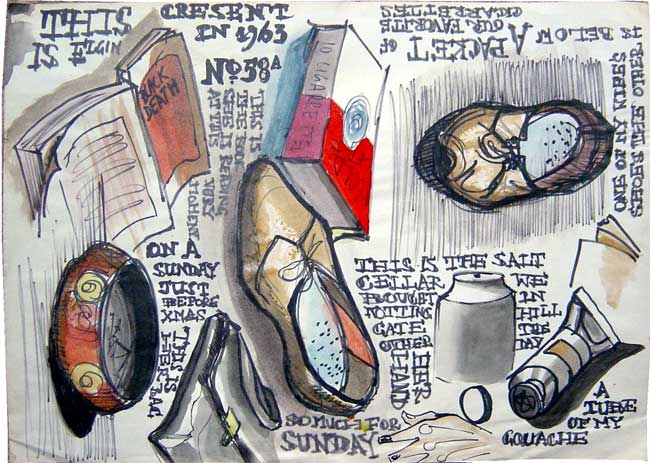
A few days ago, this drawing arrived from my stepmother, Sue. It was drawn by my father when I was about three, around the time my parents were divorced.
Many of these objects are things of my mum’s. I think she still has the copper ashtray on the lower left. Sue pointed out how similar this piece is to much of the work I have been doing and I must agree. I never really thought of him doing illustrated journaling but clearly he did.
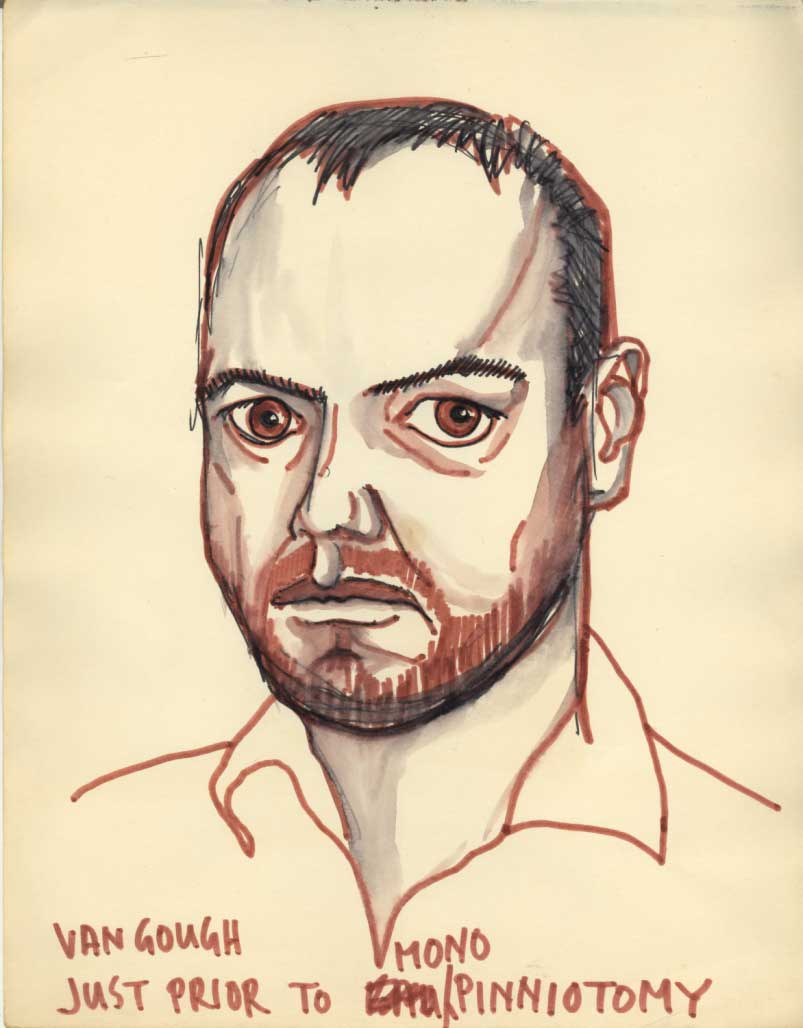
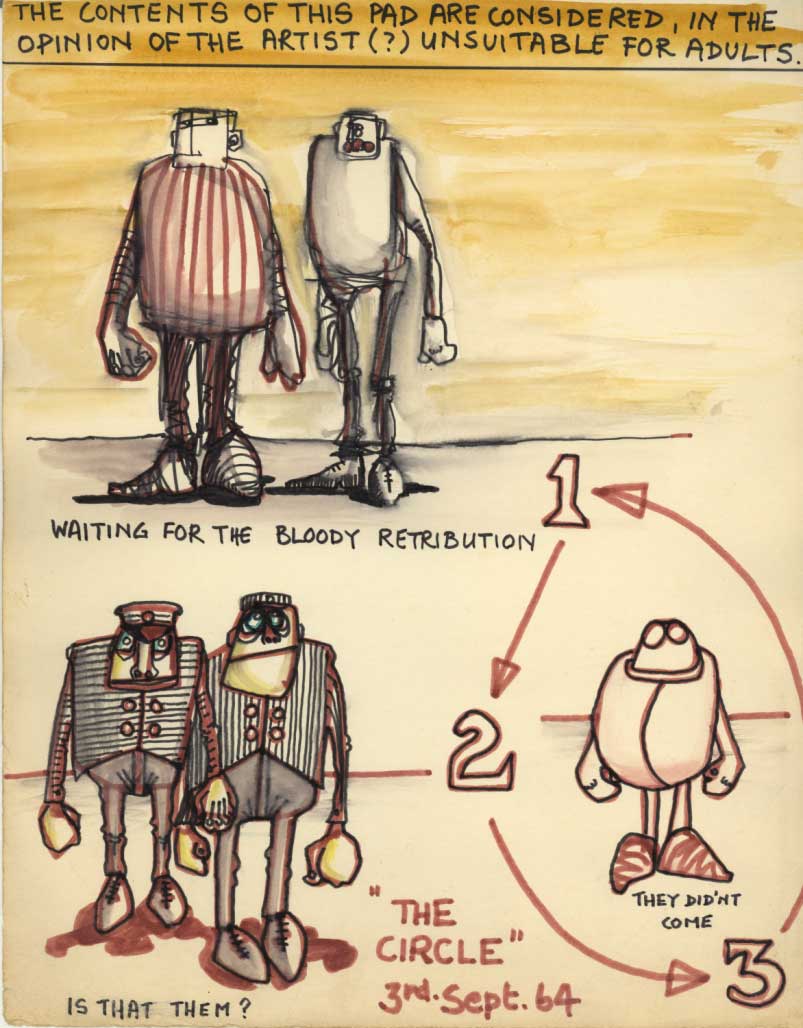
Keir lives in Leicestershire, near Nottingham (that’s in England, folks). His three daughters (my half sisters) are all grown and he seems to spend most his time drawing daily self portraits or writing software for his own amusement. I’ve only seen my father a half dozen times since the divorce and we correspond very intermittently. I have a few of his sketchbooks from the early 1960s and I have always loved them.
Between Jack’s painting and this newly arrived drawing from Keir, I must say I am thinking quite a lot about heredity these days.

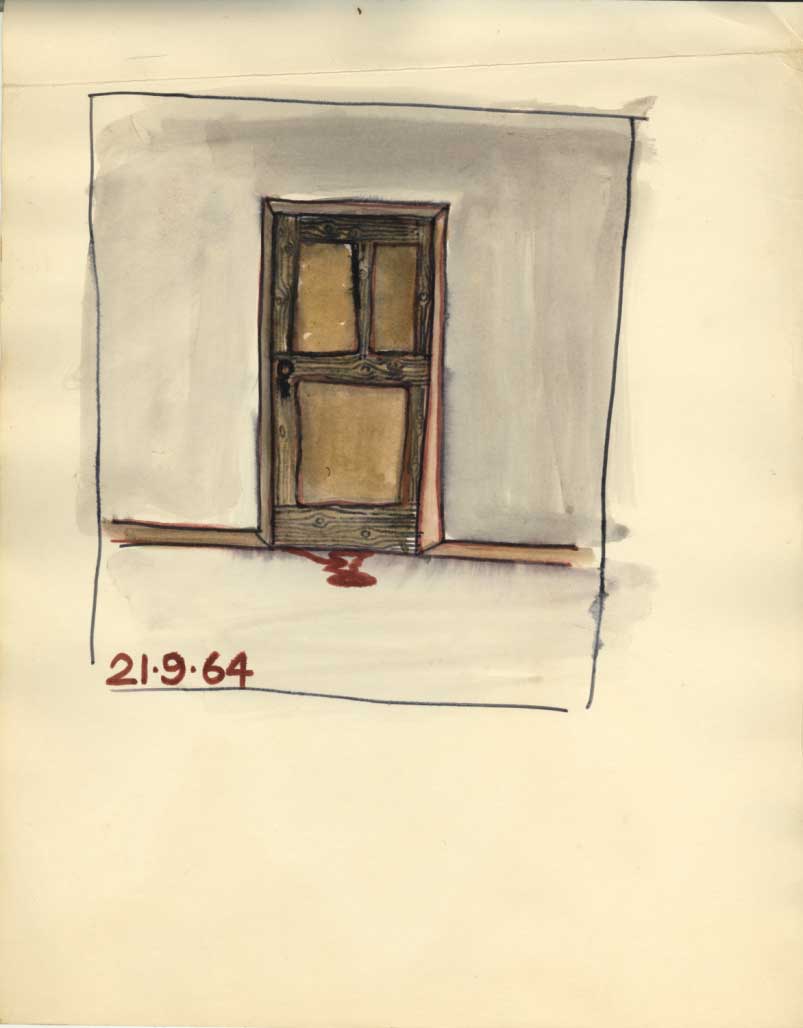
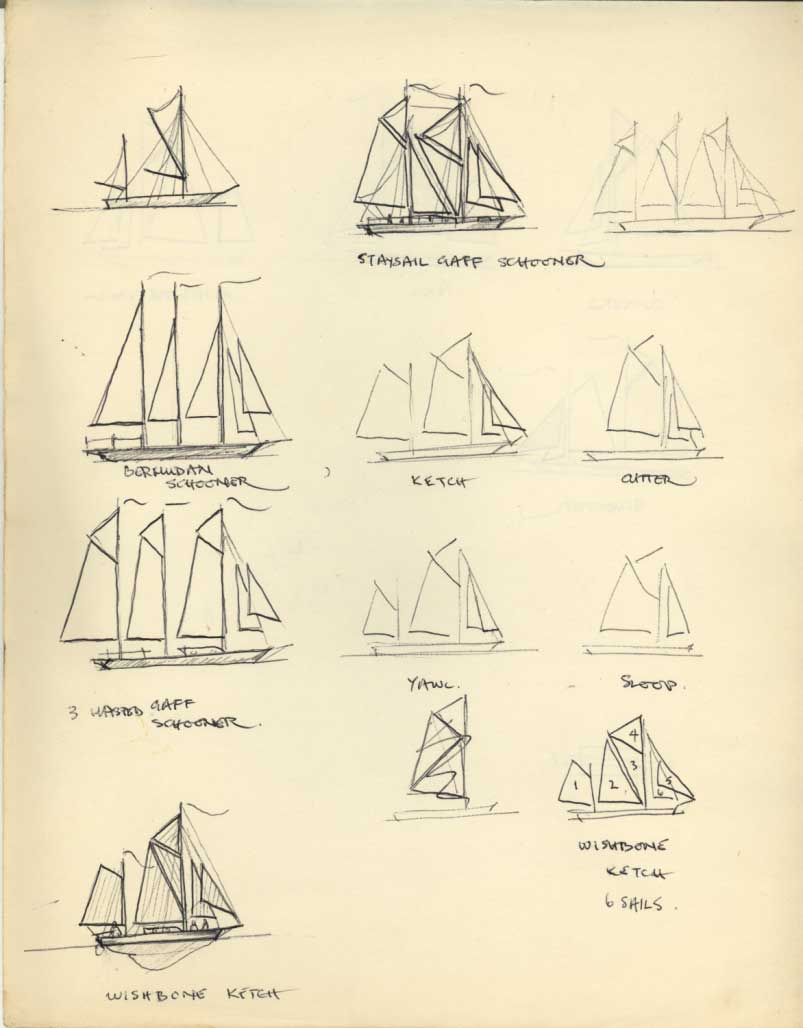
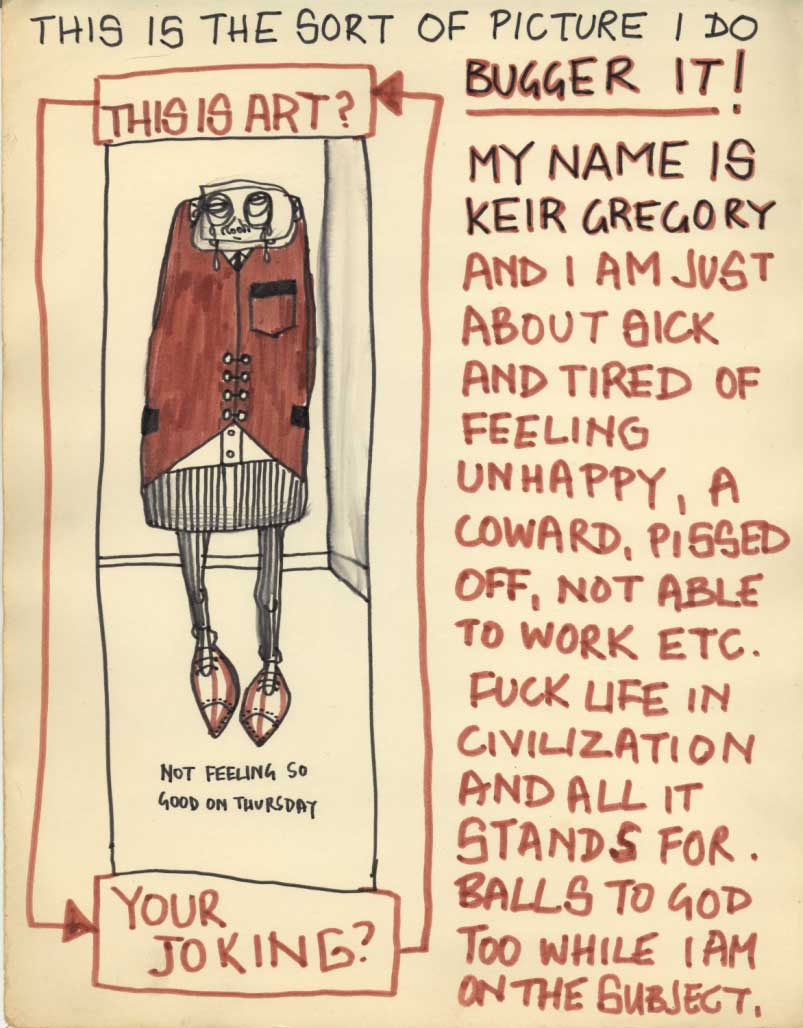
Here is some more of Keir’s work circa 1964 (he never shows his work so I hope, on the off-chance that he stumbles across this web page, that he doesn’t take offense to this little tribute exhibition). Some of it is pretty angry and hard core so please don’t yap about the language or the macabre-ness: