
 Jack takes a lunch box to school but when he goes to summer day camp, his carrot sticks, cookie and sandwiches (unvaryingly: one salami, one PB&J), travel along in a brown paper bag. At one point, maybe it was last summer or the summer before, Patti asked me to write his name on the bag. Soon this became a ritual and each morning after breakfast I would do more and more elaborate calligraphy to identify his bag.
Then I started making up panels from super hero comics and printing them on the bag with my ink jet. This year I alternate between dip pen hieroglyphics and watercolors and gouache (which look great on the biscuit brown paper).
When I first came to America at thirteen, I got my first lunch box. I think I picked it out myself, a Scooby Doo model. It wasn’t long before my classmates started to snicker and then openly deride me for my cluelessness.
Before long, I’d gotten the message and began to brown bag it. No name or watercolors.
Category: Drawing
Inklinations
 The only downside to my vacation (and this will give you an indication of what a hopeless nerd I am) were a few pen problems. First of all, though we packed virtually everything in the house into our car for the trip, I left my trusty Rotring Rapidoliner in my bedside table drawer. The only reason for such an oversight is that I had just begin to use a device called the Rotring Art Pen — a sort of fountain pen that Richard Bell uses all the time and seems to swear by. I have been interested in drawing with a fountain pen of late because I like the more variable line it gives (I love my Rapidoliner because it flows so smoothly but the line can seem a little mechanical and rigid at time) and so I have been two-timing the Rapidoliner with this long, black stranger.
The Art Pen has one obvious design flaw, the back end tapers to a near point which mean that when you take off the cap, you can’t snap it onto the back and have to lay it down somewhere and then be mildly distracted about whether or not you’ve left it behind which may effect your drawing in a sort of stone-in-your-shoe sort of way.
Then, poolside, I discovered a more significant problem.
 The Art Pen comes with a half dozen little prefilled plastic ink cartridges. The ink, I discovered after laboriously drawing this geezery couple and then beginning to slather on the old water color, is not waterproof. The ink began to branch out into spidery tendrils and my lines became fuzzy.
Fortunately I had bought a special bladder, the “Piston Fill Ink Converter”, that allows me to fill the pen manually and later I tossed out the feeble cartridge and pumped in some India Ink.
 Another minor problem arose which is that the bladder, which is a sort of syringe that you advance and withdraw by rotating a little stick at the end, doesn’t seem to draw entirely of its own accord and one must ocasionally recrank it up and refill the nib. If you don’t do this very carefully, big drops of ink fall onto your drawing.
All that having been said, I continue to use the Art Pen but plan to send Richard a nasty note.
I’ll admit, I am a fickle pen owner. I search for years, find perfection, but my eyes keep roaming. Another pen I keep on the side is called the Grumbacher Artist Pen (there’s not alot of creativity in the pen naming community, it would seem) which has the teeniest needle point and the same pointed-end, cap-losing design as the Art Pen.
It is not refillable but the line is so fine it seems to last forever anyway. I did a drawing or two with it on my trip and still quite like it but for optimal performance, use very smooth paper.
Finally, the Art-Pal Creative pen — a very groovy-looking, gold pen with a brush nib that you fill with the ink of your choice. Looks, however, are horribly deceiving. It is a piece of junk. I filled it, used it briefly twice, and the nib sort of crumbled and the tip broke off. It might be possible to replace the nib but the pen came from Jerrys Artarama with no instructions and no way to buy new nibs. I’ve written to them for explanation but so far they have been mute.

 And finally, I am determined to pick up some gouache today. I tried working with watercolor and no line drawing but the results felt wishy-washy. I need to be able to add a layer that is more defined and sharp and bright on top of watercolor and I have resorted to white ink put on with a dip pen and then tinted the ink with watercolor which works okay but is fiddly and hard to control.
I’m sure if I paid better attention to my lessons from Roz I wouldn’t have this dilemma but it seems easier to just buy more art supplies.
By George
 While I was drawing this, after dropping Jack off at school and sitting under the Washington Arch with its two newly restored statues of the general/president/slave owner/lumberjack, I heard something soft land on the ground ahead. Then, through the proscenium of the Arch, a man strode onto the stage – a 30ish black man in a tuxedo, sans the jacket, which he’d just thrown at the arch. He yelled at the top of his lungs: “Fuck you, George Washington!” Fuck you!” Then he picked up his jacket and strode offstage.
Another morning in New York City.
I drew the lines with my Rapidoliner and inked in the trees with Dr. Martin’s.
A new old friend

Sunday afternoon, I was walking through Astor Place when I saw a man in a familiar position, hunched over a big old moleskine, a pen twitching between his fingers. I knew, from across the road, that he was drawing in a journal.
As I approached, I suddenly realized it was my old partner, Tom Kane. We’d worked together in the mid-80s, dreaming up advertising campaigns for Life magazine, for cigarettes, for Barnes & Noble— we even did a very early rap song about IBM (“We were the mothers who invented high tech, now everybody wants to play Star Trek, but there just ain”t room for all that crew, all the wildest ideas come out of Big Blue, etc…).
Although I never saw him actually draw, I had seen a few pieces in his apartment, near-photorealistic paintings of pop icons, horses, and women. He obviously had a lot of talent but he expressed it on the sly. We’d lost touch over the next decade, but hooked up for a long, candid noodle lunch three years ago. Then I, in my executive haze, lost touch with him again. And now here was Tom drawing in a moleskine. What a weird coincidence.
Tom looked up from his page and, seemingly unsurprised to see me, immediately told me that he had been bought multiple copies of my last book and been lurking around this blog for a while, my book, all of which had inspired him to start keeping his first ever journal. I was floored. It was so strange to find someone who I knew and admired as a very creative and talented person hooking up with the Everyday Matters crew.
Well, as you can see from the drawing Tom was doing at the time, he sees very well. Look at how specific each window is, not just a row of squares but the very particular windows, one by one. His crosshatching is rhythmic without being monotonous, reminding of my all time favorite, r.crumb. I also love the way he fills the page, how he uses the negative space of the sky and integrates his text right into the scene. It’s a great drawing and a beautiful exercise in mediation.
Tom is a very imaginative art director. If you’ve ever seen those wild, bubble headed girls in the ads for Steve Madden shoes, you’ve seen what Tom does in his day job. We dropped over at his place and he showed me dozens of fantastic paintings, photo collages, drawings and rows of tomato cans. I could sense that he is being called more and more to devote his energy to making things that express his passions rather than peddling ladies’ shoes. I hope he follows that call.
In the meantime, I have a new journaling buddy to roam the streets with. What a happy accident it was, running into him.
Ten thousand things to draw
 Content of kitchen cabinet, fridge, bedside table, medicine cabinet
All my shoes, clothes
Covers of ten favorite CDs, books
Every significant front door of every place I’ve lived or worked
Everything I eat today
Contents of my bag, of my pockets
Every tree on my block, labeled with its official Latin name
All the cars on my block
Views out each window in my home
Clutter on my desk
A map of my neighborhood
A map of the house I grew up in
Portraits of my wife, son, and pets asleep
Every appliance in our house
Every phone in our house
Series: every cup, mug, vase and lamp
My hands, feet, face, body
The exterior of each place I buy lunch
My car’s engine
Every pen and pencil in my desk
All of Patti’s cosmetics
Every present I got on my last birthday, Christmas
All of our sports equipment
Every chair in our house
Every outlet and all its plugs
Everything that belongs to a pet: food, toys, clothes, bed, medicine, cage, etc.
All the liquor in our cabinet
The portraits in my yearbook
Ten pieces of broken cookie
Ten manhole covers
Ten hydrants
Each component of a sandwich, individually, then assembled
All our jewelry and watches
Every hat I own
Every bill and coin in my pocket
Ten things from any catalog in our mailbox
A plate of spaghetti
The laundry: clothes, machines, detergent, etc.
Living well through bad drawings

When some people see an illustrated journal, they say, “Wow, that’s great. I could never do that.” With some coaxing, they may be persuaded nonetheless to give it a try. Others say, “Wow, I’m going to do that.” And they start too. And quite a few say, “Huh, where do you find the time?” then use your journal as a coaster.
It’s comparatively easy to start. To bring yourself to draw your breakfast once or your coffee cup once and to keep it up for a couple of days. Ideally those first few days infect you with the fever and you’re compelled to carry a long series of journal books around with you for the rest of your days.
But more likely, your initial enthusiasm will wane. You’ll forget to do it one day, give in to resistance the next, then feel like you’ve broken the chain, the narrative is lost, a month’s gone by, and you drop it altogether. Why? Often it’s because you are disappointed with your drawings. You may say you don’t have the time, forgot your book, grew bored but it’s really because you aren’t that impressed with your drawing skill. You haven’t made something that looks like Art.
I don’t think that illustrated journaling is really about doing great drawings. You’re not out to make something that you could frame or give as an Xmas present. I’m not really into doing the sort of exercises on perspective and tone that you see in most drawing books, exercises that will move your skills to another level artistically. Not that you shouldn’t do them if they are fun or if you have some other goal in mind but I don’t think they are essential for the true purpose of illustrated journaling.
That purpose? To celebrate your life. No matter how small or mundane or redundant, each drawing and little essay you write to commemorate an event or an object or a place makes it all the more special. Celebrate your hairbrush and it will make you appreciate the intricacy of the bristles, the miracle of your lost hair, the beauty of you. Sounds sappy but it’s in there. Draw your lunch and it will be a very different experience from bolting down another tuna on rye. If you take your time (and we’re just talking maybe 10-20 minutes here, folks) and really study that sandwich, the nooks and valleys, the crinoline of the lettuce, the textures of the tuna, you will do a drawing that recognized the particularity of that sandwich,. That’s the point: to record this particular moment, this sandwich, not something generic. If you approach it with that attitude, you will create something as unique. reaching that place is just a matter of concentration and attention. A brief meditation and you will have a souvenir to jog your memory back to that a moment forever more. Imagine if you can keep doing that, keep dropping these little gems in your day, recognizing the incredible gift you are given each morning upon awakening. You will be a millionaire.
There’s a demon in your mind that will fight this, that will tell you your life is unworthy of acknowledgment, that today sucks through and through. It will tell you you have no time for this, that you are too harried, too stressed. Which brings me to Marybethd who wrote to me from Nebraska where she just had emergency eye surgery. For two weeks, she could only see the floor. She wasn’t sidelined though— she drew all of her visitor’s feet. She pulled art out of that tragedy, celebrated her visitors, created a positive memory that she will have to cherish long after her vision is back to normal. He nightmare became a lesson.
I have gone through my fair share of shit. My regret is that I didn’t celebrate all of it. I can’t say it often enough: life is short, art is long. Get the habit.
Sky Mall pop quiz
I have a new piece in my favorite online magazine that you might find amusing.
I first thought of it on the way home from vacation when I pulled the bizarreness that is the Sky Mall catalog from the back of the seat and wondered, “Who dreams up all this crap?”
“And who buys it?”
Grid
The members of Everyday Matters, the Yahoo!group, have been working on an interesting project. Take a page, divide it into thirty squares (pipaudstudio created a Word template you can download here), then do a drawing each day in one of the squares. After a month, it will be filled with a rich quilt of art. No matter how lame any one of the drawings is, the overall result will be beautiful. As the month ended, some of the participants have been uploading their work. It’s very interesting and inspired me.
Patti signed me up to contribute a piece to the auction at Jack’s school, a watercolor of the school. I carved my page up and got to work.

Re-learning to draw
 My boy, Jack, 9, has always loved to draw. He draws in the symbolic away kids do, inventing characters in his mind, drawings scenes and battles and maps and worlds. Recently though we have been talking about drawing realistically and from nature.
Last week, we began doing exercises from a great book by Mona Brookes, called “Drawing with Children.” The book’s method is extremely clear and simple and we’ve had a lot of fun working on it together. In the very first lesson, he drew in ways he never has before and, at the end, asked me when we could do it again.
When children draw, they are working things out, play acting, exploring and learning. They are probably being more left brained about it than adult artists are, working primarily with symbols that are not based on observation. Our society assumes that this sort of play should not be interfered with as it may somehow stunt their imaginations. Instead, there’s a risen a myth that children can’t or oughtn’t be taught to draw. When kids reach ten or eleven, they taper off with this sort of play and, for too many people, this marks the end of their drawing life.
Some kids persevere on their own, but against the odds, because they usually have insufficient instruction. It’s absurd, like giving a class full of children access to books but not teaching them to read. We expect kids magically to go from drawing symbols to seeing clearly enough and having the perseverance to train themselves to draw accurately. Some will figure it on their own, the rest will just lose interest. We don’t do that with driver’s ed, or swimming, or mathematics, or even music.
The teaching and the learning aren’t hard. At nine, Jack’s brain is a sponge and Brookes breaks seeing and rendering down to such intuitive fun exercises that he picks it right up. The system is designed to help adults too and Patti has been talking about starting soon too. I can’t wait.
If you’ve been procrastinating about learning to draw, try working through this book with a child (even two year olds can do it). The fun is contagious and it’ll light your fuse.
Art Supply Porn
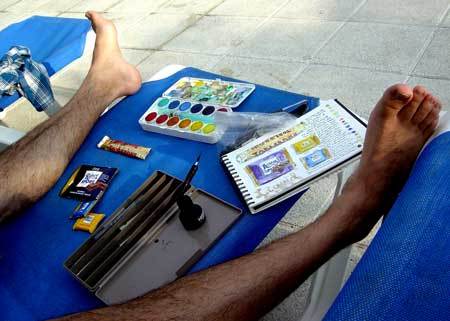
I didn’t even know I had a great aunt Greta (twice removed). But I was happy to take the call from her lawyer, the executor of her estate. Now I am the lucky owner of a 5,000 square foot studio loft not far from our home.
It is a quiet space but when I open the floor to ceiling French doors, the birds’ twittering can be heard from Central Park below. The ceilings are high, about 18 feet and, but for a few graceful, sculpted columns, the space is open and expansive with freshly painted white walls and well varnished, wide plank floors. The most notable feature is the enormous skylight overhead that floods the room with sunshine on even the gloomiest days.
Greta, who apparently enjoyed my drawings when I was six, also left me an open ended, unrestricted trust fund for art supplies and furniture, so I have been busily organizing and shopping for the past few days.
First, I had my friend Dean help me plan out the space. We covered the eastern wall with cork for pinning up drawings and things torn out of books and magazines. Next to it, we erected twelve foot high bookshelves with one of those sliding ladders. In the corner by the door, I have a seating area with a Mies leather couch (for afternoon naps) and three Eames chairs and walnut stools. There’s a large kitchen and we just had to have some of the counters redone (I love to draw at the kitchen table) and a new fridge with an ice maker installed.
There’s another wall for storage with oak flat files and cabinets for storing supplies. I have two different drawing tables, one of which is a BF23 from Italy and can be angled, and raised with a foot pedal. I have a wooden print rack and several taborets that roll around on the floor and hold pens and stuff. They’re delivering the G5 Mac tomorrow afternoon and the server, which will hold my MP3 collection. Then the guys from Harvey Electronics just need to hook the system up to the Niles Audio AT8700 speakers they installed in all the walls and we’ll have Miles playing in ever corner.
So, off to the store.
Let’s start with watercolors. I want all the colors that Daniel Smith makes, every series, big fat 15 ml. tubes. Then I’m also going to try out a few other brands, so I’ll get all three of the Maimeri sets that Catherine Anderson advertises. I’ve had fun with the Dr Ph Martin’s transparent liquid watercolors I own but I want to move up a notch to their Hydrus colors so I’ll pick up all24 colors they make. I see Schmicke makes powdered metallic watercolors – they could be fun to use in my journal so I’ll take those: rich gold, pale gold, copper, silver and aluminum. Here’s something called Ox gall Liquid; no idea what its for but I like the sound of it. In the basket.
Next, I want the best brushes money can buy. Really great watercolor brushes always spring back to a natural, razor sharp point and I think male Kolinsky red sable is considered the best (they’re made from the tips of animal tails which is mildly disturbing but maybe they just trim off the tip and it grows back like a lizard’s. In any case, I’ll ask the lawyer if the trust fund can make a contribution to PETA or something). Here’s a #14 brush for $311.95. I’ll take three. It’s by Isabey and they’re nickel plated. But the #14 is pretty chunky; for safety’s sake, I should get the whole line, 00 though 12. And, for fooling around with, maybe those Squirrel quills. And a 2″ squirrel wash or two. Oh and some fun brushes: a few of those filberts and fans, a set of lettering brushes and those weird angled tear drop brushes.
I’ll need some good new palettes, the big English glazed porcelain ones. Grab half a dozen. That watercolor bucket looks interesting – it has water basins and palettes inside it and there are holes in the hadles to keep brushes upright. Oh, and this Rinse-Well thing is cool. You fill the big bottle with water, it fills a basin with clean water and when it’s dirty, you press a button and it flushes it into a hidden reservoir. Cute and just $30. I need three. Might as well get this Sta-Wet palette with the lid that seals the paint like Tupperware. It seems a bit fiddly and I can always just get fresh paint but, oh, what the hell… in the basket.
Watercolor canvas? Apparently it has a special coating that takes the watercolor, you can lift off mistakes or even wash the whole image off the surface and start again. It doesn’t rip or shred and comes in huge rolls so you could do paintings that are 4 and half feet by 18 feet! Wow.
I also need loads of Fabriano Artistico watercolor paper. I want to try the hot press too and both 140 and 300 lbs. I love the Canon Montval Field books for journaling but also want to try out these Michael Rogers books with 140 lb. cold press acid free paper. Take a half dozen of each. This Nujabi journal looks good too: 25 130 lb. deckled pages in a Royal blue cover. In the basket. Lots of empty pans and half pans and an enameled steel box to hold them. Some nickeled brass palette cups. Check. One of these steel tube wringers that squeeze out paint. Check. A few dozen empty jars and squeeze bottles. Check.
I’ve never used a Mahl stick to rest my hand on while painting. It’s very Rembrandt looking. In the basket. And a thing called an Artist Leaning bridge, a transparent shelf that sits right on top of your page so your grubby paws don’t get on the work.
Here’s a very cute and must have item, the art traveler, a combination back pack and stool, with aluminum legs and lots of pockets and padded straps.
I like these huge art bins with the casters on them, full of individual boxes that neatly stack. Even a pocket for my wireless phone. Do they have to be such an ugly shade of purple?
I’m getting a huge paper cutter for bookbinding. I am used to the arm cutters (which could live up to their name an sever a limb) but am intrigued by the Rotatrim that rolls the blade along a bar. They have a massive 54″ one here that’s a bargain at just a little over a grand.
I need pencils: These Faber-Castell Polychromos come in a box of 120 colors and , for some reason, a CD-ROM. I like the idea of pencils so sophisticated you need to use a computer to work them. I’ll take the matching Albrecht Durer Watercolor Pencils too. In a wooden box, just $300 a piece. I’ll also need an electric eraser, just in case I ever make a mistake. These triangular TrioColor pencils looks interesting. Oooh, and these color pencil easels that organize everything in rows behind elastic straps and Velcro closures. Very nice.
I want to try some new media too: Encaustic crayons that you apply with a special electric iron. British scraper board for beautiful cross hatched drawings tat look like engravings. I’ll take some in black and some in white. And foil too. Oh and a set of cutters and scrapers you need to work on them.
No pastels. I never like drawing with them and I never like the look of pastel drawings. Except for Degas. And Lautrec.
Some gold leafing. I’ve used cheap stuff and it’s very dramatic but I’m going for the real stuff this time, 22k Double Gold and Pure Palladium too. The perfect way to class up a humble line drawing.
I’m going to have to order some clay for sculpting but I might as well pick up the armature set, the metal mesh and the riffler tools for shaping. This rotating sculpture stand is cool. It goes up and down and has a little adjustable shelf for tools. And this clay gun extrudes different shapes of clay, like a grown up play do maker, only in steel. Ultimately I want to get a welding setup and a kiln but this’ll do for now.
I love pure pigments, no idea what to do with them, but I want a few jars of them sitting around: Sennelier sells a nice starter set for just $1250 in a handsome wooden box.
I want some gouache to try out for the first time. This Lukas brand looks sort of interesting but I think Roz urged me to get Schminke. Better ingredients, less chalky and dull.
Now that I have all this space, I’m going to do some oil painting. I have painted on canvas before but always hastily, using a dining room chair as an easel and acrylics because they dry fast. I’m intrigued by Williamsburg paints. They’re made here in New York by an artist who based his recipes on research into the paint houses that supplied Monet and Cezanne. I’ll need 150 ml. tubes and the colors go from $25-145 so I should probably get the whole range, looks like about 150 colors. I can’t stand the smell of turpentine and how it gets into everything so I better get some Turpenoid and a citrus based thinner.
Brushes: If in doubt, buy the most expensive. In this case, more Kolinsky Sable. I’m getting a set of flats, of rounds, of filberts and of liners: grand total, a mere $1802.15. Hang on, these color shapers look like fun. They’re silicone brushes which I can use for applying and scraping paint, sort of like more elegant paint knives. But I should get paint knives too. Here’s a set of 60 different ones for $450. Done. Oh and a smock. Here’s a nice black one, cotton, lots of pockets. And though I won’t be getting a beret to go with it, I like this life sized human skeleton made of wood. Beautiful, and look, life sized posable manikins. They have men, women, boys and girls. A lovely family for just about two grand. And a posable giraffe too. Other miscellanea: a reducing glass les for looking at my canvas without having to step back and … duh, an easel, I’ll get two: one for plein air, a french easel that folds up into a little box to strap on my back like Van Gogh did. And then a big one made of oiled oak wood with cranks and shelves and casters. Here’s a nice one, called appropriately, the Manhatttan and it’s just $1707. Greta would approve.
Finally, canvas, double primed cotton duck to start with, and then a roll or two of Belgian linen and loads of stretcher strips and canvas pliers and a really good staple gun. And a few maple panels for painting on too, the really thin kind, satin smooth. Oh, and a Bob Ross video, maybe “More Joy of Painting”.
(This grotesque fantasy of excess was inspired by the arrival of Jerry’s Artarama catalog in our mailbox. In the real world, I ended up buying a bamboo sketch pen, for $1.79).
 Danny Gregory