

My favorite online magazine, the Morning News, ran some of my Death Row drawings today. They’re as grim as watercolors get. Check it.
And there’s more here.

Collections of things I make and/or like
 It’s late and I’m exhausted from a long day which culminated in something a little tedious but exciting: revising a new piece I’ve done for the Op-Ed page of the NY Times. It’ll run this Sunday.
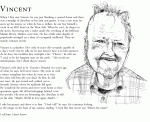

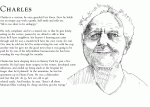
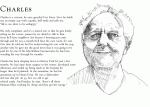


Recently, I found myself angsting about money. I decided that I should go out and talk to people who had none. I approached homeless people in my neighborhood and asked them to share their stories with me. At first it was terrifying, breaking the barrier. But I soon found that if you don’t want anything from people but their story and perspective, they are enormously forthcoming and trusting. They’ll soon forget to wonder why you’re asking.
These images and stories were published in the Morning News where my journal entires were transcribed into text.
I have a new piece in my favorite online magazine that you might find amusing.
I first thought of it on the way home from vacation when I pulled the bizarreness that is the Sky Mall catalog from the back of the seat and wondered, “Who dreams up all this crap?”
“And who buys it?”


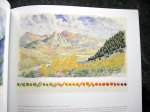
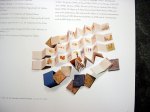
This guy is scarily good. Tony Forster’s watercolors depict his treks around the world, to the rain forests of Costa Rica, the volcanic island of Montserrat, Bolivia’s mile-high lakes, the slopes of the Sierra Nevada and the scorching desert of Death Valley. I first saw them in a froo-froo gallery, stopped dead in my tracks on Madison Avenue, thinking “Wait, wasn’t I supposed to have made these, y’know, in some parallel universe?” On the edges of his gorgeous landscapes paintings (he paints on sheets of watercolor paper, usually 22″x31″), he attaches little sample swatches, topographic maps, and then stencils, types, and hand writes notes. This softcover book of his work was published by the Frye Art Museum in 2000.
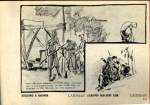

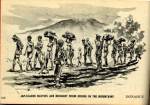
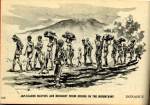
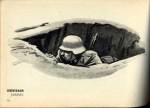

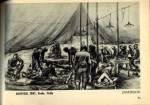


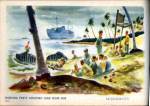
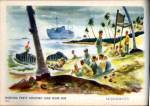
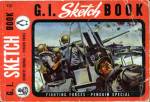
For anyone who has ever felt that they had no time to draw, were too stressed out to draw, had nothing interesting to draw, I offer a few pages from “G.I. Sketch Book”, published by Penguin Books on July 1944:
From the FOREWORD
WHEN YOU get upward of ten million men together from every walk of life, you find a large number of them who think pictorially and who burn with a desire to record their thoughts. What cries out more for the permanent record of the artist than enormous masses of men in combat, in preparation for combat, at rest, or at play! The skill of an artist is not always the same; there are influences that heighten or lessen the ability to transmute mood and scene. If he is greatly moved by what he sees, it is very probable that he will transcend his ordinary technical limitations and produce something that will come close to satisfying even him.
The pictures in this book have all been made by American G.I.’s and, as you thumb your way through the pages of sketches and finished pictures, bear in mind under what conditions some of these chef d’oeuvres were produced. What foxhole did a marine use as his studio? What bombed and burning deck inspired the sailor-painter to portray magnificent light and atmospheric effects? Many scenes were sketched on wrapping paper, some painted on ship’s canvas with ship’s paint. One lad in the Air Forces sends his wife a daily letter from China, from India or from Burma, constantly illustrating a point with a pen and ink sketch. This is what he writes about his G.I. life and art: “It’s a nice feeling that though I am so far away, I am still contributing to the cultural life of our community. Also to know that I am still doing art work in the combat zone, and under real primitive and warring conditions, proves conclusively that the desire for the fine and aesthetic is not a shallow, meek appendage to the lives of humans, but a forceful necessity to life.”


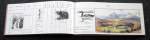
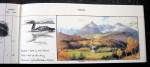


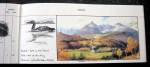

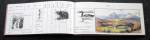
This is one of my prized possessions. In fact, I prize it so much I repeatedly give it away and then go hunt for a new copy.
Muriel Foster(1884-1963) started keeping this diary in 1913 whenever she went fishing and, for the next thirty-five years, filled it with sketches, watercolors, observations and poetry. While she was a professional artist, this little diary was just for her and never intended to be shown. Her grand niece released it for publication as a facsimile decades after her death and it is the work for which she’ll always be known (if I have anything to do with it). You can find a copy or two of the book on abebooks.com but act quickly — I may snap it up first.
 Some people have asked me what happened to my (Flash) feature 25 Books of the Year.
Well, it’s here.
 Danny Gregory