Chicago on four hours' sleep

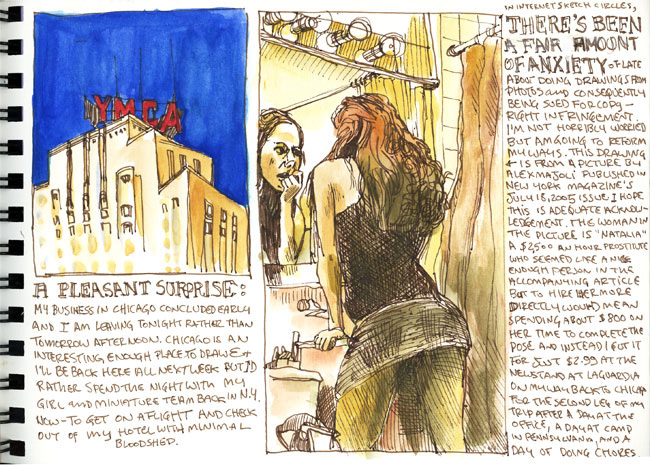
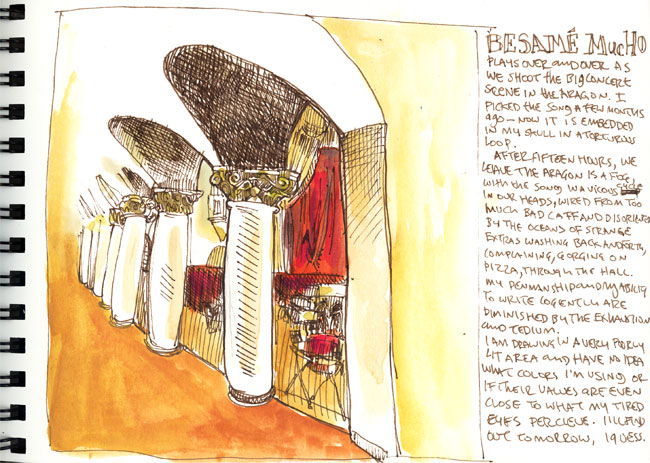
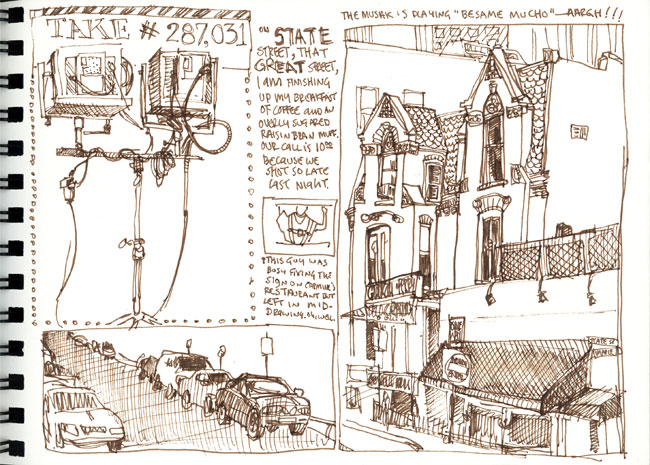
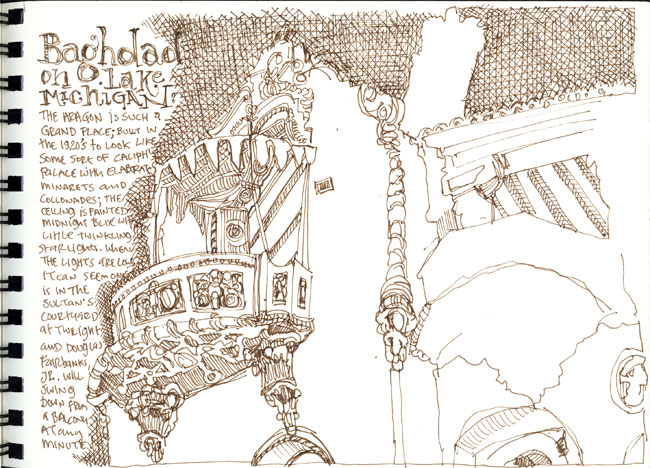
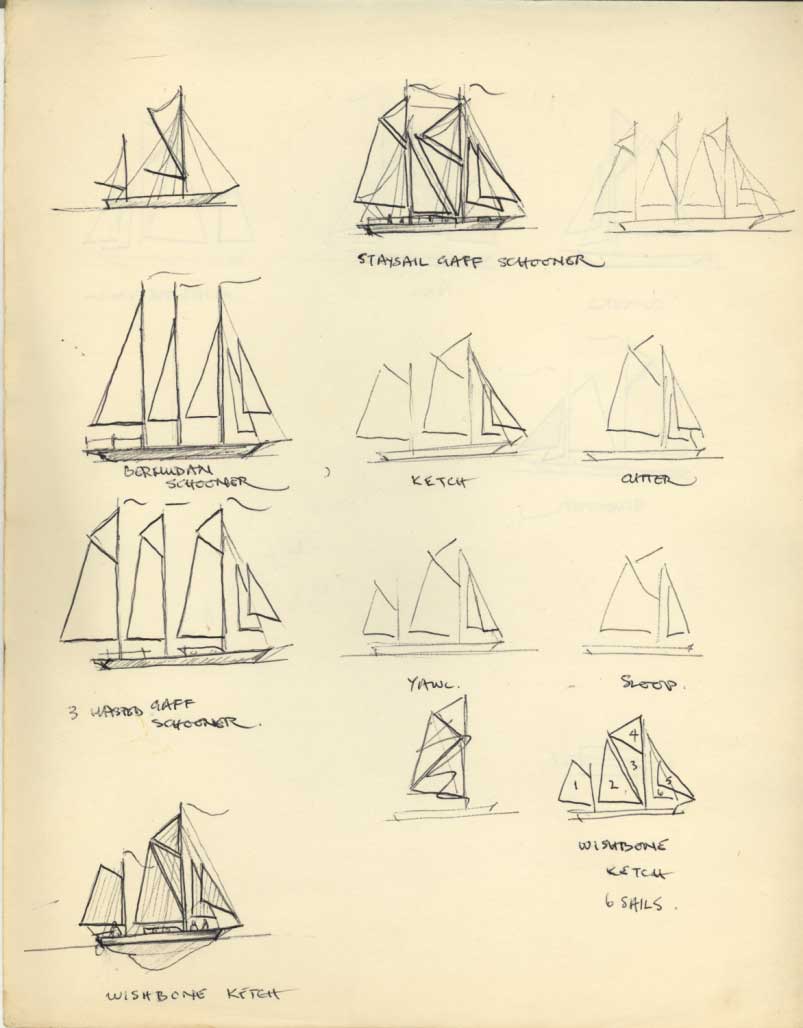
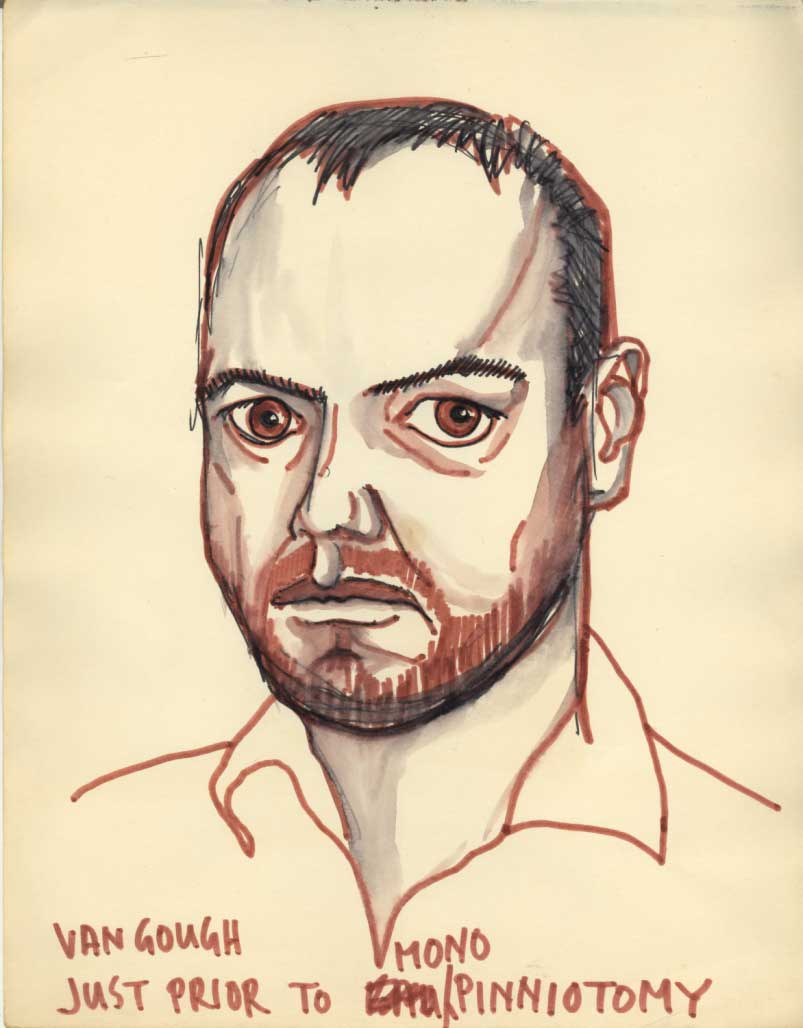
I am posting this from my room in Rome, still fairly jetlagged but eager to get out there tomorrow and start drawing. Meanwhile, here are some journal pages from the last few days while I was shooting in Chicago, specifically at an 80-year old institution called the Aragon ballroom.

Most of our days lasted more than 16 hours and we wrapped at 3 am; the effects are visible in my drawings which are actually quite nice and loose though manically, Tom Kanesian in their crosshatched detail.

My colors are a little bolder than usual — I should probably continue to paint in the gloom.

I drew entirely in Sepia ink and watercolors, and many of these entries were doing in semi darkness and while severely sleep deprived. My marginal comments seem even more crabby and distracted than usual.

Drawing day

roundtablea-1I have been kerchunking out drawings today, primarily for the Morning News. As part of the series’ illustrations I’ve been doing for the newly redesigned site, Rosecrans, my editor, asked me to create a drawing for TMN’s occasional round table discussions. At first, feeling uninspired, I pulled out a photo of a conference room business discussion and turned it into this.

roundtable

The next day, Rosecrans said he liked everything I’d been doing except the roundtable illustration one which looked like I’d done it from a photo of a conference room business discussion. So I took another crack at it, this time a little more bohemian and came up with this.

peanut-vii

My next job was to create illustrations for the next installment of Peanut is coming up on Tuesday. I decided to just focus on still life objects that represent parts of the story rather than contrive some actual illustrations of people and events, my least favorite illustration to do. These are three separate ones.
At the new Blick art store down my street, I picked up a new set of Pelikan opaque watercolors. They are a little chalky but work pretty well in moderate conjunction with my transparent watercolors. A worthwhile addition for just 20 bucks for 24 colors. I also grabbed a handful of PITT artists pens from Faber Castell. I love their brush pens and now will try out the S and F pens in black and umber.
I also splurged and bought myself a new set of watercolors called “Yarka St Petersburg”. They were pretty expensive: $69 for a set of 24 pans but I really want to upgrade my colors and I hate little tubes. I’ve tried making my own set by drying little cakes in a metal box but it was a disaster.
Anyway, when I got the St. Pete’s home, I realized they were not worth the money. The pans sit in a flimsy plastic box that would crack in no time in the field. And the pans themselves sit in the thinnest plastic egg carton sort of arrangement of cups. There’s no way they will survive a year or so of daily use. Why would anyone make such a flimsy piece of shit I wonder? The Pelikans are beautifully made and designed (though the paints themselves are probably just student grade) and these professional paints were designed by monkeys who’d never seen a real human use them,. They’re going back to the store this afternoon.

Assignment of the day

It’s hot as a bastard and we are all recovering from four performances of Annie Get Your Gun in three days. I have spent the past two mornings in the air-conditioned apartment working on an assignment for The Morning News which is about to launch its year long redesign. Rosecrans, my editor, asked me to draw three illustrations to work as launch-pads for the serialized books that appear on the site every couple of weeks.
I had already done a couple of different icons for Peanut:

peanut-sonogram.gif

This one is meant to look like a sonogram of a peanut. It’s okay though a little gimmicky.

Peanut-2.jpg

Then I came up with this one based on a photo of an embryo, sort of 2001-ish but not really uniquely mine.
I decided to start from scratch with more conventional ink and watercolor drawings, each about 4-5 inches square. I painted this fairly scary drawing; still it’s somehow cute in a plucked chick kind of way and I like it.

peanut-1.1.jpg

For The letters of Gary Benchley, Rock Star, I bypassed my initial thought of painting some instruments ( I have recently done three different illustration jobs requiring sketches of guitars) and decided to try to capture some rock’n’roll energy. I did this drawing fairly quickly and I like it too.

gary-Benchley-1.1.jpg

I struggled most with The Education of Elisabeth Eckleman. It seemed that every story had Elisabeth in tears at some point so I decided to tackle it this way. I was a little worried that I had been overly influenced by fantasies of Molly Ringwold and was listening to too much of the new 9 Inch Nails album and Elisabeth isn’t quite in that nexus.

elizabeth1.1.jpg

I fired off an email to Sarah Hepola, Elisabeth’s creator, who wrote: “She’s a cute 18 year old girl — brown shoulder-length hair that’s a bit curly/frizzy (she likes to straighten it out), a little girlish pudge in her cheeks. Blue eyes. She’s from a small town, so she doesn’t have that natural college girl look yet — she wears a lot of makeup, probably earrings. she probably wears a lot of tank tops and shorts.”
I’m no expert on the nuances of 18-year-old girls anymore and I was a little tense as I went back to the drawing board.

ELizabeth-2.1.jpg

This was my second and final effort. It has personality and particularity more than the first but tells less of a story and has a little too much Walter Keane in it
I’ll let Rosecrans pick.

Doing a 180

jims-stravinsky My pal, Jim, is directing our commercials out here in LA. After reading Everyday Matters, he’s become increasingly intrigued with learning to draw. He told me he knew he couldn’t draw, didn’t think he ever could, but still always wanted to know how. I told him about Betty Edwards’ book and the next day, he showed up with his own copy of Drawing on the Right Side of the Brain.
Each day he reads the book between takes and each night he works on drawing exercises. Just three days in, he drew the drawing above, a copy of Picasso’s Stravinsky.
This is one of the most powerful exercises in Edward’s book. You are told to copy this image which is printed upside down in the book. You draw each line individually, then move on to the next, building up the picture stroke by stroke. Everyone who tries it describes the same reaction. They are beating themselves up as they do it, ‘Oh, you drew that line wrong, this is a mess, you’ll never do this, etc.’ and yet persevere. When they are finished and turn the page around, they are blown away. They cannot believe their eyes. The drawing looks remarkably like Picasso’s original.
For almost everyone, this simple fifteen minute exercise transforms their view of themselves. It flips a switch in your head that says I can draw! and gives you permission to keep going, to polish your skills, to trust that you’ll keep improving, and get on the road to drawing as you only dreamed you could.
If you’d like to try this exercise, use Jim’s drawing (You can download a bigger scan of it here.). Print it out, turn it upside down, then slowly and carefully copy each line with a pen onto a sheet of paper. Then, brace yourself and turn it around.
What do you think? Let me know.

Seeing the forest, oh, and the trees

tree-1In The Art Spirit, my pal Bob Henri talks about the importance of that original intention which sparks one to make a drawing or a painting. What caught my interest? And, all critically, how do I hold on to that intention so my art is infused with that interest? It’s not enough to decide to draw a tree, one must feel something about that tree and have that feeling right in front of one’s eyes and one observes. His advice is to work fast and furiously, blocking in the big masses while the flame is still burning.
My usual technique is to move slowly, with a blank mind. I enter a meditative state and let my eyes cruise around the contours, laying down every line with equal weight until I have explored the whole object. I rarely try to feel anything as I do this but I must be. I choose certain subjects over others because I like them or am curious about them. So I decided to be more aware and to explore some other ways of looking at a tree a few blocks from my hotel.
I spent a good long time working in ink first. I was very into the carbuncles and folds of the tree’s skin. As I drew, I became increasingly aware of the tree’s colors: it was quite yellow but cloaked in purple, two complimentary colors. I kept thinking about how these colors inter-played and then I painted over my line with watercolors. I was using my new paper, this Yupo pad I picked up on the weekend. The ink went down very smoothly on it but had a tendency to smear. As I painted I was pretty aware of how unnaturally the paint went down, pooling on the paper instead of soaking in. The colors remained pretty vivid, undimmed by the fibers, but it all felt temporary somehow. I couldn’t really let go, worrying that the whole thing would wipe of the page when I was done. I also felt like I had a long lens on — I was only looking at each square inch of the tree but had little sense of the whole as I drew.

tree-2

While the pad lay drying in the afternoon sun, I decided to have another go and grabbed my trusty Japanese journal with its 100+lb paper ( intended for drawing but it’ll take watercolor pretty well) and my Faber-Castell PITT bold brown brush marker. In three minutes, I knocked out a sketch, thinking all the while about the flow and energy of the tree. I did a caricature of the yellow and violet and capped my pen.

tree3

Next I took a black PITT pen and thought about the tree’s architecture, how it anchored into the ground and how the limbs were bolted onto the spine of the creature. I bore down harder on my pen, drawing firmer lines and painting in more defined shapes of color.

tree-4

Finally I took my cheap Sheaffer italic pen, loaded with dark brown non-waterproof ink and this time I thought about the movement of the trees, how the carbunckly growth flowed like water or vomit from the trees crotch, how the limbs pulled in different directions and how that tension held the tree together and propelled it into the sky. Now the tree seemed almost serpentine to me, writhing out of the soil, phallic, twisting, alive. The watercolors dulled the lines but it felt okay, as if the fusing the whole thing together.

I look at these four drawings and I’m not sure yet what conclusion to draw about them. I like the earthy energy of my last drawing (as if it was made by a goat or a mole) but there’s still something lovely and light about the first bird-like one. Each has something to say in its way, like the varied members of a string quartet, the ingredients of a cassoulet.
One conclusion is clear: Drawing never fails to amaze me; how it can rip open the doors into your head, how it can transform the world and your place in it. Nobody but me can see this process, this unfolding, as it happens to me. All that’s left for others to see are the pages in my journal, the ass wipings on paper — but never the feast.

A good thing (Nancy Howell's story)

jurors-composite

From my visit to Martha’s trial last year. The Morning News editors were advised by their lawyers not to run it in my story. I’m sort of glad as it’s a fairly shitty drawing done in the height of nervous anxiety at breaking New York law.

My office is in a large building on Manhattan’s West Side. Our neighbor, one floor down, is the headquarters of Martha Stewart Living OmniMedia, so we expect to see the old ex-con wandering our halls and lurking around the showers any day now. Her stock has been soaring since she went into the clink, so I imagine we’ll hear well mannered caws of redemption from the many willowy blondes we see in the elevator each morning.
I like Martha (though I wish she’d lighten her ass up a tad) but I’m not going to talk much more about her today.
Instead I want to tell you about Nancy.
nancyNancy grew up in the South West, I think it was Albuquerque. She was always a creative person and, over Dad’s objections, she majored in Art at U of NM because she loved to draw. This was in the 70s when, frankly, drawing was not the thing. Instead her instructors were pushing performance art, conceptual art, earth works, that sort of thing. Before the first semester was over, Nancy, beaten, changed her major. She decided to become a physical education instructor., She figured art and PE both had something to do with anatomy, so she’d still be in a related field. When she graduated, she got a job as a substitute gym teacher. She would lie in bed each morning with the pillow over her head, hoping not to hear the phone ring and call her in. She hated being a gym teacher.
Nancy loved playing music. She was in band after band, playing the clubs and bars around town, making a little cash here and there. Not enough cash, however, so she got a job in a bank. She was the teller in the drive-through, sending deposits back to the branch over a pneumatic tube. She hated this job too and sucked at it.
One day, Nancy was on her lunch break at the TGIFridays across the road. It was decorated in that nostalgic style that blossomed in the ’60’s, full of mustache cups and barber poles and merry-go-round horse amidst the spiderplants. Hanging over each table was an ersatz Tiffanty lamp. Nancy deiced there and then that what she wanted to do was to work professionally in stained-glass. She found out that one of the country’s largest commercial workshops for stained glass was right there in Albuquerque and she soon had a job there.
Nancy’s friends were envious. She’d quit her straight job and was making money entirely through creative endeavors — glass in the day, music at night.
Nonetheless, Nancy still wasn’t happy. She realized that despite her field, she wasn’t really an artist. The glasswork she did was not original; she was just working from pattern books, filling orders from templates. And her band, good as it was, was really just a cover band. If they ever played original compositions, the audiences squirmed and the bar owner would complain. Albuquerque ain’t no CBGB and there was little appetite for true originality
So Nancy shed her job, her hometown and her husband, and came to New York City. Soon she had a job with the premier stained glass workshop in the country. She worked on St. John the Divine, on corporate headquarters. She even redid the glass in the Statue of Liberty’s torch. For the next fifteen years or so, she was at the top of her game. She had a new band with her new husband and they played the cutting edge clubs of the City. She had two kids. She seemed fulfilled.
Then Nancy reached the next crisis. She was the #2 person in the #1 firm. If she became #1 she would sit in an office at a computer all day and cease plying her craft. She’d topped out. She also felt past the age when she really enjoyed carrying enormous panes of glass into the grimy tops of old buildings. The work was more physical than she wanted. Time for a new page.
The part of glasswork Nancy had always enjoyed the most restoring or creating the hand-lettered legends that adorn big windows, naming the saints, the dates, the greats of the Church or the Corporation. So she decided to try her hand at something brand new to her. During her last year as a stained glass artisan, she spent each night taking classes and practicing calligraphy. She went to workshops, she learned materials and she worked hard at her craft. When the year was up, she opened her first business. She sent out a small announcement to editors and art directors and she was off doing work for weddings, for publishers, for all sorts of exciting and glamorous clients.
Within three years, Nancy went from a novice to the main calligrapher for Martha Stewart. Whenever you see some ornate lovely penmanship in MS Living, chances are Nancy did it.
Is she fulfilled now? More so than ever. But she tells me she’d still like to push further, to create pieces that are she writes herself, works of pure art that are not commercial but express herself at the deepest. She’s working on that now. Nancy and Mark and her kids are about to move out of the City to concentrate completely on their art, to play more music and to breathe fresh country air.
Nancy is a constant reminder to me that you can get what you want, no matter how far fetched it might seem. First off, know what it is you actually want. Then be willing to work hard, to take risks and most importantly, to listen only to the little voice in your head that first spoke the dream.
I hope Martha got a chance to listen to her voice as she weeded the prison grounds. Sadly. I have less faith in her than I have in Nancy. Or in you.


Like father, like son

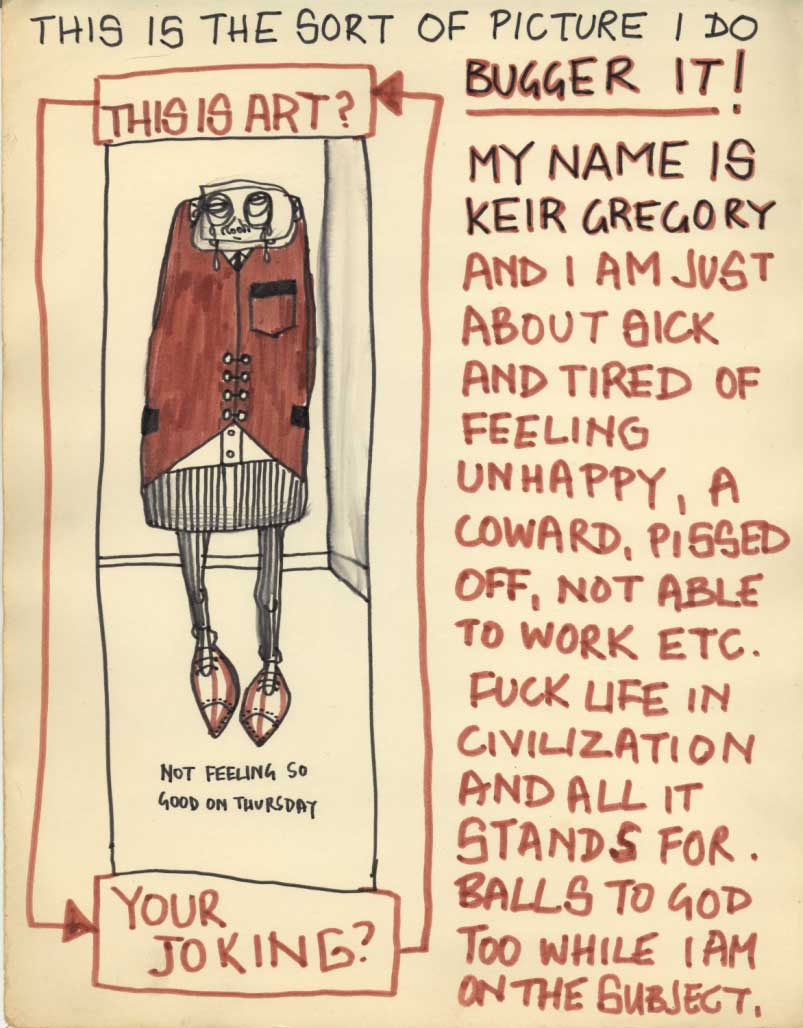
keirs-journal

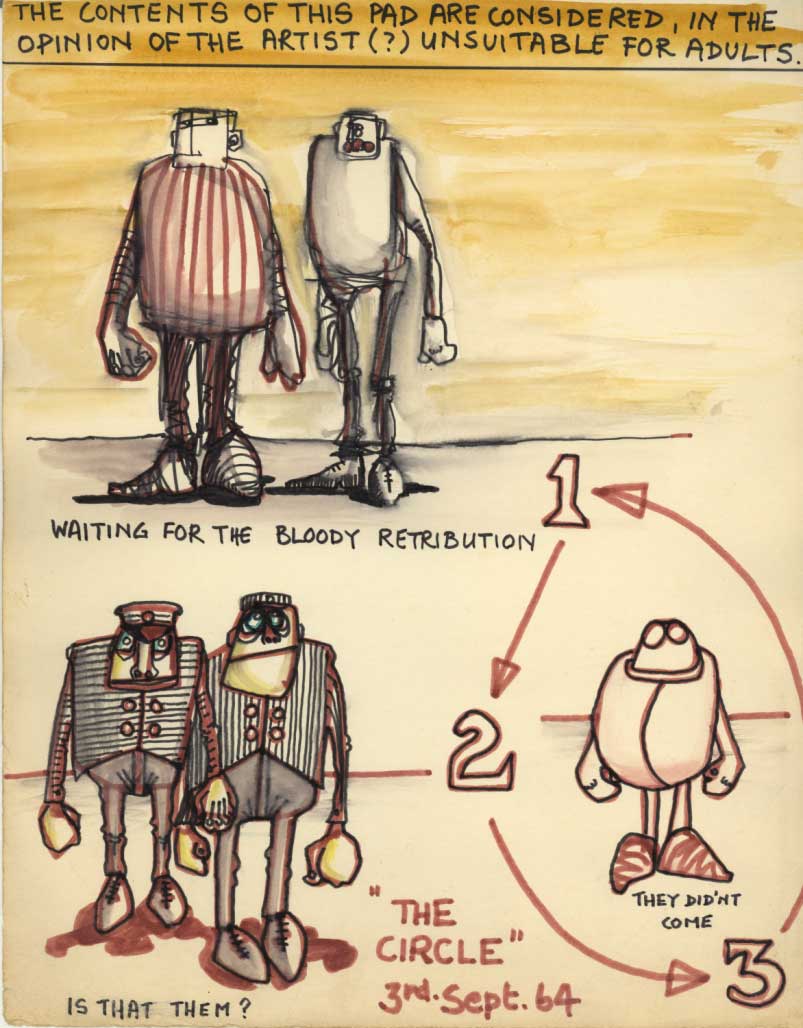
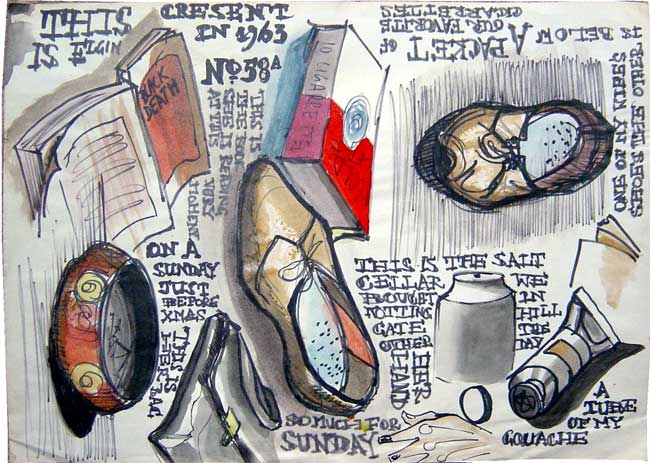
A few days ago, this drawing arrived from my stepmother, Sue. It was drawn by my father when I was about three, around the time my parents were divorced.
Many of these objects are things of my mum’s. I think she still has the copper ashtray on the lower left. Sue pointed out how similar this piece is to much of the work I have been doing and I must agree. I never really thought of him doing illustrated journaling but clearly he did.
Keir lives in Leicestershire, near Nottingham (that’s in England, folks). His three daughters (my half sisters) are all grown and he seems to spend most his time drawing daily self portraits or writing software for his own amusement. I’ve only seen my father a half dozen times since the divorce and we correspond very intermittently. I have a few of his sketchbooks from the early 1960s and I have always loved them.
Between Jack’s painting and this newly arrived drawing from Keir, I must say I am thinking quite a lot about heredity these days.

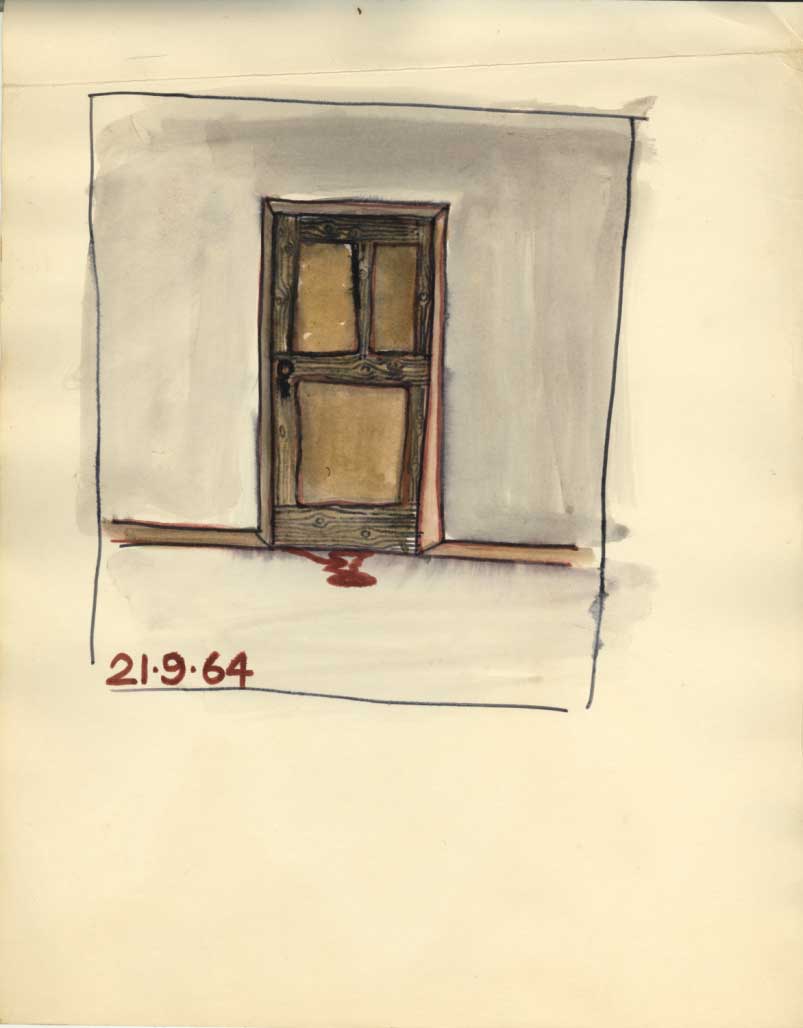
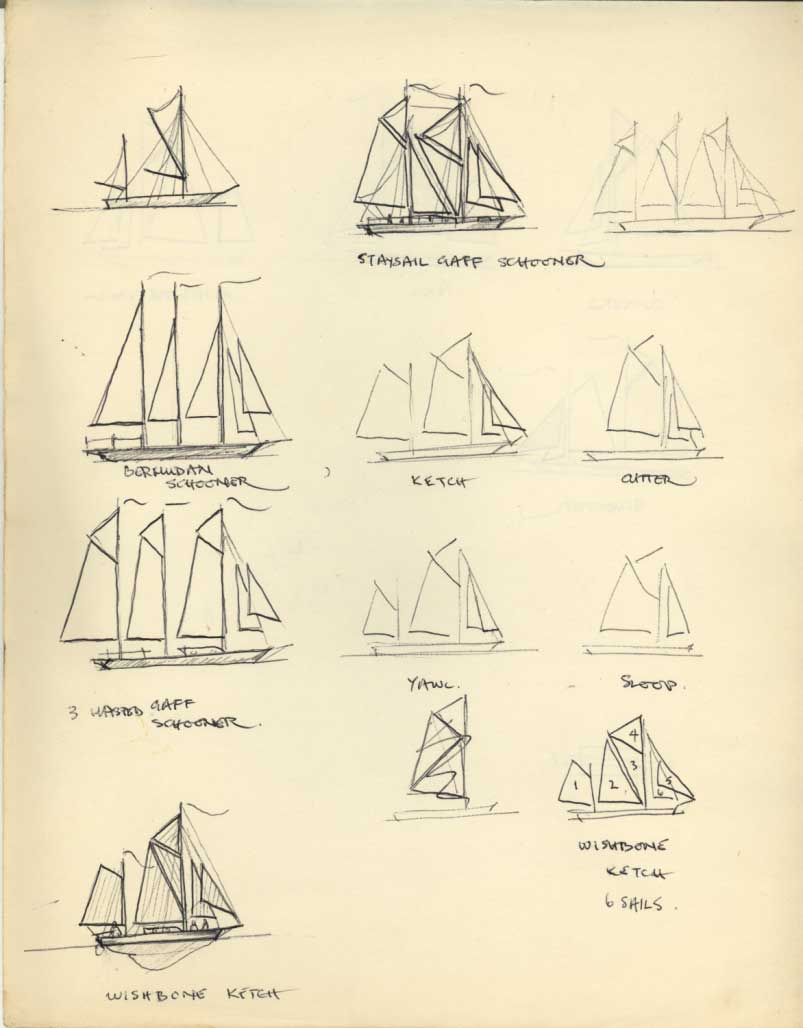
Here is some more of Keir’s work circa 1964 (he never shows his work so I hope, on the off-chance that he stumbles across this web page, that he doesn’t take offense to this little tribute exhibition). Some of it is pretty angry and hard core so please don’t yap about the language or the macabre-ness:


Early morning habits

coffee-shopToo long ago, I went to the gym every day. At seven a.m., the doors opened and a small group of us would shamble in and begin lifting weights. I had a little notebook in which I charted my regimen and recorded my progress; accumulating the little pencil scrawls kept me committed for close to a year. I was pretty intense about it, seven days a week, rain or shine, always at 7 a.m. If I overloaded the stack of iron and strained a rhomboid, I would switch to a leg routine for the next few days until I healed. But I had to keep going
I took a fair amount of pleasure in how my body developed. I wasn’t a steroid freak or anything though some of the other 7 a.m. crew were a little scary, particularly a couple of the women with lats like pterodactyl wings and neck as thick as my thighs. For me, weight lifting felt like a creative act; I liked how my arms felt like they belonged to someone else, like touching a horse or a large dog’s back. I had made my body into something, something essentially useless as I rarely had to lift toppled trees off cars or open jars of pickles, but something hand-crafted nonetheless. I don’t even know how healthy the whole thing was: I almost always hurt somewhere and woke up each 6:30 wincing and groaning.
When it was still cold and dark outside, Patti would urge me to stay in bed but I would refuse. There was simply no room for discussion. If I missed a day, I would lose momentum, my streak would end. I was convinced that I had to be 100% committed to my routine. The pathological drill sergeant in my head gave my will zero room for excuses.
Then my sister said she wanted to join me. For a week or so, she met me every 7 a.m. and it was fun to have someone to work out with. Till one morning she called me at 6:45 and croaked that she didn’t feel like going today, that I should take the day of too. So I did. And the day after that and so on. I never went back to the gym again.
——-
Habit is enormously powerful. The bad ones are easy to pick up and a drag to shake. Each bad habit starts by stifling a voice in your head, the one that knows better, and says ‘go ahead, just try it’ and leads you to drag that first cigarette though you know it’ll lead to the grave, to accompany every burger with fries, to flop on the couch in front of the tube, to drink too much, talk too much, do too little…. The angel on your shoulder doesn’t stand a chance.
For me, developing good habits requires the same sort of censorship. However, this time I have to stifle the voice that leads me astray, to be absolutely rigid in my refusal to capitulate. It works best when I have an inflexible routine, like my 7 a.m. appointment at the gym.
These days, NPR wakes me up at 6:57 a.m., and I go mechanically through a series of maneuvers that have me walking up the street and arriving at my desk at 8:30 while the office is still cold and empty. I am at my most productive in that first hour. I’d love to add another hour to my morning, to rise before six and really get something done with my first cup of joe. I haven’t muscled myself into that harness yet.
What does this sort of rigidity mean when it comes to creativity? Can you be so iron-clad and expect your imagination to function just because you have put it on a regimen? Will the ink lie cold in the pen? Will the mind stay half-asleep?
Not if you insist. The muse can be put on a tight schedule. I have had to come up with ideas, on deadline for decades and, if anything, things flow more easily when you bear down on the brain. It’s not guaranteed but showing up is half the job. If I am focussed, resolved, and present, ideas will come.
I’d like to be more disciplined about my drawing. When I have an illustration assignment or a commitment to another like sketchcrawling, I can deliver. I just did it in Paris, crawling out in to the cold rainy dawn to draw. But it’s not as much fun as when I am suddenly inspired to pick up the pen. It feels like work. But maybe that’s because I am irregular in my early morning sessions. I mean, I could stagger over to the gym tomorrow at 7 am and bench press something but it would not be fun.
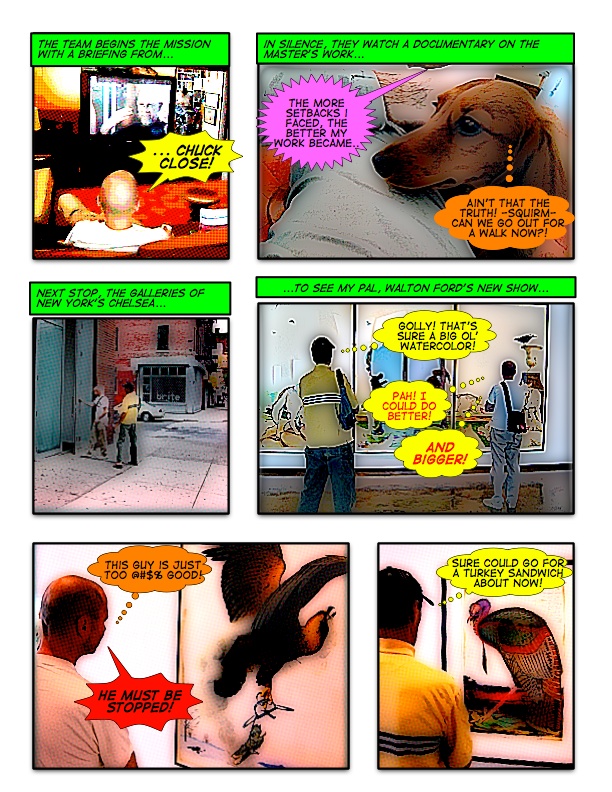
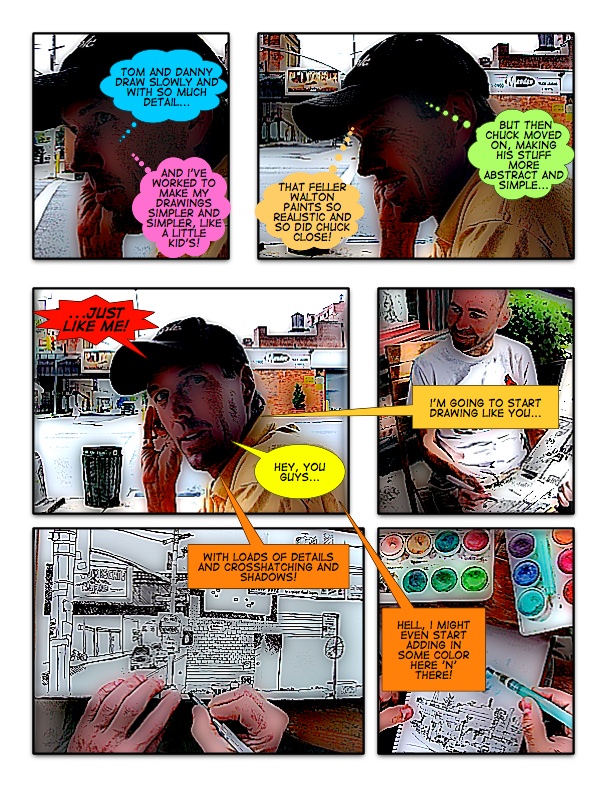
My pal, Tom Kane, has a great habit. When he walks into his office each morning, he snaps on his computer, loads the NY Times homepage and draws something from one of the lead stories in a Moleskine reserved for the purpose. Each day, at least one drawing of a newsmaker. Only then does his work day begin. His book is full now, brimming with great caricatures and portraits, built one drawing at a time. His drawings muscles ripple. Of course, he does not stop there; he draws New York City most days, detailed pen and ink drawings that fill the page from corner to corner. Tom’s compulsive too. He cannot stop until every square inch of paper is covered and crosshatched. He tells me he doesn’t do it because he enjoys it; he does it because he has to. He’s got the habit.