

 It’s late and I’m exhausted from a long day which culminated in something a little tedious but exciting: revising a new piece I’ve done for the Op-Ed page of the NY Times. It’ll run this Sunday.
Category: Art
Examples, instruction, advice, recommendations, and more.
Bagging it
 Jack takes a lunch box to school but when he goes to summer day camp, his carrot sticks, cookie and sandwiches (unvaryingly: one salami, one PB&J), travel along in a brown paper bag. At one point, maybe it was last summer or the summer before, Patti asked me to write his name on the bag. Soon this became a ritual and each morning after breakfast I would do more and more elaborate calligraphy to identify his bag.
Then I started making up panels from super hero comics and printing them on the bag with my ink jet. This year I alternate between dip pen hieroglyphics and watercolors and gouache (which look great on the biscuit brown paper).
When I first came to America at thirteen, I got my first lunch box. I think I picked it out myself, a Scooby Doo model. It wasn’t long before my classmates started to snicker and then openly deride me for my cluelessness.
Before long, I’d gotten the message and began to brown bag it. No name or watercolors.
Inklinations
 The only downside to my vacation (and this will give you an indication of what a hopeless nerd I am) were a few pen problems. First of all, though we packed virtually everything in the house into our car for the trip, I left my trusty Rotring Rapidoliner in my bedside table drawer. The only reason for such an oversight is that I had just begin to use a device called the Rotring Art Pen — a sort of fountain pen that Richard Bell uses all the time and seems to swear by. I have been interested in drawing with a fountain pen of late because I like the more variable line it gives (I love my Rapidoliner because it flows so smoothly but the line can seem a little mechanical and rigid at time) and so I have been two-timing the Rapidoliner with this long, black stranger.
The Art Pen has one obvious design flaw, the back end tapers to a near point which mean that when you take off the cap, you can’t snap it onto the back and have to lay it down somewhere and then be mildly distracted about whether or not you’ve left it behind which may effect your drawing in a sort of stone-in-your-shoe sort of way.
Then, poolside, I discovered a more significant problem.
 The Art Pen comes with a half dozen little prefilled plastic ink cartridges. The ink, I discovered after laboriously drawing this geezery couple and then beginning to slather on the old water color, is not waterproof. The ink began to branch out into spidery tendrils and my lines became fuzzy.
Fortunately I had bought a special bladder, the “Piston Fill Ink Converter”, that allows me to fill the pen manually and later I tossed out the feeble cartridge and pumped in some India Ink.
 Another minor problem arose which is that the bladder, which is a sort of syringe that you advance and withdraw by rotating a little stick at the end, doesn’t seem to draw entirely of its own accord and one must ocasionally recrank it up and refill the nib. If you don’t do this very carefully, big drops of ink fall onto your drawing.
All that having been said, I continue to use the Art Pen but plan to send Richard a nasty note.
I’ll admit, I am a fickle pen owner. I search for years, find perfection, but my eyes keep roaming. Another pen I keep on the side is called the Grumbacher Artist Pen (there’s not alot of creativity in the pen naming community, it would seem) which has the teeniest needle point and the same pointed-end, cap-losing design as the Art Pen.
It is not refillable but the line is so fine it seems to last forever anyway. I did a drawing or two with it on my trip and still quite like it but for optimal performance, use very smooth paper.
Finally, the Art-Pal Creative pen — a very groovy-looking, gold pen with a brush nib that you fill with the ink of your choice. Looks, however, are horribly deceiving. It is a piece of junk. I filled it, used it briefly twice, and the nib sort of crumbled and the tip broke off. It might be possible to replace the nib but the pen came from Jerrys Artarama with no instructions and no way to buy new nibs. I’ve written to them for explanation but so far they have been mute.

 And finally, I am determined to pick up some gouache today. I tried working with watercolor and no line drawing but the results felt wishy-washy. I need to be able to add a layer that is more defined and sharp and bright on top of watercolor and I have resorted to white ink put on with a dip pen and then tinted the ink with watercolor which works okay but is fiddly and hard to control.
I’m sure if I paid better attention to my lessons from Roz I wouldn’t have this dilemma but it seems easier to just buy more art supplies.
Bunnies or Jesus

You are not here merely to make a living. You are here in order to enable the world to live more amply, with greater vision, with a finer spirit of hope and achievement.
– Woodrow Wilson
One of the things I love about my friend Julie is her relentless energy. She is a sculptor, a painter, a photographer, and a hardworking entrepreneur who doesn’t hesitate to apply her enormous creativity to ways of funding her art.
In the last few years, she’s put her welding torch to work making furniture and fixtures for corporations that bought her art supplies and paid the mortgage on her farm. When she was in art school and realized that she could get a lot more than the minimum wage cafetraeria workers by making jewelery and selling it dorm to dorm. But back when we first met her, before Jack was even born, she lived in a crowded storefront on Elizabeth Street. She made money painting murals for fishmongers, and built elaborate iron fences entwined with grinning animals for the local school.
Every so often we would get a postcard from Julie: “I need a new refrigerator and will be having a drawing marathon on August 18th” or “I need health insurance and will be doing a drawing marathon for 24 straight hours.” For $25, she woul;d send you one of the drawings or paintings she made and you could pick from one of the themes listed on the card: President Kennedy or dogs; war or fishes. One of the best was on Easter: pick either a bunny or a Jesus. The bunnies were horrifying plaster casts with taxidermy eyes; every Jesus drooled blood with insane googly stares.
We would often drop by her studio during the marathons; there would always be a few other people around, drinking jug wine and talking to each other whole Julie spattered ink and paint, taking a break now and then to chat. It was fun fore every one and paid Julie’s dentist, Con Ed, and MasterCard.
Art ain’t about galleries and museums and the like; it’s about love and sweat and bits of yourself. Don’t be stingy. Don’t be afraid.
——–
P.S. I never mentioned here before what happened just a few days after I went up to visit Julie and her farm last month.A freak tornado came through and lifted her lovely pre-civil war farmhouse three inches up in the air and dropped it, twisting the walls. It dinged the front of her painting studio. But her welding studio took the full brunt and went from this to this. Julie’s fine and so was her poodle Tess. But then, too soon after, Tess a teenager, passed away from old age. It’s been a tough time for Julie but she’s pulling through with a lot of courage and help from friends, family and insurance companies. Her spirit won’t be phased.
See more of her great work on her website.
By George
 While I was drawing this, after dropping Jack off at school and sitting under the Washington Arch with its two newly restored statues of the general/president/slave owner/lumberjack, I heard something soft land on the ground ahead. Then, through the proscenium of the Arch, a man strode onto the stage – a 30ish black man in a tuxedo, sans the jacket, which he’d just thrown at the arch. He yelled at the top of his lungs: “Fuck you, George Washington!” Fuck you!” Then he picked up his jacket and strode offstage.
Another morning in New York City.
I drew the lines with my Rapidoliner and inked in the trees with Dr. Martin’s.
Homeless Journal
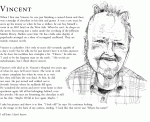

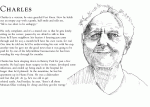
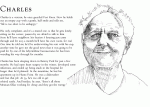


Recently, I found myself angsting about money. I decided that I should go out and talk to people who had none. I approached homeless people in my neighborhood and asked them to share their stories with me. At first it was terrifying, breaking the barrier. But I soon found that if you don’t want anything from people but their story and perspective, they are enormously forthcoming and trusting. They’ll soon forget to wonder why you’re asking.
These images and stories were published in the Morning News where my journal entires were transcribed into text.
A new old friend

Sunday afternoon, I was walking through Astor Place when I saw a man in a familiar position, hunched over a big old moleskine, a pen twitching between his fingers. I knew, from across the road, that he was drawing in a journal.
As I approached, I suddenly realized it was my old partner, Tom Kane. We’d worked together in the mid-80s, dreaming up advertising campaigns for Life magazine, for cigarettes, for Barnes & Noble— we even did a very early rap song about IBM (“We were the mothers who invented high tech, now everybody wants to play Star Trek, but there just ain”t room for all that crew, all the wildest ideas come out of Big Blue, etc…).
Although I never saw him actually draw, I had seen a few pieces in his apartment, near-photorealistic paintings of pop icons, horses, and women. He obviously had a lot of talent but he expressed it on the sly. We’d lost touch over the next decade, but hooked up for a long, candid noodle lunch three years ago. Then I, in my executive haze, lost touch with him again. And now here was Tom drawing in a moleskine. What a weird coincidence.
Tom looked up from his page and, seemingly unsurprised to see me, immediately told me that he had been bought multiple copies of my last book and been lurking around this blog for a while, my book, all of which had inspired him to start keeping his first ever journal. I was floored. It was so strange to find someone who I knew and admired as a very creative and talented person hooking up with the Everyday Matters crew.
Well, as you can see from the drawing Tom was doing at the time, he sees very well. Look at how specific each window is, not just a row of squares but the very particular windows, one by one. His crosshatching is rhythmic without being monotonous, reminding of my all time favorite, r.crumb. I also love the way he fills the page, how he uses the negative space of the sky and integrates his text right into the scene. It’s a great drawing and a beautiful exercise in mediation.
Tom is a very imaginative art director. If you’ve ever seen those wild, bubble headed girls in the ads for Steve Madden shoes, you’ve seen what Tom does in his day job. We dropped over at his place and he showed me dozens of fantastic paintings, photo collages, drawings and rows of tomato cans. I could sense that he is being called more and more to devote his energy to making things that express his passions rather than peddling ladies’ shoes. I hope he follows that call.
In the meantime, I have a new journaling buddy to roam the streets with. What a happy accident it was, running into him.
Ten thousand things to draw
 Content of kitchen cabinet, fridge, bedside table, medicine cabinet
All my shoes, clothes
Covers of ten favorite CDs, books
Every significant front door of every place I’ve lived or worked
Everything I eat today
Contents of my bag, of my pockets
Every tree on my block, labeled with its official Latin name
All the cars on my block
Views out each window in my home
Clutter on my desk
A map of my neighborhood
A map of the house I grew up in
Portraits of my wife, son, and pets asleep
Every appliance in our house
Every phone in our house
Series: every cup, mug, vase and lamp
My hands, feet, face, body
The exterior of each place I buy lunch
My car’s engine
Every pen and pencil in my desk
All of Patti’s cosmetics
Every present I got on my last birthday, Christmas
All of our sports equipment
Every chair in our house
Every outlet and all its plugs
Everything that belongs to a pet: food, toys, clothes, bed, medicine, cage, etc.
All the liquor in our cabinet
The portraits in my yearbook
Ten pieces of broken cookie
Ten manhole covers
Ten hydrants
Each component of a sandwich, individually, then assembled
All our jewelry and watches
Every hat I own
Every bill and coin in my pocket
Ten things from any catalog in our mailbox
A plate of spaghetti
The laundry: clothes, machines, detergent, etc.
Living well through bad drawings

When some people see an illustrated journal, they say, “Wow, that’s great. I could never do that.” With some coaxing, they may be persuaded nonetheless to give it a try. Others say, “Wow, I’m going to do that.” And they start too. And quite a few say, “Huh, where do you find the time?” then use your journal as a coaster.
It’s comparatively easy to start. To bring yourself to draw your breakfast once or your coffee cup once and to keep it up for a couple of days. Ideally those first few days infect you with the fever and you’re compelled to carry a long series of journal books around with you for the rest of your days.
But more likely, your initial enthusiasm will wane. You’ll forget to do it one day, give in to resistance the next, then feel like you’ve broken the chain, the narrative is lost, a month’s gone by, and you drop it altogether. Why? Often it’s because you are disappointed with your drawings. You may say you don’t have the time, forgot your book, grew bored but it’s really because you aren’t that impressed with your drawing skill. You haven’t made something that looks like Art.
I don’t think that illustrated journaling is really about doing great drawings. You’re not out to make something that you could frame or give as an Xmas present. I’m not really into doing the sort of exercises on perspective and tone that you see in most drawing books, exercises that will move your skills to another level artistically. Not that you shouldn’t do them if they are fun or if you have some other goal in mind but I don’t think they are essential for the true purpose of illustrated journaling.
That purpose? To celebrate your life. No matter how small or mundane or redundant, each drawing and little essay you write to commemorate an event or an object or a place makes it all the more special. Celebrate your hairbrush and it will make you appreciate the intricacy of the bristles, the miracle of your lost hair, the beauty of you. Sounds sappy but it’s in there. Draw your lunch and it will be a very different experience from bolting down another tuna on rye. If you take your time (and we’re just talking maybe 10-20 minutes here, folks) and really study that sandwich, the nooks and valleys, the crinoline of the lettuce, the textures of the tuna, you will do a drawing that recognized the particularity of that sandwich,. That’s the point: to record this particular moment, this sandwich, not something generic. If you approach it with that attitude, you will create something as unique. reaching that place is just a matter of concentration and attention. A brief meditation and you will have a souvenir to jog your memory back to that a moment forever more. Imagine if you can keep doing that, keep dropping these little gems in your day, recognizing the incredible gift you are given each morning upon awakening. You will be a millionaire.
There’s a demon in your mind that will fight this, that will tell you your life is unworthy of acknowledgment, that today sucks through and through. It will tell you you have no time for this, that you are too harried, too stressed. Which brings me to Marybethd who wrote to me from Nebraska where she just had emergency eye surgery. For two weeks, she could only see the floor. She wasn’t sidelined though— she drew all of her visitor’s feet. She pulled art out of that tragedy, celebrated her visitors, created a positive memory that she will have to cherish long after her vision is back to normal. He nightmare became a lesson.
I have gone through my fair share of shit. My regret is that I didn’t celebrate all of it. I can’t say it often enough: life is short, art is long. Get the habit.
Sky Mall pop quiz
I have a new piece in my favorite online magazine that you might find amusing.
I first thought of it on the way home from vacation when I pulled the bizarreness that is the Sky Mall catalog from the back of the seat and wondered, “Who dreams up all this crap?”
“And who buys it?”
 Danny Gregory