No title. Really, that’s the title.

ArtistI think my mother was the first one to tell me, “You can’t call yourself an ‘artist’.  Other people will decide that for you. It’s pretentious to assume the title for yourself. It’s like calling yourself a  genius. Maybe you can say you’re a ‘painter’. But not an artist.”

My mum is humbling like that.

“Teacher” is another title I am loathe to assume. I don’t have a degree in teaching, I don’t work at a school. And I think teaching is one of the most important and difficult and unrecognized jobs around. I really do think that’s a title you have to earn.

But I guess I do spend a fair amount of time telling people stuff, instructing them on how to live, to drawn, to think. So I’m either a bullying bore or I am maybe a teacher. Not that the two are the same thing, of course. It’s just that if you walked into a bank and started criticizing people’s penmanship or cracking knuckles in your local Starbucks because people have poor posture and are chewing gum, well, that wouldn’t fly. Teachers get to know better because they do.

I’ve had loads of corporate titles and they all seemed sort of ridiculous. Yesterday, a guy gave me his business card and said, “There’s no title there because I still haven’t quite figured out what it is I do.” He was being modest (he was actually the boss of a really big company) but I liked his attitude.

Let me get to the point.

One of the biggest irons I had in the fire when I left my last titled job was to put together an online class.  I’ve alluded to it here a bunch of times since — but it never seemed quite right to me.  Maybe it’s because of those two titles, ”artist” and “teacher” and the even more daunting combo: “art teacher.”

A couple of weeks ago, everything changed.

As result of number of amazing conversations I had in Amsterdam, most importantly with Koosje Koene, a clear, bright path has opened up. I now know what I will be doing next and I think it will be amazing.

It combines everything I have been working on for the last decade. Making art; sharing with other people; meeting so many amazing “artists” and “teachers”; thinking about creativity and all of its gifts and obstacles; the Internet and the global nature of everything; Everyday Matters and what it has come to mean on Yahoo! and Facebook; the thousands of emails I have received from great people everywhere; my decades in advertising helping big companies tell their stories —  all of this mass of rich stuff lumped together in one beautiful stew that finally is really bubbling.

A group of us are working on something that I really think is fresh and fantastic. It’s an answer to all those people who have asked me to do more workshops or to teach online or to give them advice or make more Sketchbook Films, all the people who are interested in art and want to make it more a part of their lives. And I think it’s a great answer, like nothing out there.

We still have a lot more work to do but we think we will be ready to roll it out in March. Gulp

It’s a lesson that settling for an existing title or solution or direction may not always be as good as making up something brand new.

Which is what we are doing.

If you find this, whatever it is that I’m going on about, interesting, stay tuned.

And if you’d like me to update and include you in our project, send me an email. Please do. Even if you are only intrigued. Or vaguely interested. Or utterly confused. It’s gonna be big. And probably won’t involve titles.

← Back

Thank you for your response. ✨

.

The art of living.


Life is not an oil painting, sealed behind varnish and clamped in a golden frame, hanging in a white walled gallery in Chelsea, waiting to be bought by a hedge fund manager’s third wife.
Life is not an edition of etchings, a long series of identical impressions.
Life is not a mural, intended as a public display or the backdrop to an expensively furnished room. Life is not wallpaper.
Life is not a bronze sculpture, cold, monumental, an abstracted, idealized image of a hero long forgotten.

Life is a shelf.
A long shelf partly filled with journals. Some of the journals are hand-made, some store-bought, some in ornate covers, some stained and dog-eared.
Some of the journals are completely filled, others are abandoned half-way, maybe to be taken up at a later date. Some of the books are filled with paper that felt just right under your pen, smooth and creamy, bold and bright. Others were experiments that failed or overreaches, made of materials you weren’t ready to master quite yet.
Sections of the shelf may be filled with identical volumes, a type of book that you found comfortable at the time and stuck with it, disinterested in experimentation and change so you kept filling one after another. On the shelf, they may look the same, identical spines all in a row like a suburban cul-de-sac. But inside, each page is different, drawn by the same hand and pen, yet recording unique observations, days that fill up identically-sized boxes on the calendar but were all filled with different challenges, discoveries, lessons and dreams.
Each page of each journal is always different. Some are perfectly drawn and brilliantly written, insightful and illuminating. Others are a failure, with poor perspective and distracted lines. Some of the pages are dappled with raindrops or a splash of champagne, others are drawn in haste, still others crosshatched with great intensity and care. Some contain shopping lists, phone numbers of new friends, boarding passes to far-away places. Some are bright and colorful, witty and bold. Others are intimate and personal, never to be shared. Some pages describe loss and death, others a drawing of a gift you took to a baby shower.
None of these pages is an end in itself. No matter how good it seems at the time, eventually, you turn each one over. Even the ones at the end of a volume are merely leading to the first fresh page of the next. You fill the page, maybe you like what you drew or maybe it was a disappointment, but there’s always another to follow and another beyond that.
You try your best with each blank page, try to make something fresh and beautiful. Some of the time you feel excited and proud of what you’ve made, at other times you are disappointed and desperate. Often, a page you thought was just a turd looks a whole lot better when you come back to it years later. The drawing you thought was clumsy and flawed reveals some new insight and truth about who you were at the moment, fresh energy, naiveté, hope, darkness before the dawn. Each drawing, whether you know it at the time or not, contains truth. You just have to trust it and keep on drawing and writing and living your life.
Life is a process, and every one has the same end result: that last volume, partly-filled, cut off when we thought there was still art left to make. No need to rush to get there. Make the most of the page that lies open before you today.

Clockwork Orange. And Blue. And some Green.

ImageMy neighborhood is cute. Little one-family houses with little yards all arrayed neatly along the six or so blocks of our “avenue”. My neighbors are friendly without being too. They’re definitely not New Yorkers but they don’t try to hug me either.
One evening, I tethered the hounds to the porch railing, strapped on my iPod, cracked open my colored pencil pouch, and started to draw the house across the street. Because, as George Mallory said of Everest, it was there.
As I say in the journal caption, I was listening to a dreadful story on a terrific podcast (RadioLab, actually, not TAL), and one part of my brain was listening intently to this story of a guy who corresponded with the man who raped and killed his daughter, while the other part drew every brick on my neighbor’s facade.
Now, do you remember the “Ludovico technique” in A Clockwork Orange where Alex is fed a drug that will make him nauseated by violence, strapped down and forced to watch a sadistic movie which is scored with something by Beethoven? Forever after, his beloved Ludwig Van makes him panicky and sick.

I guess my drawing/listening experience had a somewhat similar effect on me. My brain and all my senses were so wide open, so receptive, hungrily drinking in the details of my neighbor’s home while fixedly listening to this awful story. My eyes signals and ear signals somehow came together to create an utterly false experience, so now every time I walk out my front door, I feel a terrible pity for my neighbor and the ordeal he went through. Which he didn’t. Except in my journal.

They really should put a warning on this sort of story — “Listening to this broadcast while operating colored pencils and a fountain pen may cause a lingering sense of tragic empathy and melancholia.”

I’ve met the neighbor, by the way. Nice, cheerful guy and I don’t think he even has a daughter. At least not one that seems to be alive………..

Black and white habits — they’re not just for nuns.

In my thirties, I became a mad iron-pumper.

I repaired to the gym every single day at 7 a.m., rain or shine, Sunday to Sunday, and after a year, I became a muscular beast. I didn’t have a trainer, I didn’t take steroids or HGH, I didn’t wear a little posing pouch or wax my chest. Key to my success was my ironclad will, my insistence on never, ever missing a day, or being even five minutes late to the gym. I utterly refused to give myself an excuse to break routine. I was a brutal and inflexible taskmaster. And, like it or not, it worked.

My sister, impressed by my progress, joined me at the gym. She would be there every morning at 7 too, ready to get to work. Then, one rainy February morning, she called me and said, “it’s a lousy day, let’s skip it for once.” I did, and the next day, came up with another excuse not to go.  The habit was broken and I never went to the gym again.

Soon, I was back to being a 190 lb. weakling.

Obviously, I can have a tendency to black and whiteness (not just in my journals), but, as I grow older,  I am working to be more nuanced in my decisions and commitments. I have joined a gym again and I am resolved to be less crazy this time, trying to stay committed without needing to be committed. I have a trainer who I see a couple of times a week and then I try to go most days and work out on my own. At first, pushing myself was hard, and I felt nauseated and weak. But one day, my body seemed to remember our bygone 7 a.m. routine and perked up. I felt the old surge of adrenaline through my muscles and it went from being a chore to being fun again. Now I look forward to exercise. However, I’m not a slave driver anymore and if I skip a day here and there, I don’t let it break my commitment to myself and my health. I just go the following day instead and keep going.

Journaling is another one of my healthy habits. At times over the years, I have insisted on a strict regime, like a drawing every morning before breakfast, or filling a whole book in a month or on a week’s vacation. Pushing myself to draw whether I want to or not eventually makes me want to. It also means I make a lot of lackluster pages on the way to falling back in love with my book and my pen.  There have been times when, overtaken by the stress of work and other commitments,  I have fallen completely out of the practice and eventually forgotten how much fun drawing can be, and how important it in helping me stay relatively sane.

But I can recommit.  (Like the old joke says, “It’s easy to quit smoking — I’ve done it a hundred times”). Still, I don’t have a drawing trainer and there are no steroids I can take to make me get instant results. Drawing just takes practice and patience and commitment and the more I do, the better I get, and the more I want to draw. Drawing depends on muscles too and if I don’t use them they atrophy quickly.  WIthin a couple of weeks of breaking my habit, my ability to draw well suffers enormously. Fortunately, picking up the pen brings those muscles back pretty quickly and they don’t forget all the have learned over the years.

There are incentives I can give myself to keep going eve if the monkey in my head urges me to just sleep in or watch TV. This blog is one of them and my desire to keep it a regular thing can push me to do a drawing when I feel lazy. But, no offense to you, my readers, that’s not really enough.  Writing books is another one; if I have a deadline I have no choice but to fill the pages.  The same goes for presentations and speeches.

But the best incentive is art. Going to a museum. Rereading a great book on illustrated journaling or watercoloring. Spending some time with the work of artists I love. Talking to an inspiring friend. Going back through a journal I filled years ago. 

Another carrot is to give myself an assignment. Like drawing every tree on my block, drawing the cars I’d like to drive, drawing from my collection of of mug shots, drawing what I am doing every hour for an entire day. I have a long list  of drawing prompts on my website (The Everyday Matter list) which is  another favorite way to get my gear rolling and make me want to start again. 

My journal is a forgiving companion. It doesn’t wonder where I’ve been or chastise me for the gaps in its pages. It always welcomes me back with open pages and I am grateful for its friendship. Just as exercise keeps me healthy and energized, so does keeping up my art. 

Soon I’ll be thin and wiry and rippling with new muscles. And the most developed ones of all will be in my right wrist and fingers, bulging as they choke the life out of my pen and squeeze every drop of its ink onto the page. Grrr! Aaargh! Grunt!

Perfect!

fighter

I have been mulling over giving an online class since mid-Spring, when a number of people wrote to me to say that they couldn’t come to my workshop in the Berkshires and asked if I’d consider doing something on the Internet instead.

First, I did a bunch of research and talked to friends who are great teachers like Jane LaFazio and Andrea Scher and Brenda Swenson and Roz Stendahl. I had technical concerns and had to figure out the best platform, then I had to decide what the class would be like and about.  So I futzed around a lot and made very slow progress, especially for me, a person who tends to barrel into things like a bull in a china shop.

Recently, I got an email from a guy who runs workshops and manages a major teaching platform and he was asking me (well, not really me but anyone on his email list who had expressed some interest in his program but hadn’t gotten around to launching a class) what the hell I was waiting for. His question was about perfectionism, wondering if I was so intent on making the class perfect before I open it up that I might never get around to doing it at all. And he had a point — I do want it to be as good as it can be even though it’s the first time. In fact, because it is, as I assume that if it’s half-assed, no one will be back for the second better one I do, and my ambitions will be thwarted on the launch pad.

Anyway, in needling me about this he said :

“As you sit on the sidelines, waiting for the “right moment”…
People who NEED help are MISSING OUT on your unique information, your potent coaching, your ability to encourage and support, your brilliance.
People are missing out on opportunities to grow, to develop, to learn new skills, to seek happiness…

… In Judaism (my heritage), there is a beautiful idea called Tikkun olam, which means “healing the world.” Tikkun olam evokes  humanity’s shared responsibility to heal, repair and transform the world. It gives meaning and purpose to our individual strivings, putting them in service of a greater good.
You could be helping to heal the world.”

Well! That’s a far loftier ambition than I had — I certainly don’t think I am on the verge of healing the world or anything like it. But I acknowledge that every day my class isn’t out there, someone may not be learning whatever the hell it is I have to teach them.

However, I have been thinking about his point in a different context. What happens when one is so fixated on perfection that one never begins? Never begins drawing. Never begins making stuff. Never begins pursuing any sort of passion for fear of not being able to do it incredibly well. Nothing you do will be good enough even for you.Why bother if you can’t be great?

A variation is fiddliness. Constant reappraisal, erasing, tweaking, reconsidering. Taking your drawing into Photoshop and cleaning it up, coloring it, recoloring it, sharing ten versions of it, asking for comments, on and on, never done, never good enough.

I love James Lord’s book on Giacometti in which he describe sitting for a portrait in his studio for weeks which he paints it over and over, only stopping when his gallery owner shows up and forcibly drags it away from him. The book contains reproductions of each day’s work and, honestly, he could have stopped after a day and had a decent painting, but he goes on for ages, always dissatisfied, putting himself down, rethinking the idea, scraping it down again and again. Giacometti was the same with his sculptures, paring away at them so they kept getting thinner and thinner, until they were barely there. Maybe his perfectionism made him great. Or Swiss.

One of the problems with perfectionism is that you think you can conceive the destination before you embark on the journey, that you can plan it all out in advance, and that nothing else can intrude and change the outcome you have conceived. But, first of all, the world doesn’t work that way; unless you are doing something extremely simple and banal, something you can actually hold in your brain all at once, it will invariably intrude and change your well-laid plans. And, secondly, you should welcome that intrusion. The accidents, mistakes, serendipities and ink splatters that the universe throws in your path make your work and your life more interesting. Perfection isn’t organic. It can be constipated and lifeless.

So, be forewarned, my class isn’t going to be perfect. Fat chance of that considering that I am behind it. But I do at least want it to be good, not slapdash and reasonably thought through. So I’m working on it everyday and hope it will be good enough to go soon.

Meanwhile, if you are waiting to make stuff because you haven’t got the perfect pen or book or subject or teacher, get over it. We all make shit every day. If we didn’t, we’d die. Or at least be really cranky.

Why me?


20130821-091348.jpgI try to be good.

I take a multivitamin each morning. I floss each night. I give to my local public radio station. I rarely beat or kick my child. Then this….

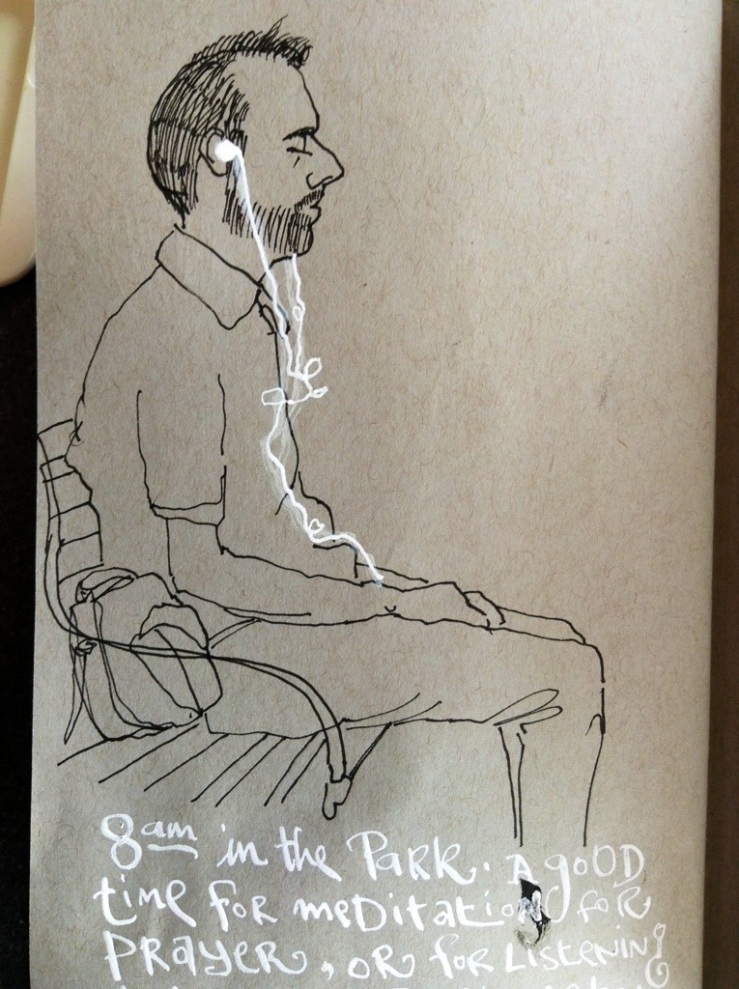
So this morning, I take my dogs to the park and plan to begin the day with a small drawing, nothing too challenging, a little amuse bouche. I see this guy on the bench nearby and it seems he is planning to sit immobile for a couple of minutes so I dash off the drawing above. At home I write a little caption with a dip pen and white ink and I am happier with a journal page than I have been in weeks.

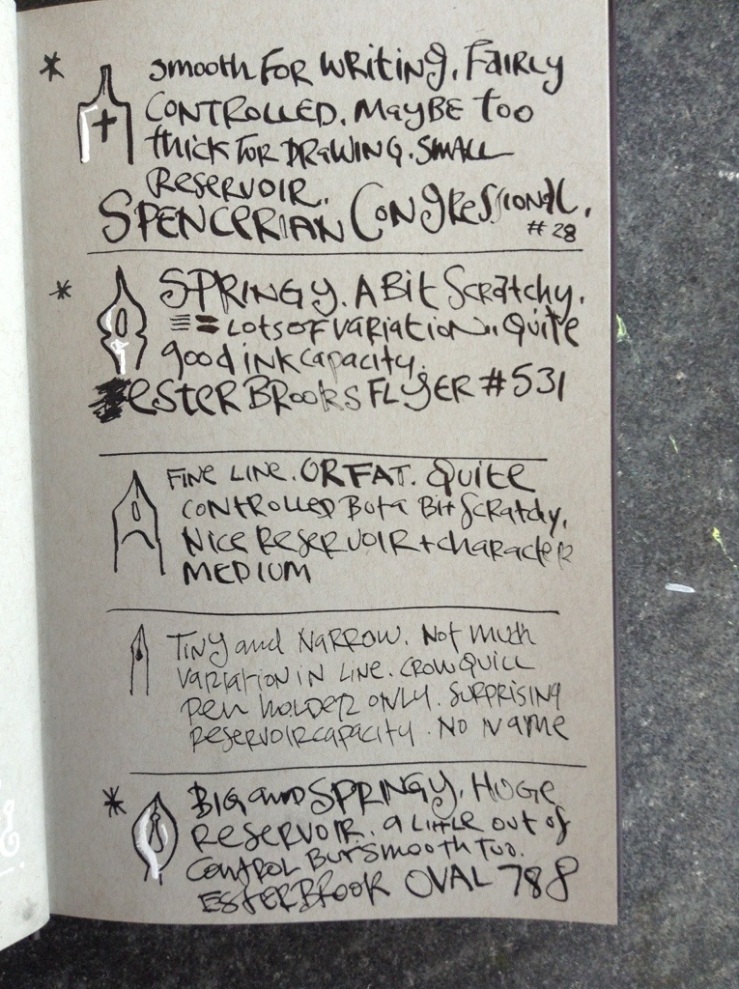
After breakfast, I decide to inventory my pens. I am going through a period of transition, easing away from markery sorts of pens like the PITTs and tending more to my dip pens. But I have a big messy box of steel nibs and I decide it’s high time to clean and inventory them. So I make a little page in my journal and chart my favorites.

20130821-091158.jpg


It’s a messy business, prying nibs off the holder, rummaging around in the vat of pen cleaner, ink and paper towels all over the place. I am trying to be fastidious but it really goes against my nature. An astrologer once did my star chart and told me I am something called “a triple Virgo” which mean I should be incredibly anal and neat and able to change a pen nib without courting disaster.

Hah ha. Not so fast.

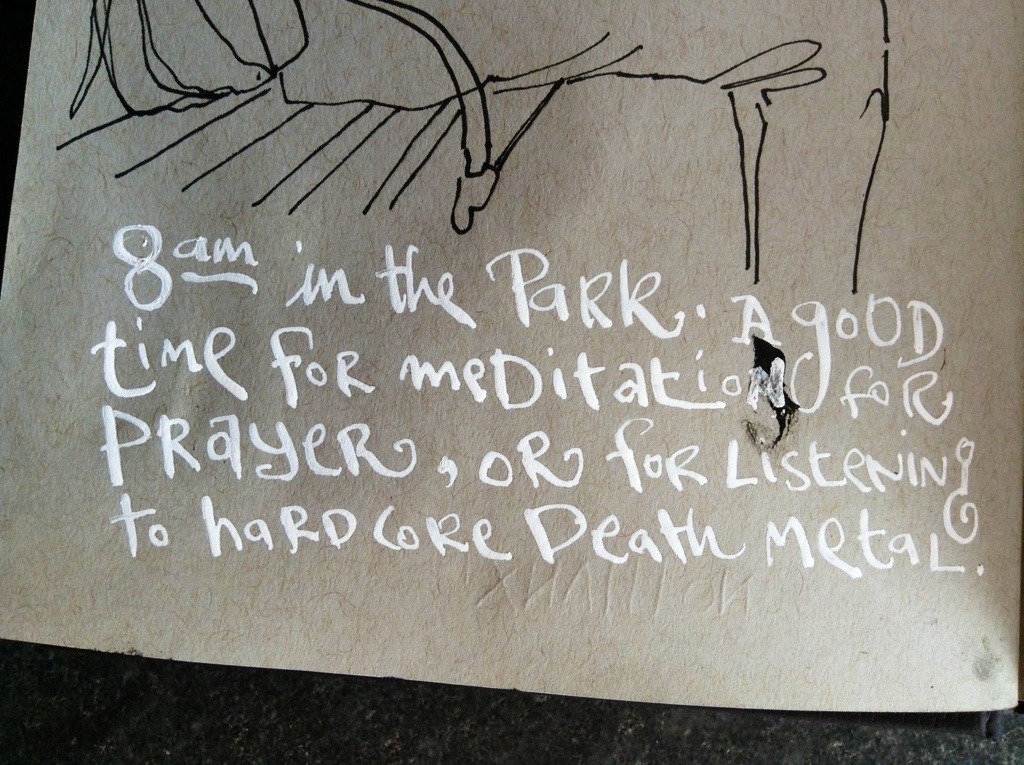
I look back at the left hand side of my spread, and somehow, mysteriously, damnably, I have managed to smear black ink across my writing. What the hell? You can see below, I try to fix it up with another layer of white ink but it probably looks even worse.

God. Damn. It.

20130821-091357.jpg

I tell you this sad story for a number of reasons. First because I am still in the grip of the anguish it caused. Secondly, I guess I can try to extract some sort of life lesson from it to share with you so at least we can profit from this disaster. What would that  be?

Do not fear mistakes. There are none.” WTF? That’s clearly not the case. That smear is a big, annoying mistake. It may not look it to you but to me, it’s a huge festering boil in the middle of Kate Moss’s forehead.

It’s the journey not the destination.” Again, I guess so, but the ink blot was part of the journey, the Montezuma’s revenge, the Metro pickpocket, the cancelled hotel reservation of the journey. Thanks for not much.

Slow down, butthead.” I guess. But I was trying to be slow and deliberate. Granted my whole dining table was covered with bottles and boxes and crumpled paper towels and my hands were black up to the wristwatch. I am a klutz and a slob so I should try to operate at 1/2 speed.

Maybe I should stick to crayons. And wear rubber gloves.

Epic.

snail2

My mother just sent me a link to a site documenting a journalist’s trek on foot from southern Africa to South America (I’ll give you the link in a minute). This isn’t just another endurance stunt —Paul Salopek is a Pulitzer Prize winning writer for National Geographic so his trip is all about science and journalism. He started earlier this year and will take seven years to complete the odyssey.

I have always been fiercely attracted to this sort of epic journey.

A few years ago, I was in thrall as my pal, d.price, rode his recumbent bike some 5,000 miles from Eastern Oregon to Key West. I loved Travels with Charley and On the Road.  Kon-Tiki by Thor Heyerdahl (finally a movie!), Bill Bryson’s Appalachian trail book, A Walk in the Woods, Cheryl Strayed’s Wild. The Happiest Man in the World by Alec Wilkinson describes Poppa Neutrino’s quest to build a boat out of garbage and sail it across the Atlantic. Mike McIntyre walked across the country with no money and relied entirely on The Kindness of Strangers (which is the name of his amazing book about the trip). The list goes on.

Ten years ago, I wrote a proposal for a book in which I’d follow the original epic travel journalists, Lewis and Clark, from St. Louis to the Pacific. I was going to adhere to their path and record the differences the couple of centuries had wrought. My editor said, “Make the trip, write the book, and then we’ll see.”  I didn’t. Life got in the way. Good thing Jefferson wasn’t counting on me.

Recently, Jenny has been urging me to drive across country with our dogs. I am sort of intrigued by the idea. Pros: 1. It seems romantic and epic and larger than life. 2. This is the perfect time of year for it. 3. It would be a great symbolic start to my life on the West Coast.  Cons: A) I don’t have a car. B) I think taking the dogs would make this a really bad idea. C) This is really her fantasy and she’ll already be across the country in her office in LA while I check into a long string of Motel 6s. For now, the cons have probably won but I still like the idea a lot, particularly if I could get a travel companion who I could stand to sit next to for a couple of weeks and who would be willing to stop and draw along the way.

Maybe next spring.

What intrigues me a lot about Paul Salopek’s journey is its emphasis on slow. He is taking seven years (!) to do this because he really wants to absorb the world as he goes. And he is looking for people along the way who are also seeking slowness in this madcap, speed obsessed world.

I think that’s the right thing to look for. Boy, it’s hard to slow down. I sat in the park this morning with my dogs and did a drawing. It was a small drawing, just filling a little box on the page, but I had to catch myself mid-way because I was tearing through it, barely looking at the arch I was drawing, just scratching out hasty, inaccurate and ugly lines. What the hell was my rush? It’s Sunday morning, I have nowhere to be till brunch, everyone else is sleeping, and yet I am belting through this drawing as if I was in an Olympic event. If I was Paul Salopek, I’d probably be half way to Rio by now.

Even though it’s been several weeks since I left the rat race, I still have my rat cleats on. I can feel it in the need I still have to accomplish things, to generate product, to log hours on my calendar. I so very much want to focus on the journey, the process, not the finish line but all these decades in the business world, in New York, still have me panting and pushing. I remind myself: I am on an epic adventure that will probably take another few decades to finish (in fact, I would like to push off the ending as far as possible) and what matters is the daily walk through life — the things I see, the people I meet, the lessons I learn.

If I’m really honest with myself, the reason I am not driving across country with my dogs is that the monkey is telling me I need to get to LA and start getting on with it. There’s no time for meandering and roses sniffing. I need to set up shop and start making something of myself. The monkey is wrong, again, of course. I make something of myself every day. It may not be something that can be direct-deposited, it’s true, but it’s also something that can’t be accelerated. Step by step, day by day, eyes open, head up.

—-

Here’s the link to Paul Salopek’s journey.  (I have put off giving it to you till the end of this blogpost for fear that you would rush off to read it and never come back to finish my blather. Clearly, I am better at slowing you down than I am at putting my own brakes on.)

Doing the wave.

20130806-200906.jpg
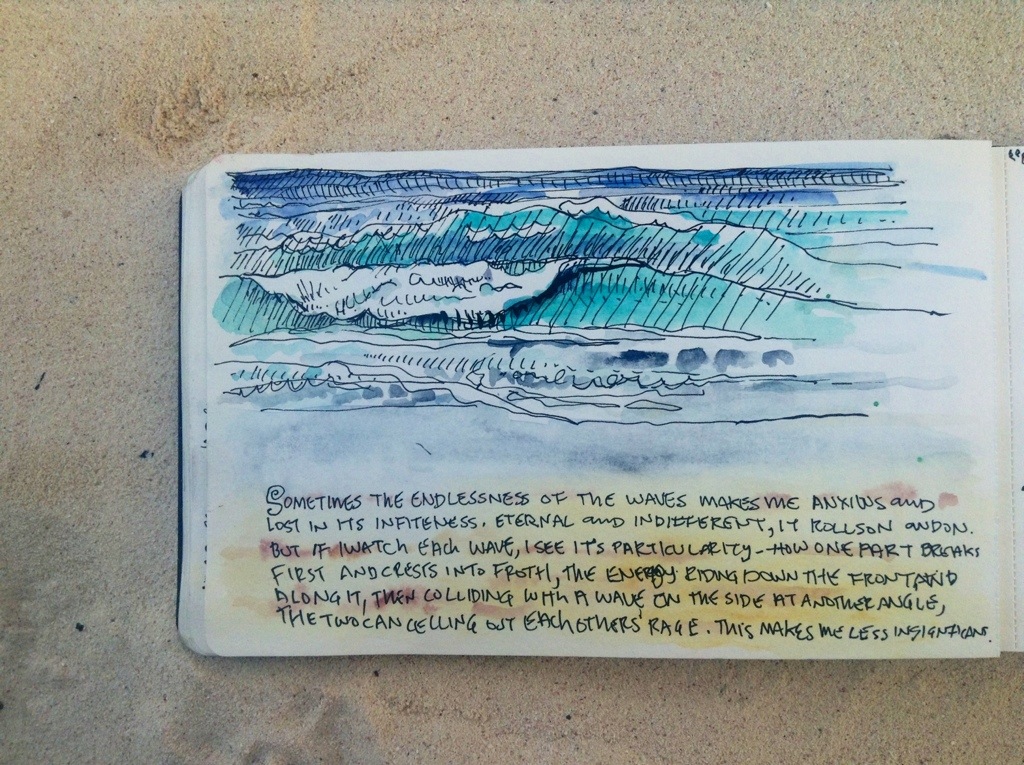
I spent last week in a basement in SoHo, looking at great length at naked people. I’ve spend the past two days looking as intently at the sea. I watch the waves and try to understand how to draw them, to turn their ceaseless roiling into lines on my page.
This close to shore, a wave’s life seems to last for five seconds, rarely more than ten. It emerges from the surface as a slowing building wall, some twenty yards wide. The pressure builds from both ends towards the middle and it becomes narrower and sharper at the peak. When I pull myself off my chaise and galumph into the sea to stand waist deep and cool off, from the side it is a narrowing triangle that reflects the sun as its angle grows more extreme. Its leading edges are dappled with bumps and ridges of energy that shimmer like the frosted glass on a public bathroom door, shadowy figures moving behind it, flashes of light bouncing of its front. The sun shines through its knife edge as it rolls forward, gleaming. Webs of foam are swept back from the ruins of previous waves and rise up to adorn its front wall, a white trellis quickly shredded in the wave’s rapacious path.

When the wall has grown as tall and thin as it can, it begins to collapse. A crest of foam appears along its battlements. The energy that was coordinated in the wave’s big charge now grows chaotic and splinters into fingers of white. The tongue of foam laps down the front of the wave and plunges into the surf, wrenching down its keystone and dragging it all down behind. Some of the froth ping-pongs on the surface, leaping to and fro, and then dives deep into the sand. The grandeur of the surge turns into a mad dash towards the shore, each water particle for himself

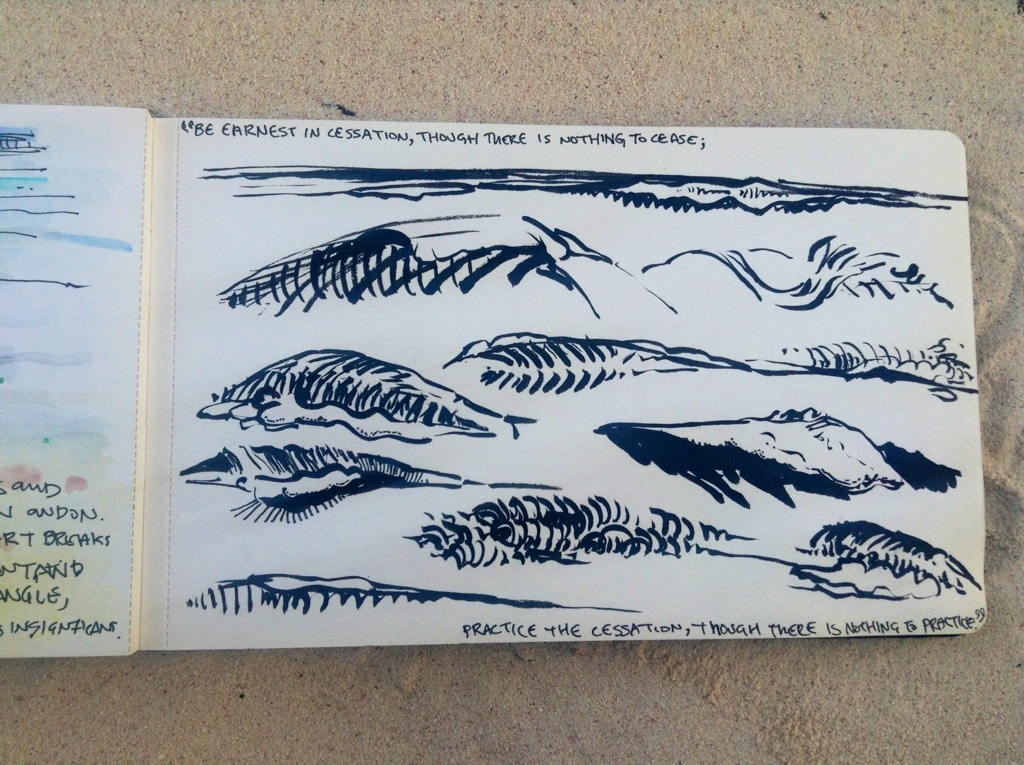
How the hell do I draw that?Leonardo tried. So did Hokusai.

So I watch a hundred waves wash in. Some are green, some blue, some auburn with kelp. My mind’s eye looks for a freeze frame, the single moment that explains the wave but is also of the wave. But though the waves arrives in a somewhat even rhythm, they are not purely cyclical. They follow similar patterns but each has a variation. Overeager waves shoulder past each other, jostling and disrupting the regular flow of energy, crashing the transition from hill to wall to blade to foam to shore.

So each drawing becomes an abstraction of waves in general. It’s impossible to track a single one perfectly. My pen’s not that fast. Nor’s my brain. I can record only the averages of my observations.
20130806-201209.jpg
Everything changes.

The best life-models aren’t the best looking or those with the best bodies. They’re the ones who can hold perfectly, unnaturally still and come back from their rest breaks and hit the exact same marks. They can look the same for three hours straight while I try to bolt down my powers of observation to notice the exact angles of their limbs, the creases in their hide.

Cezanne rarely painted cut flowers in a vase. He preferred pears and oranges that could sit in a still life for weeks without changing shape. His favorite subject was a mountain.

I am impatient, but training myself to be less so. To slow down and study, to be here and see what really is. Man, that’s hard. Especially when your subject jumps and changes its nature every millisecond. But the truth is, it’s not the sea I have to contend with. I am changing constantly. My eyes flit, my lungs expand, my heart pulses. I am all aquiver too, pulsing with nature’s rhythm.

Even if I drew Cezanne’s Mt. Ste. Victoire, or one of my beloved pieces of taxidermy, or a frozen photo of a great tsunami, I would be changing and moving. I change with every heartbeat. And even if I could control my breath and slow my eyes, the world would keep turning, the stars would keep dying, the universe would keep expanding, and life would move on. I learn with each line I make. I am different than when I began observing. The wave moves me too.

The Buddha told us long ago: Change is inevitable, suffering is optional. Roll with the flow.

How to kick monkey butt.

I’ve written a lot about the nature of the inner critic that confounds our creativity. And so far, I’ve urged you to fight it by just getting to work. That may not be as easy as all that, so let me be more specific with some ways you can push past that hectoring little voice in your head.

Just start. Do one small drawing on one small piece of paper. A Post-It. Or draw a loose grid on your sketchbook page and fill in one single square with a line drawing of your foot. Whistle while you do it. If the monkey starts to grumble, hum louder. Push off that inner criticism for 120 seconds until you can get something down on the page.

Creating something, anything, can break the logjam. And it can give you something to look back at hours later, to get excited about. Initially, the monkey may sneer about your tiny attempt but go back at it and look at it again. Find something to love in it. It’s in there.

Don’t talk about it. If you are having block, don’t endlessly discuss it and seek solace from others. The more you do, naming it and broadcasting it, The more you solidify the block, the more of  a living entity it becomes. Give it a name and you give it power. Stress over it and you become twisted and jailed.

My words here are a double-edged sword. I want you to be able to see that your problem is a common one, that you don’t suck any more than the rest of us. But the more we dwell on this discussion, the more attention the monkey gets, and the less time we are spending making something.

Give him a banana.  Try holding out some sort of reward to yourself. A bribe to get it done. Say, “if I do three drawings today, I can buy a new fountain pen. ” “Or I can watch TV for an hour if I draw during three of the commercial breaks”. Or “I can eat that donut, if I draw it first .”

Use this tool judiciously. You don’t want to end up obese, broke, or in jail.

donut

Get your lazy ass up. If the monkey tells you are a hopeless slug, agree with him. Tell him you want to improve and so you are going to set the alarm a little earlier and start the day right. Sit down and draw before your first cup of coffee. Fifteen minutes of drawing the reflections in the toaster as the coffee perks. Monkeys are lazy bastards too and they can’t get it together so early. I find I do my best work before I start reading email and talking to people and dealing with the day. Then for the rest of the day, I glow with that knowledge that I have already made art today and the rest is gravy. By knocking out a few drawings with the dawn, you will lubricate the wheels of habit while the monkey turns over and keep on snoring.

Do something you definitely suck at. Buy a medium that’s absolutely new to you. Draw on your iPad for the first time. Paint with ketchup on the kitchen counter. Play the digeridoo. By doing something you have never done before, you have the perfect excuse for sucking. If the monkey pops up, you can say, yes, yes, I know but this is my first time. Have fun. You’re making something. Sure, it’s no good. But keep going. Keep making. Keep exploring.

The great ape debates. If you can’t screen out your monkey, tune him in. Really put his critiques to the test. Ask the monkey to take the stand. Grill him.  But this time bring your inner lawyer to dissect his arguments.

Give the primate the benefit of the doubt. Take his arguments at face value and see if they hold any water. Maybe you do have room for improvement — none of us is perfect. You can learn and grow from self-examination. The thing we must avoid is self-destruction and abuse.

So, write down his complaints about you and come up with strong rational responses.  Write these down too. Next time the monkey levels these same criticisms at you, just tell him, “I’ve heard you and responded to the charges. What else you got?”

Stock your own arsenal. Sit down, like I’m doing, and come up with a bunch of ideas to trick yourself into sitting down and coming up with a bunch of ideas. If you want, start by critiquing my suggestions and then making up better ones that will work for you. Hate the idea of getting up at dawn? Fine, then draw at lunch, draw in the train, draw on the toilet. Come on, plus my ideas. What works for you?

The monkeys of yesteryear

old-monkey

Whose voice does your monkey channel?

Remember Linda Blair in The Exorcist?  The devil in her spoke to the priest in his mother’s voice, freaking him the hell out. Who is your demon quoting? Maybe it was the first art teacher who said something casual and cruel: “Remember, most people don’t have talent. I’m sure you’re good at something.” Was it your mother who you overheard telling your dad, “He wants me to pay for that painting class. I gotta break it to him, it’s an utter waste of money.” Was it the dean of the art school who rejected your application? The boss who killed all of your favorite ideas? An article about the percentage of art school grads who now work at Starbucks?

For all too many of us, the monkeys of the past are victimizing us, holding us back. Your shrink will tell you that we just have to realize that those monkey ghosts are only alive become we resuscitate them. You can defeat the specters by making stuff, by asserting your talent, by ignoring the grey-bearded monkey ghosts rehashing childhood bullshit. Want to relive an ancient drama? Read Hamlet.

Tell yourself this and believe it: whatever voice you’re hearing, it’s just a spectre. Whatever sword carved the scars into your psyche, you have the power to move past it. As grownups, we have the ability to see that the affronts and critiques of the past are just puffs of air that have long since dissipated. Only we carry them forward, re-recording them in the deepest wrinkles of the brain, keeping them alive year after year. 78 to 45 to cassette to CD to MP3. Same old song.

Every cell in your body is replaced every seven years.  You are a completely new being from cerebellum to big toe nails. You have the power to override the rewrite, to define these ancient wounds as irrelevancies that do not bear on the wonderful creature you are today, an emerging artist with great strength and potential.

You can prove your legacy wrong. Oh, your father wanted to go to art school but wasn’t supported by your grandfather and had to become an accountant so he spent your childhood channeling his pain into squashing you? To hell with that. Whatever happened before Watergate has a statute of limitations and should not crush the dreams you had last night. (That’s a little-known federal law).

Time for a fresh start that’s bright and creative.

What disappointments and harsh words are you reliving whenever you think of making art? How can we help you get past them?