How to face change.

I was in Berlin on 11/9. I woke up at 3:30 am, picked up my phone, read the election results, and discovered that the world had changed. The world has changed a number of times in my lifetime, and often it pivots in minutes. I was halfway through my first cup of coffee on 9/11 when things were completely different than they’d been when I poured it.

My world has changed in a heartbeat too. At 9:15 on 6/9, I was working on the biggest photo shoot of my career. Five minutes later, policemen were taking me to the hospital to see if my wife would ever walk again. At 10:20 on 3/18, I was in a meeting in my office. Five minutes later, I learned I was a widower.

Sometimes change is like a slowly melting icecap. Sometimes it’s a tsunami.
Whatever its pace, change is inevitable. You can’t build a wall to keep it out. You can’t hide from it by cancelling your newspaper subscription. You can’t run from it by moving to Canada.

You can soothe yourself by filling your basement with canned goods or stockpiling shotguns or ranting on Facebook. But that sort of denial won’t protect you from the next change, just the last one.

Change is the one thing you can count on. It’s always around the corner. Sometimes it’s good. Sometimes it’s awful. But it’s coming.

The scariest thing we can tell ourselves is “this changes everything.” Nothing does that. Nothing changes our need for meaning, for beauty, for connection, for love. The world may change but we have control over how much of us it changes. When my life was rocked by change, I retreated into darkness. But then, in time, I merged again and took my place on the shifted ground. And I could still draw a line from the me that is to the me that was. I still loved books and dogs and my family. I was still Danny and eventually the wounds would turn to fading scars.

One of the things that has meant the most to me in the past ten days was a discussion I came upon in the Sketchbook Skool group on Facebook. sbs-fb-comment An ever-expanding group of people talked about what the group meant to them after the election. Some of these people no doubt voted one way others probably voted another, but all agreed, that this group was the place they felt safe because the things that had drawn them all together in the past still mattered an awful lot to them: art, creativity, encouragement, a sense of commonality. Many members of the group have told me that they wanted us to keep the group closed because they didn’t feel comfortable sharing their art in their usual social media feeds — they worried that relatives and colleagues would sneer at their burgeoning creative efforts, but in this group they felt like they were among friends.
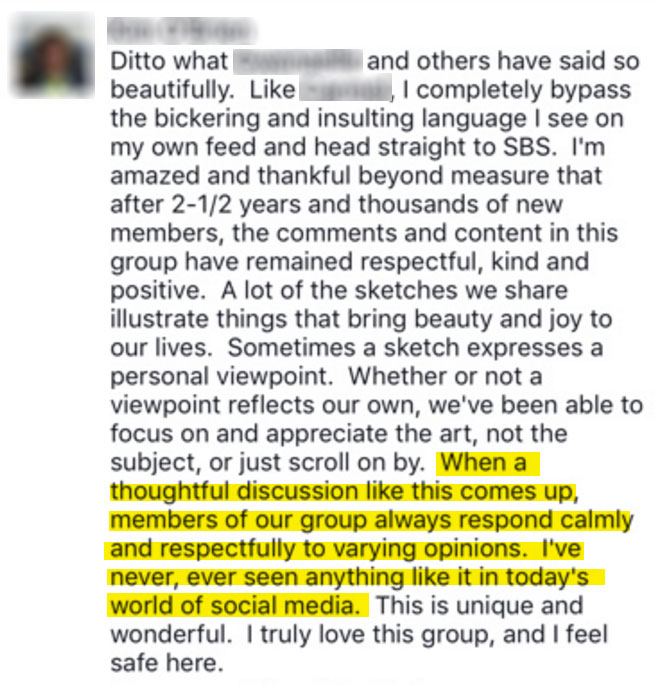
Reading my newspaper today, abrim with flailing and fear, I couldn’t help but think of the model we have found in this Facebook group. Looking at what unites us rather than what divides us, at what we love rather than what we hate, at what we can create together rather than what we can destroy. I want to live my life like that. I want to see other people like that.

And I can’t help thinking that it is the very thing that has drawn us together, our creativity, that makes this attitude possible.

Creativity helps us adapt to inevitable change. To make something new to fix something old. To see through other eyes. To discover that what is truly beautiful in the world around you may not fit the standard definition. When you find how wonderful it can be to draw a dented garbage can, a wrinkled old face, a rusting truck, you transcend the obvious, the dogmatic, the rigid, the doctrinaire, the popular, the commercial, and you face the world on new, real terms. You learn to be in the moment, rather than dwelling in some futuristic hell of your own invention.

Drawing helped me escape the prison that fears about my wife’s health had built, helped me be a bit more imaginative in constructing a wonderful though different life for our changing family. It saved my sanity and my life.

When I was little, my world changed many times. My mother’s divorces, moving from continent to continent, a dozen and a half schools in a handful of languages, and yet, I emerged okay. I was adaptive because, at that age, I was at my most flexible, most imaginative, most creative.

It didn’t last. The calcification of age always threaten to make me more brittle. But sitting down and drawing my breakfast or doodling with crayons or spending time with other artists who are creating beauty, helps me to adjust. Creativity is far healthier and more calming and ennobling than gibbering in the dark, alone with my monkey brain.

Don’t fear change. Create ways to change with it.
How to get over a creative block

My SBS co-founder, Koosje Koene, has been experiencing a bit of a creative block of late so she has been asking for strategies on how to get past it. We did a Skype chat in which I gave her a few ideas to help her reshuffle the deck and get back to work.

This chat is part of a series for the Sketchbook Skool blog which has lots of other ideas for improving your creative life. If you sign up for the SBS newsletter, this sort of advice will find you and kick your monkey’s butt.
—————————————
P.S. Please excuse my unshaven, pimply appearance. I am going through a second adolescence and my usual hair and makeup person is on sabbatical.

How to fail.  Epically. 

I just read that Roadies has been cancelled. So was Vinyl. No one gives a shit about TV shows about the music industry. It can’t be mythologized. It’s dead. Whoda thunk it ten years ago? What about publishing ? Another myth-ridden beast, gasping. As is advertising, replaced by algorithms and fast-forward buttons. Newspapers are folding. Movies, yawn. Trump blew up the conventional. Apple can’t do the job without Jobs. Even flossing has been debunked.

Change is afoot. Rampant.

Why should you escape unscathed?

What if the rules that always worked, suddenly don’t ? How will you survive?

Here’s a thought:

Instead of fleeing failure, what if you embrace it?

Leap.

Drop excuses.

Cut your safety line.

Make shit. Wild shit. See if it sticks to the wall. If not, archive the lesson, open a new file, repeat.

Take a massive risk that could destroy everything. Make it worth it.

Fail so hard you learn something serious.

Stop whining and worrying.

Stop trembling and clenching.

Stop thinking you know what will happen. You have no idea. Assumptions are just one more excuse for inertia.

Stop fearing the future and start building it.

Try shit. Get creative.

It’s time and you know it.

Dear You:

Wow. That was unexpected. And extraordinary. And a bit, um,  embarrassing.

My recent post on how I walked away from this blog and other Internatterings provoked loads of readers to write long and beautiful encouragements in the comments section. I am really touched that you took the trouble.

Thank you.

I feel a little Sally Fieldian that I provoked this outpouring but what the hell. It’s nice to hear from you.

Writing is a funny business. When you read, it feels like the author is talking to you, sitting in your head, sharing the most intimate dialogue. But if the voice coming off the page seems to be talking to someone else or is barking into a megaphone or is distracted or dishonest, it’s a turn-off. So when you write, you have to be appropriate in your tone, pitching your words to a reader you understand. After all, you’ve been together for many pages, you are old friends, and the reader expects and deserves a connection and an understanding.

Sometimes I forget who I am talking to.

Maybe that comes from my years in advertising, when my writing process had to slalom through market research, through layers of agency bureaucracy, through strata of client approvals, through the limitations of the form, character counts and such.  And when you write an ad, you aren’t meant to be expressing your point of view (though I was a good copywriter because I usually was trying to express my self from behind the golden microphone I’d been handed). You are there to speak on behalf of something inanimate, a corporation or a product, and not only speak on its behalf but sell it, and often to a reader who was indifferent at best. It’s a weird way to write, especially when you strive for authenticity, which is the core of decent writing.

I forget also because I don’t actually know you. Many of the commenters point out that we are strangers and, technically, we are. I have a sense of you, of your median age, background, various demographic info. But none of that’s really the point. I think I do know you and you me because we are drawn together by a certain point of view and interest. Like me, you are creative, you are thoughtful, you are curious, and that’s what matters, this nexis.

When I think of the writers that have meant the most to me over the years, from Gerald Durrell to Karl Ove Knaussgard, they are voices that reflect honestly and amusingly on their lives and give me heart. They let me know I am not alone in being who I am. They tell me new things but also remind me of old ones. Their voices sound like better, wiser versions of my own.

When I read your comments, I was reminded again that you are not Other. You come here to share what we have in common. And I come here to express that same thing in me so that I can share it with you and know that you share it too. A blog is a web log, a journal, a diary. It’s not a soapbox or a stage or a commercial break. It’s a place for self-reflection, for honesty, for trust.

There are people out there who are Other. Loads of them. But the miracle of the Internet is that we can each sieve ourselves from the undifferentiated mass and find a community of people who are not Other. And that’s what we have done when we come here or go to a klass at Sketchbook Skool. We have found each other. We may not look like each other, we may not come from the same background or education or families, but we are connected by our creative urges and all the joys and tolls that come with these urges.

… alone in a windswept wasteland clutching a single, dog-eared, remaindered copy of the book I toiled over for years, alone but for the monkey toldyousoing in my ear. Not pretty.

I sometimes forget that. When I come here, launch my blog dashboard and start to write, I may have different motivations for doing that. I may feel like I need to be an ad guy and sell the market a book. That’s a shitty place to start a conversation with you and I apologize. I needn’t hawk stuff at you, belabor you with hyperbole, threaten and cajole you. That would be horrifyingly inappropriate if we were having lunch together, so I shouldn’t do it here.

Why do I? Because, to some degree, it is dyed into me, it is my scorpion nature. I am a recovering copywriter and the anxieties and arrogance of my trade are hard to shake. And also because I am prone to anxiety and abandonment issues, to a fear that if I don’t sell my books or kourses, no one will help or care, my dreams will wither, and I will be left alone in a windswept wasteland clutching a single, dog-eared, remaindered copy of the book I toiled over for years, alone but for the monkey toldyousoing in my ear. Not pretty.

I also forget who you are because you don’t tell me. Studies show (that’s a copywriter’s favorite term) that 99% of readers never post comments on the Internet (I am certainly in that silent lurking majority too). But when you do, it is so interesting and helpful because it stops me from blathering like a boring narcissist and instead focus on you as a person.

But I don’t want to lay this at your feet. That’s bullshit. Please don’t feel obliged to comment. That’s not why I lose my way as a writer. If I’m honest with myself, I already know (and well) what you expect from reading my words. It’s what I expect too. Something interesting. Something true. Something funny. Something odd. I get it.

And if I do have something new to tell you about — a book I’ve written, a kourse I’m teaching, a six volume album of my accordion playing — I’ll just tell you. Not sell you. If you want it, you’ll buy it. If not, we’ll get back to our conversation.

Thanks as always for setting me straight, for caring enough to bother, for sharing my life. I have the feeling that what I did and didn’t do this summer will carry me far over the next year and beyond. Thanks for being part of it.

Your pal,

Danny


Jack Ruby’s Second Life.

Last night, JJ and I went to see a friend of hers have a dream come impossibly true. When Robin was in his late teens, he and some friends formed a band which they named Jack Ruby. They made music that was loud, distorted, punk. It was the early 1970s and that sort of things was very new, even in New York City. They played in their loft, and occasionally for other people.

After a few years of dicking around, Jack Ruby disbanded. The members got jobs, families, mortgages. Randy became the Ethics columnist for the New York Times. Robin became an advertising TV producer. Their Jack Ruby memories faded and dimmed.

One day a couple of years ago, Martin Scorsese hired Don Fleming and Lee Ranaldo (who used to be in a different band, a successful one called Sonic Youth). He asked them to help him make an HBO show about the music scene of the 1970s. At the core of the show is a punk band — the lead singer is played by Mick Jagger’s son.

In their research, the guys happened upon a bootleg tape of Jack Ruby’s songs and it blew them away. They decided that this music would be what the band in the TV show would play. They rerecorded the songs using authentic period instruments, the fake band lip-synched along, and Marty shot his show around them. Suddenly, finally, and out of the blue, Jack Ruby’s music is being heard by millions of people. It had taken forty years but the members of Jack Ruby had never intended it to happen.

Robin called up JJ one day and told her this story. He invited us to the recording of a radio show in which the guys from HBO would be interviewed about the show. At the end of it, the musicians would be performing the Jack Ruby songs. And Robin would be singing. He hadn’t been on stage since Jerry Ford was in the White House and his voice was shaking on the phone. Small wonder.

So yesterday, we went to see the show. The recording was in front of a live audience on lower Broadway, just a few blocks from Wall Street. We took an ear-poppingly fast elevator to the 20th floor and go out on what turned out to be one one of those collaborative working spaces where startups rent desks by the month and share wifi and espresso machines. About a hundred people were there to watch the interview and afterwards the band played. They were so loud we could barely hear anything Robin bellowed into the mic. It sounded awful and just like every show I ever saw at CBGBs. It was awesome and odd.

During the interview, the musicians had talked about coming to New York in the 1970s, about how exciting it was, about how there were all these overlapping cultures converging and sparking. American culture was transforming.

Three forces that would soon define today’s popular culture were emerging and NYC was Ground Zero. Downtown, CBGB was giving a stage for music that came to be labeled New Wave and Punk. In the Bronx, people were laying refrigerator boxes on the pavement to break dance and free-form poetry over spinning records, sowing the seeds of the rap and hop-hop that is today’s status quo. And in Bay Ridge, in gay clubs and eventually in Studio 54, disco music was upending Rock’n’Roll’s throne.

Because the tectonic plates were shifting, a few guys in a loft in SoHo could make noise that would make a difference. Despite never having a Soundcloud page or posting on Facebook or even releasing a record, Jack Ruby could still make a ripple. A ripple that still mattered when their hair was grey and their shades were trifocal.

While the band played, I kept thinking about where we were and how the world has changed. Here I was on a conference room chair in a co-working space. Every so often, a dude with a sleeve of tats and a man bun would emerge from his glass cube to make a macchiato, only casually interested in the piece of history being honored in his lobby.

He didn’t know it but this dude is the heir of the Jack Ruby guys. He’d come to New York to be a part of the scene too. He was one of hundreds of thousands just like him, dudes who packed up their fixies and plaid shirts and business plans and come to the Big Apple.

He’s a part of a creative revolution but one with extraordinarily different goals. These new dudes are not interested in the long dead music scene. No one makes a dime making records. Instead of smashing guitars or thundering baselines, the dude and his bros are coding VR headsets and delivery drones. Unlike Randy and Robin, the dude came to New York to get funded, IPOed, to be a billionaire by thirty.

As Jack Ruby’s last chords died out, I wondered, “Will anyone celebrate this dude’s accomplishments — in 2056?”

Let’s get rid of Art Education in schools.

Art, they say, is great for kids. Art and music programs help keep them in school, make them more committed, enhance collaboration, strengthen ties to the community and to peers, improve motor and spatial and language skills. A study by the College Board showed that students who took four years of art scored 91 points better on the SAT exams. At-risk students who take art are significantly more likely to stay in school and ultimately to get college degrees.

Awesome.

Nonetheless, arts education has been gutted in American public schools. A decade ago, the No Child Left Behind and Common Core programs prioritized science and math over other subjects. In LA County alone, 1/3 of the arts teachers were let go between 2008 and 2012 and, for half of K-5 students, art was cut all together.

After the recession of 2008, 80% of schools had their budget cut further. Arts programs were the first victims. And, predictably, lower income and minority students were the most likely to lose their art programs. Only 26.2% of African-American students have access to art classes. As the economy has improved, there is some discussion about reversing some of these cuts. But it is not enough.

IMG_2467
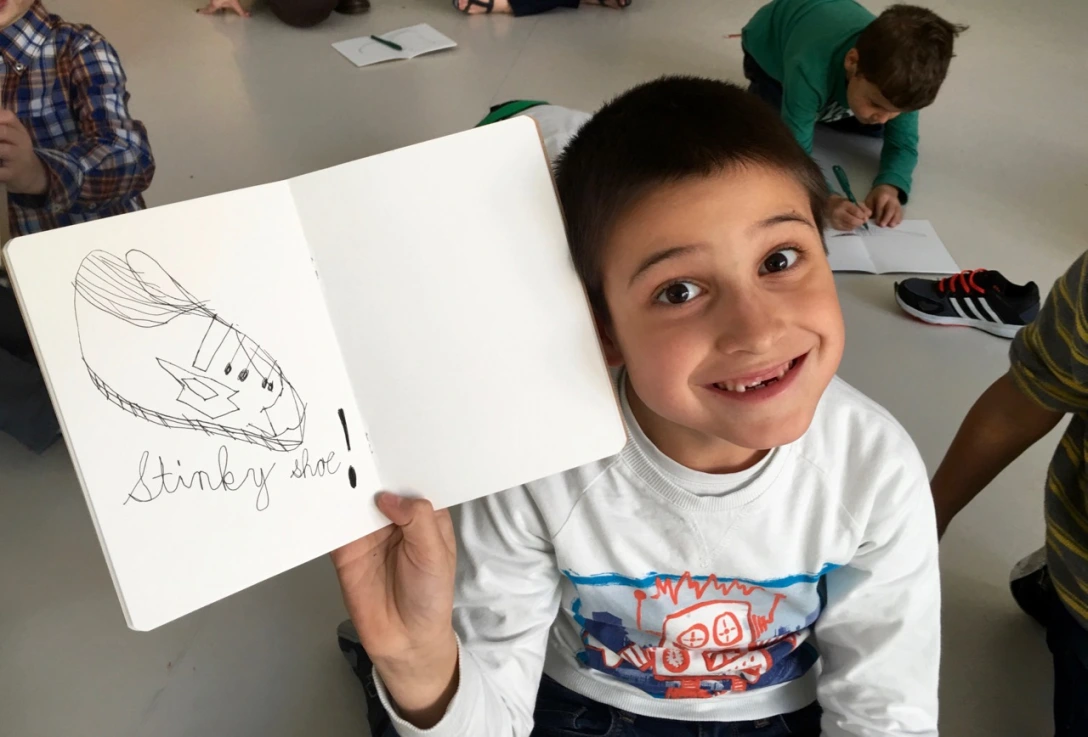
IMG_2467 They don’t need to be taught to be creative!

I’m no expert on education but I have spent a lot of time in school art programs over the past year.

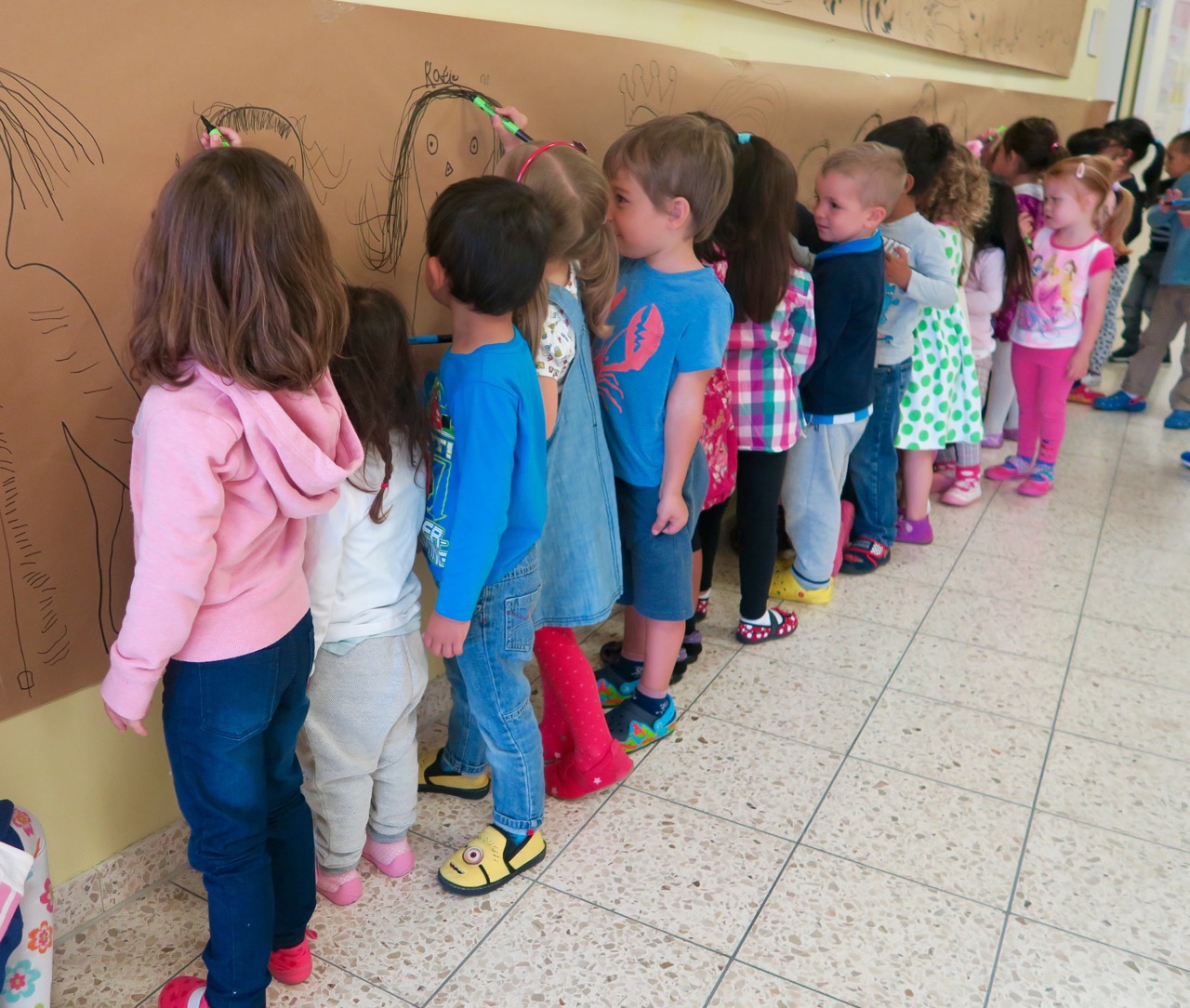
In the lower grades, kids just have fun drawing and painting. They don’t really need much encouragement or instruction. In middle school, the majority start to lose their passion for making stuff and instead learn the price of making mistakes. Art class is all too often a gut, an opportunity for adolescents to screw around. By high school, they have been divided into a handful who are ‘artsy’ and may go onto art school and a vast majority who have no interest in art at all.

In short, every child starts out with a natural interest in art which is slowly drained — until all that’s left is a handful of teens in eyeliner and black clothing whose parents worry they’ll never move out of the basement.

Here’s a modest proposal: Let’s take the “art” out of “art education.”

“Art” is not respected in this country. It’s seen as frivolity, an indulgence, a way to keep kids busy with scissors and paste. “Art” is an elitist luxury that hard-nosed bureaucrats know they can cut with impunity. And so they do, making math and science the priority to fill the  ranks of future bean-counters and pencil pushers.

So I propose we get rid of art education and replace it with something that is crucial to the future of our world: creativity.

We need to all be creative in ways that we never could be before. We have so many wonderful tools that put the power of creation in our hands and we use them every day. Solving problems, using tools, collaborating, expressing our ideas clearly, being entrepreneurial and resourceful, these are the skills that will mattering the 21-century, post-corporate, labor market. Instead of being defensive about art, instead of talking about culture and self-expression, we have to focus on the power of creativity and the skills required to develop it. A great artist is also a problem solver, a presenter, an entrepreneur, a fabricator, and more.

Imagine if Creativity became a part of our core education…

IMG_5102
High schoolers develop a creative solution together.

Instead of teaching kids to paint bowls of fruit with tempera, we’d show them how to communicate a concept through a sketch, how to explore the world in a sketchbook, how to generate ideas, how to solve real problems. Theatre would be all about collaboration, presentation and problem solving. Music classes would emphasize creative habit, teamwork, honing skills, composition, improvisation.

We’d teach creative process, how to come up with ideas, how to find inspiration, how to steal from the greats. We’d teach kids to work effectively with others to improve and test their ideas. We’d teach them how to realize their ideas, get them executed through a supply chain, how to present and market and share them.

IMG_4138
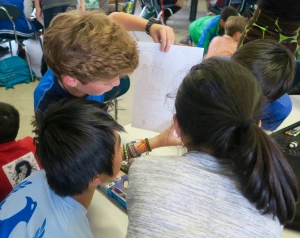
Middle schoolers discussing a story through sketches.

We’d also emphasize digital creativity, focussing on cutting edge (and cheap) technology, removing the artificial divide between arts and science, showing how engineering and sculpture are related, how drawing and User Experience (UX) Design are facets of the same sort of skills, how music and math mirror each other. We’d teach kids how to use Photoshop to communicate concepts, to shoot and cut videos, to design presentations, to use social media intelligently, to write clearly because it is key to survival. We’d give kids destined for minimum wage jobs a chance to be entrepreneurial, to create true economic power for themselves, by developing their creativity and seeing opportunity in a  whole new way.

IMG_3485
IMG_3485 Here’s what 100 8th graders collaborating looks like.

Yes, I know that there are high-school video classes and art computer labs, but they need to be turned into engines for creativity and usefulness, not abstract, high falutin’ artsiness based on some 1970s concepts of self-expression. Don’t make black and white films about leaves reflected in puddles, make a video to promote adoption at the local animal shelter. Don’t do laborious charcoal drawings of pop stars, generate ideas on paper. Fill 100 post-its with 100 doodles of ways to raise consciousness about the environment or income inequality or saving water. Stop making pinch pots and build a 3-D printer and turn out artificial hands for homeless amputees.

(And, by the way,  if we teach kids loads of math and science but don’t encourage their creativity, they aren’t going to grow up to be great engineers and scientists and inventors and discoverers — just drones and dorks.)

Creativity is not a ghetto, not a clique, not something to be exercised alone in a garret. It’s also not a freakshow of self-indulgent divas and losers.

Creativity is about helping to solve the world’s many problems. We need to make sure that the kids of today (who will need to be the creative problem solvers of tomorrow) realize their creative potential and have the tools to use them. That matters far more than football team and standardized test scores.

What do you think?


Related Post: How to make anything

Why men don’t take art classes.

For a while, I have been wondering why the art conferences at which I speak are filled with women. Why most of the commenters on this blog are women. Why Jack’s class at RISD is predominantly female. Why the students of Sketchbook Skool are about 85% women.

Where are the men?

Certainly men seem to like to make art as much as women do. Half of the SBS fakulty are male. The museums and galleries I visit are full of work by men. In fact, women have long complained that the art world seems biased against them.

So what is it about art education that seems more interesting to women than men?I searched the web for answers. There weren’t many categorical ones but here are some of the clues I picked up.

In 2007, the NY Times had an article about why adult classes of all sorts seem much more popular with women. Tennis classes. Writer’s classes. Triathlon classes. All were 65-95% women. Here’s what a man who teaches wine tasting said of his students: “It’s argued that women are better tasters of wine than men. A higher percentage of women have more taste-bud receptors.” So maybe they are getting more out of the class. But, echoing others who lead classes, he added: “It may also come down to the fact that men think they know more about wine anyway, so they don’t need to learn more about it.”

In other words, men know more. Or think they do. No need to take classes. Why admit you are ignorant?

Is it that simple? Men go to golf pros. They read business books. They take coding classes. Maybe art classes teach skills that don’t seem concrete or finite enough for men? Do men just need more goal- rather than process- oriented activities?

I have also been following a heated debate on Reddit (where all debates are heated) about why there are so many more successful male artists than females. Here’s are some highlights.

One theory is about marketing, that male artists are more into promoting themselves than women.

“In my experience the successful artists are the ones who concentrate their time about half on the art and half on the selling of the art. …That is selling paintings, building relationships with patrons of the arts, raising money for their dance/theater/etc. company, writing grant proposals to non-profits etc. 

“…perhaps men are more drawn to the concrete and the rational and less to the expressive and emotional. This keeps them away from art statistically but those who do get into art spend more of their time with the rational part of marketing art and less with the expressive side or art. This may actually be the more important part of becoming a successful artist.”

And self-promotion is not encouraged in women:

“When you look at hugely successful female artists they are generally the ones that market themselves well and are obsessive about selling their art. However, women who promote themselves and their work intensely are often seen as ruthless social climbers.”

Another argument: Art is less practical so women can afford to indulge in it more than men.

“At the university level, women are more free to pursue educational interests without as much criticism. When a guy takes an art class, he’s usually expected to come up with a practical application of it as a justification. Anytime a show wants to make a joke about a father worried about a grown son’s directionlessness, they’ll say the son is studying some art/humanities degree, like dance, or theater, or English.

(But as you can see in the chart above, there are loads of men in ‘impractical’ fields like philosophy and classics too).

“when a woman cooks, it is her duty. When a man cooks, he is an artist.”

Or is it just that women aren’t valued for what they do — and so neither is their art? In fact, as Richard Florida’s research on creative professionals has shown, women earn about 40% less than men do in creative class employment. I’m not sure if the situation is as imbalanced in all skill professions.

A poster on Reddit says: “Women’s work isn’t valued on a ‘profound’ level in the same way that men’s is. The perfect example is cooking. Cooking is seen as a woman’s task, but the vast majority of celebrity chefs are men. Of the female celebrity chefs, how many are really valued for their ‘greatness’ vs. how many are famous for showing you quick and convenient ways to cook at home? In other words, how often do we talk about women’s Michelin stars?”

“….I always think of the quote, “when a woman cooks, it is her duty. When a man cooks, he is an artist.”

Another says that women’s art tends to be ghettoized:

“I don’t know enough about the art or cooking world to judge whether it’s because the stuff that women are creating doesn’t push creative limits enough to warrant that kind of recognition. What I do know is that in the fiction and poetry industries, women are expected to write in certain niches. Maybe a small portion of their work will transcend those niches, but they are rarely able to make an entire career out of writing the same stuff men write about, even if the quality is comparable. ….”

What do you think is behind the disparity? Why don’t men take art classes? And why, despite all those workshops and classes and conferences, aren’t women equally represented in the contemporary art world?

Update:  it’s not just America. 

Take three.

What with this, that, and lots of the other, I haven’t gotten around to telling you about a brand new klass I am teaching in the new Kourse at Sketchbook Skool. So I shall. But first, let me show you a little film about the kourse and its fakulty.

I also wanted to tell you what I was thinking in putting it together. This has actually been harder to do than I thought (the telling, not the putting together). In fact, this is the third film I’ve made on the subject this week and I hated the first two. So this time I shall just turn on the camera and see what comes out. If it’s boring, don’t worry. Polishing, I assure you, is not.

I hope to see you in klass. It begins on April 15th and you can learn more about it here.

The numbers game.

Increasingly, life throws digits at us to evaluate our worth. Your watch can tell you how many steps you took today. Facebook tells you how many friends you have. Your ATM tells you how much money you have. What’s your credit score?

And social media has put us all on some endless celebrity list with Kim Kardashian and Justin Bieber at the top and each of us somewhere far, far below. How many likes did your Instagram get? How many comments did your post get? How many views did you get on YouTube? How many followers do you have on Twitter?

It’s as if we are all on the ballot, stalked by monkey pollsters projecting our fates, tabulating our votes, handing out our final grades.

Because we are all online, we are all in a line.

This is what technology and the media have wrought. Because things can be quantified, they can be ranked. Because we are all online, we are all in a line. And those digits seem to indicate our place, our worth.

And of course, it’s all bullshit. Just because the world holds up so many measuring sticks, doesn’t mean we have to step up to them. We still have the power to decide what matters. People are not numbers. Art is not worth what Sotheby’s or Google or Billboard deems its rank.

What matters when you make something, even when you share it, is what it means to you. How deeply does it touch you? Does it feel authentic? Does it speak to you? Did you work hard enough on it to make it clear and resonant? If you must have  a numerical scale, count how it makes your pulse accelerate, how broad your smile is, how many tears rise to your eyes. Those are the only digits that count.

Pednesday.

It’s the middle of the week and it’s January and it’s ludicrously cold in New York, so I need to comfort myself with a new pen or three. Know the feeling?

I am an unapologetic LAMY enthusiast. I have several different Safaris and I recommend them highly for anyone who wants an inexpensive fountain pen with a nice springy nib. I have a couple of charcoal ones, a blue one, even one in hot pink all outfitted with converters so I can use my own ink, ideally waterproof. They’re the bomb. Now it’s time to try out some other family members.

pen-1This is a LAMY Balloon. My first love in pens was the Uniball Vision which is also a rollerball like the Balloon, though a lot more utilitarian in appearance. The Uniball is a little scratchy and dresses in drab grey whereas the Balloon wears a transparent lime sheath that feels child-like and has a cartoony pocket clip. It makes a slightly thicker line than the Uni but there’s variability; I can pull back on it to make a lighter and narrower line or bear down for a thick and somehow softer mark. It’s not a ballpoint feeling but much smoother and glidier. I am using a blue refill in mine and the color is at the green end of blue. At this point, I doubt I’ll use the Ballon for serious drawing. It feels more of a pen for writing  (it’s lovely for jotting notes) or for doodling — the gliding line makes me just want to fill my margins with monsters — but it’s not either controlled enough or interesting enough to make me inspired to draw.

pen-2c

This is a LAMY nexx M. It is a lovely, modern looking fountain pen. It’s available in five different nib types, from extra-fine to broad and there’s a left-handed nib too. My nib is fine — which is fine. A tad scratchy but flexible enough to take me from a delicate line almost to a medium. The pen is light (pseudo metal with a stainless steel nib) and quite thick-barreled but the best feature is the soft, non-slip rubber grip so you can keep going and going — without getting that dreaded fountain pen claw cramp that narrower, harder pens can cause. It is intelligently designed so you can easily know which way is up. (Nothing worse than a fountain pen that somehow resolves so the nib is upside down when you bear down and it jitters across the page). The Safari has a similar contour design but I like the rubber cover of the nexx M. It’s not as functional- and tough-looking as the Safari, a bit more junior executive, but a good pen for about $25 and fun to draw with.

pen-3

This is the Lamy Joy. It’s my favorite of the new recruits. First off, it’s a calligraphy pen which may seem a weird choice for drawing but I like the expressive quality italic nibs make. Pull down and they’re broad, slide and they’re thin. And curved lines swoop from fat to thin and everything in between. My Joy came in a sleek metal box with three different nibs (1.1.,1.5 and 1.9) in it so there’s lot of room for experimentation.  I also love its shape. The end of the pen is long and narrow, almost like a dip pen. I had a Rotring Art Pen that had a similar shaft — but the cap would just fall off the narrow end so I was always losing it. The Joy has a tough clip just like the Safari and the cap snaps tightly right on the end of the pen. It was made by designers who really think about how people use pens. It might even improve my handwriting. Oh, joy.

Did you see the LAMY pen giveaway on the Sketchbook Skool blog? Check it out.