Gluttony means consuming way more than you need. And it’s a great way for the monkey to distract you from your creative path.
Walking through a museum and snapping a picture of each painting you pass, then hurrying on to the next. Signing up for classes, then never bothering to show up and do the work. Why start that painting when you and your credit card could while away the afternoon at the art supply store? Easier to amass more drying tubes of paint, teetering piles of empty sketchbooks, basket-loads of supplies for crafts you doesn’t have the time to master — than bypass the monkey and get to work.
Gluttony means valuing quantity over quality. And we live in times of more, more, more, where there’s always a new distraction, a new treat popping upon our phones. Why do they call it a Facebook feed, d’ya think? Because it stuffs our troughs with trivia, 24/7. We consume bytes instead of being in the moment and appreciating the wonder and beauty around us already. We are gluttonous with our time and yet stingy with it too, wasting it rather than investing it in the self-improvement and habits that can bring us the things that will truly satisfy our hungers.
Gluttony is a sin of lost control. Like Lust, it drives out of our minds, to places we don’t recognize in the mirror. We automatically grab for more entertainment, more stimulation, more consumption, faster, longer, all of which distract us from our purpose, our skills, our deepening experience as human beings. We are unable to ignore the buzz in our pockets, the dings on our night stands, we drool and reach and feast.
Creativity is about creating something new, adding to the world of beauty, not just taking and acquiring.
Gluttony stems from fear. We are afraid of exposing ourselves, standing naked as we are. Afraid of being vulnerable. We cloak ourselves in a thick protective layer of shopping bags from Abercrombie & Fitch, Dean & DeLuca or Windsor & Newton. We need distraction from our true selves, from loneliness, from inadequacy, from being who we are.
The solution is to make more, rather than take more. Pull your excess art supplies off the shelf and give them to your local public school. Turn off all electronics a day a week and fill your time with songbirds and wind. Unsubscribe from distraction and sign up for a healthy diet of starving artistry. It won’t kill you, it’ll fill your soul.
Creativity, like songbirds, can be bought and sold. But songs sound differently from behind the bars of a gilded cage, when sung for a supper.
Greed makes artists compromise. They follow trends rather than their hearts. They measure success in sales rather than in the call of their souls. They agree to distort their work to fit corporate agendas and market demands. Greed turns originality into predictability into a worthless tin horn.
Ironically, greed rusts the very things that made an artist’s work valuable in the first place. Greed transforms artists into celebrities, hogging the limelight, addicted to fame, prisoners of their egos, and detached from the pure, original source of their creativity.
Greed distorts and cripples the true purpose of art, turning the fruits of personal expression into a mere commodity. An artist’s heart-felt response to the world shrivels into a rich man’s prized asset, garnering millions at auction, then hidden away, another coveted diamond on a dragon’s hoard.
The opposite of greed is generosity.
Greed prevents artists from sharing their work with the world, afraid it will be poached. Rather than joining a creative community, inspiring others, collaborating, teaching, sharing their insights and lessons, greedy artists hide in their studios, squirreling away their work, waiting for the best offer. They refuse to support causes, to contribute their creativity, to reap the benefits of selflessness.
When you are afraid of being deprived, you hoard possessions against any possible future famine, no matter how remote. When you are afraid of being passed over and neglected, left to shrivel and die, you hoard attention. Afraid of competition, you crouch on your mountain of toys so no one else and play with them. Afraid of being taken advantage of, you refuse to open the door to others. Afraid of being vulnerable, you amass a pile of any stuff than could be a bulwark or a weapon. You bank your work rather than letting it see the light of day and of possible critique.
Greed blocks your way. Generosity and creativity clear it.
I frequently risk being the prisoner of my ambition. I dream big and often, then wake up exhausted with a long to-do list and a sense of dread. How will I get it all done? How will I climb this mountain I have built?
I sit at its base, exhausted by the possibilities, wrapped in a sense of failure before I begin. That sense threatens to keep me from the first step. And the longer I wait to begin, the further away the summit will stretch.
Not doing can easily become a reflex. Like a hoarder with newspapers to the rafters, like a 700 lb. man trapped in bed, like a refugee clutching a trash bag of possessions and a child’s hand, it can all seem too big to tackle. Submission to failure and the monkey can seem the only possible recourse.
But doing, like failure, can be incendiary. I start by taking on one challenge, maybe the easiest, teeniest one on the pile. When I have surmounted it, one checkmark on the epic list, I feel a flicker of hope. I pull the next task toward me and the flicker starts to smolder.
I make the bed, I got to the gym, I do a drawing, I write a blog post, I arrange a lunch meeting, I write a chapter, and soon the flames are roaring, wheels are turning, we are half-way up the peak.
Not doing can easily become a reflex.
Then, I sift through the list. I discard the pointless, the distracting, the indulgent. I break the most overwhelming obstacles into a small series of do-able tasks. I beaver on. Soon the list is a scaffolding, a set of pitons leading me hand-over-hand to the top.
Last night we watched The Martian. It’s a great move based on an even greater book. It deals with an impossible challenge: surviving on Mars, with rescue years away. The solution is increments — tackling one small problem, then the next, and so on. The more bite-sized the problems, the easier the whale is to digest.
I’ve just completed the first leg of my European crusade: a week in Switzerland. Basel is a lovely medieval city along the Rhine right on the edge of Germany and France. It’s home to loads of banks and pharmaceutical corporations and two dozen museums — some with extremely contemporary contemporary art, one which is the size of a doorway.
I’ll tell you more about my visit to the city in another post. Today I’ll just try to summarize why I was there.
Important skills: focus and self-starting.
Last winter, I was invited to be an artist-in-residency at the International School of Basel this September. Perhaps you remember that a year ago, I was in residency at another ISB (the International School of Beijing) and had a lovely and illuminating time, so this invitation was very welcome. I was pumped to spend more time with kids, making art, and wallowing in their creative energy. Additional pluses: I’ve never been to Switzerland and, of course, Basel is a mecca for art.
My week began with a school assembly. Six hundred children under the age of 11 sat on the ground while I introduced myself and talked about all we would do in the week ahead.
The future.
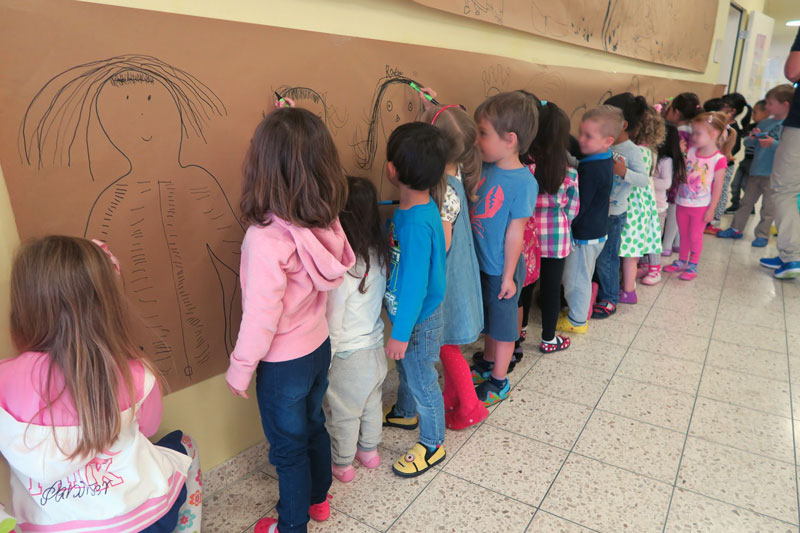
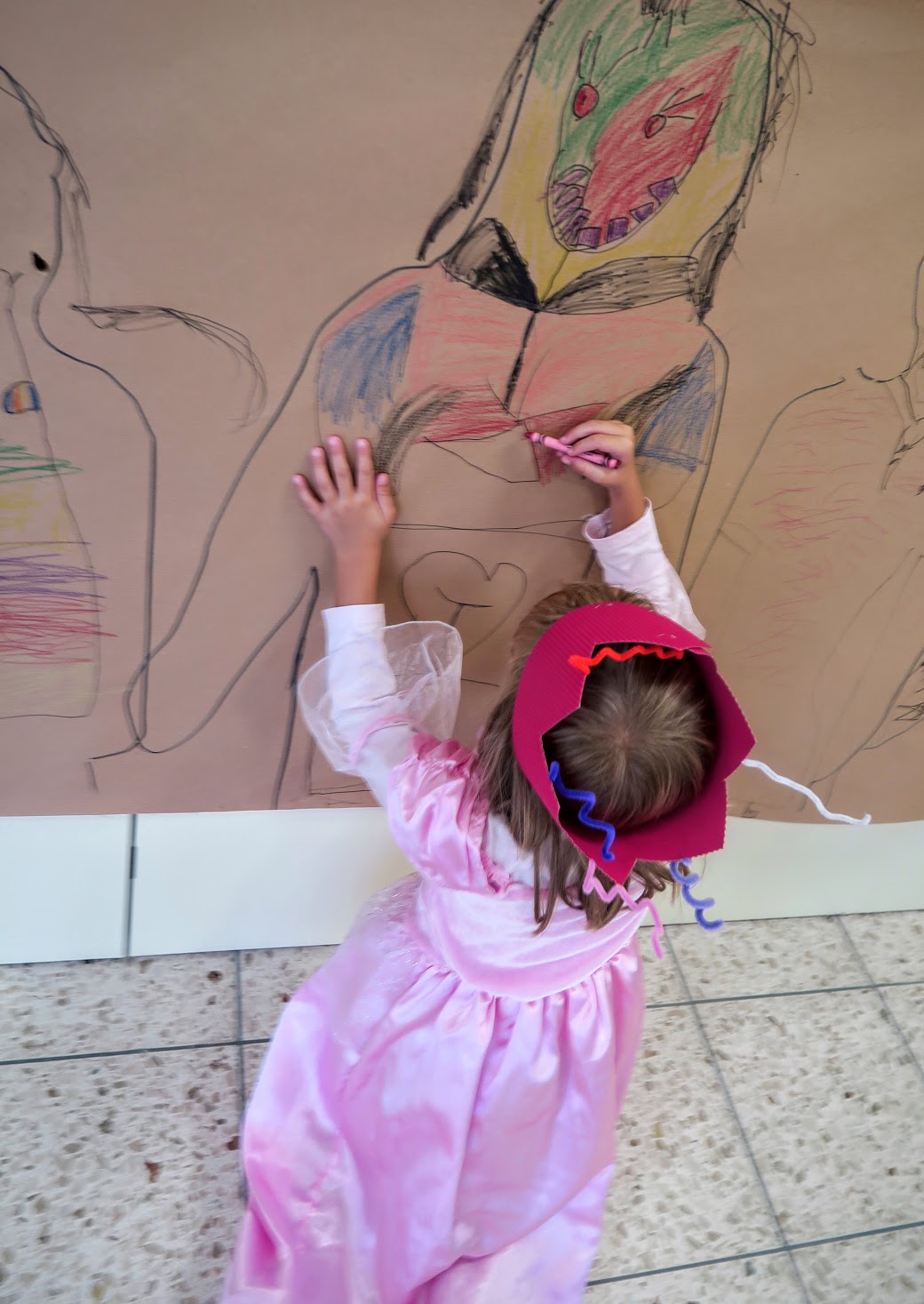
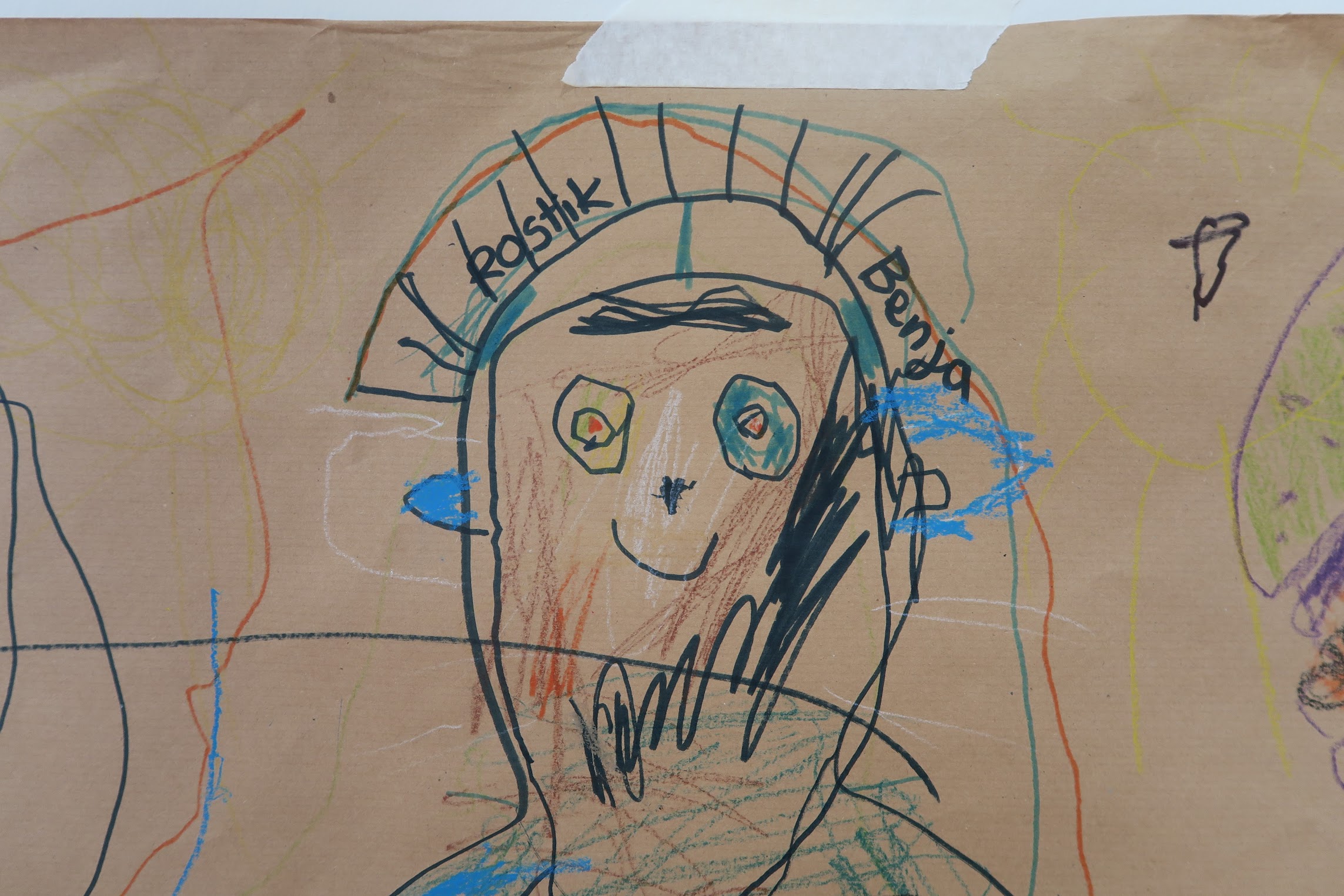
Then each morning at 8:15, I’d let a couple hundred kids and their teachers into my gigantic office/studio/lecture hall and showed them films and gave them creative assignments. We drew breakfast and lunch and shoes and upside-down bicycles and portraits and more. We made enormous murals that covered all the halls and stair wells. We ended the week with a sprawling field trip to the natural history museum to draw dinosaurs and endangered animals and then drew the cathedral and the twisting medieval streets.
It didn’t stop in my classroom. The kids went home at night mad for drawing. Each morning, moms and dads came into the school with stories of kids transformed. They filled up sketchbooks at home, drew with their parents and teachers, insisted that nobody eat their dinners until they had been drawn.
Important skill: observation
After school on Tuesday, I met with all the teachers and showed them how art had opened my eyes. I told them that art is not just for art class — it’s for learning about the world and can be applied to any discipline, from literature to social studies to science to music to gym. I pulled out examples of my travel journals, of my investigations into homelessness, fishing in Manhattan, and dogs in coats. I showed them my maps and Koosje’s recipes and the SBS students’ instruction manuals.
Important skill: problem solving
The next day, an inspired math teacher asked her 4th graders to make drawings that explain the concept of ’rounding up’ numbers. She showed me dozens of stories and watercolors the kids made in response to her assignment. They were all different, all clear, all beautiful. She was able to see how well they understood the concept and they could use their pieces to teach the 3rd graders this concept.
On Thursday evening, I met with the parents and told them why I had come to Basel and why I thought it mattered that their kids had started keeping illustrated journals.
Important skills: collaboration and communication
It was to prepare them for the future — not a future as professional artists necessarily, but as successful people in an ever-changing world. The days of being able to assume that a well-educated person could finish school, get a corporate job, and rise up the ladder till retirement, are over. Instead, kids need to be prepared for the unforeseeable. Technology is upending every industry, traditional jobs are withering while new opportunities are springing up in surprising places. Change is the constant. Kids need to learn to swim in it.
Important skill: Innovation and problem solving
Parents can no longer assume that a traditional education in math, science, literature, language and history will be enough prepare a child for the future. A crucial new skill will be the ability to think creatively. That doesn’t mean dabbling in fingerpaints, but knowing how to spark innovations, to develop ideas, to present them clearly and persuasively, to find resources and collaborators to bring them to fruition, to build networks, to be entrepreneurial. I told them that’s why I supported my own son’s plan to go to art school, so he could learn skills I think will be essential to his future. If he had majored in English or pre-med, I wouldn’t have the same sense of confidence that I had given him the necessary tools.
I told them that they should look at art not just as a sign of being cultured, a middle-class luxury, but as a key component of their children’s total education. I suggested they insist the school’s administration support and look for ways to incorporate art and creativity into all aspects of the curriculum.
Important skill: optimism
If a student is encouraged to look everywhere for inspiration, to combine ideas into new ones, to replace competition with collaboration, to accept mistakes and ambiguity and learn from them, to have faith in the creative process, to know how to overcome its pitfalls, only then will he or she be prepared for a world full of self-driving cars, delivery drones, mobile apps, and Donald Trump.
Knowledge alone is no longer power — it’s something that pops up in your browser. Knowing how to use that knowledge to create new ideas and solve new problems, that will be the source of true power, a power that will serve all mankind.
A couple of days ago, I filled out the Sketchbook Skool survey we placed at the end of our most recent course, Playing. I shared it on Facebook but because FB is such a temporary place to store important thoughts, I am reproducing it here.
| Please fill your details below
What’s your name?
Danny Gregory
How did you find out about Sketchbook Skool?
My friend Koosje told me about it.
‘Playing’ | Your Experiences
Why did you sign up for this Kourse?
I have been worrying so much about perfection, about ‘getting better,’ about ‘making art’ that I was losing the pure joy of making. The idea of playing for a few weeks seemed like it would be fun. I didn’t want to just learn more new techniques, I wanted to reconnect with the spirit of creativity I had when I was six, a spirit that burned the hottest I’ve ever experienced and that made Picasso great.
Was the kourse what you expected?
Yes
What did you expect?
I expected some people to like it and some to be disappointed. I expected some people to let loose and dance the hootchy-kootchy and some to complain it was for kids and grumble that they had paid $69. I expected some people to grumble right off and then do one assignment that opened their eyes wide and they would go back and look back at the assignments they had just skimmed and suddenly find delight. I expected some adults to share their new found creative energy with kids, making sure that those kids never forgot how much fun art can be. I expected to be inspired by the enthusiasm and freshness I saw in the galleries.
Do you prefer the more shorter lessons, which is the style of Playing? Do you like more emphasis on projects than on lectures?
I thought the change was good. I’d heard a lot of people say they didn’t have time to do the more complex assignments they got in ‘Stretching’ and ‘Storytelling’ so I thought just screwing around with crayons would be a nice break.
If you’ve taken a Sketchbook Skool Kourse before, was ‘Playing’ a welcome change?
I loved learning from the great artists who teach at SBS. But the parts of the klasses that stretch me the most are the homework assignments. I learn a lot from doing them and from seeing what others do. I thought a kourse that was all about making stuff would be a cool change.
I have been drawing for twenty years and this is how I learned. I believe that it is the only way — to be inspired and to take my lit fuse and blast off in my own personal direction.
Sketchbook Skool | How do you feel about it?
At Sketchbook Skool we believe that the best way for you to learn is to be inspired, rather than giving you a lot of step-by-step instructions. How do you feel about that?
I have been drawing for twenty years and this is how I learned. I believe that it is the only way — to be inspired and to take my lit fuse and blast off in my own personal direction.
How do you experience Sketchbook Skool: Is it about exploring yourself or about community?
SBS inspires me to start and the community keeps me going.
The lessons make me challenge my assumptions, make me marvel at what is possible with just a pen and a book, and make me accept responsibility for my own creations and education — I am my own best teacher.
The community stretches me further, shows me more of what is possible, supports me when my monkey gets me down, pushes me to keep getting better and insists I stick to my creative habits.
I could draw alone. I could learn alone. I could evaluate my work alone.
But passion is so much better when it’s shared.
So, recently, a business associate told me I should further develop my network on LinkedIn. I know that’s sort of a horrible sentence but there you have it. I have business associates and they advise me to do things that probably have some purpose beyond my understanding. Generally I am okay with following their directives so long as they don’t involve public nudity or large amounts of money. They know more than me about some stuff.
The way LinkedIn works is by burrowing into your address book and your resume and your underwear drawer and pulling up long lists of names and smiling portraits and you are supposed to click on people who you know and want to link to. When you do, each person’s links are then joined to yours in an ever-expanding gyre of connections until every man, woman and Chihuahua on the planet is arrayed in concentric circles around you.
Let me now confess something else to you. Despite how garrulous I may appear within the confines of dannygregorysblog.com, I am not an especially outgoing person. For much of my career, I was the person standing in the dimly lit corner of the office party, gnawing carrot sticks and clutching a bottom-shelf gin and tonic. I was not glad-handing, back-slapping or table-hopping. Over time, as I grew older and slunk up the ladder, I knew more and more people who didn’t seem to despise me so I would allow myself to slink out of the safe zone and talk to people. But I was never and never will be a ‘networker.’ Fortunately for me, I have been in love with two women who were quite the opposite and dragged me into various social circles where I could mumble and make self-deprecating remarks to ever-increasing numbers of people.
When Linked In began to present me with long lists of smiling faces, I swallowed hard. Some faces looked familiar, some names looked familiar, and I began to click on the faces and request to be connected. Some people were easy, the ones who I knew well and who were outgoing. Some were harder, people I knew well but who I was embarrassed to be asking, who I assumed would scoff at such a fawning request, surprised that I was not, like them, too cool for school to network.
My associate prodded me to further expand my timid circle and so I delved deeper. I began to click on the faces of those I had not shot the breeze with in their cubicle and not invited to lunch, but had sat with in endless meetings, sometimes with dozens of others, people in other departments, of other ages and ranks, like soldiers in adjoining platoons, veterans of the same wars but not aways the same battles. People who I might nod to as we motored past each other in the hall, who I might have had that one long talk with as we waited for a flight to Columbus or Wichita for another regional committee meeting, people who I might have even had one drink too many within a Holiday Inn Express lobby on the eighth night of a shoot that seemed it would never end and shared opinions and revelations that I woke up the next day to regret.
And then there were those faces who I knew and who I knew knew me but who I thought hated me for one slight or another — a layout I hadn’t approved, a suggestion I had dismissed, an opinion I had contradicted. I winced reflexively thinking about what they might think years later when I appear on their virtual doorsteps, hat in hand. I assume these requests would be junked, that I would never hear from the person whose meeting I had twice arrived ten minutes late for, the person who scowled that one time when I interrupted in a briefing, the person whose coffee mug I had taken by accident.
But masochistically, I clicked their faces nonetheless.
In the next few hours, I received emails, confirming that even these outliers were willing to open their chains and link to mine. I reached out to a few with InMail™ messages, tail between my legs, wishing them well in their new endeavors. And they responded, tails aloft and wagging hard, sometimes with their paws stretched out, ready to play.
I’m perplexed and dismayed that someone who spends so much effort thinking about and writing about and drawing himself can be so self-unaware, that I often have no idea how I appear to others. I can think I have offended someone and they have no idea what I mean. I can think I have been a pal to someone and they will reveal a long-held grudge. I can pour over a blog post and get a stinging response from some reader, dash off another one unthinking and hear it has helped someone else a lot.
Despite my quest for seeing myself objectively, I have come to terms with the fact that it is pretty much impossible. In part, because no one else sees me objectively. In part because there may not be any absolute truth there. In part, because my monkey still lurks back in that dark hole. But most of all because I am a work in progress.
I try to do my best most of time, to avoid being a selfish dick, to contribute where I can and to take others’ feelings into consideration. But beyond that, I have to stick to my own knitting, to be true to what I know of myself, and to hope that those who are in my newly expanded network of links will see and value those things that I am.
It’s important to connect with others, to engage, to be of service, and not spend ones’s days crouched in a shadowy hermitage. But it’s just as important to link in with oneself.
One evening, you go to a friend’s house and she has rented a movie. She paid for it, but you get to watch it for free.
You notice a bestseller on the table and ask if you can borrow it. Your friend waves it away and tells you how disappointing it was. Instead, she urges another book on you that you never knew about. That book changes your life.
You have coffee with a friend who offers to introduce you to a colleague with professional experience that dovetails perfectly with yours.
You are on your phone, about to jaywalk. A bicyclist zooms past you and through a red light, almost getting clipped by a taxi. Your heart spasms with adrenaline as you step back on the curb and swallow hard.
You read a memoir of a man who went against the herd to start a business in an industry others had long since abandoned. He struggles, backslides, struggles some more, but by using certain surprising skills, he reverses the trend and creates a successful, beloved business. His book is full of specific descriptions that you can use to pursue your own dream.
You read a review on Amazon for a product you have been considering for a while. The review points out three unusual criteria you had never considered which make you act immediately.
Your mother-in-law smokes like a chimney. At sixty, she is dead of lung cancer. You used to have an occasional cigarette with your second martini. No longer.
You had a parent who withheld affection to the point of abuse. When you have your own children, you use his behavior as a yardstick, a warning of things never to do.
Distracted, you say something unthinking to your spouse — who gasps aloud. You look up, suddenly aware of what you’ve said, and grow shocked at your own insensitivity.
Your grandfather survived the Great Depression. For the next sixty years, he counts every penny, then dies alone in a shabby house, its basement full of rusting canned goods and thirty pounds of gold bullion.
Every day life offers you a lesson you may or may not notice. What did you learn today? What did you teach someone else?
(Can’t think of anything? Well, that’s why there’s this.)
I don’t usually read my books for a long time after I write them. I’ll have some occasion to look back and read what I wrote and the experience will be quite odd. Sometimes it will seem familiar, and very much me. At other times, I’ll think, “Did I really say that?”, sometimes with pleasure, sometimes with dismay.
Often I am possessed by some other version of me when I write, a version that is a co-creation of the book itself, the inexorable march of ideas and words that surge forward as I write at length, ideas taking on their own voice, connections stopping out of the shadows. That’s one of the prime pleasure of writing, how the process takes over.When I wrote a novel a few years ago, I was constantly surprised at things the characters said, at the way bits of plot came full circle to tie up ends, at the life the story had quite beyond me.I sometimes think back on the characters, wondering how they are now, as if they lived on even though I stepped away from the keyboard.
I can have the same feelings when I draw. I begin with an impulse of what sort of drawing I want to make but invariably where I end up is pretty different. Making a drawing, like writing, is an exploration, an adventure. The destination is subject to change. My mission is to discover myself. And sometimes what I find may be pretty unfamiliar and surprising.
I write my books. But I read them too. And I hope I’ll always get lost in their pages, lost so I can find something surprising and new.
Teaching yourself to make art is a lifelong endeavor. Books and courses will help but it’s up to you to keep the work interesting and relevant.
Look for creative ways to keep practicing the basics, like contour drawing, proportions, foreshortening, tone, shading, volume, etc.
Don’t make drills dull. Find ways to mix things up. Draw things that mean something to you.
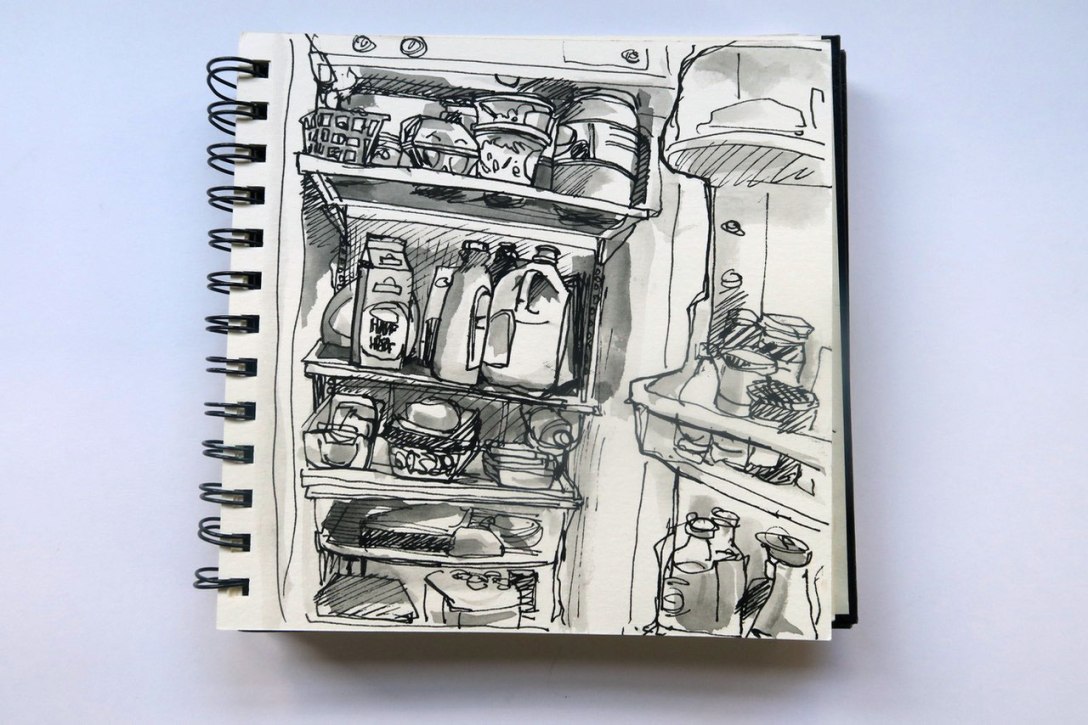
Instead ofsetting up artificial subjects like bowls of fruit or vases of flowers, draw the contents of your fridge. Draw the roses you got for your birthday and write about how you feel getting a year older. Instead of drawing naked strangers in a life drawing class, draw your naked spouse, your cat, your boss. Rather than doing “Drapery studies,” draw the shapes your feet make under the covers on a Sunday morning.
Be inventive. Be fresh. Be personal. It’s an adventure, not a chore.
But I am supremely qualified to do at least one thing. Here’s my superpower:
I’m the best person to write what I think.
I’m the best person to draw the world through my eyes.
I’m the best person to express my point of view, my experiences, my mistakes, my shortcomings, my strengths.
When I compare myself with others and what they make, when I think, ‘Oh, I could never do that!’, it’s easy to forget my superpower.
And if I do, I won’t express myself — and no one else will.
And even if they were to try, they couldn’t to do it as well as I could. So, it’s up to me.
Learn from others, but don’t wish to be them. We all have unique ways of seeing the world. And we all have our own, priceless way to express what we are.






 Danny Gregory