Gluttony means consuming way more than you need. And it’s a great way for the monkey to distract you from your creative path.
Walking through a museum and snapping a picture of each painting you pass, then hurrying on to the next. Signing up for classes, then never bothering to show up and do the work. Why start that painting when you and your credit card could while away the afternoon at the art supply store? Easier to amass more drying tubes of paint, teetering piles of empty sketchbooks, basket-loads of supplies for crafts you doesn’t have the time to master — than bypass the monkey and get to work.
Gluttony means valuing quantity over quality. And we live in times of more, more, more, where there’s always a new distraction, a new treat popping upon our phones. Why do they call it a Facebook feed, d’ya think? Because it stuffs our troughs with trivia, 24/7. We consume bytes instead of being in the moment and appreciating the wonder and beauty around us already. We are gluttonous with our time and yet stingy with it too, wasting it rather than investing it in the self-improvement and habits that can bring us the things that will truly satisfy our hungers.
Gluttony is a sin of lost control. Like Lust, it drives out of our minds, to places we don’t recognize in the mirror. We automatically grab for more entertainment, more stimulation, more consumption, faster, longer, all of which distract us from our purpose, our skills, our deepening experience as human beings. We are unable to ignore the buzz in our pockets, the dings on our night stands, we drool and reach and feast.
Creativity is about creating something new, adding to the world of beauty, not just taking and acquiring.
Gluttony stems from fear. We are afraid of exposing ourselves, standing naked as we are. Afraid of being vulnerable. We cloak ourselves in a thick protective layer of shopping bags from Abercrombie & Fitch, Dean & DeLuca or Windsor & Newton. We need distraction from our true selves, from loneliness, from inadequacy, from being who we are.
The solution is to make more, rather than take more. Pull your excess art supplies off the shelf and give them to your local public school. Turn off all electronics a day a week and fill your time with songbirds and wind. Unsubscribe from distraction and sign up for a healthy diet of starving artistry. It won’t kill you, it’ll fill your soul.
Creativity, like songbirds, can be bought and sold. But songs sound differently from behind the bars of a gilded cage, when sung for a supper.
Greed makes artists compromise. They follow trends rather than their hearts. They measure success in sales rather than in the call of their souls. They agree to distort their work to fit corporate agendas and market demands. Greed turns originality into predictability into a worthless tin horn.
Ironically, greed rusts the very things that made an artist’s work valuable in the first place. Greed transforms artists into celebrities, hogging the limelight, addicted to fame, prisoners of their egos, and detached from the pure, original source of their creativity.
Greed distorts and cripples the true purpose of art, turning the fruits of personal expression into a mere commodity. An artist’s heart-felt response to the world shrivels into a rich man’s prized asset, garnering millions at auction, then hidden away, another coveted diamond on a dragon’s hoard.
The opposite of greed is generosity.
Greed prevents artists from sharing their work with the world, afraid it will be poached. Rather than joining a creative community, inspiring others, collaborating, teaching, sharing their insights and lessons, greedy artists hide in their studios, squirreling away their work, waiting for the best offer. They refuse to support causes, to contribute their creativity, to reap the benefits of selflessness.
When you are afraid of being deprived, you hoard possessions against any possible future famine, no matter how remote. When you are afraid of being passed over and neglected, left to shrivel and die, you hoard attention. Afraid of competition, you crouch on your mountain of toys so no one else and play with them. Afraid of being taken advantage of, you refuse to open the door to others. Afraid of being vulnerable, you amass a pile of any stuff than could be a bulwark or a weapon. You bank your work rather than letting it see the light of day and of possible critique.
Greed blocks your way. Generosity and creativity clear it.
I frequently risk being the prisoner of my ambition. I dream big and often, then wake up exhausted with a long to-do list and a sense of dread. How will I get it all done? How will I climb this mountain I have built?
I sit at its base, exhausted by the possibilities, wrapped in a sense of failure before I begin. That sense threatens to keep me from the first step. And the longer I wait to begin, the further away the summit will stretch.
Not doing can easily become a reflex. Like a hoarder with newspapers to the rafters, like a 700 lb. man trapped in bed, like a refugee clutching a trash bag of possessions and a child’s hand, it can all seem too big to tackle. Submission to failure and the monkey can seem the only possible recourse.
But doing, like failure, can be incendiary. I start by taking on one challenge, maybe the easiest, teeniest one on the pile. When I have surmounted it, one checkmark on the epic list, I feel a flicker of hope. I pull the next task toward me and the flicker starts to smolder.
I make the bed, I got to the gym, I do a drawing, I write a blog post, I arrange a lunch meeting, I write a chapter, and soon the flames are roaring, wheels are turning, we are half-way up the peak.
Not doing can easily become a reflex.
Then, I sift through the list. I discard the pointless, the distracting, the indulgent. I break the most overwhelming obstacles into a small series of do-able tasks. I beaver on. Soon the list is a scaffolding, a set of pitons leading me hand-over-hand to the top.
Last night we watched The Martian. It’s a great move based on an even greater book. It deals with an impossible challenge: surviving on Mars, with rescue years away. The solution is increments — tackling one small problem, then the next, and so on. The more bite-sized the problems, the easier the whale is to digest.
I’ve just completed the first leg of my European crusade: a week in Switzerland. Basel is a lovely medieval city along the Rhine right on the edge of Germany and France. It’s home to loads of banks and pharmaceutical corporations and two dozen museums — some with extremely contemporary contemporary art, one which is the size of a doorway.
I’ll tell you more about my visit to the city in another post. Today I’ll just try to summarize why I was there.
Important skills: focus and self-starting.
Last winter, I was invited to be an artist-in-residency at the International School of Basel this September. Perhaps you remember that a year ago, I was in residency at another ISB (the International School of Beijing) and had a lovely and illuminating time, so this invitation was very welcome. I was pumped to spend more time with kids, making art, and wallowing in their creative energy. Additional pluses: I’ve never been to Switzerland and, of course, Basel is a mecca for art.
My week began with a school assembly. Six hundred children under the age of 11 sat on the ground while I introduced myself and talked about all we would do in the week ahead.
The future.
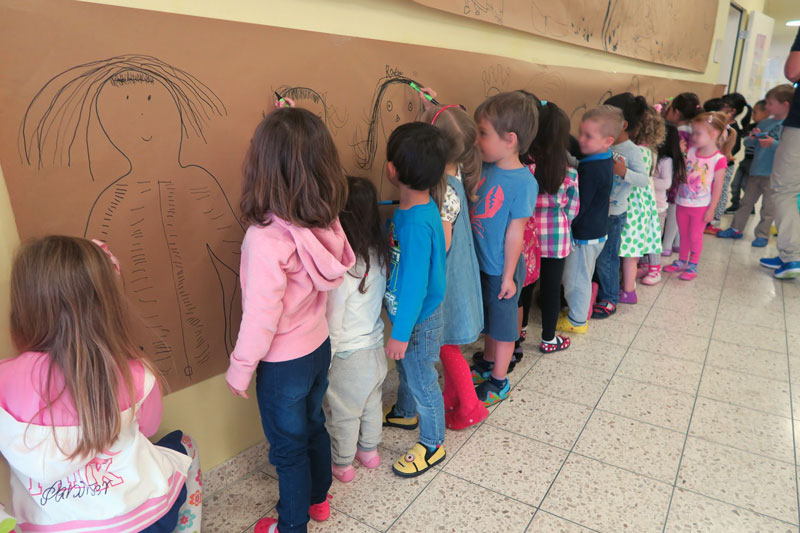
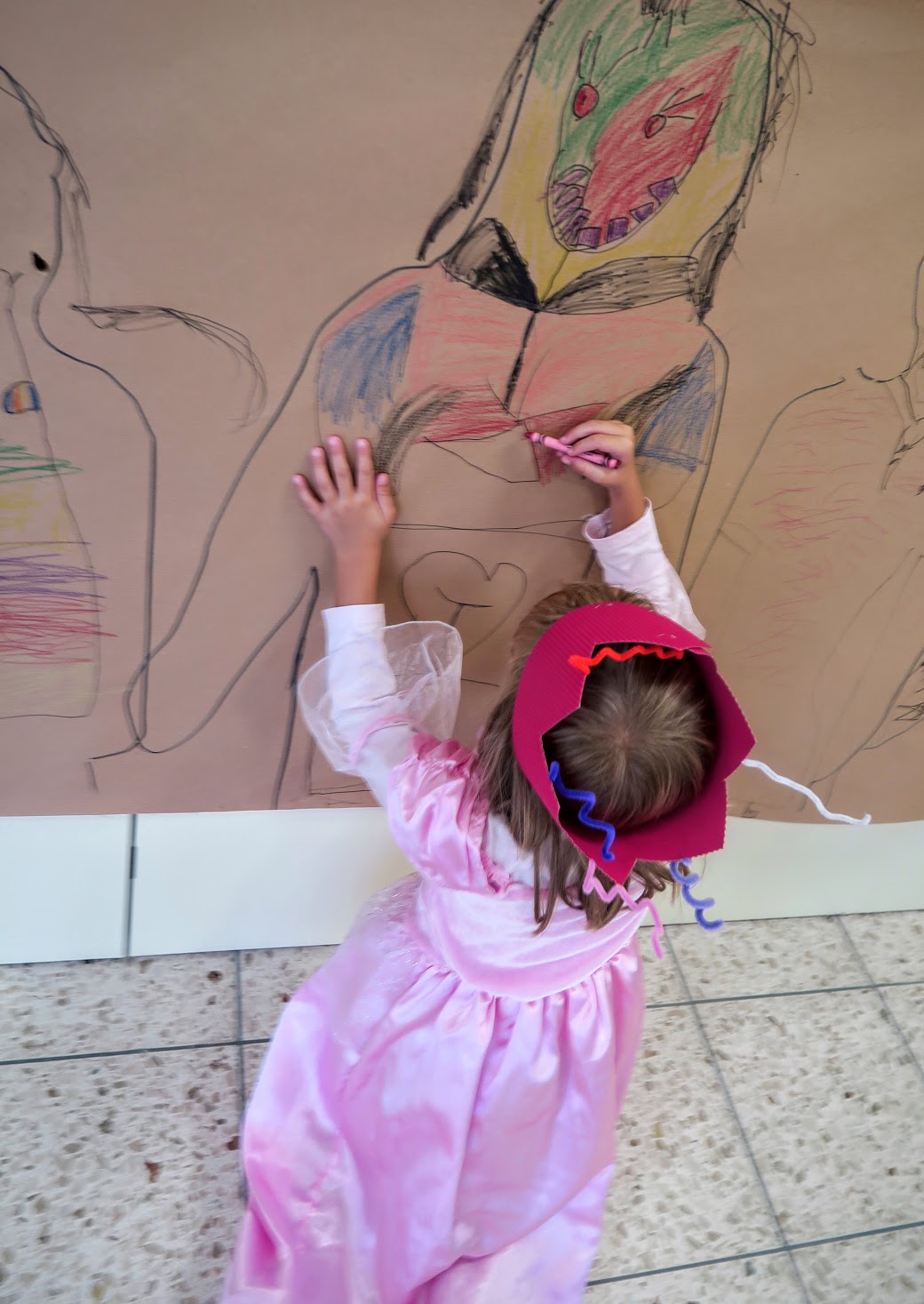
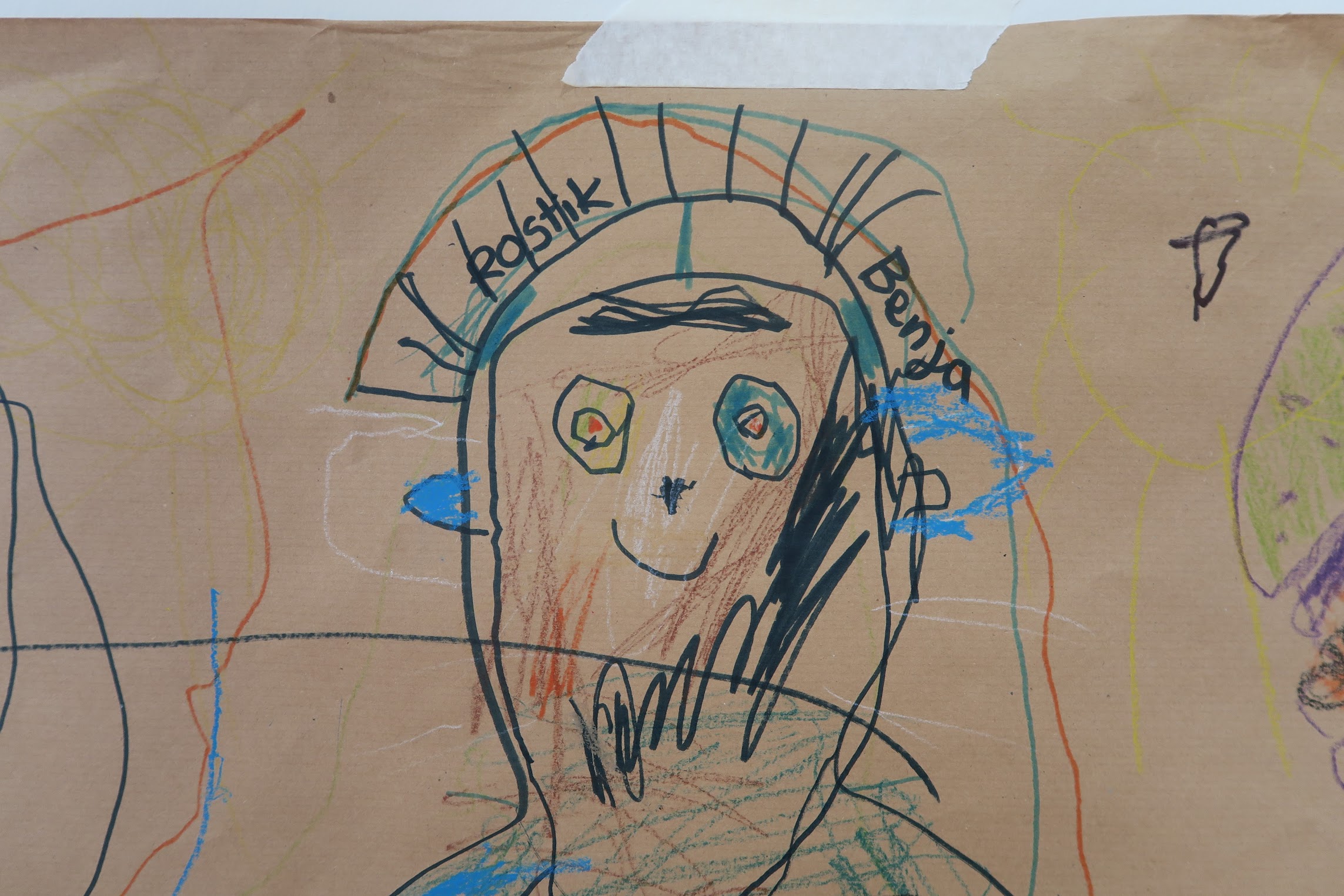
Then each morning at 8:15, I’d let a couple hundred kids and their teachers into my gigantic office/studio/lecture hall and showed them films and gave them creative assignments. We drew breakfast and lunch and shoes and upside-down bicycles and portraits and more. We made enormous murals that covered all the halls and stair wells. We ended the week with a sprawling field trip to the natural history museum to draw dinosaurs and endangered animals and then drew the cathedral and the twisting medieval streets.
It didn’t stop in my classroom. The kids went home at night mad for drawing. Each morning, moms and dads came into the school with stories of kids transformed. They filled up sketchbooks at home, drew with their parents and teachers, insisted that nobody eat their dinners until they had been drawn.
Important skill: observation
After school on Tuesday, I met with all the teachers and showed them how art had opened my eyes. I told them that art is not just for art class — it’s for learning about the world and can be applied to any discipline, from literature to social studies to science to music to gym. I pulled out examples of my travel journals, of my investigations into homelessness, fishing in Manhattan, and dogs in coats. I showed them my maps and Koosje’s recipes and the SBS students’ instruction manuals.
Important skill: problem solving
The next day, an inspired math teacher asked her 4th graders to make drawings that explain the concept of ’rounding up’ numbers. She showed me dozens of stories and watercolors the kids made in response to her assignment. They were all different, all clear, all beautiful. She was able to see how well they understood the concept and they could use their pieces to teach the 3rd graders this concept.
On Thursday evening, I met with the parents and told them why I had come to Basel and why I thought it mattered that their kids had started keeping illustrated journals.
Important skills: collaboration and communication
It was to prepare them for the future — not a future as professional artists necessarily, but as successful people in an ever-changing world. The days of being able to assume that a well-educated person could finish school, get a corporate job, and rise up the ladder till retirement, are over. Instead, kids need to be prepared for the unforeseeable. Technology is upending every industry, traditional jobs are withering while new opportunities are springing up in surprising places. Change is the constant. Kids need to learn to swim in it.
Important skill: Innovation and problem solving
Parents can no longer assume that a traditional education in math, science, literature, language and history will be enough prepare a child for the future. A crucial new skill will be the ability to think creatively. That doesn’t mean dabbling in fingerpaints, but knowing how to spark innovations, to develop ideas, to present them clearly and persuasively, to find resources and collaborators to bring them to fruition, to build networks, to be entrepreneurial. I told them that’s why I supported my own son’s plan to go to art school, so he could learn skills I think will be essential to his future. If he had majored in English or pre-med, I wouldn’t have the same sense of confidence that I had given him the necessary tools.
I told them that they should look at art not just as a sign of being cultured, a middle-class luxury, but as a key component of their children’s total education. I suggested they insist the school’s administration support and look for ways to incorporate art and creativity into all aspects of the curriculum.
Important skill: optimism
If a student is encouraged to look everywhere for inspiration, to combine ideas into new ones, to replace competition with collaboration, to accept mistakes and ambiguity and learn from them, to have faith in the creative process, to know how to overcome its pitfalls, only then will he or she be prepared for a world full of self-driving cars, delivery drones, mobile apps, and Donald Trump.
Knowledge alone is no longer power — it’s something that pops up in your browser. Knowing how to use that knowledge to create new ideas and solve new problems, that will be the source of true power, a power that will serve all mankind.
Look, I’m going to tell you some thing pretty embarrassing. I need to get it off my chest so I’m just telling you, but please don’t let it get around.
A couple of weeks ago, I realized I was horribly, horribly out of shape. I’ve been pretty busy this summer and haven’t had a lot of time for much, but this is no excuse. I know better but frankly, I had just plain let myself go.
One afternoon, I sat down, brushed the dust off my sketchbook, uncapped my pen and began to draw Jenny’s shoes.
I couldn’t believe what came out. It was awful. And even worse, the act of drawing was awkward and crabbed, like I had three left hands and they each had sprained wrists and five thumbs. I tried slathering on some gouache to cover my mistake but that just made matters worse. The prognosis was clear and so was the cause.
I had forgotten how to draw.
I felt humiliated. I mean, I have been so busy all summer writing books, giving talks, blogging, making stuff for Sketchbook Skool that I had become that archetype: he who can’t, teaches. I felt really awful. And I wasn’t sure how to fix it. Well, I sort of was but I wasn’t sure it would work.
I had three left hands and they each had sprained wrists and five thumbs.
My first impulse was to get down all my old favorite, sure-fire drawing instruction books. Sketchbook for the Artist. Work small, Learn big! Creative Ink Drawing. then all the artists who’s inspired me. Crumb. Searle. Gentleman. Hogarth. Kane. Ware. Jean. They remind me how to do it. But my mentors just made me feel more inept and hopeless and lost.
Next, I decided I’d better go to the art supply store. Maybe, I just need some thicker pens. And a new type of sketchbook. I bought a painfully expensive one that claims that ink never bleed through its page. Cool, I could finally draw with Sharpies. I’d seen Jonny Twingley doing that to great effect. And the Basquiat notebook show at the Brooklyn Museum was full of big bold lines and flat colors that seemed just the ticket. I came home with an armful.
That was another mistake. Thinking that switching everything up would provide instantly good results. Not only had I forgotten to draw, I was now setting out to learn how to use a bunch of new materials and simultaneously ape someone else’s style and POV to boot.
The first few pages in the book continued down the disastrous path. I kept thinking and thinking about how to reduce things into shapes, struggled with how to add tone, drew far too fast, and then, to cap things off, the cap came off one of my fat new pens while it was in my pocket, scrawling a tattoo of india ink down my leg, my pants and even my good salmon Lacoste shirt.
Early one sweltering morning, I sat in my boxer shorts and made a self-diagnostic comic. Time to get to work.
The weekend arrived and Jenny and the dogs and I went to the park. While my family dozed on a picnic blanket, I drew people. Fat, tall, crazy, slow-moving, sleeping, texting, skateboarding people filled my pages. Even the slowest were too unpredictable for me to do a lot of strategizing. I just drew and, if they got up off the bench, I started drawing the next person who sat down. The shadows grew longer, people got sweatier, Jenny and the dogs when back to the air-conditioning, while I kept going.
The next day, I started my morning in the window of the Lafayette bakery, drawing a couple seated at a sidewalk table and having a long argument. Over and over I drew them both, as they gesticulated, accused, sobbed, then paused to shovel down almond croissants. Then I went to church and drew the choir and the congregants, page after page of earnest reverent faces.
I spent the rest of the day watching the U.S. Open on TV. I drew the players, the commentators, the actors in the commercials. Occasionally, I would hit the pause button and to freeze and study a gesture.
As Federer rejected half the balls the linesmen lobbed him, squeezing, bouncing, assessing, until he found the right one to serve, I grabbed new pens from the pile, testing out different weights until I found my way back to an old favorite, a Stabilo pigment liner, but a fatter one than I’d ever used before, a 0.7. I was feeling my old line start to flow again and it had picked up a bit of weight from the influence of Jonny and Jean-Michel.
“I am the one who knocks!”
Monday, Jenny went to work and I began to binge. Summer rains had rolled in, and I started to rewatch Breaking Bad on Netflix. Episode after episode, season after season, I drew bald heads and grimaces and dramatic lighting.
I didn’t try to draw accurate portraits, I just let my pen slide over their heads to take me to new inventions. I didn’t write clever quips, didn’t compose my page, didn’t add color, didn’t judge. I didn’t think. Just drew the scene, turned the page, and moved on.
Fortunately there are five seasons of Breaking Bad and there are still some empty pages left in my expensive sketchbook. After a week of intensive workout, drawing has started to become second nature again. The lines flow. I’m still not thinking but I can just plunk down the pen on the page and it starts to move. And generally in the right direction. For better or worse, the drawings look like mine. And best of all, I love it again. I can’t wait to keep going.
I’ve always found it exciting and a bit chilling to read about the typical day on the life of an artist I admire. They invariably go something like this:
“I spring out of bed at 5 a.m., throw some Ethiopian into the french press, and swim in the Atlantic for 45 minutes with my Rhodesian Ridgeback, Horace. Then, still wet, I sit down at my 1928 Smith Corona and write for four hours or 4,000 words, whichever comes first. I pause to eat 200 ml. of fresh sheep yogurt, steel-cut oats and Lebanese dates. Then, 100 push ups.
“Next, I allocate 43 minutes to email my editor, manager, publicist, agent, mistresses, and fans. When the tibetan sand clock that the Dalai Lama gave me gongs at noon, I walk down to an exclusive boîte on the main street of my quaint, artisanal town to eat lunch at my regular table with one or two of my equally famous artist friends.
Then I stroll home and have a two-hour nap, a massage, a high colonic, sex, two Bolivian chocolates, and return to my studio…
“Then I stroll home and have a two-hour nap, a massage, a high colonic, sex, two Bolivian chocolates, and return to my studio where I write until my housekeeper serves dinner which I eat with twenty of my closest friends and several cases of wine bottled by some aristocratic boyhood pal, then a few lashings of espresso and off to bed where I read some Keats, wash down a handful of Lunesta, adjust my satin eye shade, and dream about tomorrow’s work.”
Making art takes work. For some of us, it is our work. Work without a boss, or a quota, or a time clock. And that kind of job can be very hard to keep up. That’s why artists establish routines, to get them off their duffs and into the studio. We need to be motivated by something to put down the remote or the opium pipe and saddle up.
The only one who will make us do what we do — is us. Sure, editors can give us deadlines in return for advances and gallerists can schedule gallery openings but we know deep down that we can always buy more time if we whine. No one can fire us.
For the last few months, I have pledged to myself that I would post something here three times every week, on Tuesday, Thursday and Saturday at 7 am. I have written several zillion posts here over the years but this is a bit more structured. I made this pledge because a deadline of some kind would keep me more productive than just waiting for inspiration, desire, and schedule to converge. I haven’t been utterly slavish about this pledge as you may have noticed but it has kept me reasonably committed.
The key has been to establish a proper routine about it, besides this slightly guilty feeling in the back of my head that I should sit down and write something. I like to do it early, before the press of the day has begun, when the streets are quiet, Jenny and the hounds are still in bed, and I have yet to read any emails or NY Times editorials that could clutter or influence the flow. I awake with a vague notion, then make a few false starts, and soon the mechanism clicks in and the sentences spool out.
If you stay up until all hours kicking the gong and chasing chorus girls around Montparnasse, it’s a lot harder to rise with the dawn…
Starting one’s days productively takes structure. If you stay up until all hours kicking the gong and chasing chorus girls around Montparnasse, it’s a lot harder to rise with the dawn, so it’s helpful to be a little disciplined about what you do all day long, even when you aren’t creating. Eat protein, read actual books, don’t watch the Tonight Show. Repeat.
And just because my body is sleeping, my brain doesn’t get to punch out. If I mull for a minute or two about what I want to write in those minutes before sleep, it’s much more likely that I will wake up with the first sentence sticking out of my brain like the beginning of a roll of Scotch tape.
The art-making process can be mysterious but it can also be somewhat controlled. You can set a wakeup call for the muse if you give yourself a predictable program, an armature to build your work on.
I’ll write more about this next time. Which reminds me of another tip: never leave your work 100% completed at the end of the day. Park on the top of the hill, leaving half a sentence or a partially drawn face, so the You of Tomorrow can pick up the work in progress rather than wrestling with a cold start.
To wit: I will always remember what Andy Warhol said to me one evening in The Odeon, “Danny, old boy, never mix chickens, ball bearings, and…”
Don’t embrace the myth of the lone genius, toiling in solitude in his garret, undiscovered. Don’t turn “I’ll show you when it’s good enough” into a day that never comes. Don’t dismiss the contributions of other people to making your art better.
Art, like all living things, doesn’t thrive in a vacuum. It needs something to push against, something to react to, the grain of sand in the oyster.
It could be a community of people with whom you collaborate. It could be an audience who shares your work and reflects new perspectives and energy. It could be colleagues who help you polish your creations and see it anew. It could be the long procession of great artists who preceded you and whose work can inspire yours in a thousand ways.
Be brave. Step out. Invite response. Share your gifts.
Art is a conversation. Make sure you’re not just talking to yourself.
A couple of days ago, I filled out the Sketchbook Skool survey we placed at the end of our most recent course, Playing. I shared it on Facebook but because FB is such a temporary place to store important thoughts, I am reproducing it here.
| Please fill your details below
What’s your name?
Danny Gregory
How did you find out about Sketchbook Skool?
My friend Koosje told me about it.
‘Playing’ | Your Experiences
Why did you sign up for this Kourse?
I have been worrying so much about perfection, about ‘getting better,’ about ‘making art’ that I was losing the pure joy of making. The idea of playing for a few weeks seemed like it would be fun. I didn’t want to just learn more new techniques, I wanted to reconnect with the spirit of creativity I had when I was six, a spirit that burned the hottest I’ve ever experienced and that made Picasso great.
Was the kourse what you expected?
Yes
What did you expect?
I expected some people to like it and some to be disappointed. I expected some people to let loose and dance the hootchy-kootchy and some to complain it was for kids and grumble that they had paid $69. I expected some people to grumble right off and then do one assignment that opened their eyes wide and they would go back and look back at the assignments they had just skimmed and suddenly find delight. I expected some adults to share their new found creative energy with kids, making sure that those kids never forgot how much fun art can be. I expected to be inspired by the enthusiasm and freshness I saw in the galleries.
Do you prefer the more shorter lessons, which is the style of Playing? Do you like more emphasis on projects than on lectures?
I thought the change was good. I’d heard a lot of people say they didn’t have time to do the more complex assignments they got in ‘Stretching’ and ‘Storytelling’ so I thought just screwing around with crayons would be a nice break.
If you’ve taken a Sketchbook Skool Kourse before, was ‘Playing’ a welcome change?
I loved learning from the great artists who teach at SBS. But the parts of the klasses that stretch me the most are the homework assignments. I learn a lot from doing them and from seeing what others do. I thought a kourse that was all about making stuff would be a cool change.
I have been drawing for twenty years and this is how I learned. I believe that it is the only way — to be inspired and to take my lit fuse and blast off in my own personal direction.
Sketchbook Skool | How do you feel about it?
At Sketchbook Skool we believe that the best way for you to learn is to be inspired, rather than giving you a lot of step-by-step instructions. How do you feel about that?
I have been drawing for twenty years and this is how I learned. I believe that it is the only way — to be inspired and to take my lit fuse and blast off in my own personal direction.
How do you experience Sketchbook Skool: Is it about exploring yourself or about community?
SBS inspires me to start and the community keeps me going.
The lessons make me challenge my assumptions, make me marvel at what is possible with just a pen and a book, and make me accept responsibility for my own creations and education — I am my own best teacher.
The community stretches me further, shows me more of what is possible, supports me when my monkey gets me down, pushes me to keep getting better and insists I stick to my creative habits.
I could draw alone. I could learn alone. I could evaluate my work alone.
But passion is so much better when it’s shared.
As I brush my teeth, while I eat my cereal, on the train, as I walk down the street, before I turn the light out — one of my chief pleasures has always been burying my nose in a book a few times a day.
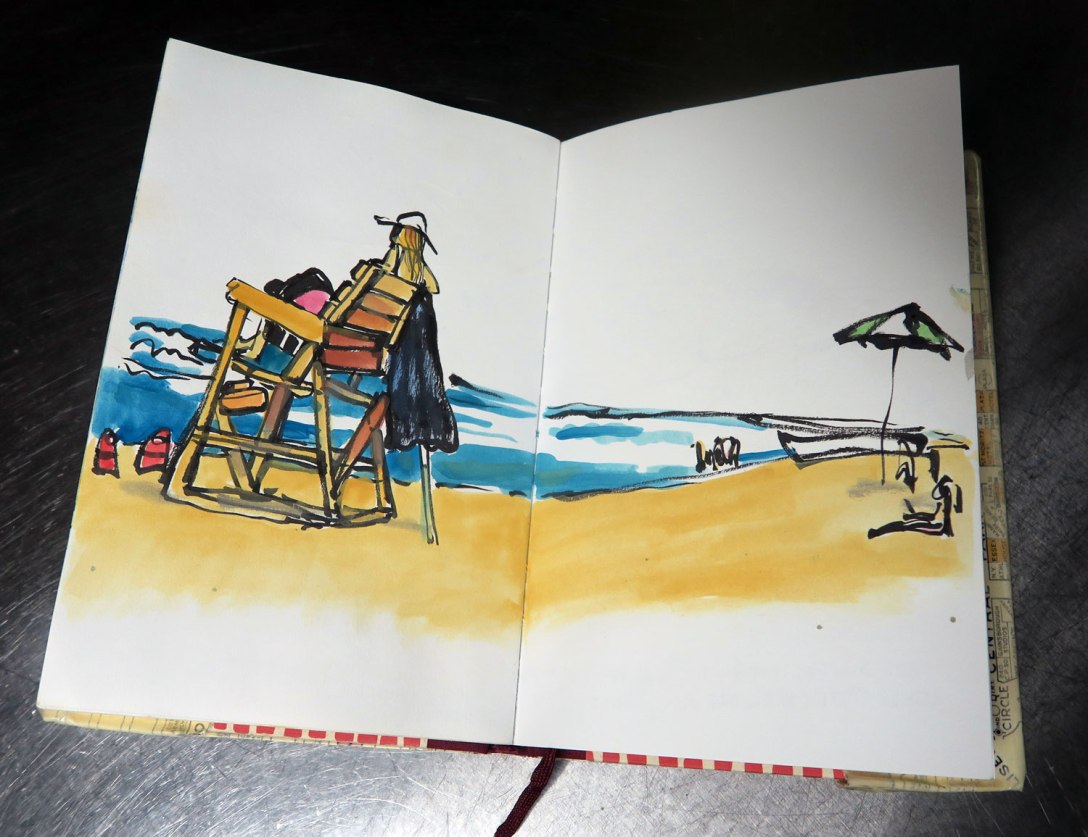
I just spent a few days on the beach with my pal Tommy Kane, parked side-by-side in deck chairs, drawing and reading and napping. I read a handful of books, dipping back and forth, as I often seem to do these days.
The hard part was really losing myself in a book. It wasn’t a matter of being distracted by people in thongs wandering by or the caws of seagulls. It was my brain —which increasingly finds it harder to stay connected with long passages, especially ones that aren’t moving the plot ahead but are lyrical or descriptive and celebrate the joy of language.
I don’t have ADHD. I have an iPhone.
These days I seem to read all day long. Emails, texts, blog posts, news, it’s just an endless stream of words. Every type of communication is written. I never speak on the phone anymore, I just type on the keyboard and read responses.
And all these words demand that I read them differently than I did Chaucer or Proust or Tom Wolfe. I skim, I scan, I browse for the gist. I exercise my eyeballs and flitter my fingertips. There is so much to wade through, I have to retrain my brain to suck down words like an endless skein of overcooked pasta.
This is called a pull quote.
It’s here to attract your attention and make you want to read my post. Hope it works!
And as a writer, I have to adapt to this pell-mell, distracted world. Instead of long, meandering blog posts, I should be writing listicles and giving people ten actionable tips they can tweet and share. My paragraphs should never be more than three active sentences. My titles should be pithy yet info-packed. I should avoid arcane references and worry about search engine optimization. And what is all this doing to my brain? Will I ever again be able to sink into a long novel like a warm bath and bask until my fingers pucker? Oy.
I recently heard a neurologist say that keeping up with all these Facebook posts and tweets is rewiring our brains so we struggle to delve deep when we read, and that we are in danger of losing the rich beauty and dense wisdom of great literature. And we stand in danger of becoming superficial thinkers, trite and incapable of going beyond the obvious, ping-ponging between stimuli, unsatisfiable.
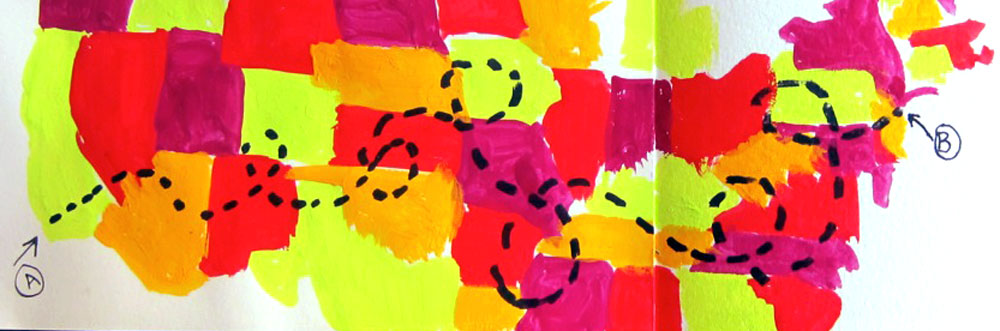
Almost exactly a year ago, Jenny and I drove from Los Angeles to New York City. In the months before, we talked a lot about where we might go and drew up lists of places to stop en route. We weighed the pros and cons of going north and driving the length of the Canadian border, of drawing a straight line from LA to NY and beelining across the Midwest, of meandering through the heat of Texas and the Deep South. I consulted web sites about cross-country drives, downloaded a half-dozen apps, and reread On the Road.
A couple of days before we left, we had a big yard sale and emptied the cottage we’d occupied for a year. Then we hit the road with 666 dollar bills in the glovebox.
Despite all our discussion and planning, we ultimately committed to just one decision: that each day we would decide where to sleep that night and that decision could be postponed until the sun was setting. Sometimes we booked our hotel while sitting in its parking lot. This was pretty atypical behavior for Jenny and me — she’s a producer and I’m a Virgo, organized and methodical people who like a sense of control. But this trip was to be different. We intended to get New York in roughly two weeks — and that was all we knew for sure.
It was a risky and brilliant strategy. We meandered all over the map and saw things we had no idea even existed. We made monumental plans while driving, then scuttled them over dinner. We acted impulsively and took many roads less traveled. When we pulled onto our street in Greenwich Village, we knew we’d had an adventure that we would always remember. It was epic.
The core of my brain (and yours, hopefully) is the limbic system, the ancient part that sits under my cortex, deep in the most protected part of my skull. It manages my emotional reactions, its gnarled, primitive fingers fidgeting on the buttons that trigger my reactions and form my most salient memories. It is primitive and essential, making me happy, angry, hungry, horny or terrified. This part of my head is me at my most impulsive.
Sitting astride is my modern brain, the source of higher function, the part that cracks the bullwhip, straightens the cutlery, talks to my accountant, and imagines itself superior. I have relied too heavily on this ultra-rational part of my brain for most of my life. It has helped me think my way out of feeling too intensely, providing Mr. Spockian rationales for my baser yearnings, keeping me in check. It has helped me succeed — but I wonder how many roses it has kept me from smelling.
I have published a dozen or so books by now, and each one has started with a road map. Sometimes my editor has asked for it, an outline to include with the proposal she submits to her editorial board. But always my frontal lobes have insisted on it, wanting some clarity about the mission ahead. Believing that I can’t build a building without a scaffold or a monument without an armature, I have arranged bullet points and sub-points into neat staircases with sturdy handrails to lead me to the summit and safely back down again.
And then I have sat down at this machine and kicked the blueprints under my desk.
Outlines and bullet points are one thing but writing or painting something that lives and breathes are something quite other. No one wants to dance in the moonlight with a sturdy skeleton. Flesh and blood are lissome, moving under your finger tips, breathing and changing shape. And so it is with art. A sketch is meant to be done in pencil so it can be erased as better choices emerge.
All this preemptive planning just gives me the courage to turn the key in my driveway, the balls to say, let’s drive three thousand miles and trust that we’ll eventually get where we’re going. Even if I draw the route in the thickest Sharpie, I still plan to listen to my gut, to my amygdala, to the songbird at the crossroads who says, hey, let’s take a left here and see what lies around the bend.







 Danny Gregory