Someone probably already said this but…

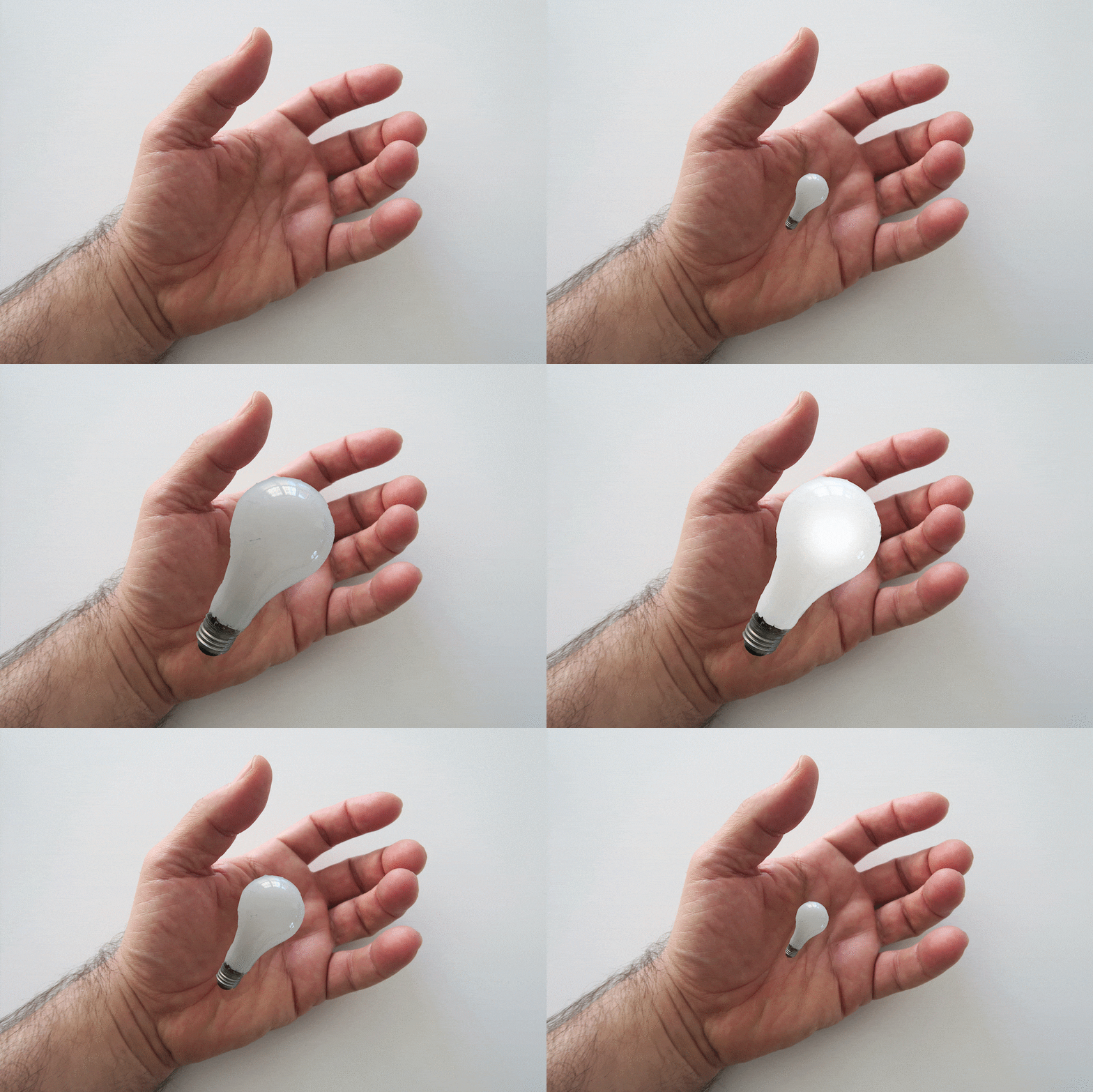
We think of genius as the ability to dream up something never seen before. But originality is overrated.

What matters more is reacting and responding and refining and adjusting and tweaking and struggling and sweating and polishing and finishing and delivering and making a difference.

AHA! is orgasmic, sure. But now the hard work begins.

I have the foggiest idea.

I’m at the very early stages of starting to think about a new idea. It’s more of an inkling at this point that I hope to develop into a notion, then maybe let it simmer in the skullpot till it becomes a concept.

Not sure where it’s gonna take me, but I’m excited to feel myself off on a new adventure. I don’t know how far I’ll go, what heights I might scale, what dead ends I might meet, wbut I’m ready to begin.

It doesn’t matter where I start this journey of discovery. Turn left at the doorstep or right. Go two blocks then turn right or continue straight.
What’s important is that I am moving, that my mind, eyes, and heart are open, that I am having new experiences and that they are connecting and sparking with other experiences to create something fresh and alive. That I am striding confidently and laying tracks.

An idea lurks around every corner. It doesn’t matter where I bump into it. But it won’t show up until I make the first move.

Drawing without drawing.

A couple of days ago, I had a mindful moment in an unlikely place. I had to go to a government office to renew a document. It was a large room filled with rows of chairs facing a series of steel desks with computers and clerks. Not Kafkaesque, just dead boring. I wasn’t perfectly prepared for this chore — it was one of a series of appointments I had that day and I had rushed there from a completely unrelated matter.

As a result, all I had with me was a sheaf of important documents. In my hurry, I hadn’t brought anything to while away the time, no book, no sketchbook. But the Kindle app on my phone was stocked with several books if need be. I figured I’d be fine.

After much paper shuffling and stapling, the desk clerk handed me a number and pointed at the sign on the wall: “No phones, cameras or recording devices.” If I took out my phone, she said, I’d be booted and have to make a new appointment for another time.

I shuffled over to an empty seat and slumped down, feeling like a snot-nosed, scuffed-kneed nine-year-old waiting to see the principal. Rows of people surrounded me, their faces blank, their eyes glazed. On the wall, a counter displayed a four-digit number in red letters. A number significantly lower than the one on the chit in my hand. I’d be there for a while.

I spent a few minutes grumbling to myself about the archaic ban on mobile devices. What could be the stupid reason? I’d already had to empty my pockets and pass through a metal detector to get into the room. What did they think I’d do with a phone? Snap pictures of my co-victims? Of the lovely clerks? Of the tottering piles of yellowing papers? Of the warning signs, the 20th century computers, the flickering fluorescents? Grumble, groan.

I fidgeted a bit in my uncomfortable chair, then I squirmed, then I examined at the boil on the neck of the man in the seat ahead of me, then tried to calculate if the glowing number on the counter was prime. I hadn’t had lunch yet so I spent a while listening to my stomach too.

Then I noticed a spray bottle of glass cleaner on one of the metal tables. I thought, that’d actually be interesting to draw. I had a pen in my pocket to fill out forms but no sketchbook. Then I remembered the neatly paper-clipped stack of papers in my lap. I flashed forward to handing over these documents to an official, papers now covered with drawings of Windex bottles and neck boils. No, I wants things to go smoothly and handing in my VIPapers festooned with junior high marginalia wouldn’t cut it.

I went back to looking at the bottle. I liked the way the neck curved into the body, the six concentric rings that were debossed into the plastic, the soft highlight in the middle, the way one square side of the nozzle was a slightly darker red that the next.

I decided to draw the bottle with my eyes. I coursed slowly along the edge, looking deeply just as I would if I were drawing. I made a run around the edge of the label, a contoured path with one continuous line. Then I jumped to the edge of the blue trigger, cruising into the hollows that fell into shadow, peering in to see every detail I could pull out. I trekked up the side, then slowed myself, not wanting to hurry too fast even though it was an unpunctuated stretch. Move too quickly, I told myself, and you miss something. I down shifted, making myself maintain the same pace no matter how dull the landscape.
A chair squeaked. I looked up, ten numbers had flipped on the counter. Still a way to go.

I moved to the boilscape on the pale neck in front of me. I uncapped my mental pen again and started to draw each hair surrounding it, the rivulets of sweat, the fold of flesh, the soft ridge of fat. I worked my way down to the yellowing neck of the t-shirt, then across to the right shoulder, then down to the sleeve, the arm, the top of the next chair, up the leather jacket of the man in the next chair, documenting each fold in the leather, then up the neck tattoo, across the lightly freckled shaven head, then up a column, over each poster, on the bulletin board, down the clerk’s handbag, over her bottle of Jergens, around the stapler and then a loud cough brought me back. My number was up. Forty-five minutes of my life had been compressed. I gathered my papers and approached the clerk on a cloud.

This morning, I sat in my kitchen. It was six thirty and the sun washed the room. I had been asleep five minutes before but I decided not to start this day by reading the paper and scanning my email.

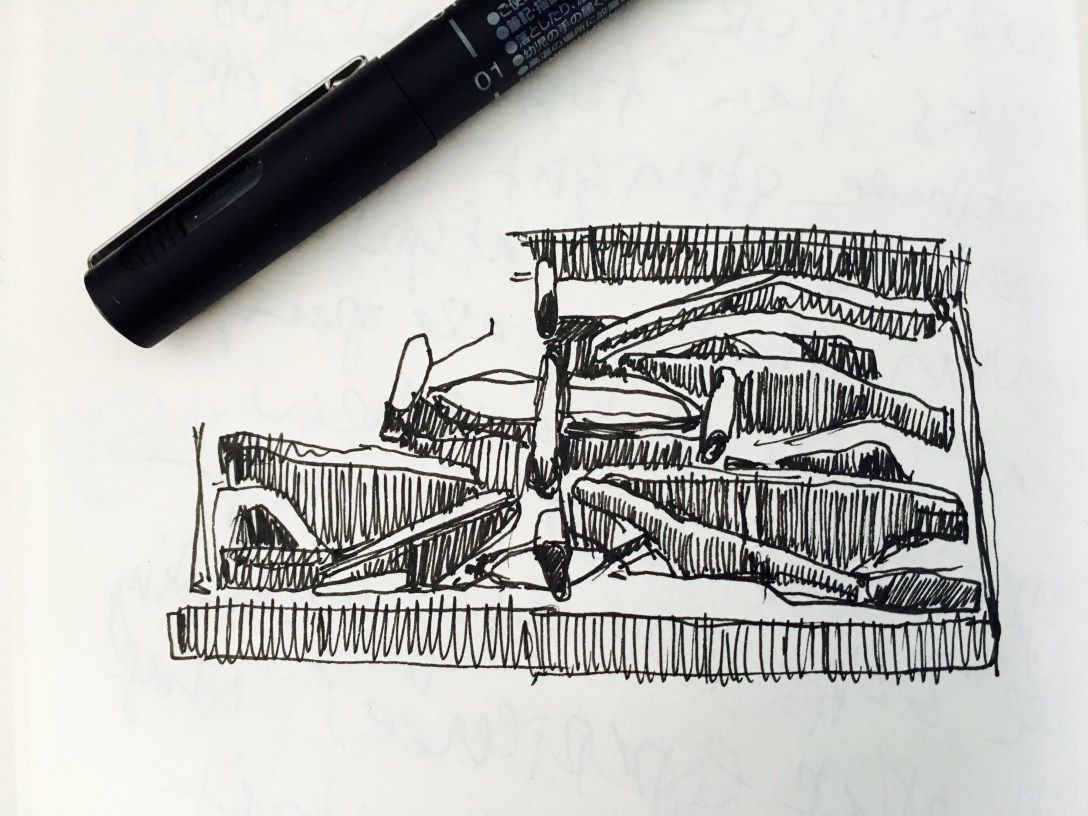
Instead, I went back to my moment in the temple of bureaucracy. I’d felt surprising peace there on my stiff-backed chair and it seemed it be a nice way to start my day, a little contemplation of nothing. I fixed my gaze on the top of my range, the burners and the bars that criss-cross the top, and started to trace the edges of the first one with my mind. The bars are black, so are the burner and the steel pan underneath, but the morning light made a hundred gradations of the curves and angles. The vertical bars stretch away from me, perspective forcing them into lozenge shapes The angled bars were cut by the bars in front of them so they formed jig saw shapes. I looked at each one in succession, working my way towards the back, increment by increment. The kitchen clock ticked away.

After twenty minutes, I had traversed the whole left side of the stove top. I slid my sketchbook over, uncapped my pen and spent the next twenty minutes taking the same trip, only this time I recorded the observations I made. At 7:20, Jenny came in to make coffee and the spell was broken.

I’ve never thought of myself as capable of mediation, but I think this exercise has a similar effect, slowing down and clearing my mind before the day begins and giving me a boost of creative energy that had me writing this blog post and sipping my morning tea.

I liked it. I think I’ll call it Omm-bama care.

Jack Ruby’s Second Life.

Last night, JJ and I went to see a friend of hers have a dream come impossibly true. When Robin was in his late teens, he and some friends formed a band which they named Jack Ruby. They made music that was loud, distorted, punk. It was the early 1970s and that sort of things was very new, even in New York City. They played in their loft, and occasionally for other people.

After a few years of dicking around, Jack Ruby disbanded. The members got jobs, families, mortgages. Randy became the Ethics columnist for the New York Times. Robin became an advertising TV producer. Their Jack Ruby memories faded and dimmed.

One day a couple of years ago, Martin Scorsese hired Don Fleming and Lee Ranaldo (who used to be in a different band, a successful one called Sonic Youth). He asked them to help him make an HBO show about the music scene of the 1970s. At the core of the show is a punk band — the lead singer is played by Mick Jagger’s son.

In their research, the guys happened upon a bootleg tape of Jack Ruby’s songs and it blew them away. They decided that this music would be what the band in the TV show would play. They rerecorded the songs using authentic period instruments, the fake band lip-synched along, and Marty shot his show around them. Suddenly, finally, and out of the blue, Jack Ruby’s music is being heard by millions of people. It had taken forty years but the members of Jack Ruby had never intended it to happen.

Robin called up JJ one day and told her this story. He invited us to the recording of a radio show in which the guys from HBO would be interviewed about the show. At the end of it, the musicians would be performing the Jack Ruby songs. And Robin would be singing. He hadn’t been on stage since Jerry Ford was in the White House and his voice was shaking on the phone. Small wonder.

So yesterday, we went to see the show. The recording was in front of a live audience on lower Broadway, just a few blocks from Wall Street. We took an ear-poppingly fast elevator to the 20th floor and go out on what turned out to be one one of those collaborative working spaces where startups rent desks by the month and share wifi and espresso machines. About a hundred people were there to watch the interview and afterwards the band played. They were so loud we could barely hear anything Robin bellowed into the mic. It sounded awful and just like every show I ever saw at CBGBs. It was awesome and odd.

During the interview, the musicians had talked about coming to New York in the 1970s, about how exciting it was, about how there were all these overlapping cultures converging and sparking. American culture was transforming.

Three forces that would soon define today’s popular culture were emerging and NYC was Ground Zero. Downtown, CBGB was giving a stage for music that came to be labeled New Wave and Punk. In the Bronx, people were laying refrigerator boxes on the pavement to break dance and free-form poetry over spinning records, sowing the seeds of the rap and hop-hop that is today’s status quo. And in Bay Ridge, in gay clubs and eventually in Studio 54, disco music was upending Rock’n’Roll’s throne.

Because the tectonic plates were shifting, a few guys in a loft in SoHo could make noise that would make a difference. Despite never having a Soundcloud page or posting on Facebook or even releasing a record, Jack Ruby could still make a ripple. A ripple that still mattered when their hair was grey and their shades were trifocal.

While the band played, I kept thinking about where we were and how the world has changed. Here I was on a conference room chair in a co-working space. Every so often, a dude with a sleeve of tats and a man bun would emerge from his glass cube to make a macchiato, only casually interested in the piece of history being honored in his lobby.

He didn’t know it but this dude is the heir of the Jack Ruby guys. He’d come to New York to be a part of the scene too. He was one of hundreds of thousands just like him, dudes who packed up their fixies and plaid shirts and business plans and come to the Big Apple.

He’s a part of a creative revolution but one with extraordinarily different goals. These new dudes are not interested in the long dead music scene. No one makes a dime making records. Instead of smashing guitars or thundering baselines, the dude and his bros are coding VR headsets and delivery drones. Unlike Randy and Robin, the dude came to New York to get funded, IPOed, to be a billionaire by thirty.

As Jack Ruby’s last chords died out, I wondered, “Will anyone celebrate this dude’s accomplishments — in 2056?”