Westward weiner smuggling.

weiner smuggling

I’ve been in this town for forty years, in this apartment for sixteen. I have my favorite deli, pizzeria, subway line, barber, newspaper, baseball team and proctologist. In 72 hours, I’ll be packing my hounds into bags and taking them to our new home in LA. Hello, white space.

These have been times of change. In the last few months, I redid my apartment and started living with my girlfriend, then decided to pull up stakes and move to LA, left my job, started some super exciting new projects, got a new book contract, spent the summer with Jack, then he left again, I started watching Real Housewives, drinking green juice, drawing with a pencil, and parting my hair on the right — the list goes on. If this is mid-life, I guess I’ll live to be 106.

My life has always been marked by change ever since my parents split before I was two. I have lived all over the world, had calamities that reshuffled my deck several times, and more and more craved stability and consistency. I hated change and wanted to just be left the hell alone. But as I age I have realized that there is no such thing as consistency. Change is inevitable and it’s good. Even more so when you have some say in it.

Now, at last, I have control over my karmic checkbook. And I am mixing it up, folks. I may even get my eyebrows threaded. Stay tuned. We fly west on Sunday night.

Out of the mouths of sophomores.

20130909-083234.jpg
Yesterday was a bittersweet day, driving up to Providence to help Jack move into his dorm and begin his sophomore year at RISD. Bitter because I am losing my boy again after we had a great summer together, spending a lot of time hanging out, making things, watching lousy movies, and drawing. Sweet because he was so excited about starting the new year, his first as a painting major, raring to get to work. He read several influential books this summer: the recent biography of David Hockney by Christopher Simon Sykes, Lives of the Artists by Calvin Tomkins and Patrick O’Brian’s plump biography of Picasso. They combined to give him a sense that he better get on with it, that Picasso was already an acknowledged genius by nineteen.
One of the many nice things about having a kid who’s also an artist is the impromptu discussions we have about all sorts of art-nerd stuff — meaning in the arts, the roles of galleries, the pros and cons of acrylic over oil, the best way to crosshatch, whether or not Jeff Koons is an idiot, and so on. I feed off his enthusiasm and will sorely miss him, though he’s only a text message away.
On the drive up I-95, we were talking about line quality. I was pointing out to him that when I want to do a ‘good’ drawing, I slow down as much as possible, striving for accuracy in my line lengths and angles, but that when I step back from a drawing done super slowly like this, it can sometimes seem cramped and without expression. When I look at a master of the drawn line like Egon Schiele, there is so much confidence and sweep in his line and I know it was turn in a broad, swift stroke, not a cautious micromillimeter at a time. For me, the real essence of a great drawing is the quality of the line. An imprecise drawing that is full of life and personality is infinitely better than a stale xerox.
Jack’s response was that you need to put in the time making cramped and crabbed drawings in order to develop the confidence to draw like Schiele. That you shouldn’t sit down to make a ‘good drawing’ but just be in the moment. It may turn out well or not but it’s all about doing the ground work and then letting yourself go.
He’s right. If you want to play Bach, you need to do endless fingering exercises. You need to slow down your golf stroke and study each inch of it before you can connect with a masterful drive. You need to train your neurons and your muscle fibers and to train them to be accurate. Doing lots of hasty drawings will just frustrate you in the long run. It’s like driving, you have to start slowly in the supermarket parking lot, inching around orange cones, before you can take the curves at LeMans.
Unfortunately, this can be frustrating if you are counting on amazing results right away. It can take years to have a completely sweeping line. And even if you do get that confidence after loads of practice, a few weeks of not drawing can cause serious backslide. You have to come back, warm up, start again.
However, there is pleasure even in these slow, inch-worm drawings. They are precise, they are accurate depictions of what’s in front of you and there’s a certain satisfaction in that. Next, to raise it up to the level of high art, to draw it with feeling and a sense of abandon.
It takes years to raise a boy to be six foot three and so smart. It takes confidence to drive away and leave him in Providence, RI and know he’s going to do his best.

Short story long.

politcians

“Whether he is a sinner I do not know. One thing I do know, that though I was blind, now I see.” — John, 9:25

My grandfather grew up in  a small village in Eastern Europe and this was one of his favorite stories:

A peasant comes to the village wise man and he is very upset. “My house is far too small for my family. It’s dark and small and smells of cabbage but I am too poor to afford a bigger one,” he complains.

The wise man strokes his beard for a minute and then says, “Do you have any chickens?”

“Of course I have chickens,” replies the man. “What sort of self-respecting Eastern European peasant do you think I am? I have six chickens and a rooster.”

“Bring them into the house and let them live with you,” says the wise man.

“What? That’s insane…,” the man says. “Chickens in the house?”

“Do it. Then come back in a week and tell me how things are going.” says the wise man and turns back to his book. The peasant leaves, grumbling.

A week passes. The peasant bursts into the wise man’s house. The wise man, not looking up from his book, says, “Well, did it work?’

The peasant explodes: “Of course not. It’s a disaster! There are chicken feathers and chicken droppings everywhere. And the house is even more crowded! We’re miserable.”

“Do you have a goat?” asks the wise man.

“A goat?” fumed the man. “Well, yes, we have a big, smelly goat.”

“Excellent. Bring the goat into the house. See you in a week.”

The peasant leaves, shaking his head with disbelief. He’s back five days later, frantic. “What have you done to me? My life is a nightmare. The goat ate my wife’s best babushka, the chicken have taken over my Barcalounger, and our house smells like a Warsaw subway men’s room.”

“Excellent,” says the wise man. “Your cow — bring her in next.”

“The cow? The COW?! She’s huge! I doubt I can even get her in the front door.”

“Do it.” The wise man dismisses him with a wave of his wrinkled hand and returns to his book. The peasant, his face turning an even more dangerous shade of vermillion, stalks out, cursing under his breath.

When he returns, his hair is dishevelled, his coat is spattered with chicken droppings, a goaty smell emanates from his overcoat, and cow dung’s on his boots. He doesn’t complain, he just stands there, broken, tears cutting a path down his grimy cheeks.  The peasant is clearly at his wit’s end. The wise man looks up and smiles. “Very, verrry good,” he says. The man gulps back a sob. A chicken feather drifts out of his beard.

“Now,” says the wise man, “For the most important step. Take all the animals — the chicken, the goat, the cow —and drive them out of your house. Get them all out.” The peasant merely shrugs hopelessly, then turns and shuffles out of the wise man’s house.

The next day, he’s back. He’s transformed. His eyes gleam, he stands tall, his energy has returned. “How is your house then, eh?” asks the wise man, a twinkle in his rheumy eye. The peasant grabs the wise man and kisses his leathery cheeks. “We drove out the chickens, the goat and the cow and now … it’s huge! It’s a mansion! It’s clean and bright and we are so happy. At last! You are a genius!”

Anyway, that’s my grandfather’s sort of story. It came to mind yesterday evening as I sat in the bleachers behind home plate and watched the Brooklyn Cyclones lose abysmally to the Aberdeen Ironbirds. I had one hand cupped over my left eye and a smile as broad as the peasant’s on my face.

Five hours earlier, it being a close and muggy afternoon, I had taken my Kindle and a single dachshund to my bed for a nice Saturday afternoon nap. I’d had a fairly rough night’s sleep, and was a little wracked with self doubt, missing Jenny in LA, and just generally feeling unnecessarily sorry for myself.

I awoke an hour later, groggy and sweaty. I had been sleeping face down and I was especially bleary-eyed. I staggered into the bedroom and splashed on some cold water. I saw a big crease running down my face, from my forehead to my cheek. My vision still seemed bleary so I splashed on some more cold water. I looked out the window and I could not focus on the view. The vision in my right eye was really blurry.  I covered my right eye and everything seemed fine but when I did the same with my left, the buildings down West 3rd street would not get sharp. I rubbed it some more. No change.

I waited. Ten minutes. Then half an hour. No real change. Clearly I had done something awful to myself in my sleep. I had been lying on my eyeball and somehow strained it or compressed it or worse. My hypochondriacal monkey had several helpful suggestions. Maybe my vision would never come back? Maybe I would be permanently blind in one eye? Maybe I’d had a stroke?

Jack and I left to catch the F train to Brooklyn to meet my sister, her husband and kids at MCU stadium to watch the Mets minor league franchise play Baltimore.

The ride to Coney Island from the Village is about 45 minutes long and I spent a lot of it in a minor sweat, my bowels liquid with worry. The monkey kept me company. Wouldn’t it be ironic if just as you decided to focus on art full time — you couldn’t focus at all? Maybe you’ll have to wear an eye patch? Maybe you’ll end up with a guide dog? Now you can really do blind contours! Ha, ha! 

The train comes above ground once you get to Brooklyn and I kept alternately covering my eyes to peer into the distance.  As we reached Avenue X, now an hour and a half after I’d woken up, things maybe, possibly, seemed to be improving. If I just used my right eye, it slowly began to focus on the housing projects in the distance. Then if I uncovered both eyes, it took a minute for them both to adjust. It was wonky but it was changing.

We got off the train on Mermaid Avenue and proceeded immediately to Nathan’s to fortify ourselves with some medicinal hot dogs and fries. I kept testing my vision. The Cyclone, the Ferris wheel, the boardwalk, came into view. I could see details of the half-clad bodies on the beach. Folds of sunburnt flesh, bad tattoos, back hair, varicose veins, details that now looked gorgeous to my worried brain. I realized that the waving blob by the stadium was actually my sister and my nieces. Over the course of the first few innings, I saw the team’s mascot transform form a fuzzy, white shape ( a snow man? An ice cream cone? A thumb?) into a giant-headed seagull, prancing around the diamond.

By the time the Cyclones started to lose badly, I was agog at how beautiful the evening looked. The sky was lavender and fuchsia. The parachute jump was wrapped in a delicate skein of twinkling lights. I could read the signs on the bumper car track, count the bulbs on the scoreboard, see every kernel of popcorn on that large man’s lap near first base. Brooklyn was the most beautiful place on earth and I was, yet again, the luckiest man alive.

The art of time management

calendar

When you punch a clock, even a gold-plated, corinthian-leather-encased execuclock, your time does not belong to you. You have sold it and the highest bidder can do what he wants with it. He can use it to make wonderful things that will improve the world or to get him coffee and scrub his bowl. You can gripe, you can whimper, but you have punched that clock and now it is going to punch you back, suckah.

These days, my time belongs to me, the new boss, same as the old boss. And I insist that this time I have bought back gets used properly, to the last tock of the ticker. There will be no lolling on the midday couch, no leisurely lunches or bowel evacuations, no navel gazing or whittling of any kind. Every day must and will be filled with productivity.

Now, because I am currently an “artist “(it says so on my LinkedIn page, so it must be true), I am allowed some wool gathering and beard stroking, so long as it is clearly being used to hunt down that pesky muse, drag her to the altar, and squeeze every last drop of creative inspiration out of her. That requires scrupulous documentation.

In the image above, you can see a page from my weekly calendar. I find it essential to structure my day so the hours don’t slip through my fingers and dribble out the door. I insist on logging what I do all day, as if I was still filling out timesheets. One simply must have a clear record, nicht? Otherwise, I might end up cracking open my first six-pack right after breakfast and playing the bongos all day in Washington Square.

So I log my hours and I color-code ’em too. Pink is personal time, hanging with friends, reading on books, kissing my girl, walking my hounds, discipling my boy.Yellow is what I now call ‘work’: drawing, painting, writing, making videos, stuff I used to call ‘fun’. And blue is old school, freelance writing and consulting projects for clients I am still connected to after all those decades in the salt mines. Those blue hours are the lucrative ones, folding-money-wise, but they also cost me the most. My heart is no longer in them though the monkey keeps picking up the phone and signing new contracts. But in my pink hours, I spend time scheming on how to get the blue hours down to a precious few. And I think I’m winning. Slowly but surely my calendar is shifting hue and by the time I’m in LA, I’ll be out of the blues for good and all.

I have had a lot of fun with the yellow hours this week. I have made a half dozen videos for my upcoming class and I am really hitting my stride. I am happy with how they are turning out and I hope you will be too. Another big addition to the yellow column is a new book — my lovely editrix, Bridget, just told me that the acquisitions group at Chronicle is really excited about my proposal and we should have the details of the contract hammered out any day. Then I have to get serious and write and draw it. I think my deadline is sometime in the spring. It’s going to be a humdinger.

20130829-231238.jpg
Pink is getting busy too, Jack and I spend two half days painting his room. You can imagine what a room that a boy has lived in for almost every one of his 19 years can be like. Instead of painting, I thought of calling in one of those companies that clean up crime scenes. I haven’t painted a room since I was in my twenties but it’s not a skill you forget and we had a great time working together, listening to music, cracking jokes and getting paint in our hair. Being Gregorys we managed to get splatters of white paint on the blue wall and blue paint on the ceiling but when we were done and exhausted to the bone, we agreed it looked amazing, like a real grownup room again.
Soon we will both leave our apartment for a good long while, meeting up again here at Thanksgiving and in the meantime we’ll have memories of a great summer, and of lots of time well spent

Why me?


20130821-091348.jpgI try to be good.

I take a multivitamin each morning. I floss each night. I give to my local public radio station. I rarely beat or kick my child. Then this….

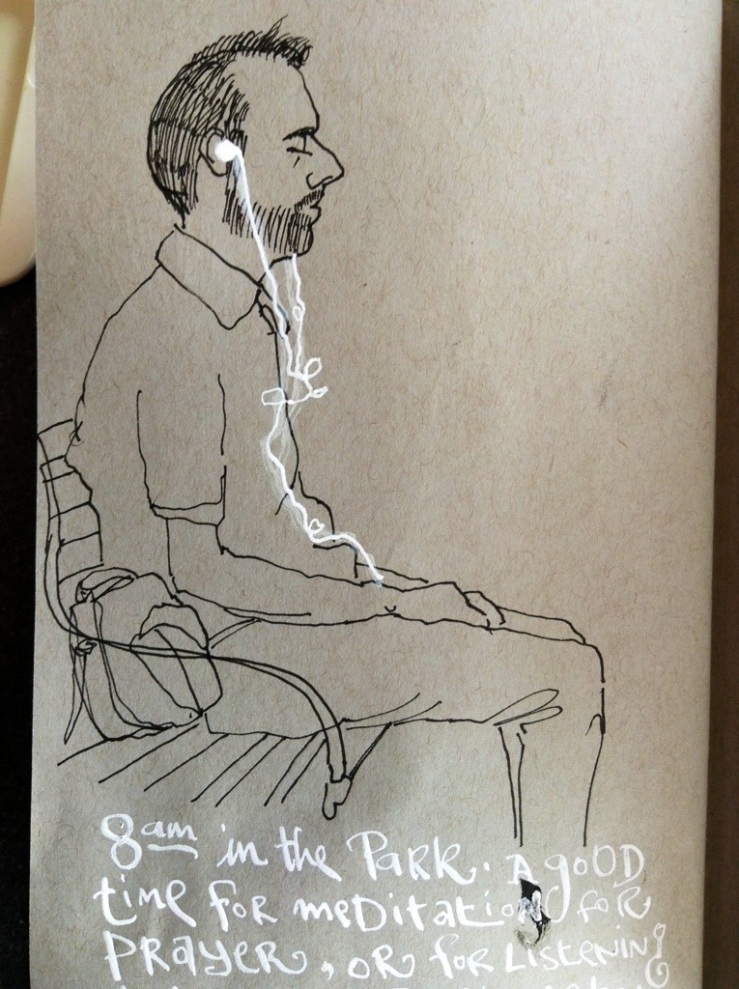
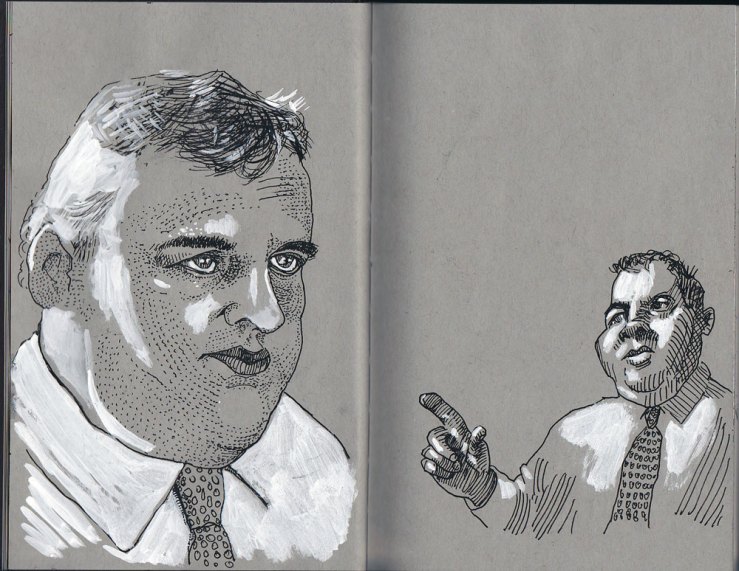
So this morning, I take my dogs to the park and plan to begin the day with a small drawing, nothing too challenging, a little amuse bouche. I see this guy on the bench nearby and it seems he is planning to sit immobile for a couple of minutes so I dash off the drawing above. At home I write a little caption with a dip pen and white ink and I am happier with a journal page than I have been in weeks.

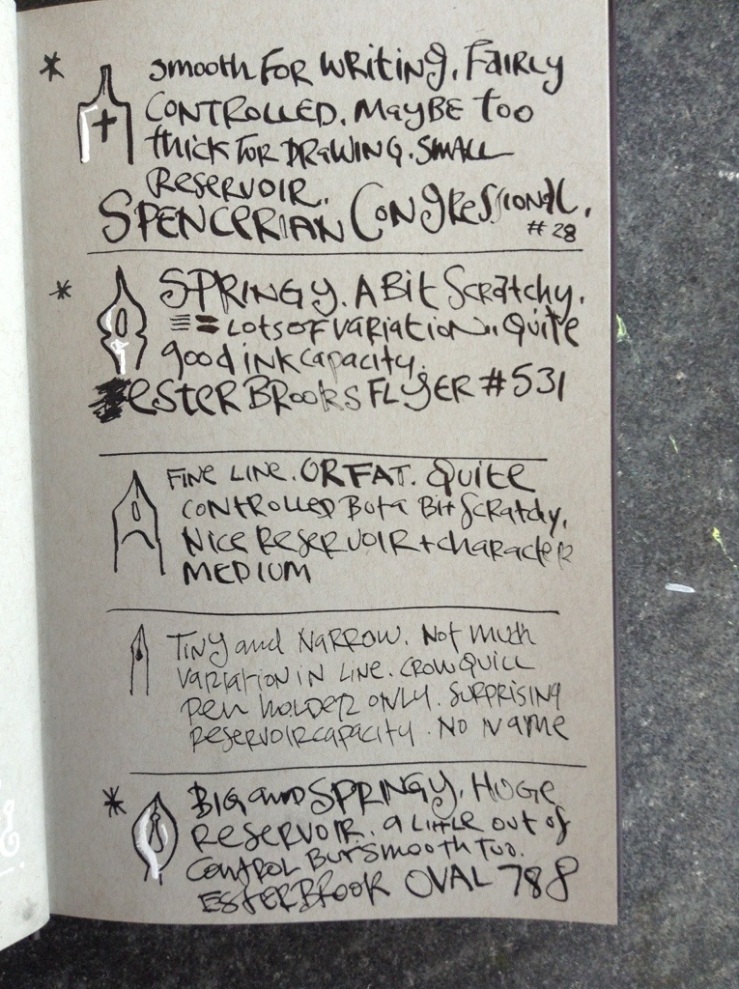
After breakfast, I decide to inventory my pens. I am going through a period of transition, easing away from markery sorts of pens like the PITTs and tending more to my dip pens. But I have a big messy box of steel nibs and I decide it’s high time to clean and inventory them. So I make a little page in my journal and chart my favorites.

20130821-091158.jpg


It’s a messy business, prying nibs off the holder, rummaging around in the vat of pen cleaner, ink and paper towels all over the place. I am trying to be fastidious but it really goes against my nature. An astrologer once did my star chart and told me I am something called “a triple Virgo” which mean I should be incredibly anal and neat and able to change a pen nib without courting disaster.

Hah ha. Not so fast.

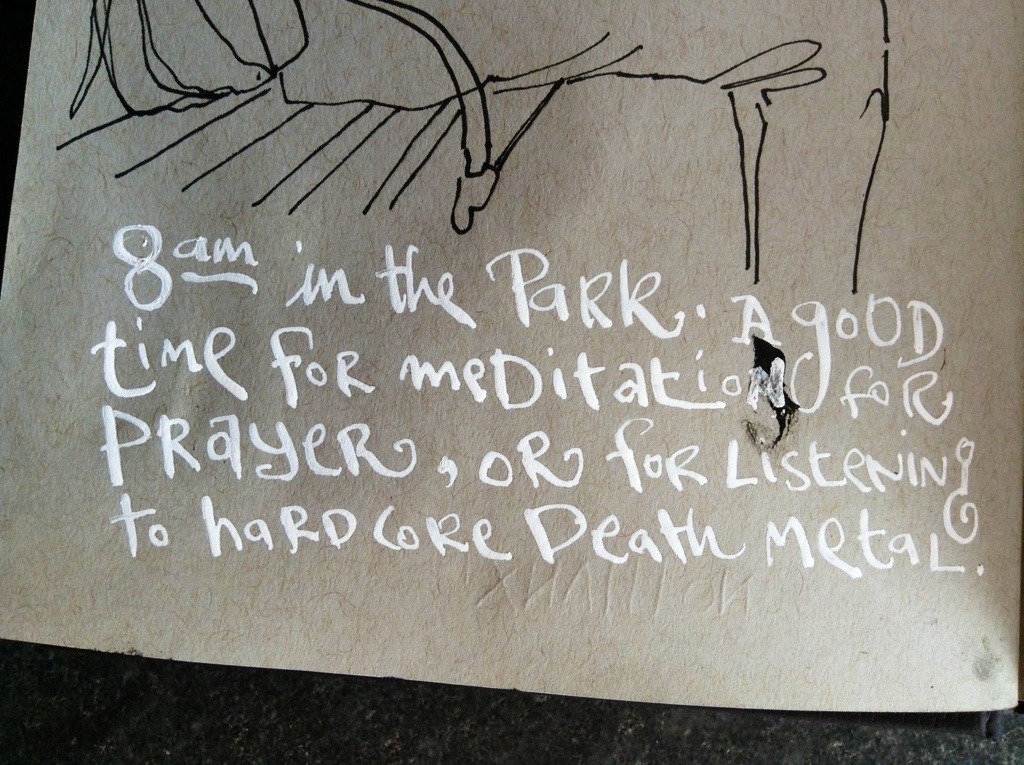
I look back at the left hand side of my spread, and somehow, mysteriously, damnably, I have managed to smear black ink across my writing. What the hell? You can see below, I try to fix it up with another layer of white ink but it probably looks even worse.

God. Damn. It.

20130821-091357.jpg

I tell you this sad story for a number of reasons. First because I am still in the grip of the anguish it caused. Secondly, I guess I can try to extract some sort of life lesson from it to share with you so at least we can profit from this disaster. What would that  be?

Do not fear mistakes. There are none.” WTF? That’s clearly not the case. That smear is a big, annoying mistake. It may not look it to you but to me, it’s a huge festering boil in the middle of Kate Moss’s forehead.

It’s the journey not the destination.” Again, I guess so, but the ink blot was part of the journey, the Montezuma’s revenge, the Metro pickpocket, the cancelled hotel reservation of the journey. Thanks for not much.

Slow down, butthead.” I guess. But I was trying to be slow and deliberate. Granted my whole dining table was covered with bottles and boxes and crumpled paper towels and my hands were black up to the wristwatch. I am a klutz and a slob so I should try to operate at 1/2 speed.

Maybe I should stick to crayons. And wear rubber gloves.

Epic.

snail2

My mother just sent me a link to a site documenting a journalist’s trek on foot from southern Africa to South America (I’ll give you the link in a minute). This isn’t just another endurance stunt —Paul Salopek is a Pulitzer Prize winning writer for National Geographic so his trip is all about science and journalism. He started earlier this year and will take seven years to complete the odyssey.

I have always been fiercely attracted to this sort of epic journey.

A few years ago, I was in thrall as my pal, d.price, rode his recumbent bike some 5,000 miles from Eastern Oregon to Key West. I loved Travels with Charley and On the Road.  Kon-Tiki by Thor Heyerdahl (finally a movie!), Bill Bryson’s Appalachian trail book, A Walk in the Woods, Cheryl Strayed’s Wild. The Happiest Man in the World by Alec Wilkinson describes Poppa Neutrino’s quest to build a boat out of garbage and sail it across the Atlantic. Mike McIntyre walked across the country with no money and relied entirely on The Kindness of Strangers (which is the name of his amazing book about the trip). The list goes on.

Ten years ago, I wrote a proposal for a book in which I’d follow the original epic travel journalists, Lewis and Clark, from St. Louis to the Pacific. I was going to adhere to their path and record the differences the couple of centuries had wrought. My editor said, “Make the trip, write the book, and then we’ll see.”  I didn’t. Life got in the way. Good thing Jefferson wasn’t counting on me.

Recently, Jenny has been urging me to drive across country with our dogs. I am sort of intrigued by the idea. Pros: 1. It seems romantic and epic and larger than life. 2. This is the perfect time of year for it. 3. It would be a great symbolic start to my life on the West Coast.  Cons: A) I don’t have a car. B) I think taking the dogs would make this a really bad idea. C) This is really her fantasy and she’ll already be across the country in her office in LA while I check into a long string of Motel 6s. For now, the cons have probably won but I still like the idea a lot, particularly if I could get a travel companion who I could stand to sit next to for a couple of weeks and who would be willing to stop and draw along the way.

Maybe next spring.

What intrigues me a lot about Paul Salopek’s journey is its emphasis on slow. He is taking seven years (!) to do this because he really wants to absorb the world as he goes. And he is looking for people along the way who are also seeking slowness in this madcap, speed obsessed world.

I think that’s the right thing to look for. Boy, it’s hard to slow down. I sat in the park this morning with my dogs and did a drawing. It was a small drawing, just filling a little box on the page, but I had to catch myself mid-way because I was tearing through it, barely looking at the arch I was drawing, just scratching out hasty, inaccurate and ugly lines. What the hell was my rush? It’s Sunday morning, I have nowhere to be till brunch, everyone else is sleeping, and yet I am belting through this drawing as if I was in an Olympic event. If I was Paul Salopek, I’d probably be half way to Rio by now.

Even though it’s been several weeks since I left the rat race, I still have my rat cleats on. I can feel it in the need I still have to accomplish things, to generate product, to log hours on my calendar. I so very much want to focus on the journey, the process, not the finish line but all these decades in the business world, in New York, still have me panting and pushing. I remind myself: I am on an epic adventure that will probably take another few decades to finish (in fact, I would like to push off the ending as far as possible) and what matters is the daily walk through life — the things I see, the people I meet, the lessons I learn.

If I’m really honest with myself, the reason I am not driving across country with my dogs is that the monkey is telling me I need to get to LA and start getting on with it. There’s no time for meandering and roses sniffing. I need to set up shop and start making something of myself. The monkey is wrong, again, of course. I make something of myself every day. It may not be something that can be direct-deposited, it’s true, but it’s also something that can’t be accelerated. Step by step, day by day, eyes open, head up.

—-

Here’s the link to Paul Salopek’s journey.  (I have put off giving it to you till the end of this blogpost for fear that you would rush off to read it and never come back to finish my blather. Clearly, I am better at slowing you down than I am at putting my own brakes on.)

The sands of time.

20130805-202959.jpg
I am sitting on a powdery beach in Southern Mexico, feeling many things. The breeze in my face, the sun on my feet, a slight sense of guilty residue in my heart. My monkey bays at me, telling me that I no longer have the right to a vacation, not after this crazy plunge I’ve taken.
My body seemed to agree.
I was really sick for the last couple of days. It came upon me on Saturday at lunch time, a queazy, bloated feeling that had me bent over the porcelain by the end of the day. A sleepless night, then up at 4 a.m to catch an early flight. After a long drive down the Mayan Riviera, we reached this beach. I was green, pale, silent, and my traveling companions were more worried about me than they were willing to say at the time. But I am from hardy, working stock, and I greeted this morning with a renewed constitution and a smile.
It’s odd how often I am sick and injured on vacations. I have almost never missed a day of work and yet I invariably end up at remote chemists on tropic isles, at Italian emergency rooms, in ocean liner infirmaries. My body is a company man, and decides that the only right time to fall apart is only when it’s off the clock.
My mind is also trained to work pretty much non-stop, so vacationing can be a much -needed challenge. It takes at least two or three days for me to stop, to disconnect for emails, from the newspaper, from the meal schedules, and to let myself float away. On arrival, I spend time scheming by the pool, thinking how wonderful it is that I have this opportunity to make big plans, to re structure my office, or to make a long-term strategies. Then one day, the switch flicks and I drop it all, just vegging, listening to the pop music on the pool speaker, playing beach volleyball, having my hair braided. I think it must correlate to my sun tan lotion. As I let my SPF go down, so descends my death grip on the “reality” back home. I begin to unwind. I began to wake up and see where I am.
I am still in “on” mode this morning, my malady notwithstanding. I remind myself that despite my blazing announcement that I now have the freedom to create 24/7, I haven’t done much on my blog. Yes, it’s been a week and a half, but the monkey is impatient. And he’s not on vacation yet either. Where are all my wonderful creations? Or shouldn’t I really be busy freelancing?
Here is the lesson I draw from this internal debate:
I need to be here now. It’s wonderful that Here and Now are 78 degrees with a tropical breeze. But I need to be present always, all places. Sometimes here and now are not so nice. A crowded subway platform. A boring conference room. A hushed back room in a funeral home, smelling slightly of lavender talc and ammonia.
Regardless, I must be here now. There is nothing else. The past is just an illusion, a mental construct I drag along with me. Sometimes it seems better than now, sometimes worse, but it is irrelevant either way. The chunks I blew last Saturday are long flushed. The green pallor is gone. I can be grateful about that but that is all. I can pick at the scabs of my past decisions but regret is a waste of the present too. All that matters is now. What I am doing with this moment. With the potential that is here. To enjoy this, to be happy here, to accept what is.
And as for the future, it never arrives. All tomorrow ever is is my fantasies about what might be when it actually is. It’s not concrete or knowable and wasting now constructing plans on these prognostications is just sculpting with clouds.
On vacation, after I get over the hump, I have that realization each time. That I must enjoy this expensive day to the max, avoid getting sunburnt, have a couple pinås, eat some fresh fish, and chill the hell out. Leave the world of back home back there and back then.
And that’s really all that matters every day when I am back home too. To inhale deep, to avoid the chimp, to be in my skin, to deal with what’s happening and make it neither greater than it is with mental constructions nor lesser with denial.
Life is what is. And that’s just exactly how it should be.
That’s the lesson I learned when I first started to draw. And which I need to remind my self of all that time. That being grounded in reality, seeing what’s in front of me, warts and all, is the only way I can be happy and adjusted. That I have to keep re-realizing what art has done for me. It has shown me the beauty all around me and that it exists even in apparent ugliness and pain. If I draw it like I want it to be, it doesn’t satisfy my need for truth and connection. But if I see it as it is, here and now, I join with it, and I feel at peace.
That’s enough thinking for now. I’m off to draw those coconuts above my lounge chair. Then it’s siesta time. I dream an awful lot on vacation. Do you?

Island life.

I feel the breeze blow through what’s left of my hair and remember my vow to enjoy it. It’s not actually wind, it’s the rush of air that come from falling into the void and waiting for the net, the catching hands, the sproing, thunk! of your opening parachute. You can gnaw through your bonds one by one, and feel only tremors, but then you sever that one pivotal strand and you suddenly fall free, released on your own recognizance. Now you own it.

I own every day, dawn to dark. I alone will decide whether I lie on the couch, or sweat at this keyboard, or wander the streets or sob or cavort. But of course this isn’t really anything new. I have been the boss of my life since I began this job of being human. It’s just that I had forgotten to look at my business cards, hadn’t read my employment contract. I have aways been in the driver’s seat. I just hadn’t turned the ignition key till last Wednesday.

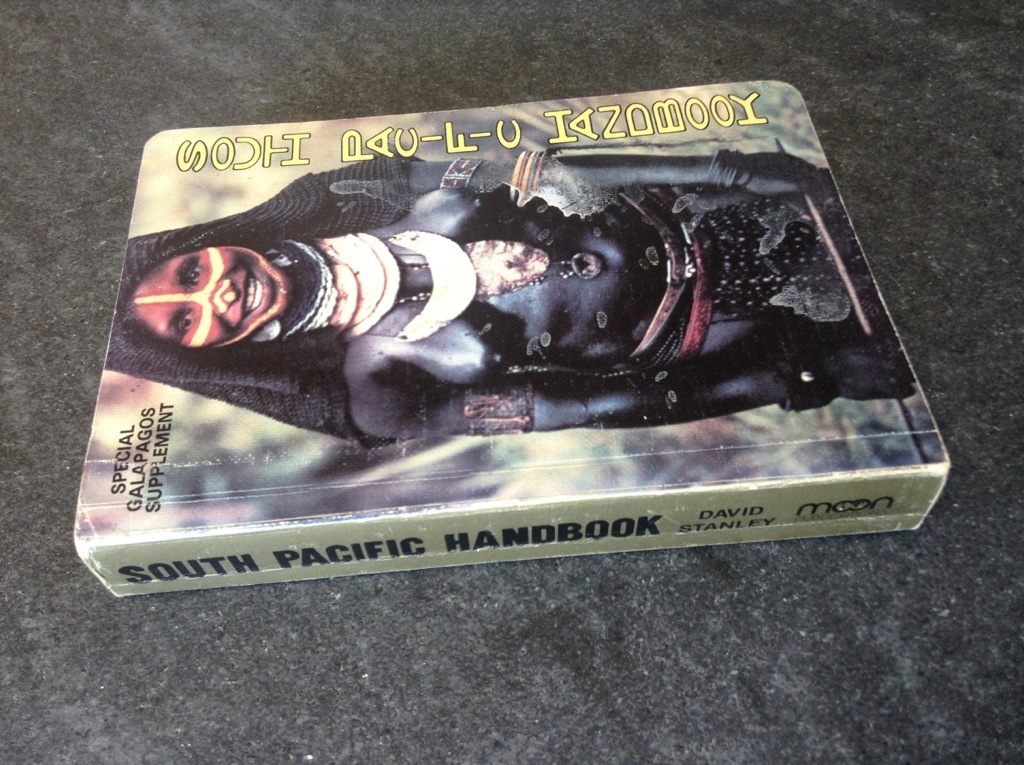
When I graduated from Princeton, I bought this book.

20130730-091626.jpg

The South Pacific Handbook was to be the manual for the next stage in my life. I was going to move to Truk in Micronesia. The handbook told me that the women still wore grass skirts and went around bare-breasted and that they used gigantic round stones as money. I would be a 20th century Gauguin, except for the painting bit. I wouldn’t need a real job, I would just build a hut and fish and eat bread fruit and coconuts. I still had a few hundred dollars in the bank from my job at McDonalds the previous summer.

By the end of the summer, however, I was living in the East Village in a 4th floor walk up. Only the local drag queens wore grass skirts.

The South Pacific Handbook has been on the shelf of every apartment I’ve lived in since, a reminder that one can postpone one’s dreams but needn’t forget them. I take it down every year and am grateful that I didn’t risk death by boredom or some horrible tropical disease or scurvy and remind myself that Gauguin died of syphilis. Then I put the book back on the shelf. I never take it to the used bookstore, however, because deep inside me I know that one day that youthful romantic ember deep in the lower basement of my soul will glow bright again and I will book a flight or a slow boat and live that crazy dream.

I’ve been on a metaphoric tropical island for six days now. The sun is shining, I am wearing shorts and flip-flops, and I am just beginning to wander the endless stretch of beach. It’s the island called Greater Dannyiana, a long flight from the mainland on which I’ve been dwelling since I bought the South Pacific Handbook. This place is probably vast, I don’t know yet. It contains a lot of empty real estate on which I can build huts and workshops and landing strips and office buildings. I could turn it into a modern-day Tahiti, filled with chain hotels and alcoholic natives, or I could keep it lean and pure and idyllic. Or, most likely, something in between.

There are monkeys here. I hear them calling from the trees. They tell me I must make a business plan, must take on lots of freelance work, must keep in touch with people who run ad agencies who will hire me back once I abandon this folly. I should write to all the people who run weekend workshops, build a slick commerce website, sign a half dozen book contracts simultaneously. They tell me to stay out of the sun, that I’ll catch some thing from the mosquitoes, that there are lots of wild animals in the jungle. They remind me that freedom isn’t free.

I did make a list of things. And it’s on this computer somewhere. But I haven’t looked at it yet. Instead I made one commitment. I will try to go to a life drawing class every day. I will draw a three-hour long pose. I will draw on a large piece of paper that’s not in a book. I will write nothing on the page except the date. And I will do it with a pencil. The monkey reminds me: I am not used to doing such long drawings, I am not used to drawing with a pencil, I always draw in a book, and I am not a huge fan of drawing strangers, even if they are bare-breasted. The monkey asks me if I quit my job to do this. And I do not answer the monkey. Instead, I pack up my awkwardly large bag with my drawing pad and my pencil and my iPod and my bottle of water and I ride a CitiBike to SoHo and I sit in the basement and I draw.

And then I discover that the reason I feel a breeze in my hair isn’t because I am falling. I am flying.

20130730-104026.jpg

The leap.

30d3176299e211e19dc71231380fe523_711,305 days ago, I started my career in advertising. Since then I have worked fulltime at nine agencies. In the spring of 2004, I freelanced briefly and also managed to write The Creative License.  Other than those brief months, I have spent most of my hour as an adult employed by other people and working on whatever they wanted me to work on.

When my boy entered high school, Patti started asking me, “How much longer are you going to do this? When Jack goes to college, will you finally stop? Aren’t there things you’d rather be doing?” For most of my career, my mum has asked me, “How can you stomach working for corporate America? When are you going to  give it up already?” Most of the people I work with have, at one point or another, asked me, “Don’t you make enough money from your books to stop working in advertising? It’s amazing you have done so much while holding down this job. Imagine what you could do if you did it full-time.”

I’ve done a lot of shrugging and changing of the subject over those thirty years.

A few months ago, I realized something had to change. I liked my job but I wasn’t growing any more. And it seemed like I spent a lot of time with my nose pressed to the window of my nice office, looking out at the wide world where so many people seemed to be doing so many interesting things. And now Jenny was echoing Patti, asking me if I wouldn’t be happier focussing on art, films, books, teaching, speaking…

With Jack happily at RISD and with no more real day-to-day obligations except walking my dogs, I realized I no longer had to make excuses to myself. I could finally try out something new.

I am writing in this in my empty office. The surprisingly few possessions I have accumulated over the past nine years here are in a bag and I am watching the clock for the last time. It’s my last day and in half an hour or so, I will step into the next chapter of my life.

My next steps are far from complete and I have realized what a luxury that is.

But I do have a big wish list to tackle. My editor at Chronicle is working with me on a really exciting new book project. I have the outlines for three others just waiting to be tightened up and sent off. I have written all of the first online class I will be teaching. Now, I just need to shot a bunch of cool videos to go along with it and release it to you soon. I have a big stack of art books I want to reread and study. There are so many galleries and museum shows I want to attend. Jack and I have some art projects we want to work on before he goes back to school. I have a long, long list of things I want to write about for my blog. I have several new invitations to give talks and workshops. Several very interesting new projects have just come knocking on my door that could open all sorts of new directions. And there are so many people I’ve met over the years, wonderful inspiring artists, who I want to get to know better and to find ways to collaborate with.

Most importantly, I am also keeping a large chunk of time open for serendipity. Open space that is reserved for adventure. If you have any you’d like to send my way, fire me a note.

The first big adventure: going bi-coastal. In September, we will be renting an apartment in Los Angeles and for at least a year will work there and here in New York. A fresh address, a fresh perspective, and loads of fresh possibilities. I can’t wait.

Well, I better go and say my last round of goodbyes, grab my bag, punch out for the last time, and head off into the sunset. See you on the trail!

Fresh wisdom to trump the monkey.

3-monkeys

I was served two giant helpings of insight this morning, both in my email inbox.

First, this note from Evelyn:

Hi Danny,

I recently ran a drawing class for adults – a sort of introduction to urban sketching, really. On the first day I shared the story of my own rediscovery of drawing, a rediscovery largely fueled by Everyday Matters. I talked about letting go of attachment to the outcome, focusing on seeing and the connection that is made with the world around us as we draw. I said don’t wait for it to be perfect before you share what you draw.

One of the participants then told me, ” I don’t have much confidence and I have no experience. The reason I signed up for this class was because the drawing on the flyer was not that good.”

It was a drawing I’d done with a bamboo pen and ink I didn’t know was water soluble, so the watercolour kind of ran into the ink and there are some pretty messy bits.

This woman’s words made a big impression on me. There is so much value in modelling joyful imperfection!!

When I teach in high schools, I don’t teach art, but the same principle holds. We need to help people to be able to love themselves unconditionally. To be self critical without anxiety and to create fearlessly.

With gratitude for all you have given, and my best wishes, Evelyn

And then, on a different but somehow related note, this blogpost from Jennifer: Live up to your full potential. It’s a lovely perspective on how to judge whether you are making the most of your gifts.

What if we redefined what this whole potential thing really meant? What if, instead of having to prove our creative selves in a particular area of art, we could reach our potential by simply living artfully? What if, instead of striving to make lots of money with our art, or show just how technically perfect we could draw… what if we engaged in our everyday lives with an artful eye, probing the moments for beauty? What if, we reached our potential by daily living the life WE HAVE, the good and the bad, the mundane and the magical, with open arms and full hearts, celebrating and capturing some of it in an artful manner along the way? What if living up to our potential as artists had MORE to do with seeing the beauty in all of life and sharing it with one or more persons, than with being able to say we have devoted our whole lives to making a career of x or y or z.

To me, these are both conversations about the monkey, about how we can cope with the incessant jabber of our self-doubt and -criticism that wastes so much energy and time. As Evelyn points out, our ‘failures’ are in fact our richest lessons. The most important things is just to start, to make, to move forward, and to shun the wimper within that woud keep us forever in the starting blocks. That voice isn’t just an impediment, it’s a cancer that chews on us, winnowing us down to smaller and smaller versions of ourselves, as we brutalize ourselves with doubt and recrimination. Be kind to yourself, and be creative.

Jennifer’s lessons comes from outside, from the larger world that uses the dollars as the only true yardstick, from the golden monkey now internalized. This monkey voice is just one of the sheepdogs of economics and really has nothing to do with us.  It barks the simple cry of the market. For art to be valued financially, it must be a limited commodity. If everybody made art, it would be so common it would have no financial value. So our society is geared towards making art an exceptional behavior created by the few, a meager supply managed by the system of galleries and museums that turn human creativity into a market.

So it’s not surprising that when you graduate from crayons and want to continue creating art as part of your everyday life, you are discouraged from making at every turn. The only way that art can be sanctioned is if you pass through the system of art schools, galleries and critics that will cull the herd and protect the market.

Fortunately, the Internet has made it possible to share your creativity with other people and to get positive feedback and constructive criticism without financial transactions. The Internet has liberated us from the marketplace of art. It has restored the impulse for creative expression that has existed in our species since we painted bison on the  walls of caves.

This isn’t anti-capitalist. It is pro-self-expression. And it is optimistic. Because no matter whether it is stifled by the government, by religion, by the marketplace or by snobs and bores, ultimately that impulse will return and prevail. Now more than ever.

One of the wonderful things about the Internet is that value and scarcity are no longer inextricably linked. Now good ideas are what are valuable and good ideas can be copied over and over and shared with billions and still retain their value. We live in the golden age of creativity, a new renaissance. Now making art will no longer be discouraged. it will be essential.

art with a small a is not a product. It’s a point of view.  It’s a way of life.

art isn’t for museums. art is for everyday.

The Art world is about money. art is about passion, love, life, humanity — everything that is truly valuable.