Dear Danny:

I’ve been lucky enough to get lots of email from visitors to this journal. These are some of the interesting questions I received over the past month:

When did you start to draw? I mean, did you ever draw when you were younger? Or try to draw? — Katharine

This is a tricky question. If I show you an example of how I use to draw before I let myself have permission to make drawing a habit, and you say, "well, that’s pretty good. I could never do that." then it’ll be raw meat for all those innner critics out there, just chomping to trash your drawings. Or you might just say, "Hold on, this guy sucks! What the hell am I listening to him for?" (Right answer, by the way).
So let me put it this way:
I’ve always doodled in symbols: cartoon heads, cubes, grids, etc. and over the years I’ve done a half dozen lame acrylic paintings. But everything changed when I developed the habit of truely seeing and of recording, deliberately and carefully and without preconception, what I saw on paper. As I have mentioned here and in my book, that is a very different thing from doodling. But if you’d still like to see some typical doodles and promise not to get thrown by it either way, go for it.

O no… you can’t take away "25 books"! — Katrine

Noooo… we NEED the 25 books! — Serena

Oh, okay. here it is: the return of 25 Books.

untitled-18a

I would like to start drawing/sketching/doodling. Do you have recommendations for paper/pencils etc for a beginner — Alan

My tools change all the time. I love to experiment and playing with materials is part of the fun for me. Generally, the only pencils I use are colored ones and I never erase my lines no matter how ‘wrong’ they may seem at the time. I urge you do to do the same. Try out different pens till you get something you like. It should flow smoothly and feel good in your grip. I like Sakura’s pigma micron pens, also Faber Castell’s PITT artist pens, and my new beloved Staedler pigment liners, but there are many other good choices. As for paper, I like to buy heavy bond paper, in sketch pad form. It’ll hold up to all sorts of abuse, ink, paint, markers, without bleeding and it feels solid and good. It also makes each page feel important, somehow.
Frankly, though, you could use a ball-point pen and a sheet of copier paper. The main thing is to begin, have fun, get hooked and then branch out. Don’t worry about posterity, readers, mistakes, etc.

My husband could not locate your book in B&N in Manhattan on Monday. THEY said they had quite a few copies and then three people could not find a single one. We ordered it from Amazon instead. — Melly

Bastards. It’s a part of the massive conspiracy to keep journal-making an obscure hobby instead of an awesome power that will take over and transform the world. Barnes & Noble loves to shelve my book in the New York section. Look for it there or take some form of political action.

I don’t know who you are! Stop emailling me! Take me off your fucking list! — Ganesh

I’m not sure who Ganiesh is either. He won’t be joining us in future discussions.

Was wondering, do you ever sign your books and sell them yourself or should I just follow the link from your site and buy the book on Amazon? — Myra

The most efficient way for you to get a copy of Everyday Matters is via Amazon or by badgering your local bookshop. If your really want, though, I’ll gladly sign it for you. And please let me know what you think of the book when you get it.

Did you hand-write the text in Everyday Matters or use a font?  I’m curious because your handwriting is fascinating to look at.  If you’ve managed to make your own font, I’d be interested in downloading or purchasing it… or just admire it from afar.  I really like your handwriting. — Wileen

While I hand wrote large parts of my book, the opening pages were primarily set in a font based on my own handwriting. It helped to distinguish these big blocks of text form the rest of the higgledy-piggledy stuff and stopped my publisher from asking if we couldn’t just set the whole thing in type. I find it ironic that an English teacher would admire my handwriting — when I was in high school, I was always getting in trouble for illegibility!

What do you use to color in your drawings?  I have been wanting to color in some of mine in my moleskines but I don’t want to mess them up. —Joe

Although I am not a moleskine user any more, I used Tombow brush markers, colored pencils and occasional patches of ink. The pages are water resistant so they’re not friendly with many paints. But don’t be afraid to experiment; it’s part of journaling. Even if you screw up a page you can always write about the experience!

Did you do a little Photoshopping on the color lay-in (of your Martha Stewart Piece), maybe? If so, how’d you like the experience? – Karen

I hated it.
I rarely work this way and regret it when I do. I did random sketches on location and made notes. Then I came home and scanned the pages and built my layouts in Photoshop, then printed them out, wrote in the captions, rescanned the calligraphy and laid it back in. Then, I colored the whole thing on screen because I was rushed. The colors are insipid and vague and didn’t come from observation. The computer makes me fussy and wooden. I also hate having the ability to undo things and to mechanically work with transparent layers and I hate using a Wacom tablet instead of a pen and I hate working vertically instead of flat on my lap. And I also hate the fact that it exists only in 72 dpi form on line. I hated it. Hate.

I was just curious as to how you get such great resolution on your drawings whenever they are posted to the web. — Jon

I scan my book at 75 dpi. Then, in Photoshop, I adjust the curves so the whites are white, the blacks are black, and the colors look right. Then I use the ‘Save for Web’ function, and boil it all down to a medium quality, JPEG 650 dpi wide. Then I mutter a brief prayer to St. Twain, the patron saint of scanning.

I’d stopped drawing and printmaking when I started a new career, but have since rediscovered journalling through your book and website…I discovered, yesterday, that I had inadvertently left my journal on the subway. What did you do when you left your journal on the plane? — Michelle

Maybe the pain of losing your journal was meant to remind you of all the days you lost when you weren’t making things. Don’t lose any more! As for some practical advice: put your name and number in future ones!

Patti's problem

pens

Patti and I were discussing her journals and scrapbooks a few days ago and, for once, I was able to give her some useful advice. Her dilemma: she collects all sorts of clippings and pictures and cards and souvenirs and stuffs them between the pages of her book or into an envelope, waiting for the rainy day that she’ll stick them all in and make something beautiful. But it rarely arrives, so the piles of ephemera grow bigger and more daunting, like a corner of the Collier Brothers’ apartment, until the whole thought of tackling the project is more than she wants to deal with. Why is it so hard to move from the collecting phase to the making phase, she asked me.

I think it comes down to a matter of purpose. Why do you want to assemble this stuff? What are you going to say with it? Is it just there because you collected it, because it seemed interesting or pretty at the time, but has long since lost its significance? Souvenirs shouldn’t get amnesia. It’s more important to have a point, a vision, a story to tell than it is to use all the materials you have. But most important of all is to just get started and make something.

I have lots of different kinds of art supplies, but I never sit down and say, well, I’d better make sure I use everything that’s in the box. I also usually don’t sit down, thinking, I haven’t use my burnt umber Caran d’Ache pencil in a while I really ought to. No, I just have a glimmer of an idea, look at my materials, and gravitate towards one pen or another.

A variation on Patti’s problem I encounter in others: “I haven’t written in my journal for so long, I have months of catching up to do, It’s too overwhelming, I’ll wait till another day.” It’s the same impulse that’ll make you put off going back to the gym or breaking up with your lousy boyfriend.
The only solution is to express something, anything. Turn over a fresh page and just do something about procrastination or dread or laziness or … You don’t need to record every single moment of your life. Just record one, in a careful and heartfelt way and the rest, all interlocking, will string along with it.

These are your enemies: procrastination, self doubt, obligation, perfectionism, judgmentalism. Now, depict them in your journal and you’ll already have them licked.

It's not easy being chartreuse

colorpants

I start most days by choosing a palette. It’s often a fairly subconscious process as I flip through my pants, shirts, sweaters, etc in the semi-darkness of my closet. I have a lot of drab, typically male colors: khaki, olive, grey, brown, black. But I also have some ludicrous shades to pick from because I like to buy light color trousers and dye them in my washing machine. I have bright orange cords, raspberry and Pepto-Bismol jeans, lime green, lemon yellow and purple paisley chinos.
So what determines why I’ll end up wearing a sap green cashmere sweater and burnt umber jeans one day and a black turtleneck and black jeans another? It ‘s nothing to do with my mood really.
I can be bad tempered and dress like a clown or feel chipper and gear up like a mime. And when I choose Jack’s clothes, I invariably dress him in a similar style and spectrum to whatever I picked for myself.
Of course, a major factor is whom I’m dressing for: although when I go to ad agencies a wild wardrobe can work for or against me. The biggest subconscious factor is probably the view out the window. If skies are sunny and blue, I put on the peacock. If the day lacks color, so will I.
Then Patti will come in and say: "You’re not wearing that are you?" and I’ll say, "Of course not" and head back to my closet. Color me yellow.

Ars longa, vita brevis

football

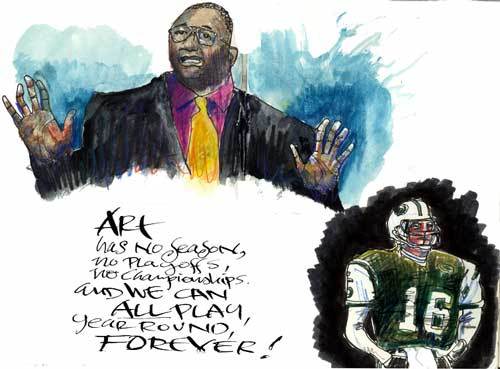
Every biographical movie about an artist depicts its subject as some sort of dysfunctional weirdo. Picasso – a woman hater. Van Gogh – a psychotic suicidal. Basquiat – a drug addicted suicide. Pollock – a drunken suicidal. Warhol – a weirdo and con man in a wig. Michelangelo – a disagreeable obsessive. Kahlo – a victim of love and disability. Toulouse-Lautrec – a horny dwarf, Mozart – a child. Beethoven – a deaf crank. Their genius is a curse, fed only by their tortured souls.
In America, we love athletes. We love pop stars. But we love to hate artists.
When we are about ten we are taught that being an artist is impractical, childish, and self indulgent, that ‘talent’ is a god-given gift you either have or you shouldn’t bother. Artists are arrogant, disconnected, elitist, millionaires or paupers. This myth is why parents accept all the cuts in art and music education yet will do anything to promote athletics in school. No one would want their kid to want to grow up to be an artist.
It wasn’t always this way. Doing watercolors used to be a standard part of a decent education, So did reading and writing poetry. Mozart, Beethoven, Bach, they were all government employees.
But in 21st century America, that critic in your head has the support and encouragement of the whole gang; your parents, your teachers, your neighbors, bosses, and role models (even so –called creative people in the media promote the illusion that it’s either a fool’s game or the lottery).
Small wonder it’s so hard to drown out. It says, “Don’t sing unless you’re going to become a pop star. Don’t paint unless you know you’ll be a genius who is recognized in your own lifetime. And if you have to practice at something, work on your pitch, your swing, your kick, skills that’ll pave the way for your future.”
You are fighting enough obstacles as it is. Don’t let your own brain join the conspiracy. Tell it to shut the hell up and let you get back to work.
Because all those voices, so right about how to build profit, are flat wrong about how to build a decent life. Without art, your soul suffers; you lack a chance to express who you are, to hone your own point of view, to make your life your own. You are less than human, no matter how many Super Bowl rings you’re wearing.
When you do make something and share it with the world, your voice will be proven wrong again. People won’t say, “Well, that drawing is pathetic. That poem is lame. That note was slightly flat. That diary reveals what a moron the writer was.” If they stop to judge it all, they’ll almost certainly say, “I wish I did that.” Which will give you the chance to say “Well, why don’t you?”

Belongings

shirts

Maybe it was going to the James Rosenquist retrospective at the Guggenheim but I’ve been feeling sort of sick of materialism. Everything we encounter, it seems, is in some insidious way aimed at making us burn to buy something, anything (and, yes, I’ve spent twenty years in the belly of the advertising beast, stoking that flame). Even at the Rosenquist show, where the art is all about the decadence of commercialism, the giftstore has all sorts of Rosenquist books and fridge magnets and coffee mugs.
Anyway, I feel like I own too much and appreciate it too little. So I am going to try to get more out of what I have and scale back, if possible. I even cut out my planned trip to the art store this afternoon. We’ll see how long this resolution sticks.
I like the idea of a journal diet. Draw everything you own. Everything. Every single book, every stick of butter and shoelace. Now that would be a humbling experience. Or just draw everything you eat for a week. You’ll be thinner, calmer and happier.
Speaking of calmness, I continue to wrestle with my new server, but the break at the Guggenheim was refreshing and inspiring.

Trust or Bust

jarrett

In 1975, Keith Jarrett recorded the best selling solo piano album ever, The Koln Concerts. What’s even more extraordinary is that the music is purely improvised. Jarrett had spent the day feeling jet lagged and under the weather, he had to sit down and start performing almost immediately after arriving at the concert hall with little chance to prepare himself, and the piano he was provided with slowly went out of tune.

Jarrett credits the quality of his performance to all these distractions. Before every performance, he tries to make himself blank. He doesn’t practice for a month beforehand. He doesn’t plan, he doesn’t have tricks to get over the hump; he just empties his mind, feels the silence completely, then wanders out on stage and sits down before the 88 keys. What balls.

“It’s far more interesting for me that for the audience even,” he said in a recent interview on WNYC. “If you don’t have total freedom, you will not make mistakes. With total freedom, you’ll make mistakes you would never have dreamed of and may end up hating yourself more than ever. I aim to be completely devoid of ideas. But I’m not going to tell the music what I should be doing.”

He is just a vehicle, an audience member, and his art has a life of its own.
Now, how do you get to that place? If I sat down in front of a concert hall full of Germans, we’d all thrill to 15 seconds of chopsticks and that would be that. But Jarrett has laid down a lot of foundation. He had years of lessons, then played in cocktail lounges and Pocono resorts for years and committed all the jazz standards to mind. He played with Miles Davis and others, learning, absorbing, filling himself up. But so far that’s ‘just’ technical preparation. Many other people have that.

But when Jarrett improvises he allows the performance to be a distillation of who he is and what he knows. He says you have to assume that what you are doing is meaningless, be willing to toss it away. You can’t think that what you are making will be recorded, sold, reviewed, even listened to. Just do it and see what happens.

The best moments, he says, “are when I am playing only in the present and not heading anywhere. I aspire to not know what I am doing.” This is mindfulness, living in the present.

In this week’s New Yorker, in a review of Savion Glover’s new show at the Joyce, there’s the following quote: “I try to keep my chops up,” Glover told Jane Goldberg, for Dance Magazine, “so I can just be.” Glover is the greatest tap dancer who ever lived, a breathtaking artist and his goal: to just be.

Don’t dismiss all this because these are incredibly accomplished craftspeople. Sure, you need enormous amounts of technical expertise to be the best in the world. But to accomplish mindfulness, you just need something you already have: the willingness to quiet down, clear the crap and trust yourself.


  • This piece was inspired by re-reading Keri Smith**’s new essay, Ode to Ross Mendes but I have tried to avoid reiterating what she has already written so eloquently. Nonetheless, I have come to a similar conclusion via a different path: “The answer is me.”

** Keri is a wonderful illustrator and writer and a very good soul —if you’ve not done so already, please examine her inspiring new book Living Out Loud

Pen Pals

dpaI am really lucky to have a friend who has taught me an awful lot about journaling. D.Price is the author of a wonderful zine called
Moonlight Chronicles (subscribe and you will be very happy) and he and I have been sharing our work for years. We copy the pages from our journals and send them to each other and, whenever possible, we get together for journaling trips in different parts of the country.
dpb
It’s a great experience to sit down and create a page in your journal, chronicling your current experience and then share it with a trusted friend who is doing the same thing at the same moment. Sometimes, when we share the same vantage point, the same size Moleskines and and the same paint box, Dan and I discover our pages are very similar.
dpc
But when we really take our times, we see things quite differently. I tend to see light and shade, whereas Dan tends to focus on shapes. I can get quite lost in a muddy mess of paints or crosshatching and his colors are bright and sharp. Our writing is quite different too. I’m the City Mouse, he’s the Country Mouse and we are impressed by very different stuff.
When we are done, we swap books and discuss why we did what we did. It’s a great way to learn and grow.

Drawing bread

breadDrawing is seeing. If you can see, you can draw. But can you see?

Let’s see.

Looking is a language. Look: a dog, a tree, a car, a man. We apply labels — to things in order to understand and process them. In Genesis, God has Adam name the animals. Labels makes abstract thinking possible. But because we over do it, looking replaces seeing and we soon stop seeing things for what they truly are. We say ‘tree’ and stop saying ‘elm’, stop saying ‘thirty year old elm, with silvery bark missing in fist sized circles on the eastern half of its trunk, 37 foot 8 inch elm with 37,437 leaves, some mustard colored, others sap green”, and we completely miss going to the next level where language fails us all together, where things are so specific they can have no name, where they are absolutely real.

This is where drawing comes from. When you can look at something slowly and carefully and refuse to see it for anything but what it is – at this very moment – in this light – from this angle. And as you begin to see, you cease to be the many things that limit you. You drop judgments, cultural biases, history, and baggage. Time slows, and then disappears. All you feel is the pen on the paper, the slow cutting drag of the nib against the grain till even that sensation fades away too. You don’t think about art or what people will say or whether you are inept or ugly or stupid or self indulgent. You stop thinking about bills and aches and grievances and chores. You, your pen, your paper, your subject, you just are.

You sink deeper and deeper as you see more and more. You draw the edges and then the textures, the shadows, the textures and shadows within textures and shadows. The orange, the tree, the body you are drawing is just a landscape your eyes traverse. Your line takes you through adventures and surprises, over hill and down valley, into light and through shade. And eventually your journey brings you home again and you feel your pen thud back against the dock, the door step, and the world slowly cranks back up again like the merry-go-round it is and you come back to all your senses, sharpened, refreshed, renewed.

On your paper, there’s a map of your trip, a souvenir, only as accurate as the clarity of your vision. Keep it if you want, frame it, sell it, but it won’t matter – every twist and turn of the trip itself will be seared into your mind.

Are you ready to give it a try?

Making book

A few people have asked me what sort of books I make my journals in, so here’s the short answer:
vols1
I bound all the books in this group. It’s not as hard as I first thought and let me choose the paper, size and shape I wanted They are not terribly long so I can have the thrill of a new volume and the book itself won’t get too dinged up from being toted around everywhere. #1 is in linen with a slipcase, #6 has a foil stamp I did with a die I designed, #7 was a travel journal for a trip to Death Valley.
vols2
After I left a journal on a plane and never got it back, I lost the heart to bind books #8 & 10 but I will some day. #11 is an old boy’s adventure novel that I refilled with watercolor paper and is a big fat journal with no writing in it at all, just drawings and watercolors. #12 is full of drawings of New York I did for #13 which was an edition (1/1) of Oscar Wilde’s The Happy Prince I did for Patti’s birthday. #14 is another rebound book.
vols3
These are all Moleskines, the small kind with drawing paper. #20 has an inlaid initial made of multicolored chicken shells that my friend Quentin Webb made for me. I dedicated it entirely to self portraits.
vols4
I had gone away from drawings for a while and did a lot of digital photos and mini-polaroids so I made this all black#22. #23 is a larger Moleskine I kept on a retreat from NY after 9/11. The books I favor these days are very rough and simple and bound for me by my sister, Miranda, who is a printer. #25 is my greatest hits album and with a few mouse clicks and just $10.47 can be on your own shelf in days.
vols5
These are various and sundry books. #28 was the journal I kept when Patti was pregnant and which is the basis for a new book I wrote last summer, #29 is the travel journal we kept on our New York vacation, #30 is from a trip to Bermuda and #31 is a pile of the books I use just for writing in and are far more self-indulgent and whiney than even the things you’ve seen so far on this site.

God — looking at them all arrayed like this instead of shoved in their cupboards makes me seem enormously self-involved, self-aggrandizing, narcissistic and horrible.

Helluva Town

nyjournal1A few years ago, we decided to take a vacation in New York. Yes, we live in New York but we’ve never been tourists here. So we went to the Whitney biennial and the Cooper Hewitt triennial, the Museum of Natural History, a Woody Guthrie show at the Museum of NYC, the Queens museum, the Hall of Science, the Bronx Zoo. We went to the top of the Empire State building and the Easter parade and heard music and ate in touristy restaurants.

What made it really special is that we kept a family travel journal. We recorded everywhere we went and how we felt about it. We took pictures and did drawings, we drew maps and made collages of souvenir stuff. The most avid journal-keeper was Jack and he was just five.
I’d like to write some more about travel journals in the future because I think they not only record your journey, they help to define it as you’re doing it.
nyjournal2
nyjournal3