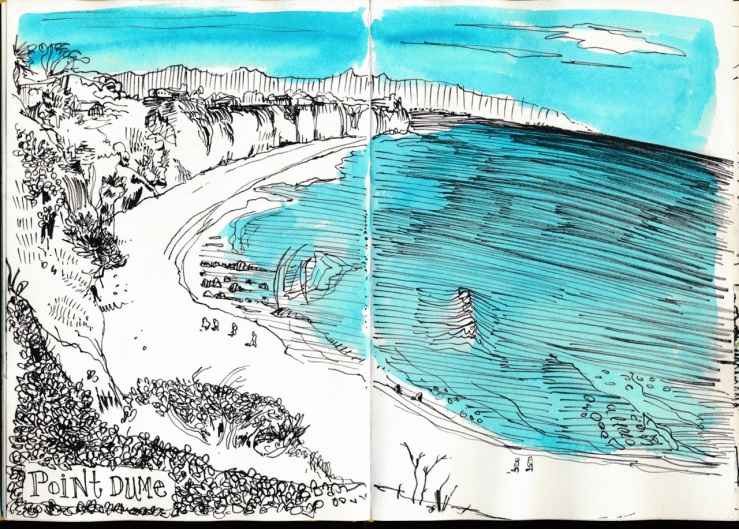
Monkey goes to the publisher.

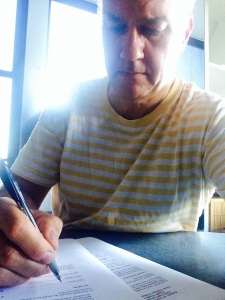
Signing the book contract for "Shut Your Monkey"

“Okay, but once you sign the contract, you have to write the book.”

“I know, I want to write the book. People need to know how to shut you up once for all.”

“And you think you can write a book about that?”

“Yes.”

“A whole book?”

“Sure.”

“Sez who? You’re not a shrink or a counselor or an expert of any kind. Who cares what you have to say?”

“I’ve lived with your voice in my head for decades, haven’t I? I’m pretty much as expert as you can get.”

“And you think you can shut me up?”

“Watch me. Hand me that pen.”

Book contract for "Shut Your Monkey" signed. 
Book out next fall.
Let the fun begin! 

Addicted.

Scan 10

When I’m anxious, I do something, I make something.

It feels like making something changes something and therefore I will be okay.

Or is making something, “look, I’m a good boy” credit that acts as a bulwark against whatever the monkey is needling me about?

Or is it just a distraction?

Is that how real artists feel? Soothed by their creativity?

I guess I have always been anxious a fair amount and that’s why I have always been pretty productive.

I don’t think much about the quality of what I’m making, it’s just the process, the act that acts as protectant. And if anyone comments on how much I get done, I feel more embarrassed than proud, as if I was getting credit for nail biting or nose picking.

I’m being particularly self flagellating right now, and maybe writing this down will just reshuffle the deck and I can get on with things again.

Could be worse, I guess — I could be a drinker or pick fights with strangers.

Instead, I’m writing this to you.

Black & white

black n whiteyOne of my most unattractive traits is my need to reduce things to the starkest terms. To force things to their conclusions, label ’em, deal with them in their simplest terms and file them away.

I can do that with people. Friend or foe. Genius or fool.

I can do that with movies, books, food, pens. Thumbs up or down.

I can do that with opportunities, trying to figure out what something might amount to, whether it’s worth doing from the get-go. I know what it will be like to go there on vacation, to eat that, to watch this, to do that.

1 or 0. The binary life.

In some ways, this is an efficient way to live. I can sift through things, sort ’em, leap to conclusions and move on. In other and more important ways, it’s dumb and limiting.

When you thing you know what some thing will be like, why live it? But no matter how smart I think I am, I don’t really know how things will actually turn out.

The most interesting things happen in the grey areas, in the open spaces, unpredictable, chaotic and fecund. Fecund because they aren’t gridded out and regimented. Because they follow the laws of nature which are chaotic and random and constantly shifting.

Learning to live with ambiguity is one of the toughest things I have done. But if life has taught me anything, it’s that you never really do know what’s going to happen and it’s self-defeating and ridiculous to pretend that you do.

Hard confession

I’ve spent a lot of time over the years convincing people that making art is just as natural as breathing. And as easy. 

But maybe I’ve been avoiding the hard truth. That making art can be hard. It can be hard keeping to a habit. Hard pushing past blocks. Hard mastering new media. Hard facing your mistakes. Hard being your own cheerleader. Hard seeing clearly. And hard putting yourself out there.

I’d convinced myself that if I make it seem like the barrier to entry is just a bead curtain that I will be doing people a favor. But when I make it seem easy and you find it hard, you might worry that you are exceptionally untalented or lazy or dumb. Which is far from true. 

The fact is that sometimes making art can be very demanding. 

And that’s okay.

Just because something is hard doesn’t mean it’s scary or to be avoided. Hard can be good. It can make the corpuscles course through your veins. It can make you stand taller. The things that are hard to do are often the ones worth doing. Success isn’t meant to be easy. 

In my own life, I have many things on my plate, but I’ve been working to eat my vegetables first and save dessert for last. Just because something is easy to tick off the list doesn’t mean I should do it first. Instead, I try to crack at least one tough nut a day.

At times, I’ve had the reverse approach. I told myself that it is better to have a sense of accomplishment by plucking low-hanging fruit and doing something easy — making the bed, answering email, emptying the dishwasher — than it is to tackle the things I dread.

But Ive learned that the pleasure of having won the hard battle is far greater and worth the pain. 

Now I start the day by thinking and writing and inching ahead, and end it in front of the TV with a basket of towels to fold. Life is easier when you scale the mountain first and coast down it the rest of the day.

My advice: Your days are numbered and there’s loads to learn — so don’t be afraid of something because it seems difficult. Rather, seek out the toughest challenges and fight your way through them.

It can be done. And you are the one to do it.

Not too late!

Sketchbook Skool‘s new semester starts today. Two kourses. I teach in both of them. If you haven’t joined us yet, it’s not too late. Click here to learn more.

Here’s what some of our students say about the experience they had last semester:

Jen Farrant: I cannot tell you the difference that SBS has made to my life, suddenly having permission to draw has made me so happy. I love sketching – even though I am a true, true beginner, having hardly lifted up a pen since school-school. I suddenly feel free, and it doesn’t matter if some of my sketches are totally rubbish, some are ok, some are good, but more importantly I am enjoying myself and feel like my creativity has been unleashed. That has made me whole again as a person in a way that I haven’t been for a very, very long time. I will be signing up to semester 2 as soon as it is live.


Chris Willis: OMG – Sketchbook School makes me feel like I died and went to Art School Heaven, where instead of being bullied because we’re weirdos, the artist’s are the cool kids … and I get to hang with them


Anna Morales Puigcerver:  Danny, Thank you very much for all the work, effort and energy you have put into this skool. I am really amazed at the bulk of inspirational material you have provided us, not to mention your encouraging and positive attitude that has boosted hundreds of us to believe in our potential. Thank you to the whole staff that makes this possible. Let’s keep drawing.  See you in klass 🙂


Linda Tennant: I am loving this. I am having so much fun that there’s just no place to stand for the comparing mind that usually puts a pretty serious damper on my fun. The ideas that particularly fired me up…that I can just draw and draw and draw, and feel what I feel while I’m drawing. I’m beginning to get a sense of how my personal style will emerge and evolve at the same time I am learning to draw. I have an absolutely new trust that I will learn what I need to learn and I will grow into whatever is needed for my continued creative growth.


Carolyn Egerszegi: I have been spending an equal amount of time on Facebook as I have with my Sketchbook, which is to say, A LOT. It’s been amazing and I am learning SO much from both the Klass and all of the students here. However… I am a little sleep deprived! I have wanted to “be an artist” my whole life, but never had the confidence or ability to do it seriously. Sketchbook Skool has been an enormous awakening for me. I am sketching every day and learning as much as I can about the “technical” aspects of painting and sketching so I can translate my vision onto paper. This is a wonderful group of kind, generous and talented artists. I am very lucky to have found Sketchbook Skool. Thank you Danny & Koosje!


Darlene Campbell:
This skool has been like unlocking the attic door and finding forgotten treasures. LOVE IT…ALL ASPECTS!

I have taken many, many on-line classes and this is so refreshing. I think because it’s not about a long list of supplies you have to buy to participate, it’s not just about techniques and a how-to format…but it has given me the freedom to create in my own spirited energy and hang out with other creative artists and see how they work. All of that gets me creating.  I have been inspired to widen opportunities such as sketching in public.

Come on!

Still undecided as to whether you should join the next semester of Sketchbook Skool?  Then watch this:


Then click here to learn more.

Outta site!

new-site-on-laptop
Koosje and I are both the type of people who tend to do everything ourselves. But as Sketchbook Skool has expanded, we have worked to wean ourselves of this habit. We hired Morgan Green, our wonderful Dean of Students and then we retained the LA design firm, Third Thing, to design a new website and a proper identity system for us. It’s ironic that I have been on the other side of the table for thirty years but now I am the client of smart, talented creative people. They have been extraordinary to work with and I have learned so much from them. Our site just went live. Please check it out and, if you haven’t already, sign up for the next semester of Sketchbook Skool, starting next week!

Skool Daze!

Are you committed?

At the end of this week, the second semester of Sketchbook Skool begins.

I am pumped up. Are you?  Click here to learn more.

Tommy Kane’s gift for you

My old pal Tommy Kane gave Sketchbook Skool an amazing work of art and we want to give it to one of our students. Enroll with a friend or relative and it could be yours. Check it out.

Don’t roll your eyes at me.

Scan 17

Imagine if your head was in a metal box and your neck didn’t move. In fact your entire body was rigid, like a quadriplegic locked into a wheelchair. You can only look straight ahead and, at any given time, your eyes are locked on a certain point. Some things are in focus, others are blurry and indistinct.

Fortunately that’s not how you see. But it is how a camera sees. A camera sees only from a one-point, locked perspective that creates a single image of a specific vantage point with certain focal characteristics.

When we look at something, our eyes constantly move about. Even if we are sitting down in a chair, our eyes dart around, passing back-and-forth over different details, noticing one aspect and sliding quickly to some other point, perhaps paying less attention to certain information between. Our impression of what we’re looking at is actually lots of different perspectives all blending into one undulating picture. And because our eyes focus on points that are different distances from us, flexing and bending our lenses, absorbing different amounts of light and therefore changing the quality of information that we absorb, all these different images that we are recording are in fact quite different from each other. One might have a wide-angle perspective, then one might feel like our aperture is more open, while another is focusing more on black-and-white information about edges or shadows, another is saturated by color.

Amazingly our brains take all this information and instantaneously create a sense of what we ‘see’. It’s not a single picture but lots of different impressions that are all blended together. (That’s what the Cubists were getting at, trying to record all those different angles and perspectives into a single painting to simulate the way that we see. They were trying to show the distinction between how humans see and what the camera was introducing. People think of Cubism as abstract art but it actually was an attempt to be even more accurate about literally how we see the world.)

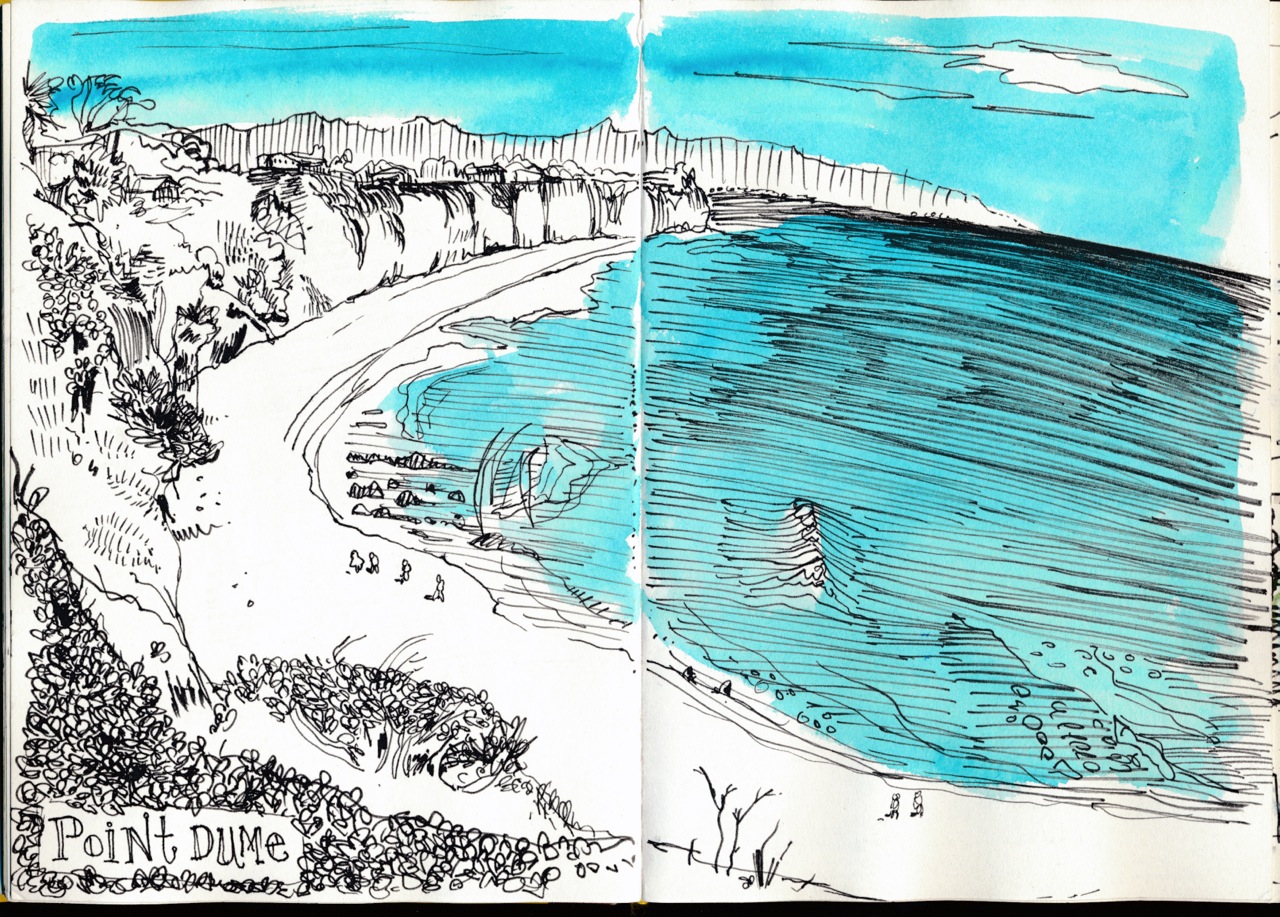
This process of observing is what goes on when we draw too. If we are drawing a landscape, an urban street scene for example, we look at the corner of the building on the left in lots of technical ways quite different from the way we are observing the street sign right in front of us or the blades of grass below or the mass of leaves on a tree above. We look at one section of the view and record it in a certain way and then we change our tools, bend lines, shift focus, let in more light from the shadows, record details all in different ways. An interesting drawing is a record of all those different forms of observation on one place.

Do you see how fundamentally different that is from taking a photograph? The camera is observing everything in the same way at the same instant, with no consideration of what it is. But we observe in a cumulative fashion, first taking the scene quickly and then scrutinizing and observing a myriad of details.  When we draw from a photograph you don’t have the benefit of all those different forms of observation. We are locked into that single view the camera gives. It takes time and lots of  observations to record the rich scene before us. The image unfolds and gets more detailed from the more perspectives you acccumulate as you spend more time drawing. That’s what gives the drawing life, that someone was living when they made, living over a period of time. Photographs don’t have that advantage, that mystery, that richness.

Photos also don’t include all of the information that go into the experience of the moment. The photographer can’t record the smells, the sounds, the movements, the moments, the moods, that he is feeling and experiencing. His camera is just recording the light waves. But when you make a drawing you have the opportunity to convey all of those diverse experiences and impressions as well. The drawing done by somebody standing in an uncomfortable and cramped position is very different from the drawing done by somebody sitting in a plush armchair. The scene they are looking at is the same but the way in which they are seeing it is influenced by their physical comfort. So the person who is rushed, or in love, or worried about paying the rent, will make a different sort of drawing.

If you focus entirely on creating what you think is an accurate representation, it would seem that using a photograph as the basis of your drawing gives you an advantage. But the fact is the camera see the world differently than human beings do.  And that’s why drawings done by people are very different from the mechanical event that is a photograph, or even the mechanical process that is a drawing done from a photograph.

Life is so complex, so rich, so ever-shifting, and the wonderful power of art (that has never been eclipsed by the invention of the camera) is to capture that experience and share it with others who are also alive. See?