It’s so easy to despair. You sit down, uncap your pen, start drawing and then realize you have drawn a large, stinking turd. It’s inescapable and it’s bad. So bad that the stench drives you from your sketchbook for days.
Congratulations, you are on your way. The fact is, crap is the inevitable byproduct of the creative process. It’s supposed to be. And it happens to us all.
(And now you know why the background of my blog is brown).
Let’s get some perspective. I recently took a huge book out of the library that contained all 2,137 known works by Vincent van Gogh. It almost broke the rear axle of my truck. Now, bear in mind that those are the 2,137 pieces that have actually survived for 125 years. You just know that there were several times as many that Vinnie or his brother or some skeptical landlord trashed, burnt or flushed long ago. So, maybe van Gogh made five or ten thousand drawings and paintings over his ten years of art making. Three a day. Sounds reasonable considering the tear he was on.
How many are great? Ten? Twenty? Let’s go crazy and say, a hundred — that still means his hit rate was, generously, 1%.
I love the movie Amadeus. But let’s face it, it’s fiction. The idea that Mozart just sharpened a fresh quill and wrote down the Requiem or the Jupiter or Don Giovanni or any of his other 623 works of varying quality as fast as he could take dictation from God is just nonsense. He squeezed out turds every day, just like the rest of us.
Picasso left behind 50,000 works. On some days, he made five paintings. The Cahiers d’Art, the complete catalog of his works, takes up 33 volumes and costs $20,000! Did Pablo think all 50,00 were genius? Did his gallery owner? I doubt it. So, these are some of the greatest geniuses of all time and even they didn’t hit home runs every time at bat. That’s why they worked on paper — because it can be crumpled up and hurled against the wall in frustration.
We have good reason to be afraid of failure. Even if we actually are great.
In our commercially rapacious world, we don’t allow for crap (although there’s certainly plenty of it). The minute we set someone up on a pedestal, we start working to pull them down. If you write a great book, have a great show, make a great record, expectations will be immediately ratcheted up. But your initial success will probably be followed by something that isn’t quite as good. Overnight, you’re the Knack or the Stone Roses or Terence Trent D’arby. Or Skeet Ulrich. Or Lindsay Lohan. And once you stumble, you’re dead Meatloaf. There is little tolerance for failure.
Better to just be Harper Lee and quit while you’re ahead.
You are different. Because you are learning (hopefully for the rest of your life).To succeed in the creative process, you need a long-term view. Thick hide. And you need to keep working. You can’t get hung up with self-doubt and give up at the gate. You can’t mistake a failed drawing for a failed you. You aren’t your turds. You just aren’t.
And stop insisting on perfection as the price of moving on. Even Tiger Woods isn’t Tiger Woods. You have to swing at lots of balls, before you slowly inch your way from van Gogh’s brown potato paintings to Sunflowers and Irises. It’s a battle of inches. Slowly but surely, your turds will smell sweeter.
Learn from your mistakes. Otherwise all the pain you endured from making that bad art was just a pricey ticket you never got punched.
Bottom line: If you’re going through a period of making bad art, you must go on. You can take a break, but eventually, soon, you must go on. Because otherwise what you’re running away from isn’t the way you put pen on paper. It’s fear of who you are. And you’ll never escape who you are. Instead learn to accept and to love it. Flaws and all. And then to go on. Trust me, you are more together and less smelly than Vincent van Gogh.
Don’t be tripped up by a few bad drawings. Keep them and learn from them and let them improve your future art and your future self.
People who never produce turds die of constipation.
Vincent van Gogh was not the only Dutch artist I met in Amsterdam. I also had a lovely time with Koosje Koene, a wonderfully talented illustrator who has been my online pal. Koosje draws amazingly well — I am especially amazed by her work with color pencil — but also has a lovely sense of wit and wisdom. She creates cartoon characters, illustrates food, tell visual stories, and has become the mentor for lots of people in the EDM community.
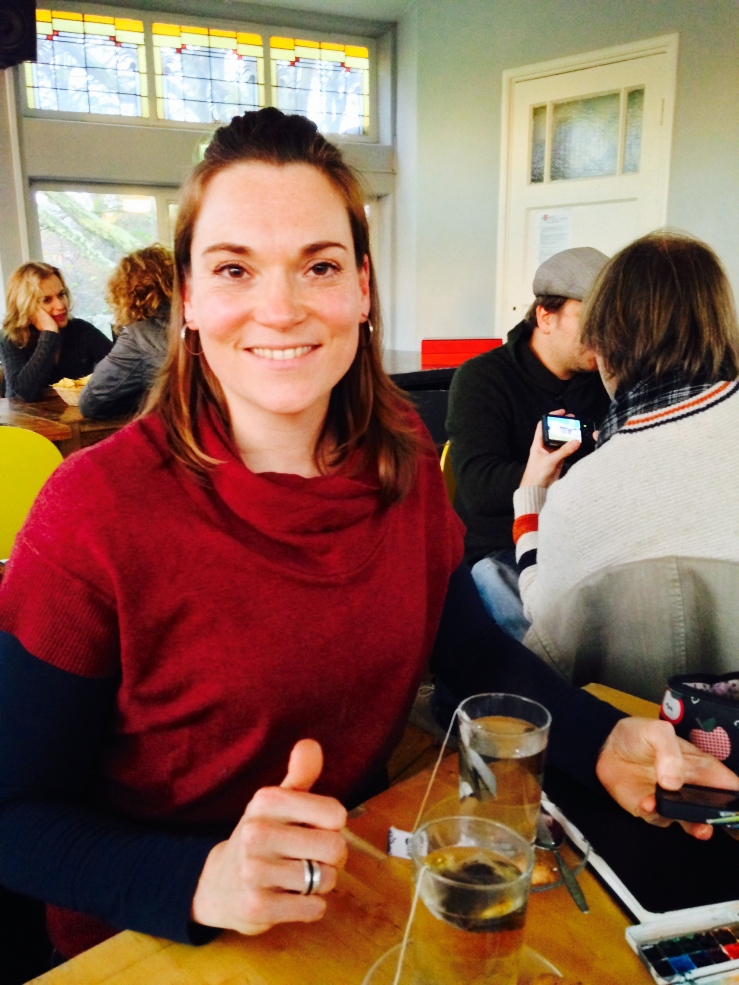
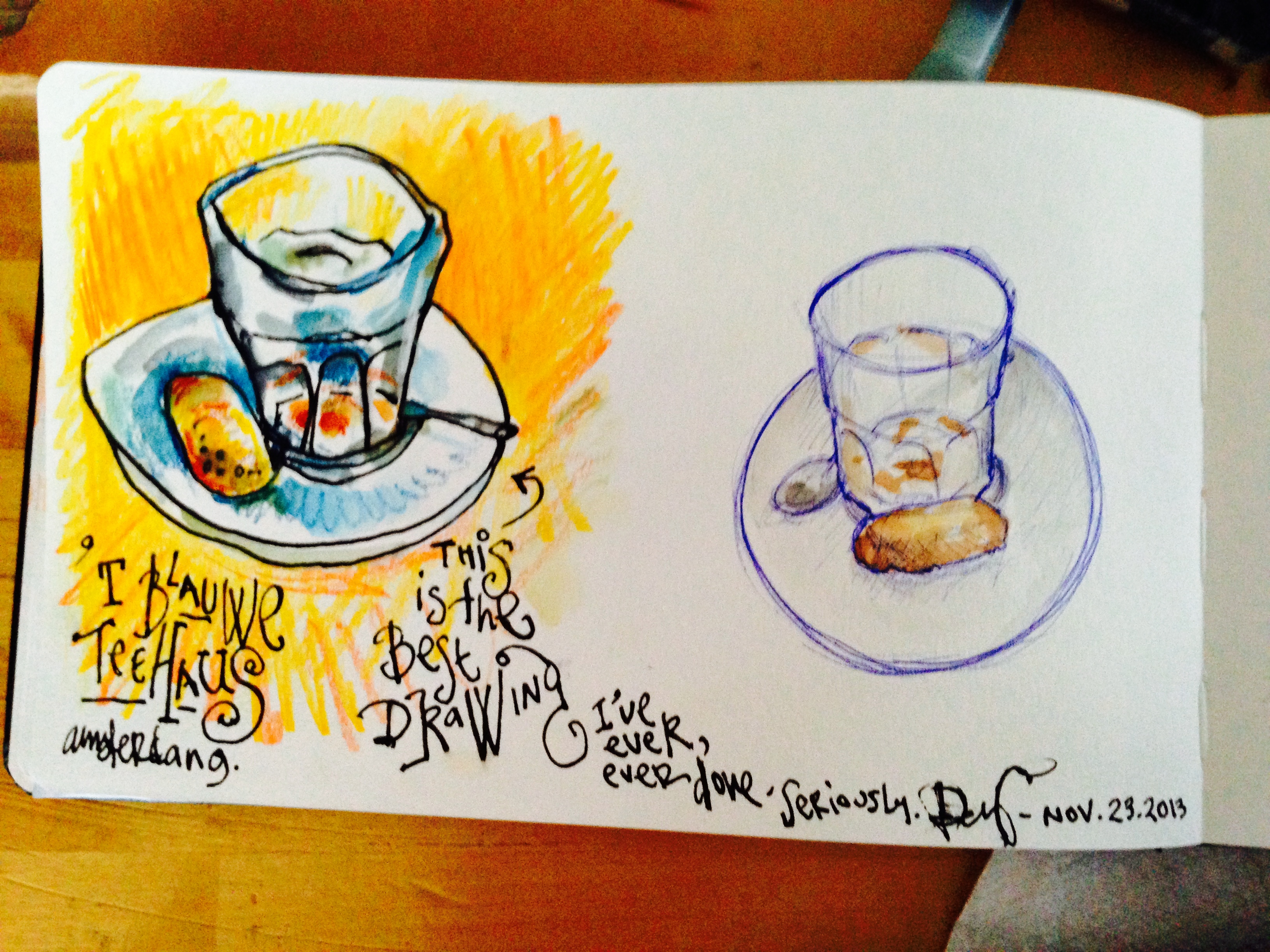
We met at a teahouse in the Vondelpark, shared stories, tea, and a stack of journals, then drew together. Our styles are different but complementary, doncha think? Then we met up with Pascal, Koosje’s musician husband, and had a sumptuous Indonesian feast.Koosje is also one of the first people to offer really great online classes in drawing and she has been really helpful with advice on my budding efforts. I urge you to check out her work, watch her free weekly drawing tip videos, and sign up for her next class. She’s awesome!
A mural in my ‘hood foreshadows my trip to Amsterdam.
The conference and Amsterdam’s cold, damp (I miss LA!) didn’t leave me a lot of opportunity to roam around the city but I did get to the Rijksmuseum and the Van Gogh Museum.
Vincent van Gogh has alway been a huge inspiration to me. I love his colors, his ferocity, but most of all, the whole journey of discovery he took trying to beat and bend himself into being an artist. In just ten years, he went from painting awful brown crap into changing art for all time. I’ve always even a kindred spirit because of the way he went about teaching himself, how he absorbed so many influences, how he went down one path after another to get clearer and more direct in his work. He spent a few months in art school, studied under a couple of professionals, read loads of instructional books, but most of all he just painted and painted, often filling a canvas a day, day after day.
As you can imagine, I was really excited by the enormous show called “Van Gogh at Work”. It focusses entirely on this process, showing how Vincent learned and evolved through more than 200 drawings, paintings, and sketchbooks. There are exhibits of his easels, his paints, palettes, preparatory drawings, and loads of completed masterpieces, in a sweeping chronological exhibit covering four entire floors.
I learned a huge amount in the hours I spent there.
First, there was the shock of seeing all these amazing paintings as working examples, rather than “Priceless Masterpieces,” giving them an immediacy that made me understand how Van Gogh himself must have seen them.
Have you ever had the experience of seeing an artist with his own work, how he might rub the paint with his thumb, or want to repaint a corner, or throws them onto a stack in the corner? Artists have such a different relationship with their pieces than curators or gallerists who tiptoe around with white gloves and X-ray machines, because artists value the process of their art as much, if not more, than the actual products of that process. Van Gogh would paint on the back of old paintings, or just scrape them down so he could make something new. He would knock out stacks of paintings of the exact same subject, trying new and different things. When you see, for example, both paintings of his room at Arles, two version of an iconic image hanging next to each other, similar but different in a hundred ways, you feel the living artist behind them, how he thought and developed, what he was considering, where he saw mistakes that became lessons. How often he would make copies of his paintings so he could give them to other people or just to brighten up his room. All those priceless sunflowers — he made them just so Gauguin would be happy in a cheerfully decorated room when he came to Arles.
And he was such a thirsty sponge. He was always studying others, absorbing, mimicking, incorporating, and then surpassing a long list of painters who seem at first to be him betters but ultimately look regressive, formulaic, and only of their moment, now past.
You get the sense that people are always telling him, “No, this is how you must make Art,” from the one professional teacher in his hometown who briefly mentored him, to the teachers at the Académie who gave him the worst marks, to the Impressionists who opened his eyes in Paris to Gauguin and on and on. Everyone knows better and he seems to listen, guilelessly. But, unlike them, he is never satisfied, never thinks he has the final answer, and keep pushing on.
You could sense how hard he was working and how he kept pushing himself onward. Even if he liked a painting he’d done, he would try something new. A new approach, a new subject, new materials, different canvas sizes… new, new, new. He never felt like the journey was over, that he had arrived; there was so much more to discover. I love that hunger and enthusiasm.
And, as the chronology of the show takes him (and you) from milestone to milestone, you can see his work progress and yet retain certain things that make them all Van Gogh. He copies and copies and copies — Impressionists, Dutch masters, Japanese Woodcuts, all of his friends from Lautrec to Seurat, absorbing each influence, going down by ways and dead ends, accumulating new ideas and ways of seeing, and yet each brush stroke can’t help but look like his. He couldn’t help being Van Gogh.
If you hear a voice within you say ‘you cannot paint,’ then by all means paint, and that voice will be silenced. — Vinny vG.
His passion and his passion never abate and the miracle of what he is making himself into through sheer force of will is exciting and inspiring. No matter how familiar the images look, seeing them in the flesh makes them new and exciting.
Oh, and he is always drawing.
There are lines over and under the paint, that give everything definition and clarity. That’s been my desire with my paintings too but it didn’t seem “painterly” and he shows how it can be. His influences in this are those Japanese woodcuts, Lautrec, and Gauguin — lines that are sometimes black or in contrasting colors or just darker shades or hues of the blocked-in shapes. Or lines that graduate in color and tone along their length. Sometimes the lines are picture elements: a branch, a window frame, a doorway, the edge of a petal, but often they are just there to separate planes and outline color fields.
Also: I was surprised to learn that he used store-bought, pre-stretched canvases. And that for a long period, he relied on a wire perspective frame to help him draw more accurately. And that he would used lengths of colored wool to plan out the color compositions of his paintings. They displayed the actual box full of balls of yarn that corresponded to many of his most famous works.
And finally, I saw that his work is a record of his life. He painted the people he knew: lovers, friends, neighbors, postmen, landlords. The places he lived. The cafés he ate in. The landscape all around him. His subjects had meaning to him and it shows in his best work.
When he does academic work, painting from professional models or plaster casts, it feels dull and lifeless. But when he paints sunflowers he picked, irises he wants to decorate a room he will live in, the difference is palpable. I have always loved his painting of almond blossoms against a teal background, a background that he painted last, carefully outlining every branch. Now I know that he painted it so carefully for his newly born nephew, blossoms for a fresh life, and there is love and care in every stroke.
Great art isn’t scary and imposing and “Important”. It’s personal and full of feeling. At some point, van Gogh gave up making paintings to be sold — that seemed like it would never happen. Instead he made so many paintings because he had to, he wanted to, he had problems to unravel and the world around him was beautiful and cried out to him to be embraced.
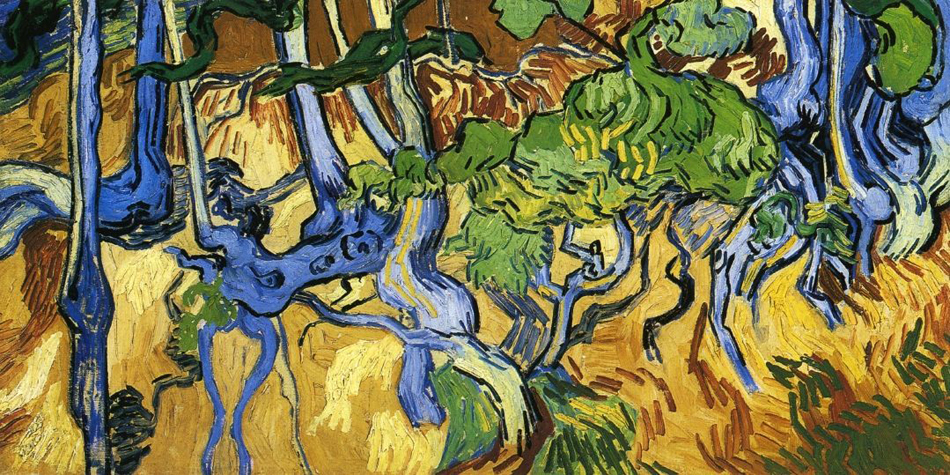
The last two paintings in the show left me with a lump in my throat, like the ending of a great 1940s movie. The wheat field aswirl with crows, big wet-on-wet strokes that he slapped down in the baking sun, is well-known as a symbol of his tortured state. But the very last painting was one I had never seen before. It’s of the roots of trees, tangled like snakes, and it’s unfinished. It was his last lesson and he never completed it.
What must that last day have been like, him stopping in the middle of a painting and deciding that he’d had enough, that it was hopeless, and putting a revolver to his chest? One can never know. But as I walked down from the fourth floor of the museum, after seeing all of his hard work over the years, all of his experiments and discoveries, his catching up to and then surpassing so many other great artists, it was so sad to think that, in the end, van Gogh felt he had failed.
The monkey got him.
Skateboards and mousepads in the gift shop.
Imagine if Vincent had known how loved he would soon be. How we would all learn from his lessons and discoveries. How his works would become icons and decorate tea towels and boxershorts. And that the voice in his head was utterly wrong, despite how it seemed that one lousy day.
The monkey is almost always wrong. And the only answer is to keep trying and pushing and learning and discovering. The road has no end, just lots of twists and turns, and it keeps moving upwards even if we can’t feel it all the time.
Since I first started drawing again, more than fifteen years ago, I’ve discovered that drawing in a book is a lot more than making nice pictures.
Observing one’s life, recording one’s days, contemplating the details of the everyday, being more present, finding the beauty all around me, these are powerful experiences that have been transformative for me, particularly in difficult times — and I have always hoped that I could discover how to share this discovery to help others. I’ve long wanted to go beyond the world of Art and illustration and talk to people in schools, hospitals, and prisons about how drawing can help them discover the world as it truly is: beautiful and full of meaning.
Since leaving my job in advertising, I have been thinking about and working on how to do this. I’m not there yet, but this week I took another step forward.
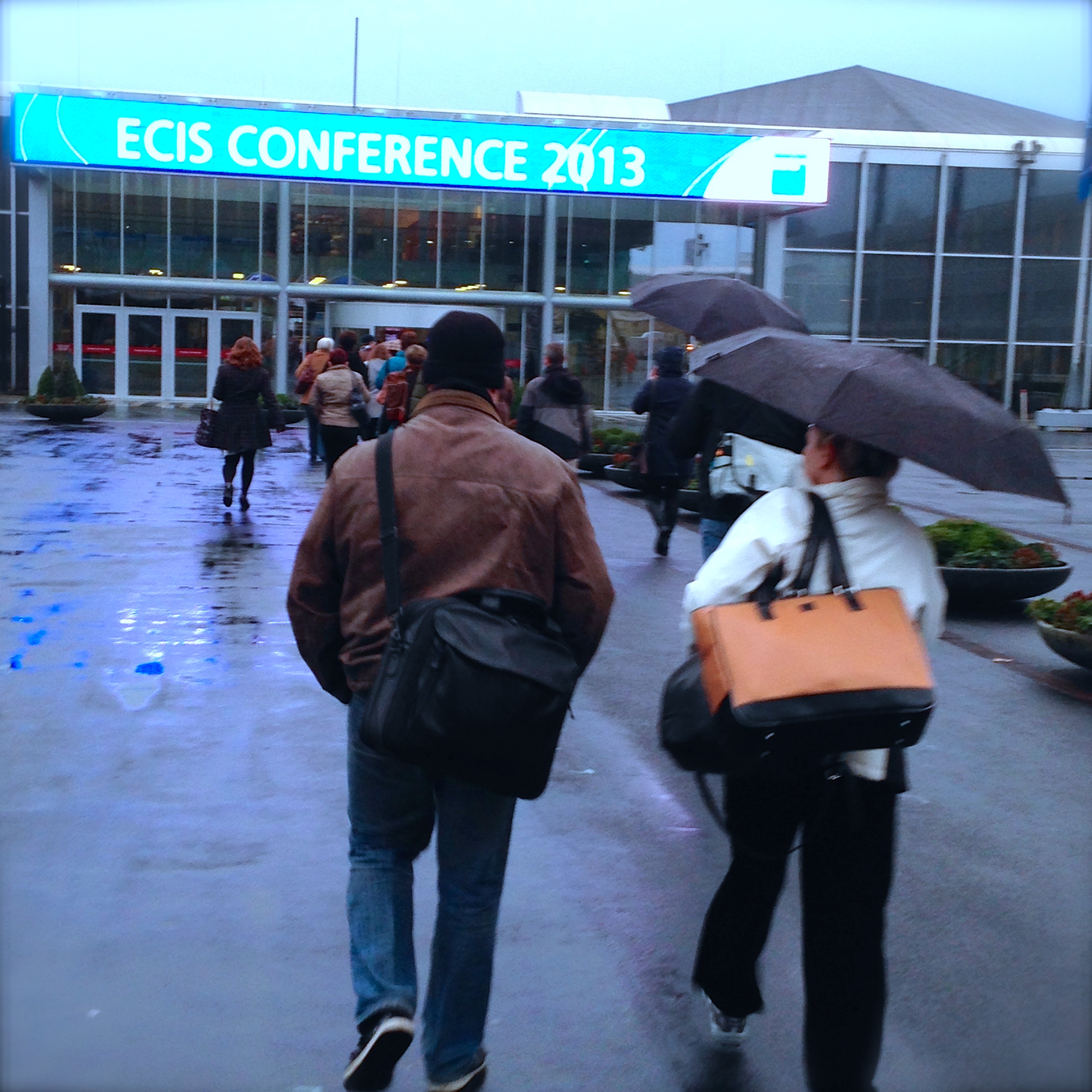
I’ve just come back from five days in Amsterdam, where I gave the keynote address at an educational conference, addressing 1800 teachers from 213 schools in 37 countries.
After my presentation and workshops, I had loads of interesting conversations — about the true meaning of drawing, how to encourage teens to reignite their childhood creativity, how to get children to express their inner lives in their own journals, how drawing can go beyond the art classroom to be a part of all subjects, and much more.
These conversations opened new doors. I got invitations to come talk with students, teachers and parents in Germany, Czech Republic, England, Tanzania, Malaysia, Switzerland and the Netherlands. I don’t know what will come of all this but it’s very exciting.
Those who educate children well are more to be honored than they who produce them; for these only gave them life, those the art of living well. — Aristotle
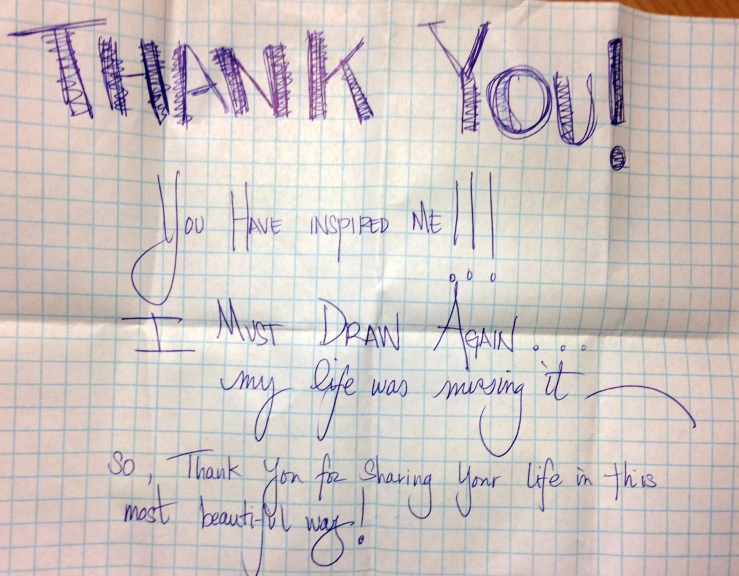
Many of you were enormously helpful over the past few months as I prepared for the conference. Dozens of teachers generously shared their experiences with illustrated journaling in the classroom and sent me the wonderful work their students had created.
Their stories and images helped build a bridge between the work I have done and the needs of the teachers at the conference. It was invaluable and I want to thank you again for collaborating with me.
Since the early 1995, Frank has cut what I laughingly call my hair. Every 18 days or so, once over with a 1.5 clipper. It takes fifteen minutes tops, we chat about the weather, listen to Italian radio. He applies warm shaving cream to my neck and sideburns, wields the straight razor, slaps on some stingy stuff. No muss, no fuss. He was trained in Sicily, authentically, pre-hipster, old school.
Now Frank is three thousand miles away. I have scoured West L.A. looking for his distant cousin and have had three haircuts from three different “barbers”. The ambience, the chit-chat, the music, the results, have all been very disappointing.
On Friday, in preparation for my trip to New York (sadly, Frank is closed the days I’ll be there) and then Amsterdam, I tried yet another place. A very nice lady tried a) to talk me out of my usual haircut, b) put a paper rather than cloth towel around my neck, and c) badly sliced the edge of my ear with the clippers. She tried to blame the shape (somewhat pointy) of my ear, then handed me a series of towels to absorb the geysering blood. I held a towel to the side of my head while she cut around it.
By the time I woke up in the morning, with bloodstains on my pillow (isn’t that the name of a song?), the wound seems to have closed. I grumbled a bit more about it and then suddenly had an epiphany. Of course! I am headed to the Netherlands, home of Vincent V. Clearly, this is a great omen that the trip will be a wonderful artistic experience.
As you’ve heard me say before, I am usually over-caffeinated and impatient. I imagined that once I had declared my intention to leave my job, served out my notice, packed my duffel bag and buckled myself into the Virgin America seat, the rest would be smooth sailing. I’d scarcely be off the plane before I’d be happily and successfully doing whatever it was I was supposed to be doing.
Two months later, I am in the garage. I am surrounded by piles of drawings, library books, art supplies, paint-spattered Ikea furniture and two dogs with dead geranium heads in their fur. I have most of my manuscript done, I have all of my presentations for Amsterdam polished and rehearsed, I have several large and more or less finished paintings leaning against the wall, my redesigned website is launched, and I have pages and pages of some sort of ideas scribbled in ink, sweat, and mustard (homemade sandwiches sustain me through most of my days, these days).
My journey, however, is not completed. I am still at that point in the ride when your feet are off the ground, you are whimpering/screaming, and glued into your seat by some magical force I forget to pay attention to in Mr Kriben’s physics class. I have clearly left the last station. It is two months in the rear view. I no longer dream about conference calls and I am starting to forget the names of people I nodded to everyday in the hall.
But my instruments however are wildly fluctuating. Let me up my metaphor. If you’ve seen Gravity([spoiler alert], you’ll know that I have passed the point where I thought I was going to suffer George’s Clooney’s fate and drift off endlessly into the void and am more or less in Sandra Bullock’s place through most of the movie, somewhere between the exhilaration of an adventurous dream come true and trying to decipher Chinese instrument panels as the flames shoot past the windows.
In short, I’m not sure where I’m going exactly but I think I’m headed in the right direction. I don’t have much better advice for myself than hang on, stay loose, and enjoy the ride.
There are days that are heaven. Listening to NPR, dogs slumbering on the studio floor, barefoot, making stuff, working till the moths activate the motion detectors to turn on the lights. I am an artist.
And there have been nights when I have awoken to the shrill monkey’s voice: “What are you doing? Where is this going? Who cares about this crap? Why’d you walk away?” I am a loser.
The good thing is the nights are short and the days, even though it’s mid-November, are still lovely and long.
So I am still vulnerable and gelatinous some of the time — but that time is lessening. I am seeing more clearly through the clouds and am excited about the landscape coming up. I finally have a sense of what it I want to do and be (you have no idea how hard it is, even for a man of my advanced years, to figure out what you want to be when you grow up). I think I have finally gone through at least 720 degrees of torment and figured out how to make an online class that seems right. I think I know how I feel about teaching workshops and what to do about that. I know what book I want to do after this one. And I am itching to make some videos again.
But most importantly I am getting clearer about the okayness of not being clear, that fuzziness and ambiguity are an inevitable part of change and of the creative process. In the end, that’s probably the best indication I have that I am doing things right and really metamorphosing, the fact that I am shaken up, that nothing is familiar or solid ground.
I don’t regret this trip for a minute, but I sure could use some Dramamine.
I have just taken the wraps off my new website. At last, I have managed to pull all of my best stuff together (drawings, books, films, ads, bloggery, etc) so it’s easy to look (even on your phone). If you aren’t familiar with all of the stuff I’m up to, check it out.
Kick the tires and do let me know if there’s anything weird, unclear or lame about it.
P.S. I will continue to blog at this location. The one you’re on now. Got it. Okay? Okay.
Artists are dismissed as dreamers. But being an artist takes focus and perseverance. It is a tough job, grounded firmly in the real.
Dreamers are roadkill. Artists work. That’s why they call it “The Work”. Not “the ideas,” “the notions”, “the dreams”, “the visions”. The Work.
Being an artist means seeing the world as it is and having something to say about it. Most people don’t. Most people are content with hackneyed second-hand points of view. Tree hugger or tea partier, paper or plastic. But being an artist means diving into what is really out there, building your own filter from scratch, a filter that adjusts the contrast, brings out the details, heightens the textures and looks deep into the shadows. If you have nothing to say, your hands will tremble, your lines will be weak, your compositions will be flat and your audience will be yawning. You need to reach down and take a stand. On something, anything.
Being an artist means working to see yourself as well. To figure out what colors you see in. What shapes you like. What appeals to you. And trying in some way to understand why. Not why as in words but why as in feelings, nuances, shades. What do I like, me? I like bent things, dead things, wounded things. I like things that are beaten by the sun and wrinkled by the years. I like to see their history in their surfaces, to feel what has happened to them, to trace the map of their journey carved into their flesh, to empathize. Why do I like these things? Is it because I know I am not perfect, I have been ravaged, I persevere and I honor those who do too? Or is it because I cannot actually make beauty? I need to ask myself these questions, even though I don’t aim to ever articulate the answers. I need to see in to that ugliness and share why it is so beautiful to me. So you can see it too, so you can see the love inside your own pain.
Being an artist takes courage. It takes balls and sweat to see the world through fresh eyes and to develop the skills to express that vision and then go out on a limb and share it. Because it’s a long row to hoe, a thankless journey most of the way, a trip no one ever asked you to take and no one feels obliged to cheer you along on. If there are any spectators along the road, they are probably skeptical, probably see you as a self-indulgent weirdo too lazy to get a proper job. But don’t look to me for sympathy. Or applause. Because being an artist is a cause you choose for yourself, the rewards are in the journey, and there is no Promised Land. You have to want to proclaim your vision, to broadcast your voice, to change the world. The finish line doesn’t lie at the doors of the Whitney Biennial, it lies at the grave. Every day is a lesson and a revelation and they follow one after the other to the horizon, providing their own reward. Artists accumulate wisdom and depth and no gallery owner can take a cut of that and no auctioneer can ring a gavel down upon the lessons learned.
The only thing to goad you on is your fire and your nerve. Because after all, who asked you? Who asked you how you see the world, what’s good or bad, what needs changing, what could be. No one. You decided you had something to say and now you want to say it. No one is obligated to listen but you will make them sit up and take heed.
Being an artist means being an entrepreneur who imposes his vision, who asserts the value of what he is doing and insists people look at it and take him seriously. No one else will do it for you. No one else will come up with your business plan or a strategy or a new idea. You don’t answer to a committee or a board or market research. You make your product, you sell your product, you create your market, you get your ass out of bed each day and punch the clock you built.
Being an artist means being a craftsman, a self-promoter, and productive without a boss, a company, a client. You are making a product no one asked to buy, sourcing your own materials, developing your strategy, and above all, shipping what you make. It can’t just sit in your brainpan or your sketchbook, it needs to be stretched, framed, and hung up for the world to see and buy and resell and love and learn from.
If that scares you, cool. Museums show about 2% of the work they own. There’s already plenty of genius in storage.
But if that excites you and inspires you, awesome. Do the work and bring it on.
“Don’t ask yourself what the world needs. Ask yourself what makes you come alive and then go do that. Because what the world needs is people who have come alive.”
Late weekend morning and Jenny and I were on bench outside a local motorcycle shop/café, eating breakfast and perusing the Sunday Times (N.Y. — Like a proper NYSnob, I haven’t been here long enough to forgo proper journalism for the local paper).
We had a croissant and a fresh and elaborately made latte apiece. I am not normally a latte person but when in Rome… (where, incidentally, I never saw anyone drink latte which is normally reserved for infants or the feeble). While reading the Book Review, I absent-mindedly chugged down the contents of my cup. It was warm, creamy, slightly sweet and, soon, disappointingly gone.
I immediately hopped up and went to order another. A young woman with multiple face-rings rang me up and a man with a waxed mustache and neck tats handed me another steaming cup full of ambrosia.
I plunked back down and resumed chomping on the NYTBR. Suddenly I started to feel, well, unwell — pulsing waves of liquid anxiety coursed up my arms, my bowels felt like quicksand, my heart thundered like Secretariat, beads of sweat dribbled down my pate. It wasn’t a stroke; it was the effects of far more caffeine than a normal, unsedated person should consume. And I had yet to touch my second cup of well-milked amphetamine.
My point is not to warn you again the evils of the world’s most widely consumed psychoactive drug. Life would be duller without it. Instead, this episode made me pause to think about my gluttony and impatience. My need to rush into things that seem vaguely interesting and to find immediate solutions to potential problems that have yet to crest the horizon.
When I came to LA, I had an urgent need to furnish my home and my studio as soon as possible. Within days, I had built truckloads full of furniture and knocked out dozens of drawings and watercolors to fill the walls. I had a shelf-full of guidebooks and had visited all of the decent museums. I had contact everyone I even vaguely knew in-town and planned get-togethers.
Something inside me felt imperiled if I didn’t get a move-on. If I hadn’t built a bulwark against the dimmest view of my future, I couldn’t feel safe.
This is an impulse I have wrestled with my whole life, a need to rush to results. Hurry up and wait. I handed in my thesis three months early — my advisor scowled at me and said he wouldn’t be even looking at it till Spring. I envy procrastinators. This isn’t false modesty. It’s the same impulse that had me ruining model airplanes when I was a gluey-fingered kid, that had me making wonky, ill-fitting covers in bookbinding class, that caused my journal to burst into flames in the microwave as I tried to hurry the drying of a watercolor. If I took my time, I might come up with more thoughtful, deeper, better crafted stuff. Instead, I splatter ink, drop glasses, and dash for second helpings.
My commitment to drawing has been an attempt to slow the hell down, despite my twitchy nature. I really do want to do things well and carefully, to stick to it, to focus on the process instead of obsessing the purpose and value of whatever I undertake. When I wrote A Kiss Before You Go, I forced myself to go slowly, to carefully check each draft, to take my time with the watercolors, to make the best book I could. It was hard and I still managed to get the book out fairly quickly, more quickly that I sometimes think was altogether decent.
Maybe advertising was the right career path for me. Thirty seconds. And all that money at stake meant I was surrounded by people who made sure I slowed down and polish every detail. I was known for making really well crafted commercials, again, despite my nature.
I left my job three months ago and I have been in LA for seven weeks now and already I am impatient. I had committed to myself that I would take six months to a year to figure out where I was going next. To explore, to reconnect with myself, to have an adventure. But the anxious monkey in my head wants another latte, wants results, clarity and purpose. It’s not enough that I am painting and drawing and blogging and writing my next book. He wants the path all worked out, wants an answer, any answer, now.
Screw the monkey. I have to be careful. That’s why I haven’t blundered into going workshops or contacting galleries or shooting all of my online classes videos or writing the five other book proposals I’ve been kicking around. I worry that I am just sitting in this garage and that cobwebs will grow over me but I must sit still.
I am trying to grow a new me. And that takes something the old me has in short supply. Patience. Calm. A long view.
This past weekend was the Day of the Dead, a lovely Mexican tradition in which people visit the graves of their loved ones and bring a picnic to share with the souls of the departed. Patti and I loved this holiday — it combined our morbid fascination with graveyards and mortuaries with a sense of humor and cartoony festivities. I wrote about this three years ago, when thoughts of death had suddenly assumed a new and less whimsical tone.
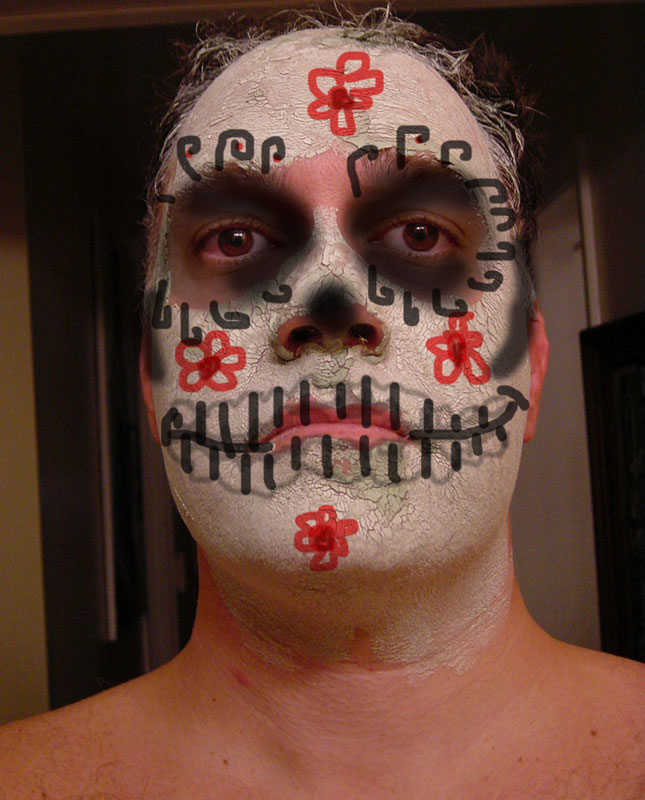
Last Saturday, Jenny and I joined thousands of other Angelinos at the Hollywood Forever cemetery to commemorate the Día de los Muertos. It’s a huge party. There’s a contest for who can build the most impressive memorial shrine and everyone has their faces painted to look like grinning skulls encrusted with jewels and flowers.
I love that this holiday turns the traditional gloominess surrounding death on its head. Instead of an occasion for grief, it is a celebration of the lives of the deceased. The Mexicans believe that a person dies a second death when their memory is forgotten and that makes a lot of sense to me. Immortality means you had an enduring effect on the world, that the things you did for people while you were here will be carried around in their hearts. If you set an example for others to follow, you never really pass away. I see that in Patti — because people have such vivid and positive memories of her, she lives on.
These days, I live a life that is three thousand miles from many of the memories Patti and I shared. I am not walking the streets she did, no longer live in her house or sleep in her bed or see the people who knew her so well. I worried about that when we Jenny and I first talked about coming West, that Patti’s memory would somehow fade when I was far from the physical world she lived in.
Now I know that’s not true, because I brought Patti with me.
I brought her photo in a frame that I see every day but more importantly, I brought the part of me she created over the quarter of a century we spent together. I also believe that Patti wanted me to grow and change and have adventures. She told me so a million times, a million times I did not hear because I was encrusted in my habits and fears. Now, when I feel the pieces scrape and shift inside me, I know that she would approve. She would be so happy that I am here, with Jenny, in this mini house, painting in this garage.
Patti was the one who taught me how to love, how to go beyond my self-absorption and love another unconditionally. If she hadn’t taught me the importance of true love, I could not truly love Jenny as I do today. But loving again does not diminish my first love. And conversely, the bottomless well of love I had to share in my past with Patti does not mean a drop less in my future with Jenny. There’s plenty to go around. The more love you give, the more love you have. And the hardest part is learning to share that endless love with yourself, to be kind and generous with who you are.
—
Recently, a Facebook friend who had suffered a recent loss, sent me a few questions about my experience with death. I’ve been waiting for a reason to share them with you and DIa de los Muertos seems as good a one as any.
-How did you survive your worst sort of days?
I guess I had no choice. I had a loving wife and small son and what other option was there but to persevere? I didn’t believe in God. I didn’t believe in karma or fate. Life was shitty and I could either deal with it or check out. In retrospect, I think that my love for my wife was a key factor to my will to continue. We planned a life together and her accident was not going to stop us from being together and having a meaningful time of it. When she died, I no longer had that to hold me together, But I had my son and my commitment to be there for him. And I had my memory of Patti and her example, the fact that she had survived a huge blow and had carried on for so long. She loved life and she loved people and I tried to absorb some of that spirit, to look on the bright side, to count my blessings, to continue to be creative. I used my art to gain perspective on the blows that were dealt me, to get them out of my head and on to the page, so I could start to put the loss behind me, and have some thing to live for. And I reached out to other people, I shared my story, I tried to make my life meaningful, and of service to others.
-Days when getting out of bed seemed impossible what motivated you?
After Patti had her accident, I got out of bed to change Jack’s diapers. He was nine months old. Life was going on. The sun was still rising and setting. There were new things to experience. I wanted each day to be better than what had preceded it and slowly but surely it did.
-What do you say to people who say things that they think are very helpful and seems to create a deeper hole in your soul?
I am glad they are trying to help and I think them for it. In each person’s story there is something useful. But I know that only I can truly understand what I have gone through. Platitudes can be so annoying and distancing but I try to concentrate on the love that is behind them. The fact is, people don’t really know what to say. And often it is surprising how certain people react to tragedy and change. I was amazed when people I thought had seen it all disappeared when we needed them. And I was equally amazed at people who I thought barely knew me stepped forward, rolled up their sleeves, and helped me so much. Do not underestimate the importance of other people’s love and comfort. But don’t be disappointed if they don’t know how exactly to help.
-being blindsided… Moments or days where you almost feel normal and a smell or a texture brings you to your knees in grief.
Yup. That’s very familiar. Grief appeared and knocked me on my ass when I thought I was long out of the woods. And it isn’t necessarily prompted by a smell or a sound, it can just pop up out of the blue. The flip side of this is that in time those little moments turn from painful to sweet, a lovely reminder of what one has lost, of how much it meant, of how dear it still is. I can smell perfume, hear an Ohio accent, and be transported back into Patti’s arms. What was once unbearable becomes cherished. Give. It. Time.
-Does it get better, Danny?
If it didn’t our species would have long vanished in a never-ending rain of pain. Every day you make progress. Sometimes you slip, sometimes you jump forward. It is a wound and if it doesn’t kill you, you emerge wiser and happier. As the Buddha told us, “Pain is inevitable, suffering is optional.”
– What helped and helps you the most as you continue moving forward?
In so many ways, my life today is better than ever. It is the life Patti always wanted for me. I have changed almost every aspect of my work and my home and am now on new adventures. My life is going on. It took three and a half years to get here. It was worth the trip. Thank you, Pat.
— Anything other words of experience you can think to offer?
I got a lot out of The Other Side of Sadness: What the New Science of Bereavement Tells Us About Life After Lossby George A. Bonnano. He points out that 95% or so of people emerge from grief in a year or less. And of course, I got a huge amount of help and wisdom from my grief counselor and from my lovely and wise girlfriend, Jenny James.










 Danny Gregory