Why me?


20130821-091348.jpgI try to be good.

I take a multivitamin each morning. I floss each night. I give to my local public radio station. I rarely beat or kick my child. Then this….

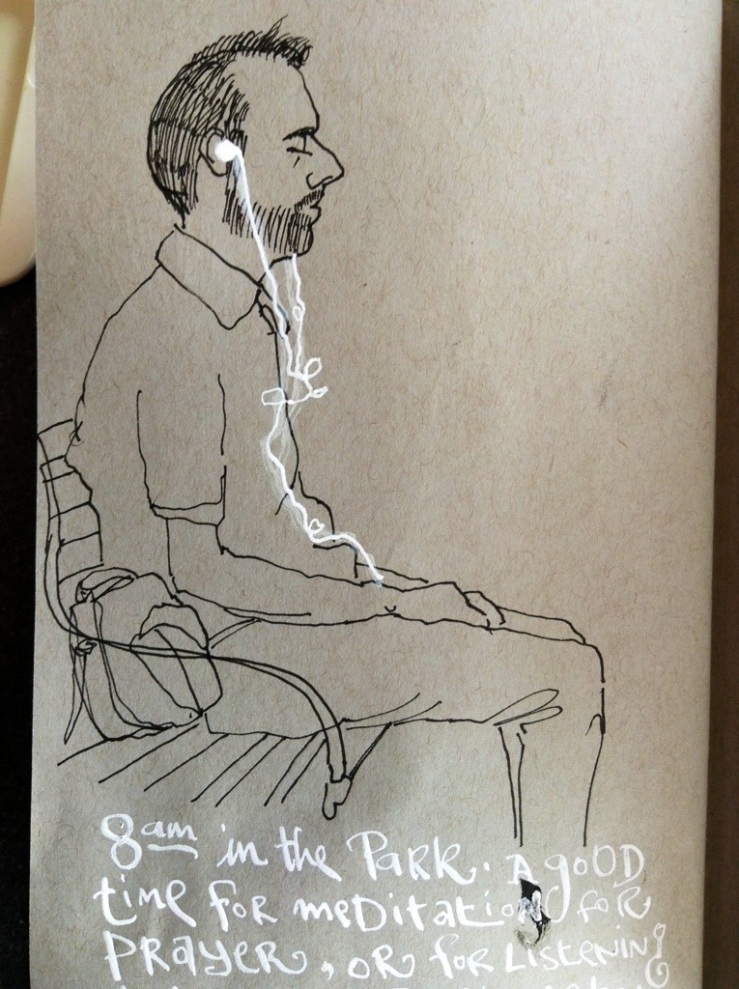
So this morning, I take my dogs to the park and plan to begin the day with a small drawing, nothing too challenging, a little amuse bouche. I see this guy on the bench nearby and it seems he is planning to sit immobile for a couple of minutes so I dash off the drawing above. At home I write a little caption with a dip pen and white ink and I am happier with a journal page than I have been in weeks.

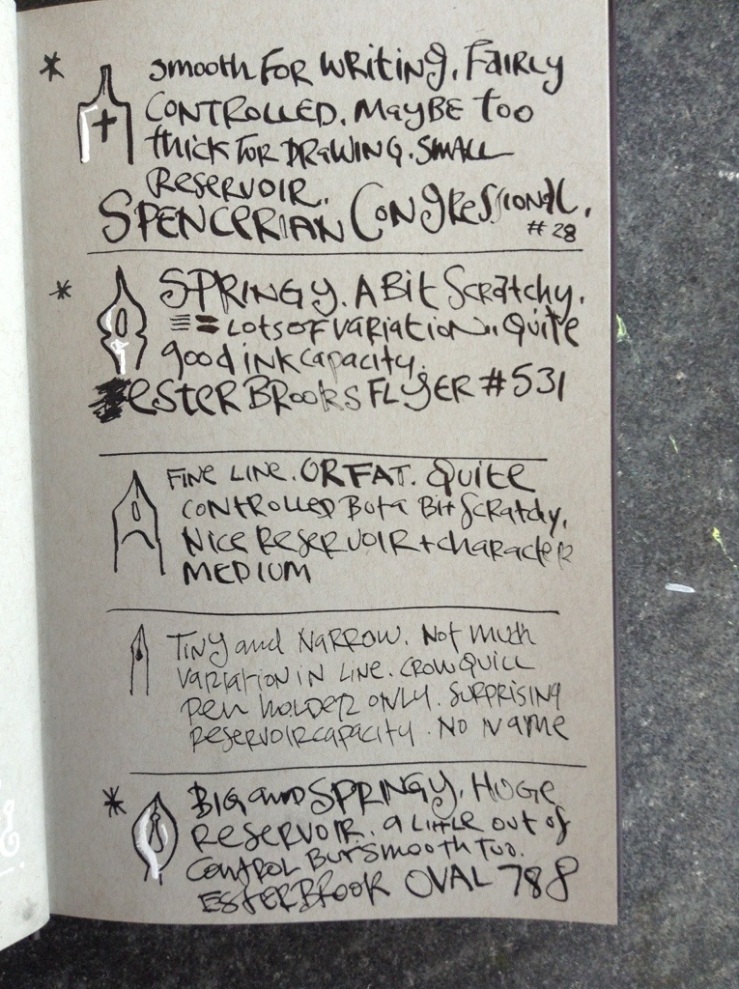
After breakfast, I decide to inventory my pens. I am going through a period of transition, easing away from markery sorts of pens like the PITTs and tending more to my dip pens. But I have a big messy box of steel nibs and I decide it’s high time to clean and inventory them. So I make a little page in my journal and chart my favorites.

20130821-091158.jpg


It’s a messy business, prying nibs off the holder, rummaging around in the vat of pen cleaner, ink and paper towels all over the place. I am trying to be fastidious but it really goes against my nature. An astrologer once did my star chart and told me I am something called “a triple Virgo” which mean I should be incredibly anal and neat and able to change a pen nib without courting disaster.

Hah ha. Not so fast.

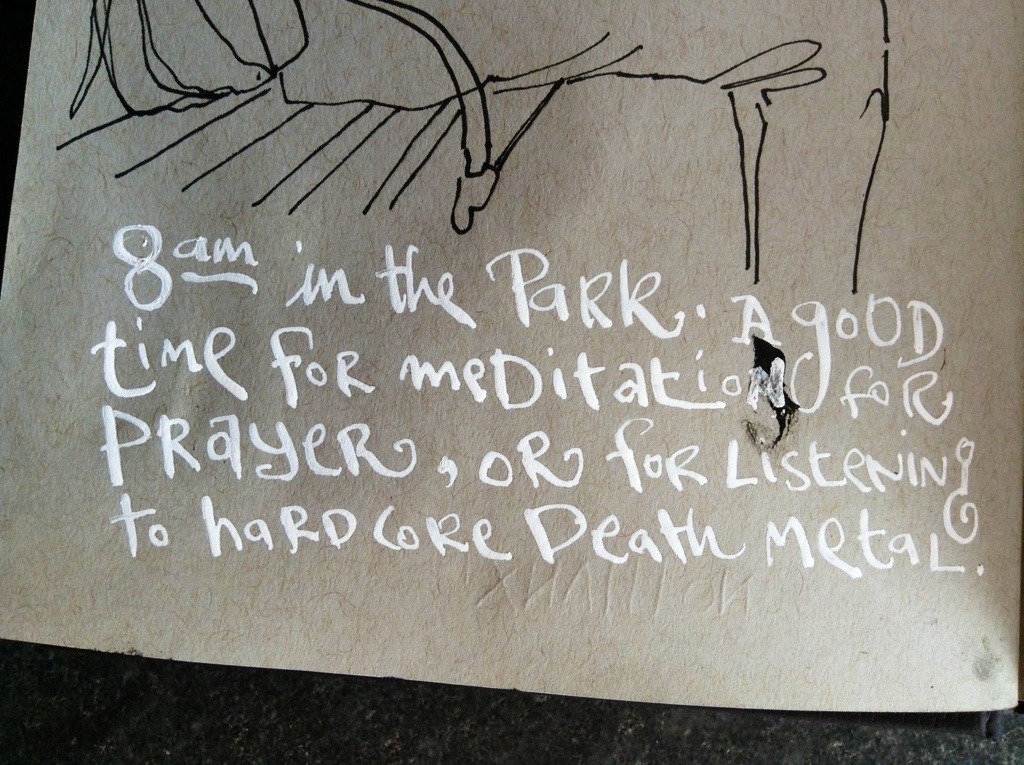
I look back at the left hand side of my spread, and somehow, mysteriously, damnably, I have managed to smear black ink across my writing. What the hell? You can see below, I try to fix it up with another layer of white ink but it probably looks even worse.

God. Damn. It.

20130821-091357.jpg

I tell you this sad story for a number of reasons. First because I am still in the grip of the anguish it caused. Secondly, I guess I can try to extract some sort of life lesson from it to share with you so at least we can profit from this disaster. What would that  be?

Do not fear mistakes. There are none.” WTF? That’s clearly not the case. That smear is a big, annoying mistake. It may not look it to you but to me, it’s a huge festering boil in the middle of Kate Moss’s forehead.

It’s the journey not the destination.” Again, I guess so, but the ink blot was part of the journey, the Montezuma’s revenge, the Metro pickpocket, the cancelled hotel reservation of the journey. Thanks for not much.

Slow down, butthead.” I guess. But I was trying to be slow and deliberate. Granted my whole dining table was covered with bottles and boxes and crumpled paper towels and my hands were black up to the wristwatch. I am a klutz and a slob so I should try to operate at 1/2 speed.

Maybe I should stick to crayons. And wear rubber gloves.

Epic.

snail2

My mother just sent me a link to a site documenting a journalist’s trek on foot from southern Africa to South America (I’ll give you the link in a minute). This isn’t just another endurance stunt —Paul Salopek is a Pulitzer Prize winning writer for National Geographic so his trip is all about science and journalism. He started earlier this year and will take seven years to complete the odyssey.

I have always been fiercely attracted to this sort of epic journey.

A few years ago, I was in thrall as my pal, d.price, rode his recumbent bike some 5,000 miles from Eastern Oregon to Key West. I loved Travels with Charley and On the Road.  Kon-Tiki by Thor Heyerdahl (finally a movie!), Bill Bryson’s Appalachian trail book, A Walk in the Woods, Cheryl Strayed’s Wild. The Happiest Man in the World by Alec Wilkinson describes Poppa Neutrino’s quest to build a boat out of garbage and sail it across the Atlantic. Mike McIntyre walked across the country with no money and relied entirely on The Kindness of Strangers (which is the name of his amazing book about the trip). The list goes on.

Ten years ago, I wrote a proposal for a book in which I’d follow the original epic travel journalists, Lewis and Clark, from St. Louis to the Pacific. I was going to adhere to their path and record the differences the couple of centuries had wrought. My editor said, “Make the trip, write the book, and then we’ll see.”  I didn’t. Life got in the way. Good thing Jefferson wasn’t counting on me.

Recently, Jenny has been urging me to drive across country with our dogs. I am sort of intrigued by the idea. Pros: 1. It seems romantic and epic and larger than life. 2. This is the perfect time of year for it. 3. It would be a great symbolic start to my life on the West Coast.  Cons: A) I don’t have a car. B) I think taking the dogs would make this a really bad idea. C) This is really her fantasy and she’ll already be across the country in her office in LA while I check into a long string of Motel 6s. For now, the cons have probably won but I still like the idea a lot, particularly if I could get a travel companion who I could stand to sit next to for a couple of weeks and who would be willing to stop and draw along the way.

Maybe next spring.

What intrigues me a lot about Paul Salopek’s journey is its emphasis on slow. He is taking seven years (!) to do this because he really wants to absorb the world as he goes. And he is looking for people along the way who are also seeking slowness in this madcap, speed obsessed world.

I think that’s the right thing to look for. Boy, it’s hard to slow down. I sat in the park this morning with my dogs and did a drawing. It was a small drawing, just filling a little box on the page, but I had to catch myself mid-way because I was tearing through it, barely looking at the arch I was drawing, just scratching out hasty, inaccurate and ugly lines. What the hell was my rush? It’s Sunday morning, I have nowhere to be till brunch, everyone else is sleeping, and yet I am belting through this drawing as if I was in an Olympic event. If I was Paul Salopek, I’d probably be half way to Rio by now.

Even though it’s been several weeks since I left the rat race, I still have my rat cleats on. I can feel it in the need I still have to accomplish things, to generate product, to log hours on my calendar. I so very much want to focus on the journey, the process, not the finish line but all these decades in the business world, in New York, still have me panting and pushing. I remind myself: I am on an epic adventure that will probably take another few decades to finish (in fact, I would like to push off the ending as far as possible) and what matters is the daily walk through life — the things I see, the people I meet, the lessons I learn.

If I’m really honest with myself, the reason I am not driving across country with my dogs is that the monkey is telling me I need to get to LA and start getting on with it. There’s no time for meandering and roses sniffing. I need to set up shop and start making something of myself. The monkey is wrong, again, of course. I make something of myself every day. It may not be something that can be direct-deposited, it’s true, but it’s also something that can’t be accelerated. Step by step, day by day, eyes open, head up.

—-

Here’s the link to Paul Salopek’s journey.  (I have put off giving it to you till the end of this blogpost for fear that you would rush off to read it and never come back to finish my blather. Clearly, I am better at slowing you down than I am at putting my own brakes on.)

My Summer Romance

In the interest of trying something new, I’ve recently taken to spending my mornings in a basement with a naked person and a pencil. The oddest part (if you’ll forgive an old copywriter the observation) is not the graphic nudity but the graphite.

As you may know, I have been a loyal pen man ever since I took up drawing last century. When I draw with a pen, I have always said, I am committed to my mark and so I draw more slowly and am fairly sure of my stroke. My line is decisive and, if it’s wrong, I must live with it and work my way out of the problem I have created.

But now, I have this pencil. Actually it’s usually a stick of graphite in a wooden handle with a little set of gripper teeth to hold it in place. And I must say, it feels sort of right for now. First off, I like the feeling of it in my hand, the chunkiness of it. And I like the organic variations, the way the mark gets soft and grey or bold and dark and everything in between. I like the range of hardnesses, the Hs and Bs with all their numbers and degrees of yield. I am least fond of the ends of the spectrum, the super hard H pencils that rip into the paper like cat’s claws or the utter spinelessness of the super soft high number Bs, malleable as turds in my paw. But in between there are a nice number of notes to play, combinations, of soft and smooth, hard and precise.

A long pose is a process and it starts by ogling. I stare at the model and paint him or her with my eyeballs. Then I take a few measurements, the overall height, midpoints, widths as a function of head heights, that sort of thing. Then I do a blind contour, my eyes slowly coursing over the edges of the body while my hand, unattended, records the line. I may look down at the page once or twice or not at all. Surprisingly, this first automatic line is usually pretty damned accurate, capturing the mood and balance of the pose, and it remains the basis for the several hours of drawing to follow. Maybe the knowledge that this is just a pencil line lets me feel comfortable and willing to take this blind risk. In any case, I can also go back in and correct here and there. I like being able to erase. It’s a relief after all those ink spattered years, like letting out my gut after I pass my reflection in a shop window.

Then I start remeasuring and seeing if my proportions will hold. I may have to erase an entire shin or redo the foreshortening on an arm — the first hour is all about tweaking and nudging until I can drop down on any point on the body and see that the angles and relationships are right.

The next hour or so is all about light and volume, trying to get a sense of the dimensions and weight of the body. I go back and forth, using the pencil sometimes as a tool that can blur and blend, and then one that makes hatches and crosshatches, creating tone out of marks. I still have one foot in the world of pen and ink, working in line as much as tone.

Finally, I’ll bring out my bag of colored pencils. I quite like all the colors and the fact that every color has so many permutations and degrees of intensity. though they don’t have the agility or smoothness of my sable brush and watercolors.

If you have had any sort of art training, you might be appalled by my technique but it works for me, these stages and homemade techniques, and I am reasonably happy with the process and my progress.

So I quite like the pencil, but it’s a summer romance, not marriage material.

The fact is, pencils make me feel like a wimp.

Maybe that goes with how i’m feeling these days, a little wimpy, a little less confident about my view of the world because I am evolving and changing. So maybe I want to record my life in pencil right now, and not to commit for the rest of time. I will not be getting a tattoo this month either.

Ink is forever. Pencil lines are more like thoughts, fleeting, evanescent, unreal. Any pencil drawing I do in my sketchbook is bound to blur and fade with time. Generally, I want to be confident and see and record the world as it truly is, but in times like these, when my life is turning a corner, and the view out of the window seems to blur, then maybe it’s more appropriate to render them in this fragile and temporary way.

This period of being soft and fragile and hopefully isn’t a permanent one. I’m in transit shuttling between one life, one coast, and another. Transit is a time of indefiniteness when you aren’t sure which suitcase you put your sandals in and if you left your toothbrush behind. But that’s okay, because when you get to your destination you can put everything in its right drawers and hang the pictures and reshelve the books. In the meantime, it’s okay to live with a little blur, to have erasers standing by just in case. Mistakes made in pencil are still lessons, but gentler, less consequential ones. Nonetheless each one helps me improve, perfect my line, tighten my observation, be in the moment, which is what this whole thing is about, this thing called drawing, and this thing called life.

On drinking the water.

20130811-164947.jpg
As our plane swooped down over Mexico, endless green filled the windows. My first instinct was to wonder what sort of farming this could be, dense, unbroken and stretching to the horizon in every direction. As the wheels touched down, I saw it was jungle, an impenetrable mass of unruly, complex life. The runways had been cut out of the wilderness but no attempt had been made to cultivate the creepers and trees. Nature was too vast, man too small.
Mexico is a mostly modern country with drive-through Starbucks and TGIFridays. But many Mexicans accept the unrelenting power of nature, impossible to dominate completely when the air is humid and the sun shines brightly all the live long year. Grasshoppers the size of iPhones, careen through the sky with chartreuse scales and hot-pink wings. Raccoons wander into four-star restaurants and take corn chips off the bar. Cars are sun-faded, concrete is cracked, donkeys walk slowly. It’s not a rich country, but that’s not the reason things seem shop-worn and resigned. It’s because Mexicans accept the inevitable encroachment of Nature, that it’s pointless to be fastidious when geckos will wander onto your kitchen counters and carpets of kelp will wash onto your freshly grouted patio.
I like it.
In New York, we have been beating Nature back for 500 years and we think we’ve won. So we can’t help but freak out when mice nibble on the organic granola box, when mosquitos find their way under our 600 thread count sheets, when Hurricane Sandy knocks out our wifi for a week. If Nature gains the slightest foothold, we take it as a sign that our entire civilization is crumbling.
I like that in general Mexicans are so much less uptight about perfection. They are cool if you do things that are a little risky — but hardly dangerous. Things that would have flocks of lawyers descending anywhere in the States. Unsecured seatbelts don’t have those annoying warning alarms. There are packs of cigarettes in the minibar. People build restaurants out of driftwood and light them with masses of candles. Some cars are missing fenders or bumpers and are painted patchily by hand. Most streets have no sidewalks or street lights so walking at night under starry skies can be an adventure.
We sat in a beachside restaurant that served food that would have been the envy of any entry in the NYC Zagat. But before our appetizer arrived, the waiters patrolled through with smoking pails, emitting clouds of burning citronella so chokingly dense we could barely see our $12 artisanal margaritas. The mosquitos and gnats were barely dissuaded but no one bothered to complain to the Health Department, pausing only to reach under our designer linens to scratch the welts.
Mexicans don’t value their lives less than their Northern neighbors. They just accept that we can’t control everything all the time. And that this acceptance makes life easier and preserves resources for more important things. Insisting on perfection makes thing a lot less interesting and spicy. It’s also a losing battle.
Maybe it was the heat or the Negro Modelo but my pen line was a little looser in Mexico. I did a number of scrawled pages in my journal, drawn half lying down, book propped against my spreading gut, mango juice on my unshaven chin. Maybe this was how Gauguin felt.
I am sloppy as a rule, but I’m not always loose. I value looseness because it feels more organic and expressive, more human, more natural, more the way life is. Less uptight, less gringo. Jack tells me his drawing teacher insists they draw standing up, with their pads on an easel, and that they draw from the shoulder, not from the wrist, to make bold and sweeping lines with their whole bodies. Flat on my back on my chaise, I am far from that, but I feel integrated, natural, in tune with my surroundings. My body, immersed in sweat and heat and verdant richness, feels sensual and at ease. My inner critic, the monkey is dulled too. He is chewing lazily on a mango in the shade, indifferent to my drawing. He can’t be bothered to nag me when we have the jungle at our doorstep. In Mexico, monkeys sit on your roof, squat on your car, hoot from the trees above your hotel window. But it seems they stay out of your head.
Over this past week in Mexico, I haven’t been as insanely productive as I might have been. But I have been more in tune with my nature. I’ve dismantled waves, I’ve counted grains of sand, I’ve listened to grackles eat French Fries, and I’ve felt the walls of perfection erode. Rules, goals and expectations, it turns out, may not help me make as much stuff as simply sitting in the sun and letting the world grow on around me.

Doing the wave.

20130806-200906.jpg
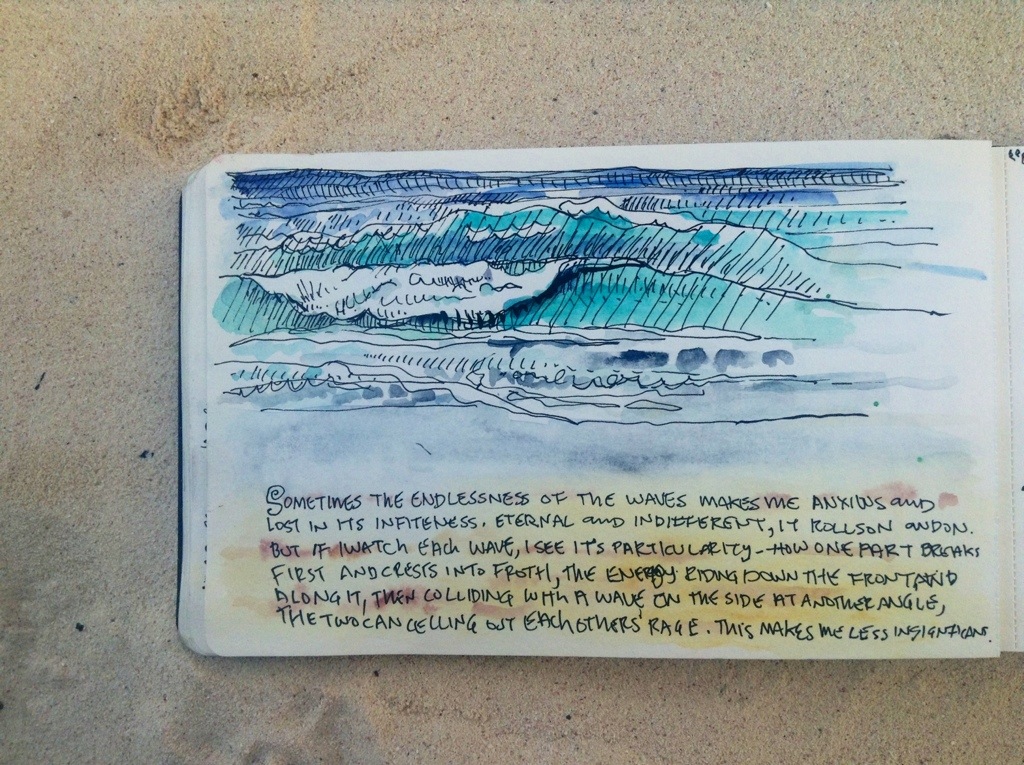
I spent last week in a basement in SoHo, looking at great length at naked people. I’ve spend the past two days looking as intently at the sea. I watch the waves and try to understand how to draw them, to turn their ceaseless roiling into lines on my page.
This close to shore, a wave’s life seems to last for five seconds, rarely more than ten. It emerges from the surface as a slowing building wall, some twenty yards wide. The pressure builds from both ends towards the middle and it becomes narrower and sharper at the peak. When I pull myself off my chaise and galumph into the sea to stand waist deep and cool off, from the side it is a narrowing triangle that reflects the sun as its angle grows more extreme. Its leading edges are dappled with bumps and ridges of energy that shimmer like the frosted glass on a public bathroom door, shadowy figures moving behind it, flashes of light bouncing of its front. The sun shines through its knife edge as it rolls forward, gleaming. Webs of foam are swept back from the ruins of previous waves and rise up to adorn its front wall, a white trellis quickly shredded in the wave’s rapacious path.

When the wall has grown as tall and thin as it can, it begins to collapse. A crest of foam appears along its battlements. The energy that was coordinated in the wave’s big charge now grows chaotic and splinters into fingers of white. The tongue of foam laps down the front of the wave and plunges into the surf, wrenching down its keystone and dragging it all down behind. Some of the froth ping-pongs on the surface, leaping to and fro, and then dives deep into the sand. The grandeur of the surge turns into a mad dash towards the shore, each water particle for himself

How the hell do I draw that?Leonardo tried. So did Hokusai.

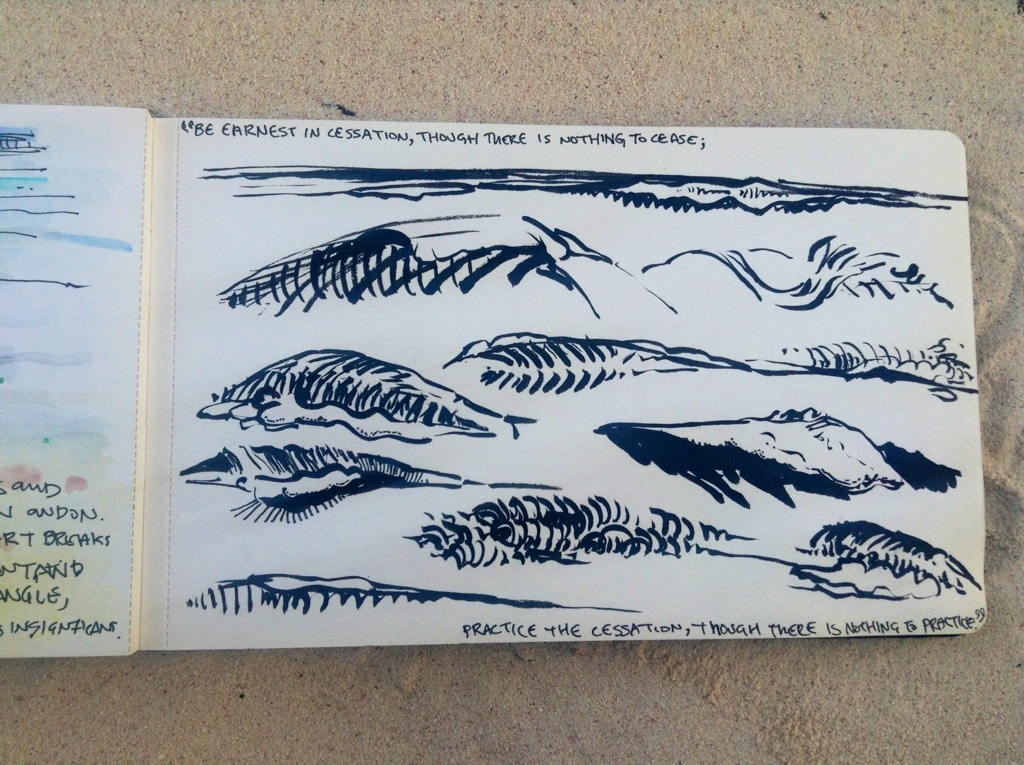
So I watch a hundred waves wash in. Some are green, some blue, some auburn with kelp. My mind’s eye looks for a freeze frame, the single moment that explains the wave but is also of the wave. But though the waves arrives in a somewhat even rhythm, they are not purely cyclical. They follow similar patterns but each has a variation. Overeager waves shoulder past each other, jostling and disrupting the regular flow of energy, crashing the transition from hill to wall to blade to foam to shore.

So each drawing becomes an abstraction of waves in general. It’s impossible to track a single one perfectly. My pen’s not that fast. Nor’s my brain. I can record only the averages of my observations.
20130806-201209.jpg
Everything changes.

The best life-models aren’t the best looking or those with the best bodies. They’re the ones who can hold perfectly, unnaturally still and come back from their rest breaks and hit the exact same marks. They can look the same for three hours straight while I try to bolt down my powers of observation to notice the exact angles of their limbs, the creases in their hide.

Cezanne rarely painted cut flowers in a vase. He preferred pears and oranges that could sit in a still life for weeks without changing shape. His favorite subject was a mountain.

I am impatient, but training myself to be less so. To slow down and study, to be here and see what really is. Man, that’s hard. Especially when your subject jumps and changes its nature every millisecond. But the truth is, it’s not the sea I have to contend with. I am changing constantly. My eyes flit, my lungs expand, my heart pulses. I am all aquiver too, pulsing with nature’s rhythm.

Even if I drew Cezanne’s Mt. Ste. Victoire, or one of my beloved pieces of taxidermy, or a frozen photo of a great tsunami, I would be changing and moving. I change with every heartbeat. And even if I could control my breath and slow my eyes, the world would keep turning, the stars would keep dying, the universe would keep expanding, and life would move on. I learn with each line I make. I am different than when I began observing. The wave moves me too.

The Buddha told us long ago: Change is inevitable, suffering is optional. Roll with the flow.

The sands of time.

20130805-202959.jpg
I am sitting on a powdery beach in Southern Mexico, feeling many things. The breeze in my face, the sun on my feet, a slight sense of guilty residue in my heart. My monkey bays at me, telling me that I no longer have the right to a vacation, not after this crazy plunge I’ve taken.
My body seemed to agree.
I was really sick for the last couple of days. It came upon me on Saturday at lunch time, a queazy, bloated feeling that had me bent over the porcelain by the end of the day. A sleepless night, then up at 4 a.m to catch an early flight. After a long drive down the Mayan Riviera, we reached this beach. I was green, pale, silent, and my traveling companions were more worried about me than they were willing to say at the time. But I am from hardy, working stock, and I greeted this morning with a renewed constitution and a smile.
It’s odd how often I am sick and injured on vacations. I have almost never missed a day of work and yet I invariably end up at remote chemists on tropic isles, at Italian emergency rooms, in ocean liner infirmaries. My body is a company man, and decides that the only right time to fall apart is only when it’s off the clock.
My mind is also trained to work pretty much non-stop, so vacationing can be a much -needed challenge. It takes at least two or three days for me to stop, to disconnect for emails, from the newspaper, from the meal schedules, and to let myself float away. On arrival, I spend time scheming by the pool, thinking how wonderful it is that I have this opportunity to make big plans, to re structure my office, or to make a long-term strategies. Then one day, the switch flicks and I drop it all, just vegging, listening to the pop music on the pool speaker, playing beach volleyball, having my hair braided. I think it must correlate to my sun tan lotion. As I let my SPF go down, so descends my death grip on the “reality” back home. I begin to unwind. I began to wake up and see where I am.
I am still in “on” mode this morning, my malady notwithstanding. I remind myself that despite my blazing announcement that I now have the freedom to create 24/7, I haven’t done much on my blog. Yes, it’s been a week and a half, but the monkey is impatient. And he’s not on vacation yet either. Where are all my wonderful creations? Or shouldn’t I really be busy freelancing?
Here is the lesson I draw from this internal debate:
I need to be here now. It’s wonderful that Here and Now are 78 degrees with a tropical breeze. But I need to be present always, all places. Sometimes here and now are not so nice. A crowded subway platform. A boring conference room. A hushed back room in a funeral home, smelling slightly of lavender talc and ammonia.
Regardless, I must be here now. There is nothing else. The past is just an illusion, a mental construct I drag along with me. Sometimes it seems better than now, sometimes worse, but it is irrelevant either way. The chunks I blew last Saturday are long flushed. The green pallor is gone. I can be grateful about that but that is all. I can pick at the scabs of my past decisions but regret is a waste of the present too. All that matters is now. What I am doing with this moment. With the potential that is here. To enjoy this, to be happy here, to accept what is.
And as for the future, it never arrives. All tomorrow ever is is my fantasies about what might be when it actually is. It’s not concrete or knowable and wasting now constructing plans on these prognostications is just sculpting with clouds.
On vacation, after I get over the hump, I have that realization each time. That I must enjoy this expensive day to the max, avoid getting sunburnt, have a couple pinås, eat some fresh fish, and chill the hell out. Leave the world of back home back there and back then.
And that’s really all that matters every day when I am back home too. To inhale deep, to avoid the chimp, to be in my skin, to deal with what’s happening and make it neither greater than it is with mental constructions nor lesser with denial.
Life is what is. And that’s just exactly how it should be.
That’s the lesson I learned when I first started to draw. And which I need to remind my self of all that time. That being grounded in reality, seeing what’s in front of me, warts and all, is the only way I can be happy and adjusted. That I have to keep re-realizing what art has done for me. It has shown me the beauty all around me and that it exists even in apparent ugliness and pain. If I draw it like I want it to be, it doesn’t satisfy my need for truth and connection. But if I see it as it is, here and now, I join with it, and I feel at peace.
That’s enough thinking for now. I’m off to draw those coconuts above my lounge chair. Then it’s siesta time. I dream an awful lot on vacation. Do you?

Island life.

I feel the breeze blow through what’s left of my hair and remember my vow to enjoy it. It’s not actually wind, it’s the rush of air that come from falling into the void and waiting for the net, the catching hands, the sproing, thunk! of your opening parachute. You can gnaw through your bonds one by one, and feel only tremors, but then you sever that one pivotal strand and you suddenly fall free, released on your own recognizance. Now you own it.

I own every day, dawn to dark. I alone will decide whether I lie on the couch, or sweat at this keyboard, or wander the streets or sob or cavort. But of course this isn’t really anything new. I have been the boss of my life since I began this job of being human. It’s just that I had forgotten to look at my business cards, hadn’t read my employment contract. I have aways been in the driver’s seat. I just hadn’t turned the ignition key till last Wednesday.

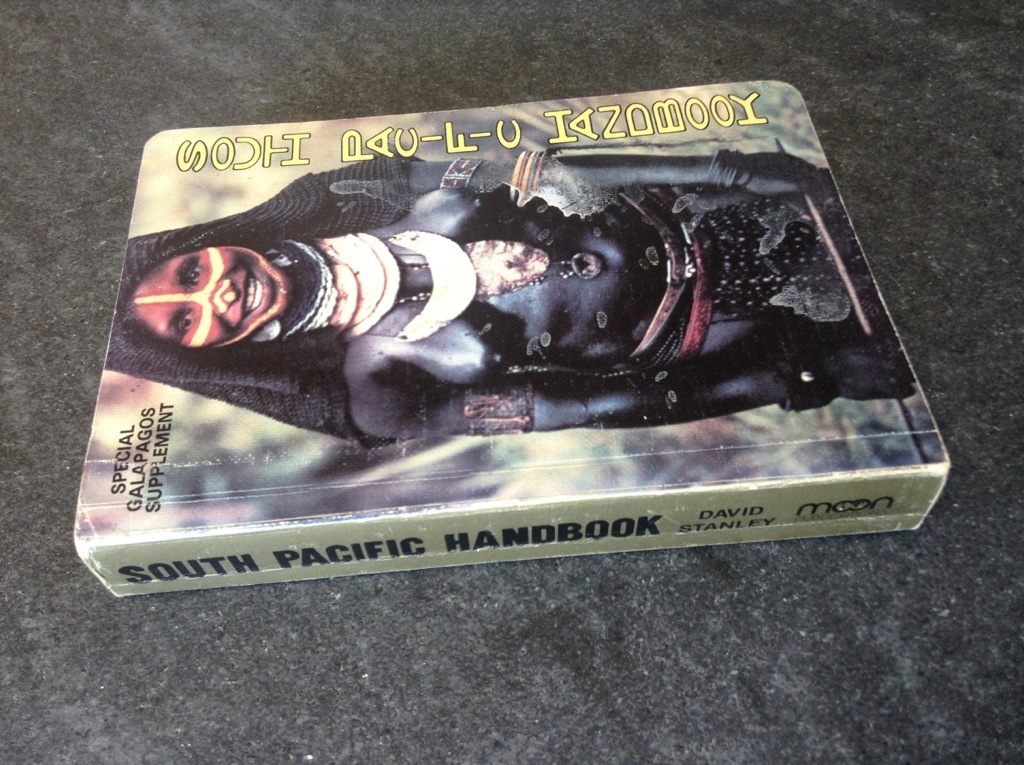
When I graduated from Princeton, I bought this book.

20130730-091626.jpg

The South Pacific Handbook was to be the manual for the next stage in my life. I was going to move to Truk in Micronesia. The handbook told me that the women still wore grass skirts and went around bare-breasted and that they used gigantic round stones as money. I would be a 20th century Gauguin, except for the painting bit. I wouldn’t need a real job, I would just build a hut and fish and eat bread fruit and coconuts. I still had a few hundred dollars in the bank from my job at McDonalds the previous summer.

By the end of the summer, however, I was living in the East Village in a 4th floor walk up. Only the local drag queens wore grass skirts.

The South Pacific Handbook has been on the shelf of every apartment I’ve lived in since, a reminder that one can postpone one’s dreams but needn’t forget them. I take it down every year and am grateful that I didn’t risk death by boredom or some horrible tropical disease or scurvy and remind myself that Gauguin died of syphilis. Then I put the book back on the shelf. I never take it to the used bookstore, however, because deep inside me I know that one day that youthful romantic ember deep in the lower basement of my soul will glow bright again and I will book a flight or a slow boat and live that crazy dream.

I’ve been on a metaphoric tropical island for six days now. The sun is shining, I am wearing shorts and flip-flops, and I am just beginning to wander the endless stretch of beach. It’s the island called Greater Dannyiana, a long flight from the mainland on which I’ve been dwelling since I bought the South Pacific Handbook. This place is probably vast, I don’t know yet. It contains a lot of empty real estate on which I can build huts and workshops and landing strips and office buildings. I could turn it into a modern-day Tahiti, filled with chain hotels and alcoholic natives, or I could keep it lean and pure and idyllic. Or, most likely, something in between.

There are monkeys here. I hear them calling from the trees. They tell me I must make a business plan, must take on lots of freelance work, must keep in touch with people who run ad agencies who will hire me back once I abandon this folly. I should write to all the people who run weekend workshops, build a slick commerce website, sign a half dozen book contracts simultaneously. They tell me to stay out of the sun, that I’ll catch some thing from the mosquitoes, that there are lots of wild animals in the jungle. They remind me that freedom isn’t free.

I did make a list of things. And it’s on this computer somewhere. But I haven’t looked at it yet. Instead I made one commitment. I will try to go to a life drawing class every day. I will draw a three-hour long pose. I will draw on a large piece of paper that’s not in a book. I will write nothing on the page except the date. And I will do it with a pencil. The monkey reminds me: I am not used to doing such long drawings, I am not used to drawing with a pencil, I always draw in a book, and I am not a huge fan of drawing strangers, even if they are bare-breasted. The monkey asks me if I quit my job to do this. And I do not answer the monkey. Instead, I pack up my awkwardly large bag with my drawing pad and my pencil and my iPod and my bottle of water and I ride a CitiBike to SoHo and I sit in the basement and I draw.

And then I discover that the reason I feel a breeze in my hair isn’t because I am falling. I am flying.

20130730-104026.jpg

The leap.

30d3176299e211e19dc71231380fe523_711,305 days ago, I started my career in advertising. Since then I have worked fulltime at nine agencies. In the spring of 2004, I freelanced briefly and also managed to write The Creative License.  Other than those brief months, I have spent most of my hour as an adult employed by other people and working on whatever they wanted me to work on.

When my boy entered high school, Patti started asking me, “How much longer are you going to do this? When Jack goes to college, will you finally stop? Aren’t there things you’d rather be doing?” For most of my career, my mum has asked me, “How can you stomach working for corporate America? When are you going to  give it up already?” Most of the people I work with have, at one point or another, asked me, “Don’t you make enough money from your books to stop working in advertising? It’s amazing you have done so much while holding down this job. Imagine what you could do if you did it full-time.”

I’ve done a lot of shrugging and changing of the subject over those thirty years.

A few months ago, I realized something had to change. I liked my job but I wasn’t growing any more. And it seemed like I spent a lot of time with my nose pressed to the window of my nice office, looking out at the wide world where so many people seemed to be doing so many interesting things. And now Jenny was echoing Patti, asking me if I wouldn’t be happier focussing on art, films, books, teaching, speaking…

With Jack happily at RISD and with no more real day-to-day obligations except walking my dogs, I realized I no longer had to make excuses to myself. I could finally try out something new.

I am writing in this in my empty office. The surprisingly few possessions I have accumulated over the past nine years here are in a bag and I am watching the clock for the last time. It’s my last day and in half an hour or so, I will step into the next chapter of my life.

My next steps are far from complete and I have realized what a luxury that is.

But I do have a big wish list to tackle. My editor at Chronicle is working with me on a really exciting new book project. I have the outlines for three others just waiting to be tightened up and sent off. I have written all of the first online class I will be teaching. Now, I just need to shot a bunch of cool videos to go along with it and release it to you soon. I have a big stack of art books I want to reread and study. There are so many galleries and museum shows I want to attend. Jack and I have some art projects we want to work on before he goes back to school. I have a long, long list of things I want to write about for my blog. I have several new invitations to give talks and workshops. Several very interesting new projects have just come knocking on my door that could open all sorts of new directions. And there are so many people I’ve met over the years, wonderful inspiring artists, who I want to get to know better and to find ways to collaborate with.

Most importantly, I am also keeping a large chunk of time open for serendipity. Open space that is reserved for adventure. If you have any you’d like to send my way, fire me a note.

The first big adventure: going bi-coastal. In September, we will be renting an apartment in Los Angeles and for at least a year will work there and here in New York. A fresh address, a fresh perspective, and loads of fresh possibilities. I can’t wait.

Well, I better go and say my last round of goodbyes, grab my bag, punch out for the last time, and head off into the sunset. See you on the trail!

FOM (Friends of the Monkey)

3-monkeys

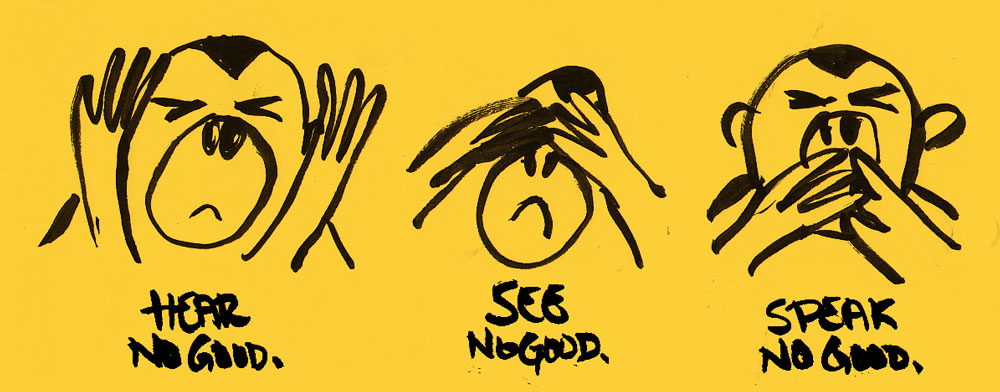
While your inner critic, that churlish monkey, sits glowering in your head, he has allies all around. They are camped on the hill and are riding in from all points of the compass, waiting for their colleague on the inside to lower the gates and let them flood in and maraud.  Most of these confederates are unwitting. They don’t know they are part of the army that can bring you down. But the monkey knows.

Some of them are driven by monkeys of their own. When you share your creative plans, your intention to start making art or to invest in yourself, they will start chattering from the trees, gibbering in fear. Fear for themselves. When you announce your brave decision to reverse the course of your life, to begin to make things again as you haven’t since third grade, you will set a shining example that will reflect back their own failures to live up to their dreams.

This isn’t universal of course. Many will applaud you and offer you encouragement. But skulking in the crowd will be those who are resentful and bitter and frustrated. And they will begin to lob suggestions, improvements, cautions, and advocacy for the Devil, designed to make you balk and backtrack.

Creativity is a particular magnet for this sort of monkey convocation. In my decades as a creative professional, I have encountered this spirit time and again. When I am awash with excitement at a new project or the possibilities of an assignment, these monkeys slink into my office, slump on to my couch and start to tell me the latest gossip, the latest management bungle, the latest reason to lose faith. They will complain about the assignment, the industry, the market. They will try to drag me into long sessions of venom and bile. They will splash me but I work to remain unblemished. Better to get up and leave that be infected with their toxicity. They are creative at coming up with reasons to stall and malinger, such is their monkeys’ gift of gab, and my own internal monkey howls with glee and joins the chorus.  These voices get me nowhere and need not to be heeded. Cut the chat short and get back to work.

And, while I am busy pointing fingers, let me point them at the mirror too. For in my own moments of weakness and doubt, I have been equally capable of joining or even initiating these grumblefests, feeling insecure in myself, acquiescing to the primate within and dragging in to a colleague’s office, leaning on my hairy knuckles. It’s a toxic affair that makes everyone feel, not purged, but depleted and sick.

Another band of accomplices are the media. The monkey loves the mindless vegetation of watching TV, numbing you with celebrities and gossip. Not the stories of artists and creative inspiration but the mindless doings of fabricated and often malignant chitchat. Besides being a time waster and anesthetic, the media can also skew your perception of art, artists and the true nature of success.

The banker is another friend of the monkey, cajoling you to focus on the bottom line. So is the electric company and the credit card company. They can make you do the monkey’s bidding, downscaling your ambitions because you feel trapped. They don’t deal in might-bes, they want theirs and now. They warn you not to take risks, to keep your day job, to be sensible. Of course, they have the right to get paid. But not to decide your future.

If you are a creative professional, you had to overcome the monkey just to get your career started. The monkey probably warned you and your parents: Don’t be a designer, an art director, an illustrator, an architect, a programmer, a musician, etc. It’s too risky, too competitive, etc. but you did nonetheless. But maybe now you see that the monkey finally let you follow this professional path but now won’t let you pursue your true passion — making art, speaking in your own voice, being your own client. The monkey giveth and he taketh away.

If you are wrestling with this issue, stop thinking. The monkey wants to engage you, wants you to obsess about his heckling and turn your creative energy into a response ego him. Don’t. Focus instead on what you want to do. Draw something. Write something. Then don’t look at it. Don’t judge it. Don’t show it to anyone else. Turn the page and write some more, do another drawing, dream another dream. When the books is done, fill another. Just keep going. Don’t ask for feedback from anyone who might derail you. Better to work alone in a cave than throw your work to the monkeys. Distance and perseverance are the best antidotes to this scourge. Build up your ramparts and lock the beast in your darkest, deepest dungeon.

Then get back to work.

Do you find your monkey has allies? What do they say? How do you deal with them? I’d love to know.

Tragedy in the Art world.

burnt-picasso

I just finished reading a horrible story in the paper. Apparently a Romanian woman’s son stole a number of works of art from a museum in Rotterdam, paintings and drawings by Matisse, Monet, Gauguin, Picasso, Lucian Freud and more. Convinced that if the paintings no longer existed, her son could not be prosecuted, the woman burned them all in the stove. Experts analyzed the ashes and concluded that her grim tale is almost certainly true. These masterpieces are lost to the world forever.

As I sat in the kitchen reading this sad story, my mind wandered off on a tangent. How many works of art have I destroyed? Not literally in my kitchen stove, but in the furnace of my mind. How many paintings have I not done? How many drawings have I aborted? How many pots have I not thrown? How many films have I not made? I thought of all the times I thought I should do some drawing and instead watched “Real Housewives”. I thought about that etching class I was thinking of taking last year and didn’t. Poof, all those would-be etchings went up in smoke. Or that three-week trip I took to Japan when I didn’t do a single sketch in my book. Or that Sketchbook Film we planned to do about a fashion illustrator but never got around to.

This isn’t the monkey talking, brutalizing me for my indolence. It’s just a fact. Every time I find a reason not to create, the art I might have made doesn’t exist. It may not have all been great art, worthy of Rotterdam, but it would have been another step on the path to better art, more fluid, more expressive, more fun.

What have you not made? And how can we fight the fire?