Flotsam and jetsam

It began when I pulled my sweaters out from storage and saw how much of Patti’s wardrobe was in there too. After eight months, I need to finally confront the chore I have been dreading — sifting through her stuff, giving it to friends, the Salvation Army, the recycler, and archiving the rest.   It’s not just sweaters and dresses and jewelery. It’s all the stuff she left behind — wallets, curlers, thigh-highs, pills, and lots and lots of paper.

I started going through the repositories that lurk in every corner. It’s a mammoth task because as I open every drawer and file cabinet, I find boxes, bags, envelopes, and loose piles of the detritus of life. Patti tried to organize a lot of these things but there’s so much still left. I find my willingness to edit quite viciously is much stronger than hers ever was. I’ll open a beautiful archival quality box and inside there are a few yellowing 10-year-old newspaper clippings describing an island she once thought might be a nice place for us to go on vacation. I find old receipts and pieces of mail, bank statements, recipes, printed emails, pages ripped from old mail order catalogs. All these things had some significance to her and she held onto them for years. They seem like trash to me.

But I hesitate.

Instead of throwing them in the garbage or transferring them to yet another file folder I have to parse them. Why did she want to keep this? What was the value to her? Is there something about her I can learn from them? What memories do they dredge up? So I separate the papers into categories of my own: receipts from gifts we gave each other; Jack’s school papers, stories and essays from third grade; notebooks filled with records of wheelchair repairs, insurance letters, hospital bills; letters I wrote to her from business trips; notes she left by my bedside or stuck into my suitcase; Frank’s vet bills from a decade ago; cards from friends; holiday letters and photographs; a folder full of songs that Patti was learning by heart so she could perform them at the library where she read  to children every Wednesday afternoon. And diaries, filled with Patti’s state of mind — getting mad at herself for the things that she hadn’t done, or reveling in the dreams she had, or how much she loved me, or how lucky she was.

I didn’t allow myself to feel much as I went through these stacks of papers, but just kept my head down and beavered through, sifting wheat from chaff, obsessed with getting through it.  But now on Sunday morning as I sit in bed alone and think about it, I can’t keep tears from  rolling down my face.

All of these documents were the building blocks of the life we had together. And now I have to arrange them into a monument to what we had together. As the pieces separate into  categories, they tell stories, stories that I want to keep for myself and for Jack. And for Patti, because I want so very much for her life to matter. Her last fifteen years were so much harder than they should have been, full of challenges and indignities and pain, difficulties that a sweet and kind and generous person should not have had to endure.

Now that the last chapter has been written and the book of her life is closed, some meaning has to come out of it all. I look for it in these piles of papers.Patti doesn’t have a headstone or a crypt, just a cookie jar filled with her ashes. I guess that by shaping these piles of paper into something understandable, I’ll be freezing the memories while they are still fresh. The river of time keeps flowing past and out to sea, carrying all of life with it. Sometimes we cannot see what is passing until it lies at some distance, but the current is strong and moments vanish around the bend, never to be recalled.

Just in case

My boy Jack has launched a line of iPod/iPhone etc, cases. They are high quality plastic and he has been selling them to his classmates like hot cakes. New designs seem to pop out of him every week. I love my cigar smoking dog one. (Click any design to see open a full-scale gallery)

Dulce Domum.

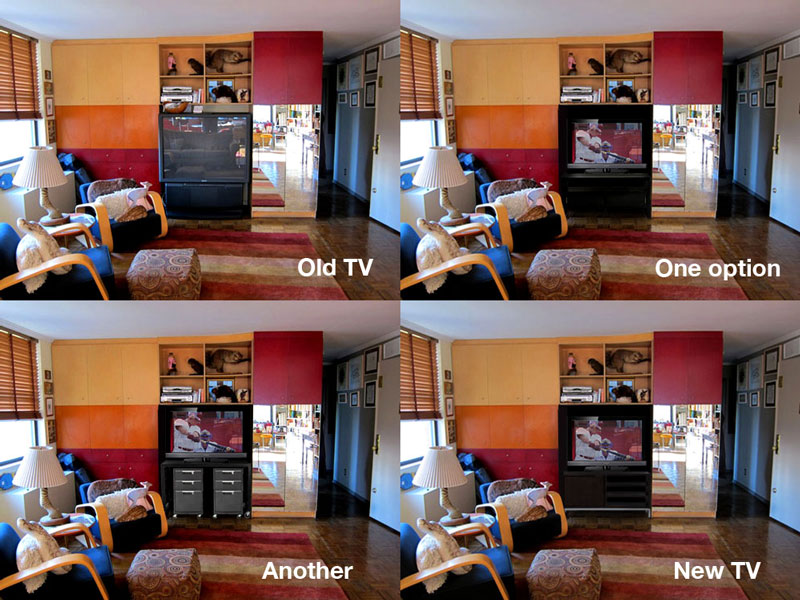
I guess it began when our TV blew up — after a dozen years of faithful service. I suddenly had to reconsider how our living room would look, find a new TV  and a piece of furniture for it to sit on, making changes to our apartment that we haven’t had to think about in years. And I’d have to do it on my own.

At first, the prospect filled me with dread and a big sense of obligation — one more hassle to deal with.

Then a pipe broke in our neighbor’s radiator and ruined the ceiling of Jack’s bedroom. It’s all been patched up but because we don’t know how to exactly match the color, I realized we’d have to paint the whole thing. All of which made me look at the disaster area that is Jack’s bedroom — a dense archaeological  collage of all of the stages of his childhood carelessly layered on top of each other, a room he really only uses now to sleep in — and thought it would be a great thing to rethink, and a creative project we could both get excited about.

So Phase One was to research HDTVs and cabinets (that took the better part of a month) and then pry open the wallet and get all the elements into our house. I worked stealthily alone so it could be a surprise for Jack (who had come to accept that we would probably never have a TV again) and  last night we flipped the switch and basked in High Definition mindlessness.

Next up is to make a plan for Jack’s room. He doesn’t seem to have much of an opinion about it yet, but I imagine a cool book-lined studio perfect for knocking out masterpieces and impressing girls.

Redecorating is like solving a Rubik’s cube and as soon as I consider Jack’s room, I start to think about turning my office into a proper studio too ( Patti and I had often discussed fantasy plans to put in counters and flat files and stuff but never did). And maybe redoing the living room. And rethinking the kitchen while we’re at it …

I spoke to a man who lost his wife around the time Patti died and he told me he developed  a strong impulse to redo his home too. He started rearranging furniture, painting walls and making his nest his own. I don’t think that’s what I’m doing. Instead, I am inspired by Patti’s example and aesthetic and am thinking of the  sort of place she would have loved. Patti had big dreams for our home but the limitations imposed by her wheelchair and disability frustrated a lot of those plans. Accessibility was always a huge factor in what we could do and even though she made our home a lovely place, a lot of the decisions that went into were limited by whether a wheelchair could get around it easily and whether everything was reachable from a seating position. Now I have carte blanche and a lot more freedom to create the home we both wanted.

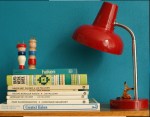
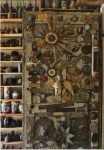
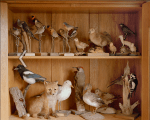
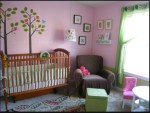
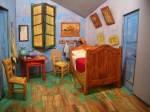
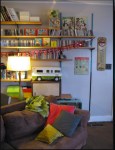
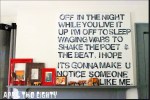
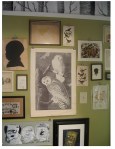
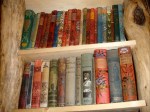
We collected  a lot of tear sheets and catalogs over the years to inspire us but I decided to start from scratch and just pull images that felt like home to me. When I look at this collection (and you can see some of them below) I learned quite a lot about where my head is at these days.

The fact is, when I lie in bed at night and think about what I should do in our home, it’s mainly about pruning, chucking out a lot of dusty-gathering tchotchkes and stuff that fills the closets that I’ll never use again. Honestly,  I won’t be putting up decorations this Halloween (though we have two boxes full of strings of jack o’lantern lights and felt ghosts and stuff) and I won’t be hosting big dinner parties and using the dozens of tablecloths and doilies and aprons we have jamming our drawers. When you live in a place for a long time you just accumulate crap that has outlived its usefulness and I feel an urge to shed that skin.

What would I end up with if I did all that? A blank, minimalist place with empty closets and big, bare surfaces punctuated by the occasional Eames chair? Is that what I want?

I think I thought so, but when I look at all the pictures I chose to represent my definition of home they all have the same themes: lots of objects, lots of color. They are busy, energetic places. Granted they look a bit more organized and freshened up than our place, but they’re also not that different from where I live, and, frankly, from the art I make too.

It is interesting to do this sort of exploration, to challenge my assumptions, purge the cobwebs even if it seems daunting, and see where I am and where I should go.

Sometimes, like Frodo, I yearn to leave home and seek adventures; usually, like Bilbo, I think they are nasty disturbing uncomfortable things that make you late for dinner. But when change is thrust upon me and the world becomes vast, it is comforting to come home, to tuck in one’s tail and curl up under fresh, fluffy new blankets.

The weary Mole also was glad to turn in without delay, and soon had his head on his pillow, in great joy and contentment. But ere he closed his eyes he let them wander round his old room, mellow in the glow of the firelight that played or rested on familiar and friendly things which had long been unconsciously a part of him, and now smilingly received him back, without rancour. He was now in just the frame of mind that the tactful Rat had quietly worked to bring about in him. He saw clearly how plain and simple—how narrow, even—it all was; but clearly, too, how much it all meant to him, and the special value of some such anchorage in one’s existence. He did not at all want to abandon the new life and its splendid spaces, to turn his back on sun and air and all they offered him and creep home and stay there; the upper world was all too strong, it called to him still, even down there, and he knew he must return to the larger stage. But it was good to think he had this to come back to; this place which was all his own, these things which were so glad to see him again and could always be counted upon for the same simple welcome.

— The Wind in the Willows

Poking my snout out into the sunshine.

Cripes, it’s hard to reanimate a habit once it’s gotten rusty. Such is the case with my online communications. I find I am thinking about drawing less and subsequently writing about it less too. However, I am still drawing. In fact, I am doing big splashy colorful spreads in my journal — but so far, they are just for me.

While my life is reasonably normalized — working, making sandwiches, vacuuming, chastising Jack about his homework — when my emotions occasionally overflow, I pour them onto paper and seal them between the covers of my Italian watercolor journal. There’s not that much to talk to people about anymore anyway. I so want not to be a draggy, whiney bore, and frankly that’s not how I feel most of the time anyway. But when I do, I’d rather just hole up and draw or write than drag others under my black cloud. My misery doesn’t really love company.

It’ll be seven months next week. Seven months. Shit. It seems both a lifetime and a blink. My wound has turned to a scab to a scar. It still affects my vision, still wakes me up in the darkness, still trips me up when I least expect it, and it has probably changed me utterly in more ways that I can bother to list. But I am still me, a more tentative, insular version perhaps, but still me.

I’ve stopped waiting for it all to pass. (Though, even this morning, it occurred to me yet again that the whole thing could be  joke, a test, and Patti would suddenly roll out of the elevator, telling me she just wanted to see how we’d cope without her.)  I’ve stopped goading myself with ‘Life goes on’ pep talks. I just know that some days I’ll feel fine, some days I’ll feel awful, and there’s not much one can do or say about it.

So far a day has yet to pass in which I don’t think about Patti, don’t see her in my peripheral, don’t wonder what she’d say I should do about some aspect of our lives. I worry that I am becoming what she prevented me from slipping back into: misanthropic, withdrawn, judgmental, timid, narrow. I tell myself I should do more, should organize the pantry, should call the friends who don’t call me anymore, should indulge myself, should cut loose. Or at least update my blog.

But my life is so full of stuff. I do my job, I do hers, I try to keep Jack on track, and the dogs from peeing on the rug. I collapse into bed each night and sleep till 5 a.m., then stare at the ceiling for an hour or two, and drag myself off the pallet.

In profound ways, the world ain’t what it used to be. Sure, sometimes I have the urge to seize the day, drain it to the dregs, paint the town red, and dye what’s left of my hair blue. But more often, I think my dogs are right, that it’s a good day to lie around in the sun instead of pushing the limits. I don’t think it’s depression but pragmatism, a sense that whatever force seemed to be watching over me, tapping its foot and checking its watch, has drifted away rather than remind me that I should check off my entire to-do list. The scoreboard is down, the crowd has drifted off, and I am okay with what is.

Our microwave died last month; Patti and I got it second-hand from a friend in 1988. I replaced it with virtually the same model just so I could soften the butter when I make Jack’s sandwiches.  Our big living room TV died last weekend — we bought it when Jack was two. I am sorely temped not to get another one; let’s see how long ’til Jack rebels.

This rumination makes things seem sadder and smaller than they are (another reason not to blog too often). The fact is, there’s a fair amount going on. Jack’s soccer team is about to wrap up the season and he is taking two AP classes. He also has a growing business making custom iPhone cases and has a dozen commissions in his backlog. There are a couple of things stirring in the publishing department; I’ll write about them when they become realer. Also I was just profiled in a book about advertising, and I’ll be in Cathy Johnson’s new book and then in Seth Apter’s.  And, I continue to exercise and lower my dress size —though my feet remain stubbornly 11 1/2.

Thanks for hanging in there. I will try to get back into the habit of sharing something here. I like formulating my thoughts in a digestible way  and I like hearing from you.

Why Everyday Matters

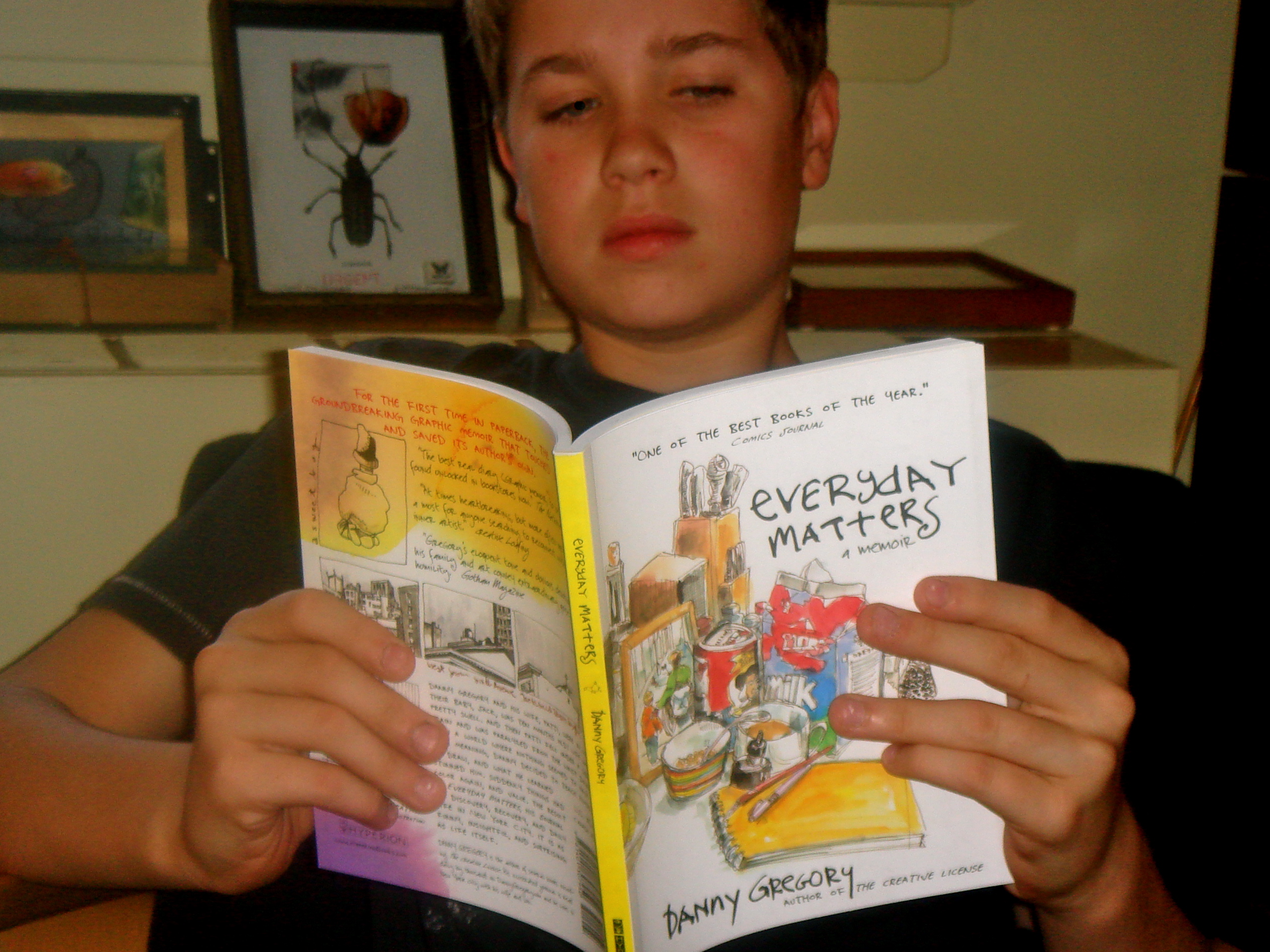
Everyday Matters” began as a simple grab bag of pages from my illustrated journals.

I’m not sure if I was lazy or clueless but I couldn’t come up with a rhyme or reason for how or why the pages were assembled. I just thought it would be cool to say, “Here are a bunch of pages that I wrote and drew over the years, — check em out.”

My editor frowned and said that wasn’t really how books worked and that I needed to come up with a theme, a story, an arc, a reason for anyone to care and keep turning the pages. After some head scratching, I decided that maybe the theme could just be “A New York diary” . Again my editor frowned. ” Just ‘New York’? What about it? What’s unique about your perspective? ‘

My next idea:  maybe it could have something to do with architecture (I had already drawn quite a lot of buildings) and she asked me from what perspective, what did I know about architecture, what was my POV on buildings and I said lamely, ” I dunno, I just draw a lot of them.”

Finally, one tense Thursday evening she said, “Look, why do you draw? Why have you always drawn?” I snapped back that I hadn’t always drawn, that I’d only started a few years before, in my mid thirties. I guess I’d never told her that. “Well, why did you start?” she asked.

I explained that the reason I’d started was private, not something I could share in a book, too personal, too private. She kept prodding me until I explained that my wife had been run over by a subway train and that in the months after I had begun to draw and to chronicle our lives and stuff I liked and places I went and thoughts I had and so on.

There was a longish silence.

In retrospect, I can see how much I’ve changed over the past decade, how much freer and more open I am with the facts of my life. But then, before I had published a word about my life, I was embarrassed, super-private, oblivious to how interested and sympathetic others might be about the changes in our lives that had occurred since Patti’s paraplegia. The fact that I hadn’t mentioned any of this to my editor up to that point is amazing to me now. As is her interest in my work, given that she knew none of the story or how it came about.

“That’s your story,” she said finally. “That’s what your book is about, about how you started to draw and what happened to your family.” I protested that I could never share that sort of stuff with strangers, that it would seem like I was exploiting our story to sell books. She explained that it would be a book that would touch a lot of people if I could write it and that she hoped I could. Otherwise there wasn’t much to discuss.

I went home and talked about the meeting with my wife. She encouraged me to do what I felt was right, that it was my story as much as hers and that if it meant something to others that maybe we should share it. I didn’t know it then but Patti was saying, “Be an artist.”

I sat down and started to write. The story poured out of me, and I saw how it gave meaning to all of the journaling I’d done, that it made it all made sense, my creative rebirth, my need to document my life, my search for meaning, and the way it had brought me to this moment, to sitting down and writing this book.

At the core of my resistance was a conviction that I was not and could not be an artist. I could draw and even publish books, but I could not delve into myself and share it with the world. I had all the capabilities but I did not have that permission. In the years since I Everyday Matters appeared, I have heard from thousands of people and I came to realize that I was not the only one with this limitation. Making art, sharing it with one’s friends and strangers is a transformative experience and I have worked ever since to encourage others to try it. I’ve written several other books exploring the ways people express their feelings and capture their lives in illustrated journaling and I hope to make more tin the future.

For me, art gives meaning to my life. Sharing it with others just makes it mean even more.

——-

Thanks to Seth Apter of The Altered Page for asking me the question that provoked this response.

Lilly

My apartment has few rooms and lots of windows. As a result, I have few walls. This situation has probably had quite a lot to do with the current state of my art making. I have made zillions of paintings and drawings in dozens and dozens of books and this decade or so of art all fits on three bookshelves. I rarely make anything to hang on the wall, because there just are so few walls to hang things on.

However, recently I decided to make a friend a painting as a gift, a portrait of her beloved American Eskimo dog, Lilly. She has ample wall space and I knew I’d not be imposing too much by presuming to take over a couple of square feet.

I bought myself a nice sheet of hot press water color paper, I think it was about 200 lb. I have taken quite a few snaps of Lilly over the years so I felt confident working from photos. There were a couple of challenges. It’s just a different problem creating picture to hang on a wall, hopefully for years, and I had to be uncharacteristically careful not to spray random bits of paint all over the place as is my custom. I also had to design the image I’d be making to stand out from afar, and to be viewed by people just coming into the room, not at all the sort of intimate relationship someone has when reading through an old journal in their lap.

Another challenge is that Lilly is all white and very furry and I wanted to represent her in realistic and tactile way. I also had to capture her expression and personality, which would be difficult with so few visual elements besides a black nose and eyes in all that white fur. I decided to do that by having no drawing in the piece, no ink, just pure watercolor, layered with a very light touch. The intensity comes from the colors that surround her and she is almost all negative space.

I am fairly comfortable with results of my experiment and my friend seemed delighted. The painting is at the framing shop now and I look forward to seeing it on a wall sometime soon.

Posted in Art

By way of explanation.

I have been received occasional emails and comments from people wondering why I have stopped posting on this site. Let me begin by saying that Jack and I are doing quite well, despite the silence. We have both had milestone birthdays in the past month; he turned 16 and I turned (gulp) 50. We have been making a lot of art, spending time with each other and friends,moving our lives ahead. There have been setbacks and moments of deep sadness and anxiety, but as each one passed, I felt stronger and clearer.

I have decided however that I am less comfortable sharing enormous amount of detail here. I have received a lot of encouragement, wisdom and support from visitors to the site,  but I feel that these enormous passages in our lives should be expressed somehow differently, with more care and perspective. So, while I continue to write and draw about these days in my journal, I will be much more selective in how I share them, here and elsewhere. Instead, I shall use dannygregory.com as a place to express myself as I always have, about matters creative and artistic, rather than as deeply personal as the posts I put up in the early summer. I promise to share a lot of this material with you in the future — just in a different shape and form.

I don’t regret that public airing of my private feelings, but I no longer have the same need to do so. I’m sure you understand.

Also, after being plagued by malware and paying a consultant to repeatedly exterminate the vermin in my site, I have decided to radically redesign dannygregory,com. I will launch the new site soon and on it I will share a lot of material from my sketchbooks which I  hope you will find useful.

If you have visited this page over the years, you are probably quite used to my occasional bouts of ambivalence about leading a public life and know that inevitably I shall prance back onto center stage, neuroses in full display and reveal more than a sane person probably should about my experience of the world.

Until then, I remain small and timidly yours,

Danny

—–

Oh, one more thing  —  Seth Apter has just published an interview with me in which I explain, for the first time, the real origins of Everyday Matters. You might find it interesting.

Hue and cry

Click image to enlarge

My sketchbooks have been becoming simpler and more austere over the years. I started just drawing in ink, then added color, then watercolors and then slowly turned back until all I have been using is a dip pen and black india ink.

Occasionally I’d get wild and add a little watered down sum-i ink. But mainly I relied on cross hatching and the varying line widths of my flexible steel nib.

Click image to enlarge

On the rarest of occasions, I would add a color,  a single solid  wash over my line, an earth tone or maybe two for the sake of variety. My work was increasingly about limitations and technique, playing with the simplest of notes and digging deep into  lots of combinations.

But in the past few months since Patti’s accident, I have gone hog-wild in an explosion of the brightest colors I could find. I cover each page with magentas and fuschias and sap green and cadmium yellow.

I even treated myself to the complete collection of Dr. PH Martin’s liquid watercolors, 56 explosive tones that even my camera cannot do justice to. These are fragile colors, they can’t be exposed to sunlight, but perfect to lurk within the pages of a sketchbook and then leap out at the reader when the page is turned.

It’s funny, this penchant I now have for the rainbow. Mourning is supposed to be conducted in shades of black and gray. But one of my love’s many nicknames was ‘Patti Pink‘ and she adored bright colors. Her memory has infected me and I want to commemorate it in the brightest colors I can find. My book is a feast of sizzling hues and she would have liked it that way.

Art Supply Porn

I didn’t even know I had a great aunt Greta (twice removed). But I was happy to take the call from her lawyer, the executor of her estate. Now I am the lucky owner of a 5,000 square foot studio loft not far from our home.
It is a quiet space but when I open the floor to ceiling French doors, the birds’ twittering can be heard from Central Park below. The ceilings are high, about 18 feet and, but for a few graceful, sculpted columns, the space is open and expansive with freshly painted white walls and well varnished, wide plank floors. The most notable feature is the enormous skylight overhead that floods the room with sunshine on even the gloomiest days.
Greta, who apparently enjoyed my drawings when I was six, also left me an open ended, unrestricted trust fund for art supplies and furniture, so I have been busily organizing and shopping for the past few days.
First, I had my friend Dean help me plan out the space. We covered the eastern wall with cork for pinning up drawings and things torn out of books and magazines. Next to it, we erected twelve foot high bookshelves with one of those sliding ladders. In the corner by the door, I have a seating area with a Mies leather couch (for afternoon naps) and three Eames chairs and walnut stools. There’s a large kitchen and we just had to have some of the counters redone (I love to draw at the kitchen table) and a new fridge with an ice maker installed.
There’s another wall for storage with oak flat files and cabinets for storing supplies. I have two different drawing tables, one of which is a BF23 from Italy and can be angled, and raised with a foot pedal. I have a wooden print rack and several taborets that roll around on the floor and hold pens and stuff. They’re delivering the G5 Mac tomorrow afternoon and the server, which will hold my MP3 collection. Then the guys from Harvey Electronics just need to hook the system up to the Niles Audio AT8700 speakers they installed in all the walls and we’ll have Miles playing in ever corner.

So, off to the store.
Let’s start with watercolors. I want all the colors that Daniel Smith makes, every series, big fat 15 ml. tubes. Then I’m also going to try out a few other brands, so I’ll get all three of the Maimeri sets that Catherine Anderson advertises. I’ve had fun with the Dr Ph Martin’s transparent liquid watercolors I own but I want to move up a notch to their Hydrus colors so I’ll pick up all24 colors they make. I see Schmicke makes powdered metallic watercolors – they could be fun to use in my journal so I’ll take those: rich gold, pale gold, copper, silver and aluminum. Here’s something called Ox gall Liquid; no idea what its for but I like the sound of it. In the basket.
Next, I want the best brushes money can buy. Really great watercolor brushes always spring back to a natural, razor sharp point and I think male Kolinsky red sable is considered the best (they’re made from the tips of animal tails which is mildly disturbing but maybe they just trim off the tip and it grows back like a lizard’s. In any case, I’ll ask the lawyer if the trust fund can make a contribution to PETA or something). Here’s a #14 brush for $311.95. I’ll take three. It’s by Isabey and they’re nickel plated. But the #14 is pretty chunky; for safety’s sake, I should get the whole line, 00 though 12. And, for fooling around with, maybe those Squirrel quills. And a 2″ squirrel wash or two. Oh and some fun brushes: a few of those filberts and fans, a set of lettering brushes and those weird angled tear drop brushes.
I’ll need some good new palettes, the big English glazed porcelain ones. Grab half a dozen. That watercolor bucket looks interesting – it has water basins and palettes inside it and there are holes in the hadles to keep brushes upright. Oh, and this Rinse-Well thing is cool. You fill the big bottle with water, it fills a basin with clean water and when it’s dirty, you press a button and it flushes it into a hidden reservoir. Cute and just $30. I need three. Might as well get this Sta-Wet palette with the lid that seals the paint like Tupperware. It seems a bit fiddly and I can always just get fresh paint but, oh, what the hell… in the basket.
Watercolor canvas? Apparently it has a special coating that takes the watercolor, you can lift off mistakes or even wash the whole image off the surface and start again. It doesn’t rip or shred and comes in huge rolls so you could do paintings that are 4 and half feet by 18 feet! Wow.
I also need loads of Fabriano Artistico watercolor paper. I want to try the hot press too and both 140 and 300 lbs. I love the Canon Montval Field books for journaling but also want to try out these Michael Rogers books with 140 lb. cold press acid free paper. Take a half dozen of each. This Nujabi journal looks good too: 25 130 lb. deckled pages in a Royal blue cover. In the basket. Lots of empty pans and half pans and an enameled steel box to hold them. Some nickeled brass palette cups. Check. One of these steel tube wringers that squeeze out paint. Check. A few dozen empty jars and squeeze bottles. Check.
I’ve never used a Mahl stick to rest my hand on while painting. It’s very Rembrandt looking. In the basket. And a thing called an Artist Leaning bridge, a transparent shelf that sits right on top of your page so your grubby paws don’t get on the work.
Here’s a very cute and must have item, the art traveler, a combination back pack and stool, with aluminum legs and lots of pockets and padded straps.
I like these huge art bins with the casters on them, full of individual boxes that neatly stack. Even a pocket for my wireless phone. Do they have to be such an ugly shade of purple?
I’m getting a huge paper cutter for bookbinding. I am used to the arm cutters (which could live up to their name an sever a limb) but am intrigued by the Rotatrim that rolls the blade along a bar. They have a massive 54″ one here that’s a bargain at just a little over a grand.
I need pencils: These Faber-Castell Polychromos come in a box of 120 colors and , for some reason, a CD-ROM. I like the idea of pencils so sophisticated you need to use a computer to work them. I’ll take the matching Albrecht Durer Watercolor Pencils too. In a wooden box, just $300 a piece. I’ll also need an electric eraser, just in case I ever make a mistake. These triangular TrioColor pencils looks interesting. Oooh, and these color pencil easels that organize everything in rows behind elastic straps and Velcro closures. Very nice.
I want to try some new media too: Encaustic crayons that you apply with a special electric iron. British scraper board for beautiful cross hatched drawings tat look like engravings. I’ll take some in black and some in white. And foil too. Oh and a set of cutters and scrapers you need to work on them.
No pastels. I never like drawing with them and I never like the look of pastel drawings. Except for Degas. And Lautrec.
Some gold leafing. I’ve used cheap stuff and it’s very dramatic but I’m going for the real stuff this time, 22k Double Gold and Pure Palladium too. The perfect way to class up a humble line drawing.
I’m going to have to order some clay for sculpting but I might as well pick up the armature set, the metal mesh and the riffler tools for shaping. This rotating sculpture stand is cool. It goes up and down and has a little adjustable shelf for tools. And this clay gun extrudes different shapes of clay, like a grown up play do maker, only in steel. Ultimately I want to get a welding setup and a kiln but this’ll do for now.
I love pure pigments, no idea what to do with them, but I want a few jars of them sitting around: Sennelier sells a nice starter set for just $1250 in a handsome wooden box.
I want some gouache to try out for the first time. This Lukas brand looks sort of interesting but I think Roz urged me to get Schminke. Better ingredients, less chalky and dull.
Now that I have all this space, I’m going to do some oil painting. I have painted on canvas before but always hastily, using a dining room chair as an easel and acrylics because they dry fast. I’m intrigued by Williamsburg paints. They’re made here in New York by an artist who based his recipes on research into the paint houses that supplied Monet and Cezanne. I’ll need 150 ml. tubes and the colors go from $25-145 so I should probably get the whole range, looks like about 150 colors. I can’t stand the smell of turpentine and how it gets into everything so I better get some Turpenoid and a citrus based thinner.
Brushes: If in doubt, buy the most expensive. In this case, more Kolinsky Sable. I’m getting a set of flats, of rounds, of filberts and of liners: grand total, a mere $1802.15. Hang on, these color shapers look like fun. They’re silicone brushes which I can use for applying and scraping paint, sort of like more elegant paint knives. But I should get paint knives too. Here’s a set of 60 different ones for $450. Done. Oh and a smock. Here’s a nice black one, cotton, lots of pockets. And though I won’t be getting a beret to go with it, I like this life sized human skeleton made of wood. Beautiful, and look, life sized posable manikins. They have men, women, boys and girls. A lovely family for just about two grand. And a posable giraffe too. Other miscellanea: a reducing glass les for looking at my canvas without having to step back and … duh, an easel, I’ll get two: one for plein air, a french easel that folds up into a little box to strap on my back like Van Gogh did. And then a big one made of oiled oak wood with cranks and shelves and casters. Here’s a nice one, called appropriately, the Manhatttan and it’s just $1707. Greta would approve.
Finally, canvas, double primed cotton duck to start with, and then a roll or two of Belgian linen and loads of stretcher strips and canvas pliers and a really good staple gun. And a few maple panels for painting on too, the really thin kind, satin smooth. Oh, and a Bob Ross video, maybe “More Joy of Painting”.

(This grotesque fantasy of excess was inspired by the arrival of Jerry’s Artarama catalog in our mailbox. In the real world, I ended up buying a bamboo sketch pen, for $1.79).


[Originally published on: Apr 21, 2004 @ 5:59]

You suck. But enough about you.

Creative people care so very much what others think of them. They ask, “Is it any good?” and then wait not just for what you say but for how you say it. It’s not enough to be effusive in your praise. Were you sincere? Really? And does the fact that you say you like it mean your opinion isn’t worth listening to? Are you Paula Abdul? Or Simon Cowell? Is there a ‘But…” lurking in your praise? If you give constructive advice. is it personal? Are you saying I, as well as my work, suck?
(Sure, there are the rare, apparent exceptions who don’t give a good god-damn what anyone else says, but I suspect that they too are motivated by the perceptions of others — they just hide it better.)
Sometimes, others’ verdicts are integral to what you’re making.
In my business, the success of an idea is entirely decided by what someone else decides it’s worth. Does the client think it’s good? Does the consumer think it’s good? Does my boss like it? Do my peers? Award show judges? Et cetera.
If I was showing my work in a gallery, the dealers’, critics’ and patrons’ opinions would make or break me. If I act in a show, a review could take bread off my table. Some person I’ve never met at the New York Times could devastate my next book.
When I draw in public, a passerby might possibly be sneering, even if just to himself, at my presumption at being ‘an artist’ while scrawling in my sketchbook. If I yank the page out of my book, I must be careful to tear it up so no one piece sit back together and scoffs. I shred the pieces small so no one thinks that I myself don’t know how much it sucks: Sure , I can’t draw, but at least I have the taste and judgment to know it. Or, maybe I’ll leave it in my book but write a long essay next to it about how bad it is, like a reminder and a slap in the head not to do such crap again. If anyone sees it, well, they’ll read my notation and know I know better.
Do you go through this? So did I, until I discovered a little fact, that boils down to this: by and large, no one cares about anyone else but themselves. I don’t mean that we’re all hateful and selfish, just that we’re almost always wrapped up in our own issues and can’t much be bothered with anyone elses’s actions, except as to how they pertain to us.
Doubt me? Prove it to yourself. Start a conversation with anyone and see how long it takes them to steer the conversation back to themselves:

“I love your shirt.
“Thanks. It’s new.
“Really? I can never wear pink.
“I didn’t think I could either…
“But you look great in it. Where’d you get it? Loehman’s?
“No, I …
“I love Loehman’s. When I can find stuff that fits me.
“Huh.
“Yeah, I must have gained ten pounds since Christmas…

Try listening instead of talking and see how long the other person will talk about themselves. Be prepared to wait because virtually anyone, if given the stage, will hold on to it eternally.

“What are you doing?”
“Drawing”
“I can’t draw a straight line. Even as a kid, I never could. You’re great. You must have taken a lot of lesssons.
“No, not really.
“Well, I just have no talent. I used to play the guitar but you know, who has the time. I’m so busy at work since I got that promotion…

Sound familiar? A couple of years ago, I gave a colleague, a ‘creative’ person, a copy of Everyday Matters. A month later, he hadn’t said anything about it so I asked him what he’d thought of it. He said,

“Yeah, it was great. You have that stuff in there about Wales and my father’s from Wales so I thought it was interesting.”
“Wales, really?”
Yeah.”

I waited for more but that was it.Wales. Sigh.

I’m not talking about hard-core self-involved people, mega-bores. I mean everyone, including me (goes without saying, I hope) spends most of their time thinking about themselves or how what others are doing affects them.
Put simply: no one is nearly as interested in what you do as you are. No one is judging it as hard as you, or analysing it, or wondering about it. The only time they really get involved is when your success or failure could effect them. Will looking at your work entertain or divert them for a moment (oh, your drawing sucks, never mind then) If you draw and they don’t are they less than you? WiIl your work make theirs look worse? Will it make them money? Can they use your technique to improve their work? WiIl praising you oblige you to them?
Seriously, what other motives do they have? And are those sufficient reasons for your to be concerned? Are these sorts of opinions what drive your work? Are you making art so others can make money or feel better about their own abilities (or worse)?
Think about it: we all, even Brad Pitt or George Bush, occupy a tiny percentage of any other given person’s interest, That’s why some of us are interested in achieving fame: because it takes all those tiny percentages and multiplies them across millions of people. Eventually that adds up to something.
And because we are all, at best, living in our own self-reflecting bubbles, you should relax and do what you want. Stop caring so much about externals. Make what you like in the way that you do. Sure, maybe you’ll manage to be a blip on someone else’s radar, but that’s not why you bother. Live and make art for the only person that matters or truly cares.

[Originally published  on: Apr 21, 2006 @ 19:17]