The art of friendship

20140323-085717.jpg
My pal, Tommy Kane and his wife Yun just spent a few days with us in California. It was so good to have them with us and we spent a lot of time eating in good restaurants, wandering through Venice and, of course, drawing.
I have known Tom for thirty years and we have drawn together for the last ten. Despite how close we are, when it comes to drawing we are quite different. Tommy is an illustrator, an artist who works toward beautiful finished pages, every one suitable for framing. His journals are immaculate, and each page is perfect from corner to corner. He just put out a lovely book of his work and it is a treat to have all that perfection in one place. The experience of looking at his journals is like looking at a final, published book—so immaculate, so rich.
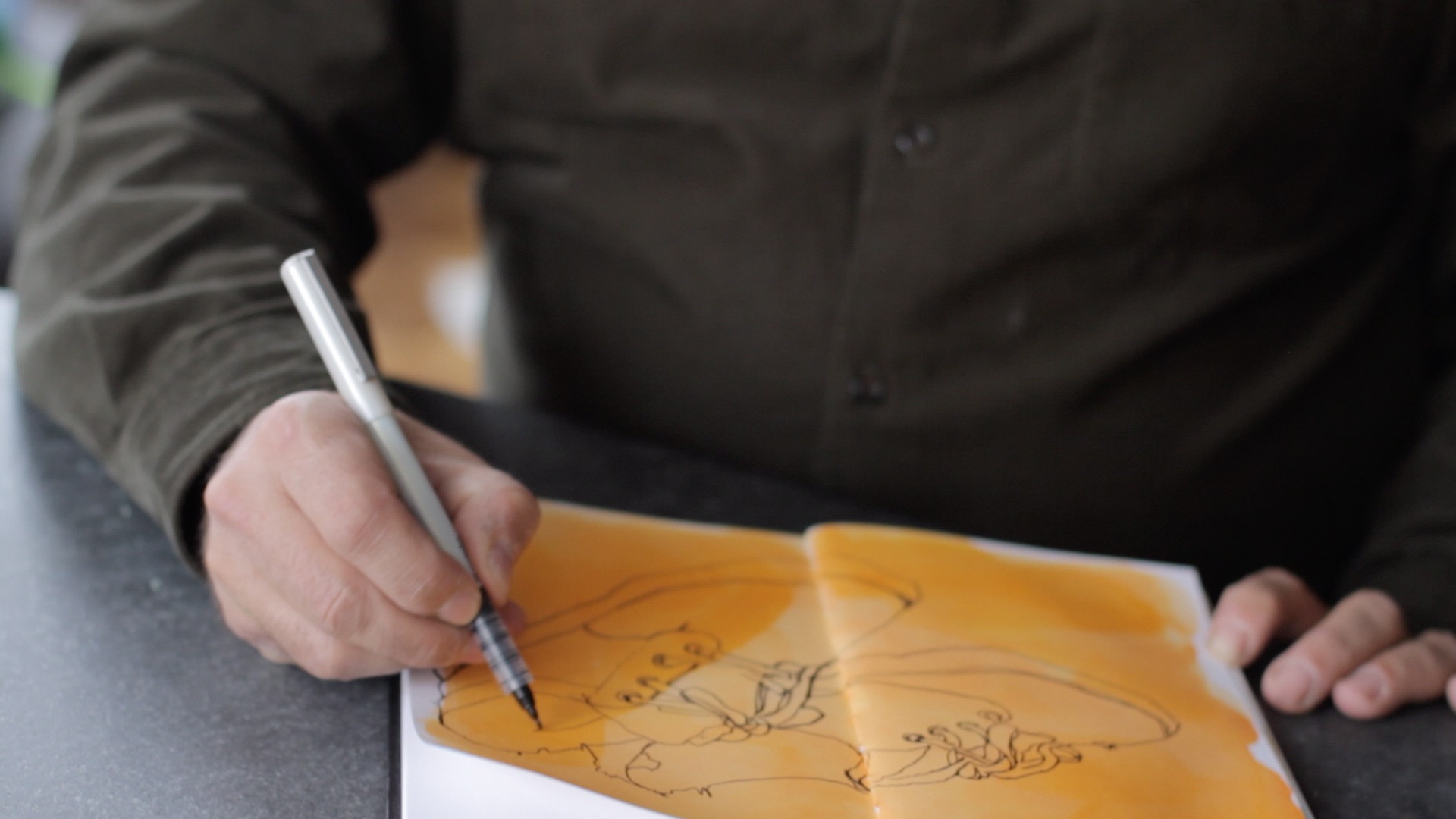
My style of drawing is far more hasty, slapdash and impatient. And that can be a problem when we draw together. Tom expects to spend hours and hours doing a single drawing. He has a very specific way of doing a page, starting with his uniball pen, putting in loads of careful hatching, then adding watercolors and finally a layer of bright pencil marks. He’d prefer to do the entire thing on location, perched on his little stool. He has a patient wife/traveling companion and has drawn this way all over the world.
When we sit down together, as we did on the Venice Boardwalk and on Lincoln Boulevard, I find myself adjusting to his pace and do horrible overdrawn pages that don’t look like my normal work. I find it impossible with the way I draw to spend hours on a single page, Tom also compromises when we’re together and usually only manages to finish his line drawing before I start squirming and pacing and has to color his picture later on, from a photo.
I don’t begrudge Tom his slow and careful pace. He manages to capture so much detail and observation and yet keep his work fresh and bright. I draw, like almost everything else, at a neurotic pace, and the luxury of time just stirs up the mud.
Everyone has their own speed. Our friend Butch draws at a glacial pace, thinking nothing of spending ten or twenty hours on a page, D.Price, on the other hand, can knock out a drawing in three minutes. We have all drawn together and it’s like a tap dancer, a heavy metal guitarist, a tuba player and a sitarist trying to jam.
Whenever I go on a sketchcrawl, I have to adjust to the group, moving toward the mean of all the people drawing together. And it’s good to challenge that someotimes, to go faster or slower to add variation and stretch. In the long run, though, the work I do with others is never my favorite. It’s more of a fun, communal, social experience than a satisfying artistic one.
I’m not antisocial and I love to hang out with my friends.
But I’d rather pee, nap and draw alone

PS if you’d like to draw with Tommy Kane, join his klass at sketchbook skool.

My way or the highway

readingWhen I was nine in Pakistan, my grandfather’s chauffeur drove me to school every day. After a year, my grandfather told me that today he wanted me to tell the driver how to get to school.  He instructed the driver to follow my directions to the letter and we would see where we ended up. Ninety minutes later, we ran into the Indian/Pakistan border. I had guided us out of the country. I shrugged and the driver turned around and took me to school.

Living in Los Angeles means spending a lot of time almost lost. I am forever heading toward destinations unknown, with no landmarks to aim at, no Empire State to reckon by, no buildings more than a story or two tall, the horizon shrouded in smog or the marine layer. And Los Angeles, even more than New York, has no time for the timid, does not allow you to hesitate and peer around in confusion or slow down to read road signs or fumble for the map. It’s a brutal town that way.

Thank God for Roger L. Easton, the inventor of GPS. For nearly six months, I have relied on that computer lady to tell me exactly where to go anyhow to get there. Actually I have three computer ladies, one of whom is an Australian man. They dispense wisdom from our two phones and our car’s built-in sat nav system. When I am feeling especially disoriented and insecure, I sometimes have them all on at the same time,  barking out conflicting commands in various accents or recalculating in disgust at my inability to follow the most basic orders.

All these decades later, I am just as lost behind the wheel of my truck as I was in the backseat of Gran’s Mercedes.  All this step-by-step guidance is now as useless as last summer’s directions for assembling my Ikea bookshelves, in one ear and out the window.  I barely know my way around town, have only the vaguest sense of where Hollywood is relative to Downtown and that there are lots of town and cities and neighborhoods in between with names that are familiar from the movies but which I couldn’t begin to drive toward if my cel service went out.

Which brings me, inevitably of course, to drawing.

For the last few months, I have gotten more and more deeply into teaching people how to make art. I’m doing workshops, I’m writing a new book, and I’m pretending to be the co-headmaster of Sketchbook Skool. So I have to figure out how to tell other people, sometimes in just a couple of hours, how to do what I have taken a decade and a half to do.
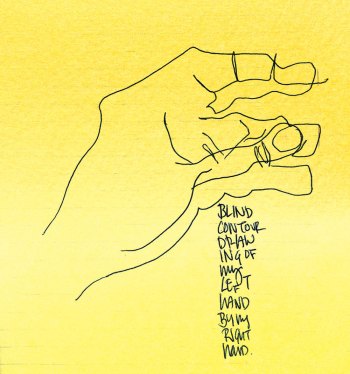
blind-handI never learned much of anything from those step-by-step diagrams in art instruction books or in “watch me paint” demos on YouTube. Following someone’s suggestion to first draw a circle and then draw two more circles and then add a triangle and then erase this bit and that till it looks like an old sea captain just has nothing to do with why I draw. I love Bob Ross’ voice and his Afro but I never learned anything about picture making from watching him paint the reflections of pine trees in a tranquil lake. 

I think the way you have to teach people is by releasing a catch hidden deep inside of them. That catch that’s locking them down with the fear of making a mistake. They are so concerned that their drawings won’t look exactly like what they are trying to draw that they can’t get off their duffs and start making some marks on paper. They so badly want to be able to pick up a pencil and draw like da Vinci that anything less unrealistic seems pointless and defeating. Instead, they waste a bunch of time saying they have no talent, can’t draw a straight line, are so stupid, and so on.

But if you can just reach that catch and unlatch it, the world of possibilities swings open. Suddenly you see that drawing isn’t a way of making wall decorations or proving you have some innate gift, it’s how you see the world.  And the funny thing is, there are as many ways of seeing the world as there are see-ers of the world.  All cameras make the same sorts of images but all artists make things differently.  As Oscar Wilde put it, ”Be yourself. Every one else is taken.”

One man wrote to us at Sketchbook Skool and said, “Before I sign up, can you guarantee that you’ll teach me to draw?” I told him, um, absolutely not. Only he can guarantee to teach himself to draw. One less customer, I guess.

So how do you teach people to make art? Well, you start by turning off the GPS lady. You can’t draw if I’m holding your hand. Instead of turn-by-turns, you start by inspiring them with some postcards of wonderful places other people have sent back from their travels and then you let them start off in a random direction.

In the driveway, you might teach them a couple of simple principles like negative space and how to take measurements but you explain that these aren’t really rules, they’re just helpful suggestions to grasp at when you worry you’re going off the rails. You hang on in the back seat and encourage them to keep going, and make a few gentle suggestions, to maybe slow down on the curves a bit, and to stop pumping the gas and the brakes together. You tell them to loosen up and not clutch the pen so tight. You point out where they made an interesting turn and you console them when they think they are hopelessly off the road. You show them that if they just keep going, they will always end up somewhere new and interesting and probably not where they thought they were headed. And the driving metaphor finally runs out when you tell them that they can and should take risks and be brave, that no one ever died making a drawing, no matter how ‘bad’ it was.

The key is to build their confidence. To let them know that they can do it. If you have confidence, then you can start to let your self come out, the self that has been watching the world through your eyeholes all these years, that has noticed odd little things. that feels deeply about certain matters, that doesn’t necessarily speak in words, and that wants really badly to share its POV with the world, if only you will let it.  You can’t force that voice and vision or even describe shortcuts to it. You just have to let it feel safe and have ample opportunity to stick is head out from that deep hole in your soul.

It’s up to you. Your mom taught you to walk. But you taught you to run. Your dad taught you to drive in a parking lot. But you taught you to drive down the 405 while checking your email, singing along with Pharrell, applying lip gloss, arguing with your husband, and remembering to buy milk.

There are no shortcuts or instruction books to being a human being or to being an artist. Every single day is a lesson and the skool year never ends.

Command Z

Day before yesterday, I was working on a painting. A proper easel painting of a still life, as if I was Paul Cezanne or Wayne Thiebaud or someone. It was quite idyllic, a mild breeze coming in the studio door, hounds slumbering on the rug, Badly Drawn Boy playing on Spotify.

I had sort of blundered into the painting as if it was just another page in my sketchbook. I had a bunch of dirty breakfast dishes piled on the table and I plunked a sheet of cardboard on my easel and started making marks. The fact that I had just plowed into it kept haunting me, a little monkey voice in my head reminding me that I’m not Jan Davidszoon de Heem and I wasn’t even painting on a canvas, for crissakes. Before I had even put the second snausage of paint on the palette, a large percentage of me was convinced it was futile.

Nonetheless, soon the whole picture was covered with a first layer of paint. It all felt a little top heavy, the things in the foreground seemed distorted for no good reason, and my palette just seemed to contain shades of brown. I was tempted to stop thinking of it as a painting and get out a big Sharpie and start drawing on top of the paint with black lines that might somehow fix it.

But a little donkey in my head kept on painting. It refused to listen and just kept traveling back and forth to the dishes, then back at the palette, then up to the painting and back to the dishes, ‘round and ‘round.

Every so often I stepped back and walked out into the garden, listened to the doves that loiter on our neighbors’ phone lines, ate a tangerine off the tree, then came back and was pleasantly surprised.  It was starting to look more like, well, a pile of dirty dishes. Fair enough.

Mid-afternoon, Jack texted me, attaching the half-dozen brilliant paintings he’d just done. I fired back a snapshot of my easel and grumbled, ”I am wrestling with a shitty painting at the moment.” He texted back encouragement and support — but what does he know about painting, he’s a kid.

At one point, I got a bit highlight mad and started putting little flecks of white on everything that could be even vaguely reflective. Maybe years of watercoloring have starved me for the luxury of using white paint, but soon my painting was a snow storm and I had to rework it all back down.

The most notable moment, and the reason I even thought to write about it today, was a moment when I was painting the corner of the teapot and the paint I had managed to get on the sleeve of my hoodie sudden slalomed across the painting and left an ugly magenta streak across what was supposed to be white china.  And at that moment (and it was a moment, so fast, so subconscious), I felt my thumb and index finger and some glinting little part of my brain simultaneously type and say, “Command Z”.

Command Z.  That’s the keyboard shortcut for ‘undo’.

What a scary moment, on several levels.  The most obvious being that, despite my new creative odyssey into my garage/studio, I still find myself tapping away at the keys of this infernal machine too many hours a day as I have done since 1983, and I have clearly been reprogrammed like some bloody pigeon in a box in a Psych 101 lab.

But on another level, despite all of the conflict between my mental monkey and my mental donkey, I don’t like to fail. I don’t want to make mistakes. I just want to create effortlessly, perfect paintings with very little work or thought.

The painting I ended up with, for better or worse, was not what I set out to do.  In fact, I’m not sure what it was I had in mind when I set up my easel but I hadn’t imagined this. And again, for better or worse, this painting, like most art worth spending most of the day doing, is a constant negotiation between mistakes and rethinking. You draw something too big or too blue, or your line’s too fat or too straight or too just wrong, and you’ve gotta just keep going, donkey head down, until it gets better. You come up with  a solution and the work gets a bit better and richer and more interesting. You don’t just drive from A to B. You zig and zag deep into adventure and discovery.

But Command Z robs you of that possibility.

Bottom line, despite my weaknesses. I don’t want to undo my mistakes, I want to triumph over them. Because the keyboard of my life doesn’t have an escape key or a delete key or control or command or return.

I blunder on and eventually get to places I’d never planned. And that’s no mistake.

after breakfast painting

The way to work

My last office was about two miles from my home.  I could walk three blocks west, hop on the subway, get off at 23rd Street, then walk the three streets and three avenues to get to my desk in about 30 minutes. I became so used to this commute, that I could read a book the whole way. Not just while sitting in the train but while walking the streets, even when crossing them, eyes down, turning the pages.

Then I began to experiment. Some times I’d take a cab. That would save me five minutes and cost me ten bucks.  When I walked, I’d add five minutes but the trip was an adventure. I would pick a slightly different path each day, because it was grassy and wanted wear, trying to never take the exact same route. I would never read a book when I walked, never wanted to. I might listen to a podcast or some music but most of the times I left my ears as open as my eyes and I just strolled. I walked year round, no matter the temperature, taking mass transportation only when it was pouring with rain.

treeMy commute went from being a drudgery to something I genuinely looked forward to. I saw so many strange and beautiful things as I walked, I connected with the seasons, with the changes in my neighborhood, with the world around me. I would get to my office refreshed and charged up.

As drawing becomes a habit, the way I draw can become habitual too. I go through periods of being in love with the same brand of pen, using the same colors in my watercolor box, reaching for the same shades of colored pencil. In some ways that’s a good thing. Working with the same approach and the same media over a long time give me more and more proficiency. I become more efficient, more adept, and able to get my tools to work just as I want them to.

But that rarely lasts. I shake things up every few weeks. In part, it’s because I get bored with the same playmates. When I grab some new media, my drawings astonish me again. They looked like someone else, someone new drew them.  I’ll study a new illustrator, a new artist, and find their influence popping up in my own work. The journey continues over new terrain.

The deep reason for my promiscuity is that I don’t want to walk through life with my nose in a book. I want adventure and I want clarity.  It’s too easy to slide into a rut and grind out more of the same. But with novelty comes a renewed awareness, another bucket of ice water over the head, the shock of the new.

Drawing is seeing is living. Keep it real. Keep it fresh.

Drawing away the veil.

like drawing because it helps me to see. It shows me what is actually in front of me. That is important to me because I’ve tended to live in my head a lot. 

I think that started when I was very small, when a lot of time the world around me wasn’t very nice and the hard walls of my skull offered me protection. I disappeared into books. I constructed theories about the world that would explain a lot of things that even to this day are inexplicable. The seismic changes in my life that were beyond my control, peoples’ disappearances, the random and selfish behavior of grownups. In my head, things could become rational, orderly and manageable.

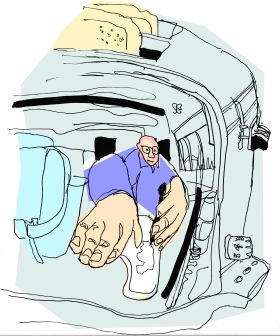
toaster reflection

But my constructions weren’t accurate. They couldn’t be. They were purposeful distortions that worked to protect me, at least for a while.  I didn’t really want to live in the real world, to face reality, because it wasn’t a good place for me. Reality didn’t use to be a friend of mine.

As an adult, when the world did mean things to me, it was very tempting to move deeper into my intellectualized view of the world.  By creating my own logic to explain the world, I could save myself from random acts.  But one pays a heavy price for disconnecting. It’s impossible to understand other people, to get a real bearing on one’s life, and ultimately to be happy. Because when you live in unreality, you can never trust your feelings.

And that’s where drawing has come in. When I hold a pen and look hard at something, I am piercing the veil and stepping out of the Matrix. It may not last for long, like diving deep to see a coral reef. But the bursting of the bubble, again and again, means breaking the temptation to disassociate from reality and run away. Instead of making habit out of fantasy, I force myself to see.

I’ve learned that being here now is not as scary as it might seem. I find now that it is easier to face even awful things things than to dwell in a fog of denial and fantasy. Some things in the world are harmful, most aren’t. Clarity makes it easier to distinguish them rather than establishing a blanket policy that keeps everyone and everything at arms’ length.  Anxiety comes from repeating old patterns when they are no longer appropriate. Treating every noise as the approach of a saber tooth tiger may have protected our ancestors but it can leave us as quivering messes. Better to face your fears, one a time, and vanquish them.

Drawing has made me look the world in the eye. That’s the only way to do it. That’s why I rarely draw from my head any more, rarely draw the cartoony faces and silly monsters that filled the margins of my high school notebooks. Now I look at a half-eaten piece of toast, a pile of bills, a broken tree branch and I boldly examine its every inch. And I do it with a pen, like an upright sword, compelling me to advance out of the shadows, to see and be seen, to take my punishment if I must, but to never again run away in fear.

A Bigger Day

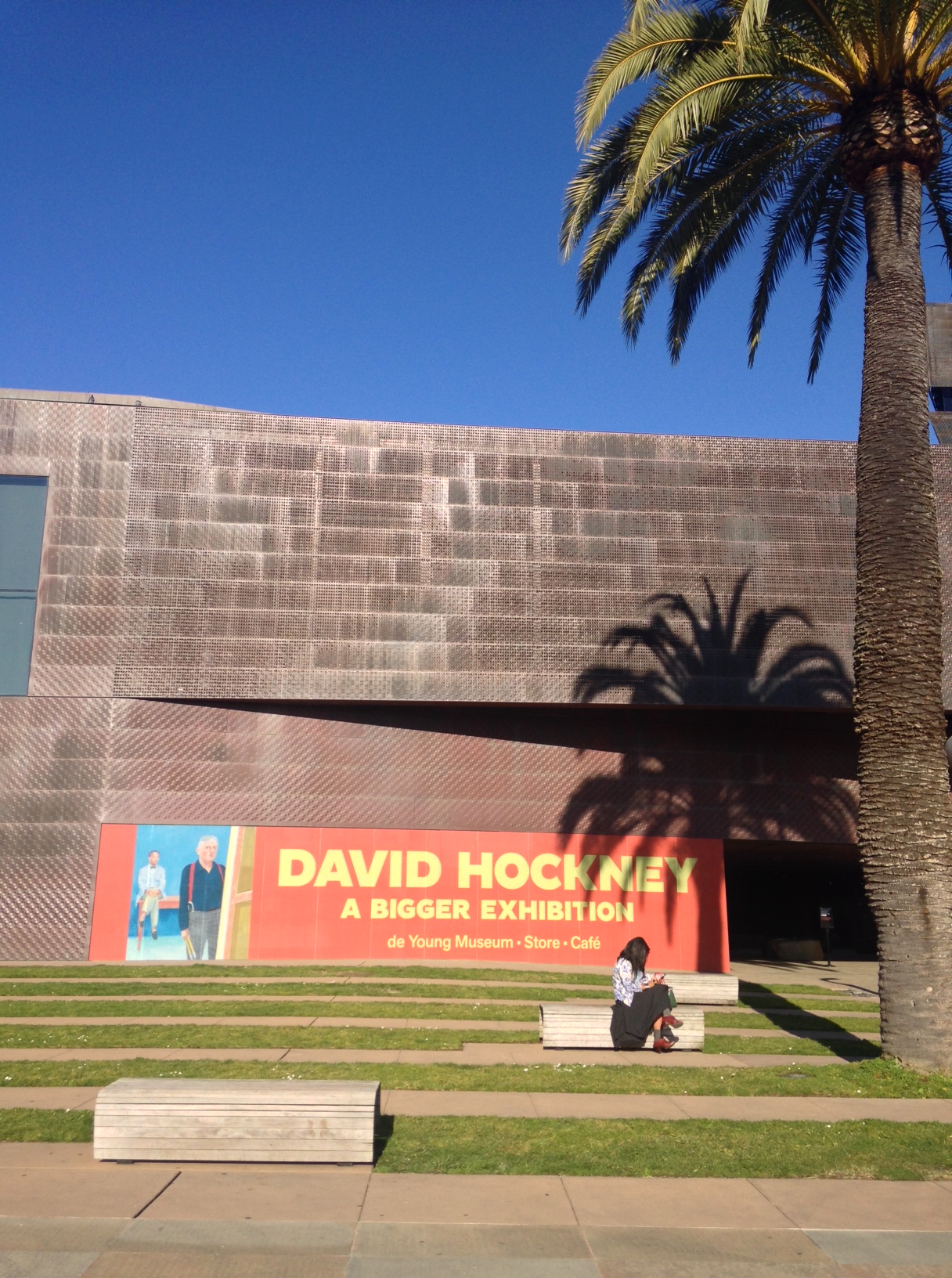
photo A couple of mornings ago I got up a bit early and took a plane, train and a bus to the de Young Museum in San Francisco. I had an early lunch in the cafe with my old pal Andrea Scher and then we began to tour A Bigger Exhibition, David Hockney’s retrospective of the past decade or so.

Color, color, color, color.

The work is traditional in a sense — all landscapes and portraits. But that’s where the familiar ends. Room after room is deluged in color, the colors that are Hockneys signature, salmon, teal, violet, burnt orange, sky blue, fuschia, and every imagine able shade of green. There are rooms full of Watercolors, watercolor that does things mine never do, bright, clean colors that vibrate off the paper, Watercolors that look like acrylics, acrylics that look like television screen, oils that fill the walls as he stacks two, then four, then twelve, then thirty (!) individual canvases to make landscapes that are as big as the landscapes themselves.

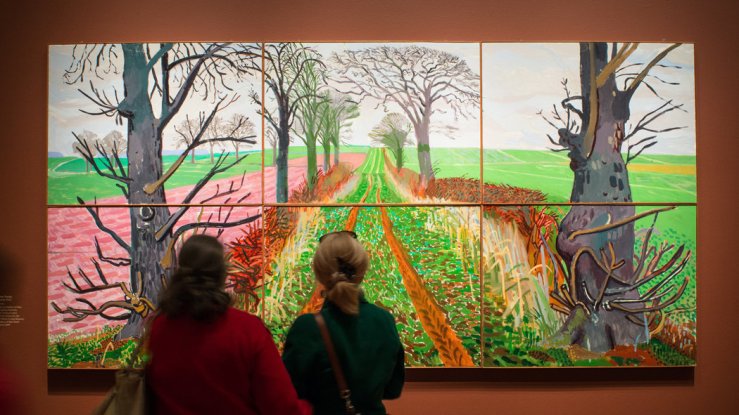
08A01_cropped
Nine canvases. He painted this scene in every season.
Iphone painting blown up 15 feet tall.

There were several rooms of paintings he made on his iPhone and iPad then blew up into prints that are ten or more feet tall, prints that look like oils from across the room and look like electric squiggles close up.*   There’s a room filled with screens and on each one new iphone images appear. You can watch them unfolding as he layers lines and pure colors. And there are hundreds and hundreds of them, landscapes, portraits, still lifes, … blah!In other rooms, long processions of watercolor and oil portraits, people sitting in the same chair in the same room, all different, all alive.

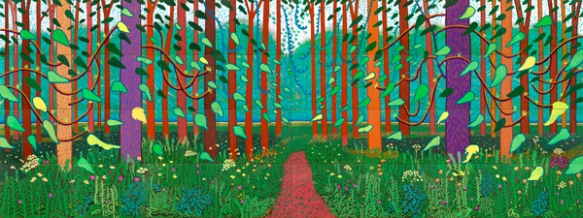
The-arrival-of-spring1
Thirty cavases, sandwiched together.

I kept getting waves of inspiration throughout the show, a fizzy feeling in my belly that I had to run away immediately and start to paint, draw, anything.  I love Hockney so much and I learn from everything he does. He’s always the smartest kid in the class, the one genius among we sheep.  His work is not heady and intellectual, it’s right there, familiar and yet, he makes it looks so easy. HOCKNEY-videoSixteenByNine1050 Watch him paint and you think, okay, okay, that’s doable. But he manages to knock out fields of spring flowers while I wade through the mud. He’s a seventy-five year old geezer but he’s working in ten media at once, filling a whole room of sketchbooks, and paintings and making these insane Cubist Videos by strapping twenty high-def cameras to his car and driving through the forest, season after season.
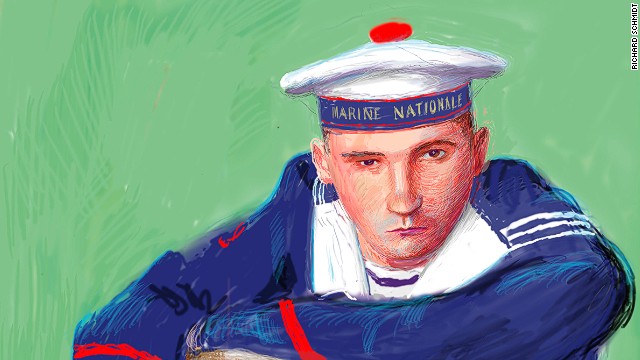
Drawn on a freakin' iPad!
Drawn on a freakin’ iPad!

The man jumps onto every new thing as soon as it half emerges.  He made fax drawings in the ’70s and Polaroid collages.  He drew on the computer before any one. I hope he keeps living and showing me what it can all be.

By Andrea Scher
By Andrea Scher

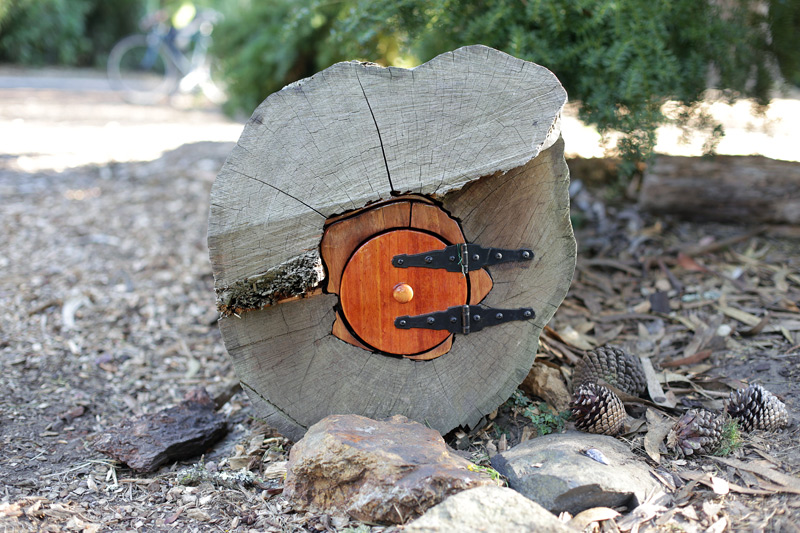
Then, on the way out, Andrea and I found a fairy door in a log in Golden Gate Park.

The perfect end to a magical day.

______

* I looked at my own iPhone in disgust and showed it these works of genius. “All you seem to do is send texts and visit Facebook all day,” I sneered, “Why don’t you make some art?” Siri just said, “Okay” and showed me a website about making Valentine’s Day hearts. Why can’t you be more like Scarlett Johansson?

———

P.S. I would urge you to go but the show closes this weekend. 😦

In production.

dog-on-transformers
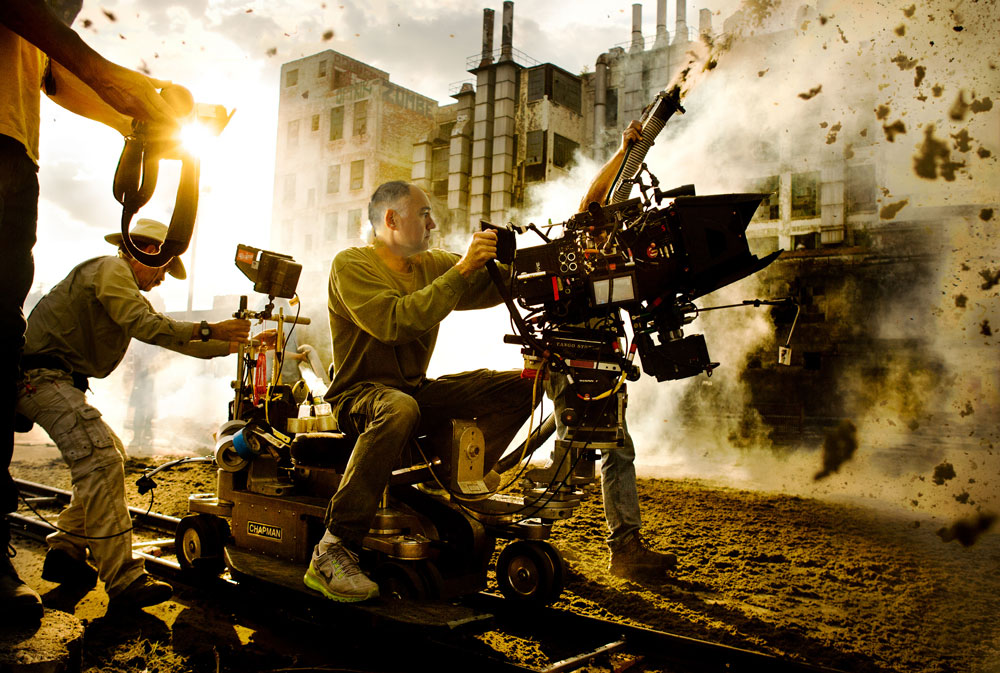
FIlming an action sequence on ink spatter.

Teaching used to be a fairly simple business. You get some chalk, a dunce cap, a book with all the answers at the back and you’re in business. In 2014, it seems to be a little more complex.

tom-and-guests
Tommy Kane and special guests on the set.
lord-of-the-rings
In production with “Lord of the Pens”

When I first started thinking about doing online classes, I wanted to make sure they were as exciting and interesting as possible. So, being me and living a couple of miles from Hollywood, I immediately started to go overboard. I started to talk to my friends, many of whom you know and who are among the best sketchbook artists in the world. We decided that it wasn’t enough to just slap together some recycled lessons, a couple of PDFs and some poorly lit snapshots. We wanted to make sumptuous, hilarious, inspirational, instructional films that would get you so fired up you’d have to start drawing night and day. Our inspiration was first of all, Bob Ross, then the Cooking Channel, then National Geographic, and now we’re thinking Spielberg and Peter Jackson.

beam-me-up
Our mission: To boldly go where no man has drawn before.

So while everyone else was drinking eggnog, we have been deep into production.

DOG demo 2
Warming up some ink.

Tommy and I spent several days in the depths of Brooklyn in production on his klass. Then we turned around and finished up filming my workshop. Meanwhile, Prashant is heading to India to rendezvous with a production team that will capture his insights about watercolors. Koosje is setting up lights and camera in Amsterdam.

kane-on-set-1
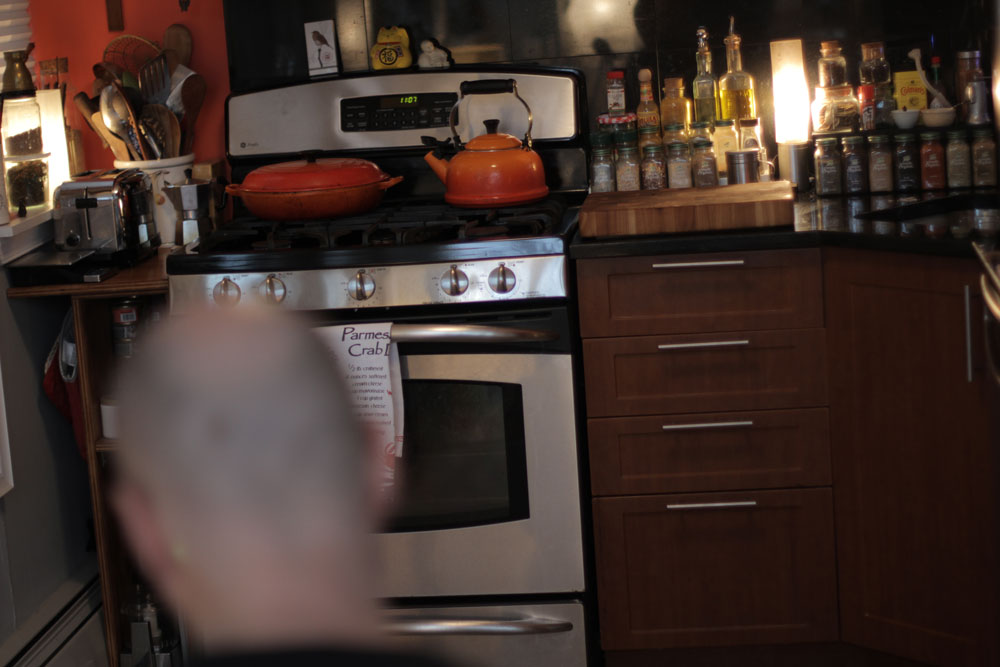
In the kitchen set, Tom gets his head into a drawing

Deep in a Minnesota snow bank, Roz is furiously pecking out epic scripts about paper and pens. And next week, I’ll be heading to San Diego to collaborate with Jane on her films.

Meanwhile, an elite team of even more amazing teachers are arrayed around the world, beavering away on the next wave of klasses. More on them soon.

If you want to know more about all of this flurry of activity when it is ready to launch, do sign up for our mailing list. Meanwhile, scrape together your pennies and polish your 3D glasses.

Happy New Year!

← Back

Thank you for your response. ✨

.

No title. Really, that’s the title.

ArtistI think my mother was the first one to tell me, “You can’t call yourself an ‘artist’.  Other people will decide that for you. It’s pretentious to assume the title for yourself. It’s like calling yourself a  genius. Maybe you can say you’re a ‘painter’. But not an artist.”

My mum is humbling like that.

“Teacher” is another title I am loathe to assume. I don’t have a degree in teaching, I don’t work at a school. And I think teaching is one of the most important and difficult and unrecognized jobs around. I really do think that’s a title you have to earn.

But I guess I do spend a fair amount of time telling people stuff, instructing them on how to live, to drawn, to think. So I’m either a bullying bore or I am maybe a teacher. Not that the two are the same thing, of course. It’s just that if you walked into a bank and started criticizing people’s penmanship or cracking knuckles in your local Starbucks because people have poor posture and are chewing gum, well, that wouldn’t fly. Teachers get to know better because they do.

I’ve had loads of corporate titles and they all seemed sort of ridiculous. Yesterday, a guy gave me his business card and said, “There’s no title there because I still haven’t quite figured out what it is I do.” He was being modest (he was actually the boss of a really big company) but I liked his attitude.

Let me get to the point.

One of the biggest irons I had in the fire when I left my last titled job was to put together an online class.  I’ve alluded to it here a bunch of times since — but it never seemed quite right to me.  Maybe it’s because of those two titles, ”artist” and “teacher” and the even more daunting combo: “art teacher.”

A couple of weeks ago, everything changed.

As result of number of amazing conversations I had in Amsterdam, most importantly with Koosje Koene, a clear, bright path has opened up. I now know what I will be doing next and I think it will be amazing.

It combines everything I have been working on for the last decade. Making art; sharing with other people; meeting so many amazing “artists” and “teachers”; thinking about creativity and all of its gifts and obstacles; the Internet and the global nature of everything; Everyday Matters and what it has come to mean on Yahoo! and Facebook; the thousands of emails I have received from great people everywhere; my decades in advertising helping big companies tell their stories —  all of this mass of rich stuff lumped together in one beautiful stew that finally is really bubbling.

A group of us are working on something that I really think is fresh and fantastic. It’s an answer to all those people who have asked me to do more workshops or to teach online or to give them advice or make more Sketchbook Films, all the people who are interested in art and want to make it more a part of their lives. And I think it’s a great answer, like nothing out there.

We still have a lot more work to do but we think we will be ready to roll it out in March. Gulp

It’s a lesson that settling for an existing title or solution or direction may not always be as good as making up something brand new.

Which is what we are doing.

If you find this, whatever it is that I’m going on about, interesting, stay tuned.

And if you’d like me to update and include you in our project, send me an email. Please do. Even if you are only intrigued. Or vaguely interested. Or utterly confused. It’s gonna be big. And probably won’t involve titles.

← Back

Thank you for your response. ✨

.

On making shit.

turd
A recent turdlette.

It’s so easy to despair. You sit down, uncap your pen, start drawing and then realize you have drawn a large, stinking turd. It’s inescapable and it’s bad. So bad that the stench drives you from your sketchbook for days.

Congratulations, you are on your way. The fact is, crap is the inevitable byproduct of the creative process. It’s supposed to be. And it happens to us all.

(And now you know why the background of my blog is brown).

Let’s get some perspective. I recently took a huge book out of the library that contained all 2,137 known works by Vincent van Gogh. It almost broke the rear axle of my truck. Now, bear in mind that those are the 2,137 pieces that have actually survived for 125 years. You just know that there were several times as many that Vinnie or his brother or some skeptical landlord trashed, burnt or flushed long ago. So, maybe van Gogh made five or ten thousand drawings and paintings over his ten years of art making. Three a day. Sounds reasonable considering the tear he was on.

How many are great? Ten? Twenty? Let’s go crazy and say, a hundred — that still means his hit rate was, generously, 1%.

I love the movie Amadeus. But let’s face it, it’s fiction. The idea that Mozart just sharpened a fresh quill and wrote down the Requiem or the Jupiter or Don Giovanni or any of his other 623 works of varying quality as fast as he could take dictation from God is just nonsense. He  squeezed out turds every day, just like the rest of us.

Picasso left behind 50,000 works. On some days, he made five paintings. The Cahiers d’Art, the complete catalog of his works, takes up 33 volumes and costs $20,000! Did Pablo think all 50,00 were genius? Did his gallery owner? I doubt it. So, these are some of the greatest geniuses of all time and even they didn’t hit home runs every time at bat. That’s why they worked on paper — because it can be crumpled up and hurled against the wall in frustration.

We have good reason to be afraid of failure.  Even if we actually are great.

In our commercially rapacious world, we don’t allow for crap (although there’s certainly plenty of it). The minute we set someone up on a pedestal, we start working to pull them down. If you write a great book, have a great show, make a great record, expectations will be immediately ratcheted up. But your initial success will probably be followed by something that isn’t quite as good. Overnight, you’re the Knack or the Stone Roses or Terence Trent D’arby. Or Skeet Ulrich. Or Lindsay Lohan. And once you stumble, you’re dead Meatloaf. There is little tolerance for failure.

Better to just be Harper Lee and quit while you’re ahead.

You are different. Because you are learning (hopefully for the rest of your life).To succeed in the creative process, you need a long-term view. Thick hide. And you need to keep working. You can’t get hung up with self-doubt and give up at the gate. You can’t mistake a failed drawing for a failed you. You aren’t your turds. You just aren’t.

And stop insisting on perfection as the price of moving on. Even Tiger Woods isn’t Tiger Woods. You have to swing at lots of balls, before you slowly inch your way from van Gogh’s brown potato paintings to Sunflowers and Irises. It’s a battle of inches. Slowly but surely, your turds will smell sweeter.

Learn from your mistakes. Otherwise all the pain you endured from making that bad art was just a pricey ticket you never got punched.

Bottom line: If you’re going through a period of making bad art, you must go on. You can take a break, but eventually, soon, you must go on. Because otherwise what you’re running away from isn’t the way you put pen on paper. It’s fear of who you are. And you’ll never escape who you are. Instead learn to accept and to love it. Flaws and all. And then to go on. Trust me, you are more together and less smelly than Vincent van Gogh.

Don’t be tripped up by a few bad drawings.  Keep them and learn from them and let them improve your future art and your future self.

People who never produce turds die of constipation.