As the last pages are plucked off the calendar, it’s time to feel the pleasure of accomplishment and the pressure of regret. Regret at the things one intended to do over the year past but lacked the stick-to-it-iveness to, well, stick to it.
The waning days of December are a time of familiar patterns. Chestnuts, figgy pudding, wrapping paper cuts, family squabbles, and vows to launch the New Year with fresh and transforming habits. Gym owners rub their hands with glee at all the self-deceivers stuffed with goose fat renewing their dusty memberships, full of the great and ephemeral intentions. Would-be artists line up at the art supply store, baskets loaded with sketchbooks and palettes and workshop catalogs. Blog keepers vow, once again, to truly stick to their publicly announced pledges to post five times weekly.
Let’s zoom down from the heights of generalization to survey this particular oath breaker. Why is it so hard for me to adhere to my own intentions? Why do I still steal the occasional late-night tablespoon of Ben and Jerry’s? Why do days, weeks even, pass without my cracking the cover of my sketchbook? Why do I still gnaw my cuticles in the darkness of the movie theatre?
Let’s get more specific still. Rather than a blanket condemnation of my many shortcomings, let’s focus on my blog keeping and try to extract some lessons from its intermittence that might apply to other habit breaking.
Time and place. When I am successful at regular writing, it’s because I get up early, pee, then sit right down at my desk. Before breakfast, I am done and posted. I don’t allow myself time to question whether or not I should bother to write today. I just get up, pee and write. I’ve said this here before — habits are easier to establish by tying them to a ‘sparking event’. In my case, peeing.
Inventory. To lubricate this dry start, I think about what I want to write days in advance, then jot down a word or two that might be the basis for a post. When I sit down, bleary eyed, I have a grain of sand to drop in the oyster.
Structure. I have a loose agenda for each weeks’ post. On Monday I write about things that have inspired me from the previous week, Tuesday and Thursday I freeform things like this, Wednesday I find or make a video, Friday is some sort of instruction. It’s not a rigid structure but it gives my ideas a trellis.
Temperance. Certainly not drinking too much is a good idea, but what I mean here is that if I temper my ambitions, I am more likely to keep producing. For instance, I had a vague notion about what to write here today, but soon my ambitions swelled and I imagined writing a really long posts with scores of ideas, research, quotes… and the thought of all that work made me want to just crawl back in bed. Instead I said to myself, just write a paragraph or two and try to encapsulate the idea. Even though now it appears I am writing much more than that, I couldn’t have started with such a hike in mind. Just planning a slow jog to the curb to pick up the paper is a more fruitful place to start. Underpromise, overdeliver.
(Incidentally, long bits of writing are not an indication of industry. I find it a lot easier to go on and on than take the time to go back and prune. By now, you’re probably feeling the consequences of my editorial laziness.)
Before I commit myself to any new regimes in early 2016, I will think about how to help myself stay true.
What are the sparks that I can connect to the habit to reinforce it? For example, if I want to draw every day, I should put a sketchbook by the coffeepot and draw the view out the kitchen window each morning as it perks.
What sort of preparation can I make to make the new pattern easier to adhere to? If I want to avoid eating carbs, maybe I should start by clearing the pantry of cookies and the freezer of Chunky Monkey.
What sort of structure can I give my habit so it isn’t just open-ended? If I want to go to the gym several times weekly, I can put a recurring appointment in my calendar and make sure nothing else gets booked at that time. And I can add details to those appointments, thinking through what sorts of exercises I want to do on any given day.
How can I set realistic expectations? I can come up with reasonable goals that won’t be a barrier to my getting going — like drawing for ten minutes or walking for twenty minutes or not drinking caffeine after ten a.m. — goals that can then be inched forward over time as I adjust to the idea of the privation or activity.
In sum, I can be like a good parent. I can provide reasonable goals, set myself up with clear and achievable markers of success, be supportive and understanding without being either a wimp or a tyrant, and remind myself that failure is not catastrophic but just a detour from a path one I still return to.
Let’s do great things in 2016 but in a reasonable, supportive, human way. And let’s start by giving up regret.
A dozen years ago, I started this blog with my first silly post. Since then I have always had a place to go to share how I am feeling, what I am learning, and what I am doing. I do have a few relationships that have lasted longer than that — but not many.
So thank you, Internet, for being there to listen and provide me an endless creative workplace.
Before I met you, I knew of two other people who, like me, thought it worthwhile to record their lives in words and pictures between the pages of a book. One, d.price, I met in 1998 or so, through a Xeroxed ‘zine in the magazine rack in Tower Records. I wrote him a letter, dropped it in the mail, and we became pals. The other, Hannah Hinchman, I found in a second-hand book store. She was far too intimidating for me to approach and I didn’t correspond with her for at least another decade. Then the web finally happened and I set up the Yahoo group, Everyday Matters, and soon I found many new friends who also kept illustrated journals, people around the world to inspire and educate me.
So, thank you, Internet, for giving me a creative community to support my passion for drawing.
(this is currently my favorite video and I run it all my waking hours)
It’s cold out today and the streets are jammed with frenzied shoppers. But I don’t have to leave my cozy spot by my virtual fireplace (thank you, YouTube). With a couple of clicks, I can buy anything I need and have it delivered to my door.
But here’s the thing — the easier it is to buy anything, the less I actually want. I want to streamline my life and reduce it to a couple of pairs of well-worn jeans, some t-shirts, a sketchbook, and my laptop. I don’t need or want to own much more — knowing it’s within reach means I’m fine just leaving it all at Amazon.com. So thank you, Internet, for make me want less — by giving me more.
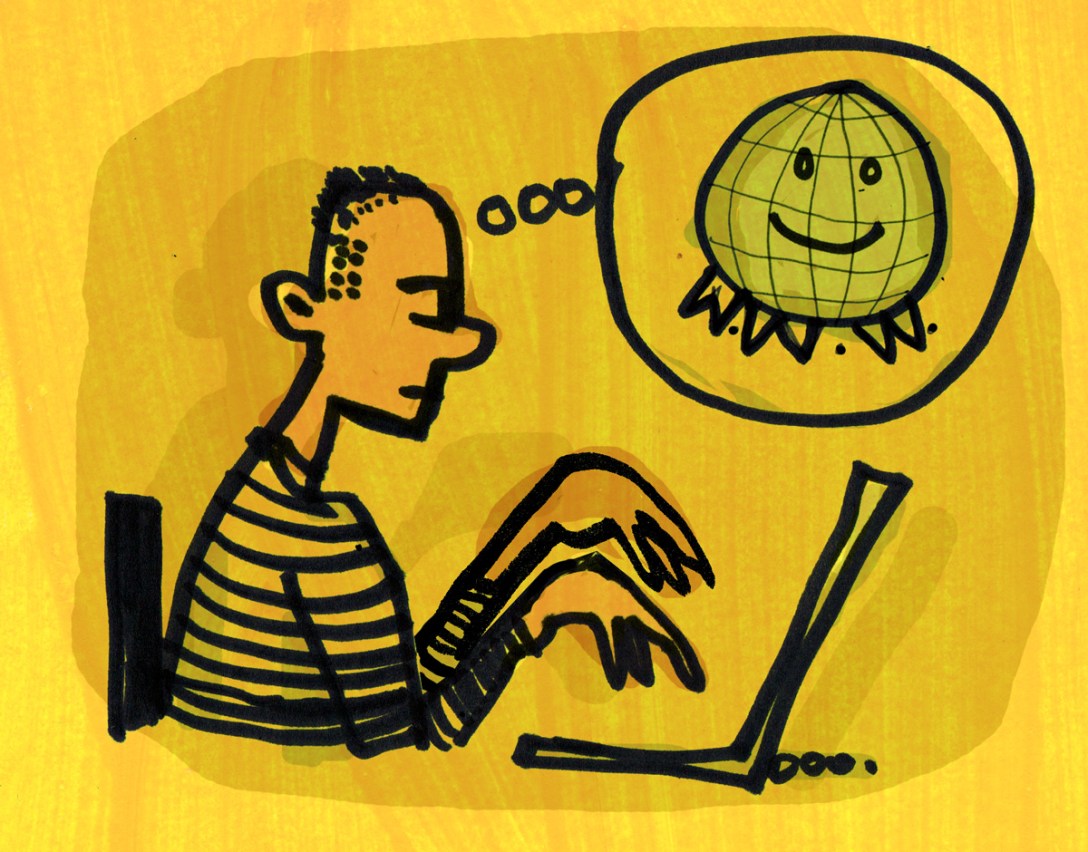
Two years ago, I stopped going to a big brick building on the shores of the Hudson River each day and started working on the Internet instead. I met my partner-to-be Koosje Koene and we started Sketchbook Skool. Now tens of thousand of people come to learn and create in a schoolhouse built of ones and zeroes that stretches from Moscow to Capetown, from New York to Walla Walla. My coworkers live thousands of miles apart and commute each day via keyboard and mousepad. Thank you, Internet, for the best workplace I’ve ever had.
Internet, you bring me lunch, pens, ideas, and cat videos. You’ve let me express myself, find people who are interested in what I make, tell my son I miss him, and learn why my dog drags his butt on the rug.
The world is far from perfect but I am hopeful about its future because if all 7,389,160,216 people on this planet (thank you, Google) can experience 1/10 of what I have online, we can look past our differences and start to work on solutions. Together. Thanks to you, Internet.
If we want to understand what our earliest ancestors were like, our best evidence are the paintings they left deep in the caves of Southern Europe. When we think of Ancient Egypt, we see the paintings anonymous artisans made on sarcophagi, grand sculptures like the Sphinx, monuments like the Great Pyramids at Giza. The Greeks and Romans are represented by marble statues and architecture too. The Medici, all-powerful merchants live on, long after their last pennies were spent, as sponsors of da Vinci and Raphael. Popes like Julius and Leo, who led armies and converted millions, are instead remembered by Michelangelo’s creations.
And when our civilization is over, what will represent us to the future? When every company on the Fortune 500 has vanished, when the borders of all the world’s nations have been redrawn a hundred times, when our glass and steel towers have tumbled, when hard drives have been wiped and silicon decayed, what will stand as our legacy? Will it be our wars, our laws, our economy? Or will it be Walt Whitman, Bob Dylan and George Lucas?
When I visited the Jewish Museum on Prague and saw all those pencil drawings by children long since consigned to the pyres of Auschwitz, I felt their spirits, felt them enter and inhabit me, felt them live on through those faint marks on paper. Hitler should have been more diligent in burning those drawings too, if he was so hellbent on wiping those children from the earth.
When I think of my grandparents, I don’t think of their success as doctors, their accumulated capital, their role in their community — I think of my grandmother’s garden, designed to look like a Persian carpet, her roses, her topiary of a peacock, her frangipani trees and her cacti. I think of my grandfather’s short stories about his childhood in the stetls of Poland and his experiences in post-partition Pakistan, all written painstakingly at his walnut desk in a cloud of pipe smoke, then hand-bound between shirt cardboards.
My grandfather would have been 106 this week. His body is under Mount Olives in Jerusalem. His house is occupied by strangers. His friends and siblings are but dust. But his stories live on in the archives of the Leo Baeck Institute.
Long after your will has been executed, your real estate dispersed, your Instagram feed expunged, the drawings you make, the recipes you write down, those are the things that will keep your spirit alive.
Art is our way to immortality. Long after your will has been executed, your real estate dispersed, your Instagram feed expunged, the drawings you make, the recipes you write down, those are the things that will keep your spirit alive. Your illustrated journals, records of what you did and experienced and felt, they will be your mark on this earth.
Make sure your family understands that your art is you. It is not to be consigned to eBay or the dump. It is the most precious part of your legacy and it should live on.
Oh, and make sure that the monkey doesn’t prevent you from making those pages, from creating the art that will keep your spirit alive. Don’t kill your memories before they can be born. Be brave, be creative, rock on.
Donald Trump. Ben Carson. Bernie Sanders. Microbrews. Artisanal pickles. Documentaries. Memoirs. Ukuleles. Normcore. Etsy. Real Housewives. YouTube. What do they have in common?
A claim to authenticity. Their appeal is a rejection of the cynical, corporate polish of the 21st century and a willingness to show it like it is.
Granted that behind a lot of these ‘authentics’ is the same old cold calculation, cynical manipulation, and ancient biases — but our hunger for them is real.
When everything seems to have passed through Photoshop, Autotune, TelePrompTers, 3D printers, Instagram filters, product placement and GMOs, we come to crave authenticity. We tire of bullshit and hidden agendas. We have all seen the DVDs extras and know how special effects can easily manipulate the truth. And so we prefer politicians who don’t seem like they are. We reject Spiderman VI and Billboard charts and McDonalds breakfasts. We hunger for the truth.
So why is authenticity at such a premium? If people want to wind back the clock, why not just let ’em? What’s the big deal?
Well, authentic authenticity is hard. It’s hard because it’s naked and vulnerable and exposing your warts can cost you dearly. Because you can’t delegate authenticity to consultants. Can’t guarantee its outcome through past success. Can’t slash its costs, can’t ship it overnight, can’t outsource it. Authenticity doesn’t fit neatly in a box so it sends shock waves through the system.
It’s easier to keep to the status quo which gleams and glistens and reflects back a shinier, faster, cheaper world.
But you have a choice. How could committing to authenticity effect your art? Your creative goals? How can you replace perfectionism and self judgement with honesty? How can you avoid succumbing to the artificiality that technology makes easy and instead reveal your soul, share the truth, make something interesting and fresh and honestly you?
For the first half of my career in advertising, I would often have irrational feelings of anger during a creative briefing. I would resent being given the assignment. Then I would be pissed off that I had to sit in a conference room with loads of other creative people while the strategists took us through the brief.
I simmered with impatience. I would ask critical, acerbic questions. I would strain against the deadline.
The monkey would tell me that the people briefing us were idiots, that their insights were lame or wrong, that I already knew more than they did about the subject, that it was wrong that we creatives had to compete for the assignment, the playing field wasn’t level, that the whole project was a waste of my time, blah blah and blah.
It was pretty crazy — and incomprehensible.
With time, I became sufficiently self-aware to identify this pattern and dampen it. But I can still feel the impulse when it comes time to get creative feedback or in the final days before a big presentation — a frothing resentment with no legitimate cause.
This reaction maybe in the minority but it’s not unique to me, alas. I often hired great creative people who would have explosions of rage at the most inappropriate times.
What is the fear that drives it? Vulnerability at having to show one’s ideas where they might be rejected? Of being misunderstood? Of losing control somehow?
Recently, I read of a study in The Journal of Experimental Social Psychology that examined the effects of anger on creativity — and found that it could actually be helpful to the creative process.
Anger provides two benefits: an energy boost in the form of an adrenaline rush which focuses the mind on the problem at hand. Secondly, anger makes your thinking irrational — which can jolt you out of creative ways of thinking. In a paroxysm of rage, you may spit out some crazy truth that makes a wild and fruitful association.
Another study found that many creative people begin their days with negativity and then shift to positive feelings. By channeling the negative energy into their work, they find sharper focus and productivity. If you wake up on the wrong side of the bed, try channeling your bad mood into energy to solve a creative problem.
But proceed with caution for anger is still a sin. Its benefits dissipate fairly quickly. And once the red mists blow away, you may find you’ve alienated potential partners, wasted time and resources, derailed the process, and damaged your reputation. And if people dislike and fear you, they are a lot less likely to be objective about the merit of your ideas.
Being a genius doesn’t excuse being an asshole.
The last in a series on the seven deadly creative sins.
I’ve been meaning to write this post for a whole but, (sigh) I’ve been tired, I’m sooo busy, I feel kinda run down, the World Series was on, I had Halloween candy to eat…
The monkey loves a good excuse for not doing what you really oughta (and wanna) get done. Maybe your small reserve of creative energy is being tapped only to make those excuses.
There’s no real shortcut to drawing, bestselling, Sgt. Peppering, or making a perfect soufflé.
It’s easy to tell yourself that you just don’t have talent. But the people you admire didn’t get to where they are just through some God-given gift or amazing luck. They worked their asses off. They sweated over their sketchbooks, threw away draft after draft, built their networks, filled their wells of inspiration, and tried, failed, tried, failed, tried, failed until their humps were busted — and only then did they became overnight successes.
When the Beatles played in Hamburg, they did six 90-minute sets a night. Lennon said: “Every song lasted twenty minutes and had twenty solos in it. That’s what improved the playing.”
Before Picasso sent Les Demoiselles D’Avignon to the framer, he made over 700 sketches and studies in preparation.
Gone With the Wind was rejected by 38 publishers. The 39th sold 20 million copies.
And Isaac Asimov wrote five hundred books. And had cool sideburns.
Sowwy. There’s no real shortcut to drawing, bestselling, Sgt. Peppering, or making a perfect soufflé. You gotta break eggs and you gotta scramble.
You have talent. Or maybe you don’t. Whatevs. But don’t let excuses and torpor and depression and sorrow and keep you from where you want to go. The world needs what you will dream up. Your contribution is anticipated and will be valued.
It could seem easier to stay on the couch with a beer in one hand and a remote in the other — until you go to the john and catch sight of yourself in the mirror.
Failure may scare you into not trying. Sloth should scare you more.
Ironically, the classic bio of my favorite painter is called Lust for Life. But lust is a sin that has sabotaged loads of great artists too. Lust is any intense sort of intense and uncontrolled desire — be it for sex, food, drugs, money, fame, power or freshly-poured, frosty lager. Society loves to depict the artist as a lusty, carnal creature — snorting, boozing, copulating, and then self-destructing at 27.
Uncontrolled. Undisciplined. Lust replaces thoughtfulness with raw impulse. You cave in to self-destructive abandon. Instead of doing the necessary work you are distracted. Instead of drawing the model, you drool on him.
Lust makes you myopic. It distorts your normal perspective and gives you tunnel vision, tuning out everything but the object of your desire. And what you see is not real. It’s a thickly veiled concoction of your fevered mind.
Perhaps you are slender and celibate and sugar-free and believe lust is a sin that doesn’t apply to you…
At the heart of sexual lust is a form of depersonalization. Instead of seeing people as human beings, they become sex symbols. Lust for money isn’t about acquiring the things you need. It’s about the symbolic value of wealth, the illusion that it will provide security and satisfy all your needs. You want gazillions you’d probably never spend. Lust for power makes you ruthless, disconnected from the effects of your actions, reduces people to symbols, to pawns on your board. Mwahahahah!
Lust turns reality into abstraction, turns people into symbols, replaces authentic needs with insatiable hunger. And an artist who cannot see or feel or connect is lost. An artist who only deals in symbols cannot find her way to truth.
Lust is obsessiveness. Lust is abstraction. Lust is infantile, sacrificing your higher goals to your basest weakness. Lust is lost in the future, a future of quelled desire that may never come, a future you cannot control.
But creativity requires control. Control over your skills, your materials, but most of all over your vision of the world you are creating.
Perhaps you are slender and celibate and sugar-free and believe lust is a sin that doesn’t apply to you. But look deep and honestly within and look for those impulses that cloud your objectivity, that distort your actions, and color your perceptions.
According to Dante’s Purgatorio, if you get sent to hell for the sin of envy, demons will sew your eyelids shut with wire. Ouchy. You get this iron mascara treatment because you spent your days on Earth getting a kick out of seeing others in pain. Now, you just get to see total blackness and writhe around on a spit.
Envy isn’t just garden-variety, green with jealousy. It’s meaner. Envy means you don’t just resent someone else’s good fortune — you want to take it away from them. It’s not enough to wish you’d made that great painting. You have to rip it out of the frame and jump up and down on it. In other words, you need to become a critic.
Envy is another sin born of fear. It begins when you see someone else making something great. Instead of just enjoying it, you feel threatened by it. The monkey whispers in your ear: ‘You could never do that. Ever.’ So you get out your knives.
One response to this fear is to dismiss the accomplishment. The artist was obviously just lucky. Or some sort of con man. She was born into a talented family. He sucked up to the top gallery owners. She has a famous boy friend. He will be forgotten in a year.
When you are envious, you set yourself back. Instead of learning from greatness, you run from it. You swaddle yourself in hostility. You withhold any kind of generosity or support. Your refuse to collaborate. You refuse to learn.
You don’t see how much work it takes to be successful. You don’t see how to acquire skills, connections, vision, happiness, all the things you really want. You are so afraid of losing, of failing, of fallingbehind, of being called out, that you lash out and destroy.
You sew your own eyes shut with wire.
And while the biggest victims of envy are the envious themselves, they can also cause loads of collateral damage along the way. Maybe you’ve been a victim of someone else’s envy. See the critic for the scared, myopic monster he is and you’ll be able to understand what his critique really means and defuse its impact.
In the 21st century, it’s more difficult to see “pride” as a sin. We think of LGBT pride, Black pride, national pride, Bono singing “In the Name of Love.” Isn’t that song about Martin Luther King — surely he wasn’t a sinner?
Here’s a different take on pride. Actually let’s call it ‘hubris’ so no one gets confused.
Hubris is about insisting on your own greatness. In fact, that’s why Lucifer fell from heaven and ended up on the dark side. He insisted that he was greater than the rest of the crew.But, Kanye not withstanding, most creative people seem to have a problem with low self-esteem, not grandiosity.
But whereas they would never say that they are better than others, they insist that their work be. They judge their art too harshly, dismissing what they produce with contempt.They demand a higher standard than is reasonable, possible, necessary. They are absolutely intolerant of anything but perfection. It’s hero or zero. Whatever misses the mark gets binned.
If you can’t accept your own normal human weakness, isn’t that hubris? If you are completely intolerant of your own mistakes, isn’t that vanity? Aren’t you saying you can and should be perfect? If it’s a sin to judge others that way, why doesn’t the same apply to how you look at yourself?
If you are unwilling to be vulnerable, you are limited by fear. Overwhelming fear of any form of weakness, of being irrelevant, of being rebuked by others, of falling even slightly below the mark, can prevent you from taking chances. If you are so wary of falling on your face that you won’t take risks, you will never achieve anything great, no matter how high your standards.
Do great work, please, and be proud of it. But don’t let perfectionist, monkey pride stop you from expressing your real, human self.
Third in a series on seven deadly creative sins. Incidentally, and I say this with all due humility, the original list of seven deadly sins was written by Pope Gregory I. Probably no relation.




 Danny Gregory