The art of being afraid.

I just read about a study from The Journal of Personality and Social Psychology (so it must be true) that says that when people are exposed to abstract art they can register many of the symptoms of fear.  What are those symptoms? Uncertainty, meaninglessness, a loss of hope, even terror. Gulp.

A
bstract painting has always challenged the casual viewer. It’s tempting to judge art by how much it looks like its subject. We want to have a yardstick to measure it by, and ‘reality’ seems the easiest one. People don’t like ambiguity. We don’t want to be challenged or confused. We want our meat and ‘taters just like Mother used to make. So we turn away from difficult art, dismissing it as a con, a mess, seeking strength in denial.

But art has the power to go beyond confirming what we already know. It can stretch us past our comfort zones and prepare us to face the unknown. And facing the unknown is a crucial survival skill, one we have to exercise every day if we are to survive.

Get used to the fact that you can’t control everything in your environment. That there may not be an explanation or a code for all you encounter. Some things are strange. And instead of feeling helpless in their presence, empower yourself with the knowledge that you are resilient and resourceful, and trust that you will find you footing even on new ground.

Go and stand before a Pollock, a Rothko, a Kiefer, breathe deep, and plunge in. You will emerge tougher and more flexible, ready to deal with reality when the picture isn’t pretty.

“Why should I learn to draw and how are you gonna teach me?”: On the teaching philosophy of Sketchbook Skool

A key to successful learning is to have a motive. Why do I want and need to learn this?

When we first started to learn things, it was to survive in the world. Learning how to walk, how to eat solid food, how to talk, and how to play with others were hard but essential lessons. When we first got to school, we had to learn things because, well, mainly because we were told to do so by adults and because everyone else in the room was doing it too. We didn’t really understand the reason for learning what we are being taught but we did it because it some big person told us too. Eventually, some grown-ups inspired and excited us in the classroom and then we were doing  it because it was fun and we wanted them to like us even more. Those kinds of teachers are the ones that have the power to change our lives.

When we are grownups, why do we want to learn things? Generally, because the new skills will help our careers or enable us to accomplish some useful goal like cooking dinner or programming the DVR.

So why do people want to learn to draw? And how do we help them to persevere?

So why do people want to learn to draw? And how do we help them to persevere? People want to learn to draw generally because is a skill that they felt was potential in them for a long time but they were never able to focus on or get proper guidance  to fulfill that potential. “I’ve always wanted to draw,” people tell me. But there were huge obstacles that sat in their way — the largeness of the task, the enormous commitment required, and most of all the fear of failure.   This stems from the sense that while others may be good at this, you were not born with the talent or ability to ever accomplish even a basic level of drawing skiinstructionll yourself.
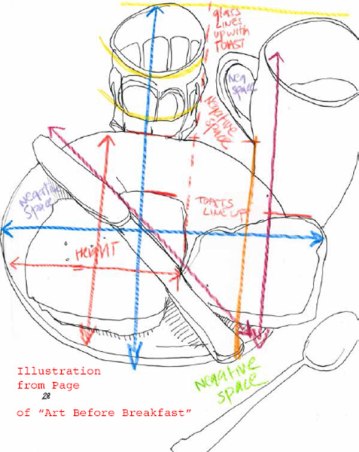
So the first and most important task is to give people back their sense of power. To make them think that they can do it, to show them that that ability does reside within them, and that if they put in a bit of work it will not be wasted effort. Because there is that sense that the process is magical and that, without that spark of magic, no amount of effort or training will pay off.

As teachers, we have to show them that it is indeed possible. And the key to doing that is to show them that people just like them —novices, frustrated creatives, people born apparently without talent — are able to make progress in the same way.

If you look at Betty Edwards’ classic  book, Drawing on the Right Side of the Brain, one of the most notable things in it are the ‘before’ and ‘after’ pictures. We see accomplished beautiful drawings and next to them the same sort of amateurish fumblings that we are now capable of. The book promises us that, just like these people, we will be able to progress from A to B.

A great way of doing that is by giving people a sense that they are surrounded by like-minded people. Community, is a key part of empowering them. I can tell you over and over why I think you will be able to accomplish this but, unless you trust me, unless you feel I am like you, your inner monkey critic can simply dismiss my expectations and say that I am different from you so my lessons do not apply.

You can buy a book and struggle alone with the exercises, giving up when you hit the first obstacle or disappointing sketch. But when you’re surrounded by thousands of others with the same ambition, the same busy lives, and the same apparently limited talent, you feel like maybe it is possible. And when you have that sense of possibility, the next step is to give you the opportunity to exercise. We need to give you work to do that will be both fun and rewarding. So we need to devise assignments that will fit in with your current life, that will remain interesting and varied, and that will move you one small step at a time, toward the goal of creative empowerment.

When you’re surrounded by thousands of others with the same ambition, the same busy lives, and the same apparently limited talent, you feel like maybe it is possible.

I think it is similar to  learn the way we did when we were children, to just enjoy the process, to have fun in the process rather than agonizing over the first meager results. All learning involves work. But it need not feel like work. It should  be fun, rewarding, and engrossing in someway.

We have the fantasy that learning a skill is simply a matter of getting access to certain shortcuts. That there is a secret set of tricks that will instantly have us drawing effortlessly and accurately, as if there were secret rules that allowed you to drive a car expertly or shoot a basket expertly. Drawing is a physical skill. Like any other, it takes practice. There are no shortcuts but there are things that will make the effort and time commitment required seem just like fun.

No one of the steps will instantly provide you with extraordinary abilities. But they will build your faith. And that faith means that you will continue to take one small step after another. And fairly quickly you will be able to look back and see how far you’ve come. And that will re-reinforce your faith again so you will continue to work and to move forward.

None of the steps has a magic formula, it just contains inspiration. Because ultimately nobody can teach you to draw — only you can teach yourself. And the way you do it is by believing that you can, and doing the work to develop the skills and the connections in your brain and body to make it so.

Living in the real world.

Things that happened so long ago were real.
The pain was real.
The marks were real.
As I grew bigger, other bad things happened.
Unexpectable things. Unimaginable things.
Things that were all too real.

But the worst things seem to be the things that could be.
The sound of approaching sirens that could be heading to my house.
The boss who could be getting ready to fire me.
The smell that could be smoke.
The leading indicators that could be a sign.
The cough from my son’s room.
The phone ringing in the night.
The falling buildings.
The impending war.
The news around the clock.

Bad things happen.
But worse things could.
What does happen can be cleaned up or treated or paid for or even buried.
But what could happen must only be dealt with one way.
By refusing to fear what could be.
By accepting that all that matters is all that is.
That no matter how bad it is, we will live with it.
That the world that skulks out of the midnight recesses of your head is just your creation.
And that you can put your imagination to better use.
And insist on living only in what is.

Starting again.

If you haven’t gone to the gym in a long time, how do you start again?

If you haven’t done a drawing in a long time, how do you start again?

If you haven’t written a blog post in a long time …. how do you start again?

You start by starting. By picking up a pen, a dumbbell, and getting to work. There is no magic trick, there is no massive process for preparation. There is simply the active of sitting down at the computer, opening a new document, and starting to type. It may seem painful, it may seem scary, but all that misery goes away as the first letters march onto the screen.

“What I try to do is write. I may write for two weeks ‘the cat sat on the mat, that is that, not a rat.’ And it might be just the most boring and awful stuff. But I try. When I’m writing, I write. And then it’s as if the muse is convinced that I’m serious and says, ‘Okay. Okay. I’ll come.'”     — Maya Angelou

Art by another name

Unafraid.
Unafraid.

One thing I keep encountering when I talk to people about starting to draw: fear.  People are terrified of pens, paper, and brushes.  Art is scary.

So I propose we call it something else. Drawing or journaling or sketching or doodling or sketchbooking or testing your pen. I call it ‘art with a small a‘.

Here’s how I look at it.

There are so many things we are willing to do that we know other people do much better. There are all sorts of amazing chefs on TV doing incredible things with scallops and opening four-star restaurants, but we are all still willing to cook some burgers for dinner without being terrified. We don’t say, I just can’t use  a microwave, I didn’t go to cooking school.

We may not be ready for the NBA but we’ll toss a basketball around with some buddies.  We won’t be headlining at Madison Square Garden or winning any Grammys but we’re all still willing to sing in the shower or whistle while we work.  We may not be on the Pulitzer shortlist but we can still write an email or a birthday card.  We are just doing it to have fun. Or because it’s an essential part of life.  And I think art can be both.

We don’t need to label ourselves chefs, or basketball players, or musicians, or writers.  So why does art have to be so different?

If you want a painless, unscary way to start expressing your creativity, sign up for the best semester yet of Sketchbook Skool. Thousands of people who are rusty as barn door hinges are doing it.  Join us!

A hundred feet of eighth graders

(A somewhat funky video I made in my hotel room in China)

Learning to draw is not like learning to drive.  You don’t have to master the fundamentals, take courses, pass tests, put thousands of dollars of equipment at risk.  You just have to start.

Drawing isn’t a learned skill so much as it’s a process of discovery that starts with skills you have had since you were a toddler. And that process requires a willingness to stretch and practice, things that can be scary or boring if you approach them with the wrong set of expectations.

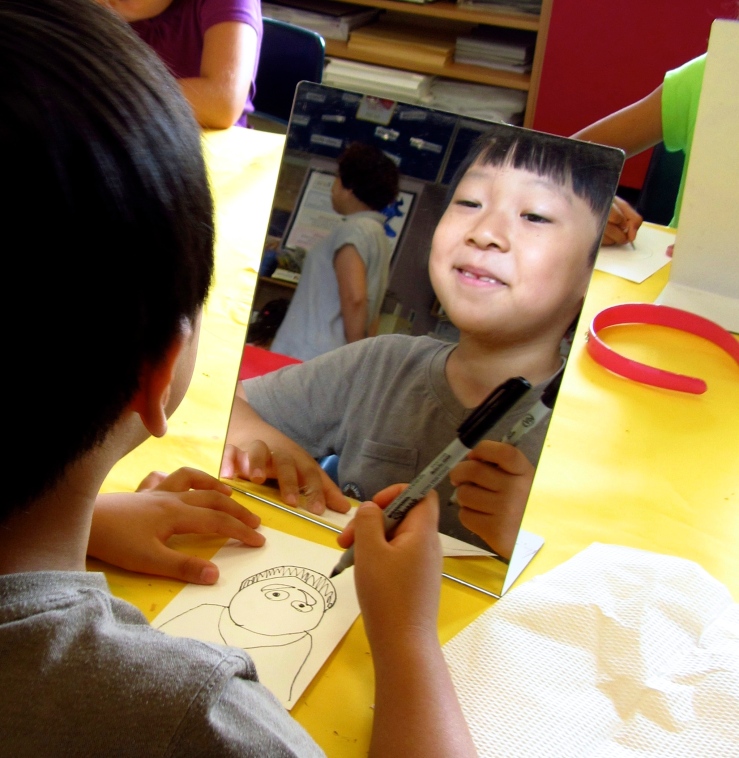
One thing that has been reinforced with me over the past few weeks that I have spent drawing with kids is that the most crucial thing is to have fun. If you are all enjoying yourself and slopping ink and paint around, well, you want to keep it doing it. As as you do it, you encounter new situations, you have questions, you want to stretch. And that’s where a decent teacher can step in and show you how to make progress. You also start to feel more comfortable with what you are doing so you are willing to make mistakes and take new risks, and that’s how your adventures to new places begin.

We all need to accept that creativity is not about immediately achieving some sort of awesome finished piece; it’s an exploration of discovery, not a straight-line commute to Perfection.

Of course, this insight isn’t just for junior high. It’s the core idea behind Sketchbook Skool: having new experiences, having fun, exploring with friends, and having opportunities to grow. Speaking of which, the new semester is about to begin. I assume you have already signed up, but if not, get over to our site and enroll.

All the t-squares in China

stuck-in-traffic

Some clichés are based in truth.  The one I encounter a lot in China is the Asian student who drives her/himself super hard and who is forced by expectant parents to be overachieving and highly pragmatic.

These kids have been coming to me, one by one, to ask for my advice on their future plans. A classic was the senior who said she was picking colleges to study art based on whether they also had a  great physics programs — in case she had to switch directions.

I understand their anxiety.  They live in a country that is going through a massive transformation and there’s a lot resting on the new generation.  They want to be as prepared as possible, to dot every ‘i’, take every course, ace every test…

Here’s my message to them and it might be useful to you too.

It’s good to be prepared, but what are you preparing for? I think the only thing you can intelligently anticipate is change. And no number of degrees or job offers at investment banks will prepare you for the unknowable. That takes creativity. An ability to adapt. A willingness to live with ambiguity. Resourcefulness. A knack for collaboration.

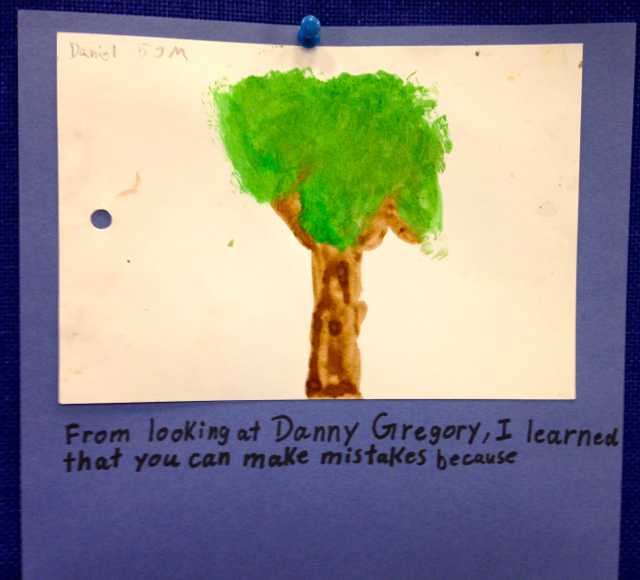
I encountered their core problem when they made art. They were so afraid of mistakes.  Kids would go to rip up their work if they encountered any sort of screwup, a bent line, wonkiness. And I would say to them, “Hold on! Try to turn that into something. Work with it. Solve the problem. It’s okay.”

mistake
I love this. It says it all.

When the teachers asked their students what they got out of my stay at their school, they say things like:” Danny taught me to make masterpieces our of mistakes” and “I tried making drawings unique instead of exact.”

Learning to live with (and embrace) our essential fallibility. It’s what I learned at Clown School earlier this year.  And I hope I managed to pass it on to all those kids who will be contributing to our imperfect future.

Speaking of mistakes, if you miss the greatest semester yet of Sketchbook Skool… well, we wouldn’t want that would we.  Enroll today!

Mad Old Men unearthed

So many people seemed interested in my recollections about old typewriters that I thought I’d share this dusty relic, a three-part conversation between Tommy Kane and me in which we discuss all the old technologies that used to be part of our work in advertising. If you’ve had a long career in design or what you used to be called ‘Madison Avenue,’ it’ll ring some ancient bells.

We recorded it about four years ago. It’s sort of pathetic how unreliable our memories were already.

Lost in the giftshop

tokyo bikes
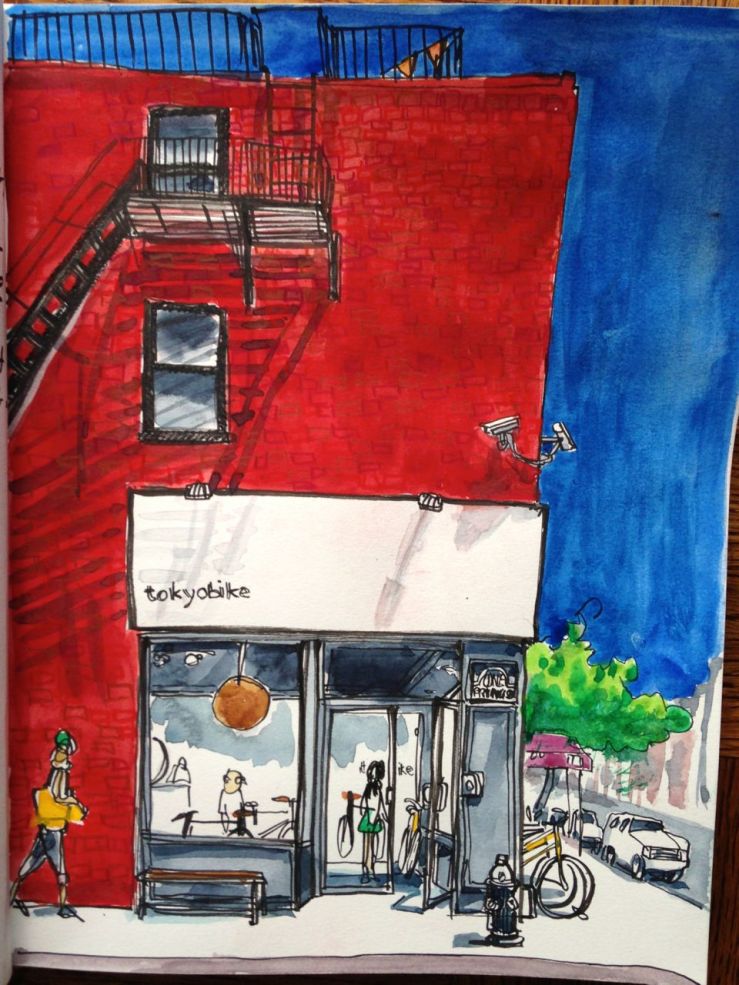
Tokyobike store, right off the Bowery, NYC.

Is art about owning?

Is the mere act of looking somehow acquisitive? As predators, when we look at something, we are tracking it, stalking it. “Just looking” can actually be an act of aggression. Is drawing even more invasive? Why do we worry that people will resent us for drawing them on the subway? We all know the cliché of the primitive societies that feared that cameras would steal their souls. When we do a good drawing, why do people say “you’ve really captured it”?

Is drawing also stealing?

Why does every single museum have a gift shop? Why do we feel drawn to shop in them?

When we have just seen the originals, why do we want postcards, tea mugs, coffee table books of the same images?

Why do people walk through museums snapping photos of every piece on the wall? Are they just adding them to their own collections?

Are museums themselves just giant closets full of acquisitions on display?

Much of the history of art has dictated by those who would own the art, the clients, the patrons.  They set the theme, dictated many of the choices for the artist.

Museums are filled with portraits of the rich and powerful. The artists didn’t choose these subjects by chance, the market dictated them. And they have survived because their various owners preserved them. The pieces that were most valuable have become what we call ‘art history’. So buying and selling and choices about importance are all bound up together.

Can art be valuable — if it’s never bought or sold?

Pulling my head out of my head.

brown paper packages

Miles Davis’ quartet is working How Deep is the Ocean a few feet away. I have an almost drained but still frosty glass of pilsner next to me on the window sill. There’s a slight breeze coming through the open window, 76 degrees, just a hint of humidity. My neighbor is roasting a chicken, smells like some tasty ‘taters and broccoli too.A cab pulls up to the stoplight downstairs, and I can year the Yankee game on his radio, there’s a pitch, a swing, and then the light changes and the game pulls away.  I am just a teeny bit light-headed from the cold beer, the first I’ve had in days.

This is the sort of moment I dreamt of in January, or in a too-long meeting, or in a middle seat to Godknowswheristan, this exact sort of moment — living is easy, all’s right with the world, summertime, deep sigh.

But this moment is only here because I suddenly let it be, put down my book, closed my eyes, felt the breeze, smelled the chicken, heard the ball game. I hadn’t noticed ten breezes, ten chickens, ten cabs before this one, hadn’t heard Miles’ last ten tunes, hadn’t tasted the last ten sips of beer.

And that’s the danger of living in my head, of not being here and now, of wishing for summer when summer is here, of missing her when she is in my arms — the voracious tyranny of imagination and distraction, of the mental life, of modern life, of mature life, of the whole parade passing by as I am busy making plans.

Time to wake up and smell the chicken.