Self-justification

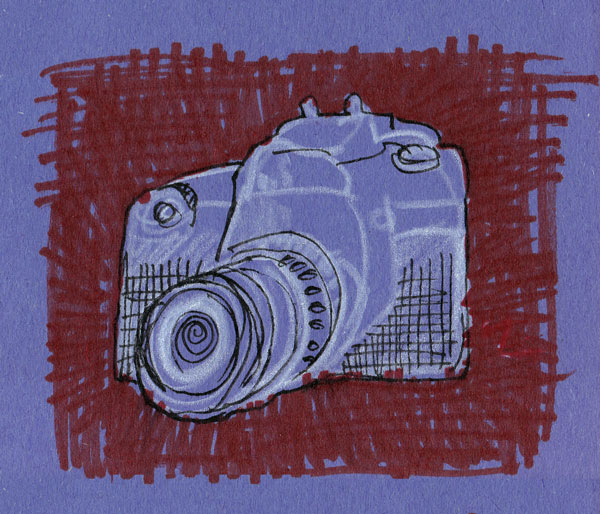
I’m kind of excited today because my new camera is supposed to be delivered tomorrow. It’s a pretty fancy one and acquiring it has entailed a long struggle with my internal demons. First of all, as one of my voice loudly declaims on a regular basis. I don’t really need a fancy camera. I have a smallish camera that I was very excited to get a couple of years ago and which takes perfectly good pictures.

But the real reason I’m getting this new supercamera is to make videos. And, yes, I have a couple of smallish video cameras that are perfectly capable of capturing a moving image and getting it onto YouTube, but I have a dream. The dream is of making videos about drawing, capturing what is beautiful in the world and how I and my friends get that beauty down on paper.  But I want to go way beyond the instructional films I’ve seen around, not just step-by-step, “this is how to paint a fruit bowl” sort of things but videos that are as beautiful as the process they record. After decades of making commercials for other people, I want to apply all of that experience to filming what I love really well. We’ll see how that turns out.

Anyway, so I have most of me convinced that this is a legitimate endeavor and use of my savings, but as I say it took a fair amount of self-doubt to get there. I don’t know about you, but when I find a new passion, I tend to spend a disproportionate amount of time researching what other people think and do with the same interest before I allow myself to make a commitment. And I can also do a lot of shopping for accessories and supplies and doodads before I actually get to work doing what I had originally set out to do.

I mean, it’s so much easier to shop for art supplies than to use them.
I think that’s why, when I first started drawing fifteen years or so ago, I imposed a lot of restrictions on myself, like only drawing with a Uniball in a not very fancy book. Then gradually, as a reward for my commitment, I let myself get a few grey brush markers, and then a few others, then some colored pens, then a better quality sketchbook and then a Rapidograph. That point took a couple of years to reach. I think if I had indulged my urge to shop any further I would have gotten into way more than I could handle. Instead of forcing myself to learn each medium well, I would have started to wrestle with complexities I didn’t understand and would have just gotten so bogged down and frustrated that I would have lost my will to go on.

Eventually, after allowing for gradual expansion and experimentation, I settled on the materials that work best for me and the way I choose to express myself right now. I know them well and know how they work, how they misbehave, were the pitfalls lie, how to make them sing fairly in tune.

Now, a new fancy camera with lots of knobs and buttons may prove frustrating or distracting. I can easily imagine that I could get sidetracked by the gizmo itself, spend lots of time reading its manual. working my way through all its menus, consulting with others, etc. But because I have  a goal in mind and am going to learn how to make the thing in my head rather than become a professional photographer who can handle any technical situation, I will be able to create something that will give me confirmation rather than frustration.

I think that’s so key in developing a new skill. Not endlessly playing scales or drawing perfect lines and circles, but getting right in there and expressing something that matters to you. That’s why illustrated journaling had kept my interest for so long, not because I am just studying drawing but because I am using drawing as a tool to learn about the world around me,  capturing the beauty of every day, discovering how I feel about the treasures that surround me.

So, hopefully, I will learn how to get this camera to make the images I see in my head, in a clearer deeper way than I ever have before. I will capture the emotions I feel in drawing, what makes the process beautiful and magical, will create scenes that will help inspire others too.

Failing that, well, I’ll hang onto the receipt.
Black and white

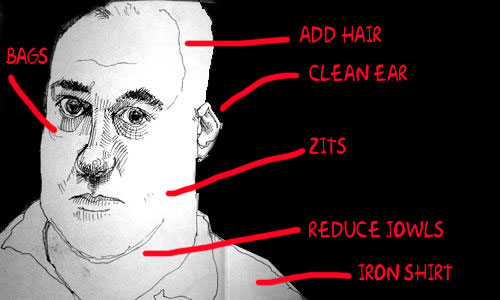
Some people don’t like reading white type on black so I have changed my theme. Please let me know what was wrong with this decision.

What do you think?


Let’s face it, one of the most important parts of making things lies beyond our ability to control — other people’s reactions to our work. Right?
“Hey, mom, look what I made.” That’s wonderful, let’s hang it on the fridge.”
Or “What is it now? Can’t you see I’m on the phone?”
It’s one of the most difficult parts of being a creative person. Not the fun, satisfying, unfurling of an idea, but the cold crickets that confront it or the “yes, but” of the professional critic or the form rejection letter or worse the anticipation of rejection that stops the egg from ever even popping into the nest.
We may not make it for others but a work is not fully realized until it bounces off another’s eyeballs, vibrates their eardrums or rearranges some of the cells deep within their corpus callosum.
And praise can be as insufficient as a shrug. We don’t just want a pat on the head; we want connection, reaction, insight, something that makes us see what we made in a newer light or on a deeper plain. Knowing we moved someone else, revealed truth to them, reminded them of something we didn’t even know corresponded, that makes us love our work all the more. Love it and wonder at it, at the fact that we were the conduit for it, that something passed through us and then passed through another heart. It dissolves the loneliness of existence.
Ideally, our art is the truest manifestation of our conclusions about the nature of things and when someone else sees it and validates it and shares it, the power of that truth is reflected back on itself like an endlessly repeating mirror.
That’s why rejection hurts, because, yes, we feel our efforts are wasted, and, yes, that we don’t matter and, yes, we didn’t make a ripple on the surface of the earth, all true. But mainly because we wonder whether the magic we found is really magic, whether the revelation we thought so profound was just a single serving glimmer of something too puny and insufficient to be shared, a whistle in the dark, not a full-blown hallelujah chorus with kindred spirits chiming in.
The true value of acknowledgment isn’t registered in the ego; it’s the opposite, a breaking down of the barriers between creator and audience so that we can unite in a shared appreciation of something that lends beauty and meaning to the grinding metronome of the day. We see a glimpse of the heavens together, a view that appeared to one of us first but is now a canopy over us all.
It’s even true of a joke, a shared laugh, the quick bark of recognition that our minds thought alike, we saw the other’s insight, and we were able to escape together from the smooth ivory prison of our skulls for a moment.
When I hear from people who like my work, or more importantly found something in my work that made their day a little brighter, I like my work more too. And when a reader has an insight or can tell me of a particular sentence that strummed their strings, I have insight into where to go next, into what matters in what I’ve done.
And conversely, of course, if my work pulls up lame and doesn’t find much of an audience, I wonder where I went wrong or why I thought something was worth my time but proved not to be worth anyone else’s.
So to all of you who have read my books or thought about my work and then have had something either nice or, even better, something honest to say about it, thanks very much and please know that it’s those sticks and carrots that are the kindling for works ahead.

Peanut. The Graphic Novel(ish)

Well, for those who have yet to consume Peanut the Paperback or Peanut the e-book, here’s a sample of Peanut the Graphic Novel. I hope you enjoy it but please be content with this helping. It’s all I could be bothered to do and no more will be forthcoming.

God, Graphic novels are an insane amount of work! But fun (ish).

(Click on each page to enlarge)

Prebreakfast rant

Go on, write  another blogpost about Peanut.

But I haven’t had my damned breakfast yet.

Just do it.

Oh, fine.

Well, much as I love to draw, I also love to write. So this book, Peanut, the first one I’ve published that’s all about the writing, is like my shy bookish child who generally doesn’t come out when company’s around but is rather in a corner, nose between the pages, building up a steamy head of potential and finally stepping into the limelight to get her due. Now, you might say, if she’s so great why is she appearing on Blurb rather than on the front table of your corner Barnes & Gobble? Is she somehow lesser? Does her picturelessness make her somehow less worthy of someone’s hard-earned pennies? Seriously, there are gazillions of paperbacks clawing at the  eyeballs of readers, jockeying to be read, and here you come with some sordid little manuscript and expect people to drop their kindles and snap it up? Be real, man, your illustrated books are being sold in Chinese bookstores, this is penny ante stuff. This little amusebouche isn’t gracing the front page of the Times Book Review. It’s not being chatted about on Morning Edition. Oprah hasn’t put her imprimatur on its cover.  You dont see Jonathan Franzen uploading his books to Blur, do you?

True, true and true. The fact is the publishing world has a mighty machine built over a couple of centuries for grinding out books and profits and making sure everyone everywhere gets to read the same stuff at the  same time. And the next fact is that self-publishing or ‘vanity publishing’ is a grimy little by-way a salon de refusés, full of conspiracy theorists and weekend poets that drizzles out awkwardly typeset drivel with badly designed cover art.

But here are some more relevant and freshly made facts. Thanks to the publishing colossus, it’s impossible for 99% of writers to survive as writers. Even really good ones end up spending most of their time teaching in creative writing departments of lesser-know midwestern colleges or cranking out reams of ad-copy or making half-caff lattes or flipping burgers or just giving up altogether. Now, no one owes writers a living as writers and the prevailing ethic in our society is that if you were any good you could make a living at your craft, but a glance at the Times Bestseller list shows that to do so you have to be James Patterson or Nora Roberts to make ends meet in the publishing world and that the majority of people who get to spend their-full time live making books are editors, publishers, printers, publicists, and agents — not writers.

Now, I love all of my editors and publishers and printers and such, but not so much that they deserve to get 92% of your money whenever you buy one of my books. I mean, I put up with it, but come on. 92%?

Writers have bitched about this inequity since Dickens’ day and finally we have an alternatives. In today’s Times, you can read about Susan Orleans venture into Amazon Singles where she gets 70 cents on every dollar. (She’s a big deal writer of course and is able to get a big article in a big paper to promote her little book so she’s hardly typical). E-books give writers a slightly larger bite of the pie. We get 25% royalties on all the books that publishers don’t need to print or  warehouse or ship or even lift a finger to reproduce.  But, as has happened in the music business, the real opportunity for writers is to short the chain that connects us to our readers. To make books available without all the middle men. That means readers get books faster (it can take over a year or more for a book to go from the author through the production machine and into your local bookstore) and cheaper (seriously, $30 for a new hardcover?) and more. More because when your favorite authors can focus on making books instead of burgers, you end up with more books you love.

It’s all up to authors to take more leaps into the new order of things and try their hand at self-promotion and self-production. And that is possible and fairly simple when you make a book that’s all text. Most of my books, illustrated, four-color, beautifully printed, are partnerships between me and a group of editors and designers who really add value and earn some (if not all) of their 92%. But when it comes to a straightforward book like Peanut, well, it’s not that hard to make it available to readers in an edition that is virtually the same as they’d find  in a  bookstore,

There are still a lot of things to be worked out. publishing on demand is still a fairly expensive model. And I have no idea if most of my readers have kindles  nooks and ipads and such. If they did it would be easier to make sand distribute electronic books that include color and even video demonstrations and commentary. That may be a few years away and frankly the publishing world doesn’t have that much incentive to make it happen. Instead, we, authors and readers can make that more common and available by supporting authors who show interest in inventing new ways of distribution.

I hope I haven’t created the impression that I am begging for your money here.

Believe me, I do fine toiling in the salt mines of advertising and will hopefully do so for some time.But it would be nice to think that an author who has a base of loyal readers might be able to connect with them directly and together they could provide an atmosphere in which writers could spend more time and effort making the books we all love.

I also realize that none of this is a particularly persuasive reason to buy and read Peanut in particular*. The fact that it’s self published on Blur (like many other books I probably wouldnt read), shouldnt make it a must buy. But if you like my writing, and the idea of the book, and have looked at a few pages in the free sample preview, then don’t let the fact that it is coming to you through this more untraditional venue hold you back from buying a copy.

You will be joining me at the barricades, striking another blow for creativity liberty, and breathing heavily down the hunched backs of the  capitalist running dogs. Vive la revolution!

Alright, now can we eat breakfast?

No, first, ask them nicely to buy a copy of  PEANUT here.

I think I’ll have marmite on toast….

—-

* Il’ll try to do a better job of selling you on  Peanut, in the days ahead.

Super cool and exciting: A new book! From me!

When Patti was pregnant, so was I. Pregnant with a book that turned our endless nine months+ into 250+ pages of memoir. I have been working on Peanut in various forms ever since, if you can believe it. It’s tried being a regular book, a graphic novel, and an online serial. And now, finally, here it is a readable form you can carry around with you and read until your are fully entertained and edified.

Back then, I was terribly interested in the experience of becoming a father and I just couldn’t find much that was practical that had been written about it. After the book was written, I came to realize that it was tricky to fill this void in the bookstore in the standard way. Because books need to be shelved in particular sections at your local Barnes & Noble or even on Amazon, no one knew quite where to put my book. It was sort of  a memoir (back in the days before memoirs were routinely bestsellers) but more specific. And it wasn’t really appropriate for the pregnancy section because it was about a man’s experience. Anyway, it got kicked around by a bunch of publishers and finally got punted into the weeds.

I always felt that was  a shame as I really liked it; I think it’s by far the funniest book I’ve written and re-reading it as I have been recently, it cracked me up over and again. I think it’s also very insightful, about what it means to be  a parent and yet remain the child of one’s parents and grandparents.

It’s also a shame because it helps to explain an awful lot about me, about the family forces that shape my view of the world and the uniques experience I had as a kid. Slowly but surely, the most important events in my life, good and bad, are becoming books — Everyday Matters; my new book on Patti’s death; and this, the prequel, Peanut.

Anyway, I have had it with trying to flog the book in the traditional way. But I really do want people to read it. So I have decided to have a number of copies printed up to see if you, the people who have supported my work for years, might be interested in reading it and maybe helping me birth it in some form. It’s a little paperback, decent quality with one of my paintings on the cover. It doesn’t contain any drawings or even the word ‘drawing’ but if you like the way I write and share my perspective on the world, you might find it entertaining. And if you’ve ever been a parent or a child, I think it’ll be right up your alley.

The book is available now —and you might want to act now. This may sound like a hucksterish pitch (though it’s 100% true, I swear) but the printer just told me they will be raising the price by a dollar in the next 48 hours. I think the book is worth that additional dollar but, if that gives you pause, please order it today or tomorrow (May 18th). Or wait till the weekend and spring for the extra buck. Your call. Or, better yet, get in under the deadline and order yourself a dozen or so copies and sell them to the neighbors for an additional 50 cents and pocket the difference. I won’t tell.

Order PEANUT here

If you get it, let me know what you think. And how you think we can collectively make it into a bestseller that will transform parenting as we know it. I welcome your collaboration and critique.

Thanks to everyone who supports my book and has ordered the book so far. If this experiment is successful, I will publish more books in this sort of immediate, hand made way in the future. 

Misty watercolored memories

It’s exciting getting to work on a new book. The excitement kicks off with the first advance check, now nestled in my bank — but that’s short-lived. The real fun is figuring out all of the bits and pieces and how they fit together. I don’t have a huge amount of time to work on this book but enough so that I can go back and rewrite and redraw things until I really like them.

When my editor read my blogpost announcing my deal with Chronicle, she wrote to me to remind me that the book is not in fact scheduled for next year but the middle of 2013. Yipes. I promised I could get things done faster if she could compress the schedule on her end and we managed to swap things around so now the book will come out six months earlier in the Fall/Winter 2012. I have until October 1 to get the first draft in which should be plenty of time (famous last words).

Much of this book is drawn from the illustrated journals I’ve kept over the past 13 months but they’re all being reworked and augmented. My journal captures the here and now so vividly but a book needs to have a more lofty perspective too, a way of winding everything together into a narrative. While the book has a clear beginning, the end is fuzzier and so I have decided to bring the story to an end after a full year, the official mourning period. Mourning, of course, takes a lot longer than a year — it seems to be  a lifelong process — but the book has to stop somewhere.

Beyond my illustrated journals, I have been writing a lot, little paragraphs, captured thoughts, revelations, and I am blending them into the pages I have already drawn and painted. That means a fair amount of editing but it’s all being created with snapshots of my moods taken as they appear.

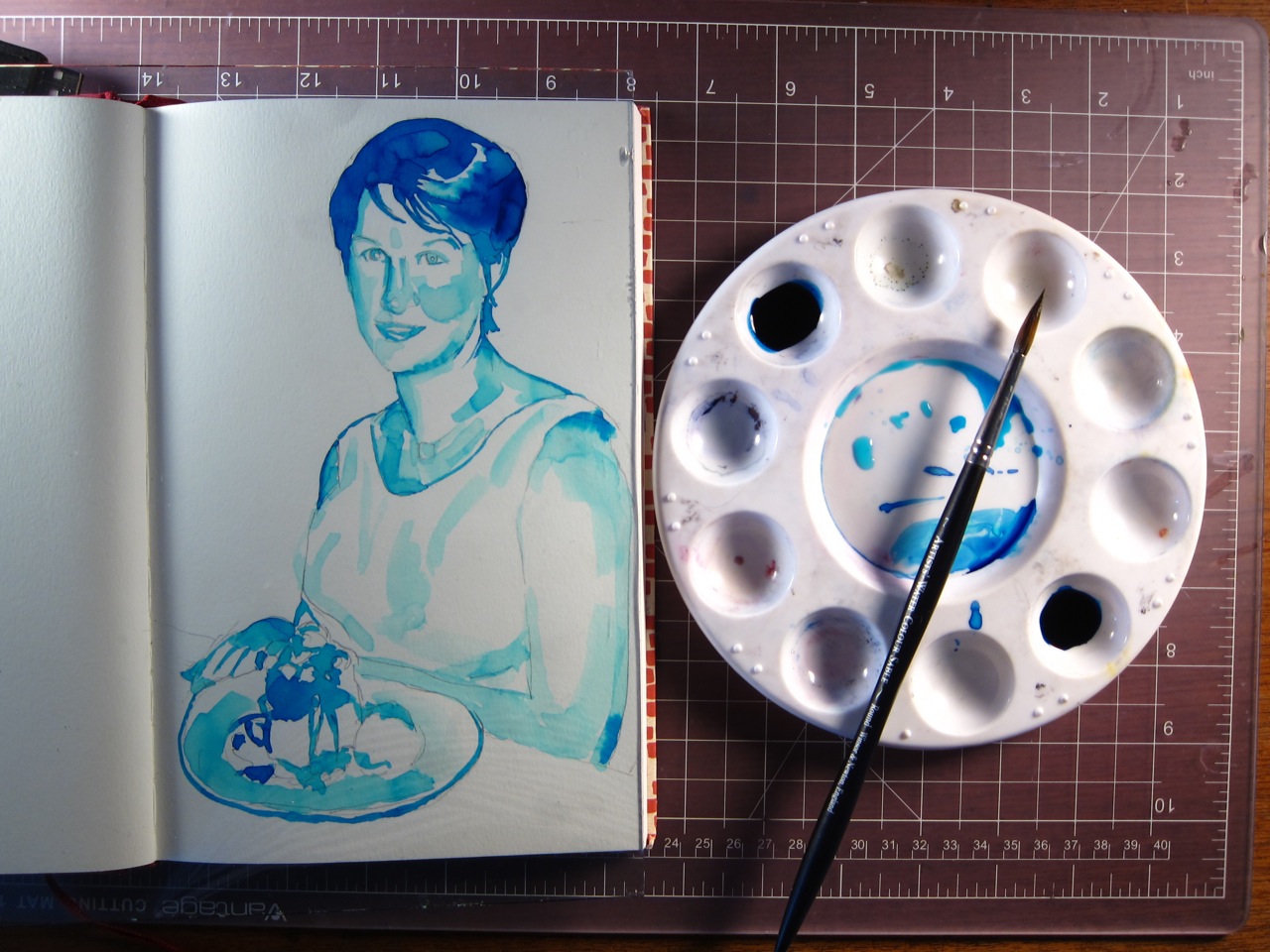
The book will open with a section focussed on Patti’s life, trying to bring her to life on the page, to tell her story before I start to hog the stage. That section of the book is going to be done in a new way, quite different from my usual style, drawings done entirely with a brush and watercolors. There’s no ink, no solid lines. And I am working from photographs, as they are all I have of her now.

I worked with this palette of eight different shades of Dr.Ph Martin watercolors. I keep them in a dark bag because they just can’t stand the sunlight. They work fine in books that remain closed most of the time.

First I drew a light contour drawing in pencil, so I would have a vague sense of where I am going.

Then I used a couple of shades of blue to do an underpainting, getting a sense of the tones. Often, this is my favorite part of a painting and I wished I’d just left it monochromatic.

I next added two dark shades of brown to build up contrast.

Next I added warm tones and started to work on the skin.

Now I added more reds and yellows.

And here’s where I left off today, with a little bit of writing in the corner. Chances are I’ll tackle this picture again after it’s been lying around for a few days.There’s still something sort of frozen and taxidermic about this, one of the reasons I ‘m not wild about working from photos, particularly contrasty ones taken with a  flash. Hopefully it will also improve once I;ve written all around it. Look for it (or some descendant) in my next book.


The year of magical drawing

I’ve kept an illustrated journal, fairly consistently, for the last dozen years or more. There have been times I got too involved with office work or other distractions and my entries grew more intermittent, but I’ve always come back to a pen and a book to get perspective on my life. When I published Everyday Matters and the books that followed, I made a decision to share this ongoing record of the  events of my life with people who I don’t know personally. It was never a particularly hard choice to make because I think that an essential part of art making is a desire to share one’s view of the world with others. It’s not just creation, it’s communication.

I also discovered that the actual details of my private life that I put on display were less important than the fact that I was recording my life in the way that I was. People were far more interested in this practice as an idea that they too could embrace and adopt themselves than in the revelations of the contents of my medicine cabinet or the places I walk my dogs.

The dialogue that I established between the people who viewed and commented on my work in my books and on the web, also helped to sustain my interest — like a vast, relatively quiet audience insisting that I keep up the habit. When I first began drawing in my solitary book, it was something that only I knew and cared about. All these years later, there are so many people doing the same sort of thing and sharing it with me and others, and the act of keeping an illustrated journal has become  far richer and more satisfying all around.

I went back to keeping a  journal soon after Patti was killed. In fact, I did it with a new sense of purpose because my life needed perspective and clarity more than ever. I discovered a whole new style of journaling too, far more colorful and intense than before, an approach that matched my whole take on life after facing this turn of events. My life has become quite different and so have my journals.

I also continued to share what I was doing, right here on this blog. But after a while, the well-meaning, compassionate outpouring of my readers started to weigh on me. I felt like I was making myself carry out this process in the most public way, adding all sorts of additional pressures that I  couldn’t handle at the time. But I felt I needed to carry on because there were so many people who seemed to care about us and what we were going through, who wanted to know how we were doing, and I didn’t feel I could just vanish and withdraw. But people close to me said, “All that matters right now is taking care of yourself and Jack. Take time to focus on what matters most and everything else can wait.”

So eventually, I started to fade away, blogging less and less and then not at all.

But I kept on drawing and confiding in my books, continuing to feel that what I have been going through is something I ought to capture and (eventually) examine. And I knew, from some of the most heart-wrenching emails and comments I got, that there were people out there who were going through similar trauma and transition and that eventually I might want to share what I was experiencing with them and others.

At times, I’ve felt like it might be possible to  tie this whole experience into a neat package, something with a beginning, middle and end. A story with a moral, a bunch of quippy epigrams that would pass on my lessons earned. It’s turned out to be a lot messier, as life is prone to be.

When the anniversary of Patti’s death came and went, a date I had been long anticipating as the official end of my mourning period, at first it seemed like nothing much had changed. I still felt alternately good, bad, shitty, and fine. There was no massive parting of the clouds or turning of a giant page. I was still alive, Patti was still dead. I hadn’t forgotten much; in fact, I think I now remember more about our lives than I had before. Life goes on but in lots of ways I guess I am pretty different.

As Jack and I began our second lap of the calendar, I felt a shift. We were no longer going through the first day of Spring without Patti, the first birthdays, the first Christmas. Instead, we had were firming up our own era, more clearly defining the way we live as two independent people without a wife and a mom. Sadness is no longer overwhelming and debilitating, it’s just a feeling that ‘s there, that can be summoned up and hugged or put back on the shelf for another time.

Now, when I think about Patti, I am rarely sad. And I do think about her, several times every single day. But lots of the  guilt and fear and darkness and panic that accompanied those thoughts are rarely present. Instead, I feel like she’s just by my side, accompanying me through a new set of doors, advising, encouraging, being my friend and my love.

So maybe that’s closure. I don’t really know the meaning of the word and I don’t feel like anything is closed. It’s more that I am mounting a staircase out of the darkness, seeing more and more around me, but my eyes are still sufficiently accommodated to the darkness I’ve passed through to be able to look back without fear and see what was what.

… Actually, I started writing this to tell you some news.

Those pages I’ve been filling (and a bunch more that I am making that will lend some introduction and perspective to my journal) are going to be made into a new book. It’s going to be published by a wonderful publisher in San Francisco, Chronicle Books, and they will be bringing it out sometime next year. Fortunately, I have a while to work on it and to figure out how to turn this experience into something coherent and good enough to be a tribute to Patti and her life.

A rather unpleasant book editor in New York told someone I know, “I can understand why he feels the need to write such a book but I can’t see why anyone would want to read it.” She may well turn out to be right.

But right now, I’m focussing more on how to do it well and make it true. If it turns out to be of no real use to anyone but me, I can live with that. I may regret sharing the pain and discovery of this last year with more strangers but I doubt it. I have been lucky enough to have so much encouragement in the work I have done over the years and I like to think it has been helpful to share my perspective with others.

I know it has been helpful to me.

Paradise Lost

Last Thursday, I got fed up and lost.
Jack and I started taking a class together at a prestigious art-class-taking-place and despite an initial enthusiasm for the undertaking, several things happened during the second class that reminded of all of the reasons I hate taking art classes and have since I was ten. As we walked out, an hour before the class ended, I said to Jack, “look, the three things I think you should get in art school are a) inspiration, ideas, and infectious passion from your fellow students, b) a teacher who gives you useful and specific direction and c) facilities that you could not duplicate at home. Tonight, we got none of the three.” I wished I’d spent the evening at home drawing in my journal instead.

What I didn’t go into with him was the sense of being lost that started to well up inside me. I suddenly realized that my general enthusiasm for art school — a Nirvana filled with printing presses and – studios and challenging assignments and benevolent mentors — might just turn out to be an expensive illusion that will fritter away the best years of my boy’s life.

What if he finds himself surrounded with nihilistic slackers and trust fund babies with no talent and loads of cynicism being carelessly fed pompous claptrap by failed conceptual bores with tenure and resentment for anyone with a naive enthusiasm for creativity in a shopworn environment filled with squeezed out tubes of drying oil paint and broken easels? Instead of bringing home arm loads of brilliant lithographs and watercolors and bronzes, Jack will slouch into our apartment with tattoos, pendulous pierced ear lobes, a ton of attitude and excuses, and a generally wasted education that produced little but a gaping divot in my bank account.
Hearing our fellow students provide lengthy and incomprehensible explanations of their poorly constructed constructions and randomly daubed canvases, explanations that were crude shadows of the sort of pompous nonsense that cultural critics have mocked since the Salon de Refuse, I was brought up short, thinking, “Shit, I’ve got to make sure he gets into a decent liberal arts college so at least he’ll have a chance to go to law school.”

Anyhow, a weekend of calmer reflection and a 6 a.m. train ride to Providence, Rhode Island calmed me down. Jack and I spent a glorious spring day touring RISD, and my fears receded. The school was filed with amazing painting studios, enormous print shops and woodshops, darkrooms and kilns and endless hallways filled with beautiful art. The students all seemed serious and passionate and ran around carrying canvases and arm loads of wood. The library was humming with studying brains. The students seemed like professionals in the making and I only saw one girl with blue hair.

I don’t know if Jack will end up going to RISD or Cooper Union or MIT or Harvard Law. But I sense in him the same sort of enthusiasm for art that I had, abandoned, and then regained. An enthusiasm that I didn’t get in school, but in spite of it. Jack has been long-marinated in art and I think he’ll always have creative juice in his marrow. Whatever he does with his education and his life, I know it will be interesting and worthwhile.

Today we are on our way to visit MICA, another creative hotspot. On Monday we’ll check out Bard for a different perspective.
My faith in higher education is stored but I still don’t know if I’ll be going to next Thursday night’s class.

Flotsam and jetsam

It began when I pulled my sweaters out from storage and saw how much of Patti’s wardrobe was in there too. After eight months, I need to finally confront the chore I have been dreading — sifting through her stuff, giving it to friends, the Salvation Army, the recycler, and archiving the rest.   It’s not just sweaters and dresses and jewelery. It’s all the stuff she left behind — wallets, curlers, thigh-highs, pills, and lots and lots of paper.

I started going through the repositories that lurk in every corner. It’s a mammoth task because as I open every drawer and file cabinet, I find boxes, bags, envelopes, and loose piles of the detritus of life. Patti tried to organize a lot of these things but there’s so much still left. I find my willingness to edit quite viciously is much stronger than hers ever was. I’ll open a beautiful archival quality box and inside there are a few yellowing 10-year-old newspaper clippings describing an island she once thought might be a nice place for us to go on vacation. I find old receipts and pieces of mail, bank statements, recipes, printed emails, pages ripped from old mail order catalogs. All these things had some significance to her and she held onto them for years. They seem like trash to me.

But I hesitate.

Instead of throwing them in the garbage or transferring them to yet another file folder I have to parse them. Why did she want to keep this? What was the value to her? Is there something about her I can learn from them? What memories do they dredge up? So I separate the papers into categories of my own: receipts from gifts we gave each other; Jack’s school papers, stories and essays from third grade; notebooks filled with records of wheelchair repairs, insurance letters, hospital bills; letters I wrote to her from business trips; notes she left by my bedside or stuck into my suitcase; Frank’s vet bills from a decade ago; cards from friends; holiday letters and photographs; a folder full of songs that Patti was learning by heart so she could perform them at the library where she read  to children every Wednesday afternoon. And diaries, filled with Patti’s state of mind — getting mad at herself for the things that she hadn’t done, or reveling in the dreams she had, or how much she loved me, or how lucky she was.

I didn’t allow myself to feel much as I went through these stacks of papers, but just kept my head down and beavered through, sifting wheat from chaff, obsessed with getting through it.  But now on Sunday morning as I sit in bed alone and think about it, I can’t keep tears from  rolling down my face.

All of these documents were the building blocks of the life we had together. And now I have to arrange them into a monument to what we had together. As the pieces separate into  categories, they tell stories, stories that I want to keep for myself and for Jack. And for Patti, because I want so very much for her life to matter. Her last fifteen years were so much harder than they should have been, full of challenges and indignities and pain, difficulties that a sweet and kind and generous person should not have had to endure.

Now that the last chapter has been written and the book of her life is closed, some meaning has to come out of it all. I look for it in these piles of papers.Patti doesn’t have a headstone or a crypt, just a cookie jar filled with her ashes. I guess that by shaping these piles of paper into something understandable, I’ll be freezing the memories while they are still fresh. The river of time keeps flowing past and out to sea, carrying all of life with it. Sometimes we cannot see what is passing until it lies at some distance, but the current is strong and moments vanish around the bend, never to be recalled.