Thinking outside the books.

gallery garage

A canary sits in its cage, gazing through the bars. Year after year, it watches the world beyond and dreams. One morning, it notices that the cage door is open. The canary catches its breath and waits to see when it will close.

Eventually, the canary hops onto the edge of the door and pops out of its cage. It flies around the room, sits on the back of the couch, perches on the bookshelf. An hour later, it returns to the cage and goes back to gazing through the bars, dreaming. The door is still open. So is the window beyond.

Freedom is not easy. Security, comfort and familiarity are.

……..

Many birthdays ago, long before I had the habit of drawing, my mother and my sister chipped in and rent me a studio for a month. It was the most terrifying gift I had ever received. I went down to Desbrosses Street in Tribeca, and walked into the studio. “Mine, all mine,” I muttered under my breath. The room was about fifteen feet square and empty. I took out a pad and a piece of charcoal and wrote about how I felt having studio all of my own. I filled several pages with writing in charcoal, taped them to the wall, and left.

I came back a week later and made a small collage from cut-up pieces of magazine. I taped that to the wall and left. A week after that, I drew colored lines on the collages with a highlighter marker. The final week in the studio, I brought in a photo of my grandfather and a large canvas. I painted a very bad copy of the portrait onto the canvas. At the end of the day, I left the canvas, the collage, and the charcoal writing on the studio, locked the door, and never went back.

……..

When I arrived in Los Angeles, I had planned to work in the second bedroom of our house, to sit at a small desk in the corner and write my new book. Then I saw our two-car garage, 300 or so feet of emptiness. Like the garage, I stood with my mouth wide open. I spent the first week, filling it with tables and shelves and cubbyholes.  I spent the second week sitting at my desk, writing my new book and rearranging bottles of ink. Occasionally I would draw in my journal, using a fountain pen and a white pencil.

I spent the third week thinking. I realized had managed to reproduce my office in New York. I had a lamp, a rug, a laptop, a phone, a box of thumbtacks. I ate lunch at my desk and surfed the web. I was even filling my calendar with a record of my daily doings in case I had to fill in timesheets at the end of the month. All that was missing was a couple of account executives and a client.

So I went to the art supply store and bought whatever I wanted (if you remember my old essay, “Art Supply Porn“, you’ll know my fantasies are legion). At first, however, that just amounted to a few tiny palettes for gouache and a bottle of ink. Oh, and a block of 14 x 17” mixed media paper.

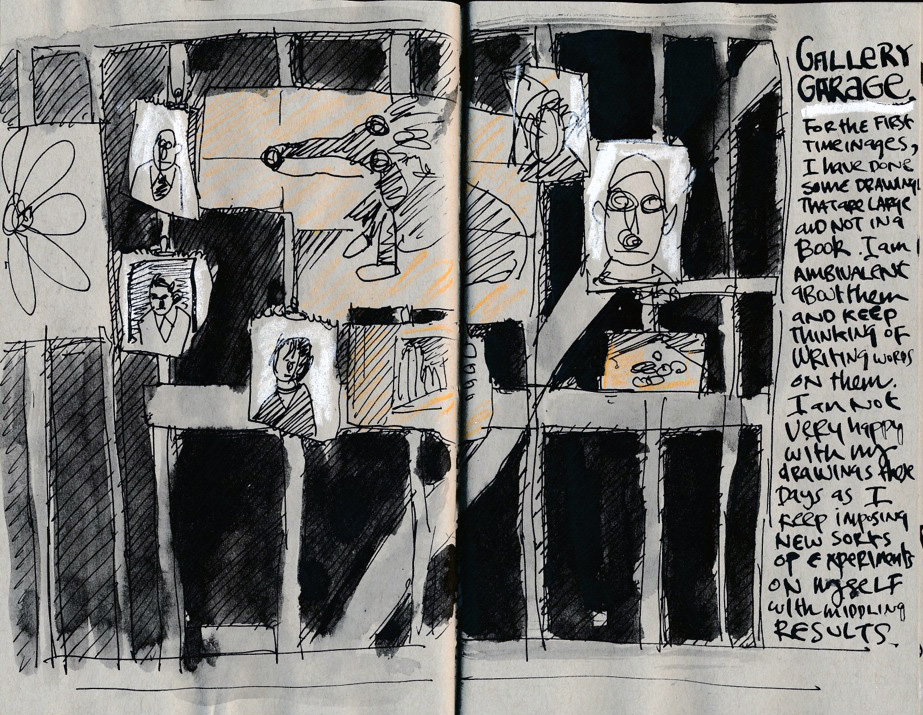
Back in my empty garage, I opened the block and did a tentative self-portrait in ink. This simple act I was breaking one of my cardinal agreements with myself. I was making drawing, with no writing , that was not in a book. No wonder the self-portrait looked like I had just eaten something bad. Then I did a gouache painting on the block and pinned it up next to the self-portrait. Then in a fit of pique, I got a house paint brush, dipped it in inks and drew a huge painting of Tim on the back of an empty Ikea box.

I felt slightly winded and rather nauseated. I took out my journal and told it what I had done, revealing my betrayal and the dim feelings I had about it.

The next day, I bought a 64-box of Crayolas and some tempera and did a wax resist portrait. Then I did some more gouache paintings, then a painting of the back of the house in poster paints on cardboard. Soon the garage wall was full.

michael-ave-hi-resAThe following week, I sat on the corner of my street holding the fattest Sharpie I could find. On a big sheet of cardboard, I drew the house across the intersection. When I had filled the whole board, I went back to the garage and got another piece of cardboard and continued the drawing, a big, grubby, dog-eared diptych.

michael-ave-hi-resBThe next day, I continued the drawing, working my way down the street. When I was done, it was eleven and a half feet wide. Then I added gouache, creating a cheerful portrait of another glorious day in my new neighborhood. Just as my hero David Hockney was transformed by the California sunshine, I felt a call to use candy colors and bold lines and to work as big as all outdoors.

michael-ave-hi-res
Click to see it bigger.

Now I am working on a drawing that is as big as my garage wall, fourteen feet in all, a broad panorama of all the crazy houses arrayed along the Venice canal. I even added a gondolier.

My sketchbook now looks a bit small and grey but, despite my sudden expansiveness, I love it still.

If you are getting little set in your ways, check out the door of your cage. The world is wide and a little terrifying, but it’s wonderful out here.  You don’t need to chuck your job, your home and all the rest, but try flying around the living room a bit and enjoy the view. There may be a cat out there, but if you fly high and far, you’ll be safer than you are trapped in a cage with an open door.
The sour life.

Lemons

“Why don’t you go on west to California? There’s work there, and it never gets cold. Why, you can reach out anywhere and pick an orange. Why there’s always some kind of crop to work in. Why don’t you go there?”   —Johnny Steinbeck, Grapes o’ Wrath.

It’s a schlep, people.

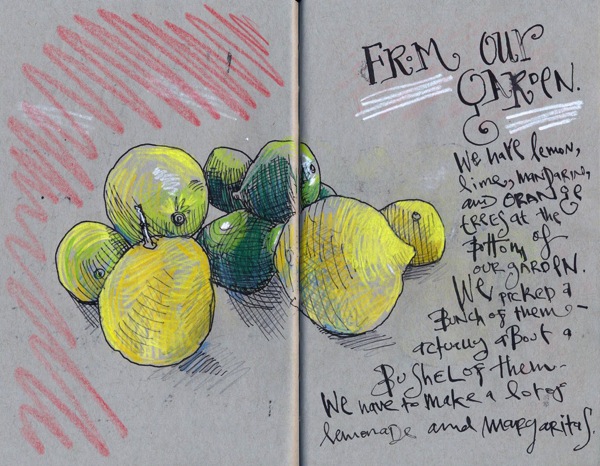
I have to get out of my lawn chair, walk all the way to the back of the yard, pick a half dozen lemons and limes from our dwarf trees, then walk all the way back to the kitchen, plug in the squeezer, slice and squeeze till my glass is half full, add soda water, and stagger back to my lawn chair.

I’m exhausted. Yet refreshed.

The art of living.


Life is not an oil painting, sealed behind varnish and clamped in a golden frame, hanging in a white walled gallery in Chelsea, waiting to be bought by a hedge fund manager’s third wife.
Life is not an edition of etchings, a long series of identical impressions.
Life is not a mural, intended as a public display or the backdrop to an expensively furnished room. Life is not wallpaper.
Life is not a bronze sculpture, cold, monumental, an abstracted, idealized image of a hero long forgotten.

Life is a shelf.
A long shelf partly filled with journals. Some of the journals are hand-made, some store-bought, some in ornate covers, some stained and dog-eared.
Some of the journals are completely filled, others are abandoned half-way, maybe to be taken up at a later date. Some of the books are filled with paper that felt just right under your pen, smooth and creamy, bold and bright. Others were experiments that failed or overreaches, made of materials you weren’t ready to master quite yet.
Sections of the shelf may be filled with identical volumes, a type of book that you found comfortable at the time and stuck with it, disinterested in experimentation and change so you kept filling one after another. On the shelf, they may look the same, identical spines all in a row like a suburban cul-de-sac. But inside, each page is different, drawn by the same hand and pen, yet recording unique observations, days that fill up identically-sized boxes on the calendar but were all filled with different challenges, discoveries, lessons and dreams.
Each page of each journal is always different. Some are perfectly drawn and brilliantly written, insightful and illuminating. Others are a failure, with poor perspective and distracted lines. Some of the pages are dappled with raindrops or a splash of champagne, others are drawn in haste, still others crosshatched with great intensity and care. Some contain shopping lists, phone numbers of new friends, boarding passes to far-away places. Some are bright and colorful, witty and bold. Others are intimate and personal, never to be shared. Some pages describe loss and death, others a drawing of a gift you took to a baby shower.
None of these pages is an end in itself. No matter how good it seems at the time, eventually, you turn each one over. Even the ones at the end of a volume are merely leading to the first fresh page of the next. You fill the page, maybe you like what you drew or maybe it was a disappointment, but there’s always another to follow and another beyond that.
You try your best with each blank page, try to make something fresh and beautiful. Some of the time you feel excited and proud of what you’ve made, at other times you are disappointed and desperate. Often, a page you thought was just a turd looks a whole lot better when you come back to it years later. The drawing you thought was clumsy and flawed reveals some new insight and truth about who you were at the moment, fresh energy, naiveté, hope, darkness before the dawn. Each drawing, whether you know it at the time or not, contains truth. You just have to trust it and keep on drawing and writing and living your life.
Life is a process, and every one has the same end result: that last volume, partly-filled, cut off when we thought there was still art left to make. No need to rush to get there. Make the most of the page that lies open before you today.

Nectar.

morning

I learned to watch birds on New Year’s Day, 2012. Jenny and I went to the annual Bird Count in Central Park, a frigid but sunny morning outing, on which we counted a goodly number of feathered friends, including two different types of woodpeckers. Woodpeckers? Yup, New York has a bunch of kinds.

Then, last spring we went to a ranch in Patagonia, AZ and saw some amazing critters, including my very first hummingbirds. I love these birds. They come in so many varieties and they do everything the cartoons say the do. They dart and hover, their wings blurring a zillion miles an hour, and they sip nectar.

Which is where I come in.

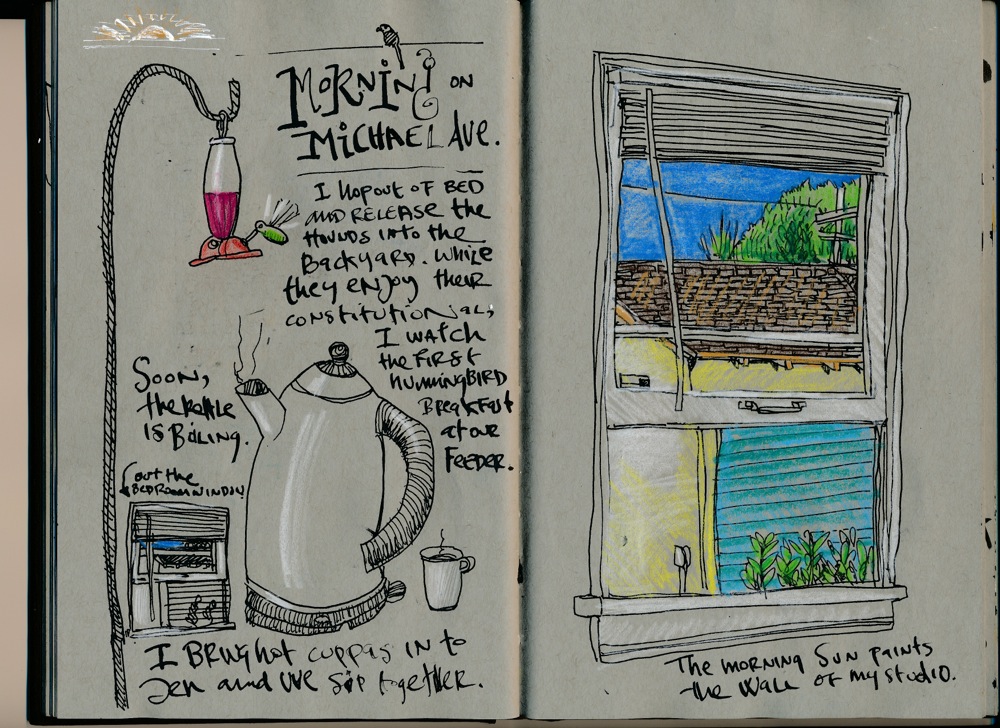
As soon as I heard that there was even the slightest possibility of hummingbirds in LA, I headed to Home Depot where they had a whole wall of attractive feeders shaped like giant flowers and such. I bought some bird Kool-Aid and a huge black iron shepherd’s crook to hang the feeder from. Then I raced home, mixed up the nectar, plunged the crook into the flower bed beneath our kitchen window and hung the feeder.

And waited.

Several days later, Jenny and I were having our tea in our lawn chairs and I complained that a) I had no idea how I was supposed to let the local hummingbirds know I had set up this lovely feeder and b) it seems the lovely feeder was leaking as the level of Kool-Aid seemed to be dropping a little bit each day.

As I was griping, Jenny tapped me on the knee and pointed.  A bright green hummingbird,  like something out of a sci-fi film, was hovering by the feeder. It gingerly approached, and slid its needle beak into one of the white plastic flowers that circle the rim. I watched in mute wonder. Then as quickly and quietly as he’d come, the hummingbird darted away and soared over our roof.

“Tell all your friends,” I shouted as he disappeared down the street.

It seems he did.  I have now seen a half-dozen different colors of hummingbirds. I’ve seen them sitting on or phone wires. I’ve even seen two of them fighting, clashing in the air with fluttering wings and puffed chests, then chirping and squawking till one was driven off and the other settled at the feeder. Fighting hummingbirds! Like tiny iridescent battle helicopters over a Taliban outpost!

Clockwork Orange. And Blue. And some Green.

ImageMy neighborhood is cute. Little one-family houses with little yards all arrayed neatly along the six or so blocks of our “avenue”. My neighbors are friendly without being too. They’re definitely not New Yorkers but they don’t try to hug me either.
One evening, I tethered the hounds to the porch railing, strapped on my iPod, cracked open my colored pencil pouch, and started to draw the house across the street. Because, as George Mallory said of Everest, it was there.
As I say in the journal caption, I was listening to a dreadful story on a terrific podcast (RadioLab, actually, not TAL), and one part of my brain was listening intently to this story of a guy who corresponded with the man who raped and killed his daughter, while the other part drew every brick on my neighbor’s facade.
Now, do you remember the “Ludovico technique” in A Clockwork Orange where Alex is fed a drug that will make him nauseated by violence, strapped down and forced to watch a sadistic movie which is scored with something by Beethoven? Forever after, his beloved Ludwig Van makes him panicky and sick.

I guess my drawing/listening experience had a somewhat similar effect on me. My brain and all my senses were so wide open, so receptive, hungrily drinking in the details of my neighbor’s home while fixedly listening to this awful story. My eyes signals and ear signals somehow came together to create an utterly false experience, so now every time I walk out my front door, I feel a terrible pity for my neighbor and the ordeal he went through. Which he didn’t. Except in my journal.

They really should put a warning on this sort of story — “Listening to this broadcast while operating colored pencils and a fountain pen may cause a lingering sense of tragic empathy and melancholia.”

I’ve met the neighbor, by the way. Nice, cheerful guy and I don’t think he even has a daughter. At least not one that seems to be alive………..

Trucker.

Image

Last weekend, I bought a truck.  Actually, I didn’t technically buy it — Jenny charged it on her Platinum American Express Card.  So, the initial surge of testosterone that came from being able to say, “I just bought a truck” was thwarted by thefact that American Express called my girlfriend back to verify her identity faster than it called me back so the charge went through on her card instead of mine and my big-man-moment shriveled into a mumbled ‘uh, thanks’.

This is the fourth (or fifth) vehicle I have ever owned.

The first was a 1965 Ford Fairlane that I bought in Jersey City for $600 when I was 26. I bought it before I had actually had a driver’s license so it sat by the curb outside my house for a month before I could manage to pass the test. It was bronze-colored and had just 30, 000 miles on the odometer. In the six months that I owned it, I added another 500 miles to that total, most of it to neighborhood car washes. I loved the car but could never really manage its “three on the tree” transmission. When I moved back to Manhattan that fall, I gave it to my roommate, SImon,  who promptly totaled it in a supermarket parking lot.

The next car I owned was ten years later, a 1962 Mercury Monterey — two-tone (teal and white), 18 feet long, and, again, had only 30, 000 miles on it.  I was too anxious to drive it out of Manhattan and too impatient to drive it in the city so every other weekend my wife and I drove it up the Henry Hudson Drive for an hour, listening to WOR-AM, and then I would wax it curbside. Four months later, I sold it back to Augie, the man I’d bought from. I lost $500 in the deal.

The third car, I won’t tell you much about. Let’s just say I was a new father and the Volvo salesman was very persuasive.

Three years ago, I bought a tiny Honda motorcycle from a man in the street. He was an artist and needed the cash to replace his dentures. I drove it to my office once. On 10th Ave and 25th Street, I stopped at a light between two enormous 18-wheelers who slowly came together like the walls in the Death Star’s trash compactor. A voice in my head said, “Well, at least now you how you’ll die.” That afternoon, I found the toothless artist and sold his bike back to him. I lost $250 in that deal.

When I was nine, my grandfather’s chauffeur drove me through the streets of Lahore to school every morning. After a year of this routine, my grandfather, worried about my sense of direction, told me that the next day I was to direct the driver myself how to get to school.Two hours later, we were stopped by the guards at the Indian border. We were ninety-six miles from home.

When we got to LA three weeks ago, Jenny rented an enormous SUV. I think it was a Ford Brobdingnagian. I drove it, white-knuckled, to IKEA three times and then begged her to exchange it for an actual car. We got a regular-sized Nissan Something that smelled of stale smoke. Last Thursday, I went to visit my old friend Tommy McG in Venice. I parked the Nissan outside his house and then we walked down to the beach and had a drink on the rooftop of a hotel.  A couple of hours later, we walked me back to my car. “Huh,” he said, “it sounds like your engine is running.” I shrugged, and got into the shuddering car. At least there was still gas in the tank and I had remembered to lock the doors.

(Lest all of these facts give you pause, you should know that I have been using New York CIty subway trains and taxis, without incident, since 1973).

Okay, so I now own a truck. It’s very basic. It’s also in decent shape considering it’s twelve years old and other people have already driven it 150,000 miles. In LA, when you drive this sport of vehicle, people assume you are  a gardener. I have no problem with that.

Why a pickup truck? Well, so I can transport all sorts of things, yet to be determined. It’s the kind of thing people do out here, moving big things from one place to another. There’s huge amounts of room, huge stores, huge roads. So you just need to be ready to haul something huge at a moment’s notice.

Another really cool feature is I can carry a folding chair and table in the bed of the truck. Then I can drive anywhere, unfold, and have an amazing drawing platform.

And finally, I can now wear a cap. And maybe grow a fu-manchu. And toughen up a bit, yo.

Image

Black and white habits — they’re not just for nuns.

In my thirties, I became a mad iron-pumper.

I repaired to the gym every single day at 7 a.m., rain or shine, Sunday to Sunday, and after a year, I became a muscular beast. I didn’t have a trainer, I didn’t take steroids or HGH, I didn’t wear a little posing pouch or wax my chest. Key to my success was my ironclad will, my insistence on never, ever missing a day, or being even five minutes late to the gym. I utterly refused to give myself an excuse to break routine. I was a brutal and inflexible taskmaster. And, like it or not, it worked.

My sister, impressed by my progress, joined me at the gym. She would be there every morning at 7 too, ready to get to work. Then, one rainy February morning, she called me and said, “it’s a lousy day, let’s skip it for once.” I did, and the next day, came up with another excuse not to go.  The habit was broken and I never went to the gym again.

Soon, I was back to being a 190 lb. weakling.

Obviously, I can have a tendency to black and whiteness (not just in my journals), but, as I grow older,  I am working to be more nuanced in my decisions and commitments. I have joined a gym again and I am resolved to be less crazy this time, trying to stay committed without needing to be committed. I have a trainer who I see a couple of times a week and then I try to go most days and work out on my own. At first, pushing myself was hard, and I felt nauseated and weak. But one day, my body seemed to remember our bygone 7 a.m. routine and perked up. I felt the old surge of adrenaline through my muscles and it went from being a chore to being fun again. Now I look forward to exercise. However, I’m not a slave driver anymore and if I skip a day here and there, I don’t let it break my commitment to myself and my health. I just go the following day instead and keep going.

Journaling is another one of my healthy habits. At times over the years, I have insisted on a strict regime, like a drawing every morning before breakfast, or filling a whole book in a month or on a week’s vacation. Pushing myself to draw whether I want to or not eventually makes me want to. It also means I make a lot of lackluster pages on the way to falling back in love with my book and my pen.  There have been times when, overtaken by the stress of work and other commitments,  I have fallen completely out of the practice and eventually forgotten how much fun drawing can be, and how important it in helping me stay relatively sane.

But I can recommit.  (Like the old joke says, “It’s easy to quit smoking — I’ve done it a hundred times”). Still, I don’t have a drawing trainer and there are no steroids I can take to make me get instant results. Drawing just takes practice and patience and commitment and the more I do, the better I get, and the more I want to draw. Drawing depends on muscles too and if I don’t use them they atrophy quickly.  WIthin a couple of weeks of breaking my habit, my ability to draw well suffers enormously. Fortunately, picking up the pen brings those muscles back pretty quickly and they don’t forget all the have learned over the years.

There are incentives I can give myself to keep going eve if the monkey in my head urges me to just sleep in or watch TV. This blog is one of them and my desire to keep it a regular thing can push me to do a drawing when I feel lazy. But, no offense to you, my readers, that’s not really enough.  Writing books is another one; if I have a deadline I have no choice but to fill the pages.  The same goes for presentations and speeches.

But the best incentive is art. Going to a museum. Rereading a great book on illustrated journaling or watercoloring. Spending some time with the work of artists I love. Talking to an inspiring friend. Going back through a journal I filled years ago. 

Another carrot is to give myself an assignment. Like drawing every tree on my block, drawing the cars I’d like to drive, drawing from my collection of of mug shots, drawing what I am doing every hour for an entire day. I have a long list  of drawing prompts on my website (The Everyday Matter list) which is  another favorite way to get my gear rolling and make me want to start again. 

My journal is a forgiving companion. It doesn’t wonder where I’ve been or chastise me for the gaps in its pages. It always welcomes me back with open pages and I am grateful for its friendship. Just as exercise keeps me healthy and energized, so does keeping up my art. 

Soon I’ll be thin and wiry and rippling with new muscles. And the most developed ones of all will be in my right wrist and fingers, bulging as they choke the life out of my pen and squeeze every drop of its ink onto the page. Grrr! Aaargh! Grunt!

Yarddogs.

IMG_0163

Since they were wee pups, my dogs Tim and Joe have spent their days on our apartment on the 8th floor of a Greenwich Village building. They had free rein — running around the living room, rassling on the cowhide rug, napping on the couch, yapping at the elevator — and if they want fresh air, they could go out on one of our balconies and look down on the street to monitor for cats and large black dogs.

Three times a day, they would don their collars and leashes for a walk up to the Park and down Thompson Street. Tim would pee on the corner of West 3rd Street, Joe would poo outside the Catholic Center, then they would come back through the double doors of our lobby and hop in the elevator. They were so comfortable with this routine that if I had a chore to run, I could let them ride up on the elevator on their own, confident that they would get out on 8 and wait for me in the apartment.

Their lives were pretty typical of New York dogs, many of whose lives are quite unusual. I have a friend who cooks her dog breakfast every morning and then pays a person to sit in her apartment all day with her dog so she never has to be alone. Maybe that’s typical too. When she complains about how badly the dog behaves, I would tell her (jokingly),”You need to just chain that dawg up in the yard and leave her to guard your property.”

When we arrived in L.A., Tim and Joe were a little bewildered. No elevators to ride, no fire engines to bark at, no half-eaten chicken bones to snatch off the sidewalk.

At first, we left them briefly alone in the house and they had a field day, knocking things over, peeing, howling at the neighbors.  Then we bought a gate so they could be sequestered in the kitchen — more peeing, more whining. I was getting worried — while I do spend a lot of time working in the house, I need to be able to go to Costco without hiring a dog sitter every time.

Each morning, I open the kitchen door and they trip down the steps into the backyard.  Within seconds of waking up, they can be peeing — dog heaven. But for Tim this luxury was utterly confusing. He looked up at me as if to say,”If you don’t want to pee in the house, but only outside on a leash when we go for a walk, what am I supposed to do here in the yard ?” Meanwhile, his brother was under a lemon tree, extruding a foot-long turd.

As I walked them, around the block several times a day, I noticed all the dogs barking at us from behind our neighbors’ fences. A lightbulb went on in my head. Aha! People leave their dogs in the backyard all day while they are at work. Yarddogs!

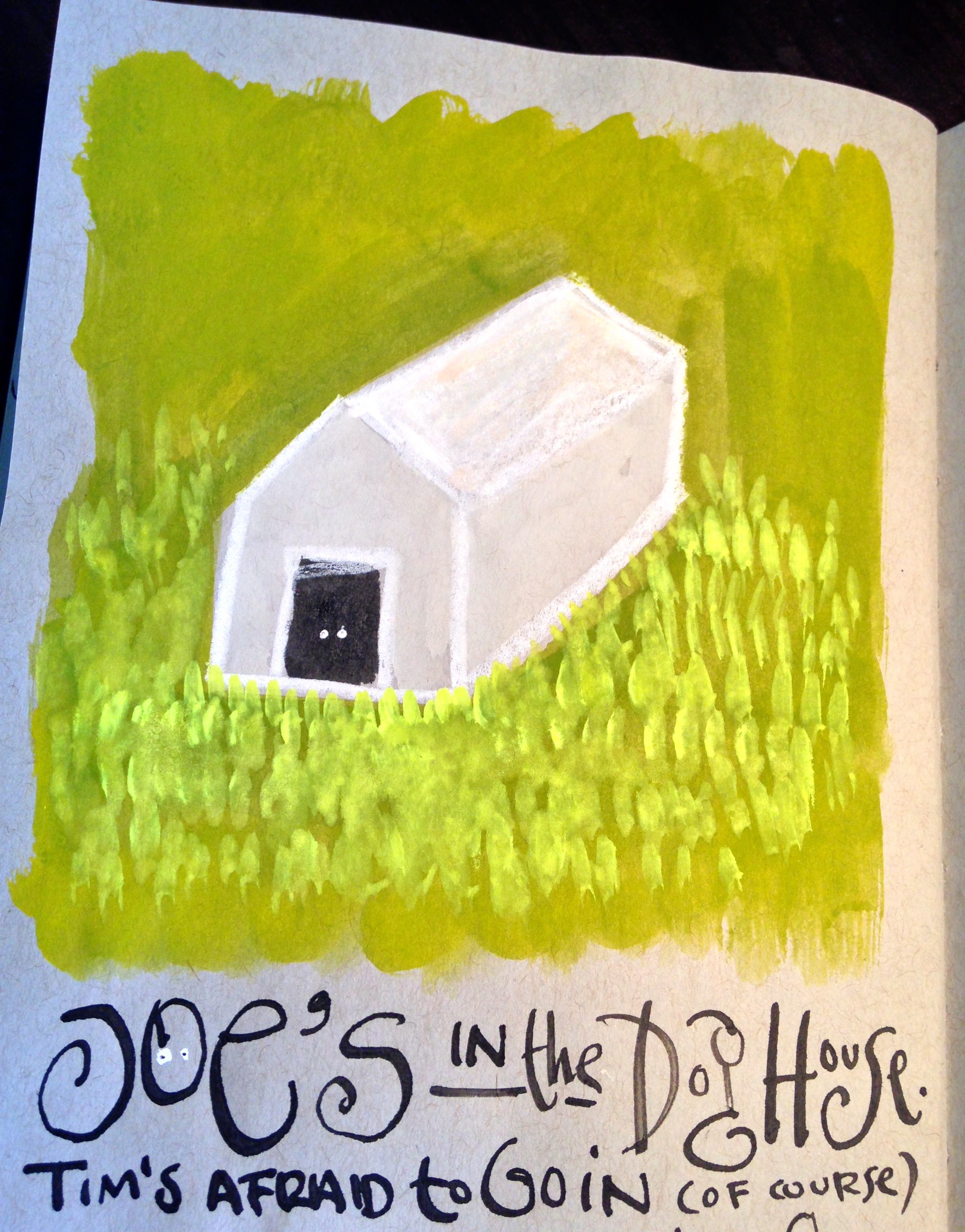
And so began Tim and Joe’s, transitions to yarddogginess. After several days in the back, they are content to spend the day lolling in the grass, sniffing through the geraniums, or relaxing in the shade of the orange trees. When I come home, they amble up to me casually, not clambering up my shins or clawing madly at the screen door. They meet me like a fellow animal. Being yard dogs, spending the day watching the hummingbirds at the feeder or rolling on the lawn, has made them more dog-like. The cold, hard streets of New York seem far away.

We built  a fomecore dog house. Joe likes it. Tim's not so sure.
We built a fomecore dog house. Joe likes it. Tim’s not so sure.

Slowly, I am undergoing my own yarddog transformation. I spent my first two weeks here in a frenzy of activity, building furnitures, stocking the pantry, reading guidebooks, writing and painting to fill the walls. I felt like I was still doing a job, in this new jury-rigged office I’d built in the back yard. I was still putting on my collar and leash and mimicking my old life in New York. But no one was holding the other end, no one was there to guide me and tell me what do.  I’d started to work for myself, but I had an absentee boss. I lost my sense of what the day’s work amounted to, because I was doing a lot of busy work to fill the day and it wasn’t moving me forward. And, for the first time in my adult life, I was alone all day. Instead of being surrounded by colleagues, meetings and deadlines, I was an old weirdo sitting alone in the garage drawing pictures for the hell of it. It should have felt liberating but I was still far from liberation.

So I made a couple of changes.

I started to structure my day and to set up some goals. I put landmarks on my calendar: going to the gym, drawing, working on my book, preparing my presentations, going to museums, and so on.  I would work on one project for a couple of hours, take a break and switch to some thing else.  It was still orderly, and somewhat corporate in its structure, but it provided me with a lot of relief, just like walking Tim around the bock before setting him free in the yard.  Eventually, I’m sure my regimen will loosen up as I discover new rhythms and a sense of accomplishment, but for now, I am getting lot more done and I feel more relaxed in this new life.

Another realization I had was that though I am not physically surrounded by co-workers, I do know a lot of people who are doing similar things. They are the ones who inspired me and showed me what a different sort of work life could be like. Illustrators, designers, drawing teachers, entrepreneurs, who work on their own and have designed successful creative careers and who I can reach with a an email or by opening Skype. They are my new colleagues. So many of my friends have generously offered me their time, chatting with me and giving me perspective. Sharing their wisdom has shown me how to do this. I am still weird, still in the garage, but I am not alone.

Changing one’s life is exciting and fresh but it is also scary and a lot of work.  I am learning so much every day.

A hut of my own.

hans and peter 1

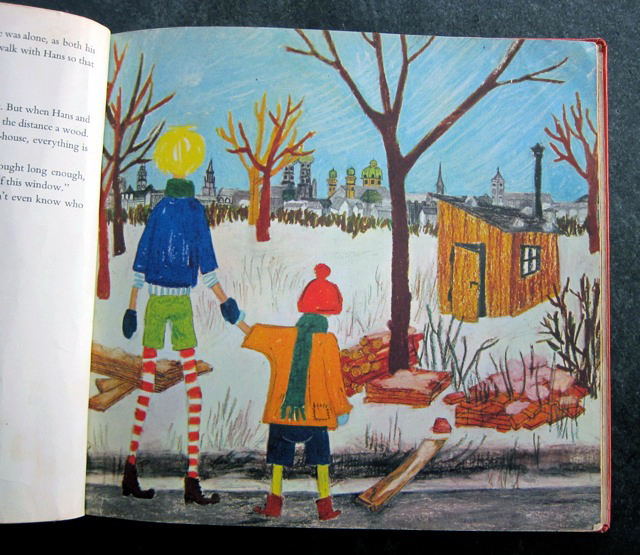
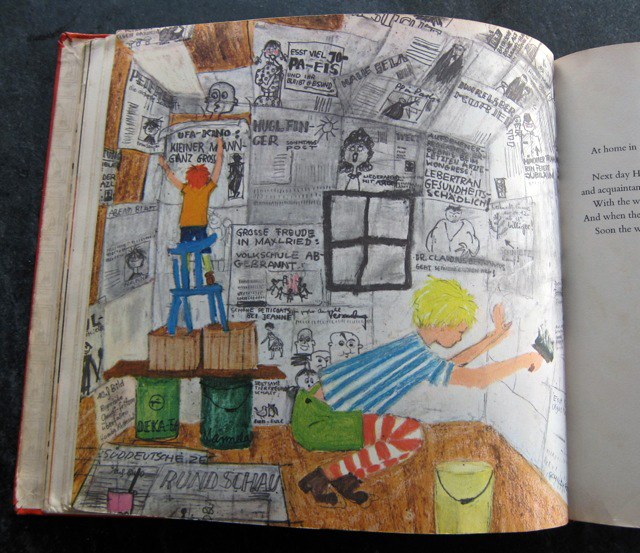
There was a book I was just obsessed with when I was eight. It was called Hans and Peter by Heidrun Petrides  (originally Swiss, “Der Xaver un Der Wastl“)and it told the story of two boys who find an abandoned workman’s shed and convert it into a playhouse.

hans and peter  2They cover the walls with newspaper and then whitewash it, they install an old wood stove, they plant geraniums in a windowbox, and make gaily colored curtains. The book was Swiss and had bright pastel paintings on every page (they were done by a 15-year-old girl!).
There was just something about this idea, of these boys making their own house, that was incredibly appealing to me.

hans and peter 3I guess it’s the same instinct that had us building forts out of sofa cushions and making a pirate ship out of the linen closet. I yearned for a treehouse or a tent or an empty refrigerator box — something domestic I could call my own.

When I was nine, I was sent to live with my grandparents in Pakistan for a couple of years. I had gotten a small tool kit for my birthday and when my grandmother promised me my own small patch of land in her garden, I had intense fantasies about using the tools to build a shed with a padlock at one end of my acreage. I was enormously disappointed when I arrived in Lahore and my grandmother pointed to a bed of snapdragons and said, “That can be your garden, Danny. You can water it whenever you want.”

The only apartment I ever had entirely to myself was my first one on Clinton Street in the Lower East SIde. It was the most dangerous neighborhood in the blighted New York of the early eighties but I was incredibly proud to have my own minihouse. I built a loft bed, a couch and cupboards, then upholstered them and sewed pillows in fabrics straight out of Hans and Peter. A year later I was gone from the ‘Hood and living with roommates, then Patti and I moved in together, and now I live with Jenny in this microhouse in Los Angeles.

However after all these years, I have finally achieved my Hans and Peter fantasy.

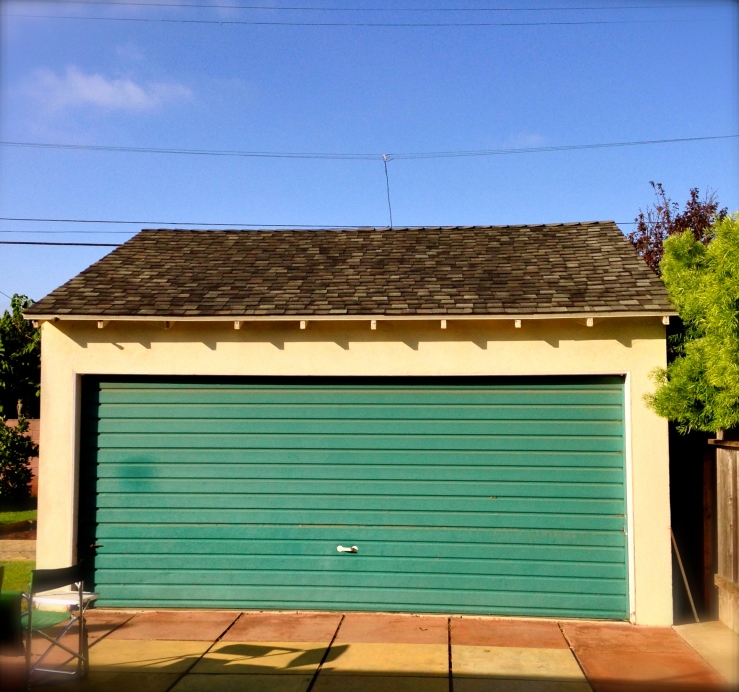
IMG_0126Our house has an old two-car garage, built in the 1940s and made of wood with a big swing-up metal door. Since the day we arrived in LA, I have been busily turning it into a studio of my own, a cubby house, a man-cave.
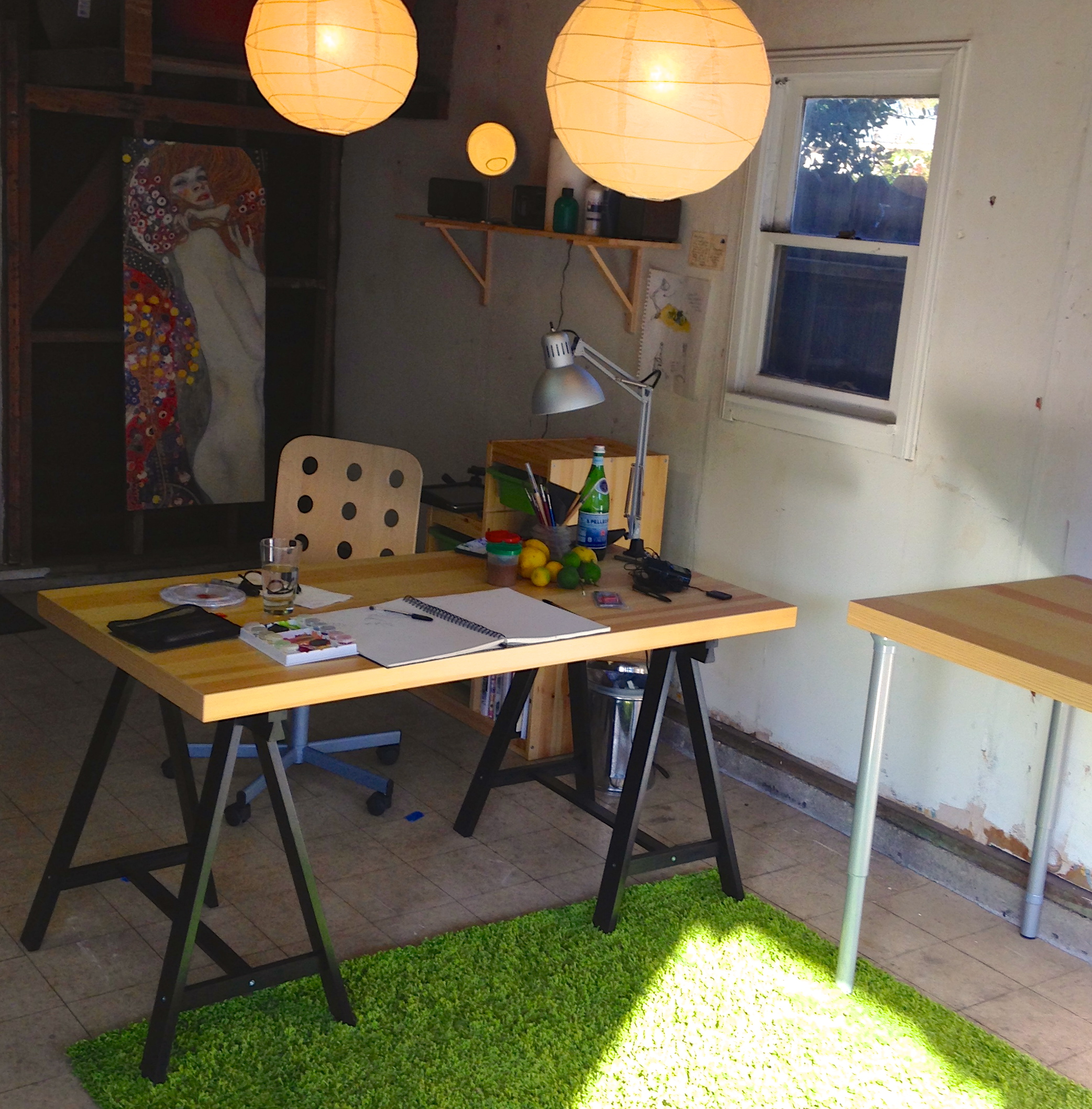
IMG_0117I spent a day on my hands and knees scrubbing the floor, half chipped lino, half cracked cement. Then I built myself shelves, tables, and drawers to hold all my paints, pens, inks, and journals. I installed lighting, a sound system, and a grass green shag rug for the dogs to lie on while I work.

IMG_0116Slowly, I am filling the walls up with paintings — the first I have done in ages that are not in a small book.

It’s wonderful. I can work any size I want, a true luxury for someone used to painting in the space between my laptop and the edge of the dining table. I can work on a project, then at the end of the day leave it out, and resume work the next day. I can shoot videos in here and completely control the lighting and the sound.

I am realizing that my whole approach to art — small books, tiny watercolor sets, etc. — is probably a function of having had so little space and time. Who knows where this newfound freedom may lead?

Welcome to America!

When I was twelve, I took a ship across the Atlantic and, after weeks at sea, finally saw the arm of the Statue of Liberty poking through the early morning mist. Upon descending the gang-plank, I bought my first-ever can of Coca-Cola from a Sabrett stand on the pier. It tasted like America and. for the next four decades, that’s where I thought I was living. 

Now, after traveling 3,000 more miles, I’ve realized I was never actually in America — I was in a completely different country called “New York”. And now, finally, I’m in the U. S. of A. It tastes quite different.

In New York, if you need groceries, you go across the street to the corner deli. In a cramped room, you will find a fridge full of beer, some shrink wrapped fig-newtons, a lottery ticket machine, and way behind the counter, a recent immigrant who will barely acknowledge you as he takes your money.

In America, there are enormous buildings called “Costco”. In New York, such a building would be called “Madison Square Garden.” But here, it is filled with palettes of merchandise stacked to the distant rafters. And what merchandise! Many of the brand names are familiar but the products themselves seems to have been manufactured for giants. Twenty-five pound bags of jerky. Seventy-two rolls of Brawny paper towels, in a bundle the size of an East Village duplex.  Need some AA batteries? Here’s a footlocker full of 500. A bucket of Vitamin C tablets, an entire side of beef marinated an shrink-wrapped. I felt like Gulliver amidst the Brobdingnagians. I staggered around for an hour and a half and walked out with a box of hangers.

In New York, if you need to get somewhere, you walk there. If it’s far, you go down to the subway or hail cab. In America, you drive your own car. Everywhere. To Costco, so you can haul home your plunder. To the gym, so you can walk on a treadmill. To the mailbox, so you can collect your Costco coupons.

Now, I know cars and I know how to drive. I got my license at 25 so I’d have proper ID. But when we arrived at LAX with several big suitcases, Jenny went to Hertz and rented a Ford Explorer which is essentially an 18 wheel-truck with cup holders. Every day, I have chauffeured her to her new office and then I have spent the day setting up our house, unpacking boxes, filling the pantry, going to Home Depot and IKEA (oy!) and building my new studio (I’ll tell you more about that next time).

All of my chores have had me glued to my Neverlost GPS device and dragging up and down the 405, which is like the Nile, the Yangtze, and the Amazon only covered with asphalt, amphetamine-addled truckers, and Mexicans in pickup trucks delivering lawn mowers. Everyone slaloms back and forth across lanes, while I squeeze my fingertips deep into the Explorer’s leather steering wheel. I am in an advanced yoga class of some kind — one ear cranes towards the clipped orders of the Neverlast lady, the other twitches at every honk and siren, one eye is on the swarming lanes ahead of me, the other darts back and forth between the various mirrors and monitors arrayed around the vast landscape of my car’s interior, sweat courses down my ribs, my right foot dribbles back and forth across the pedals, now lunging toward the accelerator, then jerking to the brake.

On one horrific trip back from IKEA, somewhere near Mexico, I realize that I have ordered and paid for a gigantic stack of lumber that they laughingly called a shelving unit and in my frenzy and disorientation I have managed to leave it behind at the store. The Neverlast lady sullenly tells me she is recalculating as I exit the freeway only to be ordered to do a U- turn and head back to the distant blue store over the horizon. In New York, incidentally, you had to rent a car and then travel to another state or borough to get to an IKEA. Here in my new American city, there are five different ones, all crammed with those 3-D jigsaw puzzles with made-up Swedish names.

In New York, you are never more than seven feet away from another human being. Literally — above, below, or on one side of you, there is alway somebody. Somebody who is blasting their radio or calling the cops or getting drunk or clog dancing. In America, you can sit in your home and hear … nothing. You can walk down the street, and see … no one. My dogs are so confused by the silence, they sit on the back yard with cocked heads and looks of utter disbelief.

In New York, you put on your coat and your scarf and your hat and a sweater or a coat and a harness and maybe a muzzle and rubber booties on your dog, take a stack of newspapers and bundle him in to the elevator, travel down to the lobby, through several sets of doors and finally onto the sidewalk. Then you drag him away from chicken bones, abandoned big macs, broken glass, pit bulls, and sleeping homeless people. When he is finally ready to relieve himself, you scoop up the offering in the paper under your arm and drop it in the corner garbage can. Then you head back, hoping you have your keys.

In America, you can just open that back door and your dog runs out onto your gigantic lawn and pees while you stand in the doorway in your underwear holding mug of coffee.

In New York, you sprout an avocado pit and put it in a mayo jar on the window sill. In America, you have lawn mowers you can ride and lemon trees and orange trees and mandarin trees all groaning with fruit and your for th taking because they are growing in your own yard!  Two nights ago, Joe and Tim walked across our neighbor’s front yard and Jenny said, “What’s that weird sound they are making?”, a sort of swishing, crunching sound as they walked across the impossibly, perfectly manicured grass. I bent down to feel it. Astroturf.

In New York, if your clothes are dirty, you put them in a bag, and take them to the laundromat on the corner where a lady shrinks and mangles them for you for ten bucks. In America, you interrupt your writing for two minutes, walk to the laundry room, take them out of the dryer, fold them and go back to your blogpost.

So far, I find America lovely and exhausting. I have to rethink so many basic things — walking, eating, slices of pizza (I have yet to see a single pizzeria in America). Even though I have visited LA many times, living here is a whole new kettle of balls of wax and fish. And so many things I thought were basically made up or exaggerated in the movies and on TV are all around me all the time.  Jenny, who grew up in Arizona and lived for nearly a decade in LA is quite used to America and rolls her eyes at my epiphanies and at my apparently dreadful driving.

With all of the new experiences I’ve had exploring America this week, I haven’t made a single piece of art. But next week, I can’t wait to begin my travel journal in earnest.

Okay, I have to stop now as tonight we are going to the movies. In America, they have movie theaters in which they bring you dinner and beers while you are in your seat watching the film. This I gotta see.