Sketchbook Club: Self-published

Today I shared a bunch of my favorite self published books. I hope they inspire you to make something awesome!  Here are the book I discussed and how to get ’em, for your own library.

And here’s some more info on Illustration Nation, our brand new kourse:

Confessions of a rueful geek.

I was just reading an article about the developments in cryptocurrencies (which is really worth checking out — but is not what I want to write about today) and was struck by a section on how the immense power of open systems to spawn creativity and community have been increasingly stifled since those systems were co-opted by big corporations. All of which led me to think about my sketchbook.

At the time I started to draw in a sketchbook — in the pre-dotcom-bubble-burst of the early mid ’90s — I was also exploring the early Internet. Back then, most people were as unaware of the transformational power of networked computers as they were unaware of the idea of illustrated journal keeping or sketchbook art. Now, of course, we all spend hours a day on the Web but, 20 years ago, it was a lot geekier place to hang out.

I loved that geekiness — because geeks are interesting and passionate. They know a lot and they care a lot. The early Internet wasn’t just the playground of tech geeks. I found wheelchair geeks there when I started curbcut.com, a community for disabled people like my wife, Patti. And I found sketchbook geeks too, like Richard Bell and Roz Stendahl.

In those days, the Internet was turning out to be a wonderful place to find people who shared niche interests like old record collecting or fishing gear or classic car restoration or knitting. These sorts of geeks gushed with knowledge that had been long bottled up because no one around them in the real world was even vaguely interested in the passions that consumed them.

But when geeks meet geeks, decades of stored up arcana comes pouring out of their basement lairs and garage workshops and people spend hours and hours talking about minor Star Wars characters or Jane Austen subplots or the best way to pickle kimchi or fill a fountain pen with waterproof ink. What seemed eye-glazing to the rest of the world was endlessly fascinating to some other geek, previously burrowed in obscurity in Croatia or North Dakota or the Bronx.

The first book I wrote, Hello World, was about an intense geek sub-species, the ham radio operator.  In the 1920s, when radio was a hot emerging technology, hams were super cool, but eighty years later, they were just geezers who wore pocket protectors, Vitalis and white socks with black shoes.

But I loved their passion, their willingness to stay up all night trying to reach a fellow ham deep in Siberia or put together dangerous expeditions to literal desert islands lost in the Pacific just to be the first to transmit from a new location. Hams loved the Internet too, helped birth it in fact, but it was ultimately the last nail in their coffin. Why hand build a radio to bounce Morse code off the moon when you could just send a text message from your phone?  Their obscure hobby was now just a silly waste of effort made redundant by Twitter and Google and Facebook, the megacorps their efforts actually spawned.

Anyway, as I read this article, I thought about my own long-time passion for keeping a sketchbook and how it has changed over two-plus decades. What started as a solitary therapeutic activity grew into a network of new geek friends, then into this blog (I wrote the first post over a fourteen years ago just to share thoughts with my pal Richard in Yorkshire), then into a series of books, and then into talks, teaching, and a full-time job and business hiring several people. My geekdom has become as increasingly mainstream as my network has expanded. When you are surrounded by an army of tens of thousands of like-minded folks, you aren’t an outsider anymore. Or a geek.

There have been lots of advantages to this mainstreaming process, both for me and for technology. Back in the day, if I had a tech problem, there were maybe three other dorks I could call on to help solve the problem. Now I can just Google an answer or walk two blocks to the Apple Store.

But all this mass-produced convenience has polished away the magic. My computer, which used to be like a hand-carved wizard staff, carefully assembled and tweaked, is now as personal as a rental car.

And my sketchbooking process, which has become an essential part of who I am, can also get diluted and homogenized if I don’t remain vigilant and true to my origins. It’s essential to hold on to what has made my art process intimate and personal, even if it needs to be shared now and then.

It’s also crucial to remind myself of what has always given the process its power and excitement. That it is an ever-changing creative lab, that it gives me a fresh perspective on the world around me, and that it never become rote.  And equally important, that it remain authentic, made by me for me, that it stays honest and unswayed by others’ wants and expectations, that I am filling pages for their own sake.

There’s a real danger in refining a method, in becoming too polished, and devolving into generic illustration, in being infected by commercialism, by some projected audience, that it goes from a passion, a hobby, an exploration, into a job. I’ve seen it happen to a lot of artists who used to excite me and are now just undistinguished self-promoters questing for likes, Etsy sales  or freelance gigs,

Amateur doesn’t mean second rate or unskilled. It’s derived from amare, to love, an activity fueled by passion — by geekery, if you will. But it can be so much more raw and exciting than the predictable, manicured path that professionalism and corporatism mandate. Just as Facebook grows duller by the day, just as my corporate agency job chafed me, striving for professional standards will dull one’s art and leach it of the passion that makes it moving.

The wild west frontier days of the Internet are now just fodder for TV shows which do no justice to the headiness of random discovery I remember. But every blank page in my sketchbook still has that power to shock and excite me, so long as I remember to stay free and explore.

How do you stay authentic?

Someone’s been monkeying with my sketchbooks.

Yesterday I had to pick out a few representative watercolors from my sketchbooks to share with a magazine editor who asked to include my work in an upcoming issue. I didn’t have a scan that was high enough resolution, so I decided to go through my sketchbook archive and shoot some new ones.

But something odd happened.

After going through the first few books, I started to wonder why they all looked so dull. The colors were washed out. I turned on more lights in my darkened living room but they still looked lifeless. But there was more to it than just the vibrancy.  The brush work seemed primitive and half-finished.  And the lines were dreadful and crude. Page after page, the drawings I knew so well looked just, well, bad.

How could I send any of these things to a magazine devoted to watercolor art? It was laughable. How had I ever had them published in books? How had I dared share them on the Internet? Had I ever done a single drawing that was any good at all?

I flipped through more books. Nope. They were all dreadful. Every last one.

Maybe they had faded over time? Nope. They were all stored, closed, in a light-proof cabinet, closed. Maybe the iPad was affecting my ability to look at analog colors? I looked through my Instagram page. Nope, they were all dreadful too. I clearly do not know how to draw and have been pulling off some massive con on the universe and myself. This magazine editor was clearly deluded in thinking she should include me in her publication and would soon lose her job.  Hmmm.

Today, Something has happened to them again.

I went back, looked through the images I’d picked, then flipped through a few of the books on the shelf, then looked at my Instagram. Not so bad. In fact, I liked quite a lot of them. Wonky, sure, but with style and a POV. I’m glad I made them. Whew.

A cautionary tale. Maybe it’s because it’s so stupidly cold. Or because I haven’t been sleeping terribly well. Or because, well, I’m me. But I can’t always rely on my judgement of the given moment. I need to trust myself, and others over the long run, and meanwhile just keep my head down and keep making stuff. It doesn’t matter if it sucks. Especially if I’m going to think it sucks so much I stop making anything altogether.

Does this ever happen to you?

How to make learning to draw a whole lot easier.

Why do you want to start drawing?

Wait, let me rephrase that — you probably don’t want to start drawing. You want to be be really good at drawing.
To pick up a pen, grab some paper, and effortlessly draw anything, perfectly, beautifully, dazzling your friends and confounding your enemies. You want to be the next daVinci, to knock out portraits indistinguishable from photographs, to replace your vacation snapshots with breathtaking watercolors, to have gallerists, collectors and reviewers clamoring outside the doors of your sunswept Tuscan studio.  And you have to start somewhere.

But deep down, you fear that you’ll never get to be great. It’ll be too hard, you’ll just give up, and instead of pride, you’ll be besieged by self-recrimination. Your dust-covered sketchbook will be just one more reminder of your failed attempts to achieve your dreams.

It doesn’t have to be that way. Seriously. Here’s how I know. I’ve been helping folks to start drawing for ages but more importantly, I have helped myself to start drawingAnd by teaching myself, I have learned a few things that could help you to get past those first few challenging steps. So this story is less about drawing techniques than it is how to incorporate drawing into your life, how to keep yourself motivated, and how to learn to learn.

How to accurately measure progress: So many fledgling artists focus on the horizon, then trip over their own feet and fall flat. They began by focussing on the end result of learning, that perfect drawing, then despair when each line they make fails to achieve that goal. What they are overlooking are all the individual steps they are making towards that objective, the small but crucial  improvements they are making every day. I know this because it happened to me too. Early on, I’d flip through my first handful of pages and grimace. They all sucked. I sucked. And I’d never get any better.

But, had I been paying attention, had I been willing to be objective instead of brutally critical, I would have noticed how much actual progress I’d been making. That my lines were more confident. That I’d tackled complex new subjects. That I was starting to see how to really see. When I look back on my early sketchbooks now, I can see that, even after a month or two, I was getting better and better. But at the time, all I could think was: “I will never get there.”
Why? Because instead of comparing me with me, I was comparing me with da Vinci, with my friend the professional illustrator, with all the artists who’d inspired me to want to start to draw. The first bar was way too high. I’d just started to jog and was beating myself up for not running a marathon in under three hours.

It’s essential to recognize that your judgement of your own progress is far from accurate. I guarantee you are doing better than you think you are because again, your perspective is distorted by the dream you have of where you want to get to. And because you feel like an impostor who’s pretending to be an Artist but can’t draw a stick figure. So stop obsessing on on how far you have yet to travel and check out the ground you’ve already covered. Spend less time on self-criticism and more on your next drawing.

How to draw like a natural: Another crucial lesson: don’t skip ahead. Keep working on the basics. Draw simple objects. Draw your lunch. Draw a shoe. Just stick to using a black pen. Don’t plunge into portraiture or three-point perspective or advanced watercoloring. Develop your confidence in the building blocks of drawing: lines, angles, measurements (I explain more in my kourse,  How To Draw Without Talent).

And if you can’t quite capture what you’re seeing yet, write down your observations. Draw an arrow to the drawing that explains how the shadow looks, point out the highlight, record what you are learning. Just the act of writing information down, helps your memory retain it. Then look for other examples of what you have observed.

The more actively you engage, the more the lessons become second nature.  And that’s really where you want to be, to draw without having to think, to intuitively translate what you see into line son the page.  But, like learning to walk, to tie your shoe, to throw a ball, to drive a car, it takes lots of repetition to build the neural connections that make a new skill feel natural.

How to motivate yourself:  And of course, if you don’t want to practice, you won’t. It’s crucial to stay motivated, even if you’re not on the verge of a career retrospective at the Guggenheim.

One way is to set yourself small goals that you know you can achieve. For instance, do a drawing every day. Even if it’s just for two minutes, pick up that pen. Or commit to filling an entire sketchbook in the next month. Then celebrate by buying a new art tool. I spent a year drawing with one type of black pen. Then I allowed myself one grey brush marker. A month later, I added a different grey, and slowly worked my way up to a bag full of color markers over a year. The next year, I bought myself a cheap watercolor set. The year after that, a really good watercolor set, and so on.

Try focussing on a single daily subject for a month. Pick a subject you find interesting but don’t try to make an “art statement”. It’s just a theme to practice variations upon. I drew my teacup every single morning. I drew a selfie every day. The view out my kitchen window. Cars on my block.  A photo from the front page. Now I draw a dog every day.  I get a sense of accomplishment when I see how much I am drawing, not just how “well” I am drawing.

Whenever you complete a sketchbook, spend some time with it. Look back at each page, study what you did, how your work has changed.  Get out your phone and make a video as you  flip through the pages.  Share it online with friends you can trust. Their support and encouragement will help keep you going.

Three facts to write in the inside cover of your sketchbook:

1. Never compare yourself to other artists. Don’t compare your first drawing to their reproduction in a coffee table book. Let their progress inspire but not intimidate you. Compare you to you. That’s all that counts.

2.  You’re making more progress than you think. You may not see it but it’s happening with every page. Guaranteed.

3. Everyone struggles at the beginning. Check out early van Gogh drawings. Awful. Struggle is normal, inevitable, a positive sign that you are working things through. Your early drawings are zero indication of what you will achieve in time. Zero.

I hope this helps. Remember, you can do it.


This post was originally written for the Sketchbook Skool Zine. If you liked it, consider subscribing. It’s free and full of interesting stuff.

Pad and i: 7. I’d like to make a toast.

When I first started to draw, my goal was never to make pretty pictures. If you’ve read my book Everyday Matters, you’ll know that I came to drawing as a form of meditation, a way to ground myself in the real and actual rather than living exclusively in my rather tortured brain. My practice was to draw the things around me, in a straightforward, observational way, using just a cheap pen and a sketchbook. I was making a record of my life, of the quotidian beauty that surrounds me.

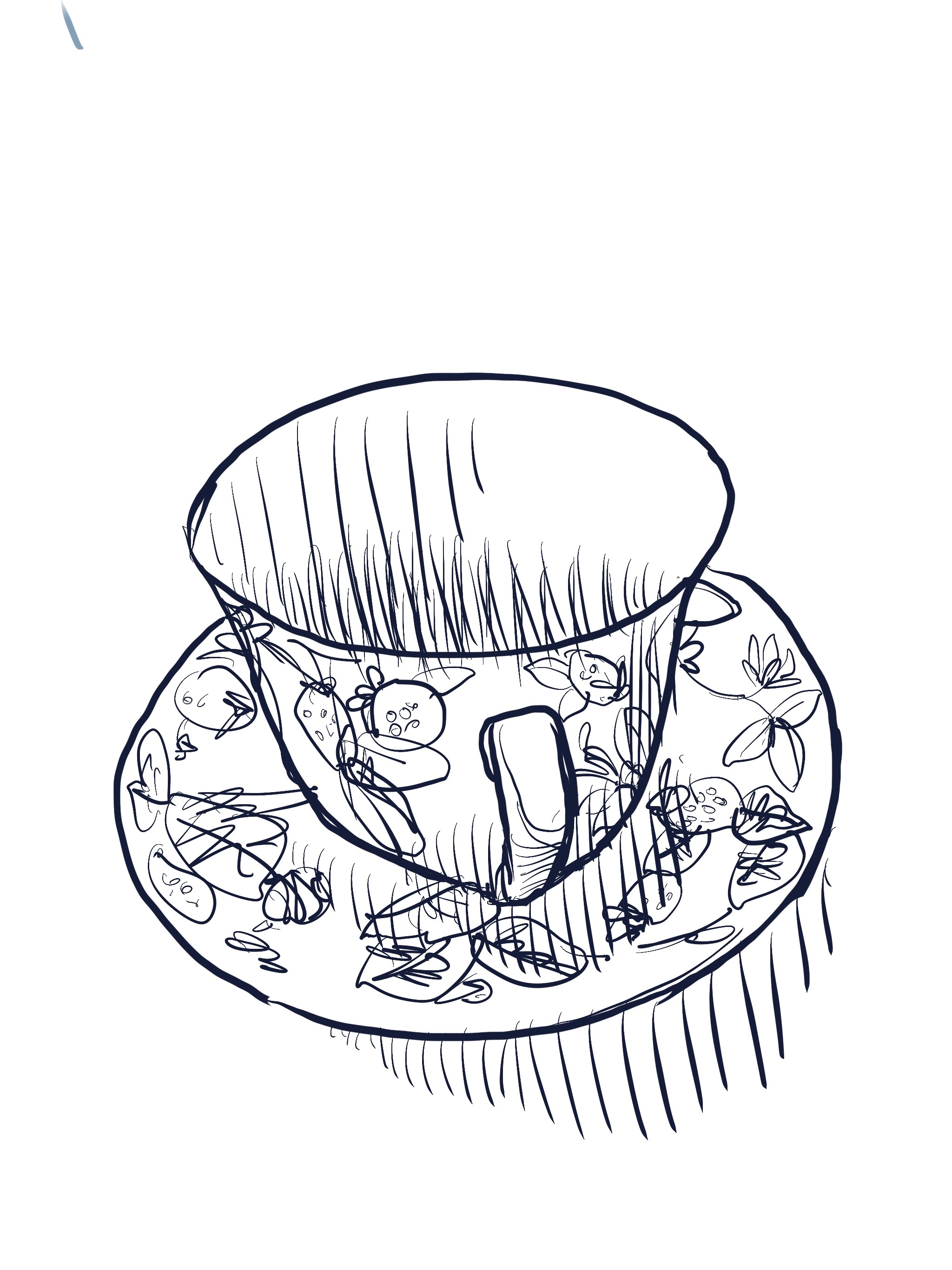
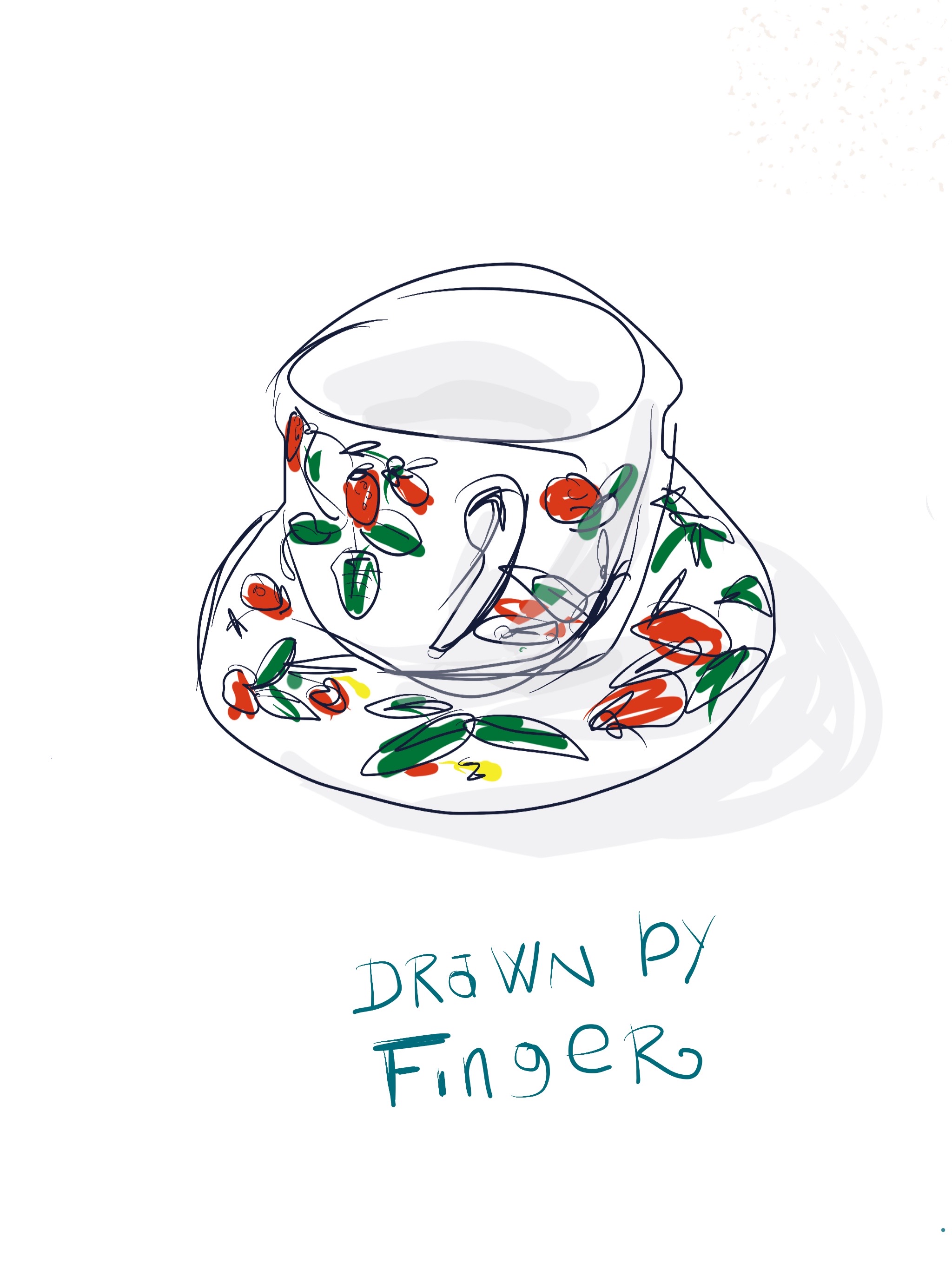
So, could I use the iPad to keep doing this?  At first, I couldn’t as I kept tripping over my enormous toolbox. The ability to tweak every line to a fair-the-well would distract me from making a strong connection between my brain and the object I was contemplating,  I’d keep switching up pens, erasing, undoing, tweaking colors and so forth, all of which would shatter the meditative spell I was used to. I was overwhelmed by my options. If one is used to taking a gentle stroll through the countryside, being dropped into a Formula 1 racer without a driving license would be understandably distracting.So I dialed back and just focused on just making a simple black line. I drew my most familiar subject, a floral tea-cup, which I had drawn dozens and dozens of times over the years. These drawings were familiar and comforting but were like driving that racecar in a school zone. I wanted to open things up, to expand beyond where I’d been and get comfortable using my new toys.

I tried one colored pencil next.


Then I tried getting even more hands on — by drawing with my fingers.

Then I added a colored background and got a little abstract.

Finally,  I tried a bit of whimsical collage.

These experiments showed me I could do what I’d done in my sketchbook and also go a lot further — if I took baby steps. Slowly, I began to capture what was around me, just as I had when I started, twenty-odd years ago: adding one tool at a time until I felt comfortable with it, then trying another.

I’d originally spent a year drawing with a Uniball roller pen. Then I’d added a felt marker, then a single grey brush marker. Then a handful of cool and warm greys. Next one orange, then a green and so on. After another year, I filled an entire sketchbook with colored pencil drawings. Then I got my first watercolor set. In all, it took me at least four or five years to consistently make reasonable color drawings in my sketchbook.  I’d have to have a little patience to feel as comfortable with my iPad.

After two more months of work, I could draw things that looked almost photographic. My ultimate goal wasn’t to make this sort of art but just to push myself and my tools to see what I could do with them. The more familiar they become, the more transparent they are, letting me focus on my subject without thinking about knob twiddling and technowizardry.

My goal is to stay in the flow, even through this sheet of glass.

(To be continued)

Pad and i: 6. East Hampton.

Our friend Suzanne invited us to spend a long weekend at her house in East Hampton and we packed up our swimtogs and the iPad. We rode a crowded bus the length of Long Island and Jenny and I were forced sit a couple of rows apart.

I used the ride as an opportunity to draw her from life, trying to capture the light on her hair. I used eight layers with different settings to capture the effect of the light — hard light, soft light, multiply, overlay and various degrees of opacity. The colors aren’t bright and cartoony like my earlier paintings but have a softness and glow that suggests the afternoon sun.

Jenny on the Jitney

The next morning as we tucked into our breakfast, I decided to tackle the reflections on the  pool, the light on the bushes, and the giant inflatable swan that drifted across the water. This painting has 16 layers to capture the hard reflections on the railing, and the diffused focus of the  bushes beyond the fence.  I also  conjured up Hockney again as I studied the glittering highlights and the varying shadows on the bottom of the pool.

Suzanne’s pool

Suzanne’s dog, Lou, is a lovely and manic creatures, endlessly chasing after balls and circumnavigating the pool.   I wanted to draw her as a thank you gift for Suzanne but it was impossible to slow her down enough to sit for me. So I snapped  a picture with the iPad camera, then split the screen so I could look at the photo side by side with my Procreate canvas.  I don’t love drawing from photos — but it was the only way to do a decent job of it.

I only used seven layers this time to achieve the layered look of the many colors of her fur and the soft flagstones beneath her.This scary beetle landed on my book. I drew his shape as quickly as I could be before he crawled away, then added textures from memory. I quite like the wood grain.

Meet the Beetle

On our final morning, as we waited to head back to New York, I quickly drew Jenny again, this tie in a fast, more abstract style with bright colors. I wanted to break away from the painstaking duplication of reality and the endless layers and tricks.

Jenny and her Kindle.

I wanted to see if I could figure out the technical components to make paintings look fairly realistic — but that is not my Holy Grail. Instead, I want to play with all the tools until they become like second nature, and then express myself as I feel at the moment. I want to use the iPad like I use my sketchbooks, to capture the world around me and the world inside me, my moods, my quirks, my points of view.  Reproducing photos is like painting-by-numbers. It’s possible but it’s not the point.

(To be continued)

The Color of Money

When you grow up in New York City, weeks can go by with your ever getting into an automobile. Generally, the only cars you travel in are subway cars. That’s how I managed to reach the ripe old age of twenty five without ever getting a driver’s license.

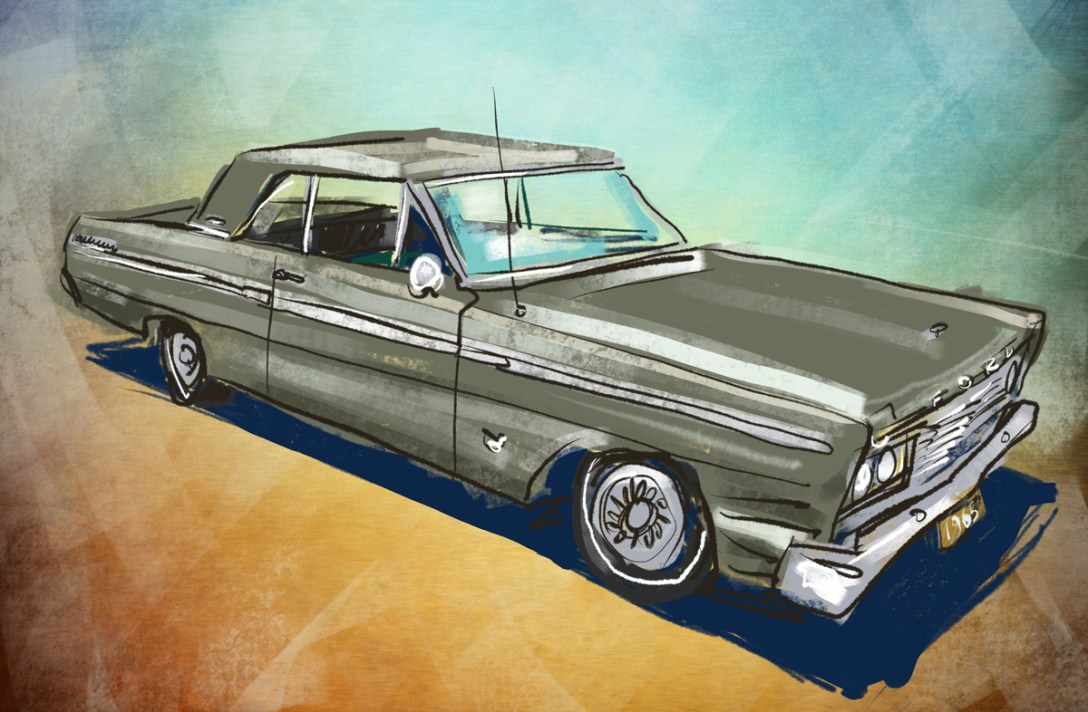
I’ve always loved cars though. I can identify most makes, models, and years from a distance. Particularly those made when cars were still cars and not just interchangeable silver blobs. I read somewhere that people love the cars most that were manufactured the year they first became aware of cars, usually around five or six.  That’s why my very first car was a 1965 Ford Fairlane. I bought it for $800 in a used car lot under Route 1 overpass in Jersey City, when I was 25 and still a month or two away from taking my driving test. I’d moved out of Manhattan to live in Jersey City with a friend and for the first time actually needed a car to go buy a carton of milk.

Despite its age, the Fairlane had about 40,000 miles and its original paint which was a buttery bronze color. Patti (who managed to go to her grave without ever getting a driver’s license) dubbed the Fairlane “The Color Of Money” after the Scorsese movie which also came out that year. It was big and boxy with a fat stripe down its side. It had a manual transmission, “three on the tree”, and suited my old-mannish driving style. The thing was perfection.

Patti and I would take it around town but were always a little nervous about taking it on a road trip. It ran fine and I was obsessed about looking after it. I bought maintenance manual and endless tools. I’d change the spark plugs and oil myself and way more than necessary. I would hand wash, then wax it, buffing the bronze till it glowed like a Marine’s buttons. Perfection.

I let my roommate Simon drive it occasionally. One bleak day he came back from running errands and casually mentioned that he’d accidentally dinged the driver-side door in the supermarket parking lot. I rushed down to survey the damage. The door looked like a moose had run into it. It was crumpled like one of Simon’s empty cigarette packs. As I pulled open the door, it emitted a pitiful screech and a groan.

I was bereft. Sure, we could probably have gone to a body shop and had the door undinged. But The Color of Money was now  imperfect, soiled, sullied. Instead of a classic, it was just an old beater. A few weeks later, I moved out of the Jersey City house  and into an apartment with Patti. I gave the car to Simon and never saw him or it again.

I thought about The Color of Money today because I was listening to Episode Six of The Unmade Podcast, one of my current favoritest indulgences.  This podcast is about podcasts which is rather meta but deeply entertaining. Actually it’s about podcasts that have never been made (hence the name) but could conceivably be one day if anyone could be bothered.

In each episode, two Australian chums swap ideas for potential podcasts, then delve into what they might be like, and whether they’d be any good. Then they move on to the next idea.  Some of the ideas are great and unspool into hilarious explorations, while other are dead ends which are equally amusing to demolish like the door of a 1965 Ford Fairlane.

I love this podcast because it is all about creativity. These two blokes come up with ideas on the fly, then bat them back and forth, twisting and shaping them then tossing them aside. There’s no obligation to prove the ideas, just the raw pleasure of invention and problem solving.

It really gets my wheels turning as it did this week when they discussed another unmade podcast idea called “My First Car.” In this nonexistent podcast, guests would come on to describe their first vehicle and tell stories about what it meant to them, what adventures they had,what memories it provoked — and that would be it. Simple, dumb, and wonderful.

I’ll never be a guest on My First Car — because it doesn’t exist. But I wanted to share my memory of the Fairlane somewhere.  What stories would you tell if you were a guest on the show?

Pad and i: 5. Surf, Dave and cartoons

In early August, we once again packed up our swimsuits, fat novels, and sunscreen and headed south to Surf City where the Kane family compound sits a few blocks from the beach.  The summer before I’d watched enviously as Tommy drew broiling semi-nudes in his sketchbook and I was determined to spend the idle hours working on my iPad chops.

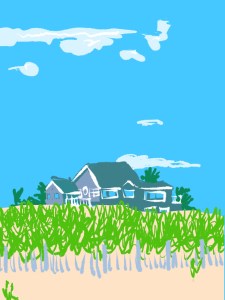
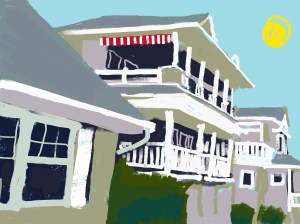
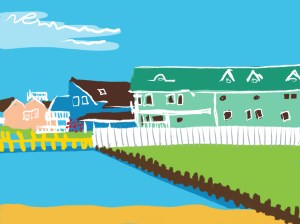
I didn’t feel like focusing on drawing sunbathers — I’ve done it before and it always makes me feel a little pervy. Instead, I wanted to draw the water and the sun-bleached houses, to continue the exploration I’d been doing with my urban sketches in Manhattan.

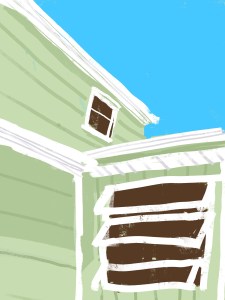
I used a similar technique, constructing buildings out of simple shapes, bright colors, flat lighting. I tried drawing people too but with less success. Overall the thing I liked best was the colors. More than watercolors, the iPad captured the bright August sunlight.

I‘d been studying Hockney a lot in the weeks before vacation and I was channeling his palette  I’d spent an hour or two in the McNally-Jackson bookshop, poring through his new book called Current which contained hundreds of iPhone and iPad drawings. There’s a simplicity to each stage of his work which builds up to an intense richness to the final results. He attacks the screen with clarity  and bold colors and keeps layering on detail. I tried to use a similar approach but I still didn’t dare to use colors as cartoony and bold as he did. Inexpertly done, they can just look garish and amateurish.

David Hockney Exhibition at the NGV

The last painting I made hinted at a new direction. I’d woken up early on the last morning in Surf City. The room was still dark but little fingers of dawn thrust themselves around the edges of the blinds. I picked up my iPad and started to construct the shapes of the window, the air-conditioner, the blinds, the bureau and then to suggest the variations in light. It was simple, crudely drawn through bleary eyes, but it was not a bad piece of observational drawing. I could still put aside style to draw just what I see.

I was still feeling a little defensive about these new drawings. That’s what happens when I am around a master like Tommy who is cranking out work that is so much more careful and labor intensive than mine. Tom’s not one  to hand out unearned praise and he was just grunting at the various iPad pieces I showed him. A little petulantly, I decided to try some thing one can’t do in a plain old sketchbook: make the pictures move.

I downloaded a few different animation programs and began to experiment. I never found an ideal program, something as well-designed as Procreate is for drawing Most were for little kids and had clumsy interfaces that were very restricting. The best is called Animation Desk and I managed to wrestle a few little samples out of it.

I tried rotoscoping some short pieces of video which is a laborious and mechanical process that delivers somewhat synthetic results.  Here’s a little film of my dogs walking through the study:

Then I tried drawing more from my imagination, a chicken running around:

And finally I took a couple of the drawings I’d done at the beach and made them move:

A fun experiment. but not really what I needed to be spending my time on.  It’s nice to know I can make a small bit of animation now and then but I was far from doing what I wanted with static drawing on the iPad.  I came back from the beach a little browner and wiser but with still a long way to go.

(To be continued)


I’d love to know anything you think about this process — with one exception. Please don’t tell me you still prefer the analog drawings I did with ink and watercolor. I know that and it just make me crabby to hear it from you. I already own a large monkey to share that sort of insight.


Pad and i: Part 4. Guttenberg Comes Alive!

The next big influence on my iPad exploratory was a tech innovation from centuries ago: moveable type. In Mid July, I took a week-long workshop in letterpress printing at the Center for Book Arts and it was quite profound.  I wrote about it soon thereafter.

In the process of figuring out how to compose the type, I first created a layout comp in InDesign. Then I tried to replicate it at the press with hand set lead type. It was impossible and, I realized, pointless to try to just mimic one technology with another. Sure, I could just hit “print” on my laptop and my laser printer would crank out the page with no-muss or fuss. But that defeated the whole point of the experience. And besides, it wouldn’t actually look the same. So, I decided to push my hand set type as far into its own domain as I could. I used big wooden typefaces and printed it in graduated colored inks. What I printed was too big, too organic, too imperfect to have been made on a Mac. And that’s what made it special.

This revelation started to haunt my iPad exploration.  What was I doing with this gizmo? Why was I trying to reproduce my 180 lb. sketchbook pages, my steel nibs and dip pen, Felix’s watercolors — with this $1000 tablet? It was so cheesy and lame.

Instead I had to embrace the way the iPad worked, go towards it — rather than trying to create a synthetic echo of the art I’ve always made. I’d have to be Dylan going electric. Frampton on TalkBox. Cher on AutoTune.

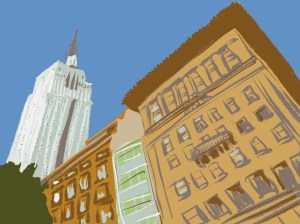
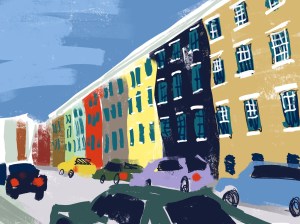
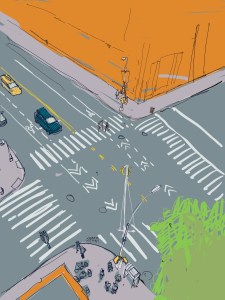
The next week, Tommy Kane and I did some urban sketching around town, perched on our little folding stools. I knew Tom was not impressed by the gizmo or my efforts so far, but I needed to push myself into a new way of seeing, to try to discover how to create something that I could only do on the iPad.

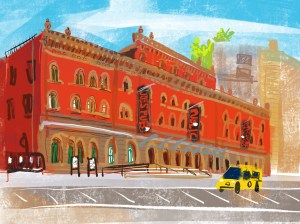
I started to work in block shapes in layered bright colors. In some drawings, I processed the layers to create unexpected effects. I even turned on brightly hues street scene in a study in shades of grey by just flipping a slider.

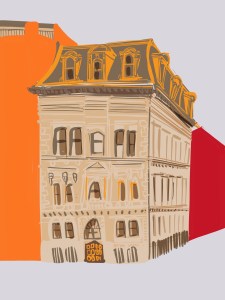
Two particular drawing that I did on while sitting on the curbs of the Village started to capture something new. One I drew of some NYU building on West 4th Street in bright cartoony colors. Then Public Theatre on Lafayette Street and finally a corner off Washington Square late at night.

They all had a hand-drawn, anarchic and unplanned feeling, sort of evocative of 1950s Ronald Searle inspired animation — but not quite.  And the thing is, they had colors that were impossible to create on paper, in any other medium.Print them out and they’d be dead. They were made of light. They were those amazing intense colors you only get by looking at a screen, utterly modern, and they made those street corners come alive.  They were unlike anything I’d made before, and I was very happy.

(To be continued)