Planet Earth is blue and there’s nothing I can do.

garage-lamp

As you’ve heard me say before, I am usually over-caffeinated and impatient. I imagined that once I had declared my intention to leave my job, served out my notice, packed my duffel bag and buckled myself into the Virgin America seat, the rest would be smooth sailing. I’d scarcely be off the plane before I’d be happily and successfully doing whatever it was I was supposed to be doing.

Two months later, I am in the garage. I am surrounded by piles of drawings, library books, art supplies, paint-spattered Ikea furniture and two dogs with dead geranium heads in their fur. I have most of my manuscript done, I have all of my presentations for Amsterdam polished and rehearsed, I have several large and more or less finished paintings leaning against the wall, my redesigned website is launched, and I have pages and pages of some sort of ideas scribbled in ink, sweat, and mustard (homemade sandwiches sustain me through most of my days, these days).

My journey, however, is not completed. I am still at that point in the ride when your feet are off the ground, you are whimpering/screaming, and glued into your seat by some magical force I forget to pay attention to in Mr Kriben’s physics class. I have clearly left the last station. It is two months in the rear view. I no longer dream about conference calls and I am starting to forget the names of people I nodded to everyday in the hall.

But my instruments however are wildly fluctuating. Let me up my metaphor. If you’ve seen Gravity([spoiler alert], you’ll know that I have passed the point where I thought I was going to suffer George’s Clooney’s fate and drift off endlessly into the void and am more or less in Sandra Bullock’s place through most of the movie, somewhere between the exhilaration of an adventurous dream come true and trying to decipher Chinese instrument panels as the flames shoot past the windows.

In short, I’m not sure where I’m going exactly but I think I’m headed in the right direction. I don’t have much better advice for myself than hang on, stay loose, and enjoy the ride.

There are days that are heaven. Listening to NPR, dogs slumbering on the studio floor, barefoot, making stuff, working till the moths activate the motion detectors to turn on the lights. I am an artist.

And there have been nights when I have awoken to the shrill monkey’s voice: “What are you doing? Where is this going? Who cares about this crap? Why’d you walk away?” I am a loser.

The good thing is the nights are short and the days, even though it’s mid-November, are still lovely and long.

So I am still vulnerable and gelatinous some of the time — but that time is lessening.  I am seeing more clearly through the clouds and am excited about the landscape coming up. I finally have a sense of what it I want to do and be (you have no idea how hard it is, even for a man of my advanced years, to figure out what you want to be when you grow up). I think I have finally gone through at least 720 degrees of torment and figured out how to make an online class that seems right. I think I know how I feel about teaching workshops and what to do about that. I know what book I want to do after this one. And I am itching to make some videos again.

But most importantly I am getting clearer about the okayness of not being clear, that fuzziness and ambiguity are an inevitable part of change and of the creative process. In the end, that’s probably the best indication I have that I am doing things right and really metamorphosing, the fact that I am shaken up, that nothing is familiar or solid ground.

I don’t regret this trip for a minute, but I sure could use some Dramamine.

Newness

Screen Shot 2013-11-14 at 9.39.55 AM

I have just taken the wraps off my new website.  At last, I have managed to pull all of my best stuff together (drawings, books, films, ads, bloggery, etc) so it’s easy to look (even on your phone).  If you aren’t familiar with all of the stuff I’m up to, check it out.

Kick the tires and do let me know if there’s anything weird, unclear or lame about it.

P.S. I will continue to blog at this location. The one you’re on now. Got it. Okay? Okay.

Thinking about my super hard-working boy.

IMG_0616 - Version 2

Artists are dismissed as dreamers. But being an artist takes focus and perseverance. It is a tough job, grounded firmly in the real.

Dreamers are roadkill. Artists work. That’s why they call it “The Work”. Not “the ideas,” “the notions”, “the dreams”, “the visions”.  The Work.

Being an artist means seeing the world as it is and having something to say about it. Most people don’t. Most people are content with hackneyed second-hand points of view. Tree hugger or tea partier, paper or plastic. But being an artist means diving into what is really out there, building your own filter from scratch, a filter that adjusts the contrast, brings out the details, heightens the textures and looks deep into the shadows. If you have nothing to say, your hands will tremble, your lines will be weak, your compositions will be flat and your audience will be yawning. You need to reach down and take a stand. On something, anything.

Being an artist means working to see yourself as well. To figure out what colors you see in. What shapes you like. What appeals to you. And trying in some way to understand why. Not why as in words but why as in feelings, nuances, shades. What do I like, me? I like bent things, dead things, wounded things. I like things that are beaten by the sun and wrinkled by the years. I like to see their history in their surfaces, to feel what has happened to them, to trace the map of their journey carved into their flesh, to empathize. Why do I like these things? Is it because I know I am not perfect, I have been ravaged, I persevere and I honor those who do too? Or is it because I cannot actually make beauty? I need to ask myself these questions, even though I don’t aim to ever articulate the answers. I need to see in to that ugliness and share why it is so beautiful to me. So you can see it too, so you can see the love inside your own pain.

Being an artist takes courage. It takes balls and sweat to see the world through fresh eyes and to develop the skills to express that vision and then go out on a limb and share it. Because it’s a long row to hoe, a thankless journey most of the way, a trip no one ever asked you to take and no one feels obliged to cheer you along on. If there are any spectators along the road, they are probably skeptical, probably see you as a self-indulgent weirdo too lazy to get a proper job. But don’t look to me for sympathy. Or applause. Because being an artist is a cause you choose for yourself, the rewards are in the journey, and there is no Promised Land. You have to want to proclaim your vision, to broadcast your voice, to change the world. The finish line doesn’t lie at the doors of the Whitney Biennial, it lies at the grave. Every day is a lesson and a revelation and they follow one after the other to the horizon, providing their own reward. Artists accumulate wisdom and depth and no gallery owner can take a cut of that and no auctioneer can ring a gavel down upon the lessons learned. 

The only thing to goad you on is your fire and your nerve. Because after all, who asked you? Who asked you how you see the world, what’s good or bad, what needs changing, what could be. No one. You decided you had something to say and now you want to say it. No one is obligated to listen but you will make them sit up and take heed.

Being an artist means being an entrepreneur who imposes his vision, who asserts the value of what he is doing and insists people look at it and take him seriously. No one else will do it for you. No one else will come up with your business plan or a strategy or a new idea. You don’t answer to a committee or a board or market research. You make your product, you sell your product, you create your market, you get your ass out of bed each day and punch the clock you built.

Being an artist means being a craftsman, a self-promoter, and productive without a boss, a company, a client. You are making a product no one asked to buy, sourcing your own materials, developing your strategy, and above all, shipping what you make. It can’t just sit in your brainpan or your sketchbook, it needs to be stretched, framed, and hung up for the world to see and buy and resell and love and learn from.

If that scares you, cool. Museums show about 2% of the work they own. There’s already plenty of genius in storage.

But if that excites you and inspires you, awesome. Do the work and bring it on.

“Don’t ask yourself what the world needs. Ask yourself what makes you come alive and then go do that. Because what the world needs is people who have come alive.” 

—Howard Thurman

L.A.Tte

latte

Late weekend morning and Jenny and I were on bench outside a local motorcycle shop/café, eating breakfast and perusing the Sunday Times (N.Y. — Like a proper NYSnob, I haven’t been here long enough to forgo proper journalism for the local paper). 

We had a croissant and a fresh and elaborately made latte apiece. I am not normally a latte person but when in Rome… (where, incidentally, I never saw anyone drink latte which is normally reserved for infants or the feeble). While reading the Book Review, I absent-mindedly chugged down the contents of my cup. It was warm, creamy, slightly sweet and, soon, disappointingly gone.

I immediately hopped up and went to order another. A young woman with multiple face-rings rang me up and a man with a waxed mustache and neck tats handed me another steaming cup full of ambrosia.

I plunked back down and resumed chomping on the NYTBR. Suddenly I started to feel, well, unwell — pulsing waves of liquid anxiety coursed up my arms, my bowels felt like quicksand, my heart thundered like Secretariat, beads of sweat dribbled down my pate.  It wasn’t a stroke;  it was the effects of far more caffeine than a normal, unsedated person should consume. And I had yet to touch my second cup of well-milked amphetamine.

My point is not to warn you again the evils of the world’s most widely consumed psychoactive drug. Life would be duller without it. Instead, this episode made me pause to think about my gluttony and impatience. My need to rush into things that seem vaguely interesting and to find immediate solutions to potential problems that have yet to crest the horizon.

When I came to LA, I had an urgent need to furnish my home and my studio as soon as possible. Within days, I had built truckloads full of furniture and knocked out dozens of drawings and watercolors to fill the walls. I had a shelf-full of guidebooks and had visited all of the decent museums. I had contact everyone I even vaguely knew in-town and planned get-togethers.

Something inside me felt imperiled if I didn’t get a move-on. If I hadn’t built a bulwark against the dimmest view of my future, I couldn’t feel safe.

This is an impulse I have wrestled with my whole life, a need to rush to results. Hurry up and wait. I handed in my thesis three months early — my advisor scowled at me and said he wouldn’t be even looking at it till Spring. I envy procrastinators. This isn’t false modesty. It’s the same impulse that had me ruining model airplanes when I was a gluey-fingered kid, that had me making wonky, ill-fitting covers in bookbinding class, that caused my journal to burst into flames in the microwave as I tried to hurry the drying of a watercolor. If I took my time, I might come up with more thoughtful, deeper, better crafted stuff. Instead, I splatter ink, drop glasses, and dash for second helpings.

My commitment to drawing has been an attempt to slow the hell down, despite my twitchy nature. I really do want to do things well and carefully, to stick to it, to focus on the process instead of obsessing the purpose and value of whatever I undertake. When I wrote  A Kiss Before You Go, I forced myself to go slowly, to carefully check each draft, to take my time with the watercolors, to make the best book I could. It was hard and I still managed to get the book out fairly quickly, more quickly that I sometimes think was altogether decent.

Maybe advertising was the right career path for me. Thirty seconds. And all that money at stake meant I was surrounded by people who made sure I slowed down and polish every detail. I was known for making really well crafted commercials, again, despite my nature.

I left my job three months ago and I have been in LA for seven weeks now and already I am impatient. I had committed to myself that I would take six months to a year to figure out where I was going next. To explore, to reconnect with myself, to have an adventure. But the anxious monkey in my head wants another latte, wants results, clarity and purpose. It’s not enough that I am painting and drawing and blogging and writing my next book. He wants the path all worked out, wants an answer, any answer, now.

Screw the monkey. I have to be careful. That’s why I haven’t blundered into going workshops or contacting galleries or shooting all of my online classes videos or writing the five other book proposals I’ve been kicking around. I worry that I am just sitting in this garage and that cobwebs will grow over me but I must sit still.

I am trying to grow a new me. And that takes something the old me has in short supply. Patience. Calm. A long view.

And less latte.

Calaveras

dayofthedead

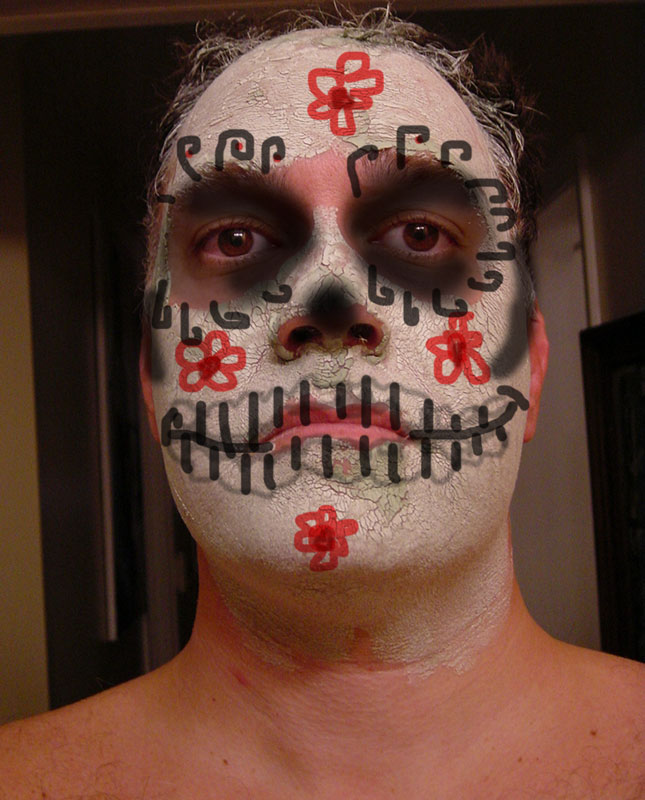
This past weekend was the Day of the Dead, a lovely Mexican tradition in which people visit the graves of their loved ones and bring a picnic to share with the souls of the departed. Patti and I loved this holiday — it combined our morbid fascination with graveyards and mortuaries with a sense of humor and cartoony festivities. I wrote about this three years ago, when thoughts of death had suddenly assumed a new and less whimsical tone.

Last Saturday, Jenny and I joined thousands of other Angelinos at the Hollywood Forever cemetery to commemorate the Día de los Muertos. It’s a huge party. There’s a contest for who can build the most impressive memorial shrine and everyone has their faces painted to look like grinning skulls encrusted with jewels and flowers.

I love that this holiday turns the traditional gloominess surrounding death on its head.  Instead of an occasion for grief, it is a celebration of the lives of the deceased. The Mexicans believe that a person dies a second death when their memory is forgotten and that makes a lot of sense to me. Immortality means you had an enduring effect on the world, that the things you did for people while you were here will be carried around in their hearts. If you set an example for others to follow, you never really pass away. I see that in Patti — because people have such vivid and positive memories of her, she lives on.

These days, I live a life that is three thousand miles from many of the memories Patti and I shared.  I am not walking the streets she did, no longer live in her house or sleep in her bed or see the people who knew her so well. I worried about that when we Jenny and I first talked about coming West, that Patti’s memory would somehow fade when I was far from the physical world she lived in.

Now I know that’s not true, because I brought Patti with me.

I brought her photo in a frame that I see every day but more importantly, I brought the part of me she created over the quarter of a century we spent together. I also believe that Patti wanted me to grow and change and have adventures. She told me so a million times,  a million times I did not hear because I was encrusted in my habits and fears. Now, when I feel the pieces scrape and shift inside me, I know that she would approve. She would be so happy that I am here, with Jenny, in this mini house, painting in this garage.

Patti was the one who taught me how to love, how to go beyond my self-absorption and love another unconditionally.  If she hadn’t taught me the importance of true love, I could not truly love Jenny as I do today. But loving again does not diminish my first love. And conversely, the bottomless well of love I had to share in my past with Patti does not mean a drop less in my future with Jenny. There’s plenty to go around. The more love you give, the more love you have. And the hardest part is learning to share that endless love with yourself, to be kind and generous with who you are.

Recently, a Facebook friend who had suffered a recent loss, sent me a few questions about my experience with death. I’ve been waiting for a reason to share them with you and DIa de los Muertos seems as good a one as any.

-How did you survive your worst sort of days?

I guess I had no choice. I had a loving wife and small son and what other option was there but to persevere? I didn’t believe in God. I didn’t believe in karma or fate. Life was shitty and I could either deal with it or check out. In retrospect, I think that my love for my wife was a key factor to my will to continue. We planned a life together and her accident was not going to stop us from being together and having a meaningful time of it.  When she died, I no longer had that to hold me together, But I had my son and my commitment to be there for him. And I had my memory of Patti and her example, the fact that she had survived a huge blow and had carried on for so long. She loved life and she loved people and I tried to absorb some of that spirit, to look on the bright side, to count my blessings, to continue to be creative. I used my art to gain perspective on the blows that were dealt me, to get them out of my head and on to the page, so I could start to put the loss behind me, and have some thing to live for. And I reached out to other people, I shared my story, I tried to make my life meaningful, and of service to others.

-Days when getting out of bed seemed impossible what motivated you?

After Patti had her accident, I got out of bed to change Jack’s diapers. He was nine months old. Life was going on. The sun was still rising and setting. There were new things to experience. I wanted each day to be better than what had preceded it and slowly but surely it did.

-What do you say to people who say things that they think are very helpful and seems to create a deeper hole in your soul?

I am glad they are trying to help and I think them for it. In each person’s story there is something useful. But I know that only I can truly understand what I have gone through.  Platitudes can be so annoying and distancing but I try to concentrate on the love that is behind them.  The fact is, people don’t really know what to say. And often it is surprising how certain people react to tragedy and change. I was amazed when people I thought had seen it all disappeared when we needed them. And I was equally amazed at people who I thought barely knew me stepped forward, rolled up their sleeves, and helped me so much.  Do not underestimate the importance of other people’s love and comfort. But don’t be disappointed if they don’t know how exactly to help.

-being blindsided… Moments or days where you almost feel normal and a smell or a texture brings you to your knees in grief. 

Yup. That’s very familiar. Grief appeared and knocked me on my ass when I thought I was long out of the woods. And it isn’t necessarily prompted by a smell or a sound, it can just pop up out of the blue.  The flip side of this is that in time those little moments turn from painful to sweet, a lovely reminder of what one has  lost, of how much it meant, of how dear it still is.  I can smell perfume, hear an Ohio accent, and be transported back into Patti’s arms.  What was once unbearable becomes cherished. Give. It. Time.

-Does it get better, Danny?

If it didn’t our species would have long vanished in a never-ending rain of pain.  Every day you make progress. Sometimes you slip, sometimes you jump forward.  It is a wound and if it doesn’t kill you, you emerge wiser and happier.  As the Buddha told us, “Pain is inevitable, suffering is optional.”

– What helped and helps you the most as you continue moving forward?

In so many ways, my life today is better than ever. It is the life Patti always wanted for me. I have changed almost every aspect of my work and my home and am now on new adventures.  My life is going on. It took three and a half years to get here.  It was worth the trip. Thank you, Pat.

— Anything other words of experience you can think to offer?

I got a lot out of The Other Side of Sadness: What the New Science of Bereavement Tells Us About Life After Loss by George A. Bonnano. He points out that 95% or so of people emerge from grief in a year or less.  And of course, I  got a huge amount of help and wisdom from my grief counselor and from my lovely and wise girlfriend, Jenny James.


Mechanical drawing.

brake lathe

So it turns out that there are some shortcomings to owning a twelve-year-old truck. Nothing major, just a reluctance to start the first time I turn the key. I spent the afternoon at my local mechanic’s garage, inhaling the heady perfume of grease and metal shavings, while he replaced some worn bits and poured in some fresh magic potions. Meanwhile, rather than watching the History Channel in the waiting room, I drew the brake lathe. My mechanic, who also likes to draw, made a color Xerox of my journal pages and hung it next to the centerfold in the office. A pleasant way to spend the afternoon. Can’t wait to go to the dentist next and draw my root canal.

Reading the manual.

desk

Recently I posted the huge drawing I did of my street here in LA. It was the culmination of a new drawing experiment I began a few weeks ago with the drawing above of the chaos on my worktable.
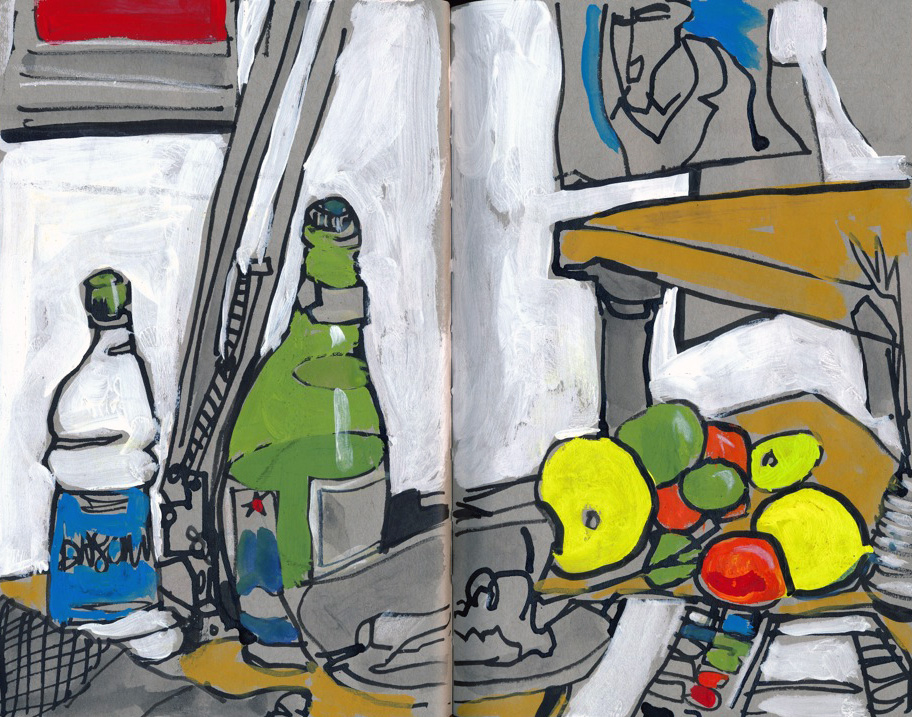
Over the years, I have played around with bamboo pens, the favored drawing tool of my old pal Vinny Van Gogh. The marks this pen makes are instantly recognizable — they have a certain roundedness to them and can be made in many thickness and degrees of blackness. My own attempts with bamboo have heretofore been disappointing; one has to redip thepen so often that it can be quite frustrating to fill a page. But recently, a chance perusal of an art manual revealed the error of my ways. Soak the pen in water for half an hour or so, it suggested, and bamboo becomes thirsty as a diabetic camel, absorbing a huge reserve of ink that can fuel half a drawing or more.
Once I had that sorted, I drew a bold outline, complete with minor variations in thickness, and was quite please with the result. Then, I decided to eschew all shading and fill in my shapes with solid gouache shapes to make a painting that was as bold as my drawing. Here and there I added a little detail and texture, but not too heavy handed. It was the sort of direct and confident drawing I have been wanting to make for ages but never quite knew what I was looking for.
One of the wonderful things about my time in the garage so far has been that I can really experiment and learn new things. I am reading more of the many art books that gathered dust on my shelves in New York. I am trying to understand the media I have been using blindly for years, improving my color mixing, understanding the limitations I often bump in to and using them to my advantage. And I am studying the work of the artists I admire most, not just for inspiration and new direction, but to see if I can figure out what they were doing and why.
I’m also taking more pleasure in my mistakes. I can afford to take a risk and then watch it go down in flames. A few days ago, I realize that the epic 15 foot drawing of the Venice canal I ‘d been working on for days was in fact a disaster. At first, I got quite depressed by it but then started to analyze what had gone wrong. By dissecting the composition, the line quality, the color range, I eventually figured out the errors I had made and how to avoid them in the future. I’m leaving the big panel up as a reminder.
God, drawing is so endlessly interesting and complex. Just when I think I have it figured out, I turn a corner into a whole new set of lessons. My garage is a lab, a school, a graveyard, a gallery, and a great place to eat a sandwich.

My other wheels.

cruiser
In New York, I had become quite used to the Citibike program, to having a fresh bicycle waiting in a rack outside my front door to drive wherever I chose. I had always assumed that in LA, I would be forced to drive everywhere — I remember from past visits that if you walk on foot down the sidewalk (where there is a sidewalk) , people look at you like you were covered with blood and dragging an axe. And the thought of toodling along on a bike where people are driving Ferraris at top speed while simultaneously talking to their agents on their bluetooth, sniffing cocaine off the dashboard and eating a double-double In’n’Out burger, well, that seemed pure fantasy.
As it turns out, Venice is something of a fantasy land. You see these bulbous beach cruiser bikes all over the place, and their riders are quite brazen. I’ve often had to yank my truck to the curb to avoid some blithe hipster, high on prescription marijuana, talking on his iphone while driving the wrong way up the middle of the road. People never wear helmets or pay attention to stop signs and generally make New Yorker cyclists look like uptight, law-abiding novices.
A friend lent us a cruiser of our own. So far, I have ridden it once and drawn it twice. It’s just not my thing. It would seem too ironic to get run over here in L.A. on a big girl’s bike. To hell with that, I’d much rather go out in a spectacular car crash like James Dean or Jackson Pollock.

My colleagues.

hangdog
I’ve always envied people who could bring their dogs with them everywhere. Old coon hounds sitting in the back of a farmer’s pickup. Fashionistas with their Pomeranians in their purses. Airport cops with stoic German shepherds on short leashes. Hip entrepreneurs writing code in old warehouses, with mixed breed companions named Woman or Copernicus or 8-track sitting under their Ikea worktables.
Finally, I have joined their ranks. Every morning, my hairy coworkers report to the garage with me. First, they make sure no one has accidentally left any bacon or chicken bones on the floor during the night, then flop down to supervise me while I work. That supervision is very trusting as Tim and Joe generally fall asleep within minutes and leave me to carry on unattended.
slumber honds
Every hour or so, something or other will pass outside our fence and they will leap outraged from their slumber and hurl themselves down the drive to bark angrily through the cracks. Then, huffily, they strut back to their stations, exhale indignantly and return to dreams of New York sidewalks and slow moving cats.
If I have to go into the house to freshen my martini or buy another ream of typing paper, they escort me to the door and wait by the kitchen steps. When I return, usually seconds later, they are delirious and insist on asking me all about my absence. Then back to bed. I mean, work.

Thinking outside the books.

gallery garage

A canary sits in its cage, gazing through the bars. Year after year, it watches the world beyond and dreams. One morning, it notices that the cage door is open. The canary catches its breath and waits to see when it will close.

Eventually, the canary hops onto the edge of the door and pops out of its cage. It flies around the room, sits on the back of the couch, perches on the bookshelf. An hour later, it returns to the cage and goes back to gazing through the bars, dreaming. The door is still open. So is the window beyond.

Freedom is not easy. Security, comfort and familiarity are.

……..

Many birthdays ago, long before I had the habit of drawing, my mother and my sister chipped in and rent me a studio for a month. It was the most terrifying gift I had ever received. I went down to Desbrosses Street in Tribeca, and walked into the studio. “Mine, all mine,” I muttered under my breath. The room was about fifteen feet square and empty. I took out a pad and a piece of charcoal and wrote about how I felt having studio all of my own. I filled several pages with writing in charcoal, taped them to the wall, and left.

I came back a week later and made a small collage from cut-up pieces of magazine. I taped that to the wall and left. A week after that, I drew colored lines on the collages with a highlighter marker. The final week in the studio, I brought in a photo of my grandfather and a large canvas. I painted a very bad copy of the portrait onto the canvas. At the end of the day, I left the canvas, the collage, and the charcoal writing on the studio, locked the door, and never went back.

……..

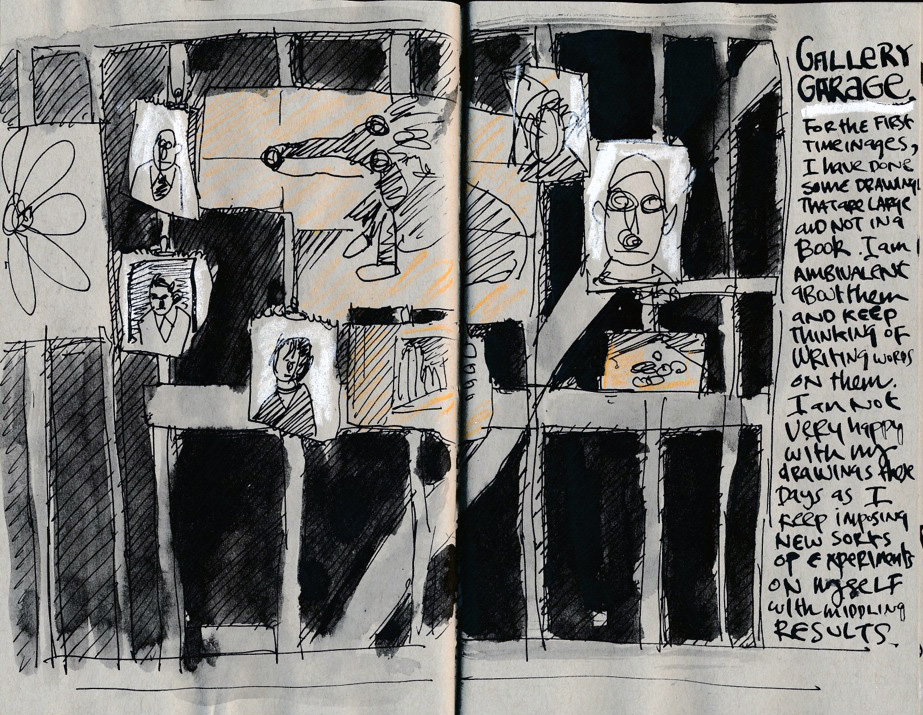
When I arrived in Los Angeles, I had planned to work in the second bedroom of our house, to sit at a small desk in the corner and write my new book. Then I saw our two-car garage, 300 or so feet of emptiness. Like the garage, I stood with my mouth wide open. I spent the first week, filling it with tables and shelves and cubbyholes.  I spent the second week sitting at my desk, writing my new book and rearranging bottles of ink. Occasionally I would draw in my journal, using a fountain pen and a white pencil.

I spent the third week thinking. I realized had managed to reproduce my office in New York. I had a lamp, a rug, a laptop, a phone, a box of thumbtacks. I ate lunch at my desk and surfed the web. I was even filling my calendar with a record of my daily doings in case I had to fill in timesheets at the end of the month. All that was missing was a couple of account executives and a client.

So I went to the art supply store and bought whatever I wanted (if you remember my old essay, “Art Supply Porn“, you’ll know my fantasies are legion). At first, however, that just amounted to a few tiny palettes for gouache and a bottle of ink. Oh, and a block of 14 x 17” mixed media paper.

Back in my empty garage, I opened the block and did a tentative self-portrait in ink. This simple act I was breaking one of my cardinal agreements with myself. I was making drawing, with no writing , that was not in a book. No wonder the self-portrait looked like I had just eaten something bad. Then I did a gouache painting on the block and pinned it up next to the self-portrait. Then in a fit of pique, I got a house paint brush, dipped it in inks and drew a huge painting of Tim on the back of an empty Ikea box.

I felt slightly winded and rather nauseated. I took out my journal and told it what I had done, revealing my betrayal and the dim feelings I had about it.

The next day, I bought a 64-box of Crayolas and some tempera and did a wax resist portrait. Then I did some more gouache paintings, then a painting of the back of the house in poster paints on cardboard. Soon the garage wall was full.

michael-ave-hi-resAThe following week, I sat on the corner of my street holding the fattest Sharpie I could find. On a big sheet of cardboard, I drew the house across the intersection. When I had filled the whole board, I went back to the garage and got another piece of cardboard and continued the drawing, a big, grubby, dog-eared diptych.

michael-ave-hi-resBThe next day, I continued the drawing, working my way down the street. When I was done, it was eleven and a half feet wide. Then I added gouache, creating a cheerful portrait of another glorious day in my new neighborhood. Just as my hero David Hockney was transformed by the California sunshine, I felt a call to use candy colors and bold lines and to work as big as all outdoors.

michael-ave-hi-res
Click to see it bigger.

Now I am working on a drawing that is as big as my garage wall, fourteen feet in all, a broad panorama of all the crazy houses arrayed along the Venice canal. I even added a gondolier.

My sketchbook now looks a bit small and grey but, despite my sudden expansiveness, I love it still.

If you are getting little set in your ways, check out the door of your cage. The world is wide and a little terrifying, but it’s wonderful out here.  You don’t need to chuck your job, your home and all the rest, but try flying around the living room a bit and enjoy the view. There may be a cat out there, but if you fly high and far, you’ll be safer than you are trapped in a cage with an open door.