A hut of my own.

hans and peter 1

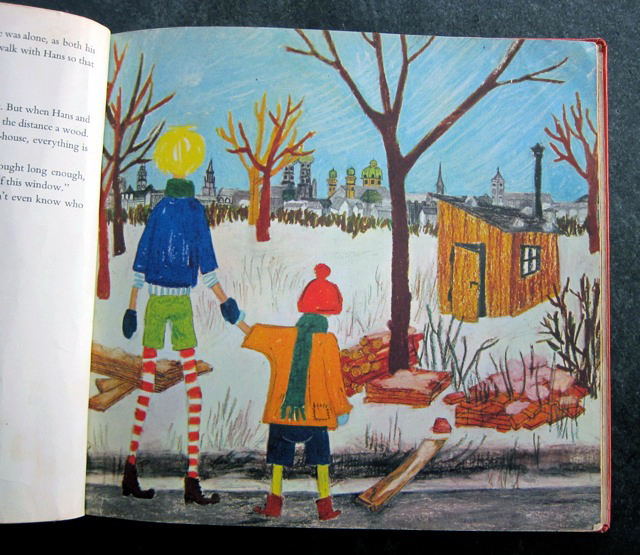
There was a book I was just obsessed with when I was eight. It was called Hans and Peter by Heidrun Petrides  (originally Swiss, “Der Xaver un Der Wastl“)and it told the story of two boys who find an abandoned workman’s shed and convert it into a playhouse.

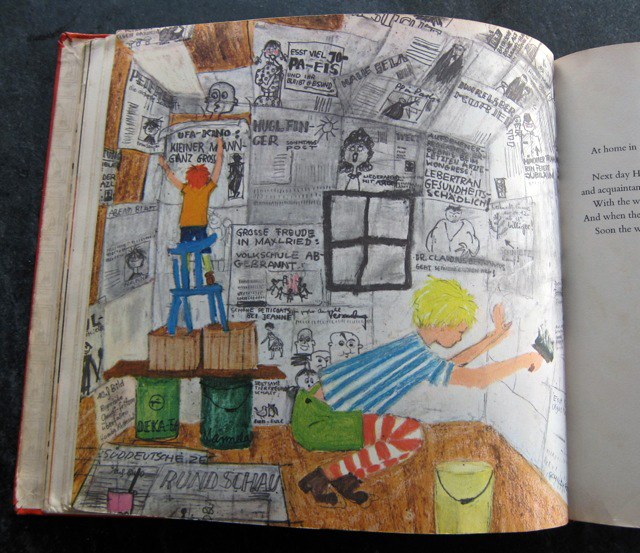
hans and peter  2They cover the walls with newspaper and then whitewash it, they install an old wood stove, they plant geraniums in a windowbox, and make gaily colored curtains. The book was Swiss and had bright pastel paintings on every page (they were done by a 15-year-old girl!).

There was just something about this idea, of these boys making their own house, that was incredibly appealing to me.

hans and peter 3I guess it’s the same instinct that had us building forts out of sofa cushions and making a pirate ship out of the linen closet. I yearned for a treehouse or a tent or an empty refrigerator box — something domestic I could call my own.

When I was nine, I was sent to live with my grandparents in Pakistan for a couple of years. I had gotten a small tool kit for my birthday and when my grandmother promised me my own small patch of land in her garden, I had intense fantasies about using the tools to build a shed with a padlock at one end of my acreage. I was enormously disappointed when I arrived in Lahore and my grandmother pointed to a bed of snapdragons and said, “That can be your garden, Danny. You can water it whenever you want.”

The only apartment I ever had entirely to myself was my first one on Clinton Street in the Lower East SIde. It was the most dangerous neighborhood in the blighted New York of the early eighties but I was incredibly proud to have my own minihouse. I built a loft bed, a couch and cupboards, then upholstered them and sewed pillows in fabrics straight out of Hans and Peter. A year later I was gone from the ‘Hood and living with roommates, then Patti and I moved in together, and now I live with Jenny in this microhouse in Los Angeles.

However after all these years, I have finally achieved my Hans and Peter fantasy.

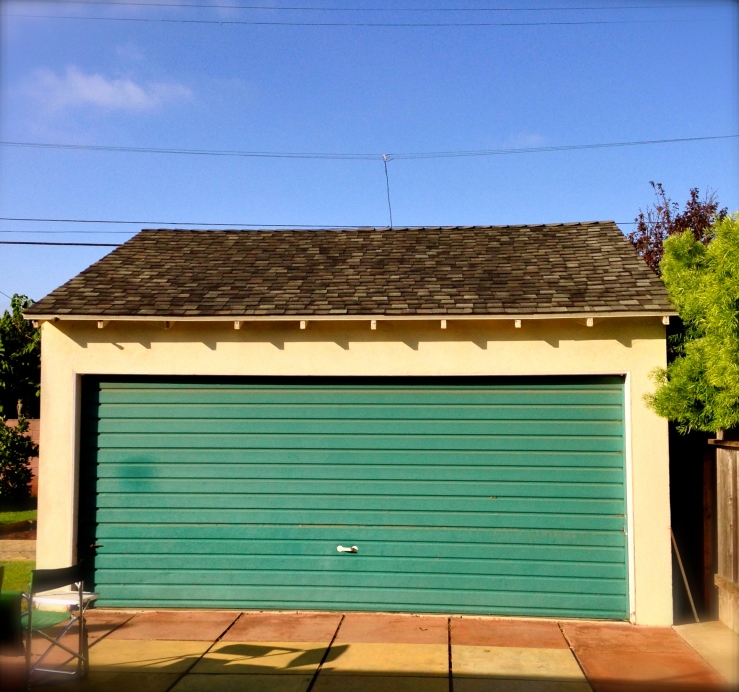
IMG_0126Our house has an old two-car garage, built in the 1940s and made of wood with a big swing-up metal door. Since the day we arrived in LA, I have been busily turning it into a studio of my own, a cubby house, a man-cave.

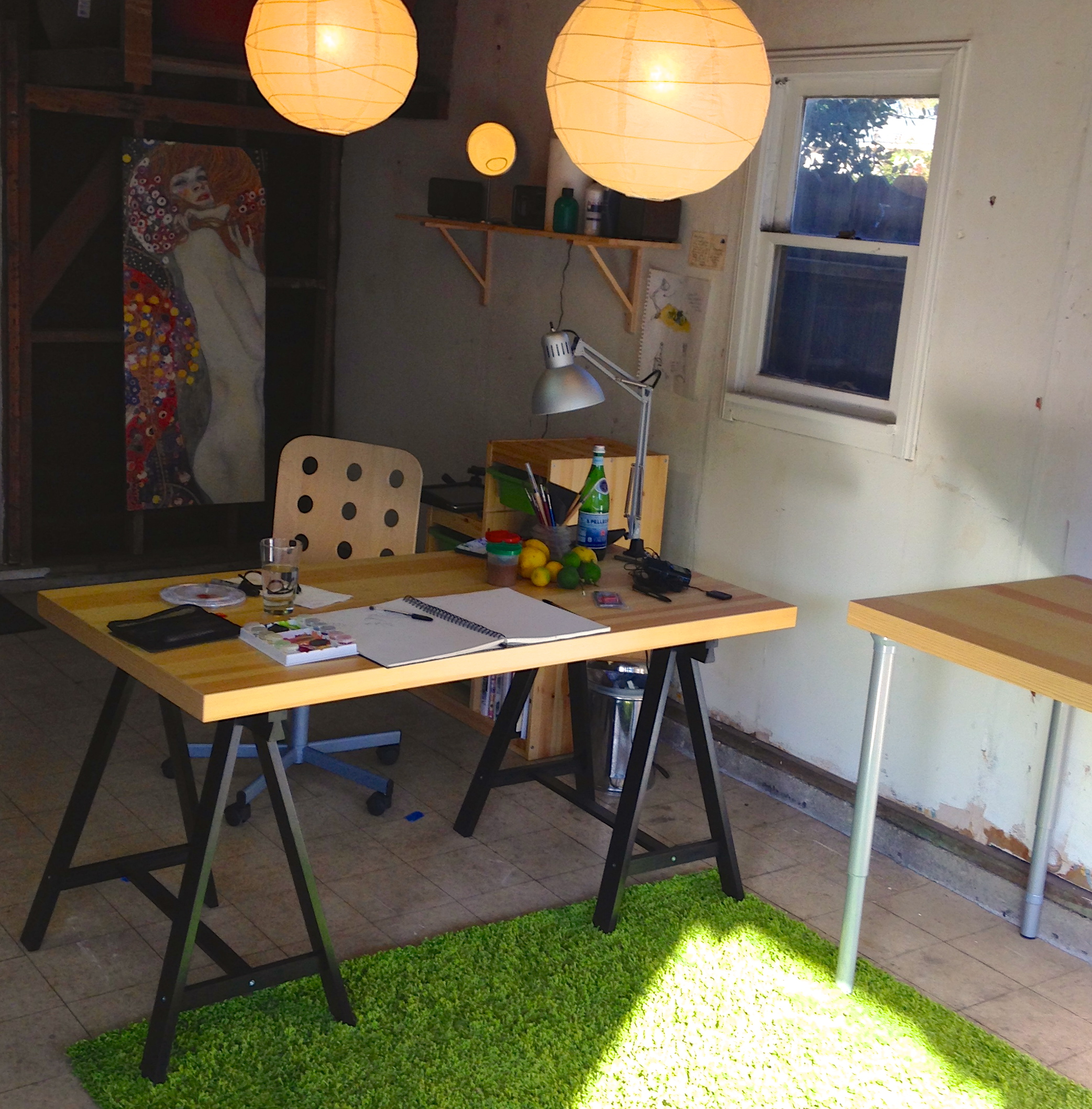
IMG_0117I spent a day on my hands and knees scrubbing the floor, half chipped lino, half cracked cement. Then I built myself shelves, tables, and drawers to hold all my paints, pens, inks, and journals. I installed lighting, a sound system, and a grass green shag rug for the dogs to lie on while I work.

IMG_0116Slowly, I am filling the walls up with paintings — the first I have done in ages that are not in a small book.

It’s wonderful. I can work any size I want, a true luxury for someone used to painting in the space between my laptop and the edge of the dining table. I can work on a project, then at the end of the day leave it out, and resume work the next day. I can shoot videos in here and completely control the lighting and the sound.

I am realizing that my whole approach to art — small books, tiny watercolor sets, etc. — is probably a function of having had so little space and time. Who knows where this newfound freedom may lead?

Going Dutch.

Amsterdam-16

Holland is the birthplace to so many artists I love. Vermeer —the original everydaymatters artist, who painted tiny moments that take my breath away. Van Gogh —the greatest self-taught artist of all, who captured the world around him and imbued it with his passion and nuttiness. Rembrandt —who was so amazing at capturing light that I scarcely bother to be inspired by him because he was on a an unreachable plain. Anne Frank —who made a humble daily journal into an immortal art piece and, despite all her hardships, said “Everyone has inside of him a piece of good news. The good news is that you don’t know how great you can be! How much you can love! What you can accomplish! And what your potential is!” 

And of course, there’s Mondrian, and Bosch, and van Eyck and De Kooning and Paul Verhoeven…

And the museums! The Rijksmuseum, the Stedelijk, and the Van Gogh , which just reopened after decades of renovation.

And then there’s the cheeses, the chocolates, the Stroopwaffles, the tulips, the prostitutes, the drugs, the wooden clogs, the windmills, the dykes, the canals, the bicycles, the ladies scrubbing their doorsteps. For a country with barely twice the population of New York CIty, it’s bursting with clichés.

I am waxing rhapsodic about the Netherlands today because I have booked my tickets for a week there in mid-November. Not the loveliest time of year to be there perhaps but I did not choose it. I was invited to be a keynote speaker at the conference of The European Council of International Schools and to tell several thousand teachers of the wonders of illustrated journaling and how it can help inspire and educate the yoots of today.

Patti, Jack and I went to Amsterdam eight years ago and had a lovely time as tourists. Now I am hoping to augment my speechifying and museum going with a few encounters with Dutch sketchbookers.

If you or someone you know can fill me in on the drawing scene there or introduce me with some people who like to draw, I would be most grateful. Or, failing that, you can just recommend a decent Indonesian restaurant or a “koffiehuis“.

Welcome to America!

When I was twelve, I took a ship across the Atlantic and, after weeks at sea, finally saw the arm of the Statue of Liberty poking through the early morning mist. Upon descending the gang-plank, I bought my first-ever can of Coca-Cola from a Sabrett stand on the pier. It tasted like America and. for the next four decades, that’s where I thought I was living. 

Now, after traveling 3,000 more miles, I’ve realized I was never actually in America — I was in a completely different country called “New York”. And now, finally, I’m in the U. S. of A. It tastes quite different.

In New York, if you need groceries, you go across the street to the corner deli. In a cramped room, you will find a fridge full of beer, some shrink wrapped fig-newtons, a lottery ticket machine, and way behind the counter, a recent immigrant who will barely acknowledge you as he takes your money.

In America, there are enormous buildings called “Costco”. In New York, such a building would be called “Madison Square Garden.” But here, it is filled with palettes of merchandise stacked to the distant rafters. And what merchandise! Many of the brand names are familiar but the products themselves seems to have been manufactured for giants. Twenty-five pound bags of jerky. Seventy-two rolls of Brawny paper towels, in a bundle the size of an East Village duplex.  Need some AA batteries? Here’s a footlocker full of 500. A bucket of Vitamin C tablets, an entire side of beef marinated an shrink-wrapped. I felt like Gulliver amidst the Brobdingnagians. I staggered around for an hour and a half and walked out with a box of hangers.

In New York, if you need to get somewhere, you walk there. If it’s far, you go down to the subway or hail cab. In America, you drive your own car. Everywhere. To Costco, so you can haul home your plunder. To the gym, so you can walk on a treadmill. To the mailbox, so you can collect your Costco coupons.

Now, I know cars and I know how to drive. I got my license at 25 so I’d have proper ID. But when we arrived at LAX with several big suitcases, Jenny went to Hertz and rented a Ford Explorer which is essentially an 18 wheel-truck with cup holders. Every day, I have chauffeured her to her new office and then I have spent the day setting up our house, unpacking boxes, filling the pantry, going to Home Depot and IKEA (oy!) and building my new studio (I’ll tell you more about that next time).

All of my chores have had me glued to my Neverlost GPS device and dragging up and down the 405, which is like the Nile, the Yangtze, and the Amazon only covered with asphalt, amphetamine-addled truckers, and Mexicans in pickup trucks delivering lawn mowers. Everyone slaloms back and forth across lanes, while I squeeze my fingertips deep into the Explorer’s leather steering wheel. I am in an advanced yoga class of some kind — one ear cranes towards the clipped orders of the Neverlast lady, the other twitches at every honk and siren, one eye is on the swarming lanes ahead of me, the other darts back and forth between the various mirrors and monitors arrayed around the vast landscape of my car’s interior, sweat courses down my ribs, my right foot dribbles back and forth across the pedals, now lunging toward the accelerator, then jerking to the brake.

On one horrific trip back from IKEA, somewhere near Mexico, I realize that I have ordered and paid for a gigantic stack of lumber that they laughingly called a shelving unit and in my frenzy and disorientation I have managed to leave it behind at the store. The Neverlast lady sullenly tells me she is recalculating as I exit the freeway only to be ordered to do a U- turn and head back to the distant blue store over the horizon. In New York, incidentally, you had to rent a car and then travel to another state or borough to get to an IKEA. Here in my new American city, there are five different ones, all crammed with those 3-D jigsaw puzzles with made-up Swedish names.

In New York, you are never more than seven feet away from another human being. Literally — above, below, or on one side of you, there is alway somebody. Somebody who is blasting their radio or calling the cops or getting drunk or clog dancing. In America, you can sit in your home and hear … nothing. You can walk down the street, and see … no one. My dogs are so confused by the silence, they sit on the back yard with cocked heads and looks of utter disbelief.

In New York, you put on your coat and your scarf and your hat and a sweater or a coat and a harness and maybe a muzzle and rubber booties on your dog, take a stack of newspapers and bundle him in to the elevator, travel down to the lobby, through several sets of doors and finally onto the sidewalk. Then you drag him away from chicken bones, abandoned big macs, broken glass, pit bulls, and sleeping homeless people. When he is finally ready to relieve himself, you scoop up the offering in the paper under your arm and drop it in the corner garbage can. Then you head back, hoping you have your keys.

In America, you can just open that back door and your dog runs out onto your gigantic lawn and pees while you stand in the doorway in your underwear holding mug of coffee.

In New York, you sprout an avocado pit and put it in a mayo jar on the window sill. In America, you have lawn mowers you can ride and lemon trees and orange trees and mandarin trees all groaning with fruit and your for th taking because they are growing in your own yard!  Two nights ago, Joe and Tim walked across our neighbor’s front yard and Jenny said, “What’s that weird sound they are making?”, a sort of swishing, crunching sound as they walked across the impossibly, perfectly manicured grass. I bent down to feel it. Astroturf.

In New York, if your clothes are dirty, you put them in a bag, and take them to the laundromat on the corner where a lady shrinks and mangles them for you for ten bucks. In America, you interrupt your writing for two minutes, walk to the laundry room, take them out of the dryer, fold them and go back to your blogpost.

So far, I find America lovely and exhausting. I have to rethink so many basic things — walking, eating, slices of pizza (I have yet to see a single pizzeria in America). Even though I have visited LA many times, living here is a whole new kettle of balls of wax and fish. And so many things I thought were basically made up or exaggerated in the movies and on TV are all around me all the time.  Jenny, who grew up in Arizona and lived for nearly a decade in LA is quite used to America and rolls her eyes at my epiphanies and at my apparently dreadful driving.

With all of the new experiences I’ve had exploring America this week, I haven’t made a single piece of art. But next week, I can’t wait to begin my travel journal in earnest.

Okay, I have to stop now as tonight we are going to the movies. In America, they have movie theaters in which they bring you dinner and beers while you are in your seat watching the film. This I gotta see.

Westward weiner smuggling.

weiner smuggling

I’ve been in this town for forty years, in this apartment for sixteen. I have my favorite deli, pizzeria, subway line, barber, newspaper, baseball team and proctologist. In 72 hours, I’ll be packing my hounds into bags and taking them to our new home in LA. Hello, white space.

These have been times of change. In the last few months, I redid my apartment and started living with my girlfriend, then decided to pull up stakes and move to LA, left my job, started some super exciting new projects, got a new book contract, spent the summer with Jack, then he left again, I started watching Real Housewives, drinking green juice, drawing with a pencil, and parting my hair on the right — the list goes on. If this is mid-life, I guess I’ll live to be 106.

My life has always been marked by change ever since my parents split before I was two. I have lived all over the world, had calamities that reshuffled my deck several times, and more and more craved stability and consistency. I hated change and wanted to just be left the hell alone. But as I age I have realized that there is no such thing as consistency. Change is inevitable and it’s good. Even more so when you have some say in it.

Now, at last, I have control over my karmic checkbook. And I am mixing it up, folks. I may even get my eyebrows threaded. Stay tuned. We fly west on Sunday night.

Out of the mouths of sophomores.

20130909-083234.jpg
Yesterday was a bittersweet day, driving up to Providence to help Jack move into his dorm and begin his sophomore year at RISD. Bitter because I am losing my boy again after we had a great summer together, spending a lot of time hanging out, making things, watching lousy movies, and drawing. Sweet because he was so excited about starting the new year, his first as a painting major, raring to get to work. He read several influential books this summer: the recent biography of David Hockney by Christopher Simon Sykes, Lives of the Artists by Calvin Tomkins and Patrick O’Brian’s plump biography of Picasso. They combined to give him a sense that he better get on with it, that Picasso was already an acknowledged genius by nineteen.
One of the many nice things about having a kid who’s also an artist is the impromptu discussions we have about all sorts of art-nerd stuff — meaning in the arts, the roles of galleries, the pros and cons of acrylic over oil, the best way to crosshatch, whether or not Jeff Koons is an idiot, and so on. I feed off his enthusiasm and will sorely miss him, though he’s only a text message away.
On the drive up I-95, we were talking about line quality. I was pointing out to him that when I want to do a ‘good’ drawing, I slow down as much as possible, striving for accuracy in my line lengths and angles, but that when I step back from a drawing done super slowly like this, it can sometimes seem cramped and without expression. When I look at a master of the drawn line like Egon Schiele, there is so much confidence and sweep in his line and I know it was turn in a broad, swift stroke, not a cautious micromillimeter at a time. For me, the real essence of a great drawing is the quality of the line. An imprecise drawing that is full of life and personality is infinitely better than a stale xerox.
Jack’s response was that you need to put in the time making cramped and crabbed drawings in order to develop the confidence to draw like Schiele. That you shouldn’t sit down to make a ‘good drawing’ but just be in the moment. It may turn out well or not but it’s all about doing the ground work and then letting yourself go.
He’s right. If you want to play Bach, you need to do endless fingering exercises. You need to slow down your golf stroke and study each inch of it before you can connect with a masterful drive. You need to train your neurons and your muscle fibers and to train them to be accurate. Doing lots of hasty drawings will just frustrate you in the long run. It’s like driving, you have to start slowly in the supermarket parking lot, inching around orange cones, before you can take the curves at LeMans.
Unfortunately, this can be frustrating if you are counting on amazing results right away. It can take years to have a completely sweeping line. And even if you do get that confidence after loads of practice, a few weeks of not drawing can cause serious backslide. You have to come back, warm up, start again.
However, there is pleasure even in these slow, inch-worm drawings. They are precise, they are accurate depictions of what’s in front of you and there’s a certain satisfaction in that. Next, to raise it up to the level of high art, to draw it with feeling and a sense of abandon.
It takes years to raise a boy to be six foot three and so smart. It takes confidence to drive away and leave him in Providence, RI and know he’s going to do his best.

Perfect!

fighter

I have been mulling over giving an online class since mid-Spring, when a number of people wrote to me to say that they couldn’t come to my workshop in the Berkshires and asked if I’d consider doing something on the Internet instead.

First, I did a bunch of research and talked to friends who are great teachers like Jane LaFazio and Andrea Scher and Brenda Swenson and Roz Stendahl. I had technical concerns and had to figure out the best platform, then I had to decide what the class would be like and about.  So I futzed around a lot and made very slow progress, especially for me, a person who tends to barrel into things like a bull in a china shop.

Recently, I got an email from a guy who runs workshops and manages a major teaching platform and he was asking me (well, not really me but anyone on his email list who had expressed some interest in his program but hadn’t gotten around to launching a class) what the hell I was waiting for. His question was about perfectionism, wondering if I was so intent on making the class perfect before I open it up that I might never get around to doing it at all. And he had a point — I do want it to be as good as it can be even though it’s the first time. In fact, because it is, as I assume that if it’s half-assed, no one will be back for the second better one I do, and my ambitions will be thwarted on the launch pad.

Anyway, in needling me about this he said :

“As you sit on the sidelines, waiting for the “right moment”…
People who NEED help are MISSING OUT on your unique information, your potent coaching, your ability to encourage and support, your brilliance.
People are missing out on opportunities to grow, to develop, to learn new skills, to seek happiness…

… In Judaism (my heritage), there is a beautiful idea called Tikkun olam, which means “healing the world.” Tikkun olam evokes  humanity’s shared responsibility to heal, repair and transform the world. It gives meaning and purpose to our individual strivings, putting them in service of a greater good.
You could be helping to heal the world.”

Well! That’s a far loftier ambition than I had — I certainly don’t think I am on the verge of healing the world or anything like it. But I acknowledge that every day my class isn’t out there, someone may not be learning whatever the hell it is I have to teach them.

However, I have been thinking about his point in a different context. What happens when one is so fixated on perfection that one never begins? Never begins drawing. Never begins making stuff. Never begins pursuing any sort of passion for fear of not being able to do it incredibly well. Nothing you do will be good enough even for you.Why bother if you can’t be great?

A variation is fiddliness. Constant reappraisal, erasing, tweaking, reconsidering. Taking your drawing into Photoshop and cleaning it up, coloring it, recoloring it, sharing ten versions of it, asking for comments, on and on, never done, never good enough.

I love James Lord’s book on Giacometti in which he describe sitting for a portrait in his studio for weeks which he paints it over and over, only stopping when his gallery owner shows up and forcibly drags it away from him. The book contains reproductions of each day’s work and, honestly, he could have stopped after a day and had a decent painting, but he goes on for ages, always dissatisfied, putting himself down, rethinking the idea, scraping it down again and again. Giacometti was the same with his sculptures, paring away at them so they kept getting thinner and thinner, until they were barely there. Maybe his perfectionism made him great. Or Swiss.

One of the problems with perfectionism is that you think you can conceive the destination before you embark on the journey, that you can plan it all out in advance, and that nothing else can intrude and change the outcome you have conceived. But, first of all, the world doesn’t work that way; unless you are doing something extremely simple and banal, something you can actually hold in your brain all at once, it will invariably intrude and change your well-laid plans. And, secondly, you should welcome that intrusion. The accidents, mistakes, serendipities and ink splatters that the universe throws in your path make your work and your life more interesting. Perfection isn’t organic. It can be constipated and lifeless.

So, be forewarned, my class isn’t going to be perfect. Fat chance of that considering that I am behind it. But I do at least want it to be good, not slapdash and reasonably thought through. So I’m working on it everyday and hope it will be good enough to go soon.

Meanwhile, if you are waiting to make stuff because you haven’t got the perfect pen or book or subject or teacher, get over it. We all make shit every day. If we didn’t, we’d die. Or at least be really cranky.

Short story long.

politcians

“Whether he is a sinner I do not know. One thing I do know, that though I was blind, now I see.” — John, 9:25

My grandfather grew up in  a small village in Eastern Europe and this was one of his favorite stories:

A peasant comes to the village wise man and he is very upset. “My house is far too small for my family. It’s dark and small and smells of cabbage but I am too poor to afford a bigger one,” he complains.

The wise man strokes his beard for a minute and then says, “Do you have any chickens?”

“Of course I have chickens,” replies the man. “What sort of self-respecting Eastern European peasant do you think I am? I have six chickens and a rooster.”

“Bring them into the house and let them live with you,” says the wise man.

“What? That’s insane…,” the man says. “Chickens in the house?”

“Do it. Then come back in a week and tell me how things are going.” says the wise man and turns back to his book. The peasant leaves, grumbling.

A week passes. The peasant bursts into the wise man’s house. The wise man, not looking up from his book, says, “Well, did it work?’

The peasant explodes: “Of course not. It’s a disaster! There are chicken feathers and chicken droppings everywhere. And the house is even more crowded! We’re miserable.”

“Do you have a goat?” asks the wise man.

“A goat?” fumed the man. “Well, yes, we have a big, smelly goat.”

“Excellent. Bring the goat into the house. See you in a week.”

The peasant leaves, shaking his head with disbelief. He’s back five days later, frantic. “What have you done to me? My life is a nightmare. The goat ate my wife’s best babushka, the chicken have taken over my Barcalounger, and our house smells like a Warsaw subway men’s room.”

“Excellent,” says the wise man. “Your cow — bring her in next.”

“The cow? The COW?! She’s huge! I doubt I can even get her in the front door.”

“Do it.” The wise man dismisses him with a wave of his wrinkled hand and returns to his book. The peasant, his face turning an even more dangerous shade of vermillion, stalks out, cursing under his breath.

When he returns, his hair is dishevelled, his coat is spattered with chicken droppings, a goaty smell emanates from his overcoat, and cow dung’s on his boots. He doesn’t complain, he just stands there, broken, tears cutting a path down his grimy cheeks.  The peasant is clearly at his wit’s end. The wise man looks up and smiles. “Very, verrry good,” he says. The man gulps back a sob. A chicken feather drifts out of his beard.

“Now,” says the wise man, “For the most important step. Take all the animals — the chicken, the goat, the cow —and drive them out of your house. Get them all out.” The peasant merely shrugs hopelessly, then turns and shuffles out of the wise man’s house.

The next day, he’s back. He’s transformed. His eyes gleam, he stands tall, his energy has returned. “How is your house then, eh?” asks the wise man, a twinkle in his rheumy eye. The peasant grabs the wise man and kisses his leathery cheeks. “We drove out the chickens, the goat and the cow and now … it’s huge! It’s a mansion! It’s clean and bright and we are so happy. At last! You are a genius!”

Anyway, that’s my grandfather’s sort of story. It came to mind yesterday evening as I sat in the bleachers behind home plate and watched the Brooklyn Cyclones lose abysmally to the Aberdeen Ironbirds. I had one hand cupped over my left eye and a smile as broad as the peasant’s on my face.

Five hours earlier, it being a close and muggy afternoon, I had taken my Kindle and a single dachshund to my bed for a nice Saturday afternoon nap. I’d had a fairly rough night’s sleep, and was a little wracked with self doubt, missing Jenny in LA, and just generally feeling unnecessarily sorry for myself.

I awoke an hour later, groggy and sweaty. I had been sleeping face down and I was especially bleary-eyed. I staggered into the bedroom and splashed on some cold water. I saw a big crease running down my face, from my forehead to my cheek. My vision still seemed bleary so I splashed on some more cold water. I looked out the window and I could not focus on the view. The vision in my right eye was really blurry.  I covered my right eye and everything seemed fine but when I did the same with my left, the buildings down West 3rd street would not get sharp. I rubbed it some more. No change.

I waited. Ten minutes. Then half an hour. No real change. Clearly I had done something awful to myself in my sleep. I had been lying on my eyeball and somehow strained it or compressed it or worse. My hypochondriacal monkey had several helpful suggestions. Maybe my vision would never come back? Maybe I would be permanently blind in one eye? Maybe I’d had a stroke?

Jack and I left to catch the F train to Brooklyn to meet my sister, her husband and kids at MCU stadium to watch the Mets minor league franchise play Baltimore.

The ride to Coney Island from the Village is about 45 minutes long and I spent a lot of it in a minor sweat, my bowels liquid with worry. The monkey kept me company. Wouldn’t it be ironic if just as you decided to focus on art full time — you couldn’t focus at all? Maybe you’ll have to wear an eye patch? Maybe you’ll end up with a guide dog? Now you can really do blind contours! Ha, ha! 

The train comes above ground once you get to Brooklyn and I kept alternately covering my eyes to peer into the distance.  As we reached Avenue X, now an hour and a half after I’d woken up, things maybe, possibly, seemed to be improving. If I just used my right eye, it slowly began to focus on the housing projects in the distance. Then if I uncovered both eyes, it took a minute for them both to adjust. It was wonky but it was changing.

We got off the train on Mermaid Avenue and proceeded immediately to Nathan’s to fortify ourselves with some medicinal hot dogs and fries. I kept testing my vision. The Cyclone, the Ferris wheel, the boardwalk, came into view. I could see details of the half-clad bodies on the beach. Folds of sunburnt flesh, bad tattoos, back hair, varicose veins, details that now looked gorgeous to my worried brain. I realized that the waving blob by the stadium was actually my sister and my nieces. Over the course of the first few innings, I saw the team’s mascot transform form a fuzzy, white shape ( a snow man? An ice cream cone? A thumb?) into a giant-headed seagull, prancing around the diamond.

By the time the Cyclones started to lose badly, I was agog at how beautiful the evening looked. The sky was lavender and fuchsia. The parachute jump was wrapped in a delicate skein of twinkling lights. I could read the signs on the bumper car track, count the bulbs on the scoreboard, see every kernel of popcorn on that large man’s lap near first base. Brooklyn was the most beautiful place on earth and I was, yet again, the luckiest man alive.


Whoops.

hoho

Sorry if you got a link in the mail last night that then fizzled. You can read the post by clicking here.

The art of time management

calendar

When you punch a clock, even a gold-plated, corinthian-leather-encased execuclock, your time does not belong to you. You have sold it and the highest bidder can do what he wants with it. He can use it to make wonderful things that will improve the world or to get him coffee and scrub his bowl. You can gripe, you can whimper, but you have punched that clock and now it is going to punch you back, suckah.

These days, my time belongs to me, the new boss, same as the old boss. And I insist that this time I have bought back gets used properly, to the last tock of the ticker. There will be no lolling on the midday couch, no leisurely lunches or bowel evacuations, no navel gazing or whittling of any kind. Every day must and will be filled with productivity.

Now, because I am currently an “artist “(it says so on my LinkedIn page, so it must be true), I am allowed some wool gathering and beard stroking, so long as it is clearly being used to hunt down that pesky muse, drag her to the altar, and squeeze every last drop of creative inspiration out of her. That requires scrupulous documentation.

In the image above, you can see a page from my weekly calendar. I find it essential to structure my day so the hours don’t slip through my fingers and dribble out the door. I insist on logging what I do all day, as if I was still filling out timesheets. One simply must have a clear record, nicht? Otherwise, I might end up cracking open my first six-pack right after breakfast and playing the bongos all day in Washington Square.

So I log my hours and I color-code ’em too. Pink is personal time, hanging with friends, reading on books, kissing my girl, walking my hounds, discipling my boy.Yellow is what I now call ‘work’: drawing, painting, writing, making videos, stuff I used to call ‘fun’. And blue is old school, freelance writing and consulting projects for clients I am still connected to after all those decades in the salt mines. Those blue hours are the lucrative ones, folding-money-wise, but they also cost me the most. My heart is no longer in them though the monkey keeps picking up the phone and signing new contracts. But in my pink hours, I spend time scheming on how to get the blue hours down to a precious few. And I think I’m winning. Slowly but surely my calendar is shifting hue and by the time I’m in LA, I’ll be out of the blues for good and all.

I have had a lot of fun with the yellow hours this week. I have made a half dozen videos for my upcoming class and I am really hitting my stride. I am happy with how they are turning out and I hope you will be too. Another big addition to the yellow column is a new book — my lovely editrix, Bridget, just told me that the acquisitions group at Chronicle is really excited about my proposal and we should have the details of the contract hammered out any day. Then I have to get serious and write and draw it. I think my deadline is sometime in the spring. It’s going to be a humdinger.

20130829-231238.jpg
Pink is getting busy too, Jack and I spend two half days painting his room. You can imagine what a room that a boy has lived in for almost every one of his 19 years can be like. Instead of painting, I thought of calling in one of those companies that clean up crime scenes. I haven’t painted a room since I was in my twenties but it’s not a skill you forget and we had a great time working together, listening to music, cracking jokes and getting paint in our hair. Being Gregorys we managed to get splatters of white paint on the blue wall and blue paint on the ceiling but when we were done and exhausted to the bone, we agreed it looked amazing, like a real grownup room again.
Soon we will both leave our apartment for a good long while, meeting up again here at Thanksgiving and in the meantime we’ll have memories of a great summer, and of lots of time well spent

Big data

20130824-180221.jpgInformation. The world is just jammed with it. I’m not talking about Facebook posts and texts from your besties; I mean the sort of analog information that is constantly flowing into the holes in our head and all over our skin.

But how much exactly? What would be the equivalent in terms I am familiar with — dpi, mexagpixels, gigs, etc.?

Well, the Internet has loads of answers but none are really definitive. The best I can make out is that if our eyes were digital cameras, they would each have the equivalent of around 600 megapixels and the resolution of the images we receive is about 530 pixels per inch (as a reference, the resolution of images we get on the internet is 72 dpi). Our ears are also constantly receiving sound data, and we can distinguish differences in the ~160kbps range.  Our skin can feel vibration, touch, pressure, temperature and of course, pain. We have 20 square feet of skin, all studded with zillions of receptors — Our fingertips alone have 2,500 receptors per cm2.

In short, our bodies are getting a huge amount of data every second. A commonly quoted estimate says that our brains receive 400 billion bits of information each second. That’s 400 gigs, enough to fill my laptop’s hard drive, every second.

But…we have this enormous data stream coming in, and what are we doing with it? According to a recent study in the MIT Technology Review, our brains can only process 60 bits of information a second. And we are only conscious of about 2,000 bits per second. That means that .000000000015% of what comes in actually gets responded to.

Wow.

Obviously, the vast majority of the time, we are screening out almost all of what is around us. How is that even possible? Well, we are living in the preconceived patterns we built for ourselves long ago, the patterns that put most things into categories that require very little data. We simply don’t need to see every pixel of every face we encounter because we know immediately, “that’s Mary”.  We may not notice that Mary is wearing a knee-length, ocean blue floral print dress with six pearl buttons, etc. because that data has no immediate value. It wouldn’t help us to survive in the wild.  Those of our ancestors who couldn’t quickly form observations into categories would have been overwhelmed by data and couldn’t have responded quickly enough if Mary turned out to be a pouncing saber-toothed tiger.

Relying on these quick sorting algorithms has been a useful way to survive, what with terabytes of incoming data and the fairly slow processors in these 3-pound, neck-top computers we were all issued.

But … over time, the price we pay for this has grown higher. As the data becomes more intense (iPhones, laptops, 2000 channels, etc), we have retreated more and more into categories and preconceptions and further and further from all the stuff that’s going on around us in what we oldsters quaintly call “the Real World”. The problem is what happens when you decide that your Facebook stream is so much more manageable than the 400 gigs of real data. You will be utterly oblivious as you cross the street, lost in your smartphone, and a saber tooth tiger pounces or an SUV squashes you flat. End of your gene line.

Which brings me to drawing.

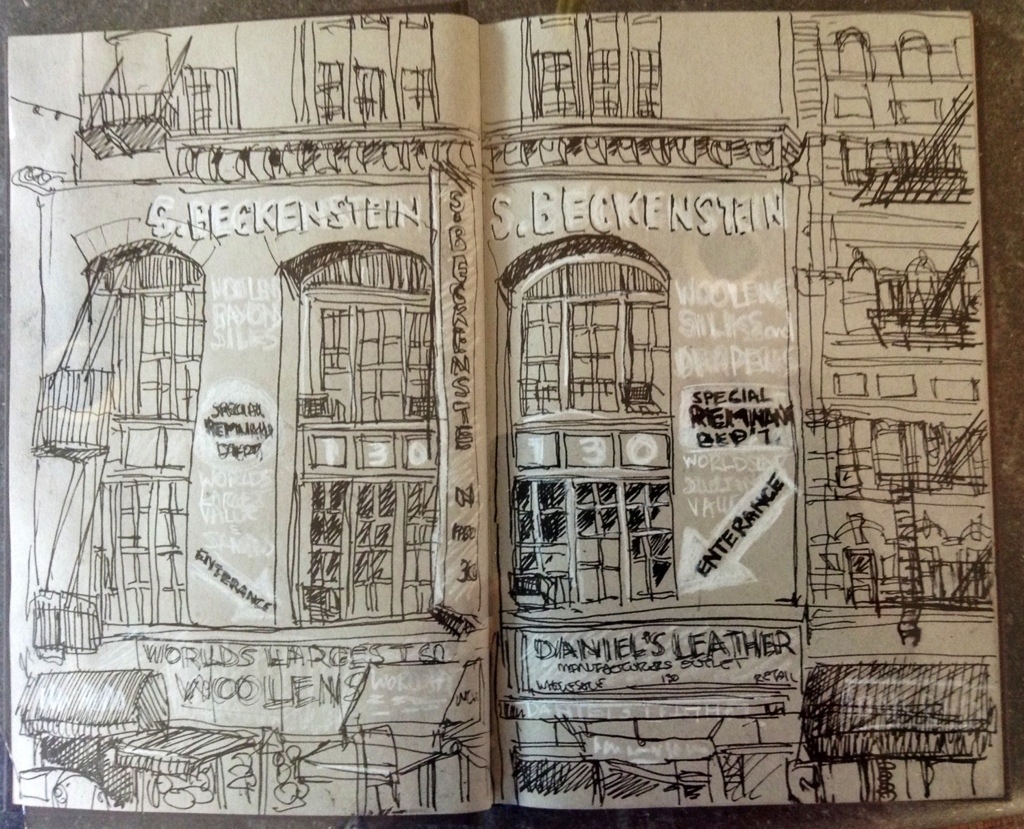
A few days ago, I was walking on the Lower East Side and I saw this building festooned with painted signs. I sat down on the pavement, leaned against a wall, and pulled out my Lamy Safari. I spent the first hour or so just drawing the building underneath the signs.  I started to see that the building itself was quite interesting, that it had curved windows and lots of interesting brickwork. I discovered how the building was constructed, how the windows lineup, where the structural underpinnings were arranged. I noticed all the stores on the ground floor, their merchandise and the ways that their awnings were hung. It seemed I was tapped into the full data stream (though oblivious to my dehydration, cramped buttock, and sleeping right leg).

Finally, I pulled out  a white pencil and start to letter the signs.

Here’s the thing. I had spend a couple of hours starting at this building but now I realize how much I still wasn’t seeing. Yes, I had studied its structure but I had skipped over a lot of the details, I had missed air conditioners, reflections, broken bricks and more. I had approximated so many things based on the patterns I could divine. And I had not observed the perspective or the lighting at all.

But what really blows me away was this weird mistake I made. I misspelled “Entrance”. It’s certainly a word I know how to spell. And I was looking right at the letters on the wall, paying careful attention to the letterforms, to the kerning, the condensed type, the wear of the paint, and then I misspelled “Entrance”. I can’t explain it (Oh, and to cover my goof, I purposefully misspelled it again on the left).

My brain, despite all the time and care I was taking, still had to jump to conclusions. And to a conclusion that I knew was wrong. I somehow drifted away and came back to see my hand adding that ‘E.’ Some other thing was inhabiting my skull, hands on the controls, driving along, a barely-literate lizard brain that just took over while my conscious floated away and debated what I should have for dinner. It’s literally, mind-boggling. Maybe it was a full blown right-brain thing, drawing what was in front of me and disengaged from the rational world of letters and numbers. But then why the mistake? Was I just overwhelmed by the raw data flow?

All this information. And all this human frailty. What we really need is a little wisdom.