Cross training

20120319-213019.jpg

My drawing muscles are out of shape after a few months of underuse. As I get back to the habit of journaling again, I am taking my tools out one at a time to see how I want to work, how to express myself, how to become fluid and unconscious once again.

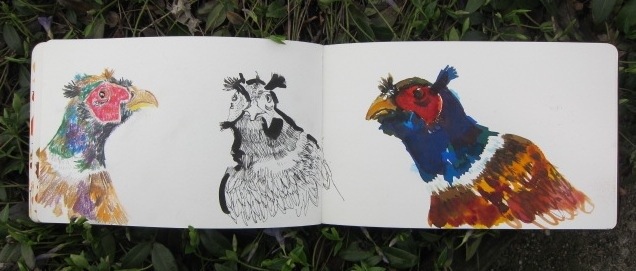
My first drawings felt scratchy and inept to me, so I put down the pen and picked up the brush, wanting to work in color and built up layers of perception. I drew my stuffed pheasant with my little winsor newton paint set and a sable brush.
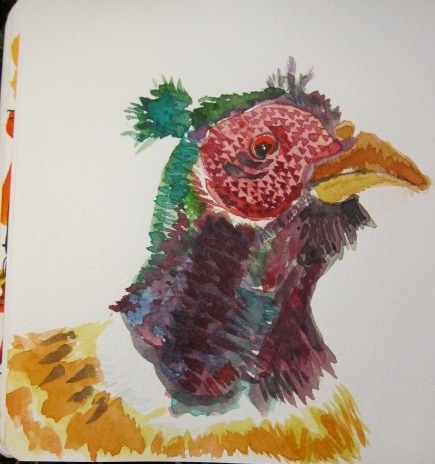
My first attempt felt too stylized in the face and I didn’t capture the iridescence of the neck feathers.

This is more like it. He has a chckeny expression in his eye which is right. My brush also feels good in my hand and I can make all sorts of marks with it in a controlled fashion. Let’s have one more go.
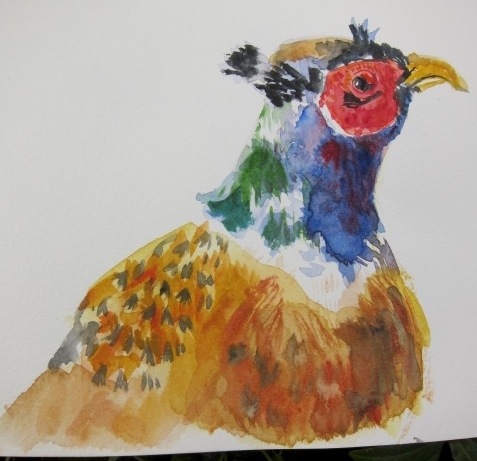
My colors are nice and bright here. My little watercolor set, while filled with high quality paints, can sometime lead me to make murky and muddy paintings as I over mix.

I turn the page and the pheasant and get out some other media.
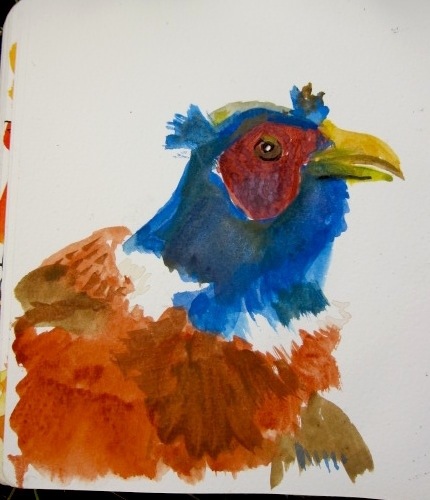
Roz had been extolling the virtues of gouache lately so I dust of my set of opaque watercolors and give it a whirl. It’s so different to work with colors that aren’t translucent; I’m used to layering and layering until things come into focus. These paints force me to commit much earlier to my tones. I also have to work from dark  to light, I think. Or maybe it’s the other way round. II dunno, I just can’t get the hang of it and cant be bothered to figure it out. Lots of other tricks in my bag to play with.

I have been using my Lamy Safari fountain pen for most of my drawings over the past year. I like the feel of the pen’s flow and the blackness of its line. It’s mildly flexible but I wish it was even springier. Drawing with a pen forces me to pay far more attention than does the brush; I am committed to every mark and I can draw much more specifically. My crosshatching is a little less even than I’d like it to be but I quite like this drawing.
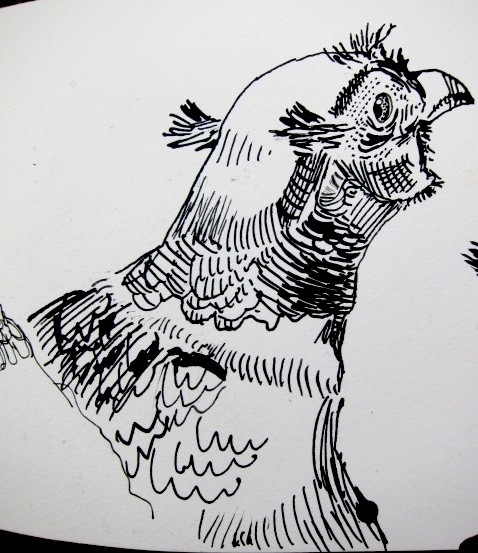
I liked drawing this one more. It’s done with a dip pen and a steel nib (no idea which one — I have a big box of randomly collected one and I know by feel which ones I like best). This pen gives me much more variation in my lines and it’s more interesting to draw with. It’s trickier to control too. My lines are a less regular and perfect and I never know exactly how the nib will behave. The springiness also means it can spring back and attack the wielder, spraying splotches and drips or suddenly scarring the page with a dark irregular line. It’s an adventure.

I pick up my sable brush again and dip it into my India ink. It’s a feeing experience, like drawing with a super liquidy marker and also has a fair degree of unpredictability (Or is that just a function of the fact that I don’t really know what I’m doing?) I make a specific kind of graphic image with this brush, almost comic booky, and unlikely to become my everyday way of capturing the world around me. A fun detour nonetheless.

Colored pencils are just too much work. I don’t like swapping pencil after pencil to find the right color and then being limited to the hues I have ( and I have a huge collection of pencils, none of which are exactly right). I cross hatch and layer them to reproduce the colors I see but I don’t like the process or the results, I don’t like seeing white paper showing between the lines either. I am trying to approximate what I do with water colors and I may well be doing it wrong. Pencils do give one a fair amount of control and the colors are fairly bright but they are also smudgy and fiddly.
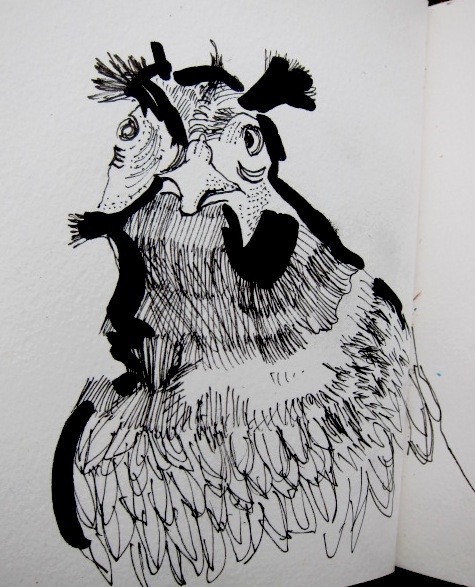
My love for Lucinda Rogers‘ work inspired me to combine a sper fat (B) Faber Castell PITT pen  with a super fine one (XS).  I’ve done a few drawings like this but I have  a lot to learn about this technique. I dont fully understand when to use the fat one and the XS doesn’t glide on the rough watercolor paper of my Moleskine.Still, it has a nutty quality that I like.Finally, I unpack my huge collection of Doc Martin’s super electric translucent water colors. I just love these colors, so bright and bold, but they need to be handled with care. Like colored pencils, they come in zillions of hues (I have over a hundred little eyedropper bottlesfull) but they can be mixed. They tend to be much more fluid that pan watercolors so it;s easy to overload the brush and make things gloppy. This isn’t the best example, but generally I love the ways paintings come out when I use this stuff.
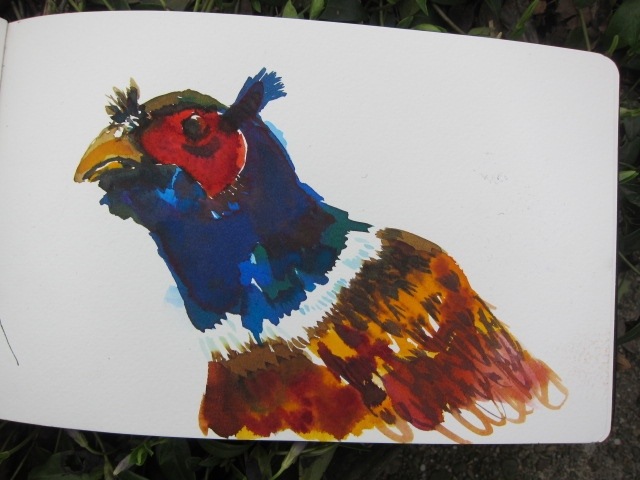
This was a liberating experience and gave me lots to think about. I also got to know my pheasant roommate better, always a smart idea.
Two Years

It’s much sunnier on March 18th than it was two years ago. And the sadness and loss I felt then have become memories. Now, when I think about Patti, I don’t feel overwhelming emptiness, just sweet thoughts and warmth. Despite the enormity of her death, Jack and I have continued to find our way and to find things to like about life. Surviving is no longer a guilty feeling; it’s what Patti would have wanted for us.

I have learned so much from her since she left. As the clouds parted, I saw how wise she had been about so many things and somehow, with her gone, I am able to better heed her advice and perspective. I have let many things go that I used to cling to, worries, fears, woeful imaginings. Why? I guess because I have to rely on myself, to be strong, to take on all aspects of myself and my life. I no longer have my love to lean on, to make up for my shortcomings, to protect me from the things I fear.

And being a single parent is much more than double being one of two. Without another person to balance my mistakes, I have to be more careful and also bolder when I help steer Jack to the next stage of his life. Would I have been as supportive of his decision to go to RISD if Patti were alive? Would I have been okay with so many of the choices he makes? Would I be as close to him as I am now? Would I have become calmer, more supportive, less judgmental? Probably not, honestly.

My life will change radically again in six months. Jack will be off to Providence and I’ll have my apartment, evenings, weekends and grocery lists to myself. I look forward to it with a mixture of excitement and dread. For the first time, except for a six month period when I first graduated from college, I will be living alone. I have no idea how I’ll take to it. Will I be lonely? Will I be free? Will I try to end my isolation by living with someone else as soon as possible? WIll I thrive? We’ll see.

I think of Patti at least once every day. I have pictures of her throughout our house and office but they have blended into the background. Instead, the way I come to think of her is because I keep encountering the parts of my life that she was  a part of — how I put the laundry away, the sheets she bought, the desk she sat at, the places she walked the dogs.  So many parts of everything. Some of those routines change, new sheets, new shopping lists, new situations with Jack she never dealt with. But she remains at the core of who I am in so many ways. After all, we grew up together and were molded by the same events, huge and minor and she was my best friend for  a quarter of  a century.

I worry sometimes that Patti’s memory will fade bit by bit until no one but her closest friends and relatives remember what she was like. That no one will know any more what a nut she was, how sweet she was, what a good friend and an inspiration. But I don’t think that’ll really ever be true. Her light burned too bright.

I wrote a book about her life and its aftermath and it’s at the publisher now. I worked on it harder and more carefully than anything I have ever done because I want the world to know about her, to fall in love with Patti Lynn like I did. In less than a year, it’ll be out there, making ripples, and creating new fans for her. I hope she would have liked it.

I miss you, Pat. I always will. I know you wouldn’t want any of us to be sad today or any day. I will always remember you and think of how you would have wanted things to be. Thanks you for being my friend and my love.

Senioritis

A tentative first step back into my illustrated journal. Drawn while sitting, overtired, in bed.

Jack was eager to settle his college plans early and so was I. His acceptance to RISD was a huge relief for both of us. The stress and uncertainty of the college process was over and now we can both relax until September.
But doing next to nothing turns out to be a lot less fun than he thought it would be. Fall is a long way away and Jack still has to get up at 7:00 each morning and sit in classes all day, listening to droning teachers, half-heartedly writing homework assignments in the period before they’re due, doing the bare minimum to keep his grades above water so his acceptance isn’t rescinded.
I say to him, well, you’re still being taught useful and interesting things, even if your grades really don’t mean as much. Can’t you just learn … for the fun of it? What’s the point, he groans. Who cares? I’ll study when I get to college… Etc.
Senioritis isn’t confined to teenagers. At every point in life, it’s easy to be so focused on goals that one can’t see the value in anything that doesn’t pertain directly to them. All around are books and classes and conversations and experiences that would enrich us greatly but it’s easier to just do the same-old and not expend the effort for something that doesn’t same to have a direct benefit or relevance to one’s occupation or obligations. What’s the point in learning to draw or reading about ancient history or trying sushi or visiting China? We think we know it better, so despite the richness of the world around you, if your mindset is wrong you won’t absorb or even register it. You screen it out.
When we’re toddlers, we are constantly exploring and asking questions about everything we encounter. That impulse diminishes when we get older because our pre-frontal cortex develops and filters out the firehouse of information that is constantly streaming in. Most of the time, we certainly need that filter so we can be focused and goal oriented — it would be impossible to get anything done if we were always walking around in slack-jawed amazement. So we increasingly notice only those things that we have decided are related to our preconceived goals and orientations.
That means it takes an extreme form of novelty or trauma to snap us out of this narrow tunnel we have burrowed into. Something like 9/11, a death, an accident, can force us into a reassessment and new orientation. Our eyes are opened, we say, and suddenly we see things we’d never seen before.
We use this metaphoric language to describe this epiphany but what if we take this notion literally and force ourselves to actually see things anew. We can reorient our perception and put on a wider lens. Of course, we don’t want to eliminate this screening function altogether or else we might wander off the road and spend all day picking wild flowers, but we can pick moments to relax our pre-frontal cortex, return to a more childlike state, rebuild our muscles of perception, and restock our cache of creative stimulation.
When you draw something you see it in a new way. A good drawing is a fresh perspective on an object you may have seen a thousand times before: a building, a body, a bowl of fruit, your breakfast dishes. But by paying deliberate and careful attention to every nook and cranny, you flood your mind and your page with new information about what you are seeing — the texture of a banana skin, the way light hits a brick, how the knee connects to the shin bone, the exact curve of a cup handle. You are suspending the critical function of your pre-frontal cortex, refusing to decide whether there’s importance to each individual line and aspect; you just record them all. This information isn’t actually that important to you beyond the act of drawing, you don’t need to retain the visual data about that banana skin, it may have no further utility to you. But it is expanding your awareness of the world around you, strengthening for observation muscles — it has as much purpose as lifting the same weight over and over at the gym.
When your mind’s eye is open and your screens and filters are down, you get more and more useful information, and that information and experience are the raw fodder for creativity. Forming associations between apparently disparate things to create a new idea is what creativity is all about. And the more open your mind is, the more you are open to experiencing things are interesting but may not have immediate and obvious relevance to your current endeavors. By exposing yourself to art, to novelty, to new ideas, facts and experiments, you stretch your mind so that it is pliable and elastic, so that it doesn’t seize up when you have to move in a new direction. Your reservoirs of references are loaded and you have oodles of bits and bobs to build new ideas with.
Senioritis hits senior citizens too. It’s easy, as you become middle aged and older, to think you know it all, that you have discovered what matters, that you know what you like to eat and like to vote for and where you like to visit and what you like to read and that experimentation and exploration are things of the past. But if you can loosen up your built-in filters, if you can slow down and draw every petal of a flower or the hairs on a dog’s muzzle, you’ll soon see that you don’t know everything, far from it, and in fact you never will. And that realization, that the more we know the less we know, will set you free to devote the rest of your days to exploring the depth of your ignorance, to gathering sticks and shells and tastes and smells, and weaving them together in to combinations you and no one else have ever seen before.
Jack can afford to suspend learning until September. But I can’t.

Now, watch this:

Getting back in shape

The last year has not been a great one for drawing. At least not for me. After being a dad and an employee and a housekeeper, the little spare time I have had left has been consumed with the two books I have been putting together. I’ve had to do a lot of drawing to get those books done, of course, but it’s certainly not been the sort of art that fills my dozens of old sketchbooks. It’s not really a record of my daily life.

A few weeks ago, once the last of my book files was picked up by the FedEx man,I had to admit that I had pretty much lost the habit of drawing and I’d better do something about it. I just kinda didn’t wanna.

Even though it’s been a mild winter, it’s not been conducive to drawing outside so I sat for in the kitchen for a while and looked at the odds and ends on the counter and tried to psych myself up. Instead, I sighed. I just can’t draw my pepper mill again, nor a box of raisins or my knife block. I have a new, great-sounding but boring-looking radio — its a black rectangle with a small monitor and two knobs. Most of the view out my window has been blocked by two newish NYU buildings. They are as dull looking as my new radio and, in any case I’ve drawn them over and again over the years. My mind whined: there’s nothing to draw. But really, beneath my feigned boredom, lurked fear. An anxiety that maybe I had lost my ability to draw. Look at Tiger Woods — even great talent can slip away in the night and leave you swatting the air.

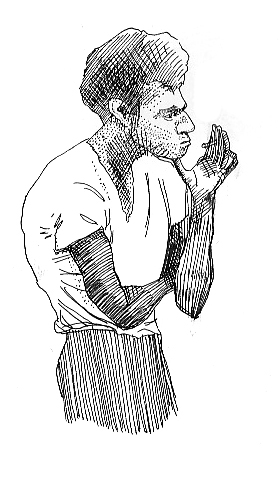
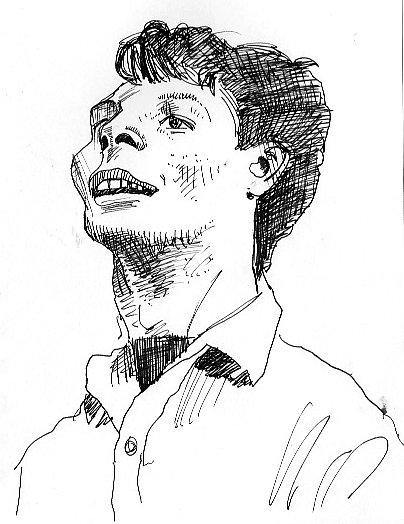
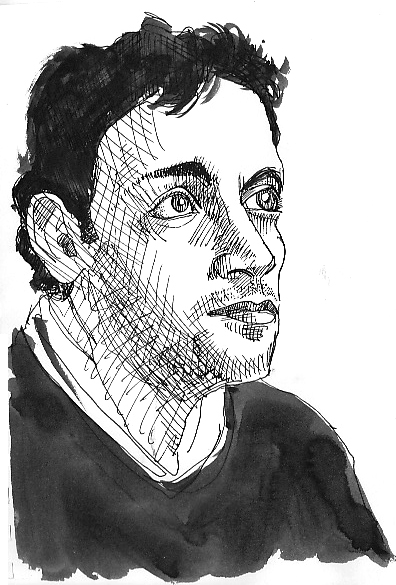
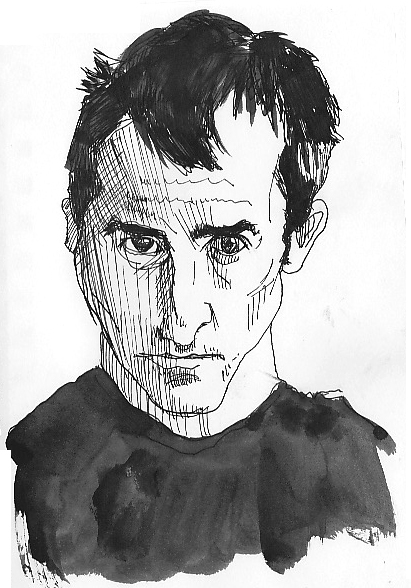
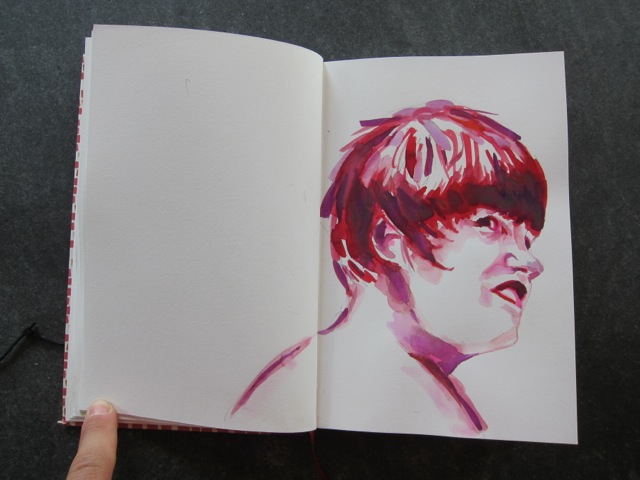
I had to find a way to ease back into the water without scaring the muse away. I didn’t want the pressure of making great journal pages or writing witty marginalia. I just wanted the visceral pleasure of making lines and slowly and carefully studying something, anything. I unearthed an empty, spiral-bound journal with not terribly nice paper and filled my fountain pen. Then I picked up the dogeared copy of last week NY Times Magazine and let it fall open to a random photo. Then I began to copy the picture into the book, focussing on cross hatching, spiraling lines in neat rows, lining up a smooth gradation of micro dots, making ribbons of greys and undulations of silky blacks.

The old pen was a little rusty but not nearly as bad as I feared. And soon the sweet flood of neurotransmitters swept over me, like emptying a too full bladder, and I entered the zone.

So I made a small deal with me. Each morning after my breakfast was chewed and the French press was still half full, I would do one drawing from the morning paper on one page in the book. At least one. If the urge was there and the coffee held out, maybe I’d make a second.

Most mornings I fill a page (and I don’t beat myself up about it if I miss a day to give the dogs some extra time in the park or to make an early meeting). And the fun is back.

Granted, I’m making drawings of unknown faces from news photos, not the sort of things I want to fill books with, but I figure, what the hey, it’s spring training, and the season will eventually  start for real. Meanwhile, just keep loosening up the shoulders, stretching the hamstrings, and shagging those flies.

Book learning

Yesterday, I ducked out of my office for a couple of hours to visit the midtown Sheraton, site of the National Art Education Association (NAEA) conference. I was the guest of Bob Fisher, a contributor to my upcoming book, An Illustrated Journey. Bob was participating in a seminar with his former teacher, Greg Stanforth, who has taught art at Cincinnati’s Archbishop Moeller High School for thirty years. Their topic, “Creating a Culture of Sketchbooks in a High School Art Program,” was close to my heart.

Greg’s school has about 1,000 students and they have three 90-minute art classes each week. He requires them to fill a page in their sketchbooks seven days  a week, and to cover it completely with color, collage and line. The boys fill at least one complete mid-sized Moleskine every semester and by the time they graduate have a tall stack of a dozen or so volumes. Greg brought a lot of these books with him and passed them around the room and then discussed how he gets these teenagers to produce so much beautiful and personal work.

FIrst of all, he insists that they consistently make pages: they work on them at home and in school and their grades are based on their consistent commitment not on any evaluation of the work itself. Nonetheless, the quality was really high and it was clear that they had spent a lot of time and thought day after day.

He also has them share their work with each other, something the students actually insisted upon. They pass their work around and boys pick out pages they like from others’ sketchbooks and discuss what they like about them. Many of the pages were surprisingly personal, discussing their reactions to parental divorce and other major issues in their lives. Greg reported that one boy even came out to his classmates, (and this is a Catholic school!)

He also brings them all sorts of inspiration, showing them established artists’ work and bringing in guests like Bob, an alumnus who went on to be a succesful illustrator and designer. But he also insists that the boys don’t copy from others but rather channel that influence through their own work, drawing always from observation, using each others as models and sketching and painting the scenes and objects around them.

Apparently Bob’s students have earned over $1 million in art scholarships, a fact that helps the program vital and cherished among the school’s administration.

Greg runs an amazing program and I’m glad to say that the room was packed with teachers sitting on the ground and eagerly asking questions after the talk. It certainly suggest that there may be many new converts to the world of sketchbooking and illustrated journaling.

At the end of the presentation, Bob distributed a list of sketchbooking resources which you can access here.

The Times they Are a Changin’

A propos of nothing, the Coen Brothers are shooting their new movie in my neighborhood, turning the clock back to 1962, one of the heydays of Greenwich Village

I’m in a new book: The Pulse of Mixed Media

Some three years ago, I taught the one and only class of my career, a 12 week program at the Open Center. I learned a lot and met a number of interesting artists over the weeks. Seth Apter was in my class and I began to visit his sumptuous website, The Altered Page , and to talk with him about drawing and art and the creative process. He interviewed me for his blog and again, the conversation broke new ground for me/
Last year, Seth began work on a book, The Pulse of Mixed Media: Secrets and Passions of 100 Artists Revealed, and invited me to participate.
Now, I have been a part of a number of books that collected the work of many artists, and generally it’s a simple and painless affair. In fact, while putting together An Illustrated Life and its upcoming sequel, An Illustrated Journey, I found myself in the reverse position of having to badger other artists to join up and then send me pages from their journals and answer my questions. It’s a fair amount of work but one learns so much by shepherding this sort of book.
Anyway, being a part of Seth’s book was more than I initially thought when I signed up. That’s because Seth really demanded that I think a lot about myself and my process in answering his questions, think in ways I’d not been asked to do before, not even by myself. He’s a psychologist and he challenged me to really explain the many things I take for granted in my work, the media I use and the ways I use them, what defines my work and what does not, He asked me questions like “What three words do not describe your artistic style?” and “If you could sell one piece of art to anyone in the world, whom would you want to buy it and why?”
Seth asked these sorts of questions of me and many, many other artists. From what I’ve seen of it, the resulting book is a rich and beautiful tapestry that explores the deepest aspects of the creative process, and provokes and inspires over and again.
The Pulse of Mixed Media will be officially published at the end of this month but apparently it’s in some stores already. You can also get it direct from the publisher.  Meanwhile, Seth is doing all sorts of things on his site to dimensionalize the content, with samples and peeks inside. Seth has promised me that the actual book will be in my hands any day now but my trips to the mailbox have been for naught so far. I hope to share a deeper dive between its covers in the near future.
Meanwhile, if you get a copy, do let me know what you think.

A new Sketchbook Film: Pencil & Ink


(Sorry for the delayed launch of this post; had some last minute tweaks to do)

Tommy Kane, Jack, and I have just completed production on another in our series of drawing films — this one about NY artist, Justin Klein. It was a long and grueling shoot day, a good 14 hours, and by the end of the shoot, our set was full of bloodied paper, broken furniture, and empty beer cans and whiskey bottles. We all left the set changed for ever.

As I say to myself with each subsequent film, this is the best one yet. It is a bit of a departure from what we have done in the past but I think you’ll agree that it is an interesting extension of our core idea.
I’ll try to post again with some behind-the-scenes details about the production and answer any questions you post here.

Happy New Year!

—-

Filmed with a Canon 7D, edited in Final Cut Pro X.
Music: “Lux Aeterna – Cum Sanctis Tuis” from the Requiem by Wolfgang Amadeus Mozart
Color Correction by Lenny Mastrandrea at Nice Shoes.

Legacy

My friend Michael loves jazz. He infected his son with the same passion for music. By the time Nick enrolled in Jack’s school, he was already an accomplished guitarist and now in his junior year, he regularly plays with several jazz bands and combos. Our friend Jeff, also a jazz lover, recently said to Michael, “Congratulations. You’ve created a jazz musician.… Now what?

When Jack was little, Patti and I, like most parents, collected and saved his artwork. We continue to encourage his creativity over the hump of the tween years, up to the present day. Along the way there were times I shared Jeff’s ambivalence, thinking to myself, “Are you just preparing him for life in a garret or working at a Starbucks full-time?”  I would hear the voice in my head chastising me for not preparing him for law school or medical school or Wall Street: “He’s a smart kid, he could be making a lot of money”. So when Jack decided that he wanted to focus on going to art college, I could feel the conflict rumbling in my tummy. I mean, there’s no question that I’ve always regretted the 10 or 15 years in which I didn’t create art. I wonder what my life would’ve been like had I gone to art school rather than studying political science.

But I knew deep in my heart that I could give Jack no better preparation in life than to let them know how important it is to follow your passion. I told him “most people are not passionate or talented in any particular way. You are a gifted artist and you love to make art. You are doubly lucky. It would be criminal to ignore those things to lead a life of mediocrity.” So I helped him to put his portfolio together and think about his application essays. We went to visit various art schools in the spring and I shared his anxiety over the weeks in which we were waiting for a decision.

He decided that RISD was his first choice. It was mine too, had been since I was 16 and I had attended the RISD summer program where I had the most extraordinary time of my young life, making art all day, living hundreds of miles away from my family, being surrounded by talented and creative friends, smelling of turpentine, and loving life.

I guess it’s a cliché: the father, frustrated in his youth, sending his son along the same path, like a mediocre football former high school player goading his son until he becomes a star quarterback. My own father was frustrated in the fact that he didn’t become a full-time artist, and, when I was in my 20s, he sort of encouraged me to take a different path, to study bookbinding or some such. Like most things my father said to me, I didn’t take it very seriously and so continued to go to the office every day.

I have learned so many things from art over the years, and I’ve learned it does not derail your destiny or condemn you to penury. Art is a constant in my life, even if I haven’t drawn a sausage for a month, informing how I see the world, how I think, how I feel. I can think of no greater legacy to leave my own son than to share in that wisdom and experience.

So I had no ambivalence last week, when Jack texted me excitedly at school to say that he’d been accepted into the class of 2016 at the Rhode Island School of Design. Instead, I felt enormously proud. And I felt, from some other plane, that Patti was sharing in my pride, because she too wanted Jack to follow his muse, to lead a creative life, but most of all to be happy. I think that in Providence he’ll be able to do all those things.

If a half-century of living on this sphere has taught me anything, it’s that regret is a waste of time, that one should seize every opportunity that comes one’s way, and that the fear of the unknown is just a one-way ticket into darkness. Fortunately, my son is braver than I am, less damaged, brighter, more confident in his abilities to change the world. He is my greatest work of art (though, of course I can’t claim all the credit).