Seeing the forest, oh, and the trees

tree-1In The Art Spirit, my pal Bob Henri talks about the importance of that original intention which sparks one to make a drawing or a painting. What caught my interest? And, all critically, how do I hold on to that intention so my art is infused with that interest? It’s not enough to decide to draw a tree, one must feel something about that tree and have that feeling right in front of one’s eyes and one observes. His advice is to work fast and furiously, blocking in the big masses while the flame is still burning.
My usual technique is to move slowly, with a blank mind. I enter a meditative state and let my eyes cruise around the contours, laying down every line with equal weight until I have explored the whole object. I rarely try to feel anything as I do this but I must be. I choose certain subjects over others because I like them or am curious about them. So I decided to be more aware and to explore some other ways of looking at a tree a few blocks from my hotel.
I spent a good long time working in ink first. I was very into the carbuncles and folds of the tree’s skin. As I drew, I became increasingly aware of the tree’s colors: it was quite yellow but cloaked in purple, two complimentary colors. I kept thinking about how these colors inter-played and then I painted over my line with watercolors. I was using my new paper, this Yupo pad I picked up on the weekend. The ink went down very smoothly on it but had a tendency to smear. As I painted I was pretty aware of how unnaturally the paint went down, pooling on the paper instead of soaking in. The colors remained pretty vivid, undimmed by the fibers, but it all felt temporary somehow. I couldn’t really let go, worrying that the whole thing would wipe of the page when I was done. I also felt like I had a long lens on — I was only looking at each square inch of the tree but had little sense of the whole as I drew.

tree-2

While the pad lay drying in the afternoon sun, I decided to have another go and grabbed my trusty Japanese journal with its 100+lb paper ( intended for drawing but it’ll take watercolor pretty well) and my Faber-Castell PITT bold brown brush marker. In three minutes, I knocked out a sketch, thinking all the while about the flow and energy of the tree. I did a caricature of the yellow and violet and capped my pen.

tree3

Next I took a black PITT pen and thought about the tree’s architecture, how it anchored into the ground and how the limbs were bolted onto the spine of the creature. I bore down harder on my pen, drawing firmer lines and painting in more defined shapes of color.

tree-4

Finally I took my cheap Sheaffer italic pen, loaded with dark brown non-waterproof ink and this time I thought about the movement of the trees, how the carbunckly growth flowed like water or vomit from the trees crotch, how the limbs pulled in different directions and how that tension held the tree together and propelled it into the sky. Now the tree seemed almost serpentine to me, writhing out of the soil, phallic, twisting, alive. The watercolors dulled the lines but it felt okay, as if the fusing the whole thing together.

I look at these four drawings and I’m not sure yet what conclusion to draw about them. I like the earthy energy of my last drawing (as if it was made by a goat or a mole) but there’s still something lovely and light about the first bird-like one. Each has something to say in its way, like the varied members of a string quartet, the ingredients of a cassoulet.
One conclusion is clear: Drawing never fails to amaze me; how it can rip open the doors into your head, how it can transform the world and your place in it. Nobody but me can see this process, this unfolding, as it happens to me. All that’s left for others to see are the pages in my journal, the ass wipings on paper — but never the feast.

The Art Spirit

police-car

“Genius is not a possession of the limited few, but exists in some degree in everyone. Where there is natural growth, a full and free play of faculties, genius will manifest itself.” — Robert Henri
I have always been a fan of Walt Disney. Not just of his animated films but of a certain image I have of the man himself. It’s not the dictatorial egomaniac that some biographers have depicted but the gentle, welcoming character who appeared at the beginning of each episode of the Wonderful World of Disney — small moustache, grey gabardine suit, warm smile, standing in his book-lined office.
When I flew home from LA for the weekend, I decided to re-screen one of my favorite videotapes for an infusion of inspiration. It’s an episode of the Disney show that I Tivo-ed a couple of years ago in which Walt answers letters from art students seeking direction in life. His advice to them is to read a book called “The Art Spirit” by Robert Henri. Henri was a painter and art teacher in the early part of the twentieth century, a terrifically inspiring guy who taught the generation of American realists that emerged in the 20s; people like Edward Hopper and Stuart Davis and John Sloan and Rockwell Kent, many of whom I like a lot. He encouraged his students to paint what they saw around them, urban scenes of everyday life — gritty, bold, and true. Henri’s students collected their noted from his lectures and assembled them into The Art Spirit and it has been a valuable guide for artists ever since, full of observations and ideas that are accessible and encouraging.
One of Walt’s correspondents asks him how he can develop style and Disney responds via Henri, with something like, “Don’t worry about your originality. You couldn’t get rid of it even if you wanted to. It will stick with you and show up for better or worse in spite of all you or anyone else can do.” To demonstrate how individual vision is really at the heart of style, he takes four animators form his studio, men who by day are paid to subvert their individuality in the service of creating a unified look for Disney movies and films them, of a Sunday, painting a tree. Each has his own way of painting, but more importantly his own way of seeing. One describes the tree in terms of architecture, like a solidly engineered structure on the landscape. He paints the tree as if it were made of steel pylons. Another artist is fascinated by the movement of the tree’s bark and studies the surface textures in detail. A third sees the tree’s relationship to the sky behind it and studies the negative space of the branches. A fourth observes the entire tree as unified shape and works on its relationship to the rectangle of his canvas.
Then we see how each artists interprets his vision in different ways through his materials. One paints of a big slab of plywood thrown down on a rock, painting with long brushes in a muscular way. Another draws in charcoal and then fills in with casein. When the paintings are done, they are juxtaposed and we can really see the varieties of worldviews in the four men. Even though they are talented artists, the real lesson comes from their willingness to put their own characters in their work.
It’s all shot in muddy black and white, typical old TV images, and the painters are not fine artists showing in NY galleries, just modestly paid artisans working for the Man. But the little film demystifies the process of art making in a wonderful way. It’s also a reminder of how the world has changed. Hard to imagine these days prime time Sunday night TV being devoted to something as ethereal as this. And the Disney Company, marred by well-publicized corporate battles and an surfeit of marketing and promotion, seems pretty far removed from the gentle art lesson on this show.
If you can, Tivo the Wonderful World of Disney, and see if you stumble on this gem. Or pickup a copy of The Art Spirit and be directly inspired by a great teacher. Try to keep in mind the wisdom of this thought from Robert Henri: “The object isn’t to make art, it’s to be in that wonderful state which makes art inevitable.”
— Written in a rental car in a rainy parking lot by the Rose Bowl, a few miles from the Walt Disney studios.

Feeling a little La-la

santa-monica-cacti

I have been holding on to my jet lag quite well while here in LA; getting up early and going to sleep most nights before ten. Still my internal clock has slowly drifted west a little more each day; I’m probably somewhere over Oklahoma today, rising at 6:30 and feeling rested (last week it was 4:30). It’s been great to get up at dawn and have a couple of hours to myself. I usually walk along the beach for forty five minutes; to the Santa Monica Pier and back before breakfast, passing the homeless people still in their sleeping bags under the palm trees.
After breakfast, I work on my book. I am able to dart on to my computer several times a day to make adjustments to the work in progress, rewriting, redesigning, lettering and drawing elements to insert into the layout. Last night, while waiting for a final meeting on casting, I finished my final read through and am pretty much satisfied. The book is 208 pages long; each with a unique design, rimming with drawing and colors and thoughts and weird lettering. It’s the best thing I’ve ever done and I feel deeply satisfied by it. I could go on tweaking forever and yet it also feels quite complete, organically whole. I will look at it on the plane again tonight and then send it off to my editor.
I’ve spent most of my days over the past week and a half working on the campaign we are set to start shooting next week. We’ve figured out every shot and transition, pulling the spots apart and reassembling them, challenging them to their basic premises and seeing how we can plus them. We have dozens of roles to cast across the campaign and each day look at DVDs full of actors in LA and New York. Last night was our last round of callbacks and we are in pretty good shape. This afternoon we will take our clients through all of the decisions we make and on Tuesday the cameras will start to roll. We have tested so-called ‘animatics’ (basically cartoon versions of the spots that let us see how people respond to the basic plots of the spots) with consumers and they have all done exceptionally well, hitting historic highs for communication, persuasion and likeability, so we are hoping that our clients will be filly on board with all of the subsequent decisions we’ve been making. But, of course, one never knows. Our director has just finished shooting a movie and every day must meet with the studio and discuss the edit; he says it is a horrible experience and one he won’t repeat any time soon.
This evening, I’ll be on the red-eye back to New York. I’ll get to spend a few days with my family (who I miss terribly) and to duck into my office and straighten out some things on the other parts of my account. We are in the midst of launching a huge print campaign too and have photographers to hire and many, many details to work out.
It has been a very stressful experience because so much is riding on our efforts both at the clients and at the agency. Hopefully things will all go smoothly and the tension will subside.
My book is keeping me sane, quite honestly. It is like a quiet lagoon I can dive in to when all around me is chaos. It’s not just the fact that it’s a real project that has been met with so much good energy so far. It’s also that it’s mine; a little world of my own making that reflects nothing but my own experience of reality. It’s also something I hope will be very positive for those who share it and will help them to embrace their own creativity and make lagoons of their own. Drawing has always brought me such peace and happiness and the further I wander into the Valley of Darkness, the more important a beacon it becomes.
Sure, my book is going to be published — but that’s not it; all of the books that precede it, the 38 volumes of drawings I have filled in the past few years, have all brought me this satisfaction, helping me see the world as it truly is, not a tangle of subjectivity and judgment and tensions and ego, but a place of peace and great beauty, even in the smallest things.
That said, I’ve finished my breakfast now. I’m going to go and do a little drawing in the sunshine before my day takes off.

Collaboration isn't just for the French

air

I am writing this on a flight to Los Angeles where we are going to shoot the first five commercials for the campaign I began last summer. It was July 27th when I stood at a urinal on 22nd street and was suddenly struck with the idea which, through various barrel jumps, backflips and slaloms, has brought me to this seat on American Airlines.
Of course, it’s absurd that it should have taken 200 days for three or four minutes of advertising to go from my urinal to your television. Well, actually the commercials haven’t even been filmed yet. It’ll be closer to 300 days before they actually hit the airwaves. This is certainly a long time for even advertising to be birthed, but not unheard of.
When you sell your creative work, the results are invariably a collaboration between your imagination and the processes of the person or corporation who is funding them. In the case of a new brand advertising campaign, your collaborators include various levels of decision makers in your agency, some ‘creative’, some administrative and some strategic, all of who provide input based on their own experience, ego, time and attention span.
Next, the work runs through the filter of the client company’s marketing executives. Some have long and illustrious careers producing great advertising and can often make your ideas better and sharper. Others have ended up in marketing by virtue of their success or failure in another part of the company. I have worked with clients who were former antifreeze salesman, flight attendants, bank tellers, and tax attorneys. When I created ads for the Postal Service, my client was a former mail carrier. However, their past is not necessarily an indication of their utility as creative collaborators.
As I have done a lot of corporate and brand advertising, I invariably end up presenting to CEOs and CFOs. Most of them have little interest in advertising and consider it a waste of time and money. They tend to be results oriented, I’m from Missouri, kind of left brainers, Some, by virtue of having a lot of money and a lot of power, have odd and interesting ideas about how advertising should work. They often cite their wives’ or children’s opinions. Because they are unused to talking about executional creative matters, their words are often ambiguous and hard to take at face value and much time is spent by others, parsing their phrases and trying to determine the hidden meaning behind all sorts of cabalistic executive signs. I have worked with agencies who note down the colors of executives’ ties and shirts in an effort to come up with logo and advertising palettes that will pass muster.
These creative approvals are funny things. They are so often subjective and frankly irrelevant to the effectiveness of advertising. The best clients are the ones who are extremely clear and smart about what they know best. They tell you what they want to accomplish with their businesses and how advertising can help. They couch their reactions to the work you bring them in terms of their original intent. Often they are surprisingly lucid and insightful, demonstrating in spades how they got to where they are. They respect the people they hire and assume that they will do their work well. They keep their egos in check and use their authority to clear impasses further down the food chain. They can break loggerheads with a phrase or two. As one CEO said to me recently, ‘People assume that because everyone has a voice that this is a democracy. It’s not. I want this done so let’s move on.” Someone who works for someone who works for someone who works for him and who had been our daily contact had said something equally memorable and candid in an earlier meeting:” My boss told me that my job is to tell you what you have done wrong. I can’t see anything wrong in what you’ve done but I still have to figure out how to do my job.”
There’s little question that, unfortunately, much of what we are paid for is to deal with the process. To be able to listen to someone’s incoherent rant and turn it into some thing actionable. To respond to the various thumbs stuck in the wet clay of one’s idea and yet emerge with something that isn’t embarrassing and wasteful.
There are different styles that creative people have to deal with this obstacle course. Some defend their work against every single remark and soon devolve into shrill defensiveness. Others sit quietly, waiting for the moment to insert a devastating retort. Some try to come up with constructive responses as the clients lays out his objections. Some give long rebuttals that communicate little but ego and leave the client wondering if they heard a word she said. Some sit gulping in anxiety, waiting for others to defend their efforts. Some smirk smugly, all but saying ‘ You are such an idiot”.
The most constructive approach is, first, just to listen. Particularly when there are lots of clients of various levels in a room, they tend to circle around each other, ideas canceling each other out, objections overruled, problems solving themselves. Then, if the audience has the patience, summarize what they have said and see if they agree with your summary. Then offer a solution or two for the present and withdraw and try to form a coherent plan of response. When you do respond, show them what they asked for, accompanied with a range of other solutions.
I think most clients like the creative process. They want to be wowed. When they come up with their own ideas and insist upon them, they also have a nagging feeling that they’re doing the wrong thing, buying a dog and barking themselves. In some ways, advertising seems easier than other creative forms. When I do illustration work, no one has ever redrawn my pictures like some clients feel they can rewrite my copy. When I work with composers, I have (almost) never seen a client tell them which specific notes to play. A bad and desperate client will push past agency and director and go up to an actor and tell him specifically how to say his lines but he’ll rarely get in front of the camera himself.
The key again is to listen and observe. That’s the way to get the clearest sense of what’s really going on. Then by re-presenting the client’s POV to him or her, you show that you get it, you want to help, you care. Don’t insist on logic — often the process spits up a lot of nonsensical mandates that come about through intricate games of Telephone that make no real sense. People, intimidated by their inarticulate bosses, can resort to just taking dictation and passing the buck on to you. But try to see through that and get to the truth underneath.
Then, try to take all of the comments as a new creative challenge. Be willing to sacrifice your children in order to end up with an even stronger result. I’ve often had good ideas become great ones as they were annealed on the forge of the approval process. Despairing of being able to fix your crippled creation, you toss it aside and fabricate a far more elegant solution.
Am I making it all sound horrible? Do I seem like an arrogant know-it-all who thinks all clients are boobs? Maybe so, but I don’t really feel that, not most of the time. It’s a thin line to tread between making something that fits the needs of the people who hired you to do it and something that you are proud of, that is fresh and exciting to you. I often write commercials based on events or perceptions that have occurred to me and it is heart breaking to see them mangled beyond recognition. It feels very personal. But in the end, it really isn’t. That’s what Art is for, to express the personal. The creative work we are paid to do, while growing from our integrity and values and personal aesthetic, is always a collaboration and must be respected as such. When created honestly and openly and generously, it is is the best sort of collaboration, Rogers and Hammerstein, Dolce & Gabbana. At other times it’s more Rogers & Frankenstein, Dolce & Gambino. So you pick your fights. You say to you yourself, if they want to drive this Lamborghini over the clff, it’s their dollar. I won’t allow myself to be twisted in the wreckage. Recognizing that jobs and millions of dollars are at stake, that these matters are impacting people’s better judgment, doesn’t make you a hack. Just a professional.
So the simple answer is: throw yourself 90% into what you do for money. Reserve that small part for self-protection. Be willing to stand back, to be objective and dispassionate. And channel the feelings you have, the reaction to disappointment and limitations, and put it into the work that really matters: your Art. Now be uncompromising. Insist on the highest quality from yourself. Be clear, be strong, be energetic and bold. Experiment, reach, push. Stay up later than you would on a client project. See yourself in this work, the real you. Keep working, keep fighting, be heedless of others. And keep telling yourself that you work to earn a living and that you must never forget to to do the living that you have earned.

A good thing (Nancy Howell's story)

jurors-composite

From my visit to Martha’s trial last year. The Morning News editors were advised by their lawyers not to run it in my story. I’m sort of glad as it’s a fairly shitty drawing done in the height of nervous anxiety at breaking New York law.

My office is in a large building on Manhattan’s West Side. Our neighbor, one floor down, is the headquarters of Martha Stewart Living OmniMedia, so we expect to see the old ex-con wandering our halls and lurking around the showers any day now. Her stock has been soaring since she went into the clink, so I imagine we’ll hear well mannered caws of redemption from the many willowy blondes we see in the elevator each morning.
I like Martha (though I wish she’d lighten her ass up a tad) but I’m not going to talk much more about her today.
Instead I want to tell you about Nancy.
nancyNancy grew up in the South West, I think it was Albuquerque. She was always a creative person and, over Dad’s objections, she majored in Art at U of NM because she loved to draw. This was in the 70s when, frankly, drawing was not the thing. Instead her instructors were pushing performance art, conceptual art, earth works, that sort of thing. Before the first semester was over, Nancy, beaten, changed her major. She decided to become a physical education instructor., She figured art and PE both had something to do with anatomy, so she’d still be in a related field. When she graduated, she got a job as a substitute gym teacher. She would lie in bed each morning with the pillow over her head, hoping not to hear the phone ring and call her in. She hated being a gym teacher.
Nancy loved playing music. She was in band after band, playing the clubs and bars around town, making a little cash here and there. Not enough cash, however, so she got a job in a bank. She was the teller in the drive-through, sending deposits back to the branch over a pneumatic tube. She hated this job too and sucked at it.
One day, Nancy was on her lunch break at the TGIFridays across the road. It was decorated in that nostalgic style that blossomed in the ’60’s, full of mustache cups and barber poles and merry-go-round horse amidst the spiderplants. Hanging over each table was an ersatz Tiffanty lamp. Nancy deiced there and then that what she wanted to do was to work professionally in stained-glass. She found out that one of the country’s largest commercial workshops for stained glass was right there in Albuquerque and she soon had a job there.
Nancy’s friends were envious. She’d quit her straight job and was making money entirely through creative endeavors — glass in the day, music at night.
Nonetheless, Nancy still wasn’t happy. She realized that despite her field, she wasn’t really an artist. The glasswork she did was not original; she was just working from pattern books, filling orders from templates. And her band, good as it was, was really just a cover band. If they ever played original compositions, the audiences squirmed and the bar owner would complain. Albuquerque ain’t no CBGB and there was little appetite for true originality
So Nancy shed her job, her hometown and her husband, and came to New York City. Soon she had a job with the premier stained glass workshop in the country. She worked on St. John the Divine, on corporate headquarters. She even redid the glass in the Statue of Liberty’s torch. For the next fifteen years or so, she was at the top of her game. She had a new band with her new husband and they played the cutting edge clubs of the City. She had two kids. She seemed fulfilled.
Then Nancy reached the next crisis. She was the #2 person in the #1 firm. If she became #1 she would sit in an office at a computer all day and cease plying her craft. She’d topped out. She also felt past the age when she really enjoyed carrying enormous panes of glass into the grimy tops of old buildings. The work was more physical than she wanted. Time for a new page.
The part of glasswork Nancy had always enjoyed the most restoring or creating the hand-lettered legends that adorn big windows, naming the saints, the dates, the greats of the Church or the Corporation. So she decided to try her hand at something brand new to her. During her last year as a stained glass artisan, she spent each night taking classes and practicing calligraphy. She went to workshops, she learned materials and she worked hard at her craft. When the year was up, she opened her first business. She sent out a small announcement to editors and art directors and she was off doing work for weddings, for publishers, for all sorts of exciting and glamorous clients.
Within three years, Nancy went from a novice to the main calligrapher for Martha Stewart. Whenever you see some ornate lovely penmanship in MS Living, chances are Nancy did it.
Is she fulfilled now? More so than ever. But she tells me she’d still like to push further, to create pieces that are she writes herself, works of pure art that are not commercial but express herself at the deepest. She’s working on that now. Nancy and Mark and her kids are about to move out of the City to concentrate completely on their art, to play more music and to breathe fresh country air.
Nancy is a constant reminder to me that you can get what you want, no matter how far fetched it might seem. First off, know what it is you actually want. Then be willing to work hard, to take risks and most importantly, to listen only to the little voice in your head that first spoke the dream.
I hope Martha got a chance to listen to her voice as she weeded the prison grounds. Sadly. I have less faith in her than I have in Nancy. Or in you.

Chillin' with Dylan

stones

Last week, I was hit by a sniffling cold midday. I spent the last few hours of the workday back at home, in bed with tea and Bob Dylan’s new memoir. By the next morning, I’d bounced back and finished reading the book.
For most of my life, I really had no interest in Dylan until about seven years ago when my friend, Bob Dye, more or less forced me to listen to The Freewheelin’ and Highway 61. The music softened my resistance but Pennebaker’s movie, “Don’t Look Back” triggered the sort of instant conversion usually limited to evangelicals. I haven’t paid much attention to the albums from the mid 1970s to the mid 90s but own and play most of the early and late records fairly regularly.
Despite all this enthusiasm, nothing prepared me for Chronicles, Vol. I. I had long assumed that , though I admired the music, the man was arrogant and withdrawn, the sort of person one would never want to spend ten minutes with. Instead, I discovered that Bob Dylan has all the hallmarks of the quintessential creative person (and I’m surprised that this surprised me).
First I was struck by how much he knows about music, all sorts of music, from classical to bebop to rap to doo-wop to the cheesiest sort of pop, and is able to extract something useful and inspiring from all of it. Like Picasso, he believed in borrowing from everywhere … but himself.
Secondly, he has always challenged himself — not to be successful financially and critically — but to constantly grow and branch out in new directions. Except for a period where he admits he was in some sort of creative stupor, he has always been motivated by some flickering notion in the back of his head that slowly grows and blooms as he feeds it. It’s not to ‘show the world’ or provoke the industry, but because he is always feeding himself with new influences that spark fresh ideas and directions.
Thirdly, despite the fact that he is such an important maverick, he has deep roots in those that came before. His love for and appreciation of roots blues and folks music has always been the core of his art. He has solid foundations, ones he forged himself, and he has been layering on top of them for fifty years. Reading about his early record collection had me revisiting mine, pulling out Sleepy John Estes, Dave Van Ronk, and Harry Smith’s American Folk Music once again.
Next, I was struck by his enormous generosity. He is lavish in his acknowledgment of all the influences on his art. He talks about what he learned from all sorts of surprising influences, everyone from Frank Sinatra, Jr. to Daniel Lanois.
It was fascinating to hear how he first came to write music, how content he had been to simply play others’ compositions, and how hesitant he was to compromise the body of folk music, sort of like if Horowitz began playing his own piano sonatas rather than Ludwig Van’s. Slowly Dylan began to introduce his own additional lyrics to folk standards and then eventually to create his own from the staff up.
While he was committed and hard working, Dylan never comes off as terribly ambitious. He wants to keep moving forward, to play for larger audiences so he can have new creative opportunities but he never set out to be a superstar. In fact, in his admiration for pop singers and Tin Pan Alley composers, he acknowledges that playing Woody Guthrie songs hardly seemed the road to fame and fortune, even in the folk-mad days of the early 1960s. Even recently, when he has been touring a lot, it’s to stretch himself creatively, to play music publicly that should be played, to shed the nostalgic classic rock trappings and talk to new audiences in new ways. Miles was much the same way. The still-touring members of the Stones, the Beatles, the Who, etc. have no such creative ambitions.
I’d urge you to read the book and see how it strikes you. I believe it has a lot in it for anyone contemplating their own creativity.
——————
A number of people have written to me for a certain kind of advice. Typically, they’ll ask how they can become professional illustrators or, even more frequently, how they can get books published. I tend to answer such letters less often than I used to because I realize that I don’t have the answers. But I think Bob does. Here are a few landmarks:
1. Figure out what you’re about. What do you like to do, what are your media, your subject matter, your style.
2. Explore. Getting to #1 requires flexibility, openness, a willingness to explore and to try on lots of costumes.
3. Focus. Spend less time on success and more on art. The more you work, the better your art, the more likely things are going to happen. And figure out what you really want. At one point, I just wanted my name on a book jacket, any book. Now I have a clearer sense of what I am willing to spend my time on. And consider your work from the point of view of those who you want to want it. Learn about the industry you are trying to break into and the audience you are talking to. Don’t just send off stuff to inappropriate and uninterested publishers. Understand the market.
4. Move to New York. You may have to make some sacrifices but if you’re not where it’s at, you’re not where it’s at. This applies to those hellbent on commercial success (but, of course, there are many other ways to be successful). But most importantly, when you are in the deep end of the creative pool surrounded by others full of energy and ideas and examples, you learn to swim a lot better.
5. Be generous. Seize every opportunity to thank people and include them in what you’re doing. Give your work away then make more.
6. There are no small parts. Play the coffee shops, pass the basket, don’t just hold out for the Garden. Be willing to illustrate school play programs or diner menus, publish a zine, start a blog etc. whatever will get your work out into the world.
7. Meet like-minded folks and be actively involved with them. Meet other artists and creative people but don’t just talk about the business of art (god, how dull) but share your passion for making things and infect each other.
8. Never complain, never explain. Be yourself and be glad of it. Creativity needs light and nourishment.
9. Above all, do what you love and love what you do. Don’t try to figure out what you should to to be successful but how to successfully express what’s makes you you. There’s nothing more pathetic and boring than those who have done everything they can to mold themselves to the prevailing notions of what is popular. That already exists (it’s on Fox and it’s called American Idol). You need to blaze new paths, your own paths. No one does what you do. Keep it that way by expressing the true you, the inner you.
Remember, Art’s most important job is to light the viewer’s fuse, to create new feelings and insights, to create by sharing. By sharing yourself, you make the world a better place. The important goal is not to win gold records or Hummers or groupies. It’s the same as the goal of every share cropper who picked up a Sears guitar and wailed the blues. To be authentic, to express yourself. That may lead you to Cleveland and the Hall of Fame or, even better, to an enriched feeling of what it is to be human.

Aliens

jellyfishLast night we went to a preview for James
Cameron’s new movie, Aliens of the Deep. It was pretty spectacular in
3-D Imax, all shot on the bottom of the ocean with extraordinary
critters and lunar landscapes. Cameron chatted with us just before the
screening and told us he much preferred these personal efforts to
Hollywood fare and would be continuing down this path. Here’s a guy who
made many of the biggest blockbuster movies ever (Alien, Terminator,
Titanic, etc) and won Oscars (Top of the World, Ma!) and instead of
making more and more crap full of explosions and mayhem has
increasingly devoted his creative energies and resources to these
little underwater documentaries aimed at schools and scientists.
As I mentioned a couple of days, I am thinking these days about the
balance between creativity for one’s pleasure versus creativity for
hire. With the exception of the few Damien Hirsts and Richard Serras
making big bucks, art is a business done mainly for its spiritual
rather than financial rewards. As an illustrator, one can make an okay
living, probably about the same as an experienced postal worker. One
has a certain amount of liberty in the way in which one works but, by
and large, you are executing other people’s ideas or at best creating a
drawing to accompany a story someone else has created. If you work for
publications, you’ll have decent freedom to interpret the assignment
and most of your drawings will be accepted pretty much as you draw
them. If you get one of the rare advertising illustration assignments
still left around, you’ll make a lot more money but have to redo your
work many times to fit the exact visions of the art director, creative
director and client.
Advertising is one of the most lucrative businesses for creative
people. We make double what designers do but generally get half as much
respect from our clients (most of whom make far less than we do). Our
ideas have to go through many layers of approval and then rounds of
testing but millions are spent to share them with the world.
Make no mistake. There is a fundamental difference between the work we
do for ourselves and almost anything we do for hire. Art is an
exploration, an unfolding of things that are deeply rooted in who the
creator is. It is not meant to fit an agenda or even express a message
(though much art is decoded for its ‘messages’, an aspect of the work
that is usually a byproduct of the artist’s process and not its true
purpose). Creativity that is commercial is always restricted by its
purpose. It may seem very free and loose and personal but it isn’t.
Even if one uses a song or an image that were created for personal
reasons and one puts it into advertising or design, one changes its
spirit forever. You can’t help but deform it by changing its content.
The song may sound lovely in the commercial but it is twisted to fit a
different agenda and thus loses it true beauty, a bird in a gilded cage
At the highest end of the advertising and design world, it appears that
top creative people have enormous control and freedom but I know many
such folks and though they are freer than their peers, compared with
the freedom of true fine artists they are crippled slaves.
Making the transition from one world to another is awfully hard.
I have hired artists to make ads for the first time and they are
horrible at it. I have hired movie directors to make their first
commercials and they struggle with the whole notion of shooting
something to time, to fitting a story into 30 seconds. Even Martin
Scorcese balked at it and produced mediocrity compared to directors who
are used to fitting their skills to the task. Composers, photographers,
painters, actors, all have trouble making the transition to the narrow
confines of commercial creativity.
The inverse is equally true. When I first started working with
publishers, I completely misunderstood the relationship. I thought my
editor was my client and assumed I had to follow their suggestions to
the letter. My agent disavowed me of this, pointing out that I
was the client, I was the goose laying the golden eggs, the producer of
the product that everyone else was profiting from ( which is equally
true in advertising but that value equation is rarely acknowledged as
if one’s salary was a lump-sum deal that expunges any rights of
ownership). Sure, the relationship was one of business partnership but
my vision was what my publisher wanted. That was a tough one to get
used to but enormously satisfying and liberating. IWhen I write a book
(and it becomes increasingly so with each book I do), I am out to
express myself and to find the best possible way to do so. Others’
functions is simply to help me understand how clear and engaging I have
been in doing so but the direction and responsibility are mine. That
feels a lot more like art to me. The check one cashes in such a case
may do less for one’s bank account but much more for one’s heart.

These thoughts on the value of creativity are rudimentary and a little
conflicted. I’ll keep working on them and share them as they are
polished.

They pull me back in

workdesk

It’s a year and a half since I left my last job, left meetings, left acount executives, left downsizing, left that tight feeling between my shoulderblades. For the next year, I managed to do a lot of drawing and travelling. I created this blog, worked on the staff of the Morning News and the New York Times, and finally achieved my dream of being paid to be an illustrator. I finished one book and then conceived and wrote another, the book I have always wanted to read. I spent a lot more time with the people I had abandoned during my four years of senior management: I picked Jack up from school, I sat in the kitchen and talked to Patti every morning, unencumbered by bosses and office gossip. I met hundreds of great creative people around the world. A happy time.
Somewhere in the back of my head, probably on a nerve that connects right to that tightness in my shoulders, a little voice continued to murmur. “You’ll never make enough money. You’ll never be able to afford the standard of living you had during all those years in advertising. You are still a rank amateur. What will you do when you’re sixty? Seventy? What if you live as long as your grandfather? You can’t survive to 95 on scraps. Wipe that smile off your face.”
On and off, I freelanced in ad agencies. I had steady clients who brought me back in time and again. In one day of advertising freelancing, I could make what took me a couple of weeks of illustration and so I did both.
And I enjoyed it. I enjoyed it like I hadn’t in years. I was being hired just to sit around and come up with ideas, to make things. Not to hold clients’ hands or draw up lists of people to fire or listen to my boss quote from his most recently read book on management techniques. All they wanted was ideas and I have become a fire hose of those. At the end of each assignment, I would throw on my suit and present the work to the client and most everything was well received.
Then last summer, just before I went on my cross-country trip, I came up with a campaign that won a small agency an account worth about a quarter of a billion dollars. When I finished my trip, visiting Andrea in San Francisco, I got a call on my cellphone while walking down Market Street. They wanted me to come back and run the account.
It was exciting to have been part of this sort of victory. We had beaten the biggest, most famous agencies in the country, based on a line I’d thought of at the urinal one afternoon. The agency has done a lot of good work and it is on a phenomenal wave of success. Right after the big win, we reeled in one of the leading sneaker companies, then an international beer, and now we are on the verge of three other huge new accounts.Our success is like nothing in the recent history of advertising and there are just a meager overworked handful of us doing it.
Like the tsunami that hit Asia, this agency’s momentum has threatened to devestate all of the changes I made to my life over the past couple of years. It is easy to succumb and work sixteen hours a day, seven days a week. I can give up this blog, see my family only in their pyjamas, stop drawing altogether.
I can also succumb to the tension and fever pitch and not even enjoy the incredible creative opportunities on my plate. I just got the go-ahead to shoot a dozen commercials, each with a budget over a million dollars. I’ll be traveling around the country to do it and yet I can still make myself feel miserable about it. Miserable because I worry about what I am losing, breaking my commitment to myself. Miserable because I can worry about not living up to expectations. Miserable because I’m an ad guy again.
It has been a struggle not to succumb. I know that sounds dreadful and there are so many people who would do anything to be in my place. What I am wrestling with, truely, is the danger that I could slide back under the waves, go back to how I felt a half dozen years ago, when I didn’t draw, didn’t share my feelings, couldn’t conceive of myself as an artist.
But guess what. I can and am and will continue to win that battle. I am not the person I was. And even though I am in the world I left, I am a new man. My year off was transformative. My imagination works better than it ever did. My confidence and self-knowledge are magnified.
If you are considering chucking a job or career or a direction that stifles you, I hope my experience is helpful. You can decide to walk away and then to walk back without feeling like your experiment was a failure. You will return, if you do, changed and smarter and knowing where the exits are in case you feel like you need fresh air ever again in the future. Or perhaps you will stay on the new path and never look back. All that really matters is that you take each day as it comes, look for the beauty in it, abandon preconceptions and focus on what you want to be. A healthy, creative, complete person.
I wish it for you. And for me.

Like father, like son

keirs-journal

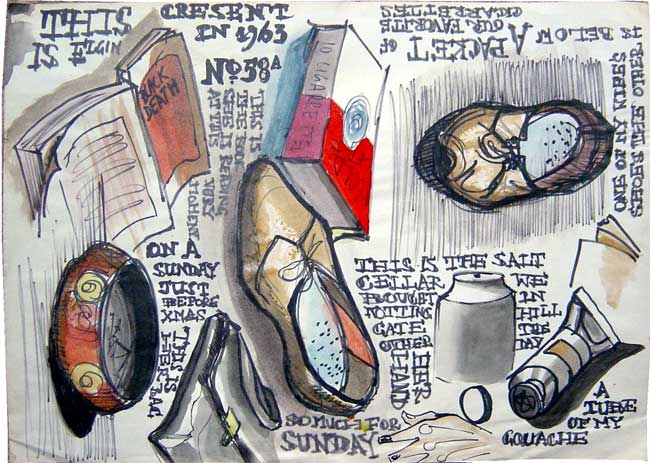
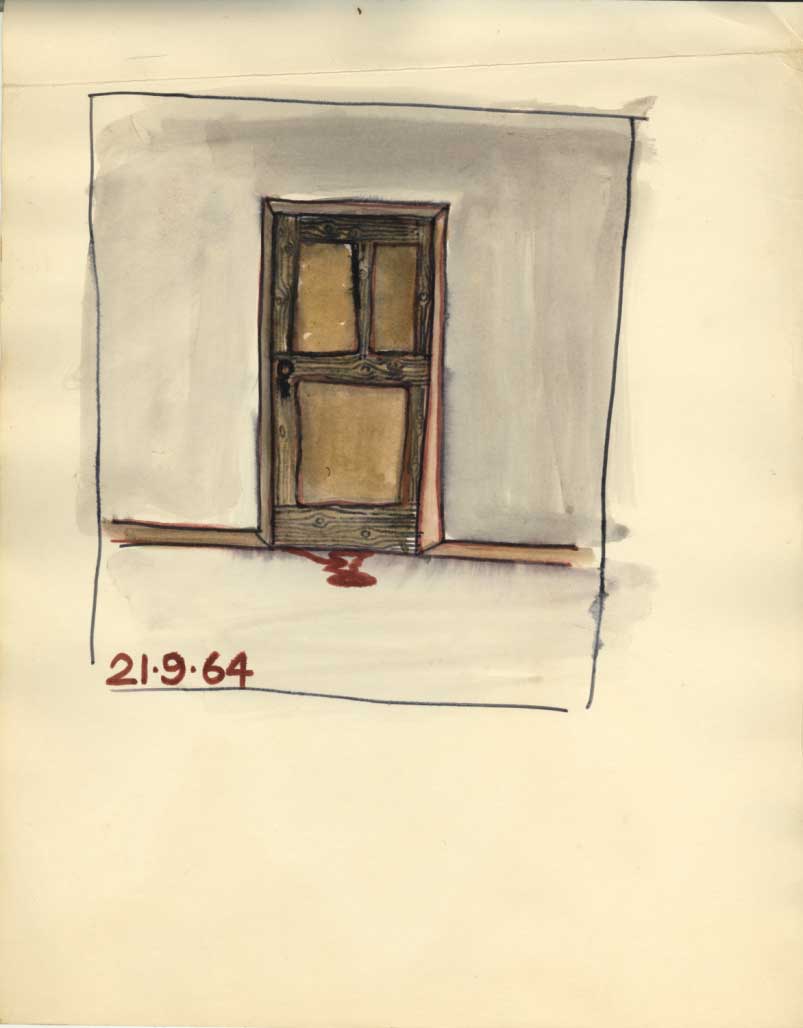
A few days ago, this drawing arrived from my stepmother, Sue. It was drawn by my father when I was about three, around the time my parents were divorced.
Many of these objects are things of my mum’s. I think she still has the copper ashtray on the lower left. Sue pointed out how similar this piece is to much of the work I have been doing and I must agree. I never really thought of him doing illustrated journaling but clearly he did.
Keir lives in Leicestershire, near Nottingham (that’s in England, folks). His three daughters (my half sisters) are all grown and he seems to spend most his time drawing daily self portraits or writing software for his own amusement. I’ve only seen my father a half dozen times since the divorce and we correspond very intermittently. I have a few of his sketchbooks from the early 1960s and I have always loved them.
Between Jack’s painting and this newly arrived drawing from Keir, I must say I am thinking quite a lot about heredity these days.

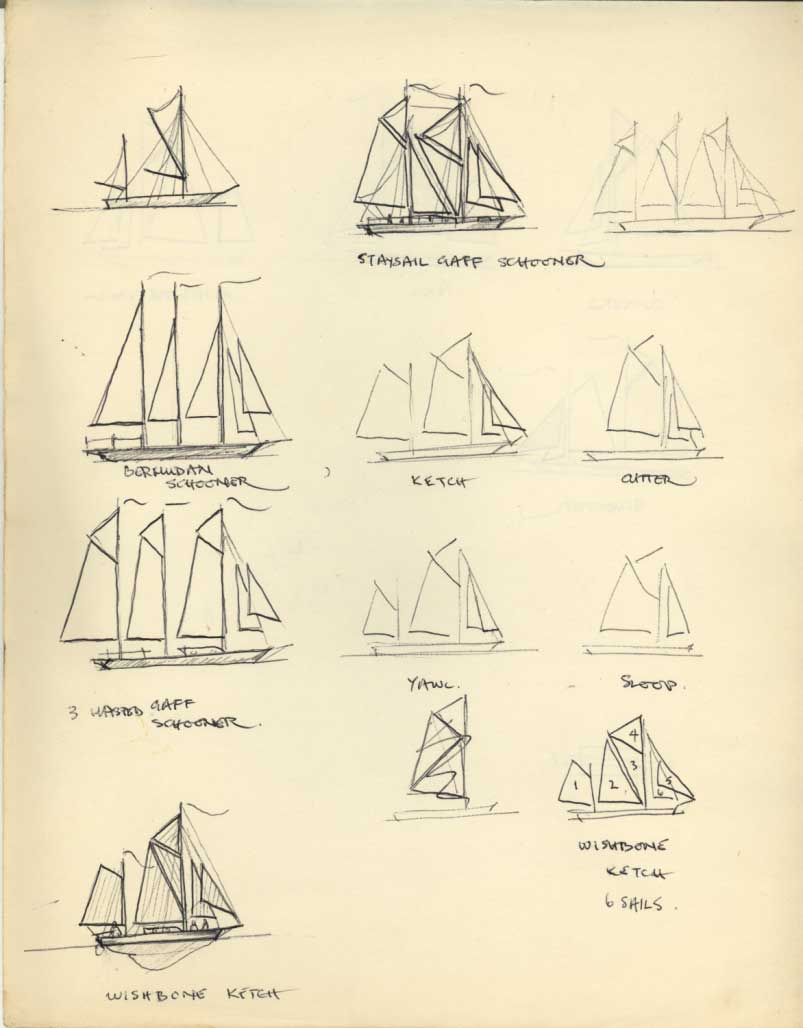
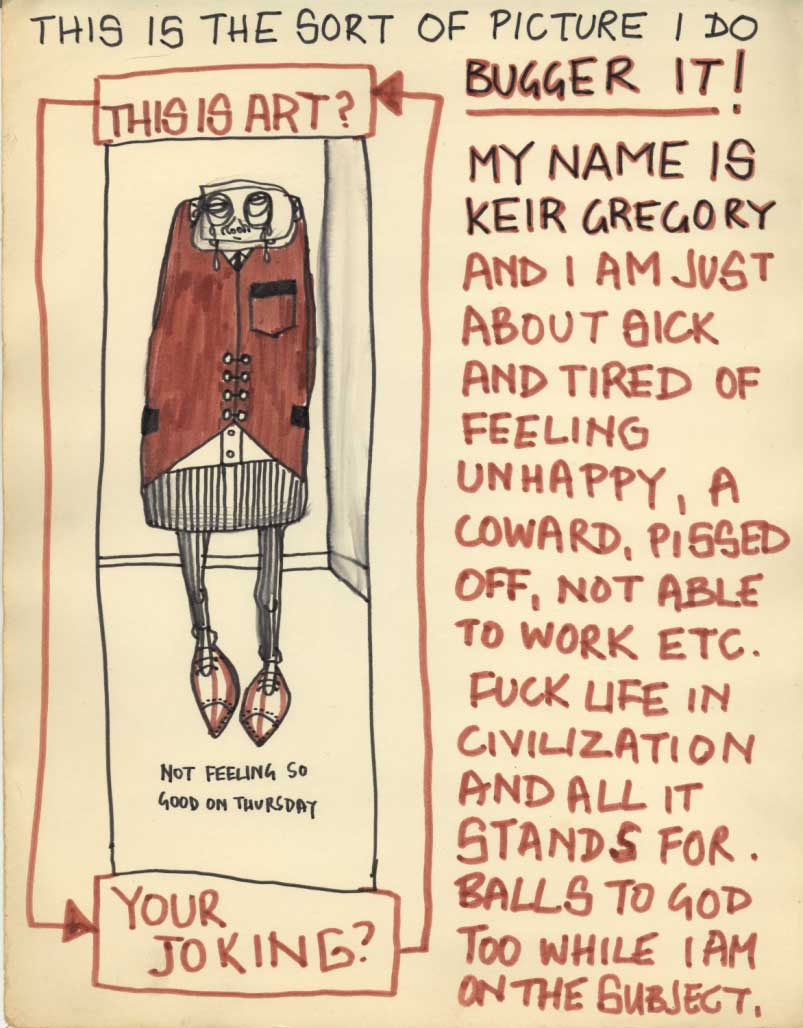
Here is some more of Keir’s work circa 1964 (he never shows his work so I hope, on the off-chance that he stumbles across this web page, that he doesn’t take offense to this little tribute exhibition). Some of it is pretty angry and hard core so please don’t yap about the language or the macabre-ness:


Early morning habits

coffee-shopToo long ago, I went to the gym every day. At seven a.m., the doors opened and a small group of us would shamble in and begin lifting weights. I had a little notebook in which I charted my regimen and recorded my progress; accumulating the little pencil scrawls kept me committed for close to a year. I was pretty intense about it, seven days a week, rain or shine, always at 7 a.m. If I overloaded the stack of iron and strained a rhomboid, I would switch to a leg routine for the next few days until I healed. But I had to keep going
I took a fair amount of pleasure in how my body developed. I wasn’t a steroid freak or anything though some of the other 7 a.m. crew were a little scary, particularly a couple of the women with lats like pterodactyl wings and neck as thick as my thighs. For me, weight lifting felt like a creative act; I liked how my arms felt like they belonged to someone else, like touching a horse or a large dog’s back. I had made my body into something, something essentially useless as I rarely had to lift toppled trees off cars or open jars of pickles, but something hand-crafted nonetheless. I don’t even know how healthy the whole thing was: I almost always hurt somewhere and woke up each 6:30 wincing and groaning.
When it was still cold and dark outside, Patti would urge me to stay in bed but I would refuse. There was simply no room for discussion. If I missed a day, I would lose momentum, my streak would end. I was convinced that I had to be 100% committed to my routine. The pathological drill sergeant in my head gave my will zero room for excuses.
Then my sister said she wanted to join me. For a week or so, she met me every 7 a.m. and it was fun to have someone to work out with. Till one morning she called me at 6:45 and croaked that she didn’t feel like going today, that I should take the day of too. So I did. And the day after that and so on. I never went back to the gym again.
——-
Habit is enormously powerful. The bad ones are easy to pick up and a drag to shake. Each bad habit starts by stifling a voice in your head, the one that knows better, and says ‘go ahead, just try it’ and leads you to drag that first cigarette though you know it’ll lead to the grave, to accompany every burger with fries, to flop on the couch in front of the tube, to drink too much, talk too much, do too little…. The angel on your shoulder doesn’t stand a chance.
For me, developing good habits requires the same sort of censorship. However, this time I have to stifle the voice that leads me astray, to be absolutely rigid in my refusal to capitulate. It works best when I have an inflexible routine, like my 7 a.m. appointment at the gym.
These days, NPR wakes me up at 6:57 a.m., and I go mechanically through a series of maneuvers that have me walking up the street and arriving at my desk at 8:30 while the office is still cold and empty. I am at my most productive in that first hour. I’d love to add another hour to my morning, to rise before six and really get something done with my first cup of joe. I haven’t muscled myself into that harness yet.
What does this sort of rigidity mean when it comes to creativity? Can you be so iron-clad and expect your imagination to function just because you have put it on a regimen? Will the ink lie cold in the pen? Will the mind stay half-asleep?
Not if you insist. The muse can be put on a tight schedule. I have had to come up with ideas, on deadline for decades and, if anything, things flow more easily when you bear down on the brain. It’s not guaranteed but showing up is half the job. If I am focussed, resolved, and present, ideas will come.
I’d like to be more disciplined about my drawing. When I have an illustration assignment or a commitment to another like sketchcrawling, I can deliver. I just did it in Paris, crawling out in to the cold rainy dawn to draw. But it’s not as much fun as when I am suddenly inspired to pick up the pen. It feels like work. But maybe that’s because I am irregular in my early morning sessions. I mean, I could stagger over to the gym tomorrow at 7 am and bench press something but it would not be fun.
My pal, Tom Kane, has a great habit. When he walks into his office each morning, he snaps on his computer, loads the NY Times homepage and draws something from one of the lead stories in a Moleskine reserved for the purpose. Each day, at least one drawing of a newsmaker. Only then does his work day begin. His book is full now, brimming with great caricatures and portraits, built one drawing at a time. His drawings muscles ripple. Of course, he does not stop there; he draws New York City most days, detailed pen and ink drawings that fill the page from corner to corner. Tom’s compulsive too. He cannot stop until every square inch of paper is covered and crosshatched. He tells me he doesn’t do it because he enjoys it; he does it because he has to. He’s got the habit.