“Why should I learn to draw and how are you gonna teach me?”: On the teaching philosophy of Sketchbook Skool

A key to successful learning is to have a motive. Why do I want and need to learn this?

When we first started to learn things, it was to survive in the world. Learning how to walk, how to eat solid food, how to talk, and how to play with others were hard but essential lessons. When we first got to school, we had to learn things because, well, mainly because we were told to do so by adults and because everyone else in the room was doing it too. We didn’t really understand the reason for learning what we are being taught but we did it because it some big person told us too. Eventually, some grown-ups inspired and excited us in the classroom and then we were doing  it because it was fun and we wanted them to like us even more. Those kinds of teachers are the ones that have the power to change our lives.

When we are grownups, why do we want to learn things? Generally, because the new skills will help our careers or enable us to accomplish some useful goal like cooking dinner or programming the DVR.

So why do people want to learn to draw? And how do we help them to persevere?

So why do people want to learn to draw? And how do we help them to persevere? People want to learn to draw generally because is a skill that they felt was potential in them for a long time but they were never able to focus on or get proper guidance  to fulfill that potential. “I’ve always wanted to draw,” people tell me. But there were huge obstacles that sat in their way — the largeness of the task, the enormous commitment required, and most of all the fear of failure.   This stems from the sense that while others may be good at this, you were not born with the talent or ability to ever accomplish even a basic level of drawing skiinstructionll yourself.
So the first and most important task is to give people back their sense of power. To make them think that they can do it, to show them that that ability does reside within them, and that if they put in a bit of work it will not be wasted effort. Because there is that sense that the process is magical and that, without that spark of magic, no amount of effort or training will pay off.

As teachers, we have to show them that it is indeed possible. And the key to doing that is to show them that people just like them —novices, frustrated creatives, people born apparently without talent — are able to make progress in the same way.

If you look at Betty Edwards’ classic  book, Drawing on the Right Side of the Brain, one of the most notable things in it are the ‘before’ and ‘after’ pictures. We see accomplished beautiful drawings and next to them the same sort of amateurish fumblings that we are now capable of. The book promises us that, just like these people, we will be able to progress from A to B.

A great way of doing that is by giving people a sense that they are surrounded by like-minded people. Community, is a key part of empowering them. I can tell you over and over why I think you will be able to accomplish this but, unless you trust me, unless you feel I am like you, your inner monkey critic can simply dismiss my expectations and say that I am different from you so my lessons do not apply.

You can buy a book and struggle alone with the exercises, giving up when you hit the first obstacle or disappointing sketch. But when you’re surrounded by thousands of others with the same ambition, the same busy lives, and the same apparently limited talent, you feel like maybe it is possible. And when you have that sense of possibility, the next step is to give you the opportunity to exercise. We need to give you work to do that will be both fun and rewarding. So we need to devise assignments that will fit in with your current life, that will remain interesting and varied, and that will move you one small step at a time, toward the goal of creative empowerment.

When you’re surrounded by thousands of others with the same ambition, the same busy lives, and the same apparently limited talent, you feel like maybe it is possible.

I think it is similar to  learn the way we did when we were children, to just enjoy the process, to have fun in the process rather than agonizing over the first meager results. All learning involves work. But it need not feel like work. It should  be fun, rewarding, and engrossing in someway.

We have the fantasy that learning a skill is simply a matter of getting access to certain shortcuts. That there is a secret set of tricks that will instantly have us drawing effortlessly and accurately, as if there were secret rules that allowed you to drive a car expertly or shoot a basket expertly. Drawing is a physical skill. Like any other, it takes practice. There are no shortcuts but there are things that will make the effort and time commitment required seem just like fun.

No one of the steps will instantly provide you with extraordinary abilities. But they will build your faith. And that faith means that you will continue to take one small step after another. And fairly quickly you will be able to look back and see how far you’ve come. And that will re-reinforce your faith again so you will continue to work and to move forward.

None of the steps has a magic formula, it just contains inspiration. Because ultimately nobody can teach you to draw — only you can teach yourself. And the way you do it is by believing that you can, and doing the work to develop the skills and the connections in your brain and body to make it so.

Fired up in the dark

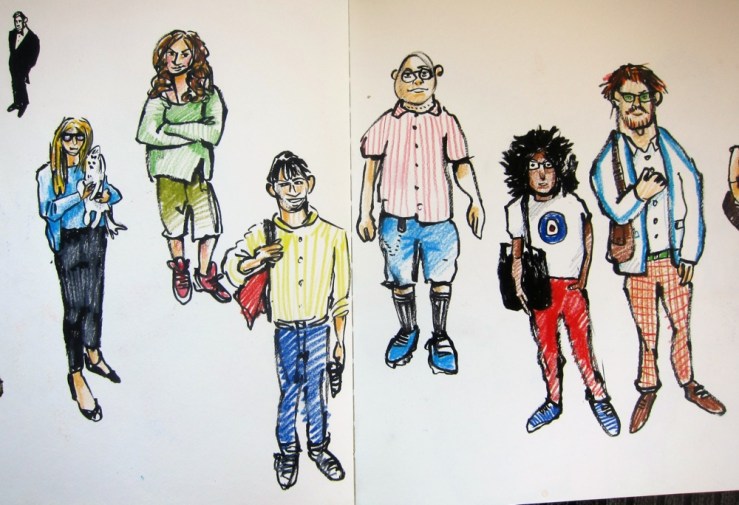
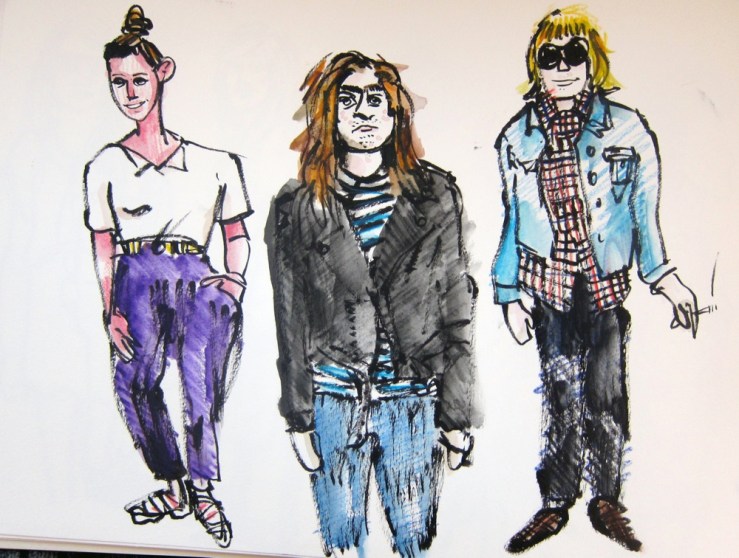
I am really inspired by working with Melanie Reim on her klass for Sketchbook Skool. Her loose, fast drawing style and her ways of capturing people in motion is just what I need to loosen up.

Here’s one of the pages I filled waiting with Jenny at the DMV.

IMG_7245

A couple of days ago we were invited to attend Sting’s new Broadway show. The music was good, the story and characters less so. During the second act, I pulled out my little Moleskine and  a couple of pens. It was so dark I couldn’t seem my book at all and  wasn’t sure what I was scrawling. During intermission, I flipped through my pages and, heartened, kept going after the curtain went up again. When I walked out of the theatre,  I had the story of the whole evening recorded in my book and my grey cells.

IMG_7246IMG_7247IMG_7244   IMG_7248

This sort of quick, take-no prisoners kept me fired up and, over the next few days, I drew a bunch of people in the street and from photos too.

IMG_7251  IMG_7252 IMG_7253+ IMG_7255 IMG_7256

Another reminder that — as in rock ‘n’ roll —sometimes speed and volume are just the ticket to loosen you up and silence your inner monkey.

Oh, and that Sketchbook Skool has the power to change your view of the world.

Even if you just work there.

Art by another name

Unafraid.
Unafraid.

One thing I keep encountering when I talk to people about starting to draw: fear.  People are terrified of pens, paper, and brushes.  Art is scary.

So I propose we call it something else. Drawing or journaling or sketching or doodling or sketchbooking or testing your pen. I call it ‘art with a small a‘.

Here’s how I look at it.

There are so many things we are willing to do that we know other people do much better. There are all sorts of amazing chefs on TV doing incredible things with scallops and opening four-star restaurants, but we are all still willing to cook some burgers for dinner without being terrified. We don’t say, I just can’t use  a microwave, I didn’t go to cooking school.

We may not be ready for the NBA but we’ll toss a basketball around with some buddies.  We won’t be headlining at Madison Square Garden or winning any Grammys but we’re all still willing to sing in the shower or whistle while we work.  We may not be on the Pulitzer shortlist but we can still write an email or a birthday card.  We are just doing it to have fun. Or because it’s an essential part of life.  And I think art can be both.

We don’t need to label ourselves chefs, or basketball players, or musicians, or writers.  So why does art have to be so different?

If you want a painless, unscary way to start expressing your creativity, sign up for the best semester yet of Sketchbook Skool. Thousands of people who are rusty as barn door hinges are doing it.  Join us!

A hundred feet of eighth graders

(A somewhat funky video I made in my hotel room in China)

Learning to draw is not like learning to drive.  You don’t have to master the fundamentals, take courses, pass tests, put thousands of dollars of equipment at risk.  You just have to start.

Drawing isn’t a learned skill so much as it’s a process of discovery that starts with skills you have had since you were a toddler. And that process requires a willingness to stretch and practice, things that can be scary or boring if you approach them with the wrong set of expectations.

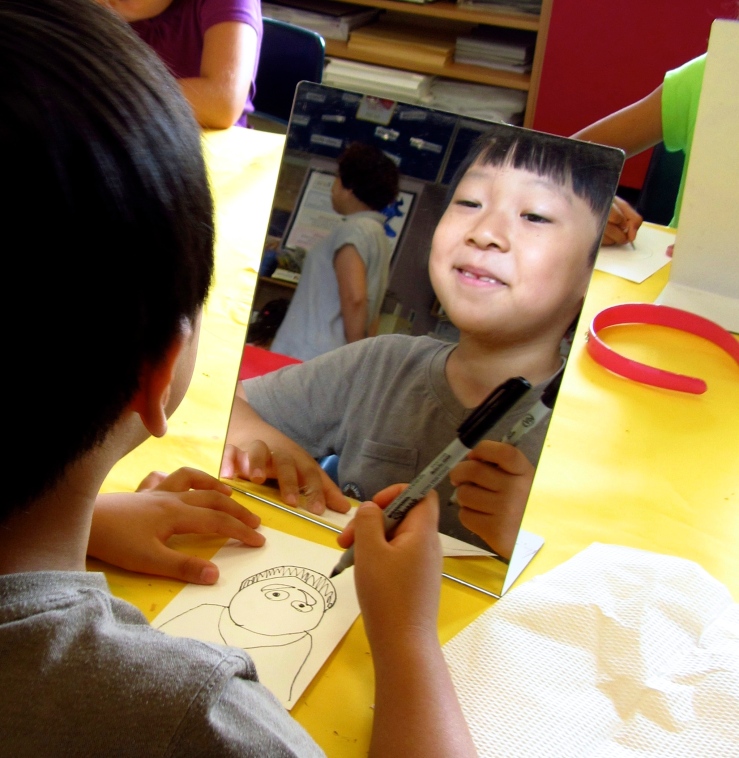
One thing that has been reinforced with me over the past few weeks that I have spent drawing with kids is that the most crucial thing is to have fun. If you are all enjoying yourself and slopping ink and paint around, well, you want to keep it doing it. As as you do it, you encounter new situations, you have questions, you want to stretch. And that’s where a decent teacher can step in and show you how to make progress. You also start to feel more comfortable with what you are doing so you are willing to make mistakes and take new risks, and that’s how your adventures to new places begin.

We all need to accept that creativity is not about immediately achieving some sort of awesome finished piece; it’s an exploration of discovery, not a straight-line commute to Perfection.

Of course, this insight isn’t just for junior high. It’s the core idea behind Sketchbook Skool: having new experiences, having fun, exploring with friends, and having opportunities to grow. Speaking of which, the new semester is about to begin. I assume you have already signed up, but if not, get over to our site and enroll.

Some stuff I learned in China that could help you too

dragon

  • 3-year-olds have a lot to teach me about drawing.
  • Chinese people rarely eat rice.  Or dog.
  • Digitizing your entire life is efficient and modern and smart. Until you can’t get online.
  • 10-year-olds can draw with a dip pen and a fountain pen.
  • Strangers are almost always helpful and friendly, especially if they have no idea what you are saying.
  • You can live happily without seat belts, helmets, or walk signs.
  • When you’re four, you’ll draw anything fearlessly. When you’re nine, you’d like to learn to draw real things but deep down would just as soon draw stick figure armies.  At thirteen, all that matters is what others think. At seventeen, you are obsessed with technique and your imagination is a liability.
  • Committing to eating new things doesn’t have to extend to donkey meat, bullfrog, or turtle.

If you’d like to learn even more stuff about all sorts of things, hurry and enroll for the best semester yet of Sketchbook Skool.  See you in klass!

Kitchen Confidential

Remember the cafeteria ladies who worked in your high school? Their last serving of chipped beef may still be lurking in your colon but your probably never knew much about the ladies themselves, not even their names.

I decided to do portrait of some of these hard working people when I was in Beijing, to learn a bit about them and share it with the students who are coming by my studio. I’d been looking at a lot of posters of proud workers from the Cultural Revolution and this take on Soviet realism inspired me. I thought about drawing them on location but I would have just gotten in the way of the preparation of the dozens of dishes they make for thousands of hungry kids. The head of catering took me behind the scenes and we got three women to agree to pose for my camera. Those photos became the basis for a cardboard painting in shades of yellow, red and gold.

When I had completed my painting and had written down what I knew about them in English and Chinese, we invited the models to see what I’d made of them. They were flattered and pleased.

The next day, one of the cooks (the one behind the safety mask) returned — with an amazing drawing she had done of me. Our studio assistant explained that the cook had always wanted to be an artist, and when she was young she had applied to the main art school in Beijing. There was just one remaining place in the class and it was given to a man. So she gave up her dreams and went to work in the kitchen — but she still kept drawing. Now she’s a grandmother but her skills are still exceptional.

Over the next few days, we saw more and more of her art and the school began to celebrate her. Soon there will be articles and videos about her story and hopefully she will be able to live her dream and share her at with the world.

What a strange serendipity. And a wonderful one.

BTW, you’ll find lots of people who are looking to get their art making back on track at SketchBook Skool, those whose skills are rusty as an old barn hinge and those who have been let their love of drawing stay buried beneath a distant failure.
Ready to get out of the kitchen and join us? Come over and enroll.

All the t-squares in China

stuck-in-traffic

Some clichés are based in truth.  The one I encounter a lot in China is the Asian student who drives her/himself super hard and who is forced by expectant parents to be overachieving and highly pragmatic.

These kids have been coming to me, one by one, to ask for my advice on their future plans. A classic was the senior who said she was picking colleges to study art based on whether they also had a  great physics programs — in case she had to switch directions.

I understand their anxiety.  They live in a country that is going through a massive transformation and there’s a lot resting on the new generation.  They want to be as prepared as possible, to dot every ‘i’, take every course, ace every test…

Here’s my message to them and it might be useful to you too.

It’s good to be prepared, but what are you preparing for? I think the only thing you can intelligently anticipate is change. And no number of degrees or job offers at investment banks will prepare you for the unknowable. That takes creativity. An ability to adapt. A willingness to live with ambiguity. Resourcefulness. A knack for collaboration.

I encountered their core problem when they made art. They were so afraid of mistakes.  Kids would go to rip up their work if they encountered any sort of screwup, a bent line, wonkiness. And I would say to them, “Hold on! Try to turn that into something. Work with it. Solve the problem. It’s okay.”

mistake
I love this. It says it all.

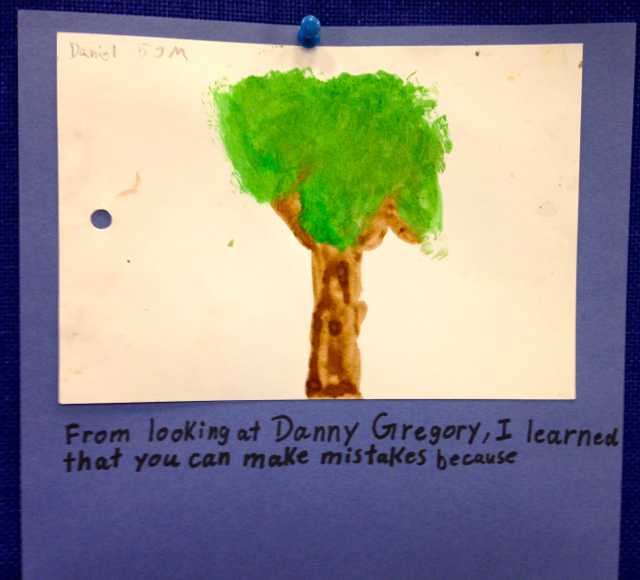
When the teachers asked their students what they got out of my stay at their school, they say things like:” Danny taught me to make masterpieces our of mistakes” and “I tried making drawings unique instead of exact.”

Learning to live with (and embrace) our essential fallibility. It’s what I learned at Clown School earlier this year.  And I hope I managed to pass it on to all those kids who will be contributing to our imperfect future.

Speaking of mistakes, if you miss the greatest semester yet of Sketchbook Skool… well, we wouldn’t want that would we.  Enroll today!

The shortest distance between two coasts is a wonky line.

sights-1

Playwrights say that if a gun appears on stage, somebody will use it before the curtain falls. Photographers say that the best camera is the one you have with you. The New York Lottery says “You gotta be in it to win it.”

I just spent ten days in a car with a journal on my lap.  As  result, I did a lot of drawing. Not that drawing in a car is ideal. I am prey to carsickness so jolting highways and juddering views are usually not the ideal environment for the delicate stomach of my muse. Nonetheless, as I looked out the windshield four thousand miles, I was constantly drawn to draw.

Aphorists say when you have a hammer, everything looks like a nail. And as I spent my whole day with a pen lightly gripped in my hand, everything looked like a drawing. The only effort required to start a drawing was to shrug off the cap and, whenever I wasn’t at the helm, I seized every excuse to draw (thank you, Tommy Kane).

sights-2

The unfolding miles inspired me to use the pen which in turn defined the journey we were on. I saw connections between things, I saw unusual shapes, I saw common things suddenly looking very uncommon. I was hyperaware of the light, of the weather, of the ravages of time. Holding a pen can be like donning polarizing sunglasses, sharpening everything in your field of vision.

Now I am back on terra firma, I want to hold on to that urge and habit. To keep recording all the days that pass under my feet, to keep seeing even the most familiar landscape with the fresh eyes and open mind of a traveler.

Sketchbook Skool Update: Danny & Koosje

We’re just a little over a month from the first day of Sketchbook Skool.  Every week or so, we’re going to do a little Skype chat with one or another of our teachers about what’s coming up and what they have planned for their klasses.  Here’s the first one in which I tell Koosje what I have in store for you.

If you’re having a problem watching this on an iPad or Mac, please make sure you have updated your system. There was a very important update from Apple today that protects your security. I urge you to make sure your system is current.  That may not be the cause of the problem with this video, but I have tested it on an updated iPad and a Powerbook and it is fine.

No title. Really, that’s the title.

ArtistI think my mother was the first one to tell me, “You can’t call yourself an ‘artist’.  Other people will decide that for you. It’s pretentious to assume the title for yourself. It’s like calling yourself a  genius. Maybe you can say you’re a ‘painter’. But not an artist.”

My mum is humbling like that.

“Teacher” is another title I am loathe to assume. I don’t have a degree in teaching, I don’t work at a school. And I think teaching is one of the most important and difficult and unrecognized jobs around. I really do think that’s a title you have to earn.

But I guess I do spend a fair amount of time telling people stuff, instructing them on how to live, to drawn, to think. So I’m either a bullying bore or I am maybe a teacher. Not that the two are the same thing, of course. It’s just that if you walked into a bank and started criticizing people’s penmanship or cracking knuckles in your local Starbucks because people have poor posture and are chewing gum, well, that wouldn’t fly. Teachers get to know better because they do.

I’ve had loads of corporate titles and they all seemed sort of ridiculous. Yesterday, a guy gave me his business card and said, “There’s no title there because I still haven’t quite figured out what it is I do.” He was being modest (he was actually the boss of a really big company) but I liked his attitude.

Let me get to the point.

One of the biggest irons I had in the fire when I left my last titled job was to put together an online class.  I’ve alluded to it here a bunch of times since — but it never seemed quite right to me.  Maybe it’s because of those two titles, ”artist” and “teacher” and the even more daunting combo: “art teacher.”

A couple of weeks ago, everything changed.

As result of number of amazing conversations I had in Amsterdam, most importantly with Koosje Koene, a clear, bright path has opened up. I now know what I will be doing next and I think it will be amazing.

It combines everything I have been working on for the last decade. Making art; sharing with other people; meeting so many amazing “artists” and “teachers”; thinking about creativity and all of its gifts and obstacles; the Internet and the global nature of everything; Everyday Matters and what it has come to mean on Yahoo! and Facebook; the thousands of emails I have received from great people everywhere; my decades in advertising helping big companies tell their stories —  all of this mass of rich stuff lumped together in one beautiful stew that finally is really bubbling.

A group of us are working on something that I really think is fresh and fantastic. It’s an answer to all those people who have asked me to do more workshops or to teach online or to give them advice or make more Sketchbook Films, all the people who are interested in art and want to make it more a part of their lives. And I think it’s a great answer, like nothing out there.

We still have a lot more work to do but we think we will be ready to roll it out in March. Gulp

It’s a lesson that settling for an existing title or solution or direction may not always be as good as making up something brand new.

Which is what we are doing.

If you find this, whatever it is that I’m going on about, interesting, stay tuned.

And if you’d like me to update and include you in our project, send me an email. Please do. Even if you are only intrigued. Or vaguely interested. Or utterly confused. It’s gonna be big. And probably won’t involve titles.

Go back

Your message has been sent

Warning
Warning

Warning.

.