Learning to teach beginners. On the teaching philosophy of Sketchbook Skool

What is the role of feedback in learning? Especially when starting to do creative things, things that are ultimately pretty subjective? When there are no answers in the back of the book?

The biggest obstacle we need to overcome in learning to create is the belief that we can’t. That’s especially true when we learn as adults. We have spent our entire lives believing that we cannot do this thing, and now, unless we are convinced that we can, we will never get to a point of any sort of mastery.

The most difficult and crucial lesson for beginners is the importance of failure. You need to make a lot of mistakes. You need to feel good about those mistakes and recognize that they are opportunities to improve. You can’t allow those errors to overwhelm you and make you feel hopeless.

The biggest obstacle we need to overcome in learning to create is the belief that we can’t.

The reason that people struggle with failure is because they believe that their failures are reflections on who they are as human beings. “Only failures fail.” The fact, of course, is that everybody fails on the path to learning, that failing is the most important part of any education. Researchers have shown that people learn far more from watching others fail than they do from watching extremely accomplished people do things without making any mistakes. You can sit and watch Lebron James shoot baskets perfectly all season but that won’t prove very instructive in developing your own game.

It is much more difficult to look at our own failings as educational opportunities if our egos and self-image are wrapped up in success and failure. When we watch other people fail, we are able to separate failure from ourselves, to see the failure as ‘other’ and thus look at it objectively.That is why it is generally better to learn creative things in a group environment where we can see others struggling and failing. We can see where the mishap occurred or how the problem was not fully solved.  The problem exists independently and facing it is an interesting challenge, rather than a demeaning disaster.

…failing is the most important part of any education

What is the value of a teacher’s comments to a new student?

In creative situations, where one’s ego and self-image are tied into the results of an exercise, any sort of perceived criticism can undermine that process. Because we are still so new at learning this new skill, it is difficult to accept that a mistake is not a reflection of who we are and an indication that we shouldn’t even bother tackling this lesson.  That’s why we need as much encouragement as possible in the beginning phase of learning, a phase that can actually last for years. We need to develop self-confidence and faith in our own creative abilities and sometimes criticism of any kind can thwart that  progress.

Students often ask for specific advice on how to improve their composition or how to use a certain medium more effectively, and some teachers are quick to provide lots of guidance, rules, and specific direction. I don’t know if that is especially effective. I find that most students are extremely vulnerable to the most benign sort of commentary — even if they asked for it. Simply telling somebody that they might want to consider a different composition, different medium, consider a slightly different approach, can be extremely undermining. There are so many open wounds as one is going through this creative rebirth that everyone involved must tread lightly. That includes the teacher, the student, and the relative looking over the shoulder.

I think it’s more effective to encourage students to experiment, to make more work, and to gradually developed their own answers to these questions. In fact, my experience is that almost all direct input from the teacher (inevitably an authority figure) is not particularly useful before the student has real confidence in their abilities. Instead the teacher should create an environment of trust, inspiration and fun. They should encourage the process, the experimentation and exploration, provide reassurance and safety, and do demonstrations in which they explain their own process, rather than making specific suggestions about the work the student has done. Turn the key, but don’t grab the wheel.

Turn the key, but don’t grab the wheel.

Many novice students believe that there are shortcuts available that once revealed will turn the student from an amateur into an expert. They want to know what brand of pen the teacher uses under the misimpression that the pen is the secret. The fact is that the student will do much better by discovering answers on their own, by studying the works of others, and by trial and error. There isn’t an accumulated body of knowledge that the student can acquire which will transform them. That knowledge only comes through years of work.

But that doesn’t mean the student can’t be delighted with their accomplishments almost immediately. Especially in the beginning of a creative education, progress happens quite quickly, simply by feeling empowered and free to actually make things. Sometimes that simple realization can wipe out years of anxiety around creative issues. And with that freedom comes an opportunity to continue working and develop one’s own style and techniques.

But that doesn’t mean the student can’t be delighted with their accomplishments almost immediately. 

Personally I find that students with the most technical skills alone rarely make art that I find very interesting.  Instead I’m far more excited by people who make mistakes and discover new and interesting ways to overcome them.

Learning the tried-and-true ways of making art is not necessarily the way to make great art. It is simply the way to rehash the lessons we’ve already learned, to make more art that is ready familiar. Instead you want to create new and exciting directions, to take risks, to see the world afresh, to find answers to new questions. Learning to draw is not like cooking Boeuf Bourguignon, a set of steps one can follow from raw ingredients to final delicious product. Instead it is a voyage, an excursion into the wilderness, an adventure that is mainly rewarding for its own sake, not for its results.

The teacher doesn’t have the answers.  Only the student does.
“Why should I learn to draw and how are you gonna teach me?”: On the teaching philosophy of Sketchbook Skool

A key to successful learning is to have a motive. Why do I want and need to learn this?

When we first started to learn things, it was to survive in the world. Learning how to walk, how to eat solid food, how to talk, and how to play with others were hard but essential lessons. When we first got to school, we had to learn things because, well, mainly because we were told to do so by adults and because everyone else in the room was doing it too. We didn’t really understand the reason for learning what we are being taught but we did it because it some big person told us too. Eventually, some grown-ups inspired and excited us in the classroom and then we were doing  it because it was fun and we wanted them to like us even more. Those kinds of teachers are the ones that have the power to change our lives.

When we are grownups, why do we want to learn things? Generally, because the new skills will help our careers or enable us to accomplish some useful goal like cooking dinner or programming the DVR.

So why do people want to learn to draw? And how do we help them to persevere?

So why do people want to learn to draw? And how do we help them to persevere? People want to learn to draw generally because is a skill that they felt was potential in them for a long time but they were never able to focus on or get proper guidance  to fulfill that potential. “I’ve always wanted to draw,” people tell me. But there were huge obstacles that sat in their way — the largeness of the task, the enormous commitment required, and most of all the fear of failure.   This stems from the sense that while others may be good at this, you were not born with the talent or ability to ever accomplish even a basic level of drawing skiinstructionll yourself.

So the first and most important task is to give people back their sense of power. To make them think that they can do it, to show them that that ability does reside within them, and that if they put in a bit of work it will not be wasted effort. Because there is that sense that the process is magical and that, without that spark of magic, no amount of effort or training will pay off.

As teachers, we have to show them that it is indeed possible. And the key to doing that is to show them that people just like them —novices, frustrated creatives, people born apparently without talent — are able to make progress in the same way.

If you look at Betty Edwards’ classic  book, Drawing on the Right Side of the Brain, one of the most notable things in it are the ‘before’ and ‘after’ pictures. We see accomplished beautiful drawings and next to them the same sort of amateurish fumblings that we are now capable of. The book promises us that, just like these people, we will be able to progress from A to B.

A great way of doing that is by giving people a sense that they are surrounded by like-minded people. Community, is a key part of empowering them. I can tell you over and over why I think you will be able to accomplish this but, unless you trust me, unless you feel I am like you, your inner monkey critic can simply dismiss my expectations and say that I am different from you so my lessons do not apply.

You can buy a book and struggle alone with the exercises, giving up when you hit the first obstacle or disappointing sketch. But when you’re surrounded by thousands of others with the same ambition, the same busy lives, and the same apparently limited talent, you feel like maybe it is possible. And when you have that sense of possibility, the next step is to give you the opportunity to exercise. We need to give you work to do that will be both fun and rewarding. So we need to devise assignments that will fit in with your current life, that will remain interesting and varied, and that will move you one small step at a time, toward the goal of creative empowerment.

When you’re surrounded by thousands of others with the same ambition, the same busy lives, and the same apparently limited talent, you feel like maybe it is possible.

I think it is similar to  learn the way we did when we were children, to just enjoy the process, to have fun in the process rather than agonizing over the first meager results. All learning involves work. But it need not feel like work. It should  be fun, rewarding, and engrossing in someway.

We have the fantasy that learning a skill is simply a matter of getting access to certain shortcuts. That there is a secret set of tricks that will instantly have us drawing effortlessly and accurately, as if there were secret rules that allowed you to drive a car expertly or shoot a basket expertly. Drawing is a physical skill. Like any other, it takes practice. There are no shortcuts but there are things that will make the effort and time commitment required seem just like fun.

No one of the steps will instantly provide you with extraordinary abilities. But they will build your faith. And that faith means that you will continue to take one small step after another. And fairly quickly you will be able to look back and see how far you’ve come. And that will re-reinforce your faith again so you will continue to work and to move forward.

None of the steps has a magic formula, it just contains inspiration. Because ultimately nobody can teach you to draw — only you can teach yourself. And the way you do it is by believing that you can, and doing the work to develop the skills and the connections in your brain and body to make it so.

Art by another name

Unafraid.
Unafraid.

One thing I keep encountering when I talk to people about starting to draw: fear.  People are terrified of pens, paper, and brushes.  Art is scary.

So I propose we call it something else. Drawing or journaling or sketching or doodling or sketchbooking or testing your pen. I call it ‘art with a small a‘.

Here’s how I look at it.

There are so many things we are willing to do that we know other people do much better. There are all sorts of amazing chefs on TV doing incredible things with scallops and opening four-star restaurants, but we are all still willing to cook some burgers for dinner without being terrified. We don’t say, I just can’t use  a microwave, I didn’t go to cooking school.

We may not be ready for the NBA but we’ll toss a basketball around with some buddies.  We won’t be headlining at Madison Square Garden or winning any Grammys but we’re all still willing to sing in the shower or whistle while we work.  We may not be on the Pulitzer shortlist but we can still write an email or a birthday card.  We are just doing it to have fun. Or because it’s an essential part of life.  And I think art can be both.

We don’t need to label ourselves chefs, or basketball players, or musicians, or writers.  So why does art have to be so different?

If you want a painless, unscary way to start expressing your creativity, sign up for the best semester yet of Sketchbook Skool. Thousands of people who are rusty as barn door hinges are doing it.  Join us!

A hundred feet of eighth graders

(A somewhat funky video I made in my hotel room in China)

Learning to draw is not like learning to drive.  You don’t have to master the fundamentals, take courses, pass tests, put thousands of dollars of equipment at risk.  You just have to start.

Drawing isn’t a learned skill so much as it’s a process of discovery that starts with skills you have had since you were a toddler. And that process requires a willingness to stretch and practice, things that can be scary or boring if you approach them with the wrong set of expectations.

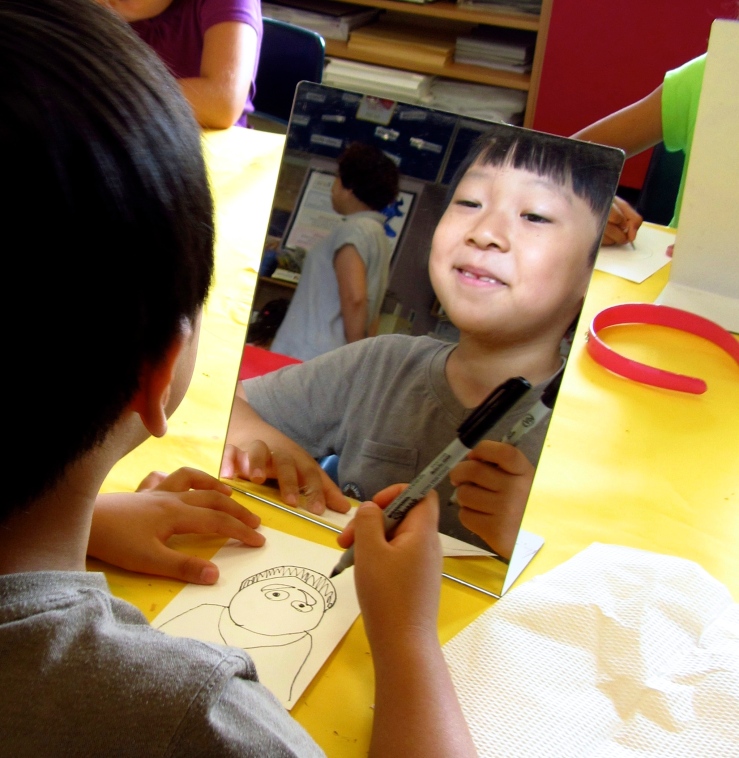
One thing that has been reinforced with me over the past few weeks that I have spent drawing with kids is that the most crucial thing is to have fun. If you are all enjoying yourself and slopping ink and paint around, well, you want to keep it doing it. As as you do it, you encounter new situations, you have questions, you want to stretch. And that’s where a decent teacher can step in and show you how to make progress. You also start to feel more comfortable with what you are doing so you are willing to make mistakes and take new risks, and that’s how your adventures to new places begin.

We all need to accept that creativity is not about immediately achieving some sort of awesome finished piece; it’s an exploration of discovery, not a straight-line commute to Perfection.

Of course, this insight isn’t just for junior high. It’s the core idea behind Sketchbook Skool: having new experiences, having fun, exploring with friends, and having opportunities to grow. Speaking of which, the new semester is about to begin. I assume you have already signed up, but if not, get over to our site and enroll.

Some stuff I learned in China that could help you too

dragon

  • 3-year-olds have a lot to teach me about drawing.
  • Chinese people rarely eat rice.  Or dog.
  • Digitizing your entire life is efficient and modern and smart. Until you can’t get online.
  • 10-year-olds can draw with a dip pen and a fountain pen.
  • Strangers are almost always helpful and friendly, especially if they have no idea what you are saying.
  • You can live happily without seat belts, helmets, or walk signs.
  • When you’re four, you’ll draw anything fearlessly. When you’re nine, you’d like to learn to draw real things but deep down would just as soon draw stick figure armies.  At thirteen, all that matters is what others think. At seventeen, you are obsessed with technique and your imagination is a liability.
  • Committing to eating new things doesn’t have to extend to donkey meat, bullfrog, or turtle.

If you’d like to learn even more stuff about all sorts of things, hurry and enroll for the best semester yet of Sketchbook Skool.  See you in klass!

Kitchen Confidential

Remember the cafeteria ladies who worked in your high school? Their last serving of chipped beef may still be lurking in your colon but your probably never knew much about the ladies themselves, not even their names.

I decided to do portrait of some of these hard working people when I was in Beijing, to learn a bit about them and share it with the students who are coming by my studio. I’d been looking at a lot of posters of proud workers from the Cultural Revolution and this take on Soviet realism inspired me. I thought about drawing them on location but I would have just gotten in the way of the preparation of the dozens of dishes they make for thousands of hungry kids. The head of catering took me behind the scenes and we got three women to agree to pose for my camera. Those photos became the basis for a cardboard painting in shades of yellow, red and gold.

When I had completed my painting and had written down what I knew about them in English and Chinese, we invited the models to see what I’d made of them. They were flattered and pleased.

The next day, one of the cooks (the one behind the safety mask) returned — with an amazing drawing she had done of me. Our studio assistant explained that the cook had always wanted to be an artist, and when she was young she had applied to the main art school in Beijing. There was just one remaining place in the class and it was given to a man. So she gave up her dreams and went to work in the kitchen — but she still kept drawing. Now she’s a grandmother but her skills are still exceptional.

Over the next few days, we saw more and more of her art and the school began to celebrate her. Soon there will be articles and videos about her story and hopefully she will be able to live her dream and share her at with the world.

What a strange serendipity. And a wonderful one.

BTW, you’ll find lots of people who are looking to get their art making back on track at SketchBook Skool, those whose skills are rusty as an old barn hinge and those who have been let their love of drawing stay buried beneath a distant failure.
Ready to get out of the kitchen and join us? Come over and enroll.

All the t-squares in China

stuck-in-traffic

Some clichés are based in truth.  The one I encounter a lot in China is the Asian student who drives her/himself super hard and who is forced by expectant parents to be overachieving and highly pragmatic.

These kids have been coming to me, one by one, to ask for my advice on their future plans. A classic was the senior who said she was picking colleges to study art based on whether they also had a  great physics programs — in case she had to switch directions.

I understand their anxiety.  They live in a country that is going through a massive transformation and there’s a lot resting on the new generation.  They want to be as prepared as possible, to dot every ‘i’, take every course, ace every test…

Here’s my message to them and it might be useful to you too.

It’s good to be prepared, but what are you preparing for? I think the only thing you can intelligently anticipate is change. And no number of degrees or job offers at investment banks will prepare you for the unknowable. That takes creativity. An ability to adapt. A willingness to live with ambiguity. Resourcefulness. A knack for collaboration.

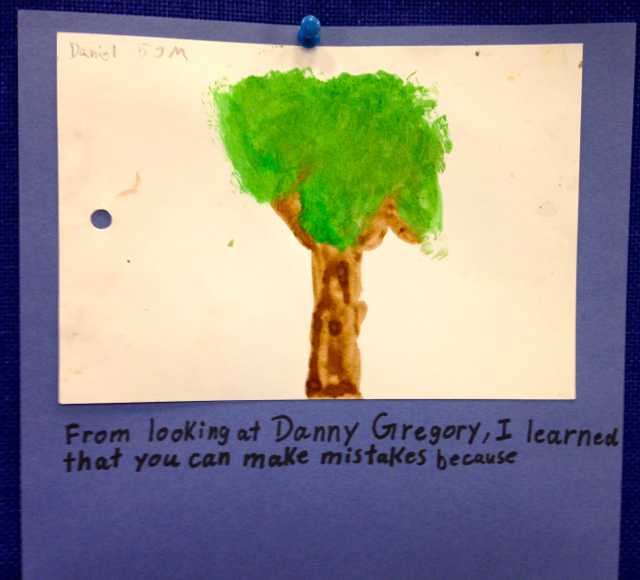
I encountered their core problem when they made art. They were so afraid of mistakes.  Kids would go to rip up their work if they encountered any sort of screwup, a bent line, wonkiness. And I would say to them, “Hold on! Try to turn that into something. Work with it. Solve the problem. It’s okay.”

mistake
I love this. It says it all.

When the teachers asked their students what they got out of my stay at their school, they say things like:” Danny taught me to make masterpieces our of mistakes” and “I tried making drawings unique instead of exact.”

Learning to live with (and embrace) our essential fallibility. It’s what I learned at Clown School earlier this year.  And I hope I managed to pass it on to all those kids who will be contributing to our imperfect future.

Speaking of mistakes, if you miss the greatest semester yet of Sketchbook Skool… well, we wouldn’t want that would we.  Enroll today!

Meanwhile…

I am enjoying my (hopefully) last day in Beijing.  I’ve been using the time to writing about the lessons I learned here and make a little film or two will be sharing them here over the next few days.

Meanwhile, here are two nice pieces on my visit to Beijing by Rena Tang, a lovely person who I met there:


Senioritis

A tentative first step back into my illustrated journal. Drawn while sitting, overtired, in bed.

Jack was eager to settle his college plans early and so was I. His acceptance to RISD was a huge relief for both of us. The stress and uncertainty of the college process was over and now we can both relax until September.
But doing next to nothing turns out to be a lot less fun than he thought it would be. Fall is a long way away and Jack still has to get up at 7:00 each morning and sit in classes all day, listening to droning teachers, half-heartedly writing homework assignments in the period before they’re due, doing the bare minimum to keep his grades above water so his acceptance isn’t rescinded.
I say to him, well, you’re still being taught useful and interesting things, even if your grades really don’t mean as much. Can’t you just learn … for the fun of it? What’s the point, he groans. Who cares? I’ll study when I get to college… Etc.
Senioritis isn’t confined to teenagers. At every point in life, it’s easy to be so focused on goals that one can’t see the value in anything that doesn’t pertain directly to them. All around are books and classes and conversations and experiences that would enrich us greatly but it’s easier to just do the same-old and not expend the effort for something that doesn’t same to have a direct benefit or relevance to one’s occupation or obligations. What’s the point in learning to draw or reading about ancient history or trying sushi or visiting China? We think we know it better, so despite the richness of the world around you, if your mindset is wrong you won’t absorb or even register it. You screen it out.
When we’re toddlers, we are constantly exploring and asking questions about everything we encounter. That impulse diminishes when we get older because our pre-frontal cortex develops and filters out the firehouse of information that is constantly streaming in. Most of the time, we certainly need that filter so we can be focused and goal oriented — it would be impossible to get anything done if we were always walking around in slack-jawed amazement. So we increasingly notice only those things that we have decided are related to our preconceived goals and orientations.
That means it takes an extreme form of novelty or trauma to snap us out of this narrow tunnel we have burrowed into. Something like 9/11, a death, an accident, can force us into a reassessment and new orientation. Our eyes are opened, we say, and suddenly we see things we’d never seen before.
We use this metaphoric language to describe this epiphany but what if we take this notion literally and force ourselves to actually see things anew. We can reorient our perception and put on a wider lens. Of course, we don’t want to eliminate this screening function altogether or else we might wander off the road and spend all day picking wild flowers, but we can pick moments to relax our pre-frontal cortex, return to a more childlike state, rebuild our muscles of perception, and restock our cache of creative stimulation.
When you draw something you see it in a new way. A good drawing is a fresh perspective on an object you may have seen a thousand times before: a building, a body, a bowl of fruit, your breakfast dishes. But by paying deliberate and careful attention to every nook and cranny, you flood your mind and your page with new information about what you are seeing — the texture of a banana skin, the way light hits a brick, how the knee connects to the shin bone, the exact curve of a cup handle. You are suspending the critical function of your pre-frontal cortex, refusing to decide whether there’s importance to each individual line and aspect; you just record them all. This information isn’t actually that important to you beyond the act of drawing, you don’t need to retain the visual data about that banana skin, it may have no further utility to you. But it is expanding your awareness of the world around you, strengthening for observation muscles — it has as much purpose as lifting the same weight over and over at the gym.
When your mind’s eye is open and your screens and filters are down, you get more and more useful information, and that information and experience are the raw fodder for creativity. Forming associations between apparently disparate things to create a new idea is what creativity is all about. And the more open your mind is, the more you are open to experiencing things are interesting but may not have immediate and obvious relevance to your current endeavors. By exposing yourself to art, to novelty, to new ideas, facts and experiments, you stretch your mind so that it is pliable and elastic, so that it doesn’t seize up when you have to move in a new direction. Your reservoirs of references are loaded and you have oodles of bits and bobs to build new ideas with.
Senioritis hits senior citizens too. It’s easy, as you become middle aged and older, to think you know it all, that you have discovered what matters, that you know what you like to eat and like to vote for and where you like to visit and what you like to read and that experimentation and exploration are things of the past. But if you can loosen up your built-in filters, if you can slow down and draw every petal of a flower or the hairs on a dog’s muzzle, you’ll soon see that you don’t know everything, far from it, and in fact you never will. And that realization, that the more we know the less we know, will set you free to devote the rest of your days to exploring the depth of your ignorance, to gathering sticks and shells and tastes and smells, and weaving them together in to combinations you and no one else have ever seen before.
Jack can afford to suspend learning until September. But I can’t.

Now, watch this: