Keeping the fun in fundamentals.

Teaching yourself to make art is a lifelong endeavor. Books and courses will help but it’s up to you to keep the work interesting and relevant.

Look for creative ways to keep practicing the basics, like contour drawing, proportions, foreshortening, tone, shading, volume, etc.

Don’t make drills dull. Find ways to mix things up. Draw things that mean something to you.

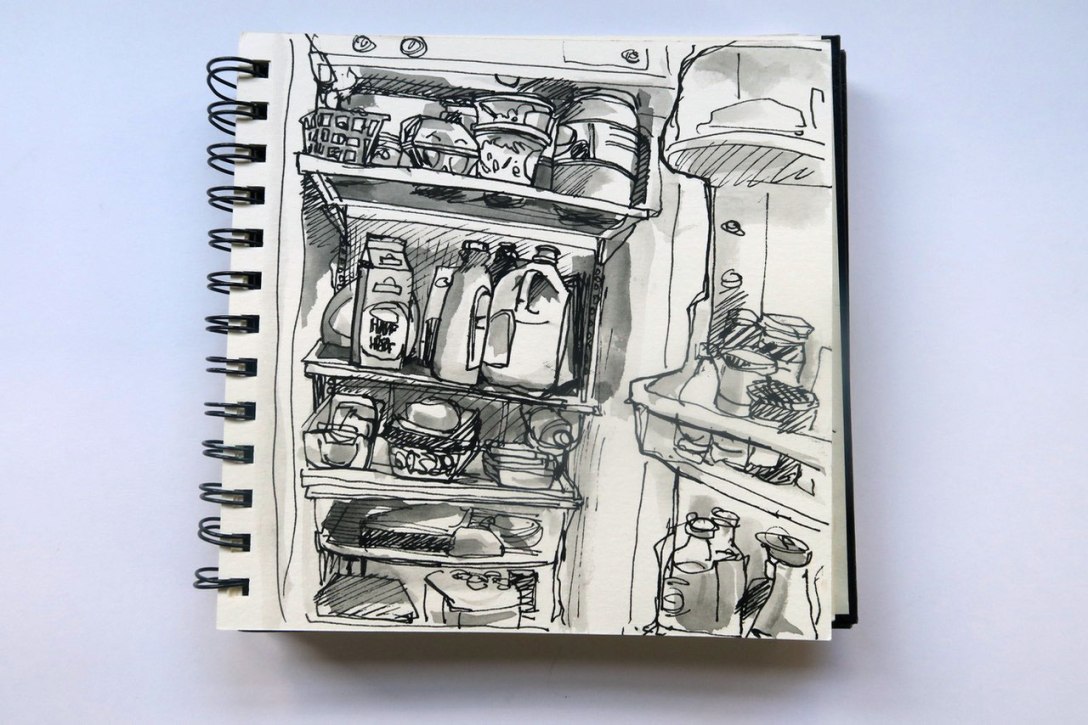
Instead of setting up artificial subjects like bowls of fruit or vases of flowers, draw the contents of your fridge. Draw the roses you got for your birthday and write about how you feel getting a year older. Instead of drawing naked strangers in a life drawing class, draw your naked spouse, your cat, your boss. Rather than doing “Drapery studies,” draw the shapes your feet make under the covers on a Sunday morning.

Be inventive. Be fresh. Be personal. It’s an adventure, not a chore.

Spare the rod.

My second stepfather was quick with his fists. He would escalate disagreements with waiters into brawls in parking lots.  He threw chairs in parent-teacher conferences. He wouldn’t hesitate to pull the car over and reach into the back seat to swing at me and my little sister. He was six feet tall with meaty forearms covered with red hairs. When I was ten years old, his right hand left an imprint on my left cheek which I wore to school for a week.

We moved a lot when I was little and, as the new kid, I was an easy target for bullies. I was tripped, teased, and occasionally had to get stitches. I was told to just walk away or to stand up for myself or to name names, but nothing made much difference. I was a wimp and a weed.

I’m no longer the new kid. And my second stepfather has been dead of pancreatic cancer for over a decade. These days, the only likely sources of physical violence I encounter are drunks and madmen. I live in Greenwich Village so there are a fair number of each around but I haven’t been struck since a large, intoxicated man appeared out of nowhere and knocked me to the ground in Washington DC. That was during the first Clinton Administration. Except for 9/11, the Bush and Obama years have been without incident.

It’s pretty unusual to see an adult strike a child in public these days. When it happens, it seems so barbaric, like witnessing a street fight. No doubt family services will soon be called, courts, foster care, but when I was a kid, it was an everyday thing, never discussed with outsiders, a family affair. I can’t imagine striking Jack. He’s taller than me these days and goes to the gym all the time, but even when he was knee-high, I would never have turned my frustration into any sort of physical response. It just wasn’t in me.

But what is in me is the battle against the impending threat. While I haven’t been physically assaulted in this millennium, a part of me is ever vigilant, waiting for an attack. It’s the part of me that bruises too easily. My ego. The slings and arrows of garden-variety disagreements and critiques can still sting disproportionately. A blog comment, a client request, a passing suggestion from my girlfriend, all can raise the specter of my second stepfather, his shadow on my doorstep.  My only weapons are flimsy and malfunctioning: defensiveness, sarcasm, withdrawal — the sorts of things that do me more harm than good.

I have long been working on toughening up. I’ve had to. I spent decades in the trenches of advertising where curt dismissal was part of the job, where hard-earned ideas would ride out of conference rooms on their shields, where creative competitions are called “gang bangs.” I have spent decades on the Internet too, where anonymous trolls are free to lumber in, 24/7, and empty their bowels on my creations with the click of  a mouse.

Here’s what I tell myself, not always successfully:

A) Everyone has the right to an opinion.

B) Each critique is an opportunity to better my work.

C) My second stepfather is dead. Even if he does live on in my head.

I force myself to first take a deep breath and try to clear the fog of emotion. This is now. It is not the past. (I know, I know. Easier said than done).

Then I consider the content of the input. (God, even the way I wrote that last sentence shows how tightly I clutch the reins). I look at my idea as objectively as I can, as if it was not mine, unvested — and then I apply the critique. Is it helpful? Can I use it? If so, all good. Thanks very much for saving me from myself. Now I can do better.

But if I am unsure of the critique, if it seems not to fit at all with the way I see the situation, then it’s time to consider the intention behind it. Is the critic there to help? Or to throw a fist? Do they want me and my idea to succeed? Or will they profit in some way from my failure? Will it make them bigger? Will it prop up their vanity and insecurity?  Because if their motives are suspect, maybe their criticism is too.

This is easier said than done, but I think it’s right.

Whatever sort of childhood you’ve had, being creative thins your skin. You take your work so personally. You have to, that why you care enough to make it good.  Not because of the money or the acclaim but because it’s a part of you that you are putting out there.

But remember that the world is essentially kind and welcoming. The people who matter want you to succeed. They will collaborate with you to help you make your work as good as it can be, because good work makes the world a better place for all of us.  And the assholes? They see your success as further proof of their own failures. That’s not your concern.

Unfortunately, I have long given my second stepfather a sort of immortality by letting him enter my dreams. But I won’t let him crush them too.

No returns, no regrets

Getting what you want out of any creative form takes work. You have to make a lot of crap to get to the good stuff. You invest time. You tussle with the monkey. You doubt yourself.

Why bother?

It’s easy to avoid being great. In fact, the world seems to want you to avoid it. It bombards you with temptations and distractions. It seems not to understand why you are wasting your time. It fills your browser with zillions of example of people who are doing what you should be doing, only better and seemingly without effort.

But being great at what you’re good at has lots of benefits. And they’re not the benefits you imagine. The goal is not numbers: not more $ in the bank, more Twitter followers, more awards on your mantle.

The goal is to be who you are meant to be: a person who is living a life of fulfillment, who is working for something bigger than themselves, who is helping, who matters.

You have gifts to give to the world. But it may just take some sweat to unwrap them.

Soup.

I’m a big, fat vat of soup.  Deep below my surface, I am roiling, ingredients churning, interacting, breaking down to add flavor and texture.  Sometimes I’m hot and bubbling, giving off a delicious aroma. At other times, I’m tepid and lifeless, the gas off, a greasy film forming, unappetizing, dull.

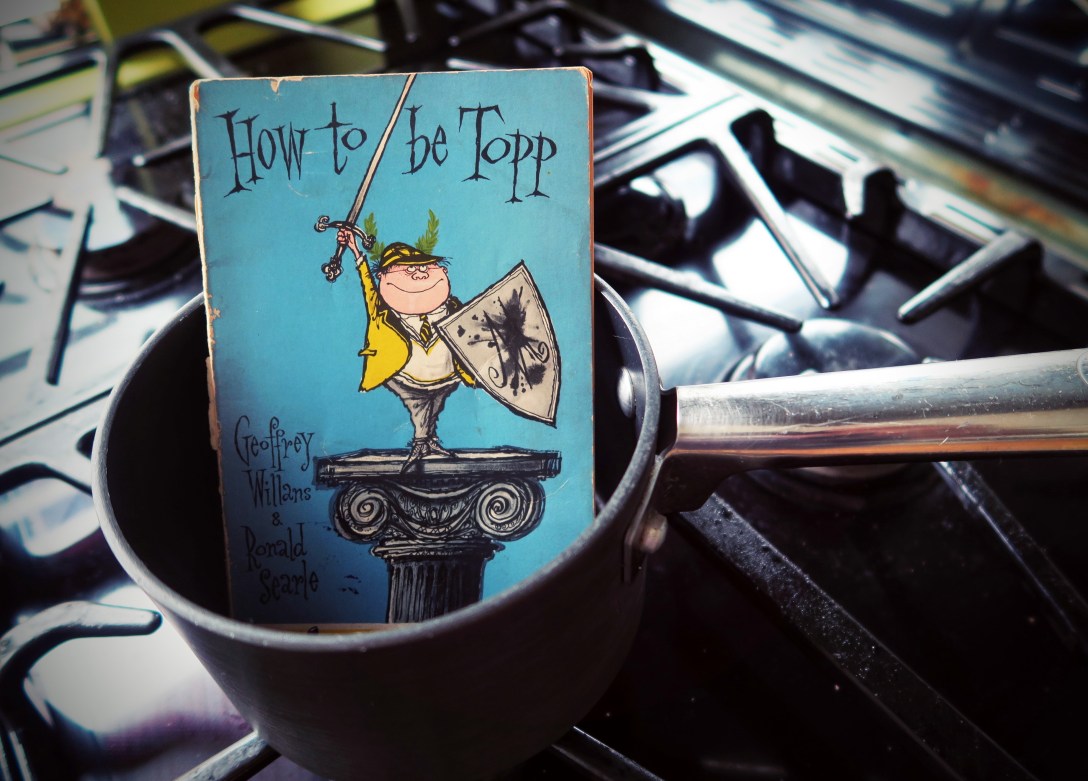
What’s in the soup? Well, let’s dip in the ladle and fish out an ingredient. Ooh, it’s a book I’ve owned since I was eight, dog-eared and well-thumbed, its browning pages loose in the binding. How to be Topp is a satire about success written by a fictional school boy. It’s a fairly silly book and I don’t think I’ve ever read it all the way through. But it was illustrated by Ronald Searle and its pages are full of splatters, spidery calligraphy and loose, scratchy drawings. I may not look at this book for years but it’s in the soup, adding its flavor.

When I was eight I read a lot, several books a week. It’s a pattern I have kept up ever since. Each of the many books stacked on many bedside, in my Kindle, on my phone, and my desk, all end up sliced, diced and scraped into the soup. Many of them break down completely, their pages diluted, vanishing from memory. But each sentence, like a single granule of salt or a delicate frond of dill, though disintegrated, has added  a few more molecules to the flavor and body of the soup that is me.

There are the Grove Press books on the top shelf of my grandfather’s study, “grownup up” books I climbed up to purloin and read in private. There are all the Gerald Durrell books that fed my fantasies about raking through the jungles of Borneo and Brazil for aardvarks and toucans, kitted out with a solar topi and a butterfly net.  There are 92 volumes of PG Wodehouse, Professor Branestawm, Raymond Chandler, Geoffrey Chaucer, Spiderman.

There’s the girl I kissed in David Heller’s basement in 1975, the bucket of coffee cooked over a campfire on a patch of Israeli wasteland one dawn, the snow boots my mother made me wear that were too big and made me trip over every hummock of snow in downtown Brooklyn. There’s my dog Pogo’s third litter of puppies, two stillborn. The boss who yelled at me while eating an egg salad sandwich. My first Rapid-o-liner. My second stepfather’s broken toe when he kicked in the door of my mum’s MGB. All are bobbing in the drink, coming up to the surface, then subsiding like Moby Dick into the darkness below. There’s Moby Dick, Holden Caulfield, JJ ‘Dynomite’ Walker, the English Beat, my Latin teacher, Jenny’s stuffed hippos, Jack’s soccer cleats, my Pakistani orthodontist.

My soup is rich and complex and like none other, a unique combination of stuff that has been cooking for decades. It contains some ingredients found in your soup, maybe lots of them, but the way they interact with the rest of the bits and bobs bobbing around is all mine, all me.

This cauldron of soup is the source of all I create. If I write a story, make a drawing, come up with an idea, it’s all because of this big bubbling vat of experiences and influences. If I neglect the soup, forget to add new spices, fail to stir it up and fill some new bowls, let the pilot light go out and the temperature cool, the soup becomes anemic and tasteless, a bland consommé that’s forgettable and without value.  But if I work the soup, it fills me up.

Being an artist or a writer means reading, looking, listening, cribbing, copying, from a zillion sources. That’s much of our job. These slices of inspiration may have disproportionate effect when they first enter the soup, big undigested chunks that are too obvious when they show up in the work. But over time they break down and dissolve, leaving only ripples that intertwine with others to form a new flavor note, subtle and unique.

We are all vats of soup. Make sure you tend yours, stirring and adding new ingredients every day. Keep the hot on medium-high and take the lid off now and then. And don’t be afraid to dish it up to share with others, to pour a few tablespoons into their tureens. I want to taste your soup. Here’s a spoonful of mine.

The Dangers of Dabbling

You may be good at several things.  You may be one of those “creative types” who cooks and weaves and writes poetry and plays the ukulele. I’m there. I am a dabbler in all sorts of things. I love plunging into new skills, learning the basics of HTML5, then editing film, then painting with gouache, then roasting a chicken.

But I know, not even that deep down, that I am not getting all I can out of any of these skills. That I am still envious when I see someone doing something truly great at which I am only marginal. I know they are getting far more out of this art than I am.

Being great at something takes work.

Doesn’t matter how talented, how smart, how connected you are, you have to focus and work to refine you skills and your vision. That can be painful at times; how much easier to find another meadow to graze in.

Here’s an interesting phenomenon: the famous, would-be poly-tasker. Michael Jordan leaving the NBA to play baseball for one dismal season. Eddie Murphy recording a disco album. Fame brings opportunity: who was gonna tell Allan Iverson not to record a gangsta rap album? When Picasso read his poetry at Gertrude Stein’s salon, she said “Pablo, stick to painting.” And then there’s James Franco. But being a genius in one field doesn’t effortlessly make you Leonardo.

I wonder how many people get sidetracked from their true calling by the fact that they have talent to excel at more than one artistic medium. This is a curse rather than a blessing. If you have only one option, you can’t make a wrong choice. If you have two options, you have a fifty percent chance of being wrong.
— Twyla Tharp

I’m not saying, “Stick to your knitting.” It’s quite possible you don’t need to excel at at one thing, that you are content playing the field. For you, creativity is just a hobby, and you don’t want to invest in any particular medium or metier. If so, good on ya — but know what you are giving up. When you focus on the thing that you were born to do, work hard and really push yourself, you will find new pleasures, deeper, richer, more fulfilling experiences that dabbling will never provide.

Do some self-examination and listen for your true calling. What do you feel in your marrow? And are you investing all you need to to achieve your own personal form of Greatness® there?

Enter your email address to subscribe to this blog and receive notifications of new posts by email.

Why I started to suck & how I plan to stop.

Let me be honest. Over the past few months, I’ve abandoned this blog — a vital part of my creative life for the last dozen years. I have been just using it as a soapbox for hawking books, talks, interviews and klasses. I’ve ignored why I’ve kept it for so many years: to explore my ideas about creativity and my experiences as an artist and a human being.

Where did I go wrong?

To find the answer, I’ve been doing a lot of self-analysis and reflection. And I’ve realized that I started to lose my perspective last September, around the time that Jenny and I drove across country, leaving sunny Cali behind for the familiar grey canyons of a New York winter.

This wasn’t how it was meant to be. When I left my advertising job almost two years ago, it was to set myself free. I wanted to slow down, to paint, to draw, to write, to ruminate, and to see if the path I had been following since college was in fact the best one for me.

Moving to LA with Jenny scared me at first but I understood myself well enough to know that, if we stayed in New York, walking the same streets I have for decades, my resolve to leave advertising and pursue my own path would be sorely tested. Before long, someone would tempt me into putting on a jacket and tie and sitting in a conference room once again. I had to get outta town.

Before long, someone would tempt me into putting on a jacket and tie and sitting in a conference room once again.

Going West transformed me. I fed hummingbirds, bought a truck, grew kale in the backyard, built a studio in my garage, made Art Before Breakfast, met Koosje on my travels and we launched Sketchbook Skool.

The first six months of SBS were amazing. It was mind-blowing that so many people signed up straight out of the gates and we were having an absolute blast working with talented friends and seeing our dream come to life.

Our ambition was grand: ‘art for all’ was our mantra from the get-go. We wanted to inspire people everywhere to start making stuff. We wanted to capture the sketchbooks and processes and ideas and experience of brilliant artists and share them with anyone looking for a fresh start.

At first, we thought, let’s just make it free — but we discovered that would mean a severely compromised version of our vision. So we settled on charging the minimum that we could to still deliver on our promise to pack each klass with quality. But charging tuition led us into a whole new world.

Welcome to Capitalism®. If you take money, you must have a bank account. To open a business bank account, you need to be a corporation. To be a corporation, you need a lawyer and accountants. To operate globally in a non-traditional business, you need more lawyers and accountants. Soon, instead of spending all our time making videos with our friends, we were doing a lot of administrative work that was not in our DNA.

We live in a time that celebrates entrepreneurialism, where twenty-year-olds assume they’ll be billionaires, where people make a living selling artisanal okra instead of taking corporate jobs. There are endless online tools and services that entice anyone anywhere to start a corporation, set up a website, and be a star.

We live in a time that celebrates entrepreneurialism, where twenty-year-olds assume they’ll be billionaires, where people make a living selling artisanal okra instead of taking corporate jobs.

I knew the appeal. Although I started a Marx-Engels study circle in high school, I spent much of my career writing poetry about business, corporate manifestos, sixty-second Super Bowl commercials about ideals and values and romantic visions for the future of mankind for my clients.

Inevitably, Sketchbook Skool was morphing from a pure passion project into a demanding business. We had to bring on a raft of advisors to cope with the ever-shifting matrix of requirements for operating a global online business. It became clear that if we didn’t want to raise prices, we had to increase sales — so we added a bunch of marketing consultants. In order to grow, we had to address the emerging limitations of our existing platform which just couldn’t handle so many students so next we brought in a team of developers.   I was working for a company again. How the hell did that happen?

I was working for a company again.

How the hell did that happen?

After much development and expense, we launched our new platform. It caused a lot of confusion among our students. Thousands of people with different computers, browsers, operating systems and varying bandwidth speeds mean that, despite all our Beta testing, we had to deal with a steady stream of concerns. Anyone who understood what we were doing told us that this was totally normal, that every new platform or system has bugs that take time to work out but it was still painful. One by one, we knocked them each down and the platform works reliably now, in a way that our old one never could. But people were unhappy and that was awful.

Meanwhile, Art Before Breakfast, came out to stellar reviews and my publisher and I were ecstatic. Only problem: there was a strike at the docks and new copies of the book were stuck in the harbor on container ships coming in from our printers in China. Despite all the NPR interviews whipping up enthusiasm for the book, no one had copies for a month or more. More people were unhappy.

Ironically (and this strikes me as the dictionary definition of irony), I was also in the middle of writing a book called Shut Your Monkey: How to control your inner critic and get more done. It was the hardest book I’ve ever written because the subject of the book, my own inner critic, was having a field day with all of the stresses I’d taken on, delighting in telling me I was the cause of them all.

Now, I don’t think I was wrong to have so many balls in the air. My error was in losing sight of what I wanted. I was defaulting to a lot of ancient habits, using a few overdeveloped muscles instead of developing the ones I really cared about. It was easy to default to having wall-to-wall logistical meetings and never saying no.

Soon, I got to the point that I just didn’t want to do anything. It was really scary to think that I had no one to blame but myself but here I was, in a rut, not having fun, feeling beleaguered. I barely had the energy to do any drawing of my own, let alone write my blog or teach. I’d been in this corner before but I could always blame my job, my boss, the Man. Now I was the Man.

… I could always blame my job, my boss, the Man. Now I was the Man.

At first, I didn’t know what to do. I was apprehensive about telling anyone how I felt because there had been so much hoopla around the success of Sketchbook Skool and Art Before Breakfast. Who would understand if I wasn’t happy about it? I felt like an ungrateful ass.

Eventually I discussed it with Jenny. We decided that something had to change. Should I just quit? Should we fold the Skool? It meant so much to so many people, especially me, but there had to be a better way.

Next, with a lump in my throat, I called Koosje. It turned out she was feeling much the same way. We talked about how we had lost our original reason for creating the Skool and we needed to have more creative fun, to reset expectations, and dial back the scope of our plans for the Skool.

First up, in the next kourse, we would be the teachers. That would give us a chance to make stuff again, to express ourselves, to get out from the back office. It would be a total departure from anything we’d done before —  playful, light, experimental and fresh. Our inspiration comes from when we most loved to draw and explore as kids, full of animation and crayons and fart sounds. It’ll take work but it’s the sort of work that creates energy rather than depletes it. Maybe some people won’t like it. Oh well, Koosje and I do. We’ll see what folks think when it starts in about a month.

I also decided that I would have to deeply examine and reconsider everything else I had on my plate. Blogging helps me further that goal. It is the seed-bed out of which grow all my ideas, projects and connections. I pledged to get back to writing new (non-self-promoting essays) several times a week, starting today.

Next, Shut Your Monkey is an important book to me and it needs to be treated with care. I am working with an incredibly talented book designer to make it look beautiful and wild and new. I think it has the potential to help a lot of people and I really want it to be great.

I also need to fill my well. That means more time reading, drawing, visiting museums and galleries, hanging out with artists and traveling. I have been invited to be an artist in residency in several international schools this fall and I can’t wait. Working with kids is the greatest inspiration for me and I crave being immersed in their creative energy. Plus, I will get to visit some amazing new places on this beautiful world we live in.

I’ve also been thinking about why I stopped blogging. Busyness isn’t the whole reason. I have written even at the busiest times over the years. I think the issue has been honesty, honestly.

I’ve always tried to be painfully straightforward when I write here. Similarly in my books and when I teach classes. I try to be myself, warts, carbuncles and all. As a writer, an artist and person, I can be flawed and vulnerable. This works less well as an entrepreneur. As person taking credit card payments, I need to project an unimpeachable face.

I try to be myself, warts, carbuncles and all.

It’s not a face I’m unfamiliar with. I wore it for years, in board meetings, client presentations, job interviews and staff briefings. The authority. The decider. 100% sure. But it’s just not me. And it’s just not my voice, especially not the one I use here, among friends. But increasingly, as the face of Sketchbook Skool, when I came to write here on my blog, I felt I had to be the shill, the Mad Man of Mad Ave, always upbeat, bringing the most awesome! things.

And that’s probably not why you read this blog. I know it’s not why I wrote it all these years. That Slick Willy facade (a close pal of the Monkey’s) is strongly advising me not to post this little diatribe on my blog today, that it’s Too Much Information, that it’s whiney. But I owe it to you and to me to explain what has been going on and why I think it has to change.

Thanks for hanging in here with me, despite my ups and downs. I appreciate it.

Honestly, I do.

How I make art before I make coffee.

Recently I was invited to participate in a lovely series called “The Original” Documented Life Project™”. Guest artists are asked to document their process in making a piece. I was emailed the following assignment:

“The theme for this month is ‘MAKING YOUR MARK (DOODLES & MARK MAKING). The art challenge for this week is ‘AS A FOCAL POINT’, and the prompt is ‘COMING INTO FOCUS”

I’m not always awfully good at following assignments so I just sort of did what I do. I hope they like it.


1dog-focus
The theme is “Coming into Focus.” It’s 7:17 a,.m. and I am decidedly not in focus yet. I need coffee and ink.
2-coffee
Purists may cringe, but I will be enjoying Trader Joe’s Half Caff® this morning.  In my advancing years, I find that if I drink a small amount of full-bore caffeinated coffee, I will snap peevishly at people all morning, be wrung out all afternoon, and wake up at 3 am, thinking about my tax return.
3-bread
This is pretzel bread.  It’s sort of a baguette but crustier and slightly salted.  Most importantly it makes nice crumb, pits, and crevices — ideal for close-up drawing.
4-eggs
Drawing, like all grueling physical activities, requires protein. Like Kevin Bacon*, I take mine in ovoid form. These are large brown eggs, free-range, organic, anti-biotic, hormone and steroid free. Despite all that palaver,  they still taste great with some Tabasco.
5-breakfast
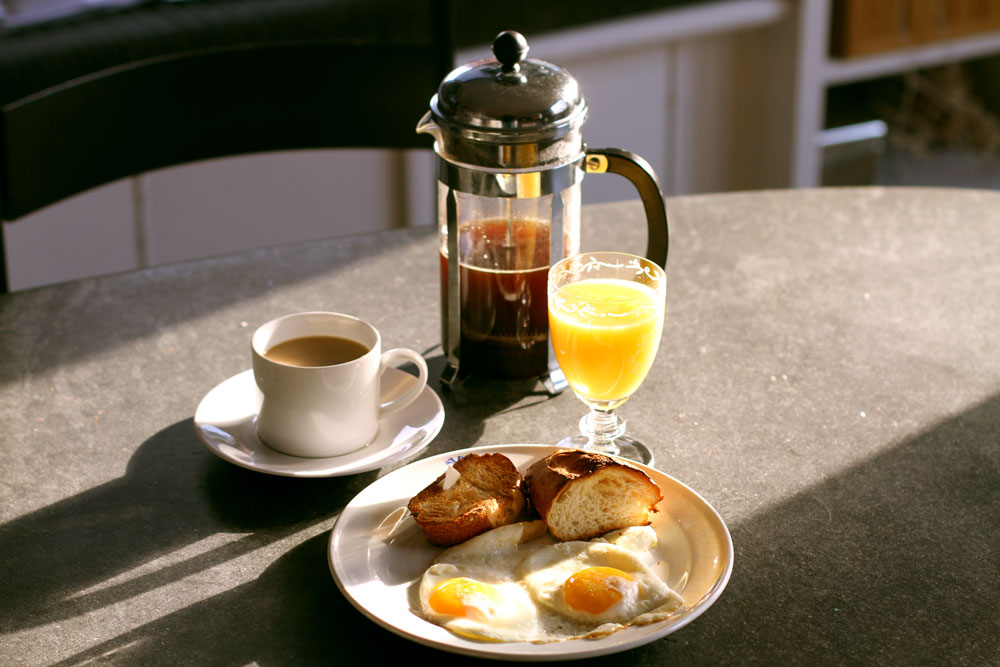
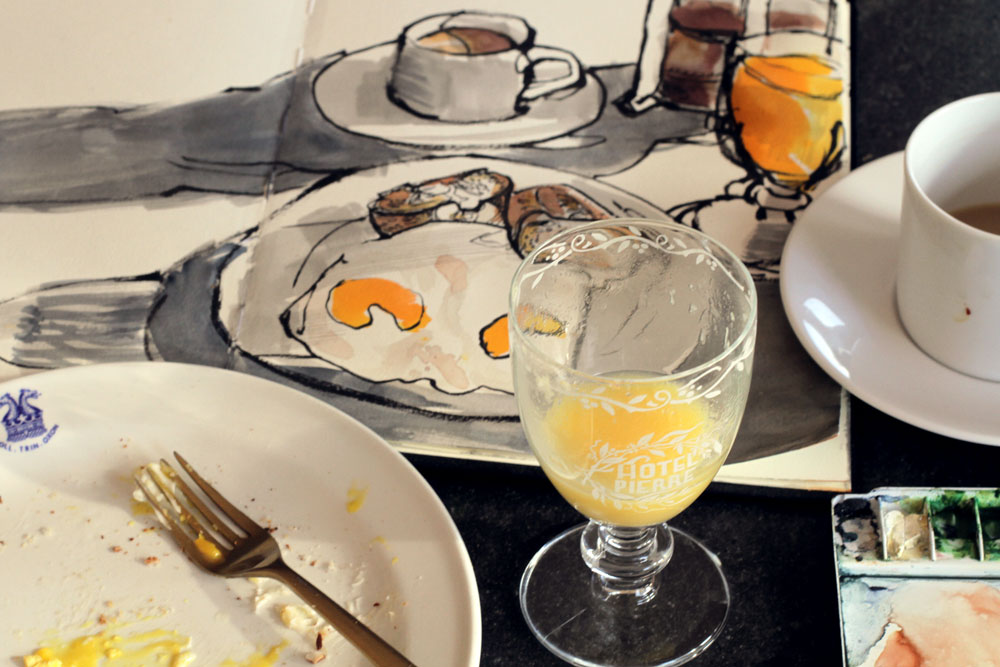
This looks like a balanced breakfast — compositionally, if not nutritionally. But, before I can eat it, I must make Art Before Breakfast (yes, that’s the name of my new book, available wherever life-changing books are sold).
6-supplies
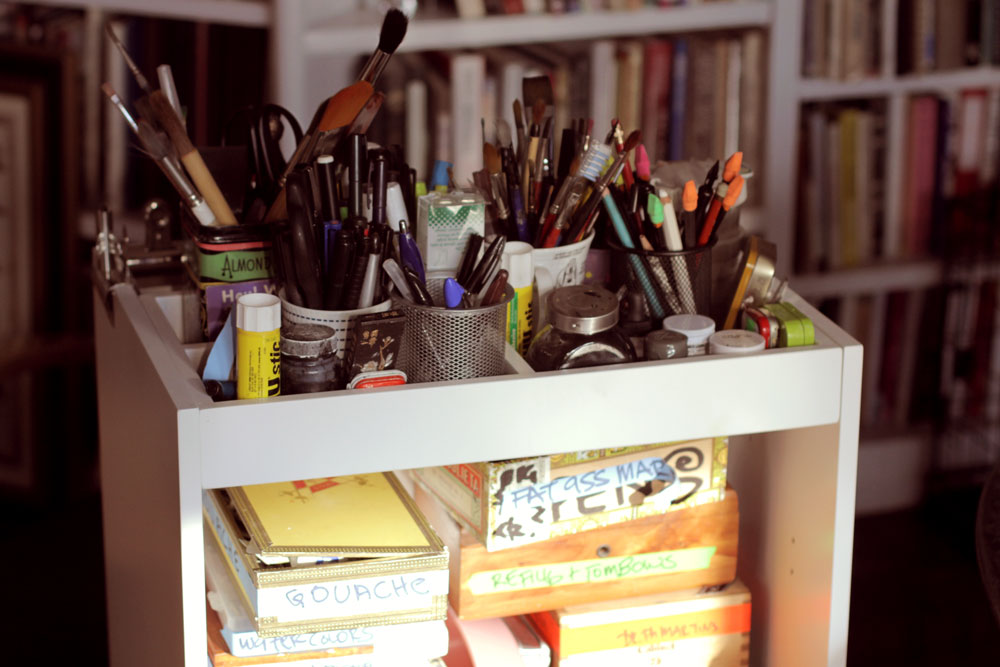
My trusty art cart. Ready to roll at any hour.
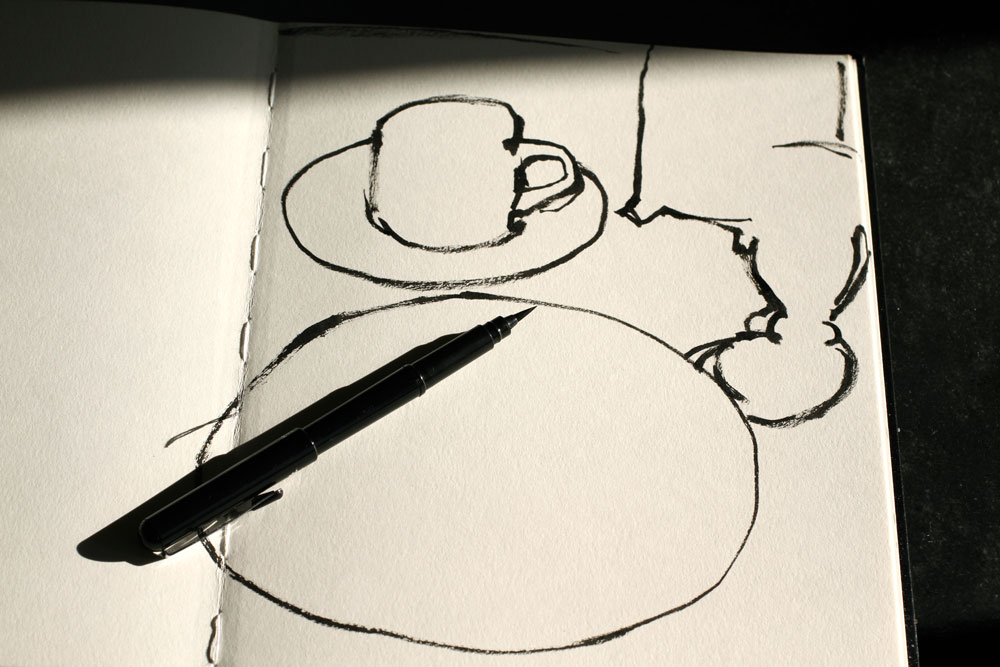
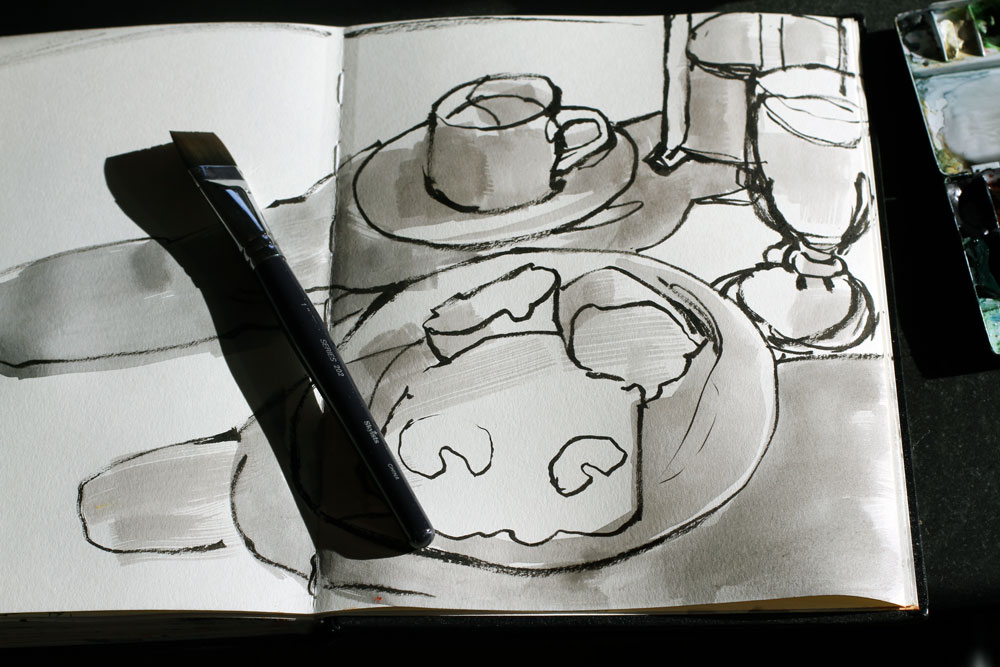
First I do a contour drawing with a brush pen, drawing the outlines of the major shapes.
First I do a contour drawing with a brush pen, drawing the outlines of the major shapes. Honestly, before I’ve had my coffee, this is about all the detail I can handle.
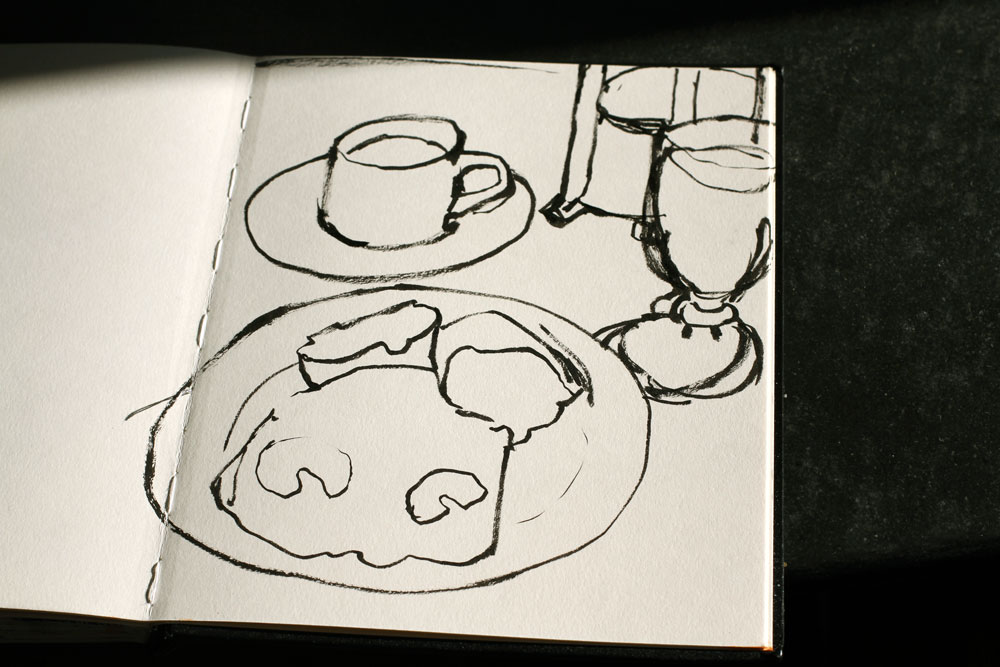
8-contour-details
Next, I draw some of the inside shapes. I define the contents of the plate, which keep jeering, “Eat me!”
9-shadows-lines
The shadows are super-long so I add their outlines next.
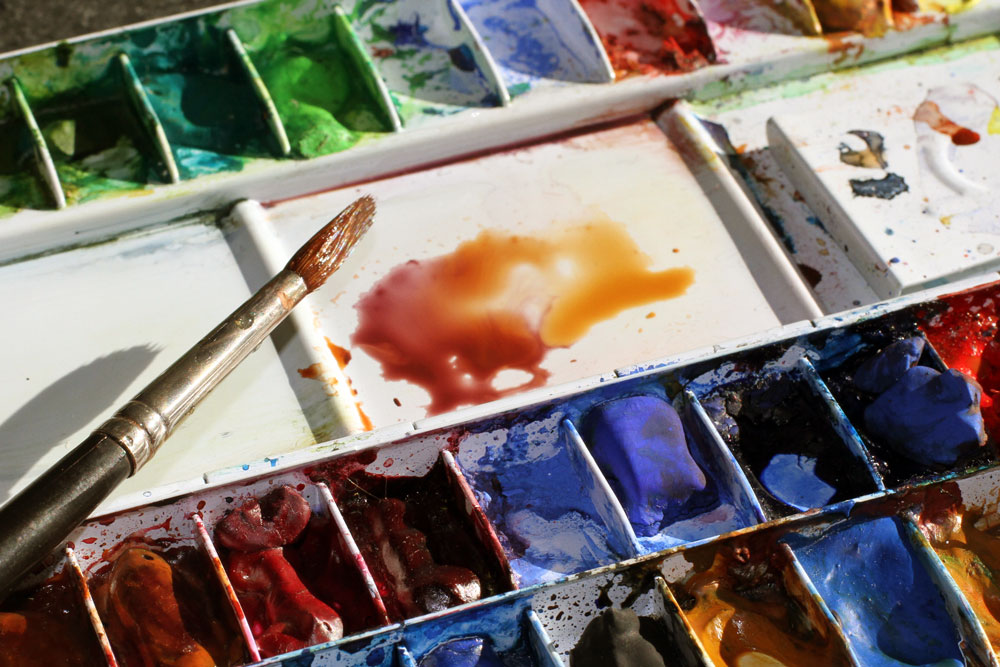
10-watercolors
I open my watercolor palette (various brands all squeezed into a metal box) and a big, fat, soft brush.
 I mix up some diluted Payne's grey and add the shadows.
I mix up some diluted Payne’s grey and add the shadows.
The shadows need  a second coat so I add more Payne's grey  so you can see its cool blue nature. It's the Miles Davis of colors and my favorite.  I eat it by the tube.
The shadows need a second coat so I add more Payne’s grey so you can see its cool blue nature. It’s the Miles Davis of colors and my favorite. I eat it by the tube.
13-toast-details
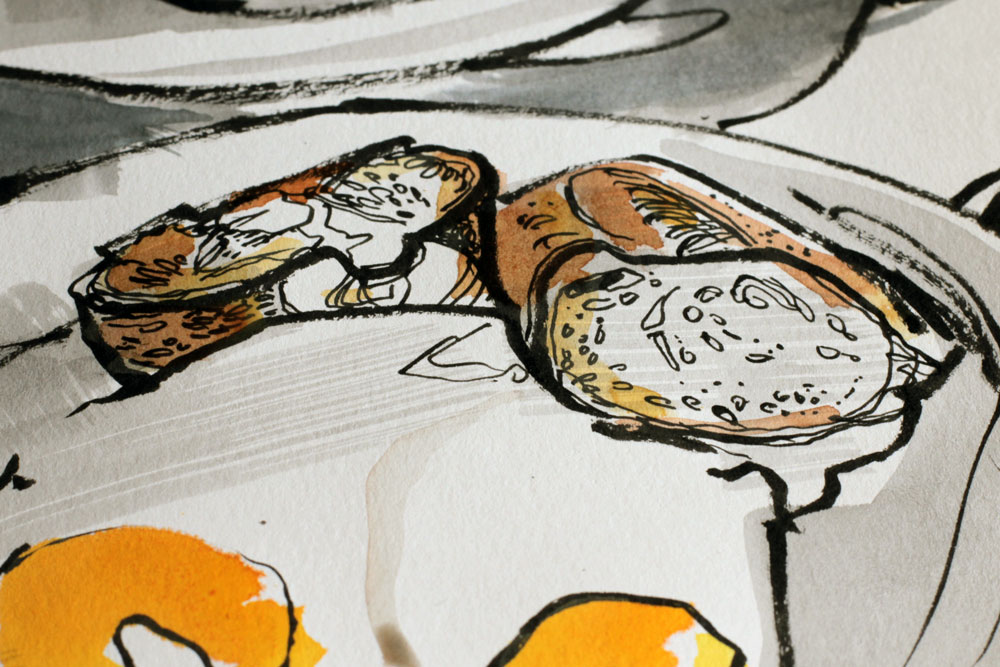
As the shadows dry, I scrutinize the crusty surface of the bread slices, pretending I am an astronaut mapping Planet Crumb. I use a Tombow Fudenosuke brush pen (WS-BS 150, for you pen nerds).
14-toastB-details
Next I visit and chart the sister planet, Crusto Maximus.
15-coffee-details
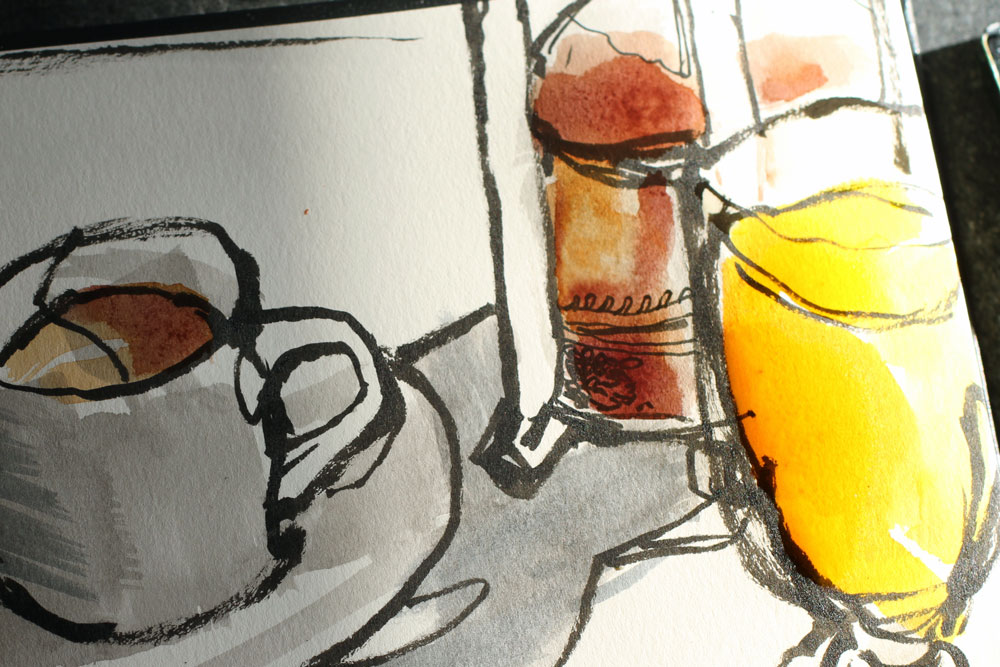
There’s a lot of stuff going on inside my french press and now that I am pretty much awake, I can draw all the grounds and bits.
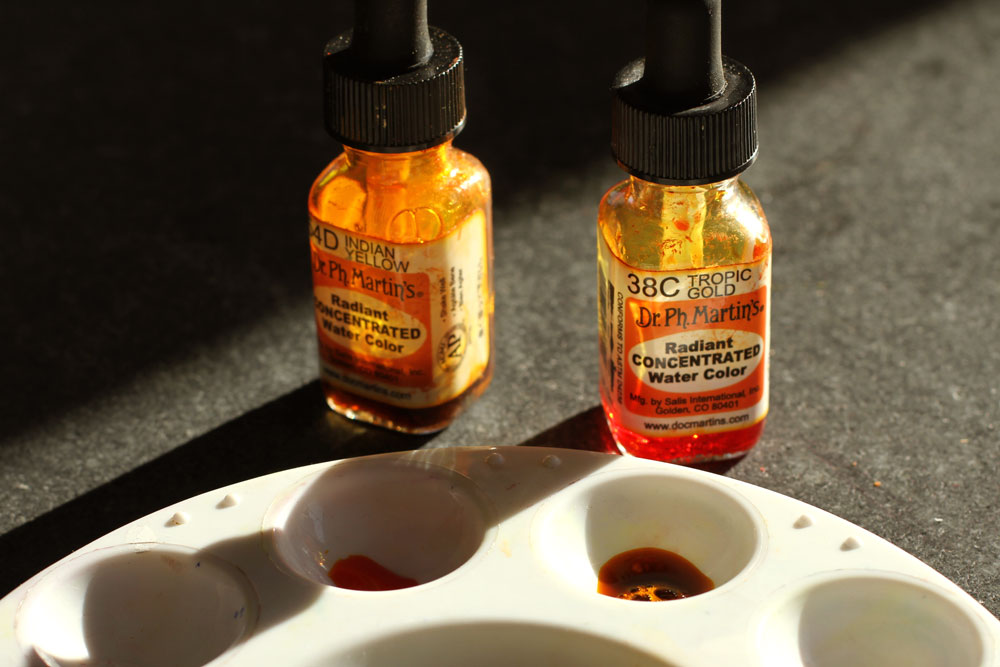
16-doc-martins
Good morning, sunshine! I pick out a couple of lovely yellows from my Doc Martin’s collections ( I have a bottle of every color they make and love to guzzle it).
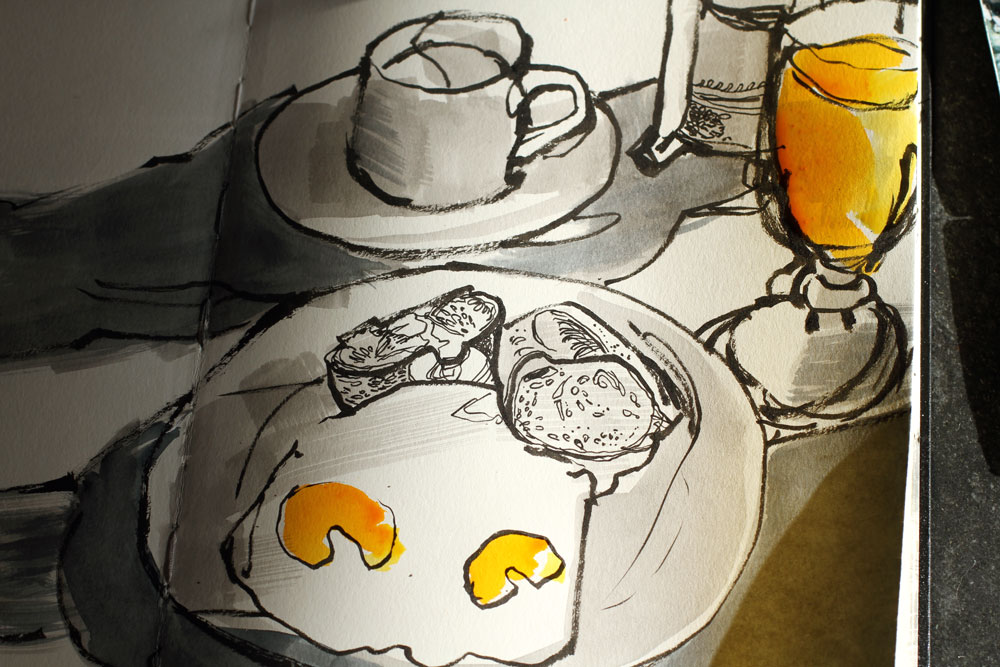
17-yolks
I hit the juice and the yolks with a blend of two tones and various degrees of diluted Doc M. Pop!
I like my coffee with three or four browns and a purple.
I try to approximate the various light values as the sunshine passes through the deep lagoon of java.
Time to toast the bread with the same palette of browns and purple.
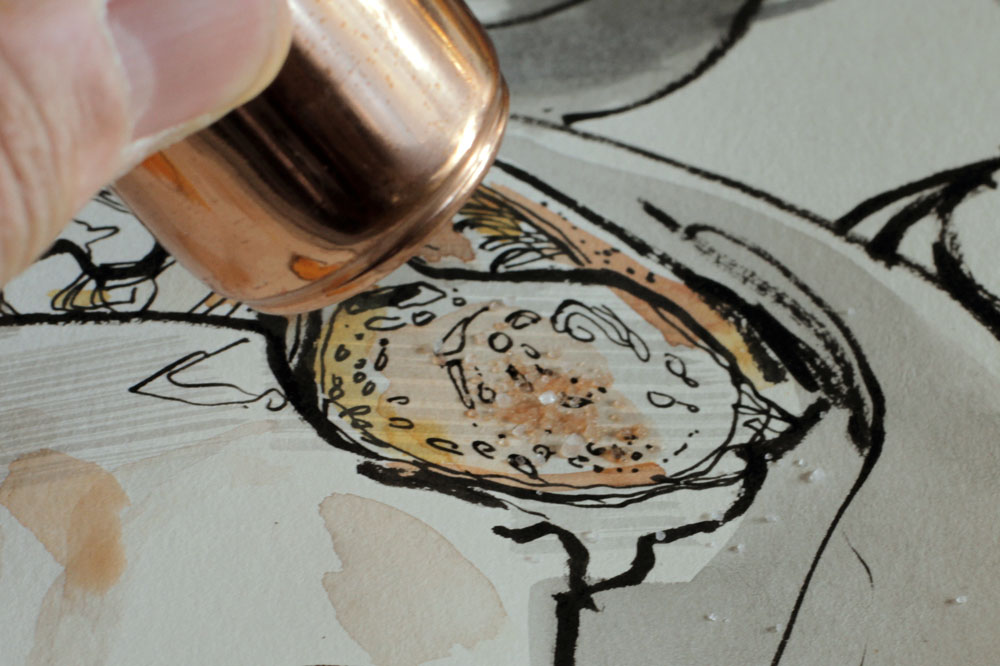
While the paint is still wet, I sprinkle in some salt to suck up moisture and make an interesting texture.  Plus, it tastes better.
While the paint is still wet, I sprinkle in some salt to suck up moisture and make an interesting texture. Plus, it tastes better.
Okay, I'm starving and  the eggs are getting cold. So I pause to digest my subject.
Okay, I’m starving and the eggs are getting cold. So I pause to digest my subject.
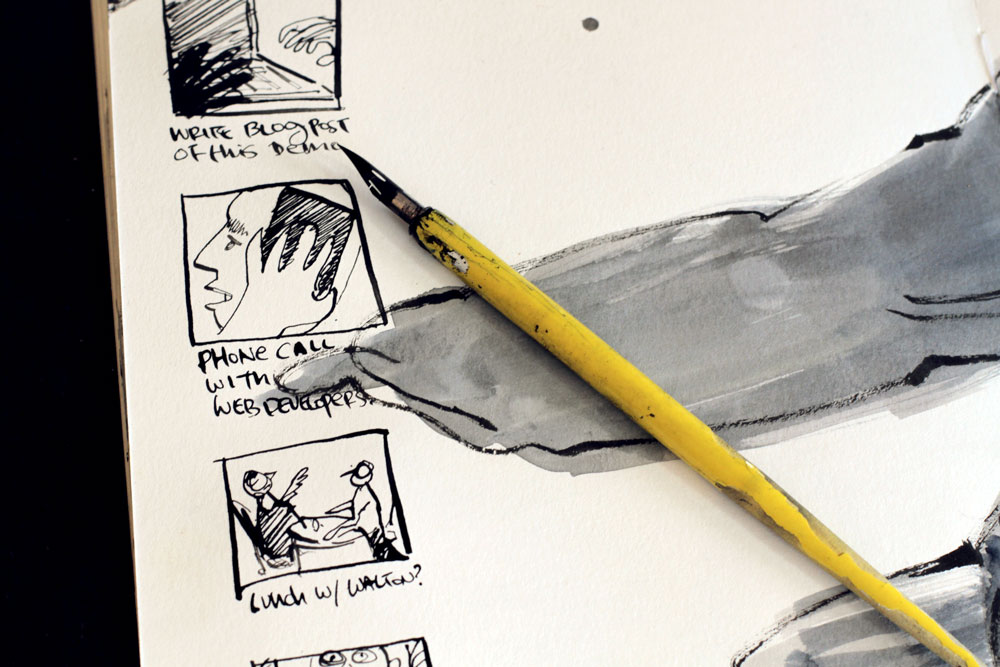
As I eat, I think about the day ahead. I drew some hasty sketches to make up my to-do list.
As I eat, I think about the day ahead. Then, burp, I drew some hasty sketches to make up my to-do list. I use a dip pen and India ink. Which reminds me, I think I’ll have Indian for lunch.
Full tummy? Time for a little white pencil to add highlights and reflections to the glass 'n' crockery. Burp.
Time for a little white pencil to add highlights and reflections to the glass ‘n’ crockery.
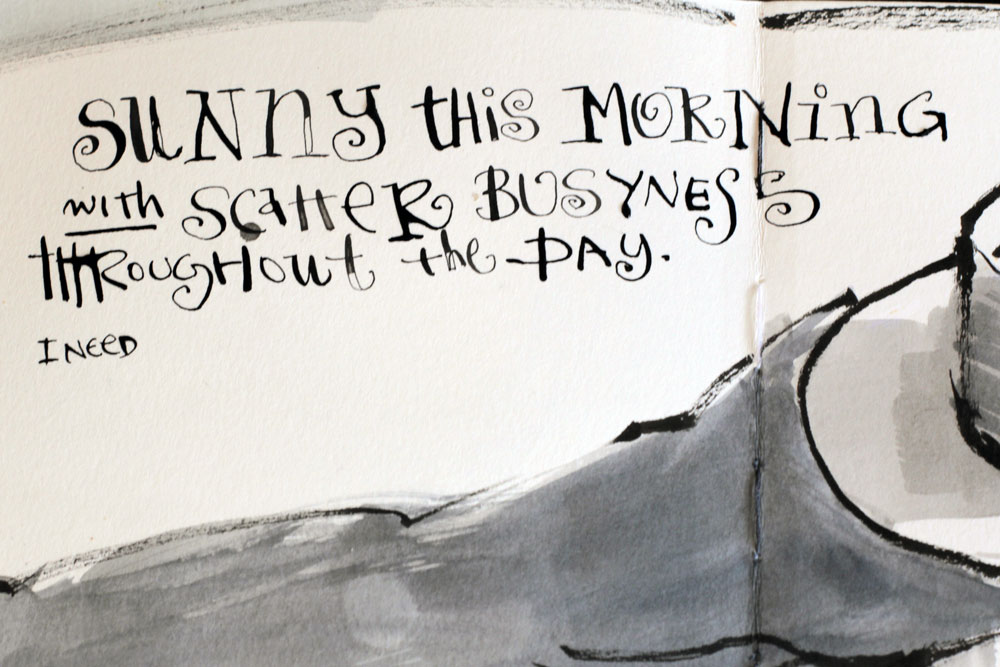
I give my page a headline.
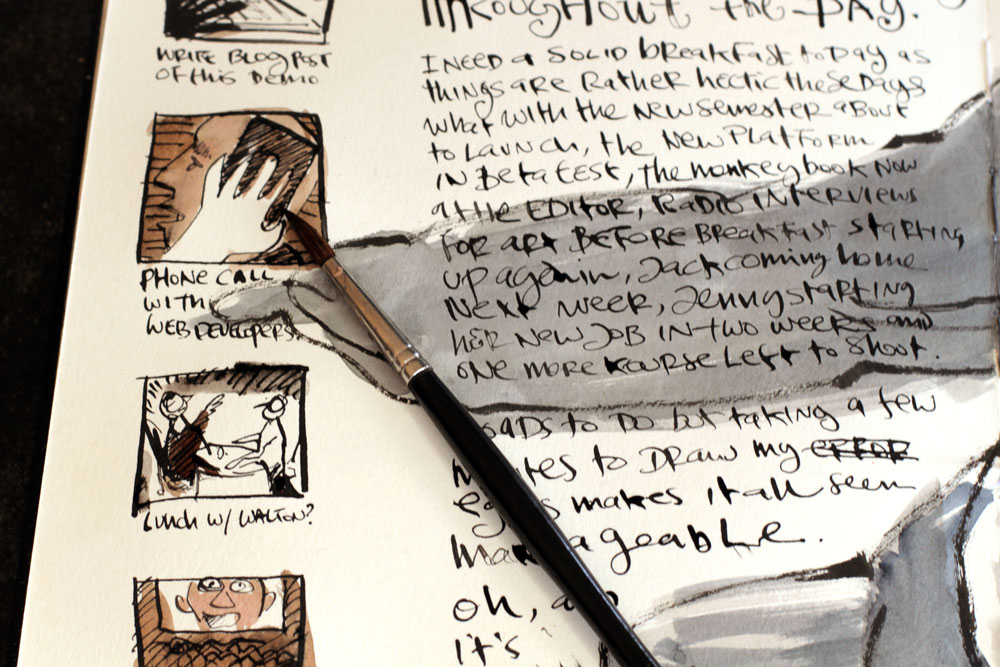
I do a little journaling, commemorating the day, counting my blessings, splattering some ink.
The sketches look a little sketchy so I hit 'em with  a fresh coat of sepia Doc's. Martins.
The sketches look a little sketchy so I hit ’em with a fresh coat of sepia Doc’s. Martins.
Okay, time to do the dishes and get on with my day.
What th'?  I left out a couple of letters. Squeeze em in, man!
What th’? I left out a couple of letters. Squeeze em in, man!

* I love Kevin’s latest.


Baby steps

When I started working with Keith, I was not in great shape.  I had pains in my lower back, carpal tunnel syndrome, and chronic headaches. But I just grinned and bore these maladies. As far as I was concerned, these were just part of being me, aches and pains that I’d developed since I’d first started pounding on a computer all day, decades before — my imperfections, unfixable.

As for going to a trainer, well, that was all very well, paying someone to hold my hand while I walked around the gym, counting off reps, giving me encouragement, helping me build my biceps or lose a few pounds. Eventually, there were some meager results so I could take it or leave it.

Keith taught me otherwise. He showed the point of exercise is not six-pack abs or marathon times. It’s about making the most of the equipment we have for living out the rest of our days and that making certain little changes could make huge differences to my body and to my life.

We worked on tiny muscles hidden deep along my spine and  between my shoulder blades. We focussed on the exact angle of my tailbone when I crouched, correcting and re-correcting. We looked at the angle of my pelvis in the mirror. We rolled the fascia alongside my left thigh with rubber logs and built up strength in my right quadriceps.

After a few months, standing and moving in a balanced way became second nature. The unnatural way I had held my shoulders, my neck, my stance, were replaced with alignment.  Now if I hunched my shoulders or sat in a cramped and twisted way, my body told me something was wrong and I adjusted.

My headaches vanished. My hands no longer tingled. My feet, which had always splayed out like Charlie Chaplin lined up toe to heel. My carriage grew more and more erect. Jenny noticed that I was getting taller, soon by a couple of inches. I felt better all the time. And happier too.

For the first time, my relationship with my body changed because I saw what truly is. Not just a couple hundred pounds of annoying meat but an amazing machine that just needs to be tuned and maintained.

I discovered that my body is a miraculous system of complex interconnected processes that can be adjusted, honed, perfected. The way I was didn’t have to be the way I’d be. The unhealthy adaptations I’d made to certain chairs, desks, sidewalks, stresses, ways of standing, sitting, sleeping, were not carved in stone. And my assumptions about my physical being, that it was some sort of curse to be endured, an uphill battle that would always let me down, was nonsense. Being out of whack, behaving in ways that hurt me, limiting my ability, assuming that there was no solution — all these behaviors and thought patterns were replaced by balance and a better way of being.

For the first time, my relationship with my body changed because I saw what truly is. Not just a couple hundred pounds of annoying meat but an amazing machine that just needs to be tuned and maintained. Not for vanity but because of how it helps me live better and get the most out of each day. A few small adjustments in my body led to a change in my entire being. In my life.

Similarly, when I began to draw, I had no idea what seismic shifts this small change would cause in my life. Many of friends tell me that picking up a pen and opening up a sketchbook ultimately led them to change careers, travel the world, publish books, make new friends, new priorities, new plans for their remaining days.

Why? Why does this simple habit make such a difference? When you start to draw, you set things in motion. You start to see what is. Perhaps you’ll see beauty where you overlooked it. Perhaps you will fill books with stories about your life, an ordinary life, and suddenly see it is actually quite rich and wonderful. And perhaps the power of seeing so clearly will make you want to go and see more. And that desire will cause you, like Mole in The Wind in the Willows or Bilbo Baggins, to lock the door of your cozy little life and wander out into the wide world.

Maybe seeing clearly will show you that you have been hiding your true self from yourself, have been leading a life that wasn’t really what you wanted, that you could do more, that you could be more. That your childhood dreams are still valid, that your parents, your banker, your boss, your children can’t call all your shots. And that time is running out.

When you make art, you slowly brush the cobwebs from your inner life and sunlight starts to stream in. Who knows what it might reveal?

Maybe you will see that drawing is a thing that you actually can do even though the monkey has too long told you that you can’t, because you suck, because you have no talent or time. And, when you discover this power, you may come to wonder what else you have overlooked or deceived yourself about, what else you can do and be. Maybe you could paint or play the piano or visit Rome or hang-glide or open a store or be a clown or run for Prime Minister.  Or hire a trainer and get rid of your headaches.

This can be scary, feeling the first winds of freedom and change sweeping through the open door of your golden cage. But if you don’t face this fear from some angle, how can you ever see your life for what is and can be?

When you make art, you slowly brush the cobwebs from your inner life and sunlight starts to stream in. Who knows what it might reveal? Who knows what journey you are about to embark upon once you uncap that pen and take that first little step? Don’t you want to see?

Learning to teach beginners. On the teaching philosophy of Sketchbook Skool

What is the role of feedback in learning? Especially when starting to do creative things, things that are ultimately pretty subjective? When there are no answers in the back of the book?

The biggest obstacle we need to overcome in learning to create is the belief that we can’t. That’s especially true when we learn as adults. We have spent our entire lives believing that we cannot do this thing, and now, unless we are convinced that we can, we will never get to a point of any sort of mastery.

The most difficult and crucial lesson for beginners is the importance of failure. You need to make a lot of mistakes. You need to feel good about those mistakes and recognize that they are opportunities to improve. You can’t allow those errors to overwhelm you and make you feel hopeless.

The biggest obstacle we need to overcome in learning to create is the belief that we can’t.

The reason that people struggle with failure is because they believe that their failures are reflections on who they are as human beings. “Only failures fail.” The fact, of course, is that everybody fails on the path to learning, that failing is the most important part of any education. Researchers have shown that people learn far more from watching others fail than they do from watching extremely accomplished people do things without making any mistakes. You can sit and watch Lebron James shoot baskets perfectly all season but that won’t prove very instructive in developing your own game.

It is much more difficult to look at our own failings as educational opportunities if our egos and self-image are wrapped up in success and failure. When we watch other people fail, we are able to separate failure from ourselves, to see the failure as ‘other’ and thus look at it objectively.That is why it is generally better to learn creative things in a group environment where we can see others struggling and failing. We can see where the mishap occurred or how the problem was not fully solved.  The problem exists independently and facing it is an interesting challenge, rather than a demeaning disaster.

…failing is the most important part of any education

What is the value of a teacher’s comments to a new student?

In creative situations, where one’s ego and self-image are tied into the results of an exercise, any sort of perceived criticism can undermine that process. Because we are still so new at learning this new skill, it is difficult to accept that a mistake is not a reflection of who we are and an indication that we shouldn’t even bother tackling this lesson.  That’s why we need as much encouragement as possible in the beginning phase of learning, a phase that can actually last for years. We need to develop self-confidence and faith in our own creative abilities and sometimes criticism of any kind can thwart that  progress.

Students often ask for specific advice on how to improve their composition or how to use a certain medium more effectively, and some teachers are quick to provide lots of guidance, rules, and specific direction. I don’t know if that is especially effective. I find that most students are extremely vulnerable to the most benign sort of commentary — even if they asked for it. Simply telling somebody that they might want to consider a different composition, different medium, consider a slightly different approach, can be extremely undermining. There are so many open wounds as one is going through this creative rebirth that everyone involved must tread lightly. That includes the teacher, the student, and the relative looking over the shoulder.

I think it’s more effective to encourage students to experiment, to make more work, and to gradually developed their own answers to these questions. In fact, my experience is that almost all direct input from the teacher (inevitably an authority figure) is not particularly useful before the student has real confidence in their abilities. Instead the teacher should create an environment of trust, inspiration and fun. They should encourage the process, the experimentation and exploration, provide reassurance and safety, and do demonstrations in which they explain their own process, rather than making specific suggestions about the work the student has done. Turn the key, but don’t grab the wheel.

Turn the key, but don’t grab the wheel.

Many novice students believe that there are shortcuts available that once revealed will turn the student from an amateur into an expert. They want to know what brand of pen the teacher uses under the misimpression that the pen is the secret. The fact is that the student will do much better by discovering answers on their own, by studying the works of others, and by trial and error. There isn’t an accumulated body of knowledge that the student can acquire which will transform them. That knowledge only comes through years of work.

But that doesn’t mean the student can’t be delighted with their accomplishments almost immediately. Especially in the beginning of a creative education, progress happens quite quickly, simply by feeling empowered and free to actually make things. Sometimes that simple realization can wipe out years of anxiety around creative issues. And with that freedom comes an opportunity to continue working and develop one’s own style and techniques.

But that doesn’t mean the student can’t be delighted with their accomplishments almost immediately. 

Personally I find that students with the most technical skills alone rarely make art that I find very interesting.  Instead I’m far more excited by people who make mistakes and discover new and interesting ways to overcome them.

Learning the tried-and-true ways of making art is not necessarily the way to make great art. It is simply the way to rehash the lessons we’ve already learned, to make more art that is ready familiar. Instead you want to create new and exciting directions, to take risks, to see the world afresh, to find answers to new questions. Learning to draw is not like cooking Boeuf Bourguignon, a set of steps one can follow from raw ingredients to final delicious product. Instead it is a voyage, an excursion into the wilderness, an adventure that is mainly rewarding for its own sake, not for its results.

The teacher doesn’t have the answers.  Only the student does.

Living in the real world.

Things that happened so long ago were real.
The pain was real.
The marks were real.
As I grew bigger, other bad things happened.
Unexpectable things. Unimaginable things.
Things that were all too real.

But the worst things seem to be the things that could be.
The sound of approaching sirens that could be heading to my house.
The boss who could be getting ready to fire me.
The smell that could be smoke.
The leading indicators that could be a sign.
The cough from my son’s room.
The phone ringing in the night.
The falling buildings.
The impending war.
The news around the clock.

Bad things happen.
But worse things could.
What does happen can be cleaned up or treated or paid for or even buried.
But what could happen must only be dealt with one way.
By refusing to fear what could be.
By accepting that all that matters is all that is.
That no matter how bad it is, we will live with it.
That the world that skulks out of the midnight recesses of your head is just your creation.
And that you can put your imagination to better use.
And insist on living only in what is.