Yipee-ki-yay

I‘ve just returned from a ranch in Patagonia, a few miles from the Mexican border. While I was there, I didn’t do any drawing. But I did some things that reminded me of drawing and how it makes me feel.

I haven’t ridden on a horse since I was three and the ghora-wallah brought a pony to our house in Lahore and led me around the garden on its back. Last week, I clambered onto the back of Joe, a huge chestnut quarter horse with enormous patience for novice riders. The experience was so new, so strange, that I couldn’t stifle girlish giggles. The strangeness increased when a half-dozen of us, most outfitted in boot, ten gallon hats, gingham shirts and jeans, galumphed out of the corral and rode off in a cloud of dust like every posse I’ve ever seen in a John Ford movie. Only this time, rather than watching from the couch, I was in the middle of the herd. This thing that I have always seen and wanted and now here I was doing it. It was new and a little tricky but nothing like as scary as I’d imagined. My fears of immediately being unseated by a balky stallion and dumped unceremoniously on my head or in the Christopher Reeves Memorial Quadriplegic Ward, were replaced by exhilaration and power. One is never too old to learn something new and to marvel at how much more one’s body can do than one gives it credit for being capable of.

By Day Two, I graduated to loping which is sort of like galloping. Att first I couldn’t get the hang of it for the simple reason that I couldn’t see it in my mind’s eye. Then it came to me: that ‘hee-yah’ moment when a cowboy puts his spurs to his steed and gallops off after the injuns or the stage-coach or the escaping dogie. And now, I, bouncing up and down like a lunatic yoyo, was doing the same. Granted I was snickering like a jackass and clutching my saddle horn but I was doing it nonetheless and remained astride my mount.

Each day, we spend four or five hours thundering around the 6,000 acres of the ranch, up mountains, through ravines, and across gulches. My wrangler counseled me in horse psychology, warning me to never let my horse get the upper hoof, that I had to always remind Joe, with a kick to the ribs and a tug on the reins, that I was the one on top. Joe had spent his whole life running around these peaks and valleys and obviously knew what he was doing, but I tried valiantly to steer him and appear in control. I’d urged him up each hillside, and he’d scramble across loose chunks of rock, harumphing and snorting out great lungfuls of dust.

While Joe was doing most of the work, I’d try to do my share. I’d keep my eyes peeled wide as we slowly inched our way down really steep inclines, pulling on the reins and muttering ‘whoa’. Rock would crumble and shift, Joe’s hooves would clatter and I would hang on for dear life.

As the hours elapsed, my brain began to shift into a new state, one that felt really familiar. I was in charge — but also letting go, alive and awake — but also zenned and blissed out. I felt on edge and alert — yet safe and calm. New York and my office and all my cares felt thousands of miles away (2,454.7 miles, to be precise). The rocking motion, the spectacular countryside, the newness of it all, combined to wring out my head like an old washcloth. When I finally staggered out of the saddle, bowlegged with locked hips and dry as a saltine, I felt empty and peaceful — much like I always have after an hour with my pen in my hand and my sketchbook on my lap.

Patagonia is one of the world’s best bird-watching spots. I haven’t really paid that much attention to my fine feathered friends until this winter when I participated in the annual Central park bird count. I was amazed to discover so many species I’d never noticed, to be heeding bird calls and then tracing them to their sources, lurking in a bush or on a windowsill. Now we sat having breakfast in the garden and saw cardinals, woodpeckers, and five different species of hummingbirds. I felt my predator instincts emerging, noticing each little change in the landscape, the slightest shift in the leaves, a shadow in the grass. It was wild to feel so a part of nature rather than just tramping through it with my iPod on. And again, this started to feel like drawing to me, like the sharpened awareness that comes when you really see something clearly, studying every detail, overcoming preconceptions to be in the moment, fully present.

Drawing is a state of mind more than a way of putting ink on paper or filling a picture frame. My days in Arizona brought that home in a whole new way.

Senioritis

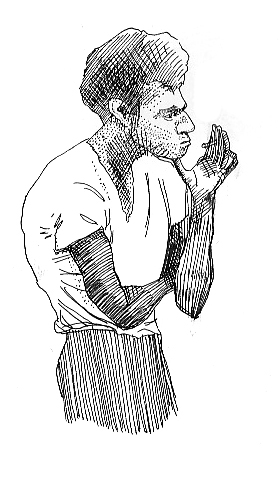
A tentative first step back into my illustrated journal. Drawn while sitting, overtired, in bed.

Jack was eager to settle his college plans early and so was I. His acceptance to RISD was a huge relief for both of us. The stress and uncertainty of the college process was over and now we can both relax until September.
But doing next to nothing turns out to be a lot less fun than he thought it would be. Fall is a long way away and Jack still has to get up at 7:00 each morning and sit in classes all day, listening to droning teachers, half-heartedly writing homework assignments in the period before they’re due, doing the bare minimum to keep his grades above water so his acceptance isn’t rescinded.
I say to him, well, you’re still being taught useful and interesting things, even if your grades really don’t mean as much. Can’t you just learn … for the fun of it? What’s the point, he groans. Who cares? I’ll study when I get to college… Etc.
Senioritis isn’t confined to teenagers. At every point in life, it’s easy to be so focused on goals that one can’t see the value in anything that doesn’t pertain directly to them. All around are books and classes and conversations and experiences that would enrich us greatly but it’s easier to just do the same-old and not expend the effort for something that doesn’t same to have a direct benefit or relevance to one’s occupation or obligations. What’s the point in learning to draw or reading about ancient history or trying sushi or visiting China? We think we know it better, so despite the richness of the world around you, if your mindset is wrong you won’t absorb or even register it. You screen it out.
When we’re toddlers, we are constantly exploring and asking questions about everything we encounter. That impulse diminishes when we get older because our pre-frontal cortex develops and filters out the firehouse of information that is constantly streaming in. Most of the time, we certainly need that filter so we can be focused and goal oriented — it would be impossible to get anything done if we were always walking around in slack-jawed amazement. So we increasingly notice only those things that we have decided are related to our preconceived goals and orientations.
That means it takes an extreme form of novelty or trauma to snap us out of this narrow tunnel we have burrowed into. Something like 9/11, a death, an accident, can force us into a reassessment and new orientation. Our eyes are opened, we say, and suddenly we see things we’d never seen before.
We use this metaphoric language to describe this epiphany but what if we take this notion literally and force ourselves to actually see things anew. We can reorient our perception and put on a wider lens. Of course, we don’t want to eliminate this screening function altogether or else we might wander off the road and spend all day picking wild flowers, but we can pick moments to relax our pre-frontal cortex, return to a more childlike state, rebuild our muscles of perception, and restock our cache of creative stimulation.
When you draw something you see it in a new way. A good drawing is a fresh perspective on an object you may have seen a thousand times before: a building, a body, a bowl of fruit, your breakfast dishes. But by paying deliberate and careful attention to every nook and cranny, you flood your mind and your page with new information about what you are seeing — the texture of a banana skin, the way light hits a brick, how the knee connects to the shin bone, the exact curve of a cup handle. You are suspending the critical function of your pre-frontal cortex, refusing to decide whether there’s importance to each individual line and aspect; you just record them all. This information isn’t actually that important to you beyond the act of drawing, you don’t need to retain the visual data about that banana skin, it may have no further utility to you. But it is expanding your awareness of the world around you, strengthening for observation muscles — it has as much purpose as lifting the same weight over and over at the gym.
When your mind’s eye is open and your screens and filters are down, you get more and more useful information, and that information and experience are the raw fodder for creativity. Forming associations between apparently disparate things to create a new idea is what creativity is all about. And the more open your mind is, the more you are open to experiencing things are interesting but may not have immediate and obvious relevance to your current endeavors. By exposing yourself to art, to novelty, to new ideas, facts and experiments, you stretch your mind so that it is pliable and elastic, so that it doesn’t seize up when you have to move in a new direction. Your reservoirs of references are loaded and you have oodles of bits and bobs to build new ideas with.
Senioritis hits senior citizens too. It’s easy, as you become middle aged and older, to think you know it all, that you have discovered what matters, that you know what you like to eat and like to vote for and where you like to visit and what you like to read and that experimentation and exploration are things of the past. But if you can loosen up your built-in filters, if you can slow down and draw every petal of a flower or the hairs on a dog’s muzzle, you’ll soon see that you don’t know everything, far from it, and in fact you never will. And that realization, that the more we know the less we know, will set you free to devote the rest of your days to exploring the depth of your ignorance, to gathering sticks and shells and tastes and smells, and weaving them together in to combinations you and no one else have ever seen before.
Jack can afford to suspend learning until September. But I can’t.

Now, watch this:

Getting back in shape

The last year has not been a great one for drawing. At least not for me. After being a dad and an employee and a housekeeper, the little spare time I have had left has been consumed with the two books I have been putting together. I’ve had to do a lot of drawing to get those books done, of course, but it’s certainly not been the sort of art that fills my dozens of old sketchbooks. It’s not really a record of my daily life.

A few weeks ago, once the last of my book files was picked up by the FedEx man,I had to admit that I had pretty much lost the habit of drawing and I’d better do something about it. I just kinda didn’t wanna.

Even though it’s been a mild winter, it’s not been conducive to drawing outside so I sat for in the kitchen for a while and looked at the odds and ends on the counter and tried to psych myself up. Instead, I sighed. I just can’t draw my pepper mill again, nor a box of raisins or my knife block. I have a new, great-sounding but boring-looking radio — its a black rectangle with a small monitor and two knobs. Most of the view out my window has been blocked by two newish NYU buildings. They are as dull looking as my new radio and, in any case I’ve drawn them over and again over the years. My mind whined: there’s nothing to draw. But really, beneath my feigned boredom, lurked fear. An anxiety that maybe I had lost my ability to draw. Look at Tiger Woods — even great talent can slip away in the night and leave you swatting the air.

I had to find a way to ease back into the water without scaring the muse away. I didn’t want the pressure of making great journal pages or writing witty marginalia. I just wanted the visceral pleasure of making lines and slowly and carefully studying something, anything. I unearthed an empty, spiral-bound journal with not terribly nice paper and filled my fountain pen. Then I picked up the dogeared copy of last week NY Times Magazine and let it fall open to a random photo. Then I began to copy the picture into the book, focussing on cross hatching, spiraling lines in neat rows, lining up a smooth gradation of micro dots, making ribbons of greys and undulations of silky blacks.

The old pen was a little rusty but not nearly as bad as I feared. And soon the sweet flood of neurotransmitters swept over me, like emptying a too full bladder, and I entered the zone.

So I made a small deal with me. Each morning after my breakfast was chewed and the French press was still half full, I would do one drawing from the morning paper on one page in the book. At least one. If the urge was there and the coffee held out, maybe I’d make a second.

Most mornings I fill a page (and I don’t beat myself up about it if I miss a day to give the dogs some extra time in the park or to make an early meeting). And the fun is back.

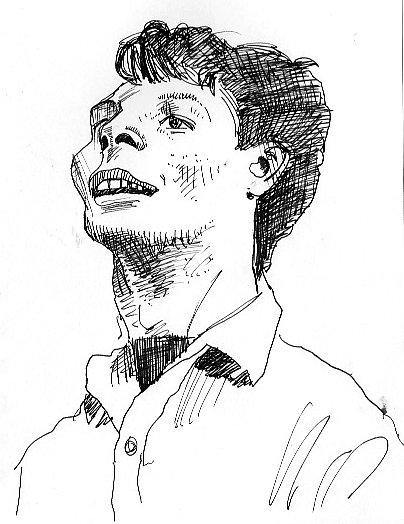
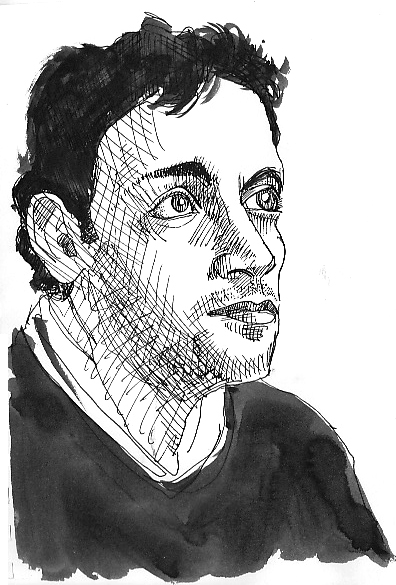
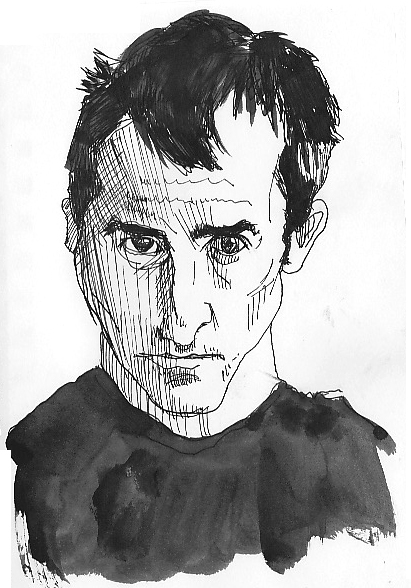
Granted, I’m making drawings of unknown faces from news photos, not the sort of things I want to fill books with, but I figure, what the hey, it’s spring training, and the season will eventually  start for real. Meanwhile, just keep loosening up the shoulders, stretching the hamstrings, and shagging those flies.

Applying myself

For the last year or so, Jack has been applying to college. And so have I. Not literally (I wish) but I have agonized vicariously through every step of the way with him. I am proud of my boy and confident in his abilities but it is nerve-wracking nonetheless.

I described it to a friend recently: “It’s like hailing a cab to the airport for an important flight. As I settle into the back seat, I quickly realize that the driver is a recent immigrant who doesn’t know New York, has limited driving skills and not only doesn’t really know where the airport is but refuses to ask for directions. I can’t make him pull over and let me get in the driver’s seat and so can only sit on the edge of the back seat, hurling suggestions through the little window in the divider. Hopefully we’ll arrive before I miss my flight.”

Anyway, the basement of my building got mildly flooded a few months ago and my super has been urging me to go to the storage room and check on my stuff which may have gotten wet. As we were getting ready to set up our first Christmas tree since Patti left us, Jack and I finally went down there yesterday to look for all the decorations she’d stored and to pull all the rest of our stuff out. One box was a bit moldy but most of them were fine but, as the thought of all those things down in the basement has haunted my sleep for a while, we hauled them all up to our apartment. For a day or two, our Christmas tree is surrounded by cardboard boxes and plastic storage bins.

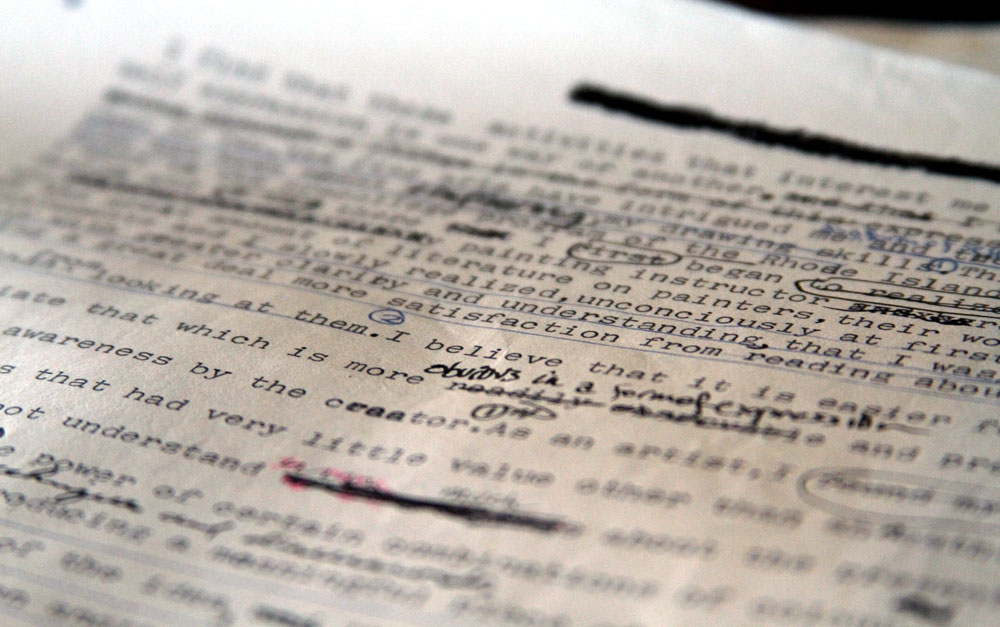
Rooting through the boxes, I came upon a folder containing the essays I’d written for my own college essays a million years ago, including my various letters of acceptance and rejection.   One essay seems apropos to share with you, so I reproduce it here, without all the XXXed out sections and marginalia (how the hell did we write on typewriters back in the day?). Bear in mind, this was written by a 17 year-old me, and yet it seems to foreshadow where I am today, 34 years later.

I find those activities that interest me the most deal with self-expression in one way or another.  In the past year or two, the fine arts have intrigued me as a form of self-expression and the bulk of my time is spent improving my drawing skills.

This summer I went to the pre-college program of the Rhode Island School of Design and there began a transition. My painting instructor revealed to me the great amount of literature on painters, their works and their environments, and I slowly realized, unconsciously at first, but eventually with greater clarity and understanding, that I was, in fact, getting a great deal more satisfaction from reading about the paintings than from looking at them. I believe it is easier for me to appreciate that which is more obvious in a form of expression and presented with the full awareness by the creator.

As an artist, I created things that had very little value other than an aesthetic one, for I did not understand much about the presentation of ideas in painting and the power of certain combinations of color, form, shapes, texture, and other techniques and dimensions. I found that in producing a meaningful piece of art, one had first to feel the force of the idea, then transcribe that force into another form, even another language, that of the colors and shapes that appear on the canvas.


On the other hand, the writer, I thought, does not go through that step, but simply records his ideas on paper in a one-to-one reproduction. He must be more specific than the painter, and his ideas more clear, so the writer appears to blatantly present the same message to every reader. The painter leaves his work to individual interpretation. This became a stumbling block. But as I began to read more, I realized that the written word too, has many levels of understanding, and a good writer must be able to be clear and unclear the same time, so his words evoke images which are purely personal for the reader.

The idea of being able to work on these many levels, to create work that makes the reader stop and wonder, outweighed the satisfaction of creating a painting that people could simply pass by. For when one reads, one ignores one’s immediate surroundings and enters a world of the author’s creation. It takes a certain commitment to read a book, a commitment to give that author a chance to persuade or entertain you. A painting, on the other hand, is hung among hundreds of others and does not have the same chance to grab the viewer and whisk them off into the creator’s world. One may go to a museum and look at all the paintings in one day, as so many people do, but who would consider reading all the books in a library one Sunday afternoon?

Thus I have begun to devote myself more to the creation of colorful words than of colorful colors, although I still return occasionally to my paints. I look forward to the day when I shall be able to find a proper balance to allow equal expression in words and paint.

Interesting that I have continued to slide back and forth across from expressing myself in words and pictures through all these subsequent years, finding as I have at last a happy meeting point in the art of the illustrated journal.

RISD will announce its decision on Jack’s application on the 15th of December. Till then, we wait with bated breath.


The Art of Breakfast

Watch this film in HD and full screen for maximum pleasure.

I have long wanted to make higher quality films that would show the process of illustrated journaling. I’m not a huge fan of detailed step-by-step instruction because I think everyone finds their own way to recording their lives in a journal. But I do know that seeing good films about how people make things is always inspirational to me. I love the videos Etsy posts periodically as well as small documentaries about how people make artisanal foods.

Jack shot this film with our new Canon 7D. He has an amazing ability to make images in any medium and picked up cinematography right away — insisting that we rent certain lenses and keeping my most commercial instincts at bay. Thanks to him we ended up with a slick film that still has some artistic merit.  Tommy Kane, my long-time drawing buddy, and master of his own video domain, was on hand to make suggestions and climb ladders. We shot over one weekend, then spent a couple more weeks putting it all together.  We all learned a lot during this process and can’t wait to make the next film.

Here are some of the videos that inspired our film:

Progress Report

I know I have developed an annoying new habit of teasing you with vague announcements of upcoming projects. So here’s a status update on a few of the pots bubbling on the stove.

My next book, currently known only as “The Patti Book” is coming along very well. I have shared the first draft with my editor Bridget and she has had a lot of useful input. The second draft is almost finished and I will soon start polishing it for final transmission to San Francisco. I’ll probably do a third before I officially submit it bto Chronicle — my deadline is in the early fall. I am struggling with the best title for the book — that’s always the hardest part of the process for me.

• I have received lots of spectacular suggestions for artists to include in my book on travel journaling. Thanks so much to everyone who sent in submissions and refferals. If you have any other ideas, I am a still wide open, particularly for journals that include both great drawings and writing. Even if all of the artists don’t end up in the book, this list of travelling journalistas as a wonderful resource that has already inspired me a great deal. Post your suggestions here in the comments section; I check it regularly.

• We had a sneek screening of the first drawing film this week. Everyone seemed to like it a lot and we got lots of suggestions that will serve to make it even better. We’re heading back into the editing suite and hope to have a world premiere very soon. Here are stills from a few of my favorite scenes:

This slideshow requires JavaScript.

• My travel schedule continues. I will be taking a quick jaunt down the C&O canal, cycling 100 miles or so in what may prove to be debilitating heat. Then Jack and I head to Paris and Rome for a brief sketching interlude. I’ll be shooting in California in September and may or may not go to Indonesia and Kazakhstan in the fall as well. I think I will have circumnavigated the globe (or the equivalent) three times by year’s end!

Cathy Johnson’s book is #1 on Amazon’s Drawing best steller list! Wahoo!

• I have been invited to apply to speak at the HOW design conference in Boston next spring. I had a great time when I did it last time, addressing thousands of designers and encouraging them to draw. I really hope I get to go again.

‘Round the Square

My snazzy new camera arrived yesterday and when I got home from work, I went to the park and made this little film — watch it in HD for maximum pleasure!

I have a lot to learn about using this camera but it’s an amazing creative tool.

The 5-Minute Creative Process Interview: Danny Gregory

I was interviewed on my creative process by Anna T. for her blog, See. Be. Draw. You can read it here:

Self-justification

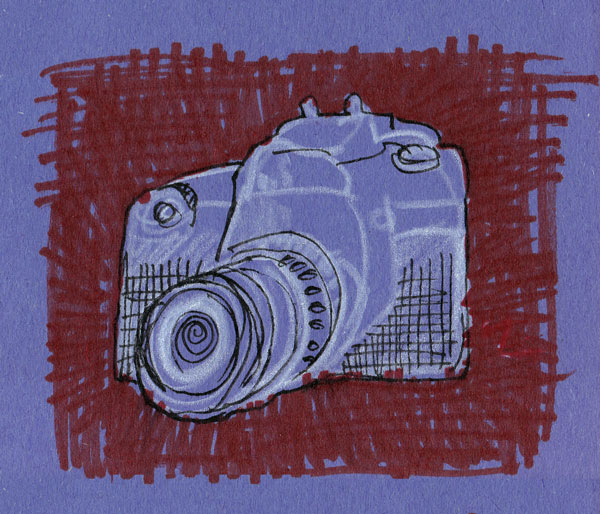
I’m kind of excited today because my new camera is supposed to be delivered tomorrow. It’s a pretty fancy one and acquiring it has entailed a long struggle with my internal demons. First of all, as one of my voice loudly declaims on a regular basis. I don’t really need a fancy camera. I have a smallish camera that I was very excited to get a couple of years ago and which takes perfectly good pictures.

But the real reason I’m getting this new supercamera is to make videos. And, yes, I have a couple of smallish video cameras that are perfectly capable of capturing a moving image and getting it onto YouTube, but I have a dream. The dream is of making videos about drawing, capturing what is beautiful in the world and how I and my friends get that beauty down on paper.  But I want to go way beyond the instructional films I’ve seen around, not just step-by-step, “this is how to paint a fruit bowl” sort of things but videos that are as beautiful as the process they record. After decades of making commercials for other people, I want to apply all of that experience to filming what I love really well. We’ll see how that turns out.

Anyway, so I have most of me convinced that this is a legitimate endeavor and use of my savings, but as I say it took a fair amount of self-doubt to get there. I don’t know about you, but when I find a new passion, I tend to spend a disproportionate amount of time researching what other people think and do with the same interest before I allow myself to make a commitment. And I can also do a lot of shopping for accessories and supplies and doodads before I actually get to work doing what I had originally set out to do.

I mean, it’s so much easier to shop for art supplies than to use them.

I think that’s why, when I first started drawing fifteen years or so ago, I imposed a lot of restrictions on myself, like only drawing with a Uniball in a not very fancy book. Then gradually, as a reward for my commitment, I let myself get a few grey brush markers, and then a few others, then some colored pens, then a better quality sketchbook and then a Rapidograph. That point took a couple of years to reach. I think if I had indulged my urge to shop any further I would have gotten into way more than I could handle. Instead of forcing myself to learn each medium well, I would have started to wrestle with complexities I didn’t understand and would have just gotten so bogged down and frustrated that I would have lost my will to go on.

Eventually, after allowing for gradual expansion and experimentation, I settled on the materials that work best for me and the way I choose to express myself right now. I know them well and know how they work, how they misbehave, were the pitfalls lie, how to make them sing fairly in tune.

Now, a new fancy camera with lots of knobs and buttons may prove frustrating or distracting. I can easily imagine that I could get sidetracked by the gizmo itself, spend lots of time reading its manual. working my way through all its menus, consulting with others, etc. But because I have  a goal in mind and am going to learn how to make the thing in my head rather than become a professional photographer who can handle any technical situation, I will be able to create something that will give me confirmation rather than frustration.

I think that’s so key in developing a new skill. Not endlessly playing scales or drawing perfect lines and circles, but getting right in there and expressing something that matters to you. That’s why illustrated journaling had kept my interest for so long, not because I am just studying drawing but because I am using drawing as a tool to learn about the world around me,  capturing the beauty of every day, discovering how I feel about the treasures that surround me.

So, hopefully, I will learn how to get this camera to make the images I see in my head, in a clearer deeper way than I ever have before. I will capture the emotions I feel in drawing, what makes the process beautiful and magical, will create scenes that will help inspire others too.

Failing that, well, I’ll hang onto the receipt.

What do you think?


Let’s face it, one of the most important parts of making things lies beyond our ability to control — other people’s reactions to our work. Right?
“Hey, mom, look what I made.” That’s wonderful, let’s hang it on the fridge.”
Or “What is it now? Can’t you see I’m on the phone?”
It’s one of the most difficult parts of being a creative person. Not the fun, satisfying, unfurling of an idea, but the cold crickets that confront it or the “yes, but” of the professional critic or the form rejection letter or worse the anticipation of rejection that stops the egg from ever even popping into the nest.
We may not make it for others but a work is not fully realized until it bounces off another’s eyeballs, vibrates their eardrums or rearranges some of the cells deep within their corpus callosum.
And praise can be as insufficient as a shrug. We don’t just want a pat on the head; we want connection, reaction, insight, something that makes us see what we made in a newer light or on a deeper plain. Knowing we moved someone else, revealed truth to them, reminded them of something we didn’t even know corresponded, that makes us love our work all the more. Love it and wonder at it, at the fact that we were the conduit for it, that something passed through us and then passed through another heart. It dissolves the loneliness of existence.
Ideally, our art is the truest manifestation of our conclusions about the nature of things and when someone else sees it and validates it and shares it, the power of that truth is reflected back on itself like an endlessly repeating mirror.
That’s why rejection hurts, because, yes, we feel our efforts are wasted, and, yes, that we don’t matter and, yes, we didn’t make a ripple on the surface of the earth, all true. But mainly because we wonder whether the magic we found is really magic, whether the revelation we thought so profound was just a single serving glimmer of something too puny and insufficient to be shared, a whistle in the dark, not a full-blown hallelujah chorus with kindred spirits chiming in.
The true value of acknowledgment isn’t registered in the ego; it’s the opposite, a breaking down of the barriers between creator and audience so that we can unite in a shared appreciation of something that lends beauty and meaning to the grinding metronome of the day. We see a glimpse of the heavens together, a view that appeared to one of us first but is now a canopy over us all.
It’s even true of a joke, a shared laugh, the quick bark of recognition that our minds thought alike, we saw the other’s insight, and we were able to escape together from the smooth ivory prison of our skulls for a moment.
When I hear from people who like my work, or more importantly found something in my work that made their day a little brighter, I like my work more too. And when a reader has an insight or can tell me of a particular sentence that strummed their strings, I have insight into where to go next, into what matters in what I’ve done.
And conversely, of course, if my work pulls up lame and doesn’t find much of an audience, I wonder where I went wrong or why I thought something was worth my time but proved not to be worth anyone else’s.
So to all of you who have read my books or thought about my work and then have had something either nice or, even better, something honest to say about it, thanks very much and please know that it’s those sticks and carrots that are the kindling for works ahead.