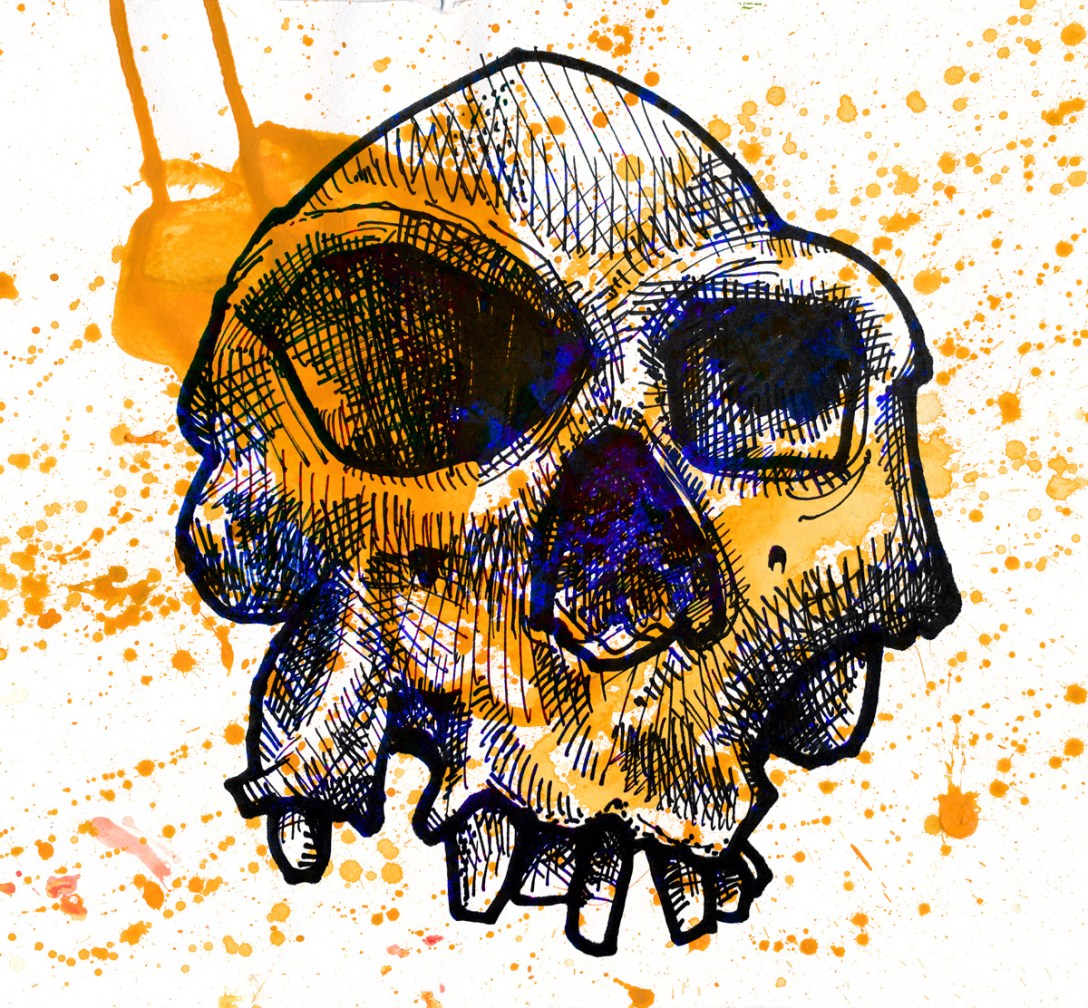
Ten courses I’d like to take

I love learning new stuff, but rarely do it in a systematic way. I should try learning from someone who knows what they are doing for a change.

Acting. I loved acting in plays in high school and college. I directed several plays. I even wrote a couple. The thrill, the camaraderie, the chance to inhabit another skill. So cool, but I haven’t done it since.

Coding. Something I did in middle and high school, when computers were made of wood and animal hide — but it’s a whole new world since the days we wrote in BASIC and Fortran. Maybe app development or CSS, before they become obsolete. Try Code academy.

After Effects. I have a vague sense of it but would love to be fluent with its animation tools . Maybe I’ll start with an online course on Lynda.com.

Clown school. It rocked my world in LA. I should go back.

Cooking. I’d like to study knife skills and the chemistry of cooking.

Singing. I always assume I have no skill and can’t carry a tune. But Jenny has been taking classes this summer and loves it. We could do duets.

Philosophy. I’ve been dabbling in Plato and Aristotle but it would be great to learn from someone who can explain and make it relevant.

History. I hated it in school. Now I love it. Maybe US and European 1880-1914. But many other periods fascinate me too. 1860s. 1770s. 1500s.

Ceramics. I’d love to throw some pots, study glazing etc.

Magic. I mean what could be cooler? Or dorkier?

Swimming. I never really got the hang of it when I was ten and still can’t mange the crawl. How great it would be to be 100% confident in the water.

Carpentry. This used to be my passion. New York City real estate defeated it. I’d love to study in a well-stocked workshop with a teacher with leathery hands and a missing finger.

What would my life have been like if I had gone to law school? Business school? Medical school? Graduate school? Art school? All were fantasies at some point or another.

What would you like to learn?

Ten ideas for classes I could teach

I’m starting off each morning by coming up with 10 ideas. Today’s topic: Ten classes I could teach.

  1. Idea machine : how to come up with 10 ideas every single day
  2. Life in pictures. How to write an illustrated memoir
  3. An Illustrated Journey. How to keep a travel journal
  4. Those who can, teach. How to teach an online art class
  5. The creative process: how it works
  6. How to draw without talent
  7. Yum! Eating and drawing. Drawing in restaurants, drawing the steps in a recipe, keeping a food, journal, wishful drawing: draw it it instead of eating it
  8. Drawing the line. Making art to face life’s challenges
  9. Pow! Telling your stories in graphic novel form
  10. Shut Your Monkey: How to control your inner critic and get more done
  11. Count your blessings: using art to appreciate the world around you
  12. The deadly sins. 7 things we do to sabotage our creativity and how to stop doing them
  13. Eating the whale. Techniques to get creative projects done.

Anything you’d add to this list?

Ten ideas for ten ideas

A new routine: I’m gonna start the day by coming up with ten ideas.

Today’s topic: Come up with at least ten topics for coming up with ten ideas. Starting tomorrow, I’ll tackle a topic on the list each day.

  1. Ten ideas for courses I could teach
  2. Ten courses I could take
  3. Ten ways I could help a stranger
  4. Ten ideas for idea lists
  5. Ten books I could write next
  6. Ten things I could do with ten bucks to serve the greater good
  7. Ten people I’d like to meet
  8. Ten New Years resolutions
  9. Ten things I like about me
  10. Ten things I’d change about me
  11. Ten product ideas
  12. Ten ways to make kids more creative

Inspired by James Altucher.

How to face change.

I was in Berlin on 11/9. I woke up at 3:30 am, picked up my phone, read the election results, and discovered that the world had changed. The world has changed a number of times in my lifetime, and often it pivots in minutes. I was halfway through my first cup of coffee on 9/11 when things were completely different than they’d been when I poured it.

My world has changed in a heartbeat too. At 9:15 on 6/9, I was working on the biggest photo shoot of my career. Five minutes later, policemen were taking me to the hospital to see if my wife would ever walk again. At 10:20 on 3/18, I was in a meeting in my office. Five minutes later, I learned I was a widower.

Sometimes change is like a slowly melting icecap. Sometimes it’s a tsunami.
Whatever its pace, change is inevitable. You can’t build a wall to keep it out. You can’t hide from it by cancelling your newspaper subscription. You can’t run from it by moving to Canada.

You can soothe yourself by filling your basement with canned goods or stockpiling shotguns or ranting on Facebook. But that sort of denial won’t protect you from the next change, just the last one.

Change is the one thing you can count on. It’s always around the corner. Sometimes it’s good. Sometimes it’s awful. But it’s coming.

The scariest thing we can tell ourselves is “this changes everything.” Nothing does that. Nothing changes our need for meaning, for beauty, for connection, for love. The world may change but we have control over how much of us it changes. When my life was rocked by change, I retreated into darkness. But then, in time, I merged again and took my place on the shifted ground. And I could still draw a line from the me that is to the me that was. I still loved books and dogs and my family. I was still Danny and eventually the wounds would turn to fading scars.

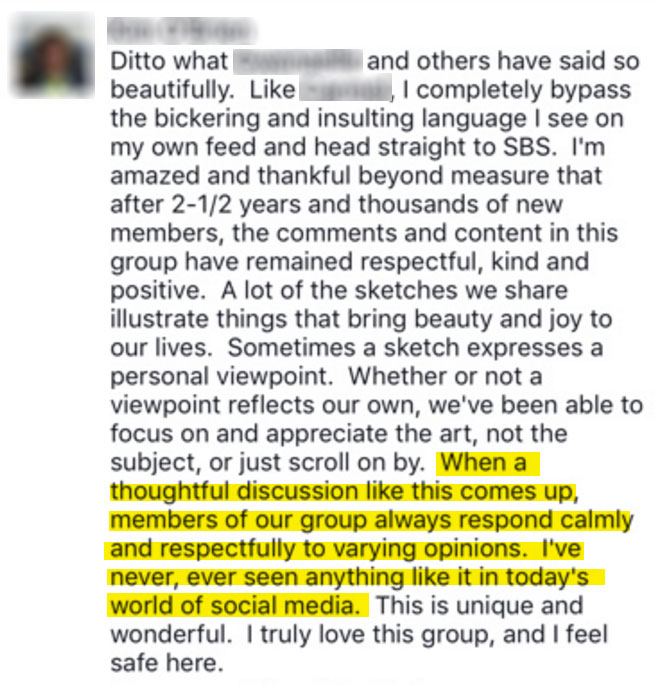
One of the things that has meant the most to me in the past ten days was a discussion I came upon in the Sketchbook Skool group on Facebook. sbs-fb-comment An ever-expanding group of people talked about what the group meant to them after the election. Some of these people no doubt voted one way others probably voted another, but all agreed, that this group was the place they felt safe because the things that had drawn them all together in the past still mattered an awful lot to them: art, creativity, encouragement, a sense of commonality. Many members of the group have told me that they wanted us to keep the group closed because they didn’t feel comfortable sharing their art in their usual social media feeds — they worried that relatives and colleagues would sneer at their burgeoning creative efforts, but in this group they felt like they were among friends.

Reading my newspaper today, abrim with flailing and fear, I couldn’t help but think of the model we have found in this Facebook group. Looking at what unites us rather than what divides us, at what we love rather than what we hate, at what we can create together rather than what we can destroy. I want to live my life like that. I want to see other people like that.

And I can’t help thinking that it is the very thing that has drawn us together, our creativity, that makes this attitude possible.

Creativity helps us adapt to inevitable change. To make something new to fix something old. To see through other eyes. To discover that what is truly beautiful in the world around you may not fit the standard definition. When you find how wonderful it can be to draw a dented garbage can, a wrinkled old face, a rusting truck, you transcend the obvious, the dogmatic, the rigid, the doctrinaire, the popular, the commercial, and you face the world on new, real terms. You learn to be in the moment, rather than dwelling in some futuristic hell of your own invention.

Drawing helped me escape the prison that fears about my wife’s health had built, helped me be a bit more imaginative in constructing a wonderful though different life for our changing family. It saved my sanity and my life.

When I was little, my world changed many times. My mother’s divorces, moving from continent to continent, a dozen and a half schools in a handful of languages, and yet, I emerged okay. I was adaptive because, at that age, I was at my most flexible, most imaginative, most creative.

It didn’t last. The calcification of age always threaten to make me more brittle. But sitting down and drawing my breakfast or doodling with crayons or spending time with other artists who are creating beauty, helps me to adjust. Creativity is far healthier and more calming and ennobling than gibbering in the dark, alone with my monkey brain.

Don’t fear change. Create ways to change with it.

How to get over a creative block

My SBS co-founder, Koosje Koene, has been experiencing a bit of a creative block of late so she has been asking for strategies on how to get past it. We did a Skype chat in which I gave her a few ideas to help her reshuffle the deck and get back to work.

This chat is part of a series for the Sketchbook Skool blog which has lots of other ideas for improving your creative life. If you sign up for the SBS newsletter, this sort of advice will find you and kick your monkey’s butt.
—————————————
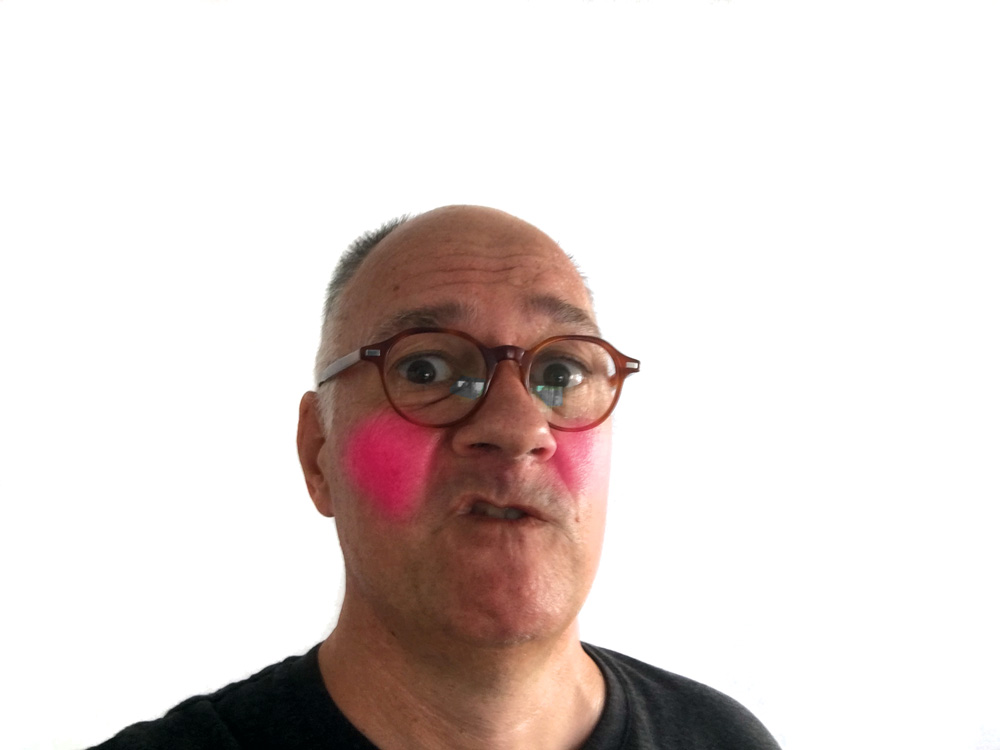
P.S. Please excuse my unshaven, pimply appearance. I am going through a second adolescence and my usual hair and makeup person is on sabbatical.

98 years of change.  

Let me tell you a story. It’s about what change sounds like when it’s kicking down your door. And what you do about it when it does.

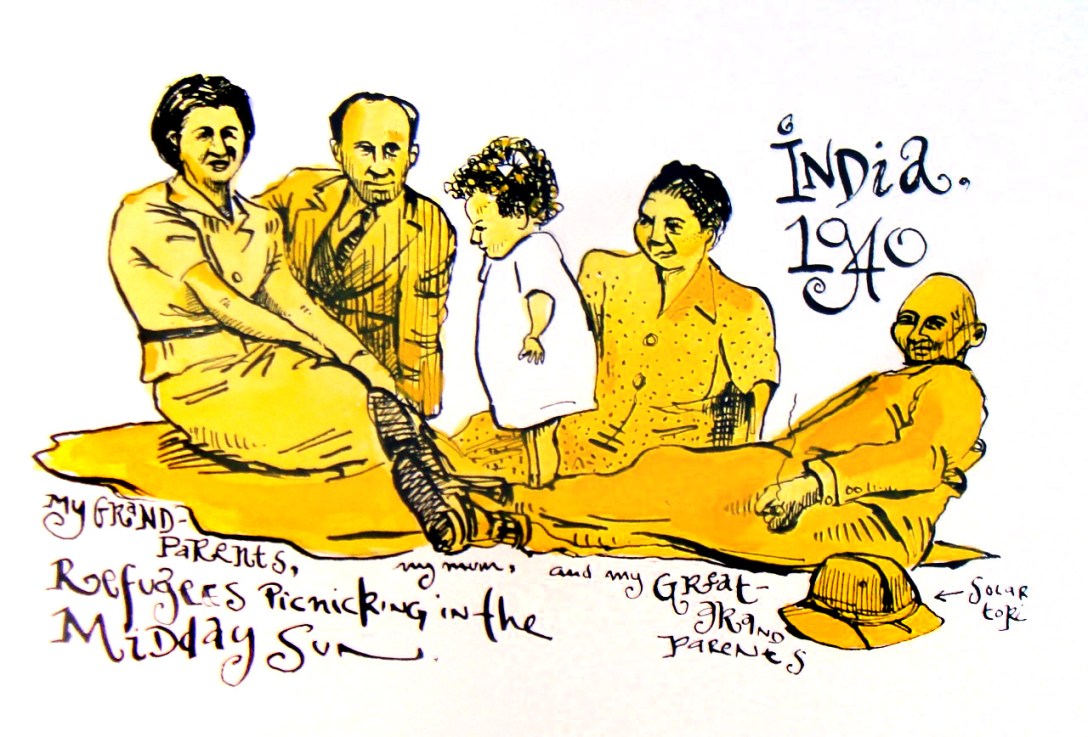
Herman was four years old when his country plunged into  the war to end all wars. World War I continued to rage on till he was nine, a boy too small to fight or even understand the causes and implications of the destruction all around him. But he soon felt the fallout.

After losing the military war, Germany was savaged by an economic one. Inflation rocketed to historic levels. It was a terrible time for even a canny entrepreneur, and Hermann’s father was born to lose, even in the best of times. He invested the family’s nest egg, the equivalent of $10,000, in a warehouse full of burlap sacks, then turned around and resold it at what would have been a handsome profit. His buyer was to pay him by day’s end, but stalled. By the time he showed up  two days later with the cash, a literal wheelbarrowful, the millions of marks would scarcely buy a loaf of day-old bread. The family was ruined.

Hermann and his siblings were sent door to door through the ghetto, hawking whatever wares their father scrounged together. When his older brother, Josef, rang an unfamiliar doorbell and discovered it was a classmate’s home, he dropped his bag of mantle clocks and ran in humiliation. No amount of beating would get him back out to sell again.

But Hermann persevered, hustling, supporting his family however he could. Knowing no one else would ever come along to bail them out.

In high school, Hermann had shown himself to be exceptional; he was clearly smarter and harder working than any of his classmates. His dream was to go to medical school, then to study with Sigmund Freud and become a psychiatrist. It was a preposterous ambition for an underfed boy from the shtetl but he stubbornly pursued it nonetheless.

By the time he completed his studies, the Nazis had decreed that a Jew could not practice medicine and he could not be receiving a doctorate. In fact, they announced, Jews should leave Germany all together. Or else.

While the getting was still good, Hermann went to a relocation office to register for exile. In a long line, he meant a lovely young woman from Koln. Kate said that she too planned to be a doctor. He told her he’d heard that Jews were still permitted to study medicine in Rome and that if she was interested, he would remain in  line and send her the necessary information and paperwork. She gave him her address, thanked him and left

Not long after, a pair of SS officers stopped Hermann on a train, demanded his papers, and said that he was under arrest. After some deliberation, they told him that red tape meant they could not arrest him on the train, but that he should continue on to his home and turn himself into the local authorities to be arrested there. Hermann got off at the next stop and secreted himself away on the next train to Italy.

In Rome, dead broke, he began studying medicine again. From the beginning. In Italian. He survived on a single herring a day and water from the Trevi fountain. One day, he met Kate again. She had made it to Rome and was still lovely. In 1936, they exchanged cheap gold wedding rings in City Hall, then exchanged them again with the authorities for steel rings enscribed “Oro Alla Patria.” The fascist government mandated that all gold items be turned in to fund the war effort.

Soon after they finished their studies (again) the Italians decided that they didn’t welcome Jews anymore and that they had to all leave the patria, pronto. Hermann and Kate looked for somewhere, anywhere, to flee. Their families had all left Germany for Palestine but Hermann was pretty sure he had a cousin who owed him money and had emigrated to India. So he booked passage on an eastbound ship, assuring Kate that he would find a haven and send for her.

He never did track down his cousin or the money he was owed, but India seemed like a safe place for a pair of young doctors and so he sent for his wife. They set up a practice in Lahore, ministering to British expats, and gave their babies English names. Hazel was born in 1939 and the next year, Michael. A thousand miles from the chaos of the war in Europe, the little family breathed a sigh of relief.

One morning, Hermann opened the door to several armed British soldiers holding manacles. Four pairs, including two for the babies. The family was arrested for being from a hostile county, enemies of the Crown, Germans, and were transported north to a prison camp. There, Hermann and Kate were assigned to be the camp doctors and ordered to treat their fellow prisoners: German spies and Nazi sympathizers. They began frantically writing letters to anyone who might give them asylum, to Palestine, to the USA, anywhere, but to no avail. Even when the war officially ended, they and their children remained behind barbed wire for a total of seven years.

When they were finally released, stateless, with no passports, they returned to Lahore. More upheaval. A civil war between the Hindus and Muslims cracked India in two. Thousands died, millions were dislocated as Lahore became a part of a new Islamic country, Pakistan.

Hermann and Kate and their family stayed on in Lahore. They worked hard, constantly updating their lab and their surgery with the most up to date equipment shipped from the West. They became pillars of the community, treating ministers and film stars. Herman was elected president of the Rotary, then Grandmaster of all Pakistani freemasons. He wore custom suits and owned 40 pairs of hand-made shoes. Kate bought her frocks in London and wore an armful of gold bangles. They had a large medical staff, a butler, cooks, two gardeners. Their chauffeur drove them in a Mercedes-Benz and they sent their children to British boarding school.

In the 1960s, the German government reinstated their citizenship, made an official declaration of apology to them and held a ceremony in their honor in Oberhausen, the hometown Hermann had fled after his encounter with those SS officers so many years before.

Then war broke out on their doorstep again. Their home was just a dozen miles from the Indian border and, as Pakistan and India locked horns and East Pakistan became Bangladesh, Hermann and Kate felt compelled to pack up their belongings once more and depart for Israel. They bought a home in Jerusalem, among their people at last. A year later, on Yom Kippur, they heard air raids sirens and ran down to their shelter. War again.

But this time, they wouldn’t be going anywhere. Kate succumbed to dementia in her 80s and Hermann died in his favorite armchair at 98. They are still in Jerusalem, buried side by side on Mount Olive, waiting for the Messiah’s trumpet to sound.

My grandparents’ lives were rife with change, none of it their doing. But every time the deck was reshuffled, they survived and thrived. I never heard them curse their luck or complain about their lot. They weathered all types of persecution, unforeseeable calamities, and yet, they never gave up, always looking for new solutions, new ways to make the most of their changed circumstances.

But it wasn’t easy. I’m sure they must have worried terribly; of course, they did. Hermann became increasingly reactionary as he got older, suspicious of Palestinians, Soviets, liberals, intolerant of anybody who was different. He saw antisemitism all around, and who could blame him after all he’d endured?

Kate’s children ended up living on the other side of the planet, marrying gentiles, pulling away, leaving her feeling isolated. She never practiced medicine after they emigrated to Israel, but became a housewife, she who had been served by a dozen servants. Despite all her years abroad, she enjoyed pottering around in her own kitchen, nostalgic for the days when she was still a fräulein in her happy, tidy, middle-class German home.

When I lie awake at night and worry about all the things that could go wrong – medical, financial, presidential, what have you — I remember all that Hermann and Kate survived, how, even when things were scariest, they pulled through.

They lived through a century of rupturing change — lived and flourished. When I suffer some piddling setback, I think of Hermann sitting down to study medicine all over again, in a language he didn’t speak, a meager herring in his belly, fascists all around. When I worry about madmen planting bombs in dumpsters a few blocks from my home, I think of how my grandparents felt every time tanks rolled past their gates or jets flew overhead. When I get annoyed at the bank or the DMV, I think of how he felt when the SS stopped to paw through his papers. When I feel anxious about my son moving three thousand miles away to start a life in California, I think of how they felt when their families disappeared into the fog of World War II, behind the gates of Auschwitz.

Don’t get me wrong. The fact that many of their trials were greater than mine doesn’t wipe away my worries. And It doesn’t trivialize them either. But it does serve to remind me that I come from hardy, resilient stock. I am descended from survivors. And when you think about it, we all are. Whether we know it or not, the world has gone through far worse than we face today, our new fears notwithstanding. We are free from famine, plague, genocide, and, though the world remains a troubled place, it’s still a beautiful one too. We can decide how we will see things, how we will cope with change, how we will survive. We are free to choose to live each day as if we were going to make it through what ever comes up, firm in the belief that we are going to survive to die in our favorite armchairs, many years from now.

How to fail.  Epically. 

I just read that Roadies has been cancelled. So was Vinyl. No one gives a shit about TV shows about the music industry. It can’t be mythologized. It’s dead. Whoda thunk it ten years ago? What about publishing ? Another myth-ridden beast, gasping. As is advertising, replaced by algorithms and fast-forward buttons. Newspapers are folding. Movies, yawn. Trump blew up the conventional. Apple can’t do the job without Jobs. Even flossing has been debunked.

Change is afoot. Rampant.

Why should you escape unscathed?

What if the rules that always worked, suddenly don’t ? How will you survive?

Here’s a thought:

Instead of fleeing failure, what if you embrace it?

Leap.

Drop excuses.

Cut your safety line.

Make shit. Wild shit. See if it sticks to the wall. If not, archive the lesson, open a new file, repeat.

Take a massive risk that could destroy everything. Make it worth it.

Fail so hard you learn something serious.

Stop whining and worrying.

Stop trembling and clenching.

Stop thinking you know what will happen. You have no idea. Assumptions are just one more excuse for inertia.

Stop fearing the future and start building it.

Try shit. Get creative.

It’s time and you know it.

What happened in the Studio.

In New York, they say, you are never more than ten feet from another human being. If there isn’t someone next to you or behind you, then they are on the floor directly below or clomping around on the floor above. Even if you wander deep into Central Park, lost in a fantasy of woodsmanning deep in a copse surrounded it would seem only by squirrels and woodpeckers, a bunch of Italians or Koreans will inevitably blunder around the corner clutching guidebooks and ruining the calm with their foreign tongues.

No wonder we New Yorkers are so misanthropic; we can’t get away from people.

It wasn’t always so unusual to have some space to oneself. When I was an odd teenager, I used to go alone to the Brooklyn Botanical Gardens of a Sunday. In the ’70’s, most of Brooklyn was still uncool, and I could stroll my grounds for ten or fifteen minutes without seeing a single other (non-imaginary) person.
Those were the days when I read all 92 volumes of PG Wodehouse as well as Anthony Powell, R.F. Delderfield, Evelyn Waugh, and other perpetuators of the mythical British landed gentry. While my classmates were making zipguns and apple bongs, I was sewing suede patches on to the elbows of my thrift store tweed jackets and shopping for monocles.

My only companion to the Gardens was my imaginary friend, Lord Roger Watford, and we would walk through the rose garden, pretending that it was part of my vast baronial estate and that the adjacent Brooklyn Museum was in fact my manor House.

Brooklyn has changed a lot since then and so, by and large, have I. But one of the many delights of the studio Jack and I rented this summer was having access to the vacant lots, abandoned dumpsters, and empty streets of the 100+ acres of the Brooklyn Navy Yard. The Yard was once abuzz with shipbuilders preparing to conquer Japan but in the ensuing decades it became an abandoned stretch of dandelion farm along the East River. Recently it has been landmarked and revitalized and turned into a hive of artisanal activity, full of little manufacturers and artists and photographers and woodshops and film studios and even a commercial farm.

We rented a studio from two women who had been painting there for several years and were taking the summer off. It’s several hundred square feet on the third floor of a brick building, neighbored by a landscape painter, a potter, and two graphic designers. The building is all industrial utility, with painted cement floors, steel casement windows, wide staircases, no air conditioning, and a tarpaper roof that looks out at a spectacular views of the East Side of Manhattan, stretching from the Brooklyn to the Manhattan Bridges and beyond to Queens and the Bronx.

There’s a street full of crumbling rowhouses being demolished on one edge of the Yard, and wandering through the site reminds of the exhilarating freedom I felt when I was ten or eleven in Israel, sneaking into building sites to inhale the smell of fresh cement to look for abandoned porn magazines, cigarette butts, and the dregs of dusty beer bottles.

On the ground floor of our building was a photo production studio full of industrial printers that churned out materials for store windows and fashion shows. There dumpster was filled to the brim with sheets of rejected foamcore, aluminum plates, and rolls of paper and fabric. Other dumpsters in the Yard brimmed with cardboard boxes, wooden pallets, skeins of wire, plastic buckets, and dead computers and TVs.

These dumpsters became my art supply store. Each time I biked into the Yard, I would dive into one dumpster or another and pull out some interesting surface to paint on. Yards of rubber matting, an old canvas, a sheet of plaques honoring David Dinkins to be displayed at the US Open, an life-sized portrait of a blank-faced Calvin Klein model.

I’d haul my find up the three sets of stairs to the studio, turn on the fan, flick on the radio to an eclectic college station in New Jersey, fill my water jug in the janitor’ sink, and get to work.

I came with nothing. No ideas, no ambitions, maybe just a small plastic bag from Blick containing some medium I’d always wanted to try. At first, it was spray paint. A dude with too many eyebrow rings explained what the variables were that led to an entire wall of locked cages of paint. Gloss, high gloss, flat, matte, indoor, enamel, oil, acrylic, high pressure and low, and every color known to man. We flipped through a menu book full of spray caps and nozzles and I assembled a bag of twelve, different shapes and angles of spray, some slim as a pencil, others designed to cover a wall and empty a can in seconds.

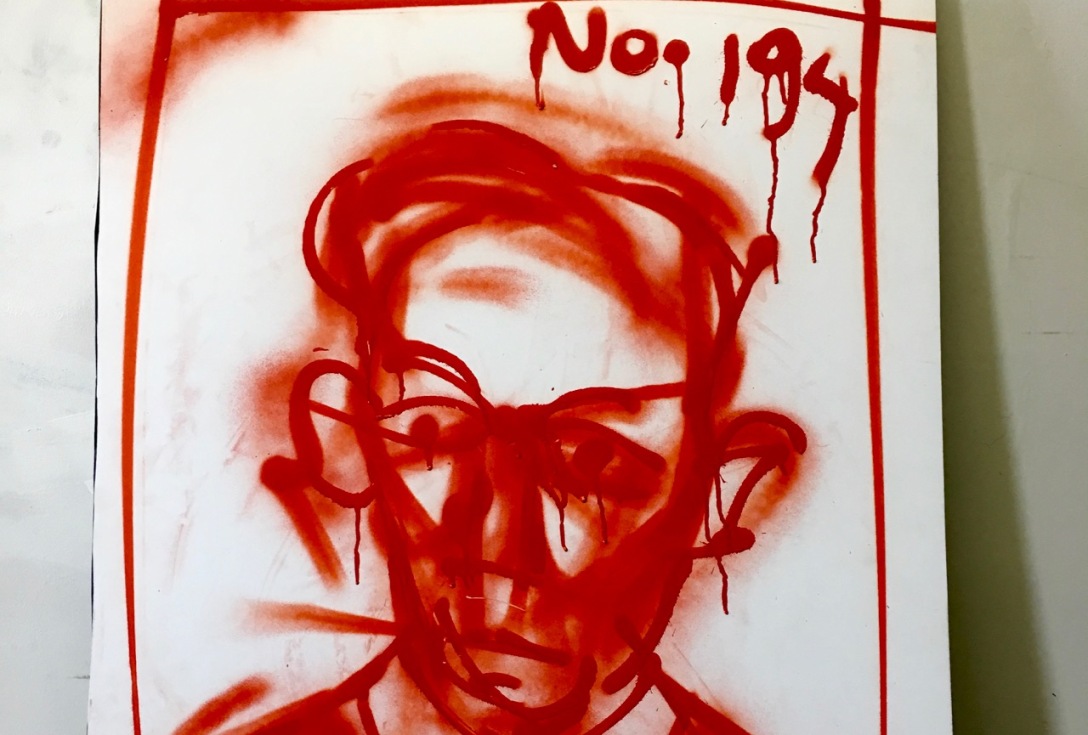
I hauled a placard announcing a diabetes fundraiser up to the roof and uncapped a can of matte black acrylic. I snapped on a medium-sized nozz and made a slow oval on the board. It was a lot less controllable than I thought. I built up faint layers to sketch out a head. Then I discovered that if the faster I moved, the sharper the stroke. I used my whole body to make the stroke, reaching up then bending down to the ground. Slowly, like layering sfumatos of watercolor, a face emerged. It wasn’t a face I’d imagined — it just appeared through the gloom.

The paint dried almost immediately in the baking July sun. I dragged the board and the cans down to the studio and squirted out a few inches of white and of black acrylic onto a folded sheet of paper. No palette for me. Jack had already explained that he and his pals at RISD didn’t go for all that jazz, no sheets of glass or wooden ovals with thumb holes. Just throw some paint down on the table and have at it.

Now, I used to fool around with acrylic paint back in high school (after I returned from surveying my property and mixing with the commoners), but I have been a watercolorman for the better part of a decade. Painting with opaque paint is so very different from watercolor. I like to layer my paint and build up glazes, slowly shaping the image over time.

But opaque paint like acrylic, oil, and gouache obscure whatever’s beneath them. You are committed to your last stroke, rather than conversing and harmonizing with all the layers before. This took some getting used to. Unwieldy as the spray paint is, it allows for that process of building. With out a medium of some kind, the acrylic just negates all that came before.

I had also forgotten how much of large-scale painting requires you to move around. Unlike working in my sketchbook, a painting that’s four or five feet tall, demands that you use your whole arm to paint. And then you need to stop and step back, often across the room, to get perspective on what you’re doing. You need to juggle and balance, moving constantly around the whole surface, darkening here, obscuring there, sharpening an edge, scraping off a mistake.

The painting is a living thing and the act of painting is all about responding to that life. Sometimes you reach perfection, then fuck it up with an an ill-conceived dollop. Then you battle back from that blunder and the painting turns a corner and brings you somewhere you’d never known could be.

This back and forth went on for a couple of hours till I reached a point where I was afraid to screw things up anymore. I’d painted a man who seemed to be going through something. Writhing, pained, pulled into himself but surrounded by turmoil. It wasn’t what I’d expected and I didn’t know if I liked it. But I was soaked in sweat, dehydrated, and happy.

On my next trip to Blick, I picked out a set of oil sticks. They are solid tubes of oil paint that work like juicy grownup crayons. Basquiat used them and I had always wanted to as well. I had no idea how or what I’d do with them but I sprayed a sketch in red and then started to draw. The juicy sticks are more like lipsticks than crayons actually, a bit out of control, very opaque and bold, but their lines are sharper and less intriguing than brushed paint. So I threw some acrylic on top, only to discover that while water-based paints dry quickly in summer studios, oil sticks take a while to dry and when you rub over them they smear.

Actually, that was good — it made the lines less boring and I started to rub them with my fingers. Soon that was a mess so I added more paint. A man emerged. He had no irises. I painted some in and he became boring so I blinded him again.

The spray paint started to scare me a bit. At first, I only used it on the roof, but then, impatient, I started to touch things up in the studio. I’d spray a layer of paint over the acrylic and the oil stick, knocking the image back a bit so I could then pull out parts of it again. But spraying paint indoors is not good. So I hauled it back to the roof where I fought the sun and the wind.

For the rest of the day, I imagined my lungs filling with paint mist and my eyes caking over with a layer of royal blue. I remembered once, in my early twenties, spray-painting a chair Chinese Red and afterwards looking in the mirror — my nostrils looked like they were leaking blood, my nose hairs struggling like overwhelmed filters.

This memory and the hypochondriacal fears of clogged lungs led me to Home Depot where I bought a spray mask and some goggles. These were really unpleasant to wear on the rooftop and my goggles quickly steamed up on the sunny roof so I was painting blind, but at least I wouldn’t end up with black lung and a ventilator.

This slideshow requires JavaScript.

One of the concerns I’d had when I first contemplated getting this studio was what I was doing it for. I knew I didn’t want or need a bunch of paintings to hang in my apartment. I wasn’t going to display the paintings in a gallery, submit them to a show, or show them to anyone at all. But I wrestled with this for a while. I didn’t want to seem pretentious, like ‘look at me, I’m a painter”. Plus, I was sharing my studio with a guy who actually is a painter — Jack, my son, the real thing, trained, newly-minted art school grad. Though I knew he would never say anything about what I was doing unless I asked, I didn’t want to have to worry about whether what I was doing was correct, was proper painting, was art. I just wanted to have fun, slop some shit around, work big, see what it was like.

And then, a few weeks into our lease, I realized I could just throw out everything I was making. Put them back in the same dumpsters I’d taken them out of when the summer was done. I’d snap some pix for a souvenir and then bu-bye. No muss, no fuss.

What a relief! I knocked out a half-dozen portraits of people who live in my skull, experimenting with different media, stumbling, recovering, going over the deep end, surprising myself, and knew all along I wasn’t handcuffed to the results. All process, no pain.

One day, I dove into a dumpster that was full of coffee urns. You know the kind they put in conference rooms, with the stack of paper cups, the pods of creamer, and the dish of wooden swizzle sticks. There were dozens of these abandoned soldiers and I hauled a bunch onto the road. Immediately I saw that they were stocky little men, like me. They had thick legs, barrel chests and protruding spigots. When I opened their lids, some screamed, some yawned, others laughed or just looked blank.

I hauled four of these guys behind the studio building and began to paint them. This was around the time of the political conventions and Donald Trump was all in my head. I found a lamp with a dangling plug and a workman’s glove and added them to the top of one urn, then painted the whole thing bright safety orange. I stood him in the corner of a brick wall and snapped his picture.
It felt a little adolescent but there was also something strangely moving and powerful about this angry little man with a stub of a penis. Later we left him by the edge of the East River, his back to Manhattan, braying with fury.

Another urn got black pants and a white shirt and tie and then I drew on some anguished arms. He opened his mouth wide to howl. Jack and I put him in a subterranean cave we found by the shoreline, then an abandoned hut, then by a smashed car. He said something different in each spot.

I gave another urn a pair of christmas ornament balls and spray painted him matte black. He looked like an ancient fertility statue, something mythical and powerful. We posed him first on a concrete block, then raised him up on a giant, black steel structure high above an intersection where he could looked down on passersby, a little god in a roadside shrine.

Another urn was all-white and we placed him far out in the river, alone on a mooring in the water where he will sit until a strong gusts knocks him into the water and sweeps him out to sea, his mouth agape.

This slideshow requires JavaScript.

On the final day, we packed all of the paintings into the car and drove back to Manhattan. It was the first day of the new term at NYU and Jack and I walked back from the garage through throngs of excited freshmen, carrying the stack of huge paintings. Outside the main dorm building, I signaled to Jack. Barely breaking stride, we leaned the paintings against a doorway and kept walking.

Maybe some weird kid took one of my portraits them to hang in his or her room, a souvenir of that first weekend in the big city. Maybe a janitor stuffed them into a dumpster later that day. I’ll never know, nor do I care. They have their life, I have mine.

I can’t be bothered to judge what I made. But I can judge the process. I enjoyed the liberation I felt in the studio this summer. I liked the risks I took, the exhilaration I felt, the battles I waged. I don’t think I’ll be a painter again for a while, but it’s great knowing that beast is in me, that I can make things without premeditation, that the process can be an adventure, that I can step away from the confines of a small page and a book and a little set of watercolors. It’ll be nice to see what effects my exploration has on the next sketchbook I fill.

Dear You:

Wow. That was unexpected. And extraordinary. And a bit, um,  embarrassing.

My recent post on how I walked away from this blog and other Internatterings provoked loads of readers to write long and beautiful encouragements in the comments section. I am really touched that you took the trouble.

Thank you.

I feel a little Sally Fieldian that I provoked this outpouring but what the hell. It’s nice to hear from you.

Writing is a funny business. When you read, it feels like the author is talking to you, sitting in your head, sharing the most intimate dialogue. But if the voice coming off the page seems to be talking to someone else or is barking into a megaphone or is distracted or dishonest, it’s a turn-off. So when you write, you have to be appropriate in your tone, pitching your words to a reader you understand. After all, you’ve been together for many pages, you are old friends, and the reader expects and deserves a connection and an understanding.

Sometimes I forget who I am talking to.

Maybe that comes from my years in advertising, when my writing process had to slalom through market research, through layers of agency bureaucracy, through strata of client approvals, through the limitations of the form, character counts and such.  And when you write an ad, you aren’t meant to be expressing your point of view (though I was a good copywriter because I usually was trying to express my self from behind the golden microphone I’d been handed). You are there to speak on behalf of something inanimate, a corporation or a product, and not only speak on its behalf but sell it, and often to a reader who was indifferent at best. It’s a weird way to write, especially when you strive for authenticity, which is the core of decent writing.

I forget also because I don’t actually know you. Many of the commenters point out that we are strangers and, technically, we are. I have a sense of you, of your median age, background, various demographic info. But none of that’s really the point. I think I do know you and you me because we are drawn together by a certain point of view and interest. Like me, you are creative, you are thoughtful, you are curious, and that’s what matters, this nexis.

When I think of the writers that have meant the most to me over the years, from Gerald Durrell to Karl Ove Knaussgard, they are voices that reflect honestly and amusingly on their lives and give me heart. They let me know I am not alone in being who I am. They tell me new things but also remind me of old ones. Their voices sound like better, wiser versions of my own.

When I read your comments, I was reminded again that you are not Other. You come here to share what we have in common. And I come here to express that same thing in me so that I can share it with you and know that you share it too. A blog is a web log, a journal, a diary. It’s not a soapbox or a stage or a commercial break. It’s a place for self-reflection, for honesty, for trust.

There are people out there who are Other. Loads of them. But the miracle of the Internet is that we can each sieve ourselves from the undifferentiated mass and find a community of people who are not Other. And that’s what we have done when we come here or go to a klass at Sketchbook Skool. We have found each other. We may not look like each other, we may not come from the same background or education or families, but we are connected by our creative urges and all the joys and tolls that come with these urges.

… alone in a windswept wasteland clutching a single, dog-eared, remaindered copy of the book I toiled over for years, alone but for the monkey toldyousoing in my ear. Not pretty.

I sometimes forget that. When I come here, launch my blog dashboard and start to write, I may have different motivations for doing that. I may feel like I need to be an ad guy and sell the market a book. That’s a shitty place to start a conversation with you and I apologize. I needn’t hawk stuff at you, belabor you with hyperbole, threaten and cajole you. That would be horrifyingly inappropriate if we were having lunch together, so I shouldn’t do it here.

Why do I? Because, to some degree, it is dyed into me, it is my scorpion nature. I am a recovering copywriter and the anxieties and arrogance of my trade are hard to shake. And also because I am prone to anxiety and abandonment issues, to a fear that if I don’t sell my books or kourses, no one will help or care, my dreams will wither, and I will be left alone in a windswept wasteland clutching a single, dog-eared, remaindered copy of the book I toiled over for years, alone but for the monkey toldyousoing in my ear. Not pretty.

I also forget who you are because you don’t tell me. Studies show (that’s a copywriter’s favorite term) that 99% of readers never post comments on the Internet (I am certainly in that silent lurking majority too). But when you do, it is so interesting and helpful because it stops me from blathering like a boring narcissist and instead focus on you as a person.

But I don’t want to lay this at your feet. That’s bullshit. Please don’t feel obliged to comment. That’s not why I lose my way as a writer. If I’m honest with myself, I already know (and well) what you expect from reading my words. It’s what I expect too. Something interesting. Something true. Something funny. Something odd. I get it.

And if I do have something new to tell you about — a book I’ve written, a kourse I’m teaching, a six volume album of my accordion playing — I’ll just tell you. Not sell you. If you want it, you’ll buy it. If not, we’ll get back to our conversation.

Thanks as always for setting me straight, for caring enough to bother, for sharing my life. I have the feeling that what I did and didn’t do this summer will carry me far over the next year and beyond. Thanks for being part of it.

Your pal,

Danny


Hatchling.

I learned recently (from an amazing, amazing must-read book called Sapiens) that human beings are born way too early.

While foals and calves are cantering around the paddock hours after birth, baby humans are toothless and hairless and defenseless  when we slide out of the womb. We need protecting for years before we can be self-sufficient.

But that fact’s not the revelation, it’s the why: because our brains are too big. We have these disproportionately giant heads and if they were allowed to remain in the womb until our big old brains and skulls were properly developed, we and our moms (and our genes) would never survive delivery.

So we come out half-baked.

Now if, when we popped out and into our first prehistoric diapers, there were hordes of hungry monkeys skulking around the veld, we would have quickly become crunchy snacks. No matter how smart we were, no matter how much potential we had to grow big and strong, we would have been powerless before the monkey.

Fortunately, we had mothers to provide for us. And nursing mothers had families to provide for them. Without these layers of protection, we would never have lived long enough to hunt and gather and breed and check Facebook.

Can we say the same for the ideas we hatch in those giant skulls?

When we hatch a delicate new idea, do we shelter it from the monkey? Do we make sure it has time to dry off and catch its breath, to have a few meals, to interact with its brothers and sisters? Or do we grab it roughly, put it under a bright light and a magnifying klass, jab it and prod it and shake it hard?

If it has some flaws, do we toss the new idea aside? What if it has a few lumpy bits that could be massaged away, some unnecessary bits that just need pruning? What are we doing to secure the incubator and give our ideas time to grow?

To shift metaphors, our little idea is still a soufflé that needs time to rise. We can’t have hairy apes flinging open the oven door to look for perfection then jabbering loudly because it’s collapsed.

Don’t listen to the snide monkeys who hoot that your idea is weak and hairless. Keep working, shelter your babies, and let the poor things grow up.